

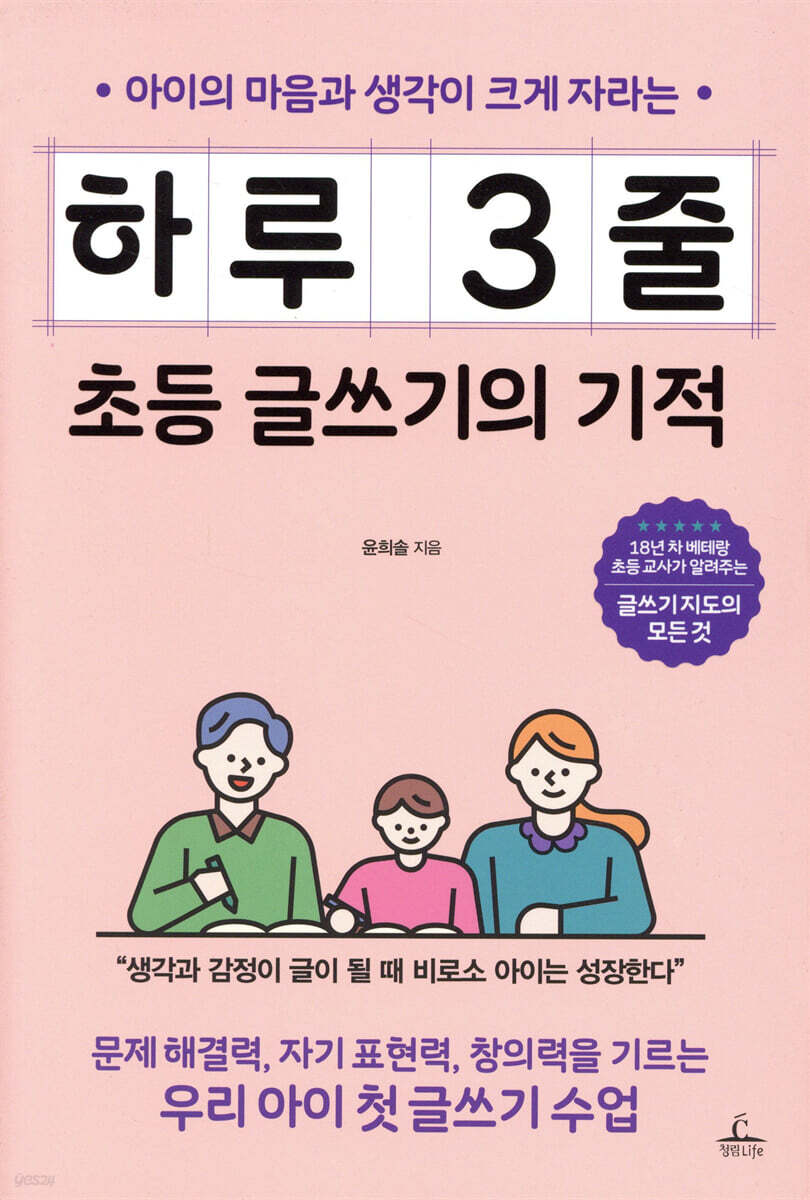
The Miracle of Elementary Writing: 3 Lines a Day
 |
Description
Book Introduction
Raising a child who learns more even when learning the same thing
The power of writing three lines a day!
“Why is my child having such a hard time writing?”
A veteran elementary school teacher with 18 years of experience tells you
All About Writing Guidance
The biggest topic in elementary schools these days is literacy.
The Ministry of Education is introducing convergence studies to foster creative convergence capabilities in response to the Fourth Industrial Revolution.
An example of this convergence of disciplines is descriptive mathematics problems.
It is a new format that incorporates mathematical problems into stories, rather than simple calculation problems like the existing method.
However, most students are not trained to read long texts and therefore cannot understand the text.
The author, an elementary school teacher, realized the shortcomings of basic education while teaching students directly in the field.
It is said that children who are only concerned with improving their grades without properly learning how to write and read suffer from serious reading difficulties when they reach high school.
Only then do we face the problem that even if we receive reading and writing education later, it will not have much effect.
To address the problems of this educational reality, the author devoted himself to elementary writing education.
Because writing is a skill that must be taught according to the students' level and timing, I studied and researched writing study cases both domestically and internationally, and came up with my own 'three lines of writing a day' method.
Writing three lines a day is a great way to relieve pressure on children and help them develop a daily writing habit.
Lower elementary school students can organize their thoughts and feelings through diaries, and upper elementary school students can build a foundation for learning by incorporating reading and studying into writing.
The author had his students practice this daily at school and at home with his two sons, and as a result, the children saw a noticeable difference.
"The Miracle of Elementary Writing in 3 Lines a Day" contains all the writing know-how the author has personally experienced in the field.
Through this book, children will learn to properly express their feelings, organize their learning content clearly, and be able to express their thoughts in writing at any time.
The power of writing three lines a day!
“Why is my child having such a hard time writing?”
A veteran elementary school teacher with 18 years of experience tells you
All About Writing Guidance
The biggest topic in elementary schools these days is literacy.
The Ministry of Education is introducing convergence studies to foster creative convergence capabilities in response to the Fourth Industrial Revolution.
An example of this convergence of disciplines is descriptive mathematics problems.
It is a new format that incorporates mathematical problems into stories, rather than simple calculation problems like the existing method.
However, most students are not trained to read long texts and therefore cannot understand the text.
The author, an elementary school teacher, realized the shortcomings of basic education while teaching students directly in the field.
It is said that children who are only concerned with improving their grades without properly learning how to write and read suffer from serious reading difficulties when they reach high school.
Only then do we face the problem that even if we receive reading and writing education later, it will not have much effect.
To address the problems of this educational reality, the author devoted himself to elementary writing education.
Because writing is a skill that must be taught according to the students' level and timing, I studied and researched writing study cases both domestically and internationally, and came up with my own 'three lines of writing a day' method.
Writing three lines a day is a great way to relieve pressure on children and help them develop a daily writing habit.
Lower elementary school students can organize their thoughts and feelings through diaries, and upper elementary school students can build a foundation for learning by incorporating reading and studying into writing.
The author had his students practice this daily at school and at home with his two sons, and as a result, the children saw a noticeable difference.
"The Miracle of Elementary Writing in 3 Lines a Day" contains all the writing know-how the author has personally experienced in the field.
Through this book, children will learn to properly express their feelings, organize their learning content clearly, and be able to express their thoughts in writing at any time.
- You can preview some of the book's contents.
Preview
index
Learning about children's inner thoughts through writing the introduction
Chapter 1.
Why Elementary School Teachers Focus on Writing
The amazing changes that happened when I started writing
Writing skills are a useful weapon in life.
The power to develop logic and thinking skills
A window into a child's mind
The Power of Short Writing to Boost Self-Esteem
Q&A.
When I ask my child to write, how do I explain it when he or she responds, “Why do I have to do it?”
Chapter 2.
Step 1: Building Writing Skills: Opening Your Mind Through Play with Books Before Entering Elementary School
Even writing has its own baby steps.
Let's play by drawing letters
How to Reach a Child Who Hates Books
Connecting book play to reading
Developing Reading and Writing Habits
Q&A.
Why is my child slow in reading and writing Korean?
Chapter 3.
Build Your Writing Skills, Step 2: Utilize Your Textbooks 100%, According to a Current Teacher
Practical writing from elementary school entry
The first step in the Korean language test: dictation
A staple of school homework: diary writing
Complete your diary by talking with your mom
Q&A.
How do I manage a diary with messy handwriting and spelling?
Chapter 4.
Step 3: Developing Writing Skills: Finding Writing Materials in Everyday Life
Breaking Down Barriers with Three Lines of Writing
Writing using emotional words
Writing using sensory words
How to overcome sadness through writing
Write about your classmate
Writing that helps you solve your worries
Q&A.
Wouldn't it be better to send your child to a specialized academy for writing education?
Chapter 5.
Step 4: Developing Writing Skills: Digesting the Learning Content
Vocabulary is the foundation of learning ability.
How to write a reading report easily and enjoyably
Writing a Reading Report Using Emotional Words
Idioms and proverbs are good for the more you have
Study summary notes to review what you've learned
Improving Literacy with Tables and Graphs
Q&A.
How do I teach a child who doesn't understand math problems?
Chapter 6.
Step 5: Building Your Writing Skills: Building a Story Through Your Child's Experience
Writing skills and creativity are proportional.
Observation is the beginning of creativity.
Play a board game to express your experiences
Complete an essay based on a dream story
Expressing and writing things down
Creating a book that awakens the writer's instinct
Q&A.
Can I incorporate writing three lines a day into my English writing?
main
References
Chapter 1.
Why Elementary School Teachers Focus on Writing
The amazing changes that happened when I started writing
Writing skills are a useful weapon in life.
The power to develop logic and thinking skills
A window into a child's mind
The Power of Short Writing to Boost Self-Esteem
Q&A.
When I ask my child to write, how do I explain it when he or she responds, “Why do I have to do it?”
Chapter 2.
Step 1: Building Writing Skills: Opening Your Mind Through Play with Books Before Entering Elementary School
Even writing has its own baby steps.
Let's play by drawing letters
How to Reach a Child Who Hates Books
Connecting book play to reading
Developing Reading and Writing Habits
Q&A.
Why is my child slow in reading and writing Korean?
Chapter 3.
Build Your Writing Skills, Step 2: Utilize Your Textbooks 100%, According to a Current Teacher
Practical writing from elementary school entry
The first step in the Korean language test: dictation
A staple of school homework: diary writing
Complete your diary by talking with your mom
Q&A.
How do I manage a diary with messy handwriting and spelling?
Chapter 4.
Step 3: Developing Writing Skills: Finding Writing Materials in Everyday Life
Breaking Down Barriers with Three Lines of Writing
Writing using emotional words
Writing using sensory words
How to overcome sadness through writing
Write about your classmate
Writing that helps you solve your worries
Q&A.
Wouldn't it be better to send your child to a specialized academy for writing education?
Chapter 5.
Step 4: Developing Writing Skills: Digesting the Learning Content
Vocabulary is the foundation of learning ability.
How to write a reading report easily and enjoyably
Writing a Reading Report Using Emotional Words
Idioms and proverbs are good for the more you have
Study summary notes to review what you've learned
Improving Literacy with Tables and Graphs
Q&A.
How do I teach a child who doesn't understand math problems?
Chapter 6.
Step 5: Building Your Writing Skills: Building a Story Through Your Child's Experience
Writing skills and creativity are proportional.
Observation is the beginning of creativity.
Play a board game to express your experiences
Complete an essay based on a dream story
Expressing and writing things down
Creating a book that awakens the writer's instinct
Q&A.
Can I incorporate writing three lines a day into my English writing?
main
References
Detailed image
Into the book
It's also a good idea to record your conversations with your child before they write down what they say.
Children enjoy hearing their own voice recorded.
And since you can just write down the recorded content, writing becomes much easier.
Another method is to have the mother write down what the child says and then read it to the child.
Children learn that writing is not difficult through the experience of seeing what they say come to fruition in writing.
--- p.
40-41, from “A Window to Look into a Child’s Mind”
After thinking about how to make children familiar with bookstores and libraries, I decided to link bookstores and libraries to places that my child likes.
After going to a bookstore or library, we go straight to the place that the child likes.
There was a kids cafe downstairs from the bookstore I often went to.
“Pick a fun book and let’s go to the kids’ cafe right away! Pick a book that looks fun, like a kids’ cafe.” After saying that, I had my child pick a book that looked fun, and once they picked a book, I ran straight to the kids’ cafe.
--- p.
77, from “Connecting Book Play to Reading”
When writing gets stuck, the parent's role begins.
We ask questions to help children think about what to write, and we also bring out the words inside children by sharing our own experiences.
If you write down exactly what you talked about with your child, it becomes a diary.
How parents speak to and listen to their children during this process can change not only their writing but also their lives.
There aren't many opportunities to have deep conversations with your child on a daily basis, more than you might think.
But as you talk to your child to write a diary, you will naturally start to listen to the voice of your child's heart.
--- p.
134-135, from “Writing a Diary While Talking with Mom”
You can make monotonous writing more interesting with just drawing paper and colored pencils.
I will show you the process of finding the main points while reading a book and summarize the learning content.
And we will prepare a sample mini-book summarizing the contents in advance.
Students just need to look at the mini-books completed by the teacher and create and write them.
--- p.
222~223, from “Learning Summary Notes for Reviewing What You Have Learned”
Children need time and space free from failure and criticism.
Even children who hate writing can write down their dreams without hesitation.
When I write normally, I have to think about the passage of time, changes in location, and the appearance of characters to make sense of it, but that's not the case with dreams.
Because dreams are originally nonsensical.
A story that only I know, material that I can write about without hesitation and enjoyably, readers who eagerly await my writing, a safe zone where I won't be criticized by anyone...
Could there be another writing playground as perfect as this one?
--- p.
249, from “Completing a Story with a Dream Story”
Just as when you learn a new story, your mouth itches to tell it, when children create an interesting story, they are eager to share it with the rest of their group.
When you have a story you want to tell but don't know how to say it, that's the perfect opportunity to write.
"That story you guys just made up is hilarious. If you published it as a book, it'd be a bestseller."
Hand out the paper with a word of encouragement.
Then, even students who usually hate writing will seriously participate in the book-making process.
Children enjoy hearing their own voice recorded.
And since you can just write down the recorded content, writing becomes much easier.
Another method is to have the mother write down what the child says and then read it to the child.
Children learn that writing is not difficult through the experience of seeing what they say come to fruition in writing.
--- p.
40-41, from “A Window to Look into a Child’s Mind”
After thinking about how to make children familiar with bookstores and libraries, I decided to link bookstores and libraries to places that my child likes.
After going to a bookstore or library, we go straight to the place that the child likes.
There was a kids cafe downstairs from the bookstore I often went to.
“Pick a fun book and let’s go to the kids’ cafe right away! Pick a book that looks fun, like a kids’ cafe.” After saying that, I had my child pick a book that looked fun, and once they picked a book, I ran straight to the kids’ cafe.
--- p.
77, from “Connecting Book Play to Reading”
When writing gets stuck, the parent's role begins.
We ask questions to help children think about what to write, and we also bring out the words inside children by sharing our own experiences.
If you write down exactly what you talked about with your child, it becomes a diary.
How parents speak to and listen to their children during this process can change not only their writing but also their lives.
There aren't many opportunities to have deep conversations with your child on a daily basis, more than you might think.
But as you talk to your child to write a diary, you will naturally start to listen to the voice of your child's heart.
--- p.
134-135, from “Writing a Diary While Talking with Mom”
You can make monotonous writing more interesting with just drawing paper and colored pencils.
I will show you the process of finding the main points while reading a book and summarize the learning content.
And we will prepare a sample mini-book summarizing the contents in advance.
Students just need to look at the mini-books completed by the teacher and create and write them.
--- p.
222~223, from “Learning Summary Notes for Reviewing What You Have Learned”
Children need time and space free from failure and criticism.
Even children who hate writing can write down their dreams without hesitation.
When I write normally, I have to think about the passage of time, changes in location, and the appearance of characters to make sense of it, but that's not the case with dreams.
Because dreams are originally nonsensical.
A story that only I know, material that I can write about without hesitation and enjoyably, readers who eagerly await my writing, a safe zone where I won't be criticized by anyone...
Could there be another writing playground as perfect as this one?
--- p.
249, from “Completing a Story with a Dream Story”
Just as when you learn a new story, your mouth itches to tell it, when children create an interesting story, they are eager to share it with the rest of their group.
When you have a story you want to tell but don't know how to say it, that's the perfect opportunity to write.
"That story you guys just made up is hilarious. If you published it as a book, it'd be a bestseller."
Hand out the paper with a word of encouragement.
Then, even students who usually hate writing will seriously participate in the book-making process.
--- p.
261, from “Creating a Book That Awakens the Writer’s Instinct”
261, from “Creating a Book That Awakens the Writer’s Instinct”
Publisher's Review
Writing: The Best Skill Chosen by Harvard University Graduates
"A child only grows when his thoughts and feelings become written words."
Harvard University requires freshmen to take a writing class.
It is said that the amount of writing a student writes from admission to graduation is over 50kg in paper weight.
It provides such intense writing training.
Why does Harvard University emphasize writing? When Harvard graduates were asked, "What is the most important skill for your job?" over 90 percent answered writing.
This is because reporting one's feelings and persuading others are all done through writing.
Writing skills are a powerful weapon that can be put to good use once you have them.
If you are good at writing, you can wisely tackle major life tasks such as papers, resumes, and reports.
The author recognized the importance of basic language education, such as reading and writing, early on and devoted himself to teaching writing in schools.
This book provides age-appropriate writing instruction methods to develop children's writing skills from before entering elementary school to after.
For children before entering elementary school, we teach them how to relieve their anxiety about reading and writing and prepare them, and for children in elementary school, we teach them how to write to develop their thoughts and inner self.
Additionally, the author includes photos of actual classes he conducted with students and writing materials from the children to convey the effects of writing more vividly.
Develop problem-solving skills, self-expression, and creativity
My Child's First Writing Class
In this book, the author shows how children change as he teaches writing directly in schools.
As a veteran elementary school teacher, she changes the writing assignment from something mandatory to something fun and engaging for children.
In particular, it is characterized by actively utilizing 'diary writing', a major task for elementary school students, and 'dictation' time conducted during Korean language class.
When starting a journal, many children begin with “I am today.”
I don't really have anything to say, so I just write about things I did because I felt like I had to.
In such cases, a word from a parent can be of help.
For children who struggle with writing, you can help them recall past events by asking specific questions like, “What did you eat for lunch?” or by asking, “What is the name of your best friend in class?” to help them think of topics they have a lot to talk about.
If you find writing material like this, it will become much easier for your child to write a diary.
Moreover, through this conversation, you can get a deeper look into your child's inner thoughts and even learn about their school life that you would not normally know about.
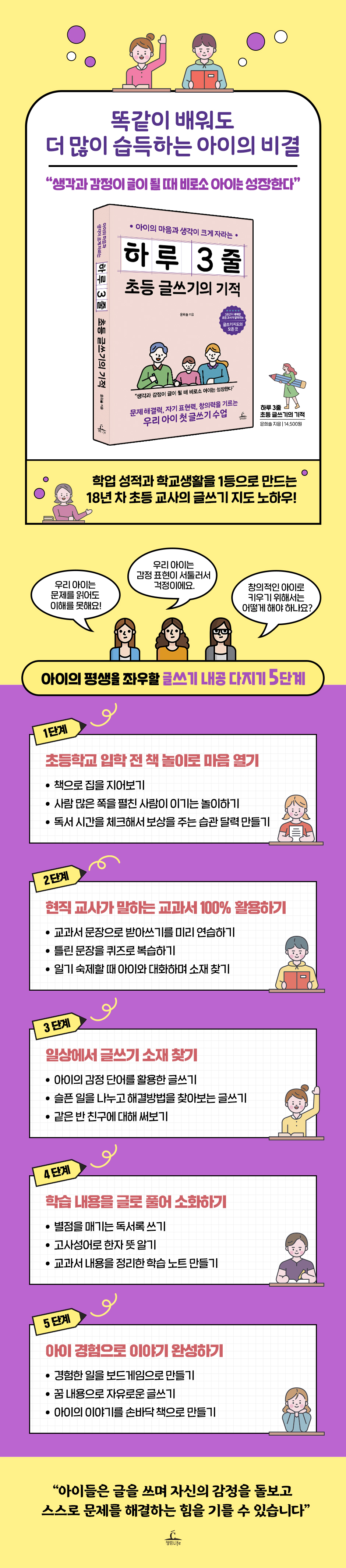
This book consists of six chapters in total.
Chapters 1-3 are the basics of writing.
The author introduces anecdotes from his own experience and provides concrete examples of how writing helps children grow.
Additionally, it helps children become familiar with letters and books through various games before entering elementary school.
Especially for elementary school students in the lower grades, we introduce a writing technique that utilizes 100% of the Korean language textbook.
The key to 'dictation' time, which is a concern for children and parents, is to build a foundation for language rather than giving grades.
Chapters 4-6 are advanced writing sections.
We will explain the three-line writing method in detail.
First, you can learn how to comfort your child's heart by looking at emotional words that are just right for their heart.
We also introduce a special method to learn the class content in your own words by learning an effective study note-taking method.
For upper elementary school students, we help develop their creativity through advanced writing activities such as writing dream stories and making palm books.
"The Miracle of Elementary Writing: 3 Lines a Day" covers not only writing, but also reading habits, vocabulary acquisition, and everything related to writing, including creating tables and graphs.
So, you can develop your child's literacy skills and solidify their language skills, which serve as the foundation for academic learning.
Through this book, parents will experience the miracle of their children's dazzling growth.
"A child only grows when his thoughts and feelings become written words."
Harvard University requires freshmen to take a writing class.
It is said that the amount of writing a student writes from admission to graduation is over 50kg in paper weight.
It provides such intense writing training.
Why does Harvard University emphasize writing? When Harvard graduates were asked, "What is the most important skill for your job?" over 90 percent answered writing.
This is because reporting one's feelings and persuading others are all done through writing.
Writing skills are a powerful weapon that can be put to good use once you have them.
If you are good at writing, you can wisely tackle major life tasks such as papers, resumes, and reports.
The author recognized the importance of basic language education, such as reading and writing, early on and devoted himself to teaching writing in schools.
This book provides age-appropriate writing instruction methods to develop children's writing skills from before entering elementary school to after.
For children before entering elementary school, we teach them how to relieve their anxiety about reading and writing and prepare them, and for children in elementary school, we teach them how to write to develop their thoughts and inner self.
Additionally, the author includes photos of actual classes he conducted with students and writing materials from the children to convey the effects of writing more vividly.
Develop problem-solving skills, self-expression, and creativity
My Child's First Writing Class
In this book, the author shows how children change as he teaches writing directly in schools.
As a veteran elementary school teacher, she changes the writing assignment from something mandatory to something fun and engaging for children.
In particular, it is characterized by actively utilizing 'diary writing', a major task for elementary school students, and 'dictation' time conducted during Korean language class.
When starting a journal, many children begin with “I am today.”
I don't really have anything to say, so I just write about things I did because I felt like I had to.
In such cases, a word from a parent can be of help.
For children who struggle with writing, you can help them recall past events by asking specific questions like, “What did you eat for lunch?” or by asking, “What is the name of your best friend in class?” to help them think of topics they have a lot to talk about.
If you find writing material like this, it will become much easier for your child to write a diary.
Moreover, through this conversation, you can get a deeper look into your child's inner thoughts and even learn about their school life that you would not normally know about.
This book consists of six chapters in total.
Chapters 1-3 are the basics of writing.
The author introduces anecdotes from his own experience and provides concrete examples of how writing helps children grow.
Additionally, it helps children become familiar with letters and books through various games before entering elementary school.
Especially for elementary school students in the lower grades, we introduce a writing technique that utilizes 100% of the Korean language textbook.
The key to 'dictation' time, which is a concern for children and parents, is to build a foundation for language rather than giving grades.
Chapters 4-6 are advanced writing sections.
We will explain the three-line writing method in detail.
First, you can learn how to comfort your child's heart by looking at emotional words that are just right for their heart.
We also introduce a special method to learn the class content in your own words by learning an effective study note-taking method.
For upper elementary school students, we help develop their creativity through advanced writing activities such as writing dream stories and making palm books.
"The Miracle of Elementary Writing: 3 Lines a Day" covers not only writing, but also reading habits, vocabulary acquisition, and everything related to writing, including creating tables and graphs.
So, you can develop your child's literacy skills and solidify their language skills, which serve as the foundation for academic learning.
Through this book, parents will experience the miracle of their children's dazzling growth.
GOODS SPECIFICS
- Date of issue: February 5, 2020
- Page count, weight, size: 272 pages | 508g | 152*224*20mm
- ISBN13: 9791188700592
- ISBN10: 1188700596
You may also like
카테고리
korean


korean

![ELLE 엘르 스페셜 에디션 A형 : 12월 [2025]](http://librairie.coreenne.fr/cdn/shop/files/b8e27a3de6c9538896439686c6b0e8fb.jpg?v=1766436872&width=3840)


