

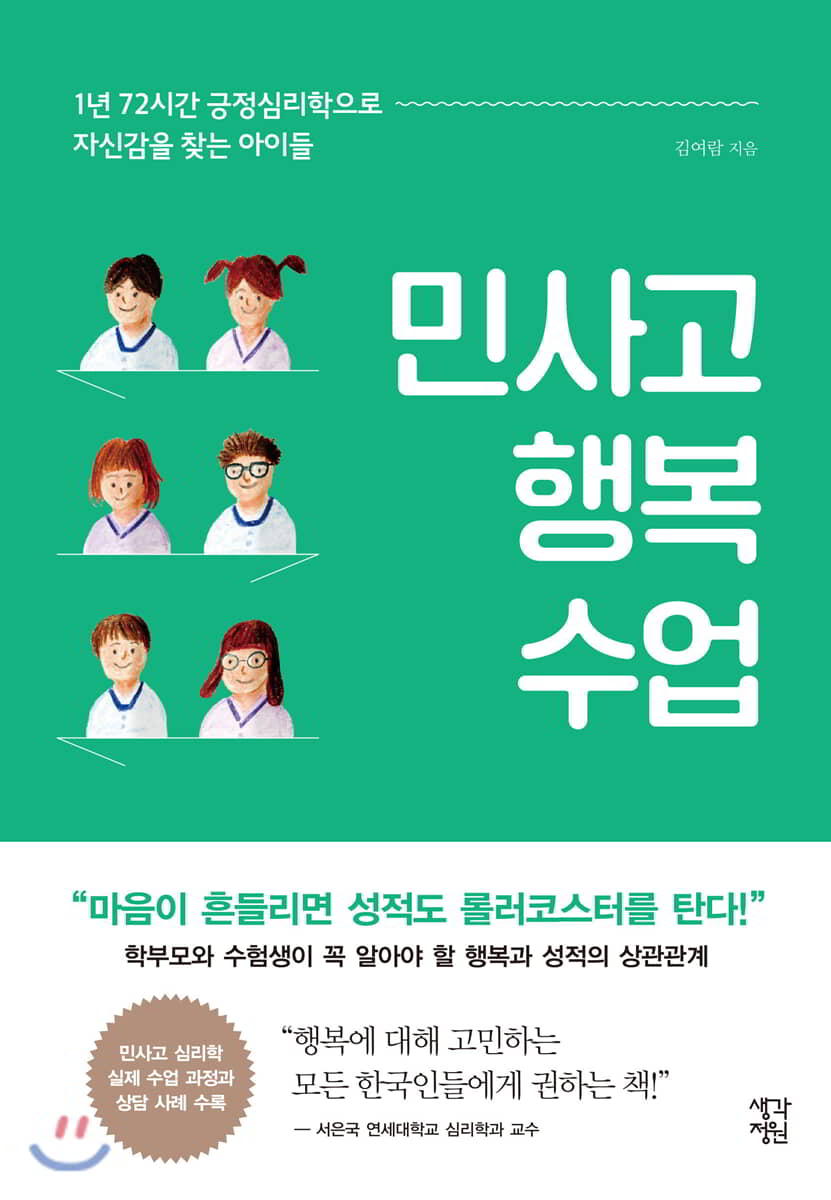
Minsago Happiness Class
 |
Description
Book Introduction
The correlation between happiness and grades revealed by a former Minsago psychology teacher.
“When your heart wavers, your grades go on a roller coaster ride!”
"Minsago Happiness Class" is a book that summarizes the author's experiences and cases while working as a psychology teacher and a counselor in the college counseling department at Minsago High School, from the perspective of a psychology expert.
It contains content that I actually taught students in my psychology classes, as well as case studies of students I counseled individually.
How does Minsago, a prestigious school for the elite of South Korea, manage student stress?
Surprisingly, Minsago High School teaches 'psychology' to children who don't have enough time to study for entrance exams.
Among them, positive psychology is a popular subject that is chosen for an average of more than 72 hours per year.
By learning psychology, children not only broaden their understanding of human nature, but also develop the ability to apply it to their own lives, society, and relationships with others.
From psychology, you learn attitudes and values about life that cannot be acquired by studying only the major subjects of Korean, English, and math.
The author's examples of 'happiness classes' taught at Minsago are a unique feature of this book that cannot be found in previous child education books.
For all the students and parents who are on an emotional roller coaster ride due to study stress, this book will provide definite comfort and help.
I also believe that this will provide the true meaning of happiness and the path to life to all those who are struggling to find happiness in their lives even at this very moment.
“When your heart wavers, your grades go on a roller coaster ride!”
"Minsago Happiness Class" is a book that summarizes the author's experiences and cases while working as a psychology teacher and a counselor in the college counseling department at Minsago High School, from the perspective of a psychology expert.
It contains content that I actually taught students in my psychology classes, as well as case studies of students I counseled individually.
How does Minsago, a prestigious school for the elite of South Korea, manage student stress?
Surprisingly, Minsago High School teaches 'psychology' to children who don't have enough time to study for entrance exams.
Among them, positive psychology is a popular subject that is chosen for an average of more than 72 hours per year.
By learning psychology, children not only broaden their understanding of human nature, but also develop the ability to apply it to their own lives, society, and relationships with others.
From psychology, you learn attitudes and values about life that cannot be acquired by studying only the major subjects of Korean, English, and math.
The author's examples of 'happiness classes' taught at Minsago are a unique feature of this book that cannot be found in previous child education books.
For all the students and parents who are on an emotional roller coaster ride due to study stress, this book will provide definite comfort and help.
I also believe that this will provide the true meaning of happiness and the path to life to all those who are struggling to find happiness in their lives even at this very moment.
- You can preview some of the book's contents.
Preview
index
Prologue
Why busy kids learn psychology
Chapter 1: Happy Children Enjoy Studying
: Study section
Studying is fun when there are no goals - The overjustification effect
The Surprising Secret of "Math Achievers" | Parental Rewards Sometimes Destroy Children's Motivation | The Lucky Results That Come When the Process is Happy
Children Competing with Others vs. Children Competing with Me: Zero-Sum and Win-Win Games
Breaking free from comparison allows for self-study | Are "top kids" truly happy?
If your grades don't match the amount you studied - Test anxiety and exposure therapy
Four Ways to Beat Test Anxiety | The Key to Exposure Therapy is Facing It, Not Avoiding It | Anxiety and Fear Are Necessary Emotions
Weapons in a Rapidly Changing World: Exploration Power and Enhanced Sensitivity Theory
Children Chasing "Inseoul" and "Seolro" | A Life of Approaching vs. A Life of Being Chased | Parents Are the Ones Who Show Us How Interesting the World Can Be
Children in Minsago are not "sloppy" when it comes to play - The Secret of Creativity: Theory of Expansion and Construction
"It's not cool to just be good at studying, right?" | IR Classes that Foster Creativity | The Positive Cycle of Creativity: Joy
Chapter 2: Why and How Are Just as Important as What
: Career and Choice Section
Should You Do What You're Good at or What You Love?_Interest, Aptitude, and Grit Theory
The Formula for Achievement: Hard Work, Not Talent | The Key Is Being Able to "Follow Through"
When Parents' Dreams Differ from Their Children's Dreams: Psychological Theories on Reality and Ideals, Money and Happiness
The Correlation Between Money and Happiness | 'Choice' and 'Giving Up' Are Synonyms | If Your Child Has a Hard Time Choosing a Career
Success is never achieved through 'effort' alone - The meaning of 'outliers'
What Makes a Recipe for Success | The Real Secret to Bill Gates' Success | When Parental Support Becomes a Burden, Not a Strength
Balancing Fun and Meaning: Hedonistic Happiness and Self-Actualizing Happiness
What Aristotle and Epicurus Have in Common | The Question: "What Should We Pursue in Life?"
The more you wander around, the clearer your dreams become - Emotional Prediction and the Illusion of Focus
The Psychological Reasons Why You Can't Accurately Predict Your Future Self | If You're Worried About What Your Child Wants to Do | The Spirit of "No, Not": The Power of Exploration
Chapter 3: Relationships Are Also an Area of Learning
: Human Relationships
The Learning of Relationships Through the Minsago Dormitory: The Desire to Belong and the Hell of Others
Making Friends is Harder for Today's Generation | What Happens When Other Kids Share a Space | How to Respect Other People's Lives
Parents also need independence from their children - separation of tasks and the need for recognition.
Children suffocated by their parents' expectations | How to separate your tasks from others' tasks | Trust instead of anxiety, support instead of expectations
The Power of a Child Who Knows How to Enjoy Being Alone - Introversion and Extroversion
Where Do Personality Differences Come From? | The Hidden Strengths of Introverts | Seeing Them for What They Are
The scientific evidence that children are happy when their parents are happy: emotional transfer and the contagiousness of happiness.
The Power of Networks to Increase Your Odds of Happiness | The Happiness of Giving Happiness
How to Help Your Child's Dating: The Core of Sex Education: Respect and Independence
The ability to love yourself is also a skill | The importance of healthy relationships
Chapter 4: A strong mind leads to strong thoughts.
: Emotional side
The 'Jab' and 'Straight' of Life: Intensity vs. Frequency of Happiness
Frequency, not intensity, is key | Trying not to miss the simple, small joys
The Key to Understanding Who I Am _ Big 5 Personality Theory
Five Key Words to Understanding Your Personality | The Correlation Between Personality and Happiness
Can We Change Our Innate Personality? The Power and Limitations of Genetics
Environmental influences vs. genetic influences | Personality can change, but temperament cannot.
"Impossible" and "Difficult" Are Different: How Introverts Pursue Happiness
Can simply acting outwardly make you happy? | Happiness requires a "cost."
How to Buy Happiness with Money and Time _ The Secret of Wise Consumption
Four Ways to Spend Money Happily | Five Ways to Spend Time Happily
Children with a sense of proximity are happy: positive fantasy and optimism.
The Unfounded Illusions of Happy People | The Ability to Imagine Good Things
Why We Must Live in the 'Here and Now' _ Mindfulness and Contemplation
Why Steve Jobs and Oprah Winfrey Addicted to Meditation | The Impact of Mindfulness on Physical and Mental Health | The Link Between Small Happinesses and Savoring
epilogue
One of the most important things when we talk about happiness
Why busy kids learn psychology
Chapter 1: Happy Children Enjoy Studying
: Study section
Studying is fun when there are no goals - The overjustification effect
The Surprising Secret of "Math Achievers" | Parental Rewards Sometimes Destroy Children's Motivation | The Lucky Results That Come When the Process is Happy
Children Competing with Others vs. Children Competing with Me: Zero-Sum and Win-Win Games
Breaking free from comparison allows for self-study | Are "top kids" truly happy?
If your grades don't match the amount you studied - Test anxiety and exposure therapy
Four Ways to Beat Test Anxiety | The Key to Exposure Therapy is Facing It, Not Avoiding It | Anxiety and Fear Are Necessary Emotions
Weapons in a Rapidly Changing World: Exploration Power and Enhanced Sensitivity Theory
Children Chasing "Inseoul" and "Seolro" | A Life of Approaching vs. A Life of Being Chased | Parents Are the Ones Who Show Us How Interesting the World Can Be
Children in Minsago are not "sloppy" when it comes to play - The Secret of Creativity: Theory of Expansion and Construction
"It's not cool to just be good at studying, right?" | IR Classes that Foster Creativity | The Positive Cycle of Creativity: Joy
Chapter 2: Why and How Are Just as Important as What
: Career and Choice Section
Should You Do What You're Good at or What You Love?_Interest, Aptitude, and Grit Theory
The Formula for Achievement: Hard Work, Not Talent | The Key Is Being Able to "Follow Through"
When Parents' Dreams Differ from Their Children's Dreams: Psychological Theories on Reality and Ideals, Money and Happiness
The Correlation Between Money and Happiness | 'Choice' and 'Giving Up' Are Synonyms | If Your Child Has a Hard Time Choosing a Career
Success is never achieved through 'effort' alone - The meaning of 'outliers'
What Makes a Recipe for Success | The Real Secret to Bill Gates' Success | When Parental Support Becomes a Burden, Not a Strength
Balancing Fun and Meaning: Hedonistic Happiness and Self-Actualizing Happiness
What Aristotle and Epicurus Have in Common | The Question: "What Should We Pursue in Life?"
The more you wander around, the clearer your dreams become - Emotional Prediction and the Illusion of Focus
The Psychological Reasons Why You Can't Accurately Predict Your Future Self | If You're Worried About What Your Child Wants to Do | The Spirit of "No, Not": The Power of Exploration
Chapter 3: Relationships Are Also an Area of Learning
: Human Relationships
The Learning of Relationships Through the Minsago Dormitory: The Desire to Belong and the Hell of Others
Making Friends is Harder for Today's Generation | What Happens When Other Kids Share a Space | How to Respect Other People's Lives
Parents also need independence from their children - separation of tasks and the need for recognition.
Children suffocated by their parents' expectations | How to separate your tasks from others' tasks | Trust instead of anxiety, support instead of expectations
The Power of a Child Who Knows How to Enjoy Being Alone - Introversion and Extroversion
Where Do Personality Differences Come From? | The Hidden Strengths of Introverts | Seeing Them for What They Are
The scientific evidence that children are happy when their parents are happy: emotional transfer and the contagiousness of happiness.
The Power of Networks to Increase Your Odds of Happiness | The Happiness of Giving Happiness
How to Help Your Child's Dating: The Core of Sex Education: Respect and Independence
The ability to love yourself is also a skill | The importance of healthy relationships
Chapter 4: A strong mind leads to strong thoughts.
: Emotional side
The 'Jab' and 'Straight' of Life: Intensity vs. Frequency of Happiness
Frequency, not intensity, is key | Trying not to miss the simple, small joys
The Key to Understanding Who I Am _ Big 5 Personality Theory
Five Key Words to Understanding Your Personality | The Correlation Between Personality and Happiness
Can We Change Our Innate Personality? The Power and Limitations of Genetics
Environmental influences vs. genetic influences | Personality can change, but temperament cannot.
"Impossible" and "Difficult" Are Different: How Introverts Pursue Happiness
Can simply acting outwardly make you happy? | Happiness requires a "cost."
How to Buy Happiness with Money and Time _ The Secret of Wise Consumption
Four Ways to Spend Money Happily | Five Ways to Spend Time Happily
Children with a sense of proximity are happy: positive fantasy and optimism.
The Unfounded Illusions of Happy People | The Ability to Imagine Good Things
Why We Must Live in the 'Here and Now' _ Mindfulness and Contemplation
Why Steve Jobs and Oprah Winfrey Addicted to Meditation | The Impact of Mindfulness on Physical and Mental Health | The Link Between Small Happinesses and Savoring
epilogue
One of the most important things when we talk about happiness
Detailed image

Into the book
If you have a child who struggles with anxiety and fear, first tell them that these feelings are not bad.
If there is someone who does not feel anxious or fearful at all, let them know that their life will not be smooth, and let them first accept the feeling of anxiety comfortably.
It may also be helpful to explore together the more fundamental reasons why your child is anxious.
If you are thinking in an extreme way, such as, 'If I fail this test, my life is over,' you need to correct it.
Tests are important, but they are not a matter of life or death. You can do your best and still get poor grades.
One thing I've discovered while working in civil engineering is that behind every extremely anxious child there's a parent who won't tolerate poor grades.
Anxiety can be overcome when the mind is at ease (i.e. through relaxation).
Many parents and teachers subtly, or sometimes openly, nag their children who are having trouble overcoming their anxiety.
Remember that a child who is frightened is already putting all his energy into fighting that emotion, so you need to provide emotional stability so that he can overcome it on his own.
--- Chapter 1: Happy Children Enjoy Studying From "If Your Grades Don't Match the Level of Studying - Test Anxiety and Exposure Therapy"
Parents speak reality, children speak ideals.
Parents ask their children to be realistic about how competitive the world is, the variety of careers available, the hours and intensity of work, and the potential for prestige and power.
These issues ultimately boil down to whether you can make a lot of money reliably.
(syncopation)
You may have heard the new word 'no effort'.
This phrase was created as a protest against the older generation or the privileged class who tell those who are already working hard to try harder that they should try harder because they are not trying hard enough to achieve success.
The word 'no effort' contains a satire of the social structure in which no matter how hard you try, things do not improve.
The younger generation in South Korea already feels deeply that the social structure cannot be changed through individual efforts alone.
If parents are even pushing their children to deal with the consequences of their actions in this world, where will the children get the strength to survive this merciless reality?
--- Chapter 2: 'Why' and 'How' are as important as 'What' From "You Can Never Succeed with 'Effort' Alone - The Meaning of Outliers"
The ultimate consequences of not studying are something that the child, not the parent, must accept.
If you feel like it's your fault for your child not studying, then that's a situation where separation of duties isn't happening.
The reality that I have to accept because my child doesn't study is the responsibility of the adult child.
It is the natural order of things for us to take responsibility for ourselves after our bodies and minds have grown.
There is no animal that leaves its 'life or death' to its parents even after it has grown up.
If you feel that the consequences of your child not studying are related to you, even though you do not intend to take responsibility for that child until the day you die, you need to seriously reflect on whether you are trying to satisfy your own greed through your child's life.
If there is someone who does not feel anxious or fearful at all, let them know that their life will not be smooth, and let them first accept the feeling of anxiety comfortably.
It may also be helpful to explore together the more fundamental reasons why your child is anxious.
If you are thinking in an extreme way, such as, 'If I fail this test, my life is over,' you need to correct it.
Tests are important, but they are not a matter of life or death. You can do your best and still get poor grades.
One thing I've discovered while working in civil engineering is that behind every extremely anxious child there's a parent who won't tolerate poor grades.
Anxiety can be overcome when the mind is at ease (i.e. through relaxation).
Many parents and teachers subtly, or sometimes openly, nag their children who are having trouble overcoming their anxiety.
Remember that a child who is frightened is already putting all his energy into fighting that emotion, so you need to provide emotional stability so that he can overcome it on his own.
--- Chapter 1: Happy Children Enjoy Studying From "If Your Grades Don't Match the Level of Studying - Test Anxiety and Exposure Therapy"
Parents speak reality, children speak ideals.
Parents ask their children to be realistic about how competitive the world is, the variety of careers available, the hours and intensity of work, and the potential for prestige and power.
These issues ultimately boil down to whether you can make a lot of money reliably.
(syncopation)
You may have heard the new word 'no effort'.
This phrase was created as a protest against the older generation or the privileged class who tell those who are already working hard to try harder that they should try harder because they are not trying hard enough to achieve success.
The word 'no effort' contains a satire of the social structure in which no matter how hard you try, things do not improve.
The younger generation in South Korea already feels deeply that the social structure cannot be changed through individual efforts alone.
If parents are even pushing their children to deal with the consequences of their actions in this world, where will the children get the strength to survive this merciless reality?
--- Chapter 2: 'Why' and 'How' are as important as 'What' From "You Can Never Succeed with 'Effort' Alone - The Meaning of Outliers"
The ultimate consequences of not studying are something that the child, not the parent, must accept.
If you feel like it's your fault for your child not studying, then that's a situation where separation of duties isn't happening.
The reality that I have to accept because my child doesn't study is the responsibility of the adult child.
It is the natural order of things for us to take responsibility for ourselves after our bodies and minds have grown.
There is no animal that leaves its 'life or death' to its parents even after it has grown up.
If you feel that the consequences of your child not studying are related to you, even though you do not intend to take responsibility for that child until the day you die, you need to seriously reflect on whether you are trying to satisfy your own greed through your child's life.
--- Chapter 3 Relationships are also an area of learning. From "Parents also need to become independent from their children - separation of tasks and the need for recognition"
Publisher's Review
"Children who are happy in their second year of middle school tend to have good grades in their third year of high school."
If your mind is happy, you will study well!
Professor Seo Eun-guk of Yonsei University's Department of Psychology once gave a TV lecture on the topic of "The Power of Happiness" on a program called [15 Minutes to Change the World].
At that time, a rather interesting research result was announced: 'Children who were happy in their second year of middle school had better grades in their third year of high school.'
On the contrary, it is said that 'the cost and time spent on private education and the parents' educational background had no effect on grades.'
This result completely overturns the expectations of parents who send their children to academies and provide private tutoring as part of early education in the hope that it will be of some help to their children.
In conclusion, it is said that 'how satisfied children are with their lives now' is a decisive factor in whether or not their children will achieve good grades in the future.
We are often taught that if we study well and stay healthy, we will have many opportunities to succeed in life and make a lot of money.
But psychology tells a slightly different story.
If we look at the research results on 'happiness', we find that the opposite is often true.
In other words, happy people are more likely to have good grades, be healthy, maintain good relationships with others, and achieve success.
Based on this, the author argues that it is not only studying well that one can be happy, but that a person who is happy in mind can also study well.
Children Find Confidence Through Positive Psychology 72 Hours a Year
Why do kids who are busy studying for college entrance exams learn psychology?
At Minsago, students can create their own schedules and choose their subjects, just like at a university.
Each teacher is assigned a classroom, and the children move to the class location.
Looking at the daily schedule, it is a tight schedule that starts at 6 AM in the dormitory, includes 30 minutes of morning exercise, eight hours of regular classes, and then self-study time until midnight.
You can participate in club activities as an extracurricular activity, but even then, you have to study in advance while holding a note with the quiz content in it.
Of course, it is difficult to study the main subjects of Korean, English, and math.
But strangely enough, children in Minsago always choose to take 'Psychology'.
That's an average of 72 hours a year for 'positive psychology' alone.
The author says that there were so many students who wanted to take psychology classes that it was difficult for the teacher to handle them alone.
Minsago High School offers a variety of psychology classes, from AP Psychology, which can be considered an introduction to psychology, to elective psychology, social psychology seminars, and psychology thesis writing. Among them, 'Positive Psychology', which discusses happiness, is the most popular among children.
Why is that?
Psychology broadens our understanding of humanity and fosters the ability to apply this knowledge to our own lives, society, and relationships with others.
Psychology teaches you attitudes and postures that you cannot acquire through entrance exam preparation alone.
For example, if you are unable to accept and properly manage the feeling of 'anxiety' that comes to you, it is natural that you will have difficulty concentrating on your studies and your grades will inevitably fluctuate.
At this time, psychology plays a role in providing great comfort to children going through growing pains and helping them build a strong inner self.
Children who learned psychological theories introduced in the book, such as the overjustification effect, the psychological effects of the zero-sum game, exposure therapy, reinforcement sensitivity theory, and the power of positive emotions, actually came to understand themselves better and were able to develop the strength to quietly persevere and move forward toward their goals.
The most important thing taught in civil service is 'happiness'.
A book recommended to everyone who is concerned about happiness!
《Minsago Happiness Class》 is a book that summarizes the thoughts and feelings of a psychology major who taught all psychology subjects at Minsago and counseled actual children as a counselor in the college counseling department.
Most of it is based on what I actually taught students in class over the past four years, and also on cases of students I counseled individually.
Professor Seo Eun-guk, author of “The Origin of Happiness,” who recommended the book, said, “I hope that many people who think happiness and success are synonymous will read this book and change,” and “I recommend this book not only to students and parents, but also to all Koreans who live intense lives and worry about happiness.”
The author also said that he wrote this book with the hope that 'happiness' would be taught to students not only in Minsago, but also in as many schools as possible in Korea, and above all, at home.
When children's minds are healthy and happy, the grades that parents worry about so much can come naturally.
No, I hope that the day will come when parents will pray for their children's happiness itself, rather than their grades.
If you are a teenager or parent who has ever wondered, “What can I do now to live a happy life?” rather than “Will I be happier if I study hard?”, I highly recommend reading “Minsago Happiness Class.”
If your mind is happy, you will study well!
Professor Seo Eun-guk of Yonsei University's Department of Psychology once gave a TV lecture on the topic of "The Power of Happiness" on a program called [15 Minutes to Change the World].
At that time, a rather interesting research result was announced: 'Children who were happy in their second year of middle school had better grades in their third year of high school.'
On the contrary, it is said that 'the cost and time spent on private education and the parents' educational background had no effect on grades.'
This result completely overturns the expectations of parents who send their children to academies and provide private tutoring as part of early education in the hope that it will be of some help to their children.
In conclusion, it is said that 'how satisfied children are with their lives now' is a decisive factor in whether or not their children will achieve good grades in the future.
We are often taught that if we study well and stay healthy, we will have many opportunities to succeed in life and make a lot of money.
But psychology tells a slightly different story.
If we look at the research results on 'happiness', we find that the opposite is often true.
In other words, happy people are more likely to have good grades, be healthy, maintain good relationships with others, and achieve success.
Based on this, the author argues that it is not only studying well that one can be happy, but that a person who is happy in mind can also study well.
Children Find Confidence Through Positive Psychology 72 Hours a Year
Why do kids who are busy studying for college entrance exams learn psychology?
At Minsago, students can create their own schedules and choose their subjects, just like at a university.
Each teacher is assigned a classroom, and the children move to the class location.
Looking at the daily schedule, it is a tight schedule that starts at 6 AM in the dormitory, includes 30 minutes of morning exercise, eight hours of regular classes, and then self-study time until midnight.
You can participate in club activities as an extracurricular activity, but even then, you have to study in advance while holding a note with the quiz content in it.
Of course, it is difficult to study the main subjects of Korean, English, and math.
But strangely enough, children in Minsago always choose to take 'Psychology'.
That's an average of 72 hours a year for 'positive psychology' alone.
The author says that there were so many students who wanted to take psychology classes that it was difficult for the teacher to handle them alone.
Minsago High School offers a variety of psychology classes, from AP Psychology, which can be considered an introduction to psychology, to elective psychology, social psychology seminars, and psychology thesis writing. Among them, 'Positive Psychology', which discusses happiness, is the most popular among children.
Why is that?
Psychology broadens our understanding of humanity and fosters the ability to apply this knowledge to our own lives, society, and relationships with others.
Psychology teaches you attitudes and postures that you cannot acquire through entrance exam preparation alone.
For example, if you are unable to accept and properly manage the feeling of 'anxiety' that comes to you, it is natural that you will have difficulty concentrating on your studies and your grades will inevitably fluctuate.
At this time, psychology plays a role in providing great comfort to children going through growing pains and helping them build a strong inner self.
Children who learned psychological theories introduced in the book, such as the overjustification effect, the psychological effects of the zero-sum game, exposure therapy, reinforcement sensitivity theory, and the power of positive emotions, actually came to understand themselves better and were able to develop the strength to quietly persevere and move forward toward their goals.
The most important thing taught in civil service is 'happiness'.
A book recommended to everyone who is concerned about happiness!
《Minsago Happiness Class》 is a book that summarizes the thoughts and feelings of a psychology major who taught all psychology subjects at Minsago and counseled actual children as a counselor in the college counseling department.
Most of it is based on what I actually taught students in class over the past four years, and also on cases of students I counseled individually.
Professor Seo Eun-guk, author of “The Origin of Happiness,” who recommended the book, said, “I hope that many people who think happiness and success are synonymous will read this book and change,” and “I recommend this book not only to students and parents, but also to all Koreans who live intense lives and worry about happiness.”
The author also said that he wrote this book with the hope that 'happiness' would be taught to students not only in Minsago, but also in as many schools as possible in Korea, and above all, at home.
When children's minds are healthy and happy, the grades that parents worry about so much can come naturally.
No, I hope that the day will come when parents will pray for their children's happiness itself, rather than their grades.
If you are a teenager or parent who has ever wondered, “What can I do now to live a happy life?” rather than “Will I be happier if I study hard?”, I highly recommend reading “Minsago Happiness Class.”
GOODS SPECIFICS
- Date of issue: June 25, 2019
- Page count, weight, size: 260 pages | 416g | 145*210*20mm
- ISBN13: 9791188388844
- ISBN10: 1188388843
You may also like
카테고리
korean


korean

![GQ KOREA Mark (Monthly): December [2025]](http://librairie.coreenne.fr/cdn/shop/files/8ef265dbbfbf186523ed75ba7319009d.jpg?v=1765340328&width=3840)


