

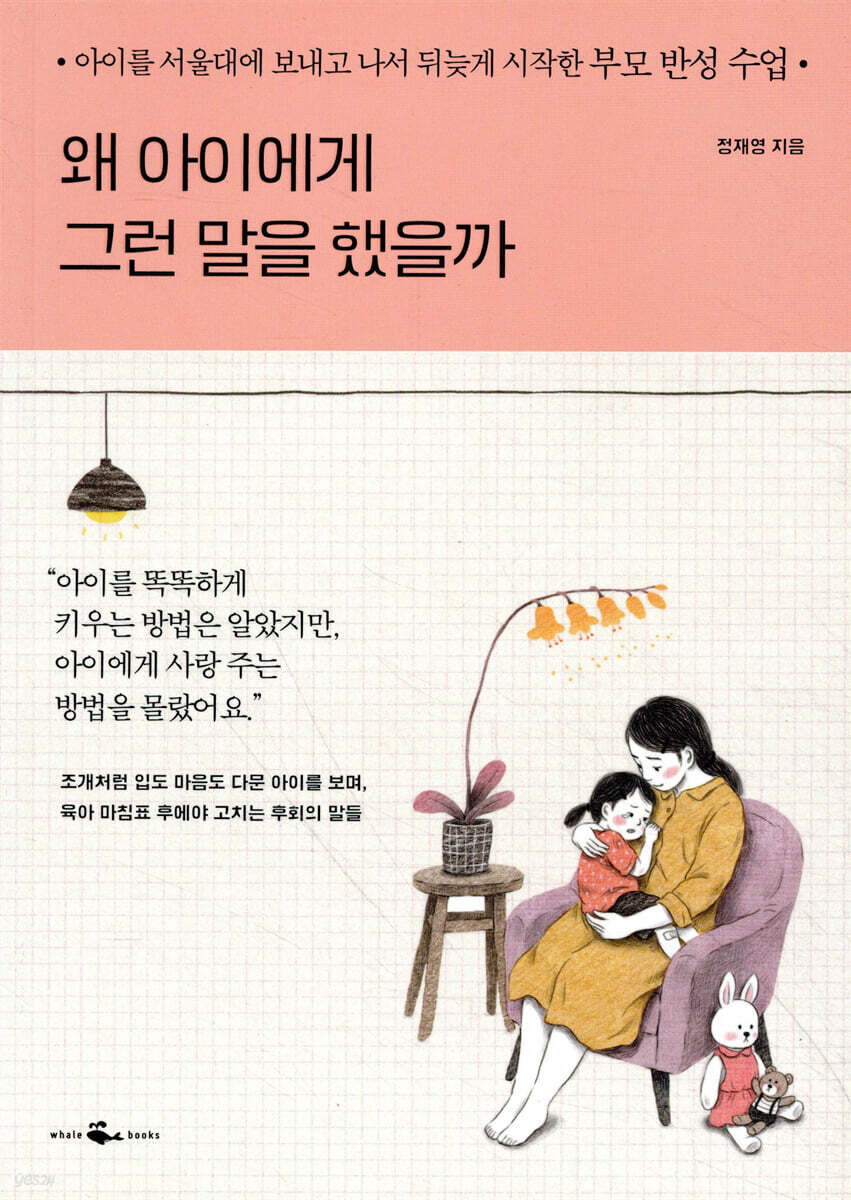
Why would you say that to a child?
 |
Description
Book Introduction
“The success or failure of parenting depends on the parents’ language warehouse.
It depends on what kind of words you let out.”
To be truly happy, you must practice not hurting others in advance.
If you raise your child to be smart and achieve big goals, happiness will come afterward. Until then, it's okay to raise them a little harshly.
While parents delay happiness, children internalize unhappiness. This book is a parenting guide filled with painful regrets for parents who sent their sons to Seoul National University.
This is a reflection on parenting from an unqualified senior, or a confession of regret that can only be clearly expressed now that one has graduated from parenthood.
In a word, it can be called a ‘parenting mistake notebook.’
Among the things I regret the most are the things I said to my child.
These were all words said with the intention of raising the child well and hoping that the child would do well.
I never dreamed that those words would become poisonous and accumulate in the child's mind.
The child studied hard, but perhaps ran away to the desk to avoid his parents' words.
And now that the goal of getting into a good college has been achieved, silence remains between the child and his parents, rather than words of happiness.
The author says:
Achieving goals alone does not bring happiness or heal wounds.
It's not too late, so you should practice speaking in advance so as not to hurt others.
This book can be a good textbook to help you spend your irreversible time raising your children well, using the trial and error words you have made to your children without fail as a lesson.
It depends on what kind of words you let out.”
To be truly happy, you must practice not hurting others in advance.
If you raise your child to be smart and achieve big goals, happiness will come afterward. Until then, it's okay to raise them a little harshly.
While parents delay happiness, children internalize unhappiness. This book is a parenting guide filled with painful regrets for parents who sent their sons to Seoul National University.
This is a reflection on parenting from an unqualified senior, or a confession of regret that can only be clearly expressed now that one has graduated from parenthood.
In a word, it can be called a ‘parenting mistake notebook.’
Among the things I regret the most are the things I said to my child.
These were all words said with the intention of raising the child well and hoping that the child would do well.
I never dreamed that those words would become poisonous and accumulate in the child's mind.
The child studied hard, but perhaps ran away to the desk to avoid his parents' words.
And now that the goal of getting into a good college has been achieved, silence remains between the child and his parents, rather than words of happiness.
The author says:
Achieving goals alone does not bring happiness or heal wounds.
It's not too late, so you should practice speaking in advance so as not to hurt others.
This book can be a good textbook to help you spend your irreversible time raising your children well, using the trial and error words you have made to your children without fail as a lesson.
- You can preview some of the book's contents.
Preview
index
Author's Note
Before it's too late, for the true happiness of your family
CHAPTER 1
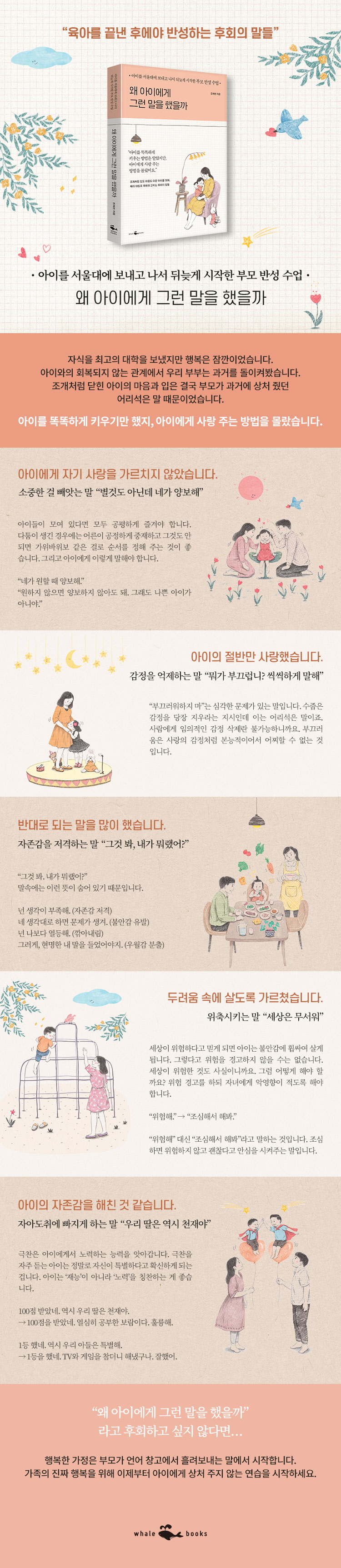
I didn't teach my child self-love.
Words that make one's presence disappear
“Friends are so, so precious.”
Help me protect myself more than my friends.
Words that take away something precious
“It’s nothing, so you give in.”
Please tell me how to protect my legitimate interests.
Words that make you watch your step
“Who would like you like this?”
Teach them to live their own lives
A horse that shoots arrows in the wrong place
“It’s because you didn’t try hard.”
Please ease your child's guilt.
Words that create walls in the heart
“What on earth is missing?”
In addition to the responsibility of providing material support, parents have other roles to play.
Chapter 2
I only loved half of the child
Words that suppress emotions
"What are you embarrassed about? Speak up."
Acknowledge your feelings without pressuring them.
Words that demand false feelings
“Even if you are sad, bear it.”
Please embrace my weak feelings too
Words that drive emotions
“Where do you dare to get angry?”
Please acknowledge the feelings but refrain from the actions.
restrictive words
“Don’t scream, don’t cry, stop.”
Raise your child to be accustomed to acceptance.
CHAPTER 3
I thought the child was being rude.
Words that make you belligerent
“Don’t you have any manners? Do you think your parents are funny?”
Give the gift of a respected experience
Words that create a breakdown in conversation
“You shouldn’t have done that.”
Please ask me any questions you feel comfortable with.
Words that force one to open one's mouth
“What do you not know?”
Please wait until I speak for myself.
Chapter 4
I've said a lot of things that are the opposite.
Words that attack self-esteem
“See, what did I tell you?”
Please speak about the future, not the past. Excuses that make you unhappy.
“I did it all for you.”
Acknowledge that parents are also immature beings.
Nagging that ruins your appetite
“Why don’t you eat healthy vegetables?”
Don't force yourself to eat vegetables.
Humiliating words
“Just do as you are told.”
Please help me understand why I have to follow the rules.
CHAPTER 5
taught us to live in fear
Words that scare you into abandoning them
“Mom is going alone.”
Don't make me an anxious coward
Words that make life scary
“This will ruin your life.”
Discipline them, but help them maintain a positive self-image.
Discouraging words
“The world is scary”
Give warnings, but also give confidence that it can be resolved.
Chapter 6
It made the child's appearance concerns worse.
Words that create complexes
“My daughter is so ugly.”
It's rude to criticize your child's appearance.
Words that distort values
“My daughter is the prettiest!”
Please let me know that there are things other than just looks when it comes to charm.
Words that don't acknowledge curiosity about appearance
“Young people are too concerned about their appearance.”
Please allow me to some extent.
nagging that causes stress
“If you eat a lot, you’ll gain weight.”
Let them eat confidently, but encourage moderation.
CHAPTER 7
I ended up insulting you without realizing it.
personal attacks
“Did you do it again?”
Don't talk about the past, just analyze the present and cheer for the future.
insulting words
“How many times do I have to say this?”
Please speak in language of appeal, not insult.
slanderous words
“Do you play games every day?”
Exaggerating the problem never helps.
A subtle insult
“You’re not stupid, so why are you like that?”
Check to see if you are shooting poison arrows
CHAPTER 8
I'm most sorry for hitting and scolding you.
Words that ruin a child's life
“Do you have to be hit to come to your senses?”
Words speak louder than words
Verbal abuse is as painful as corporal punishment
“You have yellow sprouts.”
Parents, control your emotions yourself.
Useless words
“I will make you a human being.”
Please be patient, understanding, and optimistic.
Words that can be worse than oppression
“I give up.
“Do whatever you want.”
Please balance freedom and rules.
CHAPTER 9
I didn't know how to give love
Words that create a passive personality
"I'll kiss you when you finish reading the book."
Don't put conditions on love
Words that instill guilt
“I’m completely disappointed in you.”
Ask yourself if your parents' expectations are too high.
Words that prevent one from being completely happy
“Good job, but…”
Praise your child without reservation.
Words that make you a liar
“Why don’t you keep your promise?”
Make an appointment with your child's consent.
Chapter 10
I think it hurt my child's self-esteem.
Words that increase anxiety
“I don’t like the sight of you, go away.”
Give your child a warm hug
Words that destroy confidence
“We can’t afford that.”
You might as well bluff
Words that foster inferiority complex
“Try to be like your brother.”
Focus on your child's unique strengths
Words that lead to narcissism
“Our daughter is truly a genius.”
Praise that he is special torments the child.
CHAPTER 11
I didn't know the child was an alien.
Intimidating words
"Are you brainless? Think about it."
Think about having a child at home whose brain is not fully developed.
misleading words
“Do you disrespect your parents?”
It's natural for children to misunderstand their parents.
thoughtless words
“You are so selfish, am I your servant?”
Everyone has their own pressing problems.
harassing words
“You’re so lazy, why do you sleep in every day?”
Please understand the physiological reasons
Words that further discourage motivation
“Is this a person’s room or a pigsty?”
Please look into my inner self, which is as gloomy as a dirty room.
Interfering words
“Smile, why do you always frown?”
Children also have rights as independent individuals.
CHAPTER 12
My child asked for help, but I coldly pushed him away.
Cold words
"Why are you crying? I don't understand."
Don't nag them about why they're crying. Understand the situation first.
hasty solution
“It’s nothing.
Go for it!"
Please sympathize first and then cheer.
Words that make you miserable
“You’re too sensitive.”
Acknowledge your child's sensitivity.
Words that firmly reject emotions
“Don’t joke around.”
Please let me express my feelings, even if they are exaggerated.
CHAPTER 13
I felt reassured when I placed a stone on my child's heart.
Answering a difficult question
“Did you really do your best?”
Teach us the value of leisure and slowness.
burdensome words
“You are everything to Mom and Dad.”
Become a parent who forgets about their children and lives their own life.
Words that force gratitude
“How many starving children are there?”
Don't ignore your child's pain
pressure words
“Don’t you have any dreams?”
Give big support, but ask for little effort.
Before it's too late, for the true happiness of your family
CHAPTER 1
I didn't teach my child self-love.
Words that make one's presence disappear
“Friends are so, so precious.”
Help me protect myself more than my friends.
Words that take away something precious
“It’s nothing, so you give in.”
Please tell me how to protect my legitimate interests.
Words that make you watch your step
“Who would like you like this?”
Teach them to live their own lives
A horse that shoots arrows in the wrong place
“It’s because you didn’t try hard.”
Please ease your child's guilt.
Words that create walls in the heart
“What on earth is missing?”
In addition to the responsibility of providing material support, parents have other roles to play.
Chapter 2
I only loved half of the child
Words that suppress emotions
"What are you embarrassed about? Speak up."
Acknowledge your feelings without pressuring them.
Words that demand false feelings
“Even if you are sad, bear it.”
Please embrace my weak feelings too
Words that drive emotions
“Where do you dare to get angry?”
Please acknowledge the feelings but refrain from the actions.
restrictive words
“Don’t scream, don’t cry, stop.”
Raise your child to be accustomed to acceptance.
CHAPTER 3
I thought the child was being rude.
Words that make you belligerent
“Don’t you have any manners? Do you think your parents are funny?”
Give the gift of a respected experience
Words that create a breakdown in conversation
“You shouldn’t have done that.”
Please ask me any questions you feel comfortable with.
Words that force one to open one's mouth
“What do you not know?”
Please wait until I speak for myself.
Chapter 4
I've said a lot of things that are the opposite.
Words that attack self-esteem
“See, what did I tell you?”
Please speak about the future, not the past. Excuses that make you unhappy.
“I did it all for you.”
Acknowledge that parents are also immature beings.
Nagging that ruins your appetite
“Why don’t you eat healthy vegetables?”
Don't force yourself to eat vegetables.
Humiliating words
“Just do as you are told.”
Please help me understand why I have to follow the rules.
CHAPTER 5
taught us to live in fear
Words that scare you into abandoning them
“Mom is going alone.”
Don't make me an anxious coward
Words that make life scary
“This will ruin your life.”
Discipline them, but help them maintain a positive self-image.
Discouraging words
“The world is scary”
Give warnings, but also give confidence that it can be resolved.
Chapter 6
It made the child's appearance concerns worse.
Words that create complexes
“My daughter is so ugly.”
It's rude to criticize your child's appearance.
Words that distort values
“My daughter is the prettiest!”
Please let me know that there are things other than just looks when it comes to charm.
Words that don't acknowledge curiosity about appearance
“Young people are too concerned about their appearance.”
Please allow me to some extent.
nagging that causes stress
“If you eat a lot, you’ll gain weight.”
Let them eat confidently, but encourage moderation.
CHAPTER 7
I ended up insulting you without realizing it.
personal attacks
“Did you do it again?”
Don't talk about the past, just analyze the present and cheer for the future.
insulting words
“How many times do I have to say this?”
Please speak in language of appeal, not insult.
slanderous words
“Do you play games every day?”
Exaggerating the problem never helps.
A subtle insult
“You’re not stupid, so why are you like that?”
Check to see if you are shooting poison arrows
CHAPTER 8
I'm most sorry for hitting and scolding you.
Words that ruin a child's life
“Do you have to be hit to come to your senses?”
Words speak louder than words
Verbal abuse is as painful as corporal punishment
“You have yellow sprouts.”
Parents, control your emotions yourself.
Useless words
“I will make you a human being.”
Please be patient, understanding, and optimistic.
Words that can be worse than oppression
“I give up.
“Do whatever you want.”
Please balance freedom and rules.
CHAPTER 9
I didn't know how to give love
Words that create a passive personality
"I'll kiss you when you finish reading the book."
Don't put conditions on love
Words that instill guilt
“I’m completely disappointed in you.”
Ask yourself if your parents' expectations are too high.
Words that prevent one from being completely happy
“Good job, but…”
Praise your child without reservation.
Words that make you a liar
“Why don’t you keep your promise?”
Make an appointment with your child's consent.
Chapter 10
I think it hurt my child's self-esteem.
Words that increase anxiety
“I don’t like the sight of you, go away.”
Give your child a warm hug
Words that destroy confidence
“We can’t afford that.”
You might as well bluff
Words that foster inferiority complex
“Try to be like your brother.”
Focus on your child's unique strengths
Words that lead to narcissism
“Our daughter is truly a genius.”
Praise that he is special torments the child.
CHAPTER 11
I didn't know the child was an alien.
Intimidating words
"Are you brainless? Think about it."
Think about having a child at home whose brain is not fully developed.
misleading words
“Do you disrespect your parents?”
It's natural for children to misunderstand their parents.
thoughtless words
“You are so selfish, am I your servant?”
Everyone has their own pressing problems.
harassing words
“You’re so lazy, why do you sleep in every day?”
Please understand the physiological reasons
Words that further discourage motivation
“Is this a person’s room or a pigsty?”
Please look into my inner self, which is as gloomy as a dirty room.
Interfering words
“Smile, why do you always frown?”
Children also have rights as independent individuals.
CHAPTER 12
My child asked for help, but I coldly pushed him away.
Cold words
"Why are you crying? I don't understand."
Don't nag them about why they're crying. Understand the situation first.
hasty solution
“It’s nothing.
Go for it!"
Please sympathize first and then cheer.
Words that make you miserable
“You’re too sensitive.”
Acknowledge your child's sensitivity.
Words that firmly reject emotions
“Don’t joke around.”
Please let me express my feelings, even if they are exaggerated.
CHAPTER 13
I felt reassured when I placed a stone on my child's heart.
Answering a difficult question
“Did you really do your best?”
Teach us the value of leisure and slowness.
burdensome words
“You are everything to Mom and Dad.”
Become a parent who forgets about their children and lives their own life.
Words that force gratitude
“How many starving children are there?”
Don't ignore your child's pain
pressure words
“Don’t you have any dreams?”
Give big support, but ask for little effort.
Detailed image
Into the book
There are kids who don't seem to study much but get good grades.
A child's ability to study is determined by his or her reading history.
For a child who can read and understand thick and difficult world masterpieces, a textbook is nothing more than an easy book that can be easily understood after reading it once.
Ultimately, to study well, you need to read not to cram knowledge into your head, but to develop the ability to acquire knowledge, that is, the 'language ability' to read and understand texts.
--- From the text
Reading a storybook is like living someone else's life.
Because it's about empathizing with someone who is in a completely different time and space and situation than you and experiencing the events they are going through.
It is an act of trying to understand others.
Beyond academic matters, I don't need to tell you how important the ability to understand people is in life.
The basis of a successful school and social life is human relationships.
Oh right, even family life is like that.
--- p.93
Just as there are correct postures and methods for health training, there are also correct postures and methods for reading.
First of all, the general rule is, 'the more you think, the better the reading.'
The reason speed reading is a bad reading method is because it leaves no room for thought.
In fact, children who have a habit of speed reading do not see their language ability test scores improve no matter how many books they read.
It's surprisingly unflappable.
--- p.96
The larger and thicker the mass of thoughts and emotions that arise when reading a book, the greater the effect of reading.
To do that, you need to read actively.
No one can be active while reading a boring book.
It's better to read it all the way through, even if it's a bit long.
The very fact that you find something interesting is a sign that you are reading actively.
--- p.97
Liking a book means that the story itself is interesting, but it also means that the child is comfortable with the author's way of telling the story and the rhythm of the sentences.
There's a good chance you'll like other books by that author too.
--- p.98
Most of the cases of reading instruction failure in our country show similar tendencies.
First, as students advance in grade level, the amount of reading decreases sharply.
We start reading in preschool, read the most in the lower grades of elementary school, and hit rock bottom in the upper grades of elementary school.
As we become teenagers, our reading habits tend to disappear.
Second, many children read quickly.
You sit down and say you're reading a book, but you're actually just skimming through it.
This tendency is strong in upper elementary school students.
Third, parents often choose the books their children will read.
Fourth, the final destination of reading guidance is often educational comics.
A child's ability to study is determined by his or her reading history.
For a child who can read and understand thick and difficult world masterpieces, a textbook is nothing more than an easy book that can be easily understood after reading it once.
Ultimately, to study well, you need to read not to cram knowledge into your head, but to develop the ability to acquire knowledge, that is, the 'language ability' to read and understand texts.
--- From the text
Reading a storybook is like living someone else's life.
Because it's about empathizing with someone who is in a completely different time and space and situation than you and experiencing the events they are going through.
It is an act of trying to understand others.
Beyond academic matters, I don't need to tell you how important the ability to understand people is in life.
The basis of a successful school and social life is human relationships.
Oh right, even family life is like that.
--- p.93
Just as there are correct postures and methods for health training, there are also correct postures and methods for reading.
First of all, the general rule is, 'the more you think, the better the reading.'
The reason speed reading is a bad reading method is because it leaves no room for thought.
In fact, children who have a habit of speed reading do not see their language ability test scores improve no matter how many books they read.
It's surprisingly unflappable.
--- p.96
The larger and thicker the mass of thoughts and emotions that arise when reading a book, the greater the effect of reading.
To do that, you need to read actively.
No one can be active while reading a boring book.
It's better to read it all the way through, even if it's a bit long.
The very fact that you find something interesting is a sign that you are reading actively.
--- p.97
Liking a book means that the story itself is interesting, but it also means that the child is comfortable with the author's way of telling the story and the rhythm of the sentences.
There's a good chance you'll like other books by that author too.
--- p.98
Most of the cases of reading instruction failure in our country show similar tendencies.
First, as students advance in grade level, the amount of reading decreases sharply.
We start reading in preschool, read the most in the lower grades of elementary school, and hit rock bottom in the upper grades of elementary school.
As we become teenagers, our reading habits tend to disappear.
Second, many children read quickly.
You sit down and say you're reading a book, but you're actually just skimming through it.
This tendency is strong in upper elementary school students.
Third, parents often choose the books their children will read.
Fourth, the final destination of reading guidance is often educational comics.
--- p.176
Looking back, I think I habitually forced my child to make concessions.
Even when playing with friends or cousins, I often told my child to yield.
Until then, I thought it was a good thing that I had told my child to yield.
But now I've changed my mind.
It took me a long time to realize the simple truth that forcing concessions is not a good idea.
If children are gathered together, they should all enjoy it equally.
In case of a fight, it is best for an adult to mediate fairly, and if that doesn't work, to decide the order through something like rock-paper-scissors.
And you have to tell the child this:
“Give in when you want.”
“You don’t have to give in if you don’t want to.
“But he’s not a bad kid.”
Concession is something you do when you want to.
Forcing someone to make a concession is a deprivation of rights.
Even if it's my child, I can't force him to make concessions.
Rather than teaching them to make concessions blindly, we should teach them that they must protect their legitimate interests according to fair rules.
Everyone has the right to pursue their own interests.
You could also say it's the right to love yourself.
I realized that later.
---From "I didn't teach my child self-love"
“Don’t be shy” is a seriously problematic phrase.
It's a foolish thing to say, to immediately erase your shy feelings.
Because it is impossible for a person to arbitrarily delete emotions.
Shame, like love, is an instinctive emotion and cannot be helped.
Also, that statement is bad.
Because it is a criticism.
It could send a message to the child that 'the shameful feelings you have inside your heart are bad.'
In an April 2018 article in the American culture magazine Best Life, psychotherapist Karen Koenig said:
“The worst thing a parent can say to a child is, ‘You shouldn’t feel that way.’”
The worst thing you can do is tell your child that their feelings are 'wrong'.
That's because it ignores the child's feelings and furthermore, it criticizes the child who felt those feelings.
---From "I Only Loved Half of the Child"
“Look at that.
What did I say?
I'm saying this because I feel sorry.
I've said that a lot too, and I'm sure I felt sorry for the child at that moment.
But let's put things in the other direction. Imagine hearing a friend or boss say, "Yeah, what did I tell you?"
The medicine will take effect and your pride will be hurt.
It's a party.
Because there is this meaning hidden in those words.
You are not thoughtful.
(self-esteem sniper)
If you do what you think, you'll get into trouble.
(causing anxiety)
You are inferior to me.
(cut down)
Yes, you should have listened to my wise words.
(superiority complex)
There are missiles that break into multiple pieces in the air and hit multiple targets.
Such missiles are called multiple warhead missiles.
“See, what did I tell you?” is a straight up “multi-warhead missile.”
Because it attacks the child's mind in multiple ways.
First, it is a criticism that says, "You are thoughtless," so it hurts the child's self-esteem.
It is also a belittling remark that says the child lacks ability or judgment.
And it also means, “See? I was right.”
Parents can easily end up showing off their superiority in front of their child who has failed.
Of course, as I said before, there is regret underlying the words, “See, what did I tell you?”
But the atmosphere of criticism is so strong that the parents' sorrow is not clearly expressed.
---From "I said a lot of things that were the opposite"
These are essential words for your child's safety.
But excessive worry is harmful.
Because it can cause anxiety in children.
The most powerful word that increases a child's anxiety is "It's dangerous."
There are warnings embedded in those words that make children tremble.
The world is a very scary place.
Don't relax.
(Causing tension)
If you make a small mistake, you could get seriously hurt.
be careful.
(creating anxiety)
No new attempts.
Stay still.
(Deprivation of the will to challenge)
If a child believes that the world is dangerous, he or she will live in anxiety.
Life becomes miserable.
It would be difficult to expect social success either.
A child who is afraid of strangers will not be able to live as a competent member of society.
If you are reluctant to try new things, you will miss out on opportunities to be recognized by the company.
The more parents warn their children that the world is dangerous, the more unhappy and incompetent they become.
However, this does not mean that we cannot warn of the danger.
It's true that the world is dangerous.
So what should we do? We need to warn children of the dangers, but do so in a way that minimizes the negative impact on them.
“It’s dangerous.” → “Be careful.”
Instead of saying “It’s dangerous,” say “Be careful.”
It's a reassuring word that if you're careful, it's not dangerous and you'll be fine.
It's a good expression because it warns the child without making him feel intimidated.
---From "I Taught You to Live in Fear"
Narcissism breeds insecurity.
I tremble in fear that evidence will emerge that I am ordinary.
Narcissists who always have to be number one are always anxious, like they are standing on the top of a tall pole.
But if I believe I'm superior, doesn't that mean I have high self-esteem? Could narcissism be evidence of high self-esteem? Brad Bushman, a psychology professor at Ohio State University, studied over 500 children and came to this conclusion.
People with high self-esteem believe that they and others are equally good beings.
A narcissistic person believes that he or she is superior to others.
People with high self-esteem never think they are superior to others.
I believe that both myself and others are valuable and capable beings.
Other people don't even look that bad.
He is the exact opposite of a narcissist, someone who is self-absorbed and confident in their own superiority.
So what kind of parents will bestow high self-esteem upon their children? Professor Brad Bushman explains.
“Overestimation breeds narcissism, and warmth breeds self-esteem.” Looking back, it seems I habitually forced my child to make concessions.
Even when playing with friends or cousins, I often told my child to yield.
Until then, I thought it was a good thing that I had told my child to yield.
But now I've changed my mind.
It took me a long time to realize the simple truth that forcing concessions is not a good idea.
If children are gathered together, they should all enjoy it equally.
In case of a fight, it is best for an adult to mediate fairly, and if that doesn't work, to decide the order through something like rock-paper-scissors.
And you have to tell the child this:
“Give in when you want.”
“You don’t have to give in if you don’t want to.
“But he’s not a bad kid.”
Concession is something you do when you want to.
Forcing someone to make a concession is a deprivation of rights.
Even if it's my child, I can't force him to make concessions.
Rather than teaching them to make concessions blindly, we should teach them that they must protect their legitimate interests according to fair rules.
Everyone has the right to pursue their own interests.
You could also say it's the right to love yourself.
I realized that later.
---From "I didn't teach my child self-love"
“Don’t be shy” is a seriously problematic phrase.
It's a foolish thing to say, to immediately erase your shy feelings.
Because it is impossible for a person to arbitrarily delete emotions.
Shame, like love, is an instinctive emotion and cannot be helped.
Also, that statement is bad.
Because it is a criticism.
It could send a message to the child that 'the shameful feelings you have inside your heart are bad.'
In an April 2018 article in the American culture magazine Best Life, psychotherapist Karen Koenig said:
“The worst thing a parent can say to a child is, ‘You shouldn’t feel that way.’”
The worst thing you can do is tell your child that their feelings are 'wrong'.
That's because it ignores the child's feelings and furthermore, it criticizes the child who felt those feelings.
---From "I Only Loved Half of the Child"
“Look at that.
What did I say?
I'm saying this because I feel sorry.
I've said that a lot too, and I'm sure I felt sorry for the child at that moment.
But let's change your perspective. Imagine hearing a friend or boss say, "Yeah, what did I tell you?"
The medicine will take effect and your pride will be hurt.
It's a party.
Because there is this meaning hidden in those words.
You are not thoughtful.
(self-esteem sniper)
If you do what you think, you'll get into trouble.
(causing anxiety)
You are inferior to me.
(cut down)
Yes, you should have listened to my wise words.
(superiority complex)
There are missiles that break into multiple pieces in the air and hit multiple targets.
Such missiles are called multiple warhead missiles.
“See, what did I tell you?” is a straight up “multi-warhead missile.”
Because it attacks the child's mind in multiple ways.
First, it is a criticism that says, "You are thoughtless," so it hurts the child's self-esteem.
It is also a belittling remark that says the child lacks ability or judgment.
And it also means, “See? I was right.”
Parents can easily end up showing off their superiority in front of their child who has failed.
Of course, as I said before, there is regret underlying the words, “See, what did I tell you?”
But the atmosphere of criticism is so strong that the parents' sorrow is not clearly expressed.
---From "I said a lot of things that were the opposite"
These are essential words for your child's safety.
But excessive worry is harmful.
Because it can cause anxiety in children.
The most powerful word that increases a child's anxiety is "It's dangerous."
There are warnings embedded in those words that make children tremble.
The world is a very scary place.
Don't relax.
(Causing tension)
If you make a small mistake, you could get seriously hurt.
be careful.
(creating anxiety)
No new attempts.
Stay still.
(Deprivation of the will to challenge)
If a child believes that the world is dangerous, he or she will live in anxiety.
Life becomes miserable.
It would be difficult to expect social success either.
A child who is afraid of strangers will not be able to live as a competent member of society.
If you are reluctant to try new things, you will miss out on opportunities to be recognized by the company.
The more parents warn their children that the world is dangerous, the more unhappy and incompetent they become.
However, this does not mean that we cannot warn of the danger.
It's true that the world is dangerous.
So what should we do? We need to warn children of the dangers, but do so in a way that minimizes the negative impact on them.
“It’s dangerous.” → “Be careful.”
Instead of saying “It’s dangerous,” say “Be careful.”
It's a reassuring word that if you're careful, it's not dangerous and you'll be fine.
It's a good expression because it warns the child without making him feel intimidated.
---From "I Taught You to Live in Fear"
Narcissism breeds insecurity.
I tremble in fear that evidence will emerge that I am ordinary.
Narcissists who always have to be number one are always anxious, like they are standing on the top of a tall pole.
But if I believe I'm superior, doesn't that mean I have high self-esteem? Could narcissism be evidence of high self-esteem? Brad Bushman, a psychology professor at Ohio State University, studied over 500 children and came to this conclusion.
People with high self-esteem believe that they and others are equally good beings.
A narcissistic person believes that he or she is superior to others.
People with high self-esteem never think they are superior to others.
I believe that both myself and others are valuable and capable beings.
Other people don't even look that bad.
He is the exact opposite of a narcissist, someone who is self-absorbed and confident in their own superiority.
So what kind of parents will bestow high self-esteem upon their children? Professor Brad Bushman explains.
“Overestimation breeds narcissism, and warmth breeds self-esteem.”
Even when playing with friends or cousins, I often told my child to yield.
Until then, I thought it was a good thing that I had told my child to yield.
But now I've changed my mind.
It took me a long time to realize the simple truth that forcing concessions is not a good idea.
If children are gathered together, they should all enjoy it equally.
In case of a fight, it is best for an adult to mediate fairly, and if that doesn't work, to decide the order through something like rock-paper-scissors.
And you have to tell the child this:
“Give in when you want.”
“You don’t have to give in if you don’t want to.
“But he’s not a bad kid.”
Concession is something you do when you want to.
Forcing someone to make a concession is a deprivation of rights.
Even if it's my child, I can't force him to make concessions.
Rather than teaching them to make concessions blindly, we should teach them that they must protect their legitimate interests according to fair rules.
Everyone has the right to pursue their own interests.
You could also say it's the right to love yourself.
I realized that later.
---From "I didn't teach my child self-love"
“Don’t be shy” is a seriously problematic phrase.
It's a foolish thing to say, to immediately erase your shy feelings.
Because it is impossible for a person to arbitrarily delete emotions.
Shame, like love, is an instinctive emotion and cannot be helped.
Also, that statement is bad.
Because it is a criticism.
It could send a message to the child that 'the shameful feelings you have inside your heart are bad.'
In an April 2018 article in the American culture magazine Best Life, psychotherapist Karen Koenig said:
“The worst thing a parent can say to a child is, ‘You shouldn’t feel that way.’”
The worst thing you can do is tell your child that their feelings are 'wrong'.
That's because it ignores the child's feelings and furthermore, it criticizes the child who felt those feelings.
---From "I Only Loved Half of the Child"
“Look at that.
What did I say?
I'm saying this because I feel sorry.
I've said that a lot too, and I'm sure I felt sorry for the child at that moment.
But let's put things in the other direction. Imagine hearing a friend or boss say, "Yeah, what did I tell you?"
The medicine will take effect and your pride will be hurt.
It's a party.
Because there is this meaning hidden in those words.
You are not thoughtful.
(self-esteem sniper)
If you do what you think, you'll get into trouble.
(causing anxiety)
You are inferior to me.
(cut down)
Yes, you should have listened to my wise words.
(superiority complex)
There are missiles that break into multiple pieces in the air and hit multiple targets.
Such missiles are called multiple warhead missiles.
“See, what did I tell you?” is a straight up “multi-warhead missile.”
Because it attacks the child's mind in multiple ways.
First, it is a criticism that says, "You are thoughtless," so it hurts the child's self-esteem.
It is also a belittling remark that says the child lacks ability or judgment.
And it also means, “See? I was right.”
Parents can easily end up showing off their superiority in front of their child who has failed.
Of course, as I said before, there is regret underlying the words, “See, what did I tell you?”
But the atmosphere of criticism is so strong that the parents' sorrow is not clearly expressed.
---From "I said a lot of things that were the opposite"
These are essential words for your child's safety.
But excessive worry is harmful.
Because it can cause anxiety in children.
The most powerful word that increases a child's anxiety is "It's dangerous."
There are warnings embedded in those words that make children tremble.
The world is a very scary place.
Don't relax.
(Causing tension)
If you make a small mistake, you could get seriously hurt.
be careful.
(creating anxiety)
No new attempts.
Stay still.
(Deprivation of the will to challenge)
If a child believes that the world is dangerous, he or she will live in anxiety.
Life becomes miserable.
It would be difficult to expect social success either.
A child who is afraid of strangers will not be able to live as a competent member of society.
If you are reluctant to try new things, you will miss out on opportunities to be recognized by the company.
The more parents warn their children that the world is dangerous, the more unhappy and incompetent they become.
However, this does not mean that we cannot warn of the danger.
It's true that the world is dangerous.
So what should we do? We need to warn children of the dangers, but do so in a way that minimizes the negative impact on them.
“It’s dangerous.” → “Be careful.”
Instead of saying “It’s dangerous,” say “Be careful.”
It's a reassuring word that if you're careful, it's not dangerous and you'll be fine.
It's a good expression because it warns the child without making him feel intimidated.
---From "I Taught You to Live in Fear"
Narcissism breeds insecurity.
I tremble in fear that evidence will emerge that I am ordinary.
Narcissists who always have to be number one are always anxious, like they are standing on the top of a tall pole.
But if I believe I'm superior, doesn't that mean I have high self-esteem? Could narcissism be evidence of high self-esteem? Brad Bushman, a psychology professor at Ohio State University, studied over 500 children and came to this conclusion.
People with high self-esteem believe that they and others are equally good beings.
A narcissistic person believes that he or she is superior to others.
People with high self-esteem never think they are superior to others.
I believe that both myself and others are valuable and capable beings.
Other people don't even look that bad.
He is the exact opposite of a narcissist, someone who is self-absorbed and confident in their own superiority.
So what kind of parents will bestow high self-esteem upon their children? Professor Brad Bushman explains.
“Overestimation breeds narcissism, and warmth breeds self-esteem.” Looking back, it seems I habitually forced my child to make concessions.
Even when playing with friends or cousins, I often told my child to yield.
Until then, I thought it was a good thing that I had told my child to yield.
But now I've changed my mind.
It took me a long time to realize the simple truth that forcing concessions is not a good idea.
If children are gathered together, they should all enjoy it equally.
In case of a fight, it is best for an adult to mediate fairly, and if that doesn't work, to decide the order through something like rock-paper-scissors.
And you have to tell the child this:
“Give in when you want.”
“You don’t have to give in if you don’t want to.
“But he’s not a bad kid.”
Concession is something you do when you want to.
Forcing someone to make a concession is a deprivation of rights.
Even if it's my child, I can't force him to make concessions.
Rather than teaching them to make concessions blindly, we should teach them that they must protect their legitimate interests according to fair rules.
Everyone has the right to pursue their own interests.
You could also say it's the right to love yourself.
I realized that later.
---From "I didn't teach my child self-love"
“Don’t be shy” is a seriously problematic phrase.
It's a foolish thing to say, to immediately erase your shy feelings.
Because it is impossible for a person to arbitrarily delete emotions.
Shame, like love, is an instinctive emotion and cannot be helped.
Also, that statement is bad.
Because it is a criticism.
It could send a message to the child that 'the shameful feelings you have inside your heart are bad.'
In an April 2018 article in the American culture magazine Best Life, psychotherapist Karen Koenig said:
“The worst thing a parent can say to a child is, ‘You shouldn’t feel that way.’”
The worst thing you can do is tell your child that their feelings are 'wrong'.
That's because it ignores the child's feelings and furthermore, it criticizes the child who felt those feelings.
---From "I Only Loved Half of the Child"
“Look at that.
What did I say?
I'm saying this because I feel sorry.
I've said that a lot too, and I'm sure I felt sorry for the child at that moment.
But let's change your perspective. Imagine hearing a friend or boss say, "Yeah, what did I tell you?"
The medicine will take effect and your pride will be hurt.
It's a party.
Because there is this meaning hidden in those words.
You are not thoughtful.
(self-esteem sniper)
If you do what you think, you'll get into trouble.
(causing anxiety)
You are inferior to me.
(cut down)
Yes, you should have listened to my wise words.
(superiority complex)
There are missiles that break into multiple pieces in the air and hit multiple targets.
Such missiles are called multiple warhead missiles.
“See, what did I tell you?” is a straight up “multi-warhead missile.”
Because it attacks the child's mind in multiple ways.
First, it is a criticism that says, "You are thoughtless," so it hurts the child's self-esteem.
It is also a belittling remark that says the child lacks ability or judgment.
And it also means, “See? I was right.”
Parents can easily end up showing off their superiority in front of their child who has failed.
Of course, as I said before, there is regret underlying the words, “See, what did I tell you?”
But the atmosphere of criticism is so strong that the parents' sorrow is not clearly expressed.
---From "I said a lot of things that were the opposite"
These are essential words for your child's safety.
But excessive worry is harmful.
Because it can cause anxiety in children.
The most powerful word that increases a child's anxiety is "It's dangerous."
There are warnings embedded in those words that make children tremble.
The world is a very scary place.
Don't relax.
(Causing tension)
If you make a small mistake, you could get seriously hurt.
be careful.
(creating anxiety)
No new attempts.
Stay still.
(Deprivation of the will to challenge)
If a child believes that the world is dangerous, he or she will live in anxiety.
Life becomes miserable.
It would be difficult to expect social success either.
A child who is afraid of strangers will not be able to live as a competent member of society.
If you are reluctant to try new things, you will miss out on opportunities to be recognized by the company.
The more parents warn their children that the world is dangerous, the more unhappy and incompetent they become.
However, this does not mean that we cannot warn of the danger.
It's true that the world is dangerous.
So what should we do? We need to warn children of the dangers, but do so in a way that minimizes the negative impact on them.
“It’s dangerous.” → “Be careful.”
Instead of saying “It’s dangerous,” say “Be careful.”
It's a reassuring word that if you're careful, it's not dangerous and you'll be fine.
It's a good expression because it warns the child without making him feel intimidated.
---From "I Taught You to Live in Fear"
Narcissism breeds insecurity.
I tremble in fear that evidence will emerge that I am ordinary.
Narcissists who always have to be number one are always anxious, like they are standing on the top of a tall pole.
But if I believe I'm superior, doesn't that mean I have high self-esteem? Could narcissism be evidence of high self-esteem? Brad Bushman, a psychology professor at Ohio State University, studied over 500 children and came to this conclusion.
People with high self-esteem believe that they and others are equally good beings.
A narcissistic person believes that he or she is superior to others.
People with high self-esteem never think they are superior to others.
I believe that both myself and others are valuable and capable beings.
Other people don't even look that bad.
He is the exact opposite of a narcissist, someone who is self-absorbed and confident in their own superiority.
So what kind of parents will bestow high self-esteem upon their children? Professor Brad Bushman explains.
“Overestimation breeds narcissism, and warmth breeds self-esteem.”
--- From "I think it hurt the child's self-esteem"
GOODS SPECIFICS
- Date of publication: June 21, 2019
- Page count, weight, size: 312 pages | 440g | 150*210*30mm
- ISBN13: 9791188248919
- ISBN10: 118824891X
You may also like
카테고리
korean


korean

![ELLE 엘르 스페셜 에디션 A형 : 12월 [2025]](http://librairie.coreenne.fr/cdn/shop/files/b8e27a3de6c9538896439686c6b0e8fb.jpg?v=1766436872&width=3840)


