

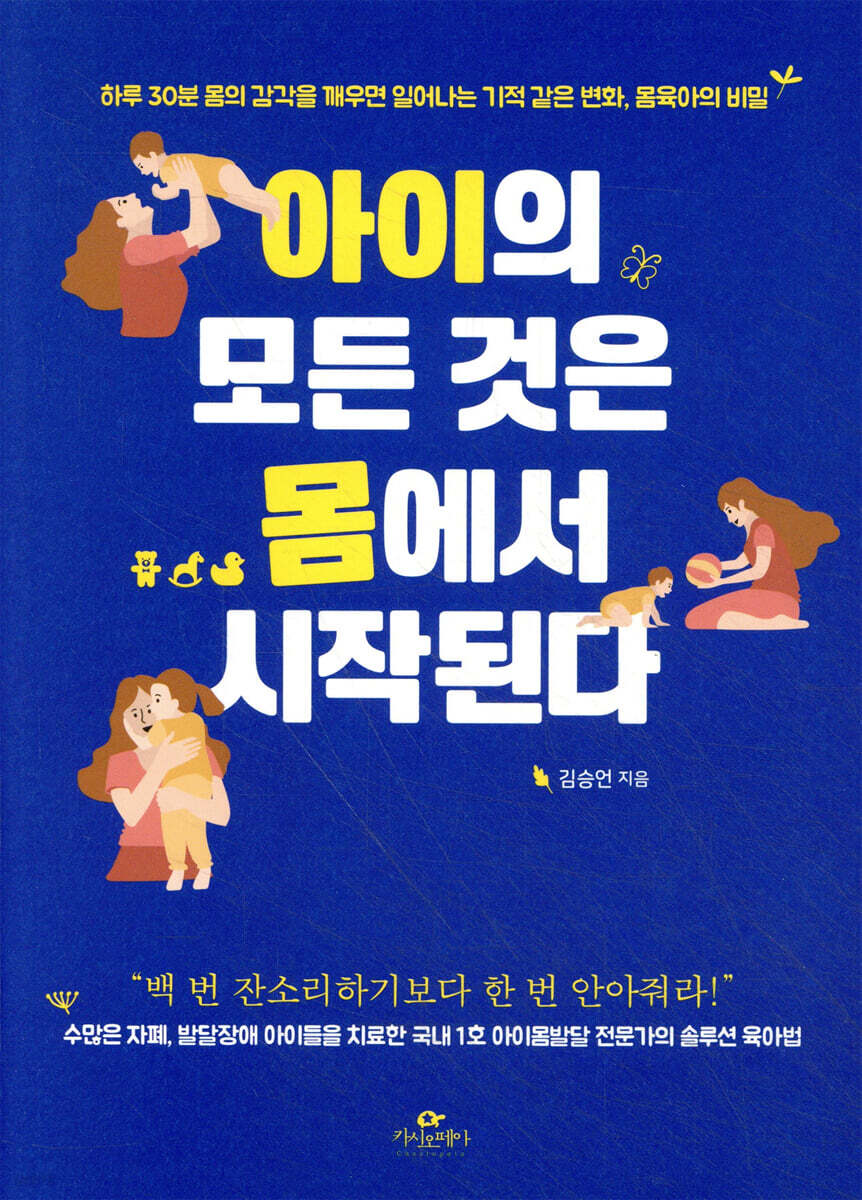
Everything about a child begins in the body.
 |
Description
Book Introduction
“30 minutes a day, focusing on your child’s body, can create miracles.” From children with developmental delays to those with communication difficulties Through physical parenting, your child can become good at anything! The body-rearing method that has worked miracles in curing children with autism and developmental disabilities is now being revealed for the first time to all children in the world. The author, who is the director of Touch Eye Development Center, has been treating children with various characteristics such as developmental delay, autism, and ADHD for over 30 years, points out the 'body parenting method' that focuses on the child's 'body' as the core of the treatment method. This book explains the importance of awakening a child's senses through various examples and specific examples of the changes that occur when the senses are awakened. Many children come to the counseling room for various reasons, such as lack of social skills, poor cognitive ability, and underdeveloped language development, but there was one method that changed these children. It was a body play where we made eye contact with the child, bumped into each other with our whole bodies, and laughed together. Just knowing a few things, such as the 30-minute a day, 8:2 rule, and other principles for safe and healthy parenting, as well as 10 physical activities that can be done anytime, anywhere, will help you transform difficult and challenging parenting into enjoyable and easy parenting. Hear the amazing story of how body sensations trigger brain activity and solve numerous developmental delays. |
- You can preview some of the book's contents.
Preview
index
Recommendation
Prologue: Knowing a Child's Body
Chapter 1.
The Life-Changing Physical Play Parenting Revolution
The miraculous effects of body movement therapy
Why Children Need Enough Skin Contact
Our children's bodies are becoming increasingly paralyzed.
Wise parents raise their children with their bodies, not their minds.
Children learn to love only when they are taught through their bodies.
[Q&A for Healthy Physical Play] What should I do when I'm too tired to play with my child?
Chapter 2 What We Can Learn from Our Children's Bodies
Is it okay for a child to refuse to play?
Understanding your child's development through their body
The brain develops only when the body's senses are awakened.
Acquisition comes before learning
The best area of exploration for children is the 'body'.
How to Use Your Body to Raise a Child Who Eats Well, Sleeps Well, and Poops Well
[Q&A for Healthy Body Movement] Is it okay to engage in extreme body movement with Dad?
Chapter 3: The Secret to Effective Body Movement Parenting
The body's ability to control itself by telling you one thing and letting you know ten things
Body movement creates Einstein's brain
The secret of a child who is good at everything
You have to know how to communicate with your body to be able to speak well.
Sensory experiences influence a child's ability to concentrate.
The most excellent way to improve self-regulation skills
[Q&A for healthy body movement] Once you start, do you want to keep doing body movement endlessly?
Chapter 4.
Children learning about the world through their bodies
The beginning of healthy self-development is the 'body'
What makes a child with high self-esteem different?
Why Experiencing 'Power' Is Important
If my child lacks social skills
If my child has delayed cognitive development
Parents' words that paralyze their children's bodies
Parents who give their children 'opportunities'
[Q&A for Healthy Body Movement] Do I really have to do body movement even though I hate it?
Chapter 5.
5 Rules for Happy Body Movement
Roll around together for 30 minutes before bed.
30 minutes at a time is better than several short sessions.
The 8:2 Body Movement Rule for Brain Development
Make it wide and strong.
It's okay to cry
Enjoy physical play with your child, mom and dad too
[Q&A for Healthy Body Play] What should I do if my child gets hurt while playing?
Chapter 6.
10 Recommended Body Exercises You Can Do Anytime, Anywhere
Play 1.
My body is a blank canvas
Play 2.
Electric play
Play 3.
Rock-Paper-Scissors Honey Chestnut Game
Play 4.
Thumb wrestling
Play 5.
Drawing on the back
Play 6.
tickle
Play 7.
boarding a plane
Play 8.
Coca-Cola is delicious
Play 9.
Sesse sese
Play 10.
Buy rice cakes
[Q&A for Healthy Body Movement] Is it possible to discipline with the body?
Epilogue
Prologue: Knowing a Child's Body
Chapter 1.
The Life-Changing Physical Play Parenting Revolution
The miraculous effects of body movement therapy
Why Children Need Enough Skin Contact
Our children's bodies are becoming increasingly paralyzed.
Wise parents raise their children with their bodies, not their minds.
Children learn to love only when they are taught through their bodies.
[Q&A for Healthy Physical Play] What should I do when I'm too tired to play with my child?
Chapter 2 What We Can Learn from Our Children's Bodies
Is it okay for a child to refuse to play?
Understanding your child's development through their body
The brain develops only when the body's senses are awakened.
Acquisition comes before learning
The best area of exploration for children is the 'body'.
How to Use Your Body to Raise a Child Who Eats Well, Sleeps Well, and Poops Well
[Q&A for Healthy Body Movement] Is it okay to engage in extreme body movement with Dad?
Chapter 3: The Secret to Effective Body Movement Parenting
The body's ability to control itself by telling you one thing and letting you know ten things
Body movement creates Einstein's brain
The secret of a child who is good at everything
You have to know how to communicate with your body to be able to speak well.
Sensory experiences influence a child's ability to concentrate.
The most excellent way to improve self-regulation skills
[Q&A for healthy body movement] Once you start, do you want to keep doing body movement endlessly?
Chapter 4.
Children learning about the world through their bodies
The beginning of healthy self-development is the 'body'
What makes a child with high self-esteem different?
Why Experiencing 'Power' Is Important
If my child lacks social skills
If my child has delayed cognitive development
Parents' words that paralyze their children's bodies
Parents who give their children 'opportunities'
[Q&A for Healthy Body Movement] Do I really have to do body movement even though I hate it?
Chapter 5.
5 Rules for Happy Body Movement
Roll around together for 30 minutes before bed.
30 minutes at a time is better than several short sessions.
The 8:2 Body Movement Rule for Brain Development
Make it wide and strong.
It's okay to cry
Enjoy physical play with your child, mom and dad too
[Q&A for Healthy Body Play] What should I do if my child gets hurt while playing?
Chapter 6.
10 Recommended Body Exercises You Can Do Anytime, Anywhere
Play 1.
My body is a blank canvas
Play 2.
Electric play
Play 3.
Rock-Paper-Scissors Honey Chestnut Game
Play 4.
Thumb wrestling
Play 5.
Drawing on the back
Play 6.
tickle
Play 7.
boarding a plane
Play 8.
Coca-Cola is delicious
Play 9.
Sesse sese
Play 10.
Buy rice cakes
[Q&A for Healthy Body Movement] Is it possible to discipline with the body?
Epilogue
Detailed image

Into the book
Mothers who raise children are already adults.
Development is complete when the body is used to its full potential.
That is, because sensory development has fully developed, moving the body is not only fun.
Rather, many people complain of fatigue and physical limitations.
Children's sensory development is not yet complete and they do not know how to use their bodies.
As you use your body, you learn and your senses develop.
So children want to move their bodies a lot.
The problem is that when a child moves, the mother must move along with it, but a mother who is tired and exhausted from raising a child wants the child to stay still.
--- p.
41
Hyunsik, 4 years old, screamed often.
But the sound didn't sound like a human voice.
Should I call it the ultrasonic sound of a dolphin? Or the sound of a bird stricken with fear? It was so high-pitched and shrill that it was difficult to even imitate, causing the person next to me to frown.
I sat Hyunsik down in front of me and tapped his waist so that he felt vibrations and his torso vibrated.
I repeated the process of gently and then a little harder.
After tapping his entire back and forth for about 5 minutes, the dolphin's voice changed a little, and after that, Hyunsik smiled at his teacher and friends, as if he felt better.
After class, I gave Hyunsik a lot of pats on the back and advised him to move around a lot.
--- p.
115
Body movements should not be easy, repetitive, familiar, or comfortable.
It has to be difficult, new, diverse, and even uncomfortable.
80% of the body movements should be ones that the child likes, and the remaining 20% should be ones that are a little uncomfortable.
A child's brain is often referred to as a 'thought bag'.
The process of the pockets growing is likened to the development of the brain.
How can we gradually expand our imagination pockets? Children must continually fill them through diverse experiences.
--- p.
206
There are many different types of body movements.
Among the many body movements, I mainly do body movements that involve a wide area of body-to-body contact.
Because such body movements are more beneficial to the child's development.
It is said that the size of the brain is determined by the amount of skin sensation.
Therefore, the area of contact between the body and the body must be wide.
The wider the body contact area, the more senses within the body are used.
More skin sensations receive external stimuli and send them to the brain.
When you move your body, the larger the contact surface, the greater the amount of sensation.
The more input there is, the more output there is.
Ultimately, brain development is promoted.
Development is complete when the body is used to its full potential.
That is, because sensory development has fully developed, moving the body is not only fun.
Rather, many people complain of fatigue and physical limitations.
Children's sensory development is not yet complete and they do not know how to use their bodies.
As you use your body, you learn and your senses develop.
So children want to move their bodies a lot.
The problem is that when a child moves, the mother must move along with it, but a mother who is tired and exhausted from raising a child wants the child to stay still.
--- p.
41
Hyunsik, 4 years old, screamed often.
But the sound didn't sound like a human voice.
Should I call it the ultrasonic sound of a dolphin? Or the sound of a bird stricken with fear? It was so high-pitched and shrill that it was difficult to even imitate, causing the person next to me to frown.
I sat Hyunsik down in front of me and tapped his waist so that he felt vibrations and his torso vibrated.
I repeated the process of gently and then a little harder.
After tapping his entire back and forth for about 5 minutes, the dolphin's voice changed a little, and after that, Hyunsik smiled at his teacher and friends, as if he felt better.
After class, I gave Hyunsik a lot of pats on the back and advised him to move around a lot.
--- p.
115
Body movements should not be easy, repetitive, familiar, or comfortable.
It has to be difficult, new, diverse, and even uncomfortable.
80% of the body movements should be ones that the child likes, and the remaining 20% should be ones that are a little uncomfortable.
A child's brain is often referred to as a 'thought bag'.
The process of the pockets growing is likened to the development of the brain.
How can we gradually expand our imagination pockets? Children must continually fill them through diverse experiences.
--- p.
206
There are many different types of body movements.
Among the many body movements, I mainly do body movements that involve a wide area of body-to-body contact.
Because such body movements are more beneficial to the child's development.
It is said that the size of the brain is determined by the amount of skin sensation.
Therefore, the area of contact between the body and the body must be wide.
The wider the body contact area, the more senses within the body are used.
More skin sensations receive external stimuli and send them to the brain.
When you move your body, the larger the contact surface, the greater the amount of sensation.
The more input there is, the more output there is.
Ultimately, brain development is promoted.
--- p.
209
209
Publisher's Review
“It’s better to hug once than to nag a hundred times!”
Treated numerous children with autism and developmental disabilities
Solutions for parenting from Korea's first child development expert
If you play airplane with a child who avoids eye contact, play tag with a child who hits a friend, or regularly rub the stomach of a child who has a stomachache out of habit, the child will change as if nothing had happened.
Why is that? The secret lies in the body.
Our bodies store much more information than we think.
Children perceive the world through their bodies, and establish their egos to the extent that they perceive through their bodies.
As society has developed, the era of physical contact and cuddling has passed, but when raising a child, you learn that giving a hug once is more effective than nagging a hundred times, and looking into each other's faces and rubbing cheeks is several times more effective than just saying "I love you."
This book focuses on the 'child's body', awakening the child's senses, helping the child listen to the language of the body, and awakening the body's communication.
I hope that through this book, many parents will be able to experience the joy of parenting through their own bodies.
What changes when you focus on your child's body? First, your child's ability to perceive his or her own body (body awareness) increases. As children become aware of the size, feel, taste, and texture of every part of their body, they become more aware of what they are good at and what they are not.
Second, it awakens your physical sensitivity.
When you become aware of your body, you can learn to harness its power and use it.
You will learn how to apply and release force to each part of your body to achieve the desired body control.
This will help the child develop concentration and physical control.
Third, the body's ability to communicate increases.
Our communication is influenced more by nonverbal than verbal communication.
This is why a child who knows how to be considerate with his or her body is popular wherever he or she goes.
Children who know how to communicate with their bodies grow up to be socially adept without having to be taught it.
“Wise parents raise their children with their bodies, not their minds.”
The amazing changes that occur when you develop body awareness.
Every child is born with two things.
One is time, and the other is your own body.
A child's future depends on how he or she spends his or her time using his or her body.
Children become healthy when they spend time getting to know their own bodies.
Everything a child does begins with the body, grows with the body, and learns with the body.
This is why we need to focus on the ‘child’s body.’
Chapter 1 explains why it is important to know your child's body.
This indicates that the rapidly increasing number of children in modern times, such as those who are particularly sensitive, irritable, or silent outside the home, or who hit other children and do not eat well, have problems in the process of experiencing their 'body'.
Chapter 2 shows that a child's development and cognitive abilities can be known simply by observing the child's body.
We introduce a method to recognize and listen to the body language that children express with their bodies even though they cannot express it verbally.
Chapter 3 explains how using the body helps children.
Chapter 4 introduces the five core rules of body play that will change a child's future, and Chapter 5 introduces ten basic body play movements that can be easily done at home.
Each chapter's tips cover the most frequently asked questions and answers from mothers about raising their children.
Treated numerous children with autism and developmental disabilities
Solutions for parenting from Korea's first child development expert
If you play airplane with a child who avoids eye contact, play tag with a child who hits a friend, or regularly rub the stomach of a child who has a stomachache out of habit, the child will change as if nothing had happened.
Why is that? The secret lies in the body.
Our bodies store much more information than we think.
Children perceive the world through their bodies, and establish their egos to the extent that they perceive through their bodies.
As society has developed, the era of physical contact and cuddling has passed, but when raising a child, you learn that giving a hug once is more effective than nagging a hundred times, and looking into each other's faces and rubbing cheeks is several times more effective than just saying "I love you."
This book focuses on the 'child's body', awakening the child's senses, helping the child listen to the language of the body, and awakening the body's communication.
I hope that through this book, many parents will be able to experience the joy of parenting through their own bodies.
What changes when you focus on your child's body? First, your child's ability to perceive his or her own body (body awareness) increases. As children become aware of the size, feel, taste, and texture of every part of their body, they become more aware of what they are good at and what they are not.
Second, it awakens your physical sensitivity.
When you become aware of your body, you can learn to harness its power and use it.
You will learn how to apply and release force to each part of your body to achieve the desired body control.
This will help the child develop concentration and physical control.
Third, the body's ability to communicate increases.
Our communication is influenced more by nonverbal than verbal communication.
This is why a child who knows how to be considerate with his or her body is popular wherever he or she goes.
Children who know how to communicate with their bodies grow up to be socially adept without having to be taught it.
“Wise parents raise their children with their bodies, not their minds.”
The amazing changes that occur when you develop body awareness.
Every child is born with two things.
One is time, and the other is your own body.
A child's future depends on how he or she spends his or her time using his or her body.
Children become healthy when they spend time getting to know their own bodies.
Everything a child does begins with the body, grows with the body, and learns with the body.
This is why we need to focus on the ‘child’s body.’
Chapter 1 explains why it is important to know your child's body.
This indicates that the rapidly increasing number of children in modern times, such as those who are particularly sensitive, irritable, or silent outside the home, or who hit other children and do not eat well, have problems in the process of experiencing their 'body'.
Chapter 2 shows that a child's development and cognitive abilities can be known simply by observing the child's body.
We introduce a method to recognize and listen to the body language that children express with their bodies even though they cannot express it verbally.
Chapter 3 explains how using the body helps children.
Chapter 4 introduces the five core rules of body play that will change a child's future, and Chapter 5 introduces ten basic body play movements that can be easily done at home.
Each chapter's tips cover the most frequently asked questions and answers from mothers about raising their children.
GOODS SPECIFICS
- Date of issue: August 31, 2018
- Page count, weight, size: 248 pages | 416g | 152*210*15mm
- ISBN13: 9791188674251
- ISBN10: 1188674250
You may also like
카테고리
korean


korean

![ELLE 엘르 스페셜 에디션 A형 : 12월 [2025]](http://librairie.coreenne.fr/cdn/shop/files/b8e27a3de6c9538896439686c6b0e8fb.jpg?v=1766436872&width=3840)


