

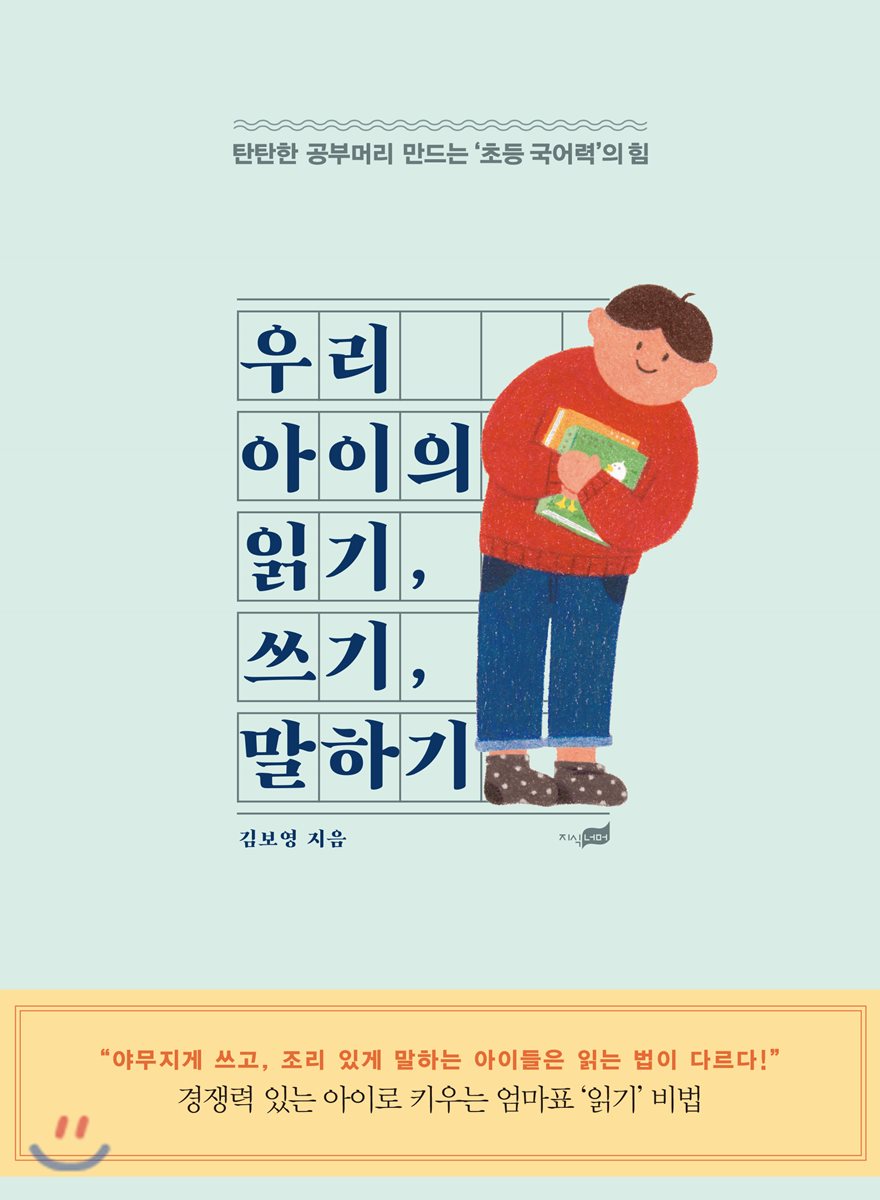
Our child's reading, writing, and speaking
 |
Description
Book Introduction
“Children who write neatly and speak coherently read differently!”
A mother's secret to raising a competitive child: reading.
Ages 6-13: A period of explosive growth in vocabulary.
Develop lifelong study habits through 'Read-Write-Speak'!
When children start elementary school, parents' minds become busy.
Even mothers who insisted that "playing is the best thing for children" until their children started kindergarten begin to take a keen interest in education around this time.
Not only do they teach students in advance what they will learn in elementary school, but they also get excited about preparing for English debate competitions and math competitions.
But does reading the Harry Potter books fluently or solving addition and subtraction problems quickly make a child a top student? Indeed, many children who attend English kindergartens struggle to understand the curriculum after entering school.
This is a natural result since I received English immersion education while learning Korean.
The recently published book, "Our Child's Reading, Writing, and Speaking," is a book that reminds parents of the importance of 'Korean language skills' that they are often overlooking.
The author, a current announcer and mother of two, interviewed numerous education experts and writers to compile the know-how of Korean language education in which 'reading, writing, and speaking' interact like a Möbius strip.
A mother's secret to raising a competitive child: reading.
Ages 6-13: A period of explosive growth in vocabulary.
Develop lifelong study habits through 'Read-Write-Speak'!
When children start elementary school, parents' minds become busy.
Even mothers who insisted that "playing is the best thing for children" until their children started kindergarten begin to take a keen interest in education around this time.
Not only do they teach students in advance what they will learn in elementary school, but they also get excited about preparing for English debate competitions and math competitions.
But does reading the Harry Potter books fluently or solving addition and subtraction problems quickly make a child a top student? Indeed, many children who attend English kindergartens struggle to understand the curriculum after entering school.
This is a natural result since I received English immersion education while learning Korean.
The recently published book, "Our Child's Reading, Writing, and Speaking," is a book that reminds parents of the importance of 'Korean language skills' that they are often overlooking.
The author, a current announcer and mother of two, interviewed numerous education experts and writers to compile the know-how of Korean language education in which 'reading, writing, and speaking' interact like a Möbius strip.
- You can preview some of the book's contents.
Preview
index
Prologue│Our Children's First Korean Lessons Create Lifelong Study Habits
Chapter 01 Reading, Writing, and Speaking are Like a Möbius Strip
Before entering elementary school, seize the golden time for Korean language education!
If you just read the textbook properly, you will have no problem getting into the top elementary school level. Reading education that makes children study independently. Children who read well write well and speak well.
Smart reading techniques to develop a study mindset
The foundation of all studies, before and after entering elementary school ㆍ Children who do not understand the problem ㆍ Ages 6 to 13, the best time to develop reading habits ㆍ The power of fun that is stronger than habit
Why is Korean language education becoming increasingly important?
The Key to College Admission Success: Korean Language ㆍ How Finland Became an Education Powerhouse ㆍ The Fourth Industrial Revolution and Korean Language Proficiency
Chapter 02 Why You Don't Need to Go to an Essay Academy
Mom's Reading Education: Start Now
What will you learn at Daechi-dong's essay academy? The "academy" is a dilemma, whether you should send your child to it or not. Mom's plan vs. private education.
Mom is my child's personalized teacher.
Understanding Your Child's Aptitudes ㆍ Reading Habits: Let Moms Take the Lead ㆍ Raising Your Child's Speaking Quotient (TQ) ㆍ A Working Mom's Reading Education Method
What is the reading environment at home?
Check your reading environment first. Create a study space together. Move the dining table to the living room. You can temporarily turn off the TV and smartphone. Don't organize your books.
Chapter 03: Reading Education for Our Children Led by Mothers
Clear standards are needed even for book purchases.
Should I buy a complete collection? ㆍ Forget recommended books ㆍ Shop offline rather than online ㆍ Non-recommended books are more important than recommended ones ㆍ Don't fall into the trap of textbook-linked books ㆍ Start with easy books ㆍ Read children's books together, too.
Reading habits created by moms
Is there enough reading time in kindergarten and elementary school? ㆍ Setting a reading time at home ㆍ Creating a mom-friendly reading club
The power of reading scraps every day
A little goes a long way. Read 10 minutes a day. Read the newspaper. The first step is crucial. Find stories in the newspaper.
Make the most of your library
Let's have a quick and intense time at the library. Weekends at the library. The humanities and classics craze: Should kids read too? Let's give our daughter a science book! Short but profound emotions: reading poetry. A look into the future: historical stories.
QnA
What should I do with a child who only reads comics? Should I focus on reading extensively or focusing on reading first? How should I guide a child who struggles to finish reading? Is it okay to allow them to read e-books?
Chapter 04: Developing Speaking Skills Through Reading
Speaking before reading is as important as reading.
Associating content with titles ㆍ The joy of reading with mom ㆍ The joy of children recommending books themselves
Brain-stimulating 'reading aloud'
The Amazing Effects of Reading Aloud ㆍ Parents should read to their children until they are in elementary school ㆍ Reading aloud helps them experience the joy of reading ㆍ Reading aloud also requires planning ㆍ Start with short texts
The Power of Post-Reading Conversation: Book Talk
The Power of Questions and Conversations ㆍ Developing Presentation Skills through Reading ㆍ Learning Considerate Speaking from Books
Speaking training to foster empathy
Morning Discussion, Interviewing the Main Character, Speaking as a Character, and Raising Children to Become Dignified People
Chapter 05: Developing Writing Skills Through Reading
Creating a reading log that your child can find and write in first
Should I write a reading log? How to write one? Writing letters to characters
A reading exchange for families to use together
Reading Logs: Let's Boldly Break the Format ㆍ Writing Habits in Daily Life ㆍ Secure at Least 3 Readers
Get familiar with paper dictionaries
How to use the Korean dictionary to improve your vocabulary: ㆍ Create a vocabulary list to learn Chinese characters ㆍ Play a dictionary-based speaking game
Reading slowly, the power of transcription
Concentration training through transcription: Copying short sentences first. Developing your child as a writer.
Epilogue│Taking the Right Reading Timing Changes Your Child's Life
Recommendation
References
Chapter 01 Reading, Writing, and Speaking are Like a Möbius Strip
Before entering elementary school, seize the golden time for Korean language education!
If you just read the textbook properly, you will have no problem getting into the top elementary school level. Reading education that makes children study independently. Children who read well write well and speak well.
Smart reading techniques to develop a study mindset
The foundation of all studies, before and after entering elementary school ㆍ Children who do not understand the problem ㆍ Ages 6 to 13, the best time to develop reading habits ㆍ The power of fun that is stronger than habit
Why is Korean language education becoming increasingly important?
The Key to College Admission Success: Korean Language ㆍ How Finland Became an Education Powerhouse ㆍ The Fourth Industrial Revolution and Korean Language Proficiency
Chapter 02 Why You Don't Need to Go to an Essay Academy
Mom's Reading Education: Start Now
What will you learn at Daechi-dong's essay academy? The "academy" is a dilemma, whether you should send your child to it or not. Mom's plan vs. private education.
Mom is my child's personalized teacher.
Understanding Your Child's Aptitudes ㆍ Reading Habits: Let Moms Take the Lead ㆍ Raising Your Child's Speaking Quotient (TQ) ㆍ A Working Mom's Reading Education Method
What is the reading environment at home?
Check your reading environment first. Create a study space together. Move the dining table to the living room. You can temporarily turn off the TV and smartphone. Don't organize your books.
Chapter 03: Reading Education for Our Children Led by Mothers
Clear standards are needed even for book purchases.
Should I buy a complete collection? ㆍ Forget recommended books ㆍ Shop offline rather than online ㆍ Non-recommended books are more important than recommended ones ㆍ Don't fall into the trap of textbook-linked books ㆍ Start with easy books ㆍ Read children's books together, too.
Reading habits created by moms
Is there enough reading time in kindergarten and elementary school? ㆍ Setting a reading time at home ㆍ Creating a mom-friendly reading club
The power of reading scraps every day
A little goes a long way. Read 10 minutes a day. Read the newspaper. The first step is crucial. Find stories in the newspaper.
Make the most of your library
Let's have a quick and intense time at the library. Weekends at the library. The humanities and classics craze: Should kids read too? Let's give our daughter a science book! Short but profound emotions: reading poetry. A look into the future: historical stories.
QnA
What should I do with a child who only reads comics? Should I focus on reading extensively or focusing on reading first? How should I guide a child who struggles to finish reading? Is it okay to allow them to read e-books?
Chapter 04: Developing Speaking Skills Through Reading
Speaking before reading is as important as reading.
Associating content with titles ㆍ The joy of reading with mom ㆍ The joy of children recommending books themselves
Brain-stimulating 'reading aloud'
The Amazing Effects of Reading Aloud ㆍ Parents should read to their children until they are in elementary school ㆍ Reading aloud helps them experience the joy of reading ㆍ Reading aloud also requires planning ㆍ Start with short texts
The Power of Post-Reading Conversation: Book Talk
The Power of Questions and Conversations ㆍ Developing Presentation Skills through Reading ㆍ Learning Considerate Speaking from Books
Speaking training to foster empathy
Morning Discussion, Interviewing the Main Character, Speaking as a Character, and Raising Children to Become Dignified People
Chapter 05: Developing Writing Skills Through Reading
Creating a reading log that your child can find and write in first
Should I write a reading log? How to write one? Writing letters to characters
A reading exchange for families to use together
Reading Logs: Let's Boldly Break the Format ㆍ Writing Habits in Daily Life ㆍ Secure at Least 3 Readers
Get familiar with paper dictionaries
How to use the Korean dictionary to improve your vocabulary: ㆍ Create a vocabulary list to learn Chinese characters ㆍ Play a dictionary-based speaking game
Reading slowly, the power of transcription
Concentration training through transcription: Copying short sentences first. Developing your child as a writer.
Epilogue│Taking the Right Reading Timing Changes Your Child's Life
Recommendation
References
Detailed image
Into the book
How can we develop our children's reading, writing, and speaking skills? Should we send them to a renowned reading and writing academy right now? Of course, that could be an option.
But parents can be our children's personalized teachers more than anyone else.
It is because parents know their children's tendencies well and spend the most time with them.
Of course, there are difficulties involved.
Because it is something that needs to be done consistently with the child every day.
But if you think about it, it's not that difficult.
As little as 10 minutes a day is enough.
--- From 'Prologue'
Many parents who have just started their children in school are amazed when they open their children's textbooks.
This is because the difficulty level has increased significantly compared to our generation.
Even in Korean, it is the same.
First of all, the amount of fingerprints is not small.
To put it a bit exaggeratedly, it is very reminiscent of the language section of the CSAT.
If I think back to my elementary school days when we learned “Goodbye Baduk” and “Goodbye Cheolsu,” it’s like a world of difference.
Therefore, in order to properly study elementary school Korean these days, the ability to read long texts at once and understand the content, or 'Korean language skills', is essential.
Math is no different.
Nowadays, mathematics has the characteristics of descriptive and sentence-type.
You've probably heard a lot about the so-called thinking mathematics.
Originally, thinking mathematics was a learning method that emerged with the purpose of making learning more fun by understanding the principles of mathematics.
Rather than simply plugging numbers into a formula and getting an answer, we emphasize the 'solution process', which explains how the answer was derived.
--- From 'Seize the Golden Time for Korean Language Education Before Entering Elementary School!'
There is no reason to pay to learn 'reading, writing, and speaking'.
Even if it's not this one, there are many subjects that require money.
The first reason why it is difficult to expect the effects of 'reading, writing, and speaking' through private education is the frequency of classes.
Because it is difficult to expect results with just one or two hours once a week.
Second, ‘reading, writing, and speaking’ are the foundation of learning, so they must be done under the child’s leadership.
If children are forced to read books selected by their teachers and answer questions, child-directed learning will become increasingly difficult.
“Give a man a fish and he will eat for a day; teach him to fish and he will eat for a lifetime.” This is a famous saying from the Talmud.
To help children develop the habit of reading, writing, and speaking on their own, consistent training at home is much more effective than private education.
--- From 'Mom's Reading Education, Start Now'
The complete collection is a book planned under the leadership of a publisher.
Therefore, there is a risk that the quality of the book may be somewhat lower than that of individually planned books.
Also, it is difficult to carefully examine each one before purchasing.
If you give your child too many books at once, you may put pressure on them to read all of those books.
Therefore, if your child is not yet interested in books, I recommend starting with single books rather than a complete collection.
Even if you buy just one book, if you and your child look at it together and choose it carefully, there is a high possibility that you will read it over and over again for a long time.
--- From 'Books, even purchasing requires clear standards'
For children under 12 years of age, it is better to read aloud rather than silently.
It's also good for parents to read books to their children.
This is why parents should read aloud to their children even if they know Korean.
If it is difficult to read all the books your child reads, we recommend that you read at least one book a day.
Of course, it is not easy to keep this from the beginning.
But if you repeat it every day, it becomes a kind of habit and there will come a day when you feel more awkward if you don't read it.
Of course, to achieve that, you will need to practice consistently and repeatedly for a certain period of time.
There is no achievement without effort.
Dieting, abstinence from alcohol, and quitting smoking can all be achieved through consistent training.
However, the difference is that reading education is not for myself, but for my child.
Please remember that reading education is ultimately a joint effort between children and parents.
But parents can be our children's personalized teachers more than anyone else.
It is because parents know their children's tendencies well and spend the most time with them.
Of course, there are difficulties involved.
Because it is something that needs to be done consistently with the child every day.
But if you think about it, it's not that difficult.
As little as 10 minutes a day is enough.
--- From 'Prologue'
Many parents who have just started their children in school are amazed when they open their children's textbooks.
This is because the difficulty level has increased significantly compared to our generation.
Even in Korean, it is the same.
First of all, the amount of fingerprints is not small.
To put it a bit exaggeratedly, it is very reminiscent of the language section of the CSAT.
If I think back to my elementary school days when we learned “Goodbye Baduk” and “Goodbye Cheolsu,” it’s like a world of difference.
Therefore, in order to properly study elementary school Korean these days, the ability to read long texts at once and understand the content, or 'Korean language skills', is essential.
Math is no different.
Nowadays, mathematics has the characteristics of descriptive and sentence-type.
You've probably heard a lot about the so-called thinking mathematics.
Originally, thinking mathematics was a learning method that emerged with the purpose of making learning more fun by understanding the principles of mathematics.
Rather than simply plugging numbers into a formula and getting an answer, we emphasize the 'solution process', which explains how the answer was derived.
--- From 'Seize the Golden Time for Korean Language Education Before Entering Elementary School!'
There is no reason to pay to learn 'reading, writing, and speaking'.
Even if it's not this one, there are many subjects that require money.
The first reason why it is difficult to expect the effects of 'reading, writing, and speaking' through private education is the frequency of classes.
Because it is difficult to expect results with just one or two hours once a week.
Second, ‘reading, writing, and speaking’ are the foundation of learning, so they must be done under the child’s leadership.
If children are forced to read books selected by their teachers and answer questions, child-directed learning will become increasingly difficult.
“Give a man a fish and he will eat for a day; teach him to fish and he will eat for a lifetime.” This is a famous saying from the Talmud.
To help children develop the habit of reading, writing, and speaking on their own, consistent training at home is much more effective than private education.
--- From 'Mom's Reading Education, Start Now'
The complete collection is a book planned under the leadership of a publisher.
Therefore, there is a risk that the quality of the book may be somewhat lower than that of individually planned books.
Also, it is difficult to carefully examine each one before purchasing.
If you give your child too many books at once, you may put pressure on them to read all of those books.
Therefore, if your child is not yet interested in books, I recommend starting with single books rather than a complete collection.
Even if you buy just one book, if you and your child look at it together and choose it carefully, there is a high possibility that you will read it over and over again for a long time.
--- From 'Books, even purchasing requires clear standards'
For children under 12 years of age, it is better to read aloud rather than silently.
It's also good for parents to read books to their children.
This is why parents should read aloud to their children even if they know Korean.
If it is difficult to read all the books your child reads, we recommend that you read at least one book a day.
Of course, it is not easy to keep this from the beginning.
But if you repeat it every day, it becomes a kind of habit and there will come a day when you feel more awkward if you don't read it.
Of course, to achieve that, you will need to practice consistently and repeatedly for a certain period of time.
There is no achievement without effort.
Dieting, abstinence from alcohol, and quitting smoking can all be achieved through consistent training.
However, the difference is that reading education is not for myself, but for my child.
Please remember that reading education is ultimately a joint effort between children and parents.
--- From 'Brain-stimulating reading aloud'
Publisher's Review
A sharp Korean language coaching session from a mother who is a good senior.
Raising children who understand deeply and think logically!
“Mom, I don’t understand what you mean.
“If you read the problem all the way through, you’ll forget the beginning part.” A second-grade elementary school student runs out of the middle of a math problem and complains.
Parents look at their children's math problems and tilt their heads.
More and more children are having difficulty not because of the difficulty of the problem, but because they do not understand the problem itself.
It is not easy to write down the answer because you do not understand the problem or the text.
This is also why the author advocates a three-dimensional learning method that connects 'writing' and 'speaking' rather than a flat 'reading' education.
Children who have developed the habit of 'reading, writing, and speaking' can think three-dimensionally and confidently even when faced with difficult sentences.
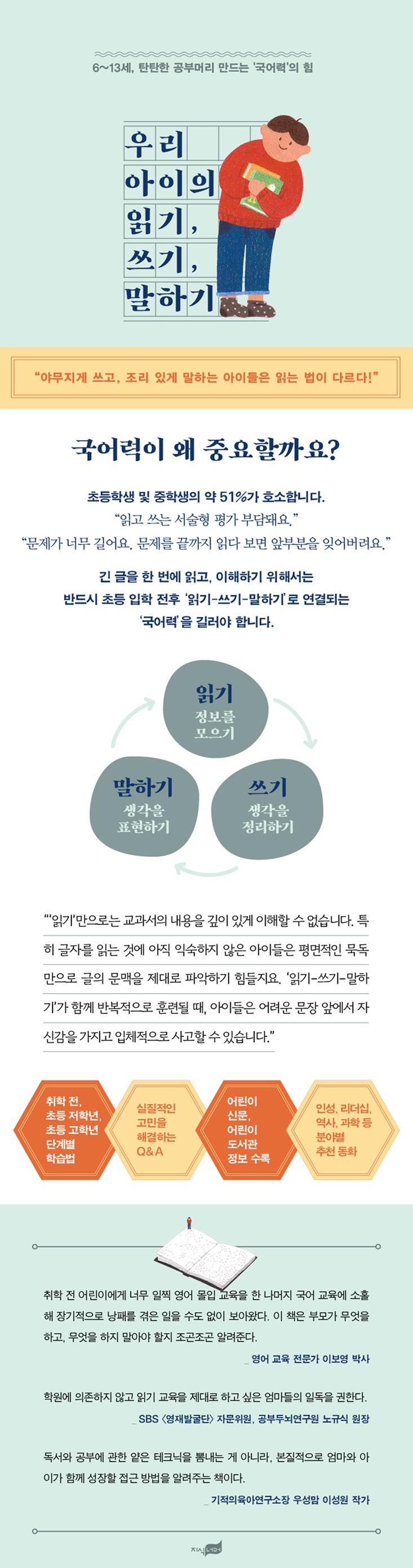
To put it simply, 'reading-writing-speaking' is the process of gathering information (reading), organizing thoughts (writing), and expressing thoughts (speaking).
In "Reading, Writing, and Speaking for Our Children," this process is divided into five chapters.
Chapter 1 carefully selects areas that can be applied to children, along with recent educational issues, such as the importance of Korean language skills as a differentiating factor from artificial intelligence in the era of the Fourth Industrial Revolution and the educational methods of Finland, a leading country in education.
Chapter 2 explains the importance of parents becoming their children's personalized teachers.
Parents and children naturally share interests and communicate by reading, writing, and speaking on the same topic.
Chapters 3 through 5 explain in detail how reading, writing, and speaking are connected and learned.
Easy-to-follow examples are written in a friendly tone, making you feel like you're listening to the advice of a seasoned senior mother right next to you.
The Power of Elementary Korean Language Skills: Building a Strong Aptitude for Studying
“Children who write neatly and speak coherently read differently!”
Above all, the greatest strength of this book is that it contains specific and diverse practical guides.
It contains meticulously organized information that is essential but not easily found, such as 'Learning methods by stage for preschool, lower elementary school, and upper elementary school', 'Q&A to solve practical concerns about children's reading habits', and 'Children's newspaper and children's library information'.
Additionally, a list of recommended fairy tales by subject, such as character, leadership, history, and science, is included throughout the book, providing solutions to parents who are having trouble deciding which books to read.
‘Korean language skills’ are a powerful weapon that will help children develop lifelong habits.
Not only does it affect your immediate grades, but speaking and writing also play a crucial role in determining success or failure in college entrance exams, interviews, and social life.
So, what's the first thing we should do to improve our children's Korean language skills? Set achievable goals with your child, even if it's just for 10 minutes once a week.
“Our Child’s Reading, Writing, and Speaking” will serve as a guide.
Raising children who understand deeply and think logically!
“Mom, I don’t understand what you mean.
“If you read the problem all the way through, you’ll forget the beginning part.” A second-grade elementary school student runs out of the middle of a math problem and complains.
Parents look at their children's math problems and tilt their heads.
More and more children are having difficulty not because of the difficulty of the problem, but because they do not understand the problem itself.
It is not easy to write down the answer because you do not understand the problem or the text.
This is also why the author advocates a three-dimensional learning method that connects 'writing' and 'speaking' rather than a flat 'reading' education.
Children who have developed the habit of 'reading, writing, and speaking' can think three-dimensionally and confidently even when faced with difficult sentences.
To put it simply, 'reading-writing-speaking' is the process of gathering information (reading), organizing thoughts (writing), and expressing thoughts (speaking).
In "Reading, Writing, and Speaking for Our Children," this process is divided into five chapters.
Chapter 1 carefully selects areas that can be applied to children, along with recent educational issues, such as the importance of Korean language skills as a differentiating factor from artificial intelligence in the era of the Fourth Industrial Revolution and the educational methods of Finland, a leading country in education.
Chapter 2 explains the importance of parents becoming their children's personalized teachers.
Parents and children naturally share interests and communicate by reading, writing, and speaking on the same topic.
Chapters 3 through 5 explain in detail how reading, writing, and speaking are connected and learned.
Easy-to-follow examples are written in a friendly tone, making you feel like you're listening to the advice of a seasoned senior mother right next to you.
The Power of Elementary Korean Language Skills: Building a Strong Aptitude for Studying
“Children who write neatly and speak coherently read differently!”
Above all, the greatest strength of this book is that it contains specific and diverse practical guides.
It contains meticulously organized information that is essential but not easily found, such as 'Learning methods by stage for preschool, lower elementary school, and upper elementary school', 'Q&A to solve practical concerns about children's reading habits', and 'Children's newspaper and children's library information'.
Additionally, a list of recommended fairy tales by subject, such as character, leadership, history, and science, is included throughout the book, providing solutions to parents who are having trouble deciding which books to read.
‘Korean language skills’ are a powerful weapon that will help children develop lifelong habits.
Not only does it affect your immediate grades, but speaking and writing also play a crucial role in determining success or failure in college entrance exams, interviews, and social life.
So, what's the first thing we should do to improve our children's Korean language skills? Set achievable goals with your child, even if it's just for 10 minutes once a week.
“Our Child’s Reading, Writing, and Speaking” will serve as a guide.
GOODS SPECIFICS
- Date of publication: March 27, 2018
- Page count, weight, size: 256 pages | 604g | 164*225*19mm
- ISBN13: 9788952790422
- ISBN10: 8952790421
You may also like
카테고리
korean


korean

![ELLE 엘르 스페셜 에디션 A형 : 12월 [2025]](http://librairie.coreenne.fr/cdn/shop/files/b8e27a3de6c9538896439686c6b0e8fb.jpg?v=1766436872&width=3840)


