

Twelve Months of a Gardener
 |
Description
Book Introduction
If the gardening life you've been dreaming of seems vague and difficult, start with this book!
Twelve Months of Gardening Guided by Garden Designer Oh Kyung-ah
Practical indoor and outdoor gardening lessons that are easy to learn through pictures
A book that 'becomes' a garden when held in your arms!
“The more you know, the easier it becomes, and the easier it becomes, the closer you become,
So, I can dream something new again,
“That is the true joy of gardening!”
- Oh Kyung-ah
“I want to create a garden, but I don’t know where to start.” “I confidently created a gorgeous flower bed, but once the spring flowers bloom and fall, it becomes utterly desolate.
What should I do? “The garden is now overgrown with weeds.
"Weeds are living things too, so should I just leave them alone?" "Is there a way to have a beautiful garden all year round?" "My plants keep withering. What did I do wrong?" "Aren't gardens only possible in houses with yards? Can I have a garden in my small room?" and so on.
These are the questions that author Oh Kyung-ah has heard most often over the past 10 years as a garden designer, giving lectures and writing.
Many people love plants and dream of having their own garden, but the reality is that creating and maintaining a garden is not easy.
Although garden culture has expanded significantly in Korea and a number of garden-related books have been published, the fact that many of these books are written at a professional level makes it difficult for the general public to easily understand the content and apply it to their daily lives.
So, after much thought, the author decided to write this book, “Twelve Months of Garden Life.”
Twelve Months of Gardening Guided by Garden Designer Oh Kyung-ah
Practical indoor and outdoor gardening lessons that are easy to learn through pictures
A book that 'becomes' a garden when held in your arms!
“The more you know, the easier it becomes, and the easier it becomes, the closer you become,
So, I can dream something new again,
“That is the true joy of gardening!”
- Oh Kyung-ah
“I want to create a garden, but I don’t know where to start.” “I confidently created a gorgeous flower bed, but once the spring flowers bloom and fall, it becomes utterly desolate.
What should I do? “The garden is now overgrown with weeds.
"Weeds are living things too, so should I just leave them alone?" "Is there a way to have a beautiful garden all year round?" "My plants keep withering. What did I do wrong?" "Aren't gardens only possible in houses with yards? Can I have a garden in my small room?" and so on.
These are the questions that author Oh Kyung-ah has heard most often over the past 10 years as a garden designer, giving lectures and writing.
Many people love plants and dream of having their own garden, but the reality is that creating and maintaining a garden is not easy.
Although garden culture has expanded significantly in Korea and a number of garden-related books have been published, the fact that many of these books are written at a professional level makes it difficult for the general public to easily understand the content and apply it to their daily lives.
So, after much thought, the author decided to write this book, “Twelve Months of Garden Life.”
- You can preview some of the book's contents.
Preview
index
january.
Time to prepare for spring on a blank canvas
- Garden Notes
Create your own twelve-month garden calendar | Growing with willow and camellia stems | Temperature at which each plant sprouts | Checking the winter survival of plants that bloom in early spring | Pruning fruit trees: apple trees, pear trees, etc. | Various pruning methods | Managing a greenhouse in winter | Sowing seeds in a greenhouse | Preparing the soil where you will create a flower bed | Observing pests and diseases
- Plants that brighten the garden in January
- An ancient gardening wisdom passed down to gardeners from the East and the West.
- Palm Gardening Note
The Truth About Orchids, the Queen of Indoor Plants | Oriental vs. Western Orchids? | Different Types of Orchids | DIY Orchid Pot Ideas | Winter Garden Design Ideas
february.
Spring comes only to the gardener who prepares!
- Garden Notes
Daffodils, crocuses, and hyacinths are sprouting | Supporting tall herbaceous plants: peonies, dahlias, yarrow, and chrysanthemums | Following plant support designs | Sowing in the greenhouse: annual vegetables / tomatoes, eggplants, and peppers | Sprouting potatoes | Checking the health of evergreen conifers | Pruning black raspberries and raspberries
- Plants that brighten the garden in February
- An ancient gardening wisdom passed down to gardeners from the East and the West.
- Palm Gardening Note
How to Grow Hyacinths, a Natural Air Freshener | How to Grow Cyclamen in Winter | How to Grow Poinsettias After the Flowers Fade | Indoor Window Garden Ideas
March.
Will it work or not? Exciting times!
- Garden Notes
Pruning roses | Cutting stems of overwintered shrubs: hydrangeas, reeds, and dogwood | Sowing seeds: vegetables, chrysanthemums, heleniums, sunflowers, and rudbeckia | Dividing roots: irises, astilbe (deer urine), and daylilies | Early suppression of weeds | Perennial herbaceous plants that germinate easily from seeds | Planting peas | Plants that bloom in the fall and bloom in the spring | Everything about growing potatoes | Growing plants from stems and leaves | Understanding pH levels | Understanding the nutrients plants need
- Plants that brighten the garden in March
- An ancient gardening wisdom passed down to gardeners from the East and the West.
- Palm Gardening Note
Tips for repotting plants every 3-4 years | Root reduction | Creating a balcony pot garden | Sowing vegetable seeds on a windowsill | Ideas for making pots out of plastic bottles
april.
Don't be greedy!
- Garden Notes
What Plants for Which Spots? | Things to Consider When Planting Evergreens | Planting Summer Bulbs: Dahlias, Agapanthus, and Cannas | Plants That Love Them | Lawn Care | How to Build a Pond | How to Plant | Tips for Watering Newly Planted Trees
- Plants that brighten the garden in April
- An ancient gardening wisdom passed down to gardeners from the East and the West.
- Palm Gardening Note
How to Make a Small Pond Full of Aquatic Plants | How to Make a Balcony Garden with Styrofoam Boxes | How to Make a Wooden Frame Garden | How to Make a Rock Crevice Garden
May.
Together, we learn to live in harmony.
- Garden Notes
Tie vines together and grow them neatly | Avoid using pesticides as much as possible | Control aphids | Put straw under strawberries | Plant vegetables in flower beds | Visit other people's gardens | The benefits of planting plants densely | Pruning flowers and flower stalks: azaleas, lilacs | Edible flowers | Sowing garden seeds: turnips, carrots, beans, peas, spinach, cabbage, lettuce, mustard | Sowing seeds for flower beds | Plants and companions that protect the garden | Vegetable garden design ideas
- Plants that brighten the garden in May
- An ancient gardening wisdom passed down to gardeners from the East and the West.
- Palm Gardening Note
Creating a Balcony Garden | Watering Pots | Feeding Pots | Creating a Growing Bag Garden | How to Cut Plants for Flower Arrangements | How to Arrange Plants in a Vase
June.
Plants grow to the sound of the gardener's footsteps!
- Garden Notes
It's getting warmer for planting and transplanting, but still! | Sowing summer flower seeds | Summer flower bed ideas | Summer plants that are cold-tolerant but produce colorful flowers | Prune evergreen hedges regularly: yews, boxwoods, and privets | Prune early spring flowering shrubs: bottlebrush, horse chestnuts, hollyhocks, and azaleas | Preparing winter flower beds: Sowing seeds of Chinese cabbage, kale, and pansies | Leaving leaves: daffodils, tulips, and crocuses | Annual strawberry patch care | Enjoying your vegetable garden | No flowers in your garden?
- Plants that brighten the garden in June
- An ancient gardening wisdom passed down to gardeners from the East and the West.
- Palm Gardening Note
Increase the amount of water you give your potted plants | Creating a balcony garden, a breath of fresh air in city life | Examples of gardening work tables suitable for balcony gardening | Types of air plants and tillandsia | Misconceptions and truths about air plants and tillandsia | Indoor garden design ideas
July.
Applause for living hard!
- Garden Notes
Harvesting seeds for next year | Storing seeds in the refrigerator | Harvesting vegetables and fruits | Pruning climbing wisteria in summer | The garden before harvest: installing beautiful and functional supports is essential | Maintaining a summer pond | Tips for creating an ecological pond | How to create an herb garden | Herb garden design ideas | Herbs that are easy to grow in the garden and make into tea | Ways to use fresh herb leaves | Tips for drying herbs | Why not harvest potatoes in midsummer | Summer flowers: keep cutting flower stalks | Choosing herbaceous plants suited to the soil | Plants that bloom for a long time | Plants that prefer the seaside
- Plants that brighten the garden in July
- An ancient gardening wisdom passed down to gardeners from the East and the West.
- Palm Gardening Note
Checking for pests and diseases in your veranda garden | Watering plants you've forgotten: camellias, azaleas, and rhododendrons | Mulching and providing nutrients to pots | Pot garden ideas | Indoor plants that are easy to grow even for beginners | Terrariums made in small glass bottles
August.
The change that comes at the end of the climax!
- Garden Notes
Hot summer watering in the early morning or evening! | Pond garden, bottom cleaning | Winter spinach planting | Fruit thinning | Harvest fruit and collect seeds! | Creating a butterfly-attracting garden | Creating a colorful garden | Small trees that decorate the garden with colorful flowers
- Plants that brighten the August garden
- An ancient gardening wisdom passed down to gardeners from the East and the West.
- Palm Gardening Note
How to Care for Your Plants During Summer Vacation | How to Grow Plants Without Drainage Holes | Making a Hanging Basket | Various Hanging Basket Ideas | Easy Stem Cuttings | Flower Pots Made from Old Shoes | Growing Pelargoniums in a Ball Shape
September.
Time to start preparing for the next year
- Garden Notes
Planning for winter | Begin preparing the garden for next spring | Late summer, a thorough lawn cleanup | Sowing the last of the leafy greens | Sowing kimchi cabbage | Making a bin to collect leaves | Buying bulbs for next spring | Clearing the ground after harvesting | Ornamental reed plants emerging as garden plants
- Plants that brighten the garden in September
- An ancient gardening wisdom passed down to gardeners from the East and the West.
- Palm Gardening Note
Preparing Veranda Flower Pots for Winter | Indoor Plants that Bloom in Winter: Poinsettias and Christmas Cacti | Creating a Winter Veranda Flower Bed | Reduce Watering | Making Flower Pots Using Kitchen Containers
october.
Falling leaves pat my shoulder
- Garden Notes
When is the best time to move large trees? | When to divide roots: daylilies, Chinese angelica, hostas | Storing cold-sensitive herbaceous plants: dahlias, begonias, gladiolus, papyrus | Plants that are more beautiful in autumn | Plants with silvery leaves | Things to do in the garden with kids! | Creating a winter garden to help wildlife survive the winter | Creating a late-fall flower bed: eryshimums, Chinese cabbage, primroses, pansies | Buying seeds for next spring | Composing a four-season flower bed | Tips for designing a flower bed that blooms all year round
- Plants that brighten the garden in October
- An ancient gardening wisdom passed down to gardeners from the East and the West.
- Palm Gardening Note
Pruning Potted Plants | Things to Consider Before Creating an Indoor Garden | Choosing Plants to Your Taste | Mini Flower Pots Made from Discarded Encyclopedias | Creating Indoor Flower Beds Without Drainage | Indoor Moss Garden Ideas
November.
It's time to prepare for winter!
- Garden Notes
Pruning against the winter wind | Cleaning greenhouse glass | Gardening that attracts wildlife | Making an apple feeder frame | Evergreen plants that keep the garden green through the winter | Creating a fall garden optimized for Korea | Protecting the soil | Creating a flower bed for next year | Creating a garden for flower arrangements
- Plants that brighten the garden in November
- An ancient gardening wisdom passed down to gardeners from the East and the West.
- Palm Gardening Note
Indoor Garden Conditions: Spraying to Protect Indoor Plants in Dry Indoors | Providing Artificial Light to Indoor Plants | Our Plants That Can Survive Indoors | Succulents You Can Grow Indoors | Indoor Plants That Can Grow in Water | Creating an Indoor Water Garden | Aquatic Plants That Can Be Growed in Glass Cups and Bottles | Indoor Garden Ideas for Decorating a Small Flower Bed
december.
Time spent in the barn
- Garden Notes
Creating a winter garden | Time to trim and repair the extension | Garden design, the value of the focal point | Vertically expressed focal point design ideas | Plants with beautiful seed bearing | Creating a Christmas garden | Wrapping flower pots with vinyl and non-woven fabric | Dropping a ball in a pond | Planting, moving, and growing trees | Try growing a tree with your own hands | Maintaining walls, fences, and floors | Tips for creating a path in the garden | Preparing for attacks by wild animals
- Plants that brighten the garden in December
- An ancient gardening wisdom passed down to gardeners from the East and the West.
- Palm Gardening Note
Growing Vegetables Indoors in Winter | Watering Orchids | Growing Tangerine Trees Indoors | Growing Orchids Tied to a Wooden Board
Time to prepare for spring on a blank canvas
- Garden Notes
Create your own twelve-month garden calendar | Growing with willow and camellia stems | Temperature at which each plant sprouts | Checking the winter survival of plants that bloom in early spring | Pruning fruit trees: apple trees, pear trees, etc. | Various pruning methods | Managing a greenhouse in winter | Sowing seeds in a greenhouse | Preparing the soil where you will create a flower bed | Observing pests and diseases
- Plants that brighten the garden in January
- An ancient gardening wisdom passed down to gardeners from the East and the West.
- Palm Gardening Note
The Truth About Orchids, the Queen of Indoor Plants | Oriental vs. Western Orchids? | Different Types of Orchids | DIY Orchid Pot Ideas | Winter Garden Design Ideas
february.
Spring comes only to the gardener who prepares!
- Garden Notes
Daffodils, crocuses, and hyacinths are sprouting | Supporting tall herbaceous plants: peonies, dahlias, yarrow, and chrysanthemums | Following plant support designs | Sowing in the greenhouse: annual vegetables / tomatoes, eggplants, and peppers | Sprouting potatoes | Checking the health of evergreen conifers | Pruning black raspberries and raspberries
- Plants that brighten the garden in February
- An ancient gardening wisdom passed down to gardeners from the East and the West.
- Palm Gardening Note
How to Grow Hyacinths, a Natural Air Freshener | How to Grow Cyclamen in Winter | How to Grow Poinsettias After the Flowers Fade | Indoor Window Garden Ideas
March.
Will it work or not? Exciting times!
- Garden Notes
Pruning roses | Cutting stems of overwintered shrubs: hydrangeas, reeds, and dogwood | Sowing seeds: vegetables, chrysanthemums, heleniums, sunflowers, and rudbeckia | Dividing roots: irises, astilbe (deer urine), and daylilies | Early suppression of weeds | Perennial herbaceous plants that germinate easily from seeds | Planting peas | Plants that bloom in the fall and bloom in the spring | Everything about growing potatoes | Growing plants from stems and leaves | Understanding pH levels | Understanding the nutrients plants need
- Plants that brighten the garden in March
- An ancient gardening wisdom passed down to gardeners from the East and the West.
- Palm Gardening Note
Tips for repotting plants every 3-4 years | Root reduction | Creating a balcony pot garden | Sowing vegetable seeds on a windowsill | Ideas for making pots out of plastic bottles
april.
Don't be greedy!
- Garden Notes
What Plants for Which Spots? | Things to Consider When Planting Evergreens | Planting Summer Bulbs: Dahlias, Agapanthus, and Cannas | Plants That Love Them | Lawn Care | How to Build a Pond | How to Plant | Tips for Watering Newly Planted Trees
- Plants that brighten the garden in April
- An ancient gardening wisdom passed down to gardeners from the East and the West.
- Palm Gardening Note
How to Make a Small Pond Full of Aquatic Plants | How to Make a Balcony Garden with Styrofoam Boxes | How to Make a Wooden Frame Garden | How to Make a Rock Crevice Garden
May.
Together, we learn to live in harmony.
- Garden Notes
Tie vines together and grow them neatly | Avoid using pesticides as much as possible | Control aphids | Put straw under strawberries | Plant vegetables in flower beds | Visit other people's gardens | The benefits of planting plants densely | Pruning flowers and flower stalks: azaleas, lilacs | Edible flowers | Sowing garden seeds: turnips, carrots, beans, peas, spinach, cabbage, lettuce, mustard | Sowing seeds for flower beds | Plants and companions that protect the garden | Vegetable garden design ideas
- Plants that brighten the garden in May
- An ancient gardening wisdom passed down to gardeners from the East and the West.
- Palm Gardening Note
Creating a Balcony Garden | Watering Pots | Feeding Pots | Creating a Growing Bag Garden | How to Cut Plants for Flower Arrangements | How to Arrange Plants in a Vase
June.
Plants grow to the sound of the gardener's footsteps!
- Garden Notes
It's getting warmer for planting and transplanting, but still! | Sowing summer flower seeds | Summer flower bed ideas | Summer plants that are cold-tolerant but produce colorful flowers | Prune evergreen hedges regularly: yews, boxwoods, and privets | Prune early spring flowering shrubs: bottlebrush, horse chestnuts, hollyhocks, and azaleas | Preparing winter flower beds: Sowing seeds of Chinese cabbage, kale, and pansies | Leaving leaves: daffodils, tulips, and crocuses | Annual strawberry patch care | Enjoying your vegetable garden | No flowers in your garden?
- Plants that brighten the garden in June
- An ancient gardening wisdom passed down to gardeners from the East and the West.
- Palm Gardening Note
Increase the amount of water you give your potted plants | Creating a balcony garden, a breath of fresh air in city life | Examples of gardening work tables suitable for balcony gardening | Types of air plants and tillandsia | Misconceptions and truths about air plants and tillandsia | Indoor garden design ideas
July.
Applause for living hard!
- Garden Notes
Harvesting seeds for next year | Storing seeds in the refrigerator | Harvesting vegetables and fruits | Pruning climbing wisteria in summer | The garden before harvest: installing beautiful and functional supports is essential | Maintaining a summer pond | Tips for creating an ecological pond | How to create an herb garden | Herb garden design ideas | Herbs that are easy to grow in the garden and make into tea | Ways to use fresh herb leaves | Tips for drying herbs | Why not harvest potatoes in midsummer | Summer flowers: keep cutting flower stalks | Choosing herbaceous plants suited to the soil | Plants that bloom for a long time | Plants that prefer the seaside
- Plants that brighten the garden in July
- An ancient gardening wisdom passed down to gardeners from the East and the West.
- Palm Gardening Note
Checking for pests and diseases in your veranda garden | Watering plants you've forgotten: camellias, azaleas, and rhododendrons | Mulching and providing nutrients to pots | Pot garden ideas | Indoor plants that are easy to grow even for beginners | Terrariums made in small glass bottles
August.
The change that comes at the end of the climax!
- Garden Notes
Hot summer watering in the early morning or evening! | Pond garden, bottom cleaning | Winter spinach planting | Fruit thinning | Harvest fruit and collect seeds! | Creating a butterfly-attracting garden | Creating a colorful garden | Small trees that decorate the garden with colorful flowers
- Plants that brighten the August garden
- An ancient gardening wisdom passed down to gardeners from the East and the West.
- Palm Gardening Note
How to Care for Your Plants During Summer Vacation | How to Grow Plants Without Drainage Holes | Making a Hanging Basket | Various Hanging Basket Ideas | Easy Stem Cuttings | Flower Pots Made from Old Shoes | Growing Pelargoniums in a Ball Shape
September.
Time to start preparing for the next year
- Garden Notes
Planning for winter | Begin preparing the garden for next spring | Late summer, a thorough lawn cleanup | Sowing the last of the leafy greens | Sowing kimchi cabbage | Making a bin to collect leaves | Buying bulbs for next spring | Clearing the ground after harvesting | Ornamental reed plants emerging as garden plants
- Plants that brighten the garden in September
- An ancient gardening wisdom passed down to gardeners from the East and the West.
- Palm Gardening Note
Preparing Veranda Flower Pots for Winter | Indoor Plants that Bloom in Winter: Poinsettias and Christmas Cacti | Creating a Winter Veranda Flower Bed | Reduce Watering | Making Flower Pots Using Kitchen Containers
october.
Falling leaves pat my shoulder
- Garden Notes
When is the best time to move large trees? | When to divide roots: daylilies, Chinese angelica, hostas | Storing cold-sensitive herbaceous plants: dahlias, begonias, gladiolus, papyrus | Plants that are more beautiful in autumn | Plants with silvery leaves | Things to do in the garden with kids! | Creating a winter garden to help wildlife survive the winter | Creating a late-fall flower bed: eryshimums, Chinese cabbage, primroses, pansies | Buying seeds for next spring | Composing a four-season flower bed | Tips for designing a flower bed that blooms all year round
- Plants that brighten the garden in October
- An ancient gardening wisdom passed down to gardeners from the East and the West.
- Palm Gardening Note
Pruning Potted Plants | Things to Consider Before Creating an Indoor Garden | Choosing Plants to Your Taste | Mini Flower Pots Made from Discarded Encyclopedias | Creating Indoor Flower Beds Without Drainage | Indoor Moss Garden Ideas
November.
It's time to prepare for winter!
- Garden Notes
Pruning against the winter wind | Cleaning greenhouse glass | Gardening that attracts wildlife | Making an apple feeder frame | Evergreen plants that keep the garden green through the winter | Creating a fall garden optimized for Korea | Protecting the soil | Creating a flower bed for next year | Creating a garden for flower arrangements
- Plants that brighten the garden in November
- An ancient gardening wisdom passed down to gardeners from the East and the West.
- Palm Gardening Note
Indoor Garden Conditions: Spraying to Protect Indoor Plants in Dry Indoors | Providing Artificial Light to Indoor Plants | Our Plants That Can Survive Indoors | Succulents You Can Grow Indoors | Indoor Plants That Can Grow in Water | Creating an Indoor Water Garden | Aquatic Plants That Can Be Growed in Glass Cups and Bottles | Indoor Garden Ideas for Decorating a Small Flower Bed
december.
Time spent in the barn
- Garden Notes
Creating a winter garden | Time to trim and repair the extension | Garden design, the value of the focal point | Vertically expressed focal point design ideas | Plants with beautiful seed bearing | Creating a Christmas garden | Wrapping flower pots with vinyl and non-woven fabric | Dropping a ball in a pond | Planting, moving, and growing trees | Try growing a tree with your own hands | Maintaining walls, fences, and floors | Tips for creating a path in the garden | Preparing for attacks by wild animals
- Plants that brighten the garden in December
- An ancient gardening wisdom passed down to gardeners from the East and the West.
- Palm Gardening Note
Growing Vegetables Indoors in Winter | Watering Orchids | Growing Tangerine Trees Indoors | Growing Orchids Tied to a Wooden Board
Detailed image

Into the book
“This book contains the know-how of gardening that I have learned theoretically and practiced directly in the garden.
To help city dwellers without gardens easily and simply create an indoor garden, the book is divided into two parts: a monthly garden notebook for outdoor gardens and a palm-sized gardening notebook for indoor gardens.
Of course, the timing may vary somewhat depending on the region's climate, but I believe that understanding and learning the things to do and the tips for each month will help anyone plan and create their own twelve-month gardening life.
We hope that you will experience the splendor of the garden through garden plants that brighten it up throughout the twelve months, and share the age-old knowledge hidden in the garden wisdom passed down by gardeners from the East and the West.
I hope that this book will be an opportunity for beginners who are just starting out in gardening, and for those who have thought gardening was difficult and vague, to try again.”
“The best way to garden well is to approach gardening as a way of life rather than a hobby.
The best way to garden is to think of gardening as a regular part of your life, rather than doing it when you have free time.
Just as in everyday life, when the house gets messy, you have to clean it up, and when there's nothing to eat, you have to buy ingredients, things like cleaning the garden and redecorating with new plants happen very naturally.
I don't think there's any gardening know-how more certain than this.
But sometimes, you might feel like you're doing something really annoying and difficult for no reason, and that's where the charm of the twist lies.
“Because the garden has the power to bring about changes in our bodies, change our values in life, and bring about healthy happiness little by little.”
To help city dwellers without gardens easily and simply create an indoor garden, the book is divided into two parts: a monthly garden notebook for outdoor gardens and a palm-sized gardening notebook for indoor gardens.
Of course, the timing may vary somewhat depending on the region's climate, but I believe that understanding and learning the things to do and the tips for each month will help anyone plan and create their own twelve-month gardening life.
We hope that you will experience the splendor of the garden through garden plants that brighten it up throughout the twelve months, and share the age-old knowledge hidden in the garden wisdom passed down by gardeners from the East and the West.
I hope that this book will be an opportunity for beginners who are just starting out in gardening, and for those who have thought gardening was difficult and vague, to try again.”
“The best way to garden well is to approach gardening as a way of life rather than a hobby.
The best way to garden is to think of gardening as a regular part of your life, rather than doing it when you have free time.
Just as in everyday life, when the house gets messy, you have to clean it up, and when there's nothing to eat, you have to buy ingredients, things like cleaning the garden and redecorating with new plants happen very naturally.
I don't think there's any gardening know-how more certain than this.
But sometimes, you might feel like you're doing something really annoying and difficult for no reason, and that's where the charm of the twist lies.
“Because the garden has the power to bring about changes in our bodies, change our values in life, and bring about healthy happiness little by little.”
--- From the text
Publisher's Review
This book, "Twelve Months of Gardening," is a twelve-month guide for those who are currently living a garden life or dream of living a garden life, as the title suggests.
We've included gardening know-how in a way that's as easy as possible and immediately applicable, so that even beginners who are just starting out with gardening will feel, "Ah, this is worth a try!"
In particular, I tried to be specific about what to prepare and what to do each month.
It is designed to be easy to understand and to learn by giving examples of actual events that occur according to the flow of the seasons in the twelve-month garden.
This book is full of interesting knowledge for enjoying gardening every day, from the basic preparations for creating a garden to the unique personalities of each plant, gardening know-how, how to plant and transplant trees, how to get rid of weeds, flower bed and vegetable garden management, making a container to collect leaves, how to prune and set up supports, dividing roots, harvesting seeds, and how to care for indoor pots.
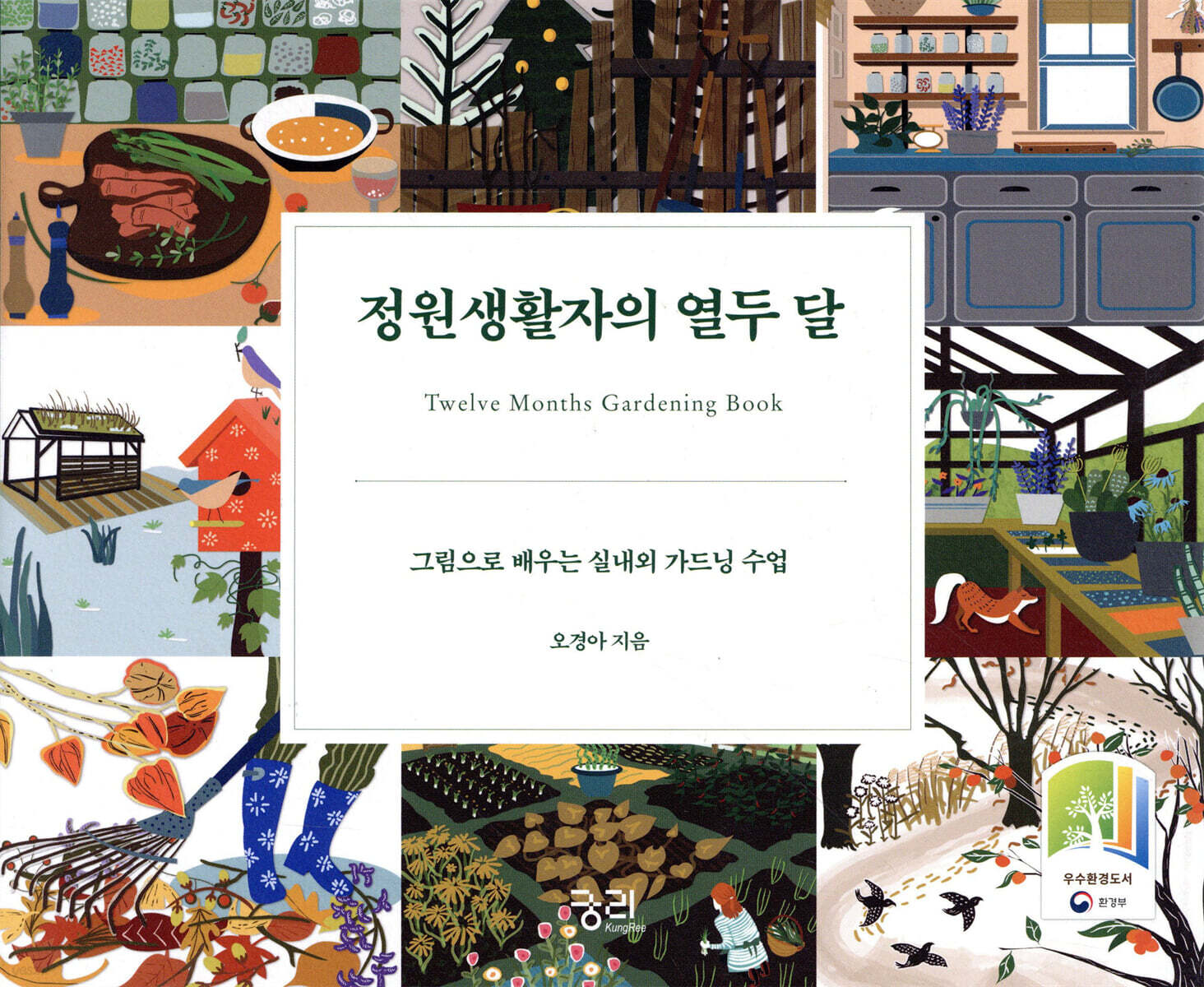
Additionally, the author has included many illustrations in this book to help readers intuitively understand gardening at a glance.
The delicate yet vibrant paintings of plants and gardens provide healing and joy just by looking at them.
“In fact, even I, an expert, sometimes feel at a loss as to what to do when I look at the garden of my house in Sokcho.
There are many cases where you end up in trouble because you have already missed the opportunity to do something that shouldn't have been done.
So I thought I also needed to organize my twelve-month garden work.
“I wanted to plan and sketch out a twelve-month gardening experience that both beginners and experts can relate to.”
A 365-Day Guide for Preparing Gardeners
The joy of imagining and planning each day spent in the garden!
A book that 'becomes' a garden when held in your arms!
This book, "Twelve Months of a Gardener," can be said to be a more realistic and practical version of the author's best-selling book, "Discovery of the Garden."
If 『The Discovery of the Garden』 was a book written to provide a basic understanding of the space called a garden, then this 『Twelve Months of a Gardener』 is a book published to help solve the various difficulties and vague problems of gardening that one encounters when creating and managing a garden in earnest.
The book, which consists of 12 chapters, does not need to be read sequentially.
At the end of the book, there is a topic-based index so that you can select and read the parts you want and look up things that come to mind or that you are curious about.
We also paid special attention to the binding method (four-strand binding) so that you can comfortably open the book and practice the contents.
Above all, the author divided the book into two parts: ‘Monthly Gardening Notes for Outdoor Gardens’ and ‘Palm Gardening Notes’ for indoor gardens, so that even city dwellers without gardens can easily and simply decorate an indoor garden.
Of course, the timing may vary slightly depending on the region's climate, but understanding and learning the steps and tips for each month will help anyone plan and create their own twelve-month gardening life.
In addition, we hope to experience the splendor of the garden through ‘Garden Plants that Shine Through the Twelve Months’ and share the age-old knowledge hidden in ‘Garden Wisdom Passed Down by Eastern and Western Gardeners.’
“This book provides tips for growing an indoor garden as well as an outdoor garden.
So I think this will help people who don't have a garden to create an indoor garden.
Even if you have a garden, indoor gardens are an important part of it.
I, too, enjoy my indoor garden regardless of the season.
So, I hope that even those who live in the city and do not have a garden will find help in this book and enjoy creating a garden in their daily lives even more.” - From an interview with the author
This is how the twelve months of a gardener pass!
January "Preparing for Spring on a White Canvas"
If it snowed all night and the garden turned white, think about this.
I could draw something new on a blank canvas! As I walk through the garden, leaving white footprints, my imagination naturally begins to flow.
A spring flower bed is created with peonies and magnolias in bloom, rose vines grow thickly on the pergola, and large water lily buds bloom in the small pond in midsummer.
When walking through a garden filled with abundance, the sketch that was not well drawn can be created anew in the garden in January.
So, January, which is completely frozen, is also a time of new beginnings where we can dream of something new.
February 〈Spring Comes Only to the Prepared Gardener!〉
Even though it's still cold and the ground is frozen solid, February is definitely the beginning of spring.
If January was the time to make plans, February is the time to prepare.
It's okay to break ground on a well-drawn sketch.
It's still cold and spring is clearly a long way off, but the days are getting longer, and if you have a greenhouse, you'll notice that the hours of warmth are also increasing.
The rising temperatures in the greenhouse also mean that it is time to sprout the seeds of crops and flowers that should be planted in early spring.
On a warm day, when the frozen ground thaws, let's hurry and work the land.
Just as farming begins in February, it is now time for the garden to begin full-scale preparations.
If you prepare well, things in spring will go smoothly.
March "Will It Work or Not? Exciting Times!"
During this time, I look at the thermometer several times a day.
Will it work or not? Because you have to predict whether it's okay to plant plants or open the greenhouse door.
If this guess is wrong, the plant can be killed by frostbite in just a week, and if it is too late, the fruit may not be produced well.
It is important to check the weather every day.
But what's better than a weather forecast is awakening our primal senses.
The night sky is an important key to predicting the next day's weather.
You can predict the weather by looking at whether the moon is out, how bright the stars are, and what constellations are overhead.
There is no better teacher than experience!
April "Don't Be Greedy!"
It's April, and my heart keeps swelling.
Now, it is the season when seeds can be sown directly in the ground and sprouts appear, so I am filled with confidence.
But if you're planning a trip to the plant market at this time, you'll need to brace yourself.
It's hard to pass up the rows of vegetable seedlings, including lettuce, cabbage, cucumbers, pumpkins, peppers, green onions, and strawberries, and the allure of ornamental plants like daylilies, primroses, and chrysanthemums is no joke.
The problem is that if you plant too much, you will end up having to manage it without being able to handle it.
Just like taking a shopping list to the supermarket, you should make a shopping list after carefully considering the size of your veranda and the environment inside your home where you can grow your plants.
It is actually better to purchase an amount that seems a little small.
May: Learning to Live Together in Coexistence
May, the queen of seasons, is the time when plants grow most vigorously.
However, as the plants grow, the number of pests also increases rapidly to feed on the sweet sap of young plants.
Unfortunately, there are few ways to grow plants safely from pests and diseases.
And if we wipe out the insects themselves in the natural ecosystem because they are harmful to plants, this will also cause great chaos.
It is time to think again about a life of coexistence where we all live together.
All we have to do is help nature find its own balance.
It is also a good idea to create insect nests that can increase beneficial insects and increase the number of plants that can repel pests.
A garden is more beautiful when plants, animals, and human life shine together in harmony, rather than standing out alone.
Let's learn about this beautiful symbiotic life together in the garden.
June 〈Plants Grow to the Sound of the Gardener's Footsteps!〉
Summer is deepening.
The leaves of the plant become darker and thicker.
It is a sign of aging, but it is also the plant's arduous effort to withstand the intense sunlight.
Plants that bloomed in the spring now devote all their energy to fattening their fruits.
It is also necessary to prune unnecessary branches so that fruit-bearing plants can photosynthesize well.
Although the greenery is getting thicker, let's not forget the summer herbs that are just starting to bloom.
June is also the month when summer herbaceous plants put on a flower feast.
However, unwanted weed growth can ruin a beautiful herbaceous flower bed.
The best way to reduce weeds is through consistent management.
Let's take a look around the garden every day.
Just looking back, you can see the state of the plants, you can see empty spaces, you can see things that can help.
The garden grows to the sound of the gardener's footsteps!
July 〈Applause for Living Hard!〉
July is the beginning of a difficult summer for us and for plants.
Plants that bloomed in the cold winds of early spring, sometimes even enduring the fatal threat of freezing petals, are now bearing fruit.
The fruit, still small and tender, has a long way to go.
We have to endure the monsoon season, the typhoon winds and the scorching heat.
The leaves are torn, punctured, burned, and torn, but they do not give up until the very end.
So, it is not something to be sad about when summer gardens lose their greenery and decline.
Because the last passion of the plant, the fruit, will soon give us another beauty.
Plant life is sublime.
But it is time to encourage and comfort each other, knowing that we too are working hard to live just like the plants!
August 〈Change at the End of the Peak!〉
Summer is coming to a close.
As the weather gets hotter, summer gardens also wear bright primary colors.
But the climax always coincides with the end.
As the heat reaches its peak in mid-August, the morning and evening temperatures begin to change.
Now the plants are slowly preparing for fall.
The leaves gradually lose their color after photosynthesis, using their last strength, but they still leave behind seeds.
Let's not forget to collect the seeds of the precious plants that protect our garden.
The collected seeds will become valuable fertilizer for next year's garden.
Seeds are the evolution of plants.
A more evolved seed, different from its parent, may bring unexpected specialness to next year's garden.
A garden full of seeds signals not the end, but the beginning of something new to come.
September: A Time to Begin Preparing for the Next Year
A spring garden and an autumn garden are definitely different.
In September, which seems to be a month of only decline, there is an unexpected highlight.
Heleniums, sunflowers, chrysanthemums, sea chrysanthemums, Chinese chives, chrysanthemums, cosmos, and rudbeckia decorate late summer as brightly as spring, and the fruits of grapes, gourds, persimmon trees, apple trees, and apple trees turn yellow, orange, and red.
The September sky is now beginning to get high and blue.
It is a time to be thankful that there are not many countries that have such clear and transparent autumns.
Times when the clear sunlight adds flavor to whatever you do.
Let's take a look back at the time we spent in the garden during this splendid time.
Now it's time to prepare for next year.
October 〈Falling Leaves Pat My Shoulder〉
The persimmons from the persimmon tree are sweeter than any other fruit in the world, and the chestnut tree gives us chestnuts that fall like altolan even in the slightest breeze.
It's a cold, dewy dawn, but after taking a walk around the garden, my pockets are full of chestnuts.
Not only that.
When you step outside the house, the rice paddies are covered with golden, ripe rice stalks that bow their heads.
The leaves of cherry trees, maples, and ginkgo trees have turned a vibrant color and are decorating the streets.
No matter what anyone says, autumn is the most bountiful season of the year.
It's time to say that the garden has lived well for the past year, and it's time to pat ourselves on the shoulder for getting through a difficult time.
November: Time to Prepare for Winter!
It was around the time when news came that ice had formed on Seorak Mountain.
Although the winter cold has not yet fully set in, one day a sharp cold suddenly creeps deep into the garden.
The garden in November is a time to wrap up a hectic year.
But the gardener's hands are still busy.
It's time to help your plants survive the winter.
Plants that need warmth need to be moved or covered.
It is also necessary to take time to carefully examine the branches of plants that have spent another year.
After the leaves fall, the bare faces of the branches that had not been visible until then begin to show, and the inner suffering of the tree that had endured a difficult summer becomes clearly visible.
It is best to prune diseased and injured branches before the cold weather sets in to prevent the wounds from deepening.
December "Time in the Barn"
December is cold.
Although the severity of the cold may vary from region to region, the number of days with temperatures below freezing across the country is increasing, making outdoor activities difficult.
Fortunately, there isn't much to do in the winter garden.
But the sheds and greenhouses that store the extensions are still busy.
Pruning shears, hedge shears, shovels, forks, hoes, lawn mowers, and grass cutters that have been used for a year are already showing signs of wear and tear.
December is a great time to make sure your extensions are well-maintained and maintained so they will be ready for use next year.
It's also time to clean out the barn.
The barn, which has been busy for a year, is now filled with things that can be thrown away and things that need to be sorted out.
A well-organized barn is often the starting point for a more beautiful garden next year.
We've included gardening know-how in a way that's as easy as possible and immediately applicable, so that even beginners who are just starting out with gardening will feel, "Ah, this is worth a try!"
In particular, I tried to be specific about what to prepare and what to do each month.
It is designed to be easy to understand and to learn by giving examples of actual events that occur according to the flow of the seasons in the twelve-month garden.
This book is full of interesting knowledge for enjoying gardening every day, from the basic preparations for creating a garden to the unique personalities of each plant, gardening know-how, how to plant and transplant trees, how to get rid of weeds, flower bed and vegetable garden management, making a container to collect leaves, how to prune and set up supports, dividing roots, harvesting seeds, and how to care for indoor pots.
Additionally, the author has included many illustrations in this book to help readers intuitively understand gardening at a glance.
The delicate yet vibrant paintings of plants and gardens provide healing and joy just by looking at them.
“In fact, even I, an expert, sometimes feel at a loss as to what to do when I look at the garden of my house in Sokcho.
There are many cases where you end up in trouble because you have already missed the opportunity to do something that shouldn't have been done.
So I thought I also needed to organize my twelve-month garden work.
“I wanted to plan and sketch out a twelve-month gardening experience that both beginners and experts can relate to.”
A 365-Day Guide for Preparing Gardeners
The joy of imagining and planning each day spent in the garden!
A book that 'becomes' a garden when held in your arms!
This book, "Twelve Months of a Gardener," can be said to be a more realistic and practical version of the author's best-selling book, "Discovery of the Garden."
If 『The Discovery of the Garden』 was a book written to provide a basic understanding of the space called a garden, then this 『Twelve Months of a Gardener』 is a book published to help solve the various difficulties and vague problems of gardening that one encounters when creating and managing a garden in earnest.
The book, which consists of 12 chapters, does not need to be read sequentially.
At the end of the book, there is a topic-based index so that you can select and read the parts you want and look up things that come to mind or that you are curious about.
We also paid special attention to the binding method (four-strand binding) so that you can comfortably open the book and practice the contents.
Above all, the author divided the book into two parts: ‘Monthly Gardening Notes for Outdoor Gardens’ and ‘Palm Gardening Notes’ for indoor gardens, so that even city dwellers without gardens can easily and simply decorate an indoor garden.
Of course, the timing may vary slightly depending on the region's climate, but understanding and learning the steps and tips for each month will help anyone plan and create their own twelve-month gardening life.
In addition, we hope to experience the splendor of the garden through ‘Garden Plants that Shine Through the Twelve Months’ and share the age-old knowledge hidden in ‘Garden Wisdom Passed Down by Eastern and Western Gardeners.’
“This book provides tips for growing an indoor garden as well as an outdoor garden.
So I think this will help people who don't have a garden to create an indoor garden.
Even if you have a garden, indoor gardens are an important part of it.
I, too, enjoy my indoor garden regardless of the season.
So, I hope that even those who live in the city and do not have a garden will find help in this book and enjoy creating a garden in their daily lives even more.” - From an interview with the author
This is how the twelve months of a gardener pass!
January "Preparing for Spring on a White Canvas"
If it snowed all night and the garden turned white, think about this.
I could draw something new on a blank canvas! As I walk through the garden, leaving white footprints, my imagination naturally begins to flow.
A spring flower bed is created with peonies and magnolias in bloom, rose vines grow thickly on the pergola, and large water lily buds bloom in the small pond in midsummer.
When walking through a garden filled with abundance, the sketch that was not well drawn can be created anew in the garden in January.
So, January, which is completely frozen, is also a time of new beginnings where we can dream of something new.
February 〈Spring Comes Only to the Prepared Gardener!〉
Even though it's still cold and the ground is frozen solid, February is definitely the beginning of spring.
If January was the time to make plans, February is the time to prepare.
It's okay to break ground on a well-drawn sketch.
It's still cold and spring is clearly a long way off, but the days are getting longer, and if you have a greenhouse, you'll notice that the hours of warmth are also increasing.
The rising temperatures in the greenhouse also mean that it is time to sprout the seeds of crops and flowers that should be planted in early spring.
On a warm day, when the frozen ground thaws, let's hurry and work the land.
Just as farming begins in February, it is now time for the garden to begin full-scale preparations.
If you prepare well, things in spring will go smoothly.
March "Will It Work or Not? Exciting Times!"
During this time, I look at the thermometer several times a day.
Will it work or not? Because you have to predict whether it's okay to plant plants or open the greenhouse door.
If this guess is wrong, the plant can be killed by frostbite in just a week, and if it is too late, the fruit may not be produced well.
It is important to check the weather every day.
But what's better than a weather forecast is awakening our primal senses.
The night sky is an important key to predicting the next day's weather.
You can predict the weather by looking at whether the moon is out, how bright the stars are, and what constellations are overhead.
There is no better teacher than experience!
April "Don't Be Greedy!"
It's April, and my heart keeps swelling.
Now, it is the season when seeds can be sown directly in the ground and sprouts appear, so I am filled with confidence.
But if you're planning a trip to the plant market at this time, you'll need to brace yourself.
It's hard to pass up the rows of vegetable seedlings, including lettuce, cabbage, cucumbers, pumpkins, peppers, green onions, and strawberries, and the allure of ornamental plants like daylilies, primroses, and chrysanthemums is no joke.
The problem is that if you plant too much, you will end up having to manage it without being able to handle it.
Just like taking a shopping list to the supermarket, you should make a shopping list after carefully considering the size of your veranda and the environment inside your home where you can grow your plants.
It is actually better to purchase an amount that seems a little small.
May: Learning to Live Together in Coexistence
May, the queen of seasons, is the time when plants grow most vigorously.
However, as the plants grow, the number of pests also increases rapidly to feed on the sweet sap of young plants.
Unfortunately, there are few ways to grow plants safely from pests and diseases.
And if we wipe out the insects themselves in the natural ecosystem because they are harmful to plants, this will also cause great chaos.
It is time to think again about a life of coexistence where we all live together.
All we have to do is help nature find its own balance.
It is also a good idea to create insect nests that can increase beneficial insects and increase the number of plants that can repel pests.
A garden is more beautiful when plants, animals, and human life shine together in harmony, rather than standing out alone.
Let's learn about this beautiful symbiotic life together in the garden.
June 〈Plants Grow to the Sound of the Gardener's Footsteps!〉
Summer is deepening.
The leaves of the plant become darker and thicker.
It is a sign of aging, but it is also the plant's arduous effort to withstand the intense sunlight.
Plants that bloomed in the spring now devote all their energy to fattening their fruits.
It is also necessary to prune unnecessary branches so that fruit-bearing plants can photosynthesize well.
Although the greenery is getting thicker, let's not forget the summer herbs that are just starting to bloom.
June is also the month when summer herbaceous plants put on a flower feast.
However, unwanted weed growth can ruin a beautiful herbaceous flower bed.
The best way to reduce weeds is through consistent management.
Let's take a look around the garden every day.
Just looking back, you can see the state of the plants, you can see empty spaces, you can see things that can help.
The garden grows to the sound of the gardener's footsteps!
July 〈Applause for Living Hard!〉
July is the beginning of a difficult summer for us and for plants.
Plants that bloomed in the cold winds of early spring, sometimes even enduring the fatal threat of freezing petals, are now bearing fruit.
The fruit, still small and tender, has a long way to go.
We have to endure the monsoon season, the typhoon winds and the scorching heat.
The leaves are torn, punctured, burned, and torn, but they do not give up until the very end.
So, it is not something to be sad about when summer gardens lose their greenery and decline.
Because the last passion of the plant, the fruit, will soon give us another beauty.
Plant life is sublime.
But it is time to encourage and comfort each other, knowing that we too are working hard to live just like the plants!
August 〈Change at the End of the Peak!〉
Summer is coming to a close.
As the weather gets hotter, summer gardens also wear bright primary colors.
But the climax always coincides with the end.
As the heat reaches its peak in mid-August, the morning and evening temperatures begin to change.
Now the plants are slowly preparing for fall.
The leaves gradually lose their color after photosynthesis, using their last strength, but they still leave behind seeds.
Let's not forget to collect the seeds of the precious plants that protect our garden.
The collected seeds will become valuable fertilizer for next year's garden.
Seeds are the evolution of plants.
A more evolved seed, different from its parent, may bring unexpected specialness to next year's garden.
A garden full of seeds signals not the end, but the beginning of something new to come.
September: A Time to Begin Preparing for the Next Year
A spring garden and an autumn garden are definitely different.
In September, which seems to be a month of only decline, there is an unexpected highlight.
Heleniums, sunflowers, chrysanthemums, sea chrysanthemums, Chinese chives, chrysanthemums, cosmos, and rudbeckia decorate late summer as brightly as spring, and the fruits of grapes, gourds, persimmon trees, apple trees, and apple trees turn yellow, orange, and red.
The September sky is now beginning to get high and blue.
It is a time to be thankful that there are not many countries that have such clear and transparent autumns.
Times when the clear sunlight adds flavor to whatever you do.
Let's take a look back at the time we spent in the garden during this splendid time.
Now it's time to prepare for next year.
October 〈Falling Leaves Pat My Shoulder〉
The persimmons from the persimmon tree are sweeter than any other fruit in the world, and the chestnut tree gives us chestnuts that fall like altolan even in the slightest breeze.
It's a cold, dewy dawn, but after taking a walk around the garden, my pockets are full of chestnuts.
Not only that.
When you step outside the house, the rice paddies are covered with golden, ripe rice stalks that bow their heads.
The leaves of cherry trees, maples, and ginkgo trees have turned a vibrant color and are decorating the streets.
No matter what anyone says, autumn is the most bountiful season of the year.
It's time to say that the garden has lived well for the past year, and it's time to pat ourselves on the shoulder for getting through a difficult time.
November: Time to Prepare for Winter!
It was around the time when news came that ice had formed on Seorak Mountain.
Although the winter cold has not yet fully set in, one day a sharp cold suddenly creeps deep into the garden.
The garden in November is a time to wrap up a hectic year.
But the gardener's hands are still busy.
It's time to help your plants survive the winter.
Plants that need warmth need to be moved or covered.
It is also necessary to take time to carefully examine the branches of plants that have spent another year.
After the leaves fall, the bare faces of the branches that had not been visible until then begin to show, and the inner suffering of the tree that had endured a difficult summer becomes clearly visible.
It is best to prune diseased and injured branches before the cold weather sets in to prevent the wounds from deepening.
December "Time in the Barn"
December is cold.
Although the severity of the cold may vary from region to region, the number of days with temperatures below freezing across the country is increasing, making outdoor activities difficult.
Fortunately, there isn't much to do in the winter garden.
But the sheds and greenhouses that store the extensions are still busy.
Pruning shears, hedge shears, shovels, forks, hoes, lawn mowers, and grass cutters that have been used for a year are already showing signs of wear and tear.
December is a great time to make sure your extensions are well-maintained and maintained so they will be ready for use next year.
It's also time to clean out the barn.
The barn, which has been busy for a year, is now filled with things that can be thrown away and things that need to be sorted out.
A well-organized barn is often the starting point for a more beautiful garden next year.
GOODS SPECIFICS
- Date of publication: March 12, 2018
- Format: Hardcover book binding method guide
- Page count, weight, size: 264 pages | 796g | 220*180*23mm
- ISBN13: 9788958205142
- ISBN10: 8958205148
You may also like
카테고리
korean


korean

![ELLE 엘르 스페셜 에디션 A형 : 12월 [2025]](http://librairie.coreenne.fr/cdn/shop/files/b8e27a3de6c9538896439686c6b0e8fb.jpg?v=1766436872&width=3840)


