

daily rhythm
 |
Description
Book Introduction
Recommended by major local media outlets immediately after publication!
A joint study by the Netherlands' leading neuroscientists and chronobiologists!
The health keyword that first drew attention from the Nobel Prize in Medicine, 'circadian rhythm'
Uncover the secrets that will transform your life and health.
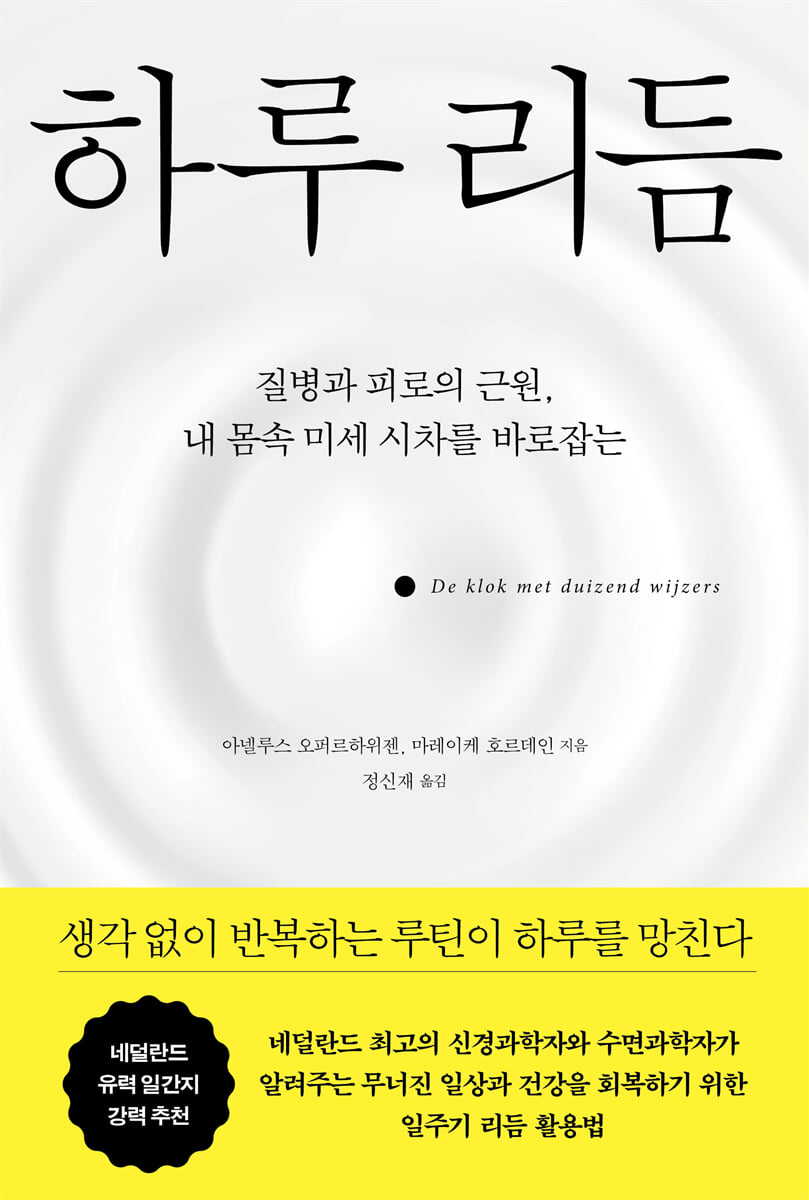
Purunsup Publishing published “Daily Rhythm,” which helps people find their own circadian rhythm and overcome fatigue and illness in daily life.
Authors studying chronobiology and sleep science say that our day, including sleep, health, exercise, and performance, is determined by our biological clock, based on the Nobel Prize-winning theory of circadian rhythms.
This means that when you sleep, when you perform best, when you feel hungry and when your body can best process food are all determined by your biological clock.
Therefore, it is argued that if you can know your own biological clock, you can live a healthier and more fulfilling life.
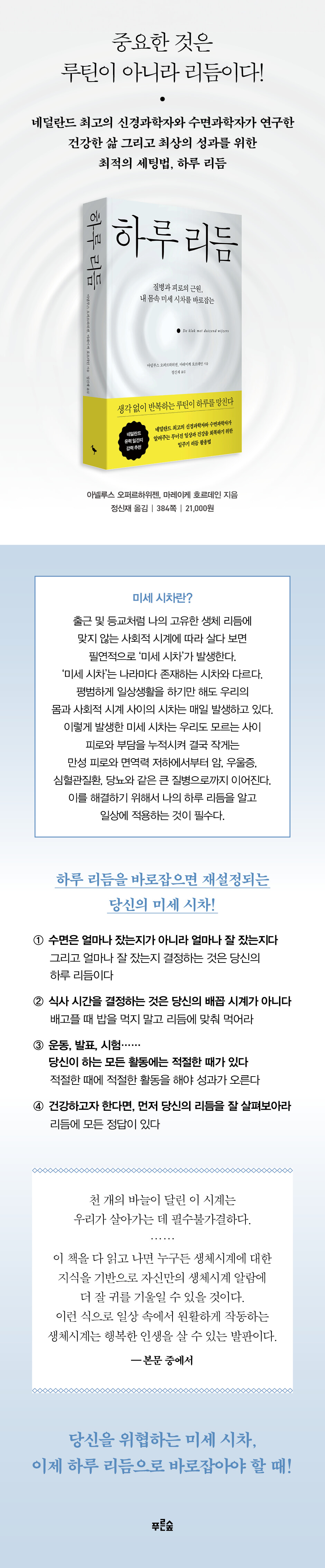
And this biological clock is like a 'clock with a thousand hands'.
This is because our brain has a 'master clock' and the organs and cells throughout our body also have small clocks that create biological rhythms.
The authors show how to use these sophisticated and complex clocks to restore health and improve performance.
In modern society, there are many reasons why our biological rhythms differ from our actual lives, such as working nights, commuting to and from work, or using artificial light late at night.
However, in order to live a healthy life, it is important to maintain lifestyle habits that are in line with the rhythm of the biological clock.
If your health has deteriorated, you can recover your health by resetting your biological rhythm and biological clock.
This book explains where our internal biological clocks come from and how our daily lives disrupt them.
It shows scenes where circadian rhythms are disrupted throughout the day, explains how the circadian clock affects our daily lives, and provides examples and methods for a healthier life.
In particular, it presents the role of the biological clock in each area, such as sleep, exercise, eating, and disease.
In particular, it details how the misalignment between the biological clock and daily routine affects health, providing readers who want to know more about the relationship between the biological clock and health with specific methods and information on what to do for their health and performance.
One of the key concepts is the concept of ‘social jet lag (micro-jet lag)’.
For example, it explains the impact of the lifestyle habit of most modern people, which is to make up for the lack of sleep during the week by sleeping in on the weekends.
It also addresses the health problems faced by night shift workers and provides tips for living a healthier life without experiencing circadian syndrome.
If you can read your internal clock, you can regain lost health and achieve lost accomplishments.
Now is the time to listen to the alarms your own biological clock sends!
A joint study by the Netherlands' leading neuroscientists and chronobiologists!
The health keyword that first drew attention from the Nobel Prize in Medicine, 'circadian rhythm'
Uncover the secrets that will transform your life and health.
Purunsup Publishing published “Daily Rhythm,” which helps people find their own circadian rhythm and overcome fatigue and illness in daily life.
Authors studying chronobiology and sleep science say that our day, including sleep, health, exercise, and performance, is determined by our biological clock, based on the Nobel Prize-winning theory of circadian rhythms.
This means that when you sleep, when you perform best, when you feel hungry and when your body can best process food are all determined by your biological clock.
Therefore, it is argued that if you can know your own biological clock, you can live a healthier and more fulfilling life.
And this biological clock is like a 'clock with a thousand hands'.
This is because our brain has a 'master clock' and the organs and cells throughout our body also have small clocks that create biological rhythms.
The authors show how to use these sophisticated and complex clocks to restore health and improve performance.
In modern society, there are many reasons why our biological rhythms differ from our actual lives, such as working nights, commuting to and from work, or using artificial light late at night.
However, in order to live a healthy life, it is important to maintain lifestyle habits that are in line with the rhythm of the biological clock.
If your health has deteriorated, you can recover your health by resetting your biological rhythm and biological clock.
This book explains where our internal biological clocks come from and how our daily lives disrupt them.
It shows scenes where circadian rhythms are disrupted throughout the day, explains how the circadian clock affects our daily lives, and provides examples and methods for a healthier life.
In particular, it presents the role of the biological clock in each area, such as sleep, exercise, eating, and disease.
In particular, it details how the misalignment between the biological clock and daily routine affects health, providing readers who want to know more about the relationship between the biological clock and health with specific methods and information on what to do for their health and performance.
One of the key concepts is the concept of ‘social jet lag (micro-jet lag)’.
For example, it explains the impact of the lifestyle habit of most modern people, which is to make up for the lack of sleep during the week by sleeping in on the weekends.
It also addresses the health problems faced by night shift workers and provides tips for living a healthier life without experiencing circadian syndrome.
If you can read your internal clock, you can regain lost health and achieve lost accomplishments.
Now is the time to listen to the alarms your own biological clock sends!
- You can preview some of the book's contents.
Preview
index
Introduction: Morning People and Night People
The biological clock with the alarm turned off
How to adjust your biological clock
Listen to your biological clock
Nobel Prize-winning chronobiologists
A clock with a thousand hands
Part 1: All About Your Biological Clock
biological time
From blue-green algae to humans
Mimosas have rhythm too
cave experiment
How does the biological clock work?
Where the biological clock is
The suprachiasmatic nucleus, the conductor of biological rhythms
Find the clock gene
Why a watch?
Set the clock
Inaccuracy and synchronization
Morning sunlight setting the clock
Rhythm not influenced by light
What good light has
Zeitgeber
Part 2: A Perfect Day
AM0:00 - 6:00 Sleep
Sleep is not a black box.
Deep sleep is not good
Optimal sleep time
Day and night of the biological clock
The correlation between melatonin and cortisol
What is a 'normal' sleep pattern?
owl or early bird
The Wisdom of Camping
Naps, siestas, and power naps
Rules for Healthy Sleep
Tips for a good night's sleep
6:00 AM - 12:00 PM Meal
The four stages of energy metabolism
Hunger felt by the brain
Peripheral clocks within the organs
Hormonal rhythms throughout the day
craving for a late-night snack
24-hour rhythm of the gut microbiota
Meal Times for Weight Loss
Why You Should Cut Down on Dinner
Eat less when you eat breakfast
Breakfast and dinner meals
Breakfast in a bright place
Intermittent fasting using the biological clock
Tips for a Healthy Eating Clock
PM12:00 - 18:00 Performance
Run in the evening rather than in the morning
The correlation between medals and biological clocks
Work during the day, exercise in the evening
The Best Exercise Schedule for Your Health
Adapt to the optimal exercise time
The Trap of the 'Wrong' Time Zone
Biorhythms of fine motor skills
The brain rhythm that produces results
Feeling your biological clock
The time when you achieve your best academic performance
The biological clock that causes morning blues
Using circadian rhythms at work
Eventually, an accident occurs
Tips for achieving peak performance
PM6:00 PM - 12:00 AM Disease and Health
The rhythm of the immune system
A feverish night
Respiratory Health in the Midnight
midnight allergies
Get vaccinated in the morning!
Wound care and sunbathing in the morning too!
Visit the dentist in the afternoon!
Heart attack in the morning
I'm scared of the night
Circadian rhythms that regulate pain
Health Tips Using Your Biological Clock
Part 3: Circadian Syndrome
unsynchronized clocks
jet lag syndrome
Why is jet lag so hard to adjust to?
Adjusting Your Body Clock While Traveling
Pre-flight acclimatization period
Will melatonin help?
Monday blues is also jet lag.
Preventing Social Jet Lag
Things to do after vacation
Tips for Overcoming Jet Lag
Daylight saving time
12 o'clock, not actually 12 o'clock
Sleep according to the sundial
The problem that only takes an hour
Is it summer time or winter time?
Tips for Coping When Your Circadian Rhythm Changes
night shift
A Look Inside the Night Shift
The occurrence of extreme discrepancies
How to minimize circadian rhythm misalignment
Adjusting Your Circadian Rhythm: Should You Do It or Not?
Shift work order and biological rhythms
Light of the Night
The Best Sleep Method for Night Shift Workers
Midnight Power Nap
Sleeping while the world is awake
Night shift workers' diet and exercise
Tips for Coping with Night Shifts
Circadian rhythm sleep-wake disorder
Repeated oversleeping
Treating DSPD
If a day had 23 hours
Sometimes morning type, sometimes evening type
Why Nursing Homes Need to Be Bright
Tips for Sleep-Wake Rhythm Disorders
Growth and Aging of the Biological Clock
Fetal biological clock
Baby's biological clock
Birds that wake up in the morning
Lazy teenagers?
Finally becoming an adult
The biological clock entering retirement
Differences in the biological clocks of women and men
Slow Aging of the Biological Clock and Parenting Tips
Biological Clock and Disease
Correlation with cancer
How to Prevent Cancer with a Balanced Rhythm
The Impact of Your Biological Clock on Mental Health
Autism Spectrum and ADHD
melancholia
Anxiety disorders and schizophrenia
Neurological diseases such as Alzheimer's and Parkinson's disease
stress
circadian stress
But what time is my biological clock now?
Conclusion
Acknowledgements
References
The biological clock with the alarm turned off
How to adjust your biological clock
Listen to your biological clock
Nobel Prize-winning chronobiologists
A clock with a thousand hands
Part 1: All About Your Biological Clock
biological time
From blue-green algae to humans
Mimosas have rhythm too
cave experiment
How does the biological clock work?
Where the biological clock is
The suprachiasmatic nucleus, the conductor of biological rhythms
Find the clock gene
Why a watch?
Set the clock
Inaccuracy and synchronization
Morning sunlight setting the clock
Rhythm not influenced by light
What good light has
Zeitgeber
Part 2: A Perfect Day
AM0:00 - 6:00 Sleep
Sleep is not a black box.
Deep sleep is not good
Optimal sleep time
Day and night of the biological clock
The correlation between melatonin and cortisol
What is a 'normal' sleep pattern?
owl or early bird
The Wisdom of Camping
Naps, siestas, and power naps
Rules for Healthy Sleep
Tips for a good night's sleep
6:00 AM - 12:00 PM Meal
The four stages of energy metabolism
Hunger felt by the brain
Peripheral clocks within the organs
Hormonal rhythms throughout the day
craving for a late-night snack
24-hour rhythm of the gut microbiota
Meal Times for Weight Loss
Why You Should Cut Down on Dinner
Eat less when you eat breakfast
Breakfast and dinner meals
Breakfast in a bright place
Intermittent fasting using the biological clock
Tips for a Healthy Eating Clock
PM12:00 - 18:00 Performance
Run in the evening rather than in the morning
The correlation between medals and biological clocks
Work during the day, exercise in the evening
The Best Exercise Schedule for Your Health
Adapt to the optimal exercise time
The Trap of the 'Wrong' Time Zone
Biorhythms of fine motor skills
The brain rhythm that produces results
Feeling your biological clock
The time when you achieve your best academic performance
The biological clock that causes morning blues
Using circadian rhythms at work
Eventually, an accident occurs
Tips for achieving peak performance
PM6:00 PM - 12:00 AM Disease and Health
The rhythm of the immune system
A feverish night
Respiratory Health in the Midnight
midnight allergies
Get vaccinated in the morning!
Wound care and sunbathing in the morning too!
Visit the dentist in the afternoon!
Heart attack in the morning
I'm scared of the night
Circadian rhythms that regulate pain
Health Tips Using Your Biological Clock
Part 3: Circadian Syndrome
unsynchronized clocks
jet lag syndrome
Why is jet lag so hard to adjust to?
Adjusting Your Body Clock While Traveling
Pre-flight acclimatization period
Will melatonin help?
Monday blues is also jet lag.
Preventing Social Jet Lag
Things to do after vacation
Tips for Overcoming Jet Lag
Daylight saving time
12 o'clock, not actually 12 o'clock
Sleep according to the sundial
The problem that only takes an hour
Is it summer time or winter time?
Tips for Coping When Your Circadian Rhythm Changes
night shift
A Look Inside the Night Shift
The occurrence of extreme discrepancies
How to minimize circadian rhythm misalignment
Adjusting Your Circadian Rhythm: Should You Do It or Not?
Shift work order and biological rhythms
Light of the Night
The Best Sleep Method for Night Shift Workers
Midnight Power Nap
Sleeping while the world is awake
Night shift workers' diet and exercise
Tips for Coping with Night Shifts
Circadian rhythm sleep-wake disorder
Repeated oversleeping
Treating DSPD
If a day had 23 hours
Sometimes morning type, sometimes evening type
Why Nursing Homes Need to Be Bright
Tips for Sleep-Wake Rhythm Disorders
Growth and Aging of the Biological Clock
Fetal biological clock
Baby's biological clock
Birds that wake up in the morning
Lazy teenagers?
Finally becoming an adult
The biological clock entering retirement
Differences in the biological clocks of women and men
Slow Aging of the Biological Clock and Parenting Tips
Biological Clock and Disease
Correlation with cancer
How to Prevent Cancer with a Balanced Rhythm
The Impact of Your Biological Clock on Mental Health
Autism Spectrum and ADHD
melancholia
Anxiety disorders and schizophrenia
Neurological diseases such as Alzheimer's and Parkinson's disease
stress
circadian stress
But what time is my biological clock now?
Conclusion
Acknowledgements
References
Detailed image
Into the book
This clock with a thousand hands is essential to our lives.
Of course, the clock doesn't always work properly and can be very out of sync at some points.
Even so, it doesn't mean it's completely broken.
After reading this book, anyone with a knowledge of the biological clock will be able to better listen to their own biological clock alarms.
A biological clock that operates smoothly in daily life in this way is the foundation for living a happy life.
--- p.14 From “Introductory Remarks”
In this way, the biological clock is an inseparable part of living organisms and is very important for both survival and life success.
Therefore, there are plenty of reasons to know how the biological clock works.
--- p.28 From “Biological Time”
Following a single rhythm throughout the day has clear benefits for both plants and animals.
The harmony of these rhythms is ultimately essential for the survival of all species!
--- pp.33-34 From “Mimosa Has Rhythm Too”
Clocks located throughout our body direct the functioning of our organs according to circadian rhythms.
This is the basis of all rhythms that create the human body and all its actions.
Our bodies function thanks to the thousands, even tens of thousands, of clocks within them, and if these clocks are out of sync with each other, our bodies can get a little chaotic.
Of course, there is a solution to govern all these clocks.
--- p.44 From “The conductor of biological rhythms, the suprachiasmatic nucleus”
It is very important to synchronize our body's biological clock with the time of the outside world.
This is because it allows our bodies to adapt perfectly to predictable changes.
For example, waking up from sleep, digesting food properly during meal times, and ensuring that the brain and muscles perform optimally when thinking or moving.
This way, we can do the right things at the right times, which not only keeps us healthy but also gives us a better chance of success.
--- p.56 From “Inaccuracy and Synchronization”
If you get enough light during the day, you can fall asleep naturally at night without suffering from insomnia.
It is very important to be aware of the impact light has on our biological clock and our sleep.
Here, good quality light means light that satisfies brightness, color, and timing.
--- p.66 From “What Good Light Has”
As you pay off your sleep debt, the lighter sleep of non-REM sleep follows.
This first process is called 'sleep debt' or 'process S', an acronym for 'sleep need'.
The second process is called 'Process C', taking the first letters of 'cycle'.
And this process is controlled by the biological clock.
Your body clock determines the optimal time to go to sleep and wake up in a 24-hour cycle.
--- p.95 From “Optimal Sleep Time”
In humans, there is a circadian rhythm in insulin, cortisol, and blood sugar.
For example, every morning, just before we wake up, our bodies experience a rise in cortisol and blood sugar levels.
This happens even before breakfast, due to the influence of the biological clock.
--- p.128 From “Hormonal Rhythms Throughout the Day”
However, there are research results that show that exercising in the evening increases free fatty acid in the blood, which is evidence that fat burning occurs.
The tricky thing is that fat burning is linked to nutrition.
--- p.164 From “The Optimal Exercise Schedule for Health”
High blood pressure is a risk factor that can lead to several serious diseases.
Stroke, including cerebral hemorrhage and cerebral infarction, and heart attack are caused by high blood pressure.
Of course, other factors are at play, but often the combination of changes in blood pressure due to the body's biological clock and morning activity is the final "hit" that actually causes a heart attack.
--- p.206 From “Heart Attack in the Morning”
Social jet lag occurs practically twice a week.
When Saturday comes, we start to gradually turn back the clock, and when Monday comes, we suddenly pull it forward.
In many cases, especially for young people or students who are true night owls, time tolerance varies from person to person.
… … This puts a heavy burden on the biological clock and affects health.
--- p.236 From “Monday blues is also jet lag”
If you've already worked an all-nighter, meaning you need to sleep during breaks between shifts, it might be more convenient to split your sleep into a few hours in the morning and a few hours in the evening.
This way, you will have less sleep inertia when you wake up and will be able to stay awake relatively more easily at night.
--- p.278 From “The Best Sleep Method for Night Workers”
Considering all the information previously mentioned about the correlation between circadian rhythms and tumor growth, it is likely that maintaining a good rhythm can be very helpful in slowing the growth of (certain types of) cancer.
Additionally, some cancers are treated using fasting therapy.
The stronger the circadian rhythm, the more effective cancer treatments such as chemotherapy are, as the strong rhythm of clock genes and clock proteins helps attack cancer cells.
Of course, the clock doesn't always work properly and can be very out of sync at some points.
Even so, it doesn't mean it's completely broken.
After reading this book, anyone with a knowledge of the biological clock will be able to better listen to their own biological clock alarms.
A biological clock that operates smoothly in daily life in this way is the foundation for living a happy life.
--- p.14 From “Introductory Remarks”
In this way, the biological clock is an inseparable part of living organisms and is very important for both survival and life success.
Therefore, there are plenty of reasons to know how the biological clock works.
--- p.28 From “Biological Time”
Following a single rhythm throughout the day has clear benefits for both plants and animals.
The harmony of these rhythms is ultimately essential for the survival of all species!
--- pp.33-34 From “Mimosa Has Rhythm Too”
Clocks located throughout our body direct the functioning of our organs according to circadian rhythms.
This is the basis of all rhythms that create the human body and all its actions.
Our bodies function thanks to the thousands, even tens of thousands, of clocks within them, and if these clocks are out of sync with each other, our bodies can get a little chaotic.
Of course, there is a solution to govern all these clocks.
--- p.44 From “The conductor of biological rhythms, the suprachiasmatic nucleus”
It is very important to synchronize our body's biological clock with the time of the outside world.
This is because it allows our bodies to adapt perfectly to predictable changes.
For example, waking up from sleep, digesting food properly during meal times, and ensuring that the brain and muscles perform optimally when thinking or moving.
This way, we can do the right things at the right times, which not only keeps us healthy but also gives us a better chance of success.
--- p.56 From “Inaccuracy and Synchronization”
If you get enough light during the day, you can fall asleep naturally at night without suffering from insomnia.
It is very important to be aware of the impact light has on our biological clock and our sleep.
Here, good quality light means light that satisfies brightness, color, and timing.
--- p.66 From “What Good Light Has”
As you pay off your sleep debt, the lighter sleep of non-REM sleep follows.
This first process is called 'sleep debt' or 'process S', an acronym for 'sleep need'.
The second process is called 'Process C', taking the first letters of 'cycle'.
And this process is controlled by the biological clock.
Your body clock determines the optimal time to go to sleep and wake up in a 24-hour cycle.
--- p.95 From “Optimal Sleep Time”
In humans, there is a circadian rhythm in insulin, cortisol, and blood sugar.
For example, every morning, just before we wake up, our bodies experience a rise in cortisol and blood sugar levels.
This happens even before breakfast, due to the influence of the biological clock.
--- p.128 From “Hormonal Rhythms Throughout the Day”
However, there are research results that show that exercising in the evening increases free fatty acid in the blood, which is evidence that fat burning occurs.
The tricky thing is that fat burning is linked to nutrition.
--- p.164 From “The Optimal Exercise Schedule for Health”
High blood pressure is a risk factor that can lead to several serious diseases.
Stroke, including cerebral hemorrhage and cerebral infarction, and heart attack are caused by high blood pressure.
Of course, other factors are at play, but often the combination of changes in blood pressure due to the body's biological clock and morning activity is the final "hit" that actually causes a heart attack.
--- p.206 From “Heart Attack in the Morning”
Social jet lag occurs practically twice a week.
When Saturday comes, we start to gradually turn back the clock, and when Monday comes, we suddenly pull it forward.
In many cases, especially for young people or students who are true night owls, time tolerance varies from person to person.
… … This puts a heavy burden on the biological clock and affects health.
--- p.236 From “Monday blues is also jet lag”
If you've already worked an all-nighter, meaning you need to sleep during breaks between shifts, it might be more convenient to split your sleep into a few hours in the morning and a few hours in the evening.
This way, you will have less sleep inertia when you wake up and will be able to stay awake relatively more easily at night.
--- p.278 From “The Best Sleep Method for Night Workers”
Considering all the information previously mentioned about the correlation between circadian rhythms and tumor growth, it is likely that maintaining a good rhythm can be very helpful in slowing the growth of (certain types of) cancer.
Additionally, some cancers are treated using fasting therapy.
The stronger the circadian rhythm, the more effective cancer treatments such as chemotherapy are, as the strong rhythm of clock genes and clock proteins helps attack cancer cells.
--- p.341 From “How to Prevent Cancer with a Balanced Rhythm”
Publisher's Review
Circadian rhythm and biological clock,
Beyond a mere trend, it has become a steady keyword for health.
Recently, a new term called “chrono walking”, coined by British journalist Ellen Scott, has become popular in Australia.
According to one article, “Chronoworking, which allows workers to choose their own work hours when they are most productive rather than working at fixed hours set by the company,” “has seen a 600% increase in Google searches this year compared to the previous year.”
This means that many people agree on the benefits of working according to their own circadian rhythm.
This isn't just a story limited to the workplace.
Interest in daily routines tailored to an individual's biological clock is growing worldwide.
In this way, topics related to circadian rhythms and biological clocks have been receiving more attention recently.
In 2017, three American scientists won the Nobel Prize in Medicine for their work on chronobiology.
The Nobel Committee emphasized the importance of the biological clock, stating that their discovery explains why the Earth's rotation and the unique biological rhythms of living things are synchronized.
A YouTube video discussing the biological clock has been viewed 1.39 million times, proving just how much interest people have in circadian rhythms.
This reveals the public's desire to know more specific and substantive information than simply going to bed early and waking up early to relieve fatigue.
This is because the demand for wellness information, including 'slow aging', has rapidly increased, and the number of people trying to take care of their health in their daily lives has increased significantly.
The beauty of circadian rhythms is that you don't have to spend a lot of money on health; you can achieve big results just by changing small habits in your daily life.
The authors of this book also say that “because the biological clock is connected to everything,” “no matter what you study or do, you will find that the results are different in the morning, afternoon, evening, or night.”
In this way, all of our future activities will have to be interpreted from the perspective of the biological clock.
Morning and evening runs
What would be better?
Is there really a correlation between specific periods and health? Our bodies are maintained in accordance with specific cycles.
We all know that certain times of day are linked to certain bodily reactions, such as a high fever at night or worsening allergies.
But this is only a glimpse.
Because we are governed by our biological clocks in more ways than one.
Our body is like a giant clock with a thousand hands, made up of organs that move according to their own time zones.
From the perspective that the movements of these organs have a rhythm, it becomes clear that solving problems our bodies face and achieving better performance ultimately depends on our "daily rhythm."
The same goes for exercise, including running.
According to this book, our bodies are influenced by a biological clock, so there are specific times when we can function optimally.
“Because if it is not the right time for your biological clock, you cannot function properly and achieve results.”
Oxygen, energy, body temperature, hormones, and mitochondria, which play a role in muscle function, have a rhythm that peaks and troughs in a 24-hour cycle.
Therefore, the time when muscle activity is optimized and reaches its peak is already set.
Studies show that most people find that the late afternoon is a good time to activate their muscles.
For example, in tennis, serve speed is higher in the early evening (6 p.m.) than in the morning (9 a.m.).
But in the morning, the accuracy is higher.
In the evening, you may hit the ball harder, but the tennis ball or shuttlecock may bounce faster.
One sport that prioritizes accuracy over strength or reaction time is archery, and in this sport, late morning is much better than evening.
From morning fatigue to incurable diseases,
"Daily Rhythm": Solving the Problems Caused by "Microjet Disparity"
《Daily Rhythm》 is a book written by leading Dutch scientists to explain the results of their joint research on biological clocks to the general public.
First, we will introduce the scientific research results on the biological clock, and then we will examine how the biological clock actually works by following the daily trajectory of life.
In the process, we comprehensively examine the various health and work-related problems caused by 'jet lag', which occurs when the body's biological clock is out of sync with the external time.
Using rich, specific medical research and clinical examples, it demonstrates that these problems are not simply day-to-day disruptions, but rather macroscopic, life-long issues.
For example, if you go to bed late, it is natural to wake up late the next day.
This problem doesn't stop with oversleeping that day, but accumulates into 'micro-jet lag', pushing back the time of going to bed.
If that happens, our rhythm will be disrupted, and we will inevitably experience fatigue and health problems.
This book suggests solutions such as synchronizing your body clock by getting as much natural light as possible in the morning to adjust your sleep schedule.
Alternatively, if you work night shifts, it's suggested that taking "power naps," short naps that don't affect your circadian rhythm, can also help maintain your sleep rhythm.
'Social jet lag' is an inevitable occurrence every day.
Unlike the time difference that occurs when traveling abroad, the authors' argument throughout this book is that although there is only a 'few minutes' difference between our daily routines and our biological clocks, if this accumulates, it can ultimately have a significant impact on our health and daily lives.
And to solve this, we present specific solutions that can be applied directly to everyday life.
In particular, in parts 2 and 3, which talk about how to utilize your biological clock depending on the time zone and situation, “Tips for utilizing your biological clock” is included as a separate page at the end of each chapter to emphasize the solution once more so that you can intuitively check it.
The clocks inside my body come together to form the rhythm that makes up my day.
If you follow this 'daily rhythm' well, you will be able to naturally reduce 'micro-jet lag' and lead a healthier and more energetic daily life.
Beyond a mere trend, it has become a steady keyword for health.
Recently, a new term called “chrono walking”, coined by British journalist Ellen Scott, has become popular in Australia.
According to one article, “Chronoworking, which allows workers to choose their own work hours when they are most productive rather than working at fixed hours set by the company,” “has seen a 600% increase in Google searches this year compared to the previous year.”
This means that many people agree on the benefits of working according to their own circadian rhythm.
This isn't just a story limited to the workplace.
Interest in daily routines tailored to an individual's biological clock is growing worldwide.
In this way, topics related to circadian rhythms and biological clocks have been receiving more attention recently.
In 2017, three American scientists won the Nobel Prize in Medicine for their work on chronobiology.
The Nobel Committee emphasized the importance of the biological clock, stating that their discovery explains why the Earth's rotation and the unique biological rhythms of living things are synchronized.
A YouTube video discussing the biological clock has been viewed 1.39 million times, proving just how much interest people have in circadian rhythms.
This reveals the public's desire to know more specific and substantive information than simply going to bed early and waking up early to relieve fatigue.
This is because the demand for wellness information, including 'slow aging', has rapidly increased, and the number of people trying to take care of their health in their daily lives has increased significantly.
The beauty of circadian rhythms is that you don't have to spend a lot of money on health; you can achieve big results just by changing small habits in your daily life.
The authors of this book also say that “because the biological clock is connected to everything,” “no matter what you study or do, you will find that the results are different in the morning, afternoon, evening, or night.”
In this way, all of our future activities will have to be interpreted from the perspective of the biological clock.
Morning and evening runs
What would be better?
Is there really a correlation between specific periods and health? Our bodies are maintained in accordance with specific cycles.
We all know that certain times of day are linked to certain bodily reactions, such as a high fever at night or worsening allergies.
But this is only a glimpse.
Because we are governed by our biological clocks in more ways than one.
Our body is like a giant clock with a thousand hands, made up of organs that move according to their own time zones.
From the perspective that the movements of these organs have a rhythm, it becomes clear that solving problems our bodies face and achieving better performance ultimately depends on our "daily rhythm."
The same goes for exercise, including running.
According to this book, our bodies are influenced by a biological clock, so there are specific times when we can function optimally.
“Because if it is not the right time for your biological clock, you cannot function properly and achieve results.”
Oxygen, energy, body temperature, hormones, and mitochondria, which play a role in muscle function, have a rhythm that peaks and troughs in a 24-hour cycle.
Therefore, the time when muscle activity is optimized and reaches its peak is already set.
Studies show that most people find that the late afternoon is a good time to activate their muscles.
For example, in tennis, serve speed is higher in the early evening (6 p.m.) than in the morning (9 a.m.).
But in the morning, the accuracy is higher.
In the evening, you may hit the ball harder, but the tennis ball or shuttlecock may bounce faster.
One sport that prioritizes accuracy over strength or reaction time is archery, and in this sport, late morning is much better than evening.
From morning fatigue to incurable diseases,
"Daily Rhythm": Solving the Problems Caused by "Microjet Disparity"
《Daily Rhythm》 is a book written by leading Dutch scientists to explain the results of their joint research on biological clocks to the general public.
First, we will introduce the scientific research results on the biological clock, and then we will examine how the biological clock actually works by following the daily trajectory of life.
In the process, we comprehensively examine the various health and work-related problems caused by 'jet lag', which occurs when the body's biological clock is out of sync with the external time.
Using rich, specific medical research and clinical examples, it demonstrates that these problems are not simply day-to-day disruptions, but rather macroscopic, life-long issues.
For example, if you go to bed late, it is natural to wake up late the next day.
This problem doesn't stop with oversleeping that day, but accumulates into 'micro-jet lag', pushing back the time of going to bed.
If that happens, our rhythm will be disrupted, and we will inevitably experience fatigue and health problems.
This book suggests solutions such as synchronizing your body clock by getting as much natural light as possible in the morning to adjust your sleep schedule.
Alternatively, if you work night shifts, it's suggested that taking "power naps," short naps that don't affect your circadian rhythm, can also help maintain your sleep rhythm.
'Social jet lag' is an inevitable occurrence every day.
Unlike the time difference that occurs when traveling abroad, the authors' argument throughout this book is that although there is only a 'few minutes' difference between our daily routines and our biological clocks, if this accumulates, it can ultimately have a significant impact on our health and daily lives.
And to solve this, we present specific solutions that can be applied directly to everyday life.
In particular, in parts 2 and 3, which talk about how to utilize your biological clock depending on the time zone and situation, “Tips for utilizing your biological clock” is included as a separate page at the end of each chapter to emphasize the solution once more so that you can intuitively check it.
The clocks inside my body come together to form the rhythm that makes up my day.
If you follow this 'daily rhythm' well, you will be able to naturally reduce 'micro-jet lag' and lead a healthier and more energetic daily life.
GOODS SPECIFICS
- Date of issue: October 27, 2025
- Page count, weight, size: 384 pages | 596g | 145*215*26mm
- ISBN13: 9791172540791
You may also like
카테고리
korean


korean

![ELLE 엘르 스페셜 에디션 A형 : 12월 [2025]](http://librairie.coreenne.fr/cdn/shop/files/b8e27a3de6c9538896439686c6b0e8fb.jpg?v=1766436872&width=3840)


