

I hope only good things happen to you while you live.
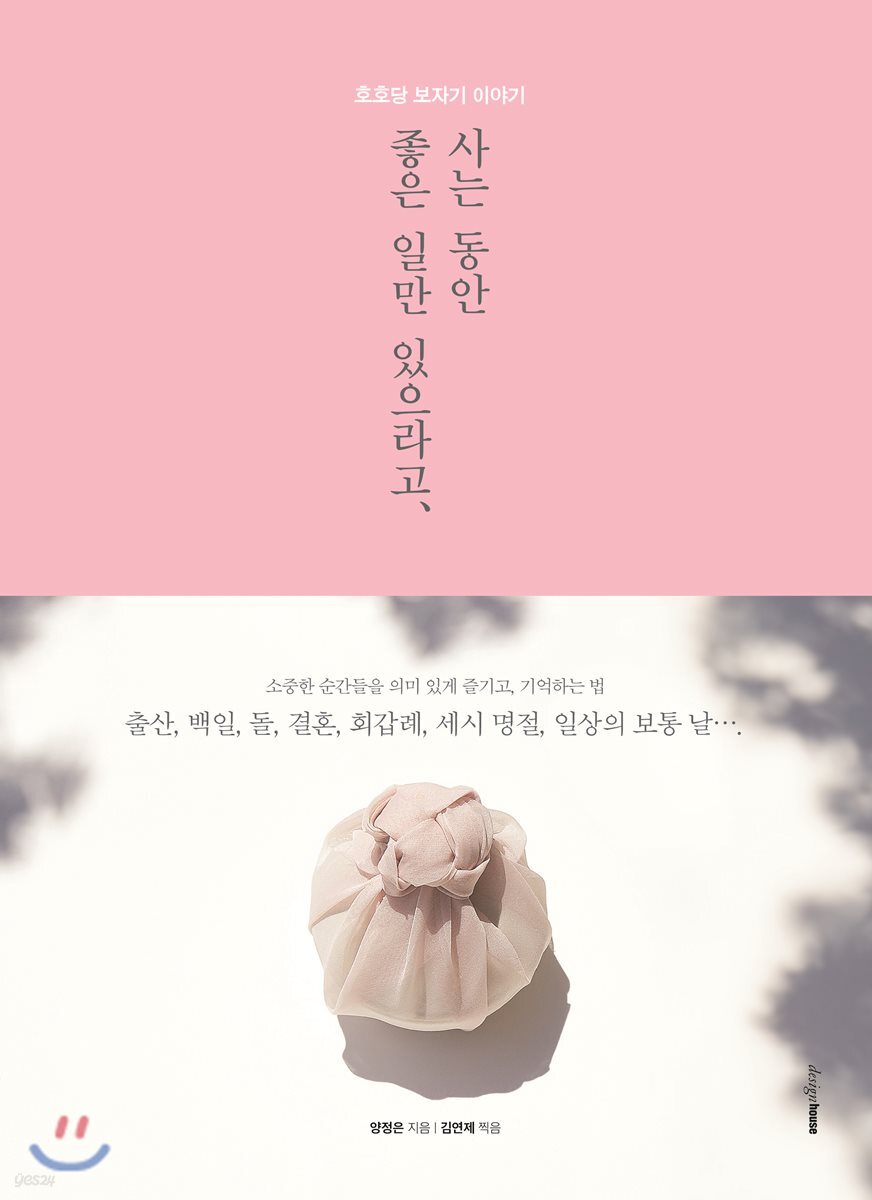 |
Description
Book Introduction
New Family Ritual Guidelines for the 21st Century
She gives birth to a child, holds it in her chest, feeds it with her milk, and raises it by rubbing her flesh against it.
The child celebrates his 100th day and first birthday, and runs around with a precocious gait, growing in wisdom and playfulness… .
You become an adult while fighting an invisible battle with your mom and dad, and you get married through many coincidences and fate.
That child grows older and gives birth to and raises another child.
In these ordinary days that continue at every turn of life, there are ‘our good days.’
The moment of 'birth' when life separates from the mother's body and comes into the world, the 'dol' feast day to celebrate having passed the four seasons without incident, 'Coming of Age Day' to announce that one has finally reached the age to take responsibility for one's own life, the moment of 'marriage' to form a new family, the 'hoegap' day to turn one's life around and meet the year of one's birth again...
We call these days, when we move from one stage of life to another, rites of passage or rites of life.
This book suggests ways to commemorate, celebrate, and inform about the rites of passage in life as a Korean with sincerity and courtesy.
This is a 'lifestyle guidebook' that examines the original meaning of important days in life, such as childbirth, 100th day, first birthday, ceremonies, coming-of-age ceremonies, weddings, 60th birthdays, and 60th weddings, and suggests ways to do so in a modern way.
Why is a white thread hung on a baby's diadem? Why is the first outfit worn by a newborn always white? How is the gold string decoration, comparable to a Western-style garland or mobile, prepared? Why is it best to serve rice and seaweed soup to baby shower guests?
Even with just one birth ceremony, it conveys the 'true' meaning contained within it, suggests ways to properly commemorate it, and even shows ways to share that happy moment.
This is literally a 'New Family Etiquette Guidelines' that every 21st century Korean must have in their home.
She gives birth to a child, holds it in her chest, feeds it with her milk, and raises it by rubbing her flesh against it.
The child celebrates his 100th day and first birthday, and runs around with a precocious gait, growing in wisdom and playfulness… .
You become an adult while fighting an invisible battle with your mom and dad, and you get married through many coincidences and fate.
That child grows older and gives birth to and raises another child.
In these ordinary days that continue at every turn of life, there are ‘our good days.’
The moment of 'birth' when life separates from the mother's body and comes into the world, the 'dol' feast day to celebrate having passed the four seasons without incident, 'Coming of Age Day' to announce that one has finally reached the age to take responsibility for one's own life, the moment of 'marriage' to form a new family, the 'hoegap' day to turn one's life around and meet the year of one's birth again...
We call these days, when we move from one stage of life to another, rites of passage or rites of life.
This book suggests ways to commemorate, celebrate, and inform about the rites of passage in life as a Korean with sincerity and courtesy.
This is a 'lifestyle guidebook' that examines the original meaning of important days in life, such as childbirth, 100th day, first birthday, ceremonies, coming-of-age ceremonies, weddings, 60th birthdays, and 60th weddings, and suggests ways to do so in a modern way.
Why is a white thread hung on a baby's diadem? Why is the first outfit worn by a newborn always white? How is the gold string decoration, comparable to a Western-style garland or mobile, prepared? Why is it best to serve rice and seaweed soup to baby shower guests?
Even with just one birth ceremony, it conveys the 'true' meaning contained within it, suggests ways to properly commemorate it, and even shows ways to share that happy moment.
This is literally a 'New Family Etiquette Guidelines' that every 21st century Korean must have in their home.
- You can preview some of the book's contents.
Preview
index
Chapter 1: Life Rites
016 Birth
030 100 days
042 stone
068 Book Precedent
078 Coming of Age Ceremony
090 Wedding
126. Sixtieth birthday and sixth wedding ceremonies
Chapter 2 Session
136 Lunar New Year
144 First full moon of the lunar year
154 Beginning of Spring
156 Dano
160 Chuseok
Comrade 166
170 New Year's Eve
Chapter 3: Everyday Gifts
180 Parents' Day, Teachers' Day
186 Gifts for Foreign Friends
192 Children's Gifts
204 Christmas
Chapter 4: May only good things happen, 好好堂
214 Hohodang
Brands with 216 Hohodang
016 Birth
030 100 days
042 stone
068 Book Precedent
078 Coming of Age Ceremony
090 Wedding
126. Sixtieth birthday and sixth wedding ceremonies
Chapter 2 Session
136 Lunar New Year
144 First full moon of the lunar year
154 Beginning of Spring
156 Dano
160 Chuseok
Comrade 166
170 New Year's Eve
Chapter 3: Everyday Gifts
180 Parents' Day, Teachers' Day
186 Gifts for Foreign Friends
192 Children's Gifts
204 Christmas
Chapter 4: May only good things happen, 好好堂
214 Hohodang
Brands with 216 Hohodang
Into the book
“I hope this book will help us remember that even a single piece of snow on a 100th day celebration has meaning, and that each gift prepared for each season has its origin.
I hope that as a Korean, you will be filled with life and have fun stories throughout the four seasons and at important moments in your life."
“The 100th day thank you rice cakes that are supposed to be shared with everyone around the child are said to bring blessings to the child, and the person who received them will never return them empty-handed.
They return the bowl that contained the rice cakes without washing it and fill it with a lot of things like rice cakes, money, and other things.
Just like the elders of old, give a bundle of yarn to a child celebrating their 100th day as a small gift.
You will be able to create an elegant look when preparing a 100th-day celebration or a dol-sang later on.
Of course, I hope the child lives a long life!”
"In fact, the brush, inkstone, and Thousand Character Classic, which are perfect for our daily lives, are already on Mom and Dad's desk.
You can just bring a fountain pen and ink, your dad's favorite book, your mom's favorite colored pencils, a record of a famous musician, or a small item made by a great designer and place it on the first birthday table.
Wouldn't it be fun for moms and dads, who are most interested and curious about their children's future, to prepare the first birthday items one by one?"
"In fact, to put it simply, the 'honsu' these days is the household goods prepared while moving to the groom's house after the wedding, and the 'yedan' these days is a gift prepared for the in-laws.
I think that this isn't just empty formalities, but rather 'etiquette' that must be observed when starting a new life."
"Just like our parents take care of our 100th day and 1st birthday celebrations, as well as our grandchildren's 100th day and 1st birthday celebrations, how about preparing 'Bangi' (food served in wooden bowls as a thank-you gift) and giving it as a gift to your parents' friends?
If you give them a small gift of sweets, rice cakes, or fruit, it will be a chance to express your gratitude to your parents' elderly friends, and your parents will also be able to have a happy and meaningful day.
I hope that as a Korean, you will be filled with life and have fun stories throughout the four seasons and at important moments in your life."
“The 100th day thank you rice cakes that are supposed to be shared with everyone around the child are said to bring blessings to the child, and the person who received them will never return them empty-handed.
They return the bowl that contained the rice cakes without washing it and fill it with a lot of things like rice cakes, money, and other things.
Just like the elders of old, give a bundle of yarn to a child celebrating their 100th day as a small gift.
You will be able to create an elegant look when preparing a 100th-day celebration or a dol-sang later on.
Of course, I hope the child lives a long life!”
"In fact, the brush, inkstone, and Thousand Character Classic, which are perfect for our daily lives, are already on Mom and Dad's desk.
You can just bring a fountain pen and ink, your dad's favorite book, your mom's favorite colored pencils, a record of a famous musician, or a small item made by a great designer and place it on the first birthday table.
Wouldn't it be fun for moms and dads, who are most interested and curious about their children's future, to prepare the first birthday items one by one?"
"In fact, to put it simply, the 'honsu' these days is the household goods prepared while moving to the groom's house after the wedding, and the 'yedan' these days is a gift prepared for the in-laws.
I think that this isn't just empty formalities, but rather 'etiquette' that must be observed when starting a new life."
"Just like our parents take care of our 100th day and 1st birthday celebrations, as well as our grandchildren's 100th day and 1st birthday celebrations, how about preparing 'Bangi' (food served in wooden bowls as a thank-you gift) and giving it as a gift to your parents' friends?
If you give them a small gift of sweets, rice cakes, or fruit, it will be a chance to express your gratitude to your parents' elderly friends, and your parents will also be able to have a happy and meaningful day.
--- From the text
Publisher's Review
Our happy day wrapped in a bojagi
This book contains essential suggestions for important ceremonies in life, such as simple yet meaningful traditional dol-sang (stone table) setting and dol-bok preparation, modern-style ceremonial methods, how to congratulate someone coming of age with a single handkerchief engraved with their name, how to prepare a chest and ye-dan while maintaining both formality and reason, and how to brighten your parents' wedding with a single return gift.
The proposal is sometimes a table setting, sometimes a creation, but mostly a wrapping method to share meaningful moments.
These are suggestions for everyday life, wrapped and unfolded in bojagi (traditional Korean wrapping cloth) by Yang Jeong-eun, CEO of Hohodang, a brand that embodies the aesthetics of everyday life in Korea.
We present a method for tying up, storing, and gifting special items with bojagi, which is a wrapping paper, a bag, a chest of drawers for storing blankets, and a protective covering to prevent breakage.
This book also contains stories of seasonal holidays that we celebrate in our own way, along with life rites.
These include stories about rice and salt, which are useful as New Year's gifts, a fancy gift of five-grain rice for the first full moon of the lunar year, decorated with paper napkins in disposable lunch boxes, and how to store hanbok for Chuseok.
Along with this, we also suggest gifts for the elderly, children, and Christmas gifts for special moments in everyday life.
At the end of each chapter, a wrapping method is also included.
This book contains essential suggestions for important ceremonies in life, such as simple yet meaningful traditional dol-sang (stone table) setting and dol-bok preparation, modern-style ceremonial methods, how to congratulate someone coming of age with a single handkerchief engraved with their name, how to prepare a chest and ye-dan while maintaining both formality and reason, and how to brighten your parents' wedding with a single return gift.
The proposal is sometimes a table setting, sometimes a creation, but mostly a wrapping method to share meaningful moments.
These are suggestions for everyday life, wrapped and unfolded in bojagi (traditional Korean wrapping cloth) by Yang Jeong-eun, CEO of Hohodang, a brand that embodies the aesthetics of everyday life in Korea.
We present a method for tying up, storing, and gifting special items with bojagi, which is a wrapping paper, a bag, a chest of drawers for storing blankets, and a protective covering to prevent breakage.
This book also contains stories of seasonal holidays that we celebrate in our own way, along with life rites.
These include stories about rice and salt, which are useful as New Year's gifts, a fancy gift of five-grain rice for the first full moon of the lunar year, decorated with paper napkins in disposable lunch boxes, and how to store hanbok for Chuseok.
Along with this, we also suggest gifts for the elderly, children, and Christmas gifts for special moments in everyday life.
At the end of each chapter, a wrapping method is also included.
GOODS SPECIFICS
- Date of issue: July 6, 2018
- Format: Hardcover book binding method guide
- Page count, weight, size: 224 pages | 885g | 198*255*20mm
- ISBN13: 9788970417240
- ISBN10: 8970417249
You may also like
카테고리
korean


korean

![GQ KOREA Mark (Monthly): December [2025]](http://librairie.coreenne.fr/cdn/shop/files/8ef265dbbfbf186523ed75ba7319009d.jpg?v=1765340328&width=3840)


