

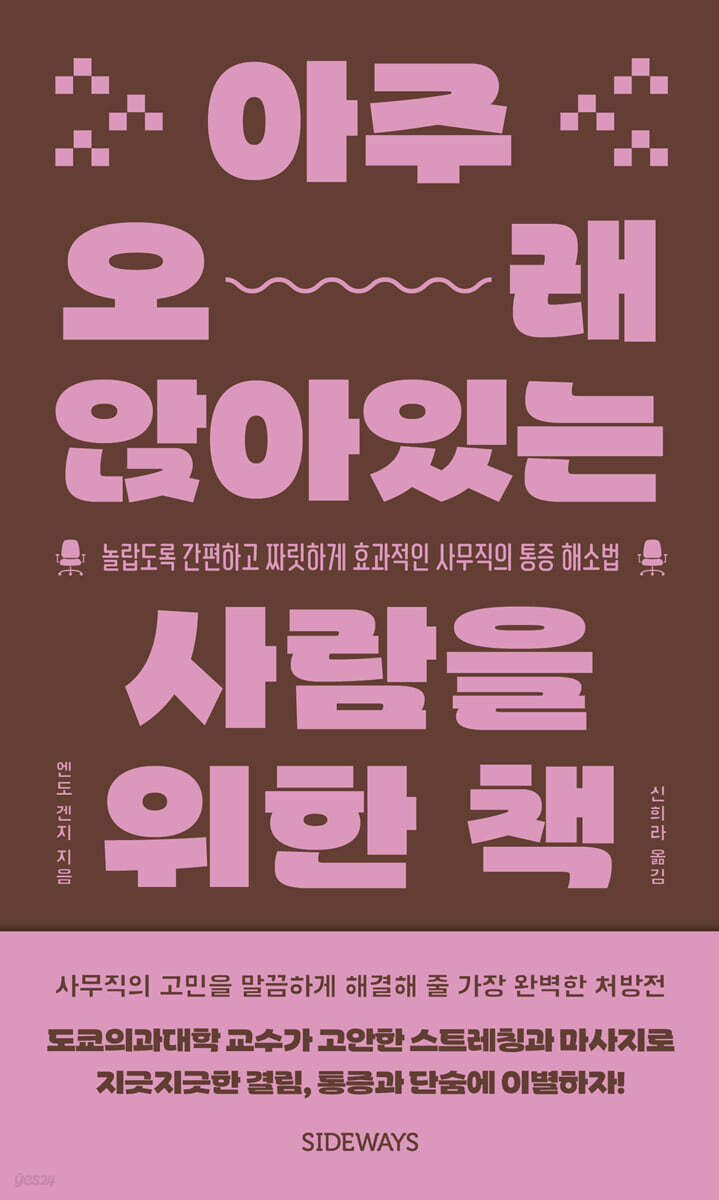
A book for people who sit for very long periods of time
 |
Description
Book Introduction
- A word from MD
-
Say goodbye to stiffness and pain!A prescription to relieve stiffness and pain from prolonged sitting at an office job.
You can say goodbye to that nagging pain with just simple stretching, massage, and posture correction.
Let's lighten both your body and mind with these 5-minute stretches that can be done without any special equipment or space.
November 14, 2025. Health and Hobbies by PD Hyunjae Ahn
Endless stamina, increased concentration, and restful sleep…
When your neck and shoulders are relaxed, everything changes!
The perfect prescription to completely solve office workers' worries.
Stretching and massage designed by a professor at Tokyo Medical University
Say goodbye to the constant stiffness and pain in one breath!
My shoulders are stiff and it's hard to sit at my desk, I'm tired no matter how much I sleep, my mind is unstable and I'm always listless, my concentration and memory are getting worse...
Any office worker who sits at a desk all day will have these concerns.
Rubbing my stiff neck and patting my shoulders only provides temporary relief, and my fatigue doesn't go away.
Many office workers suffer from chronic shoulder stiffness and pain, but few recognize it as a serious enough problem to require hospitalization.
Most people consider these symptoms as a type of occupational disease and take them lightly.
However, the consequences we face when we neglect stiffness in our shoulders and neck are by no means light.
This familiar pain that plagues us can escalate into a problem that threatens our health, our daily lives, and even our happiness in life.
"The Book for People Who Sit for Long Hours" introduces simple methods that will completely solve the problems that everyone in the modern world has, such as chronic fatigue, headaches, back pain, and turtle neck.
The author of this book, Kenji Endo, is a professor of orthopedic surgery at Tokyo Medical School. He has personally experienced how difficult life can be for him to live with shoulder stiffness and back pain.
And by adding his own experience to his medical knowledge, he created an exercise method that anyone can easily follow.
The solution he proposes is so simple.
But the effect is surprisingly certain.
No special tools or large spaces are required.
You can do this right now, right at your desk, in just 5 minutes.
You can take your hands off the keyboard for a moment and do the 'shoulder blade separation stretch', do the 'pelvic pendulum exercise' while going to the bathroom, and do the 'magpie toe exercise' during your lunch break.
Then, you will feel your heavily pressed shoulders become lighter and your stiff pelvis become more flexible.
If you make these three exercises a habit, your body will regain its lost balance, and your disturbed mind will gradually become more at ease.
This book is not just a simple exercise guide.
It clearly explains, based on medical principles, why prolonged sitting makes the body sick, how stiffness occurs, and where pain comes from.
Because fundamental recovery is possible only when the mechanism of the knot is understood.
It also includes the correct massage method for each painful area and habits that can be easily practiced in daily life.
The author says:
Being free from knots and the pain they cause can transform our bodies, minds, and even our lives.
They say that when your body becomes lighter, your mind also becomes lighter.
So, let's pick up this book now.
It will be a powerful prescription to heal your tired body and mind.
When your neck and shoulders are relaxed, everything changes!
The perfect prescription to completely solve office workers' worries.
Stretching and massage designed by a professor at Tokyo Medical University
Say goodbye to the constant stiffness and pain in one breath!
My shoulders are stiff and it's hard to sit at my desk, I'm tired no matter how much I sleep, my mind is unstable and I'm always listless, my concentration and memory are getting worse...
Any office worker who sits at a desk all day will have these concerns.
Rubbing my stiff neck and patting my shoulders only provides temporary relief, and my fatigue doesn't go away.
Many office workers suffer from chronic shoulder stiffness and pain, but few recognize it as a serious enough problem to require hospitalization.
Most people consider these symptoms as a type of occupational disease and take them lightly.
However, the consequences we face when we neglect stiffness in our shoulders and neck are by no means light.
This familiar pain that plagues us can escalate into a problem that threatens our health, our daily lives, and even our happiness in life.
"The Book for People Who Sit for Long Hours" introduces simple methods that will completely solve the problems that everyone in the modern world has, such as chronic fatigue, headaches, back pain, and turtle neck.
The author of this book, Kenji Endo, is a professor of orthopedic surgery at Tokyo Medical School. He has personally experienced how difficult life can be for him to live with shoulder stiffness and back pain.
And by adding his own experience to his medical knowledge, he created an exercise method that anyone can easily follow.
The solution he proposes is so simple.
But the effect is surprisingly certain.
No special tools or large spaces are required.
You can do this right now, right at your desk, in just 5 minutes.
You can take your hands off the keyboard for a moment and do the 'shoulder blade separation stretch', do the 'pelvic pendulum exercise' while going to the bathroom, and do the 'magpie toe exercise' during your lunch break.
Then, you will feel your heavily pressed shoulders become lighter and your stiff pelvis become more flexible.
If you make these three exercises a habit, your body will regain its lost balance, and your disturbed mind will gradually become more at ease.
This book is not just a simple exercise guide.
It clearly explains, based on medical principles, why prolonged sitting makes the body sick, how stiffness occurs, and where pain comes from.
Because fundamental recovery is possible only when the mechanism of the knot is understood.
It also includes the correct massage method for each painful area and habits that can be easily practiced in daily life.
The author says:
Being free from knots and the pain they cause can transform our bodies, minds, and even our lives.
They say that when your body becomes lighter, your mind also becomes lighter.
So, let's pick up this book now.
It will be a powerful prescription to heal your tired body and mind.
- You can preview some of the book's contents.
Preview
index
- Entering
Prologue: The Three Major Risks of Neck Pain and Pain on Work
● Risk 1: Decreased concentration, judgment, and motivation
● Risk 2: Decreased sleep quality
● Risk 3: Chronic headaches and eye strain
Chapter 1: The way office workers work causes stiffness and pain.
● If you stay in the same position for a long time, your muscles will stiffen.
● Stress amplifies shoulder, neck, and back pain
● Your head becomes heavier when you look at your smartphone.
● The deep connection between posture and back pain
Chapter 1 Summary
Chapter 2: Improve Your Condition with the Right Massage Technique! The Best Body Care Tips from a Doctor
● Don't rub it, just let it flow
● What is ‘fascia’, which has a major impact on stiffness and pain?
● Points of the flowing massage
● Pattern 1 If it hurts when you raise your arm to the side
● Pattern 2 If it hurts when you put your armpits together and move your arms left and right
● Pattern 3 If it hurts when you lift your elbow and rotate your arm
● Pattern 4 If it hurts when you lower your head and turn it left and right
● Pattern 5 If it hurts when you turn your head left and right
● Pattern 6 If your back hurts when you bend forward
● Pattern 7 If your butt hurts when you lean forward
● Pattern 8 If your sides hurt when you tilt your upper body left and right
Chapter 2 Summary
Chapter 3: Let's solve stiffness and pain in an instant!
A doctor-designed method for removing a shoulder blade
● 3 exercises to correct your posture and relieve stiffness and pain
● 'Shoulder blade separation stretch' to relieve shoulder blade pain
● The effects of 'shoulder blade removal'
● Straightening your pelvis corrects body imbalances! Pelvic pendulum exercise
● Anyway, the 'magpie leg exercise' that makes you feel good
Chapter 3 Summary
Chapter 4: 6 Performance-boosting Habits You Can Implement at Work
● Once every 15 minutes! Sitting up straight reduces the strain on your back.
● Just pulling your chin in resets your posture.
● Just by bringing your shoulder blades together, your back will be straight.
● What office supplies have the same effect as a balance ball?
● Lean your arms on the desk
● Let's make a habit of walking on purpose.
Chapter 4 Summary
Chapter 5: Let's change our lifestyle habits a little!
8 Secrets to Relieve Pain and Stiffness
● If your neck hurts, sit on a chair without a backrest.
● Creating a sleep environment that encourages tossing and turning
● Get enough calcium and magnesium
● Activate the parasympathetic nervous system by drinking water
● When going to work, wear clothes that are comfortable on your shoulders.
● Be mindful of time and posture when using your smartphone.
● Unexpected benefits you can get from massage shops
● When you're tired, just rest.
Chapter 5 Summary
Special Appendix 1
Special Appendix 2
- Going out
Prologue: The Three Major Risks of Neck Pain and Pain on Work
● Risk 1: Decreased concentration, judgment, and motivation
● Risk 2: Decreased sleep quality
● Risk 3: Chronic headaches and eye strain
Chapter 1: The way office workers work causes stiffness and pain.
● If you stay in the same position for a long time, your muscles will stiffen.
● Stress amplifies shoulder, neck, and back pain
● Your head becomes heavier when you look at your smartphone.
● The deep connection between posture and back pain
Chapter 1 Summary
Chapter 2: Improve Your Condition with the Right Massage Technique! The Best Body Care Tips from a Doctor
● Don't rub it, just let it flow
● What is ‘fascia’, which has a major impact on stiffness and pain?
● Points of the flowing massage
● Pattern 1 If it hurts when you raise your arm to the side
● Pattern 2 If it hurts when you put your armpits together and move your arms left and right
● Pattern 3 If it hurts when you lift your elbow and rotate your arm
● Pattern 4 If it hurts when you lower your head and turn it left and right
● Pattern 5 If it hurts when you turn your head left and right
● Pattern 6 If your back hurts when you bend forward
● Pattern 7 If your butt hurts when you lean forward
● Pattern 8 If your sides hurt when you tilt your upper body left and right
Chapter 2 Summary
Chapter 3: Let's solve stiffness and pain in an instant!
A doctor-designed method for removing a shoulder blade
● 3 exercises to correct your posture and relieve stiffness and pain
● 'Shoulder blade separation stretch' to relieve shoulder blade pain
● The effects of 'shoulder blade removal'
● Straightening your pelvis corrects body imbalances! Pelvic pendulum exercise
● Anyway, the 'magpie leg exercise' that makes you feel good
Chapter 3 Summary
Chapter 4: 6 Performance-boosting Habits You Can Implement at Work
● Once every 15 minutes! Sitting up straight reduces the strain on your back.
● Just pulling your chin in resets your posture.
● Just by bringing your shoulder blades together, your back will be straight.
● What office supplies have the same effect as a balance ball?
● Lean your arms on the desk
● Let's make a habit of walking on purpose.
Chapter 4 Summary
Chapter 5: Let's change our lifestyle habits a little!
8 Secrets to Relieve Pain and Stiffness
● If your neck hurts, sit on a chair without a backrest.
● Creating a sleep environment that encourages tossing and turning
● Get enough calcium and magnesium
● Activate the parasympathetic nervous system by drinking water
● When going to work, wear clothes that are comfortable on your shoulders.
● Be mindful of time and posture when using your smartphone.
● Unexpected benefits you can get from massage shops
● When you're tired, just rest.
Chapter 5 Summary
Special Appendix 1
Special Appendix 2
- Going out
Detailed image

Into the book
If we neglect pain or stiffness, the balance of our autonomic nervous system, which controls our body and mind, is disrupted.
If it gets worse, it can lead to mental illnesses such as autonomic nervous system dysfunction and depression.
When you become anxious, it doesn't just end with a decline in work performance.
It comes down to a question of whether or not you can continue working at the company.
--- From "Entering"
As I will explain in detail in the main text, an office worker's day is very inappropriate by human design standards.
From this perspective, office work is a very difficult job.
However, if you use the methods in this book to eliminate stiffness and pain, your mind and body will be in balance, and you will be able to live each day with a positive and energetic spirit.
--- From "Entering"
The fact that your shoulders, neck, and lower back are stiff and sore means that you are constantly experiencing muscle pain in those areas.
If this condition persists, it also affects the brain, which continues to feel pain.
The brain secretes serotonin, a hormone that protects against the effects of pain-inducing substances (Substance P), but this secretion of serotonin is reduced.
--- From the "Prologue"
Many cases of autonomic nervous system imbalance due to stiffness and pain lead to physical and mental disorders, but few people seek treatment that can resolve the cause.
This is exactly the problem.
Even if you receive treatment tailored to each symptom, if the fundamental cause is stiffness or pain, the balance of the autonomic nervous system will not be restored unless the root cause is addressed.
--- From the "Prologue"
The stiffness and pain itself may be bearable unless the condition is too severe.
In reality, most people live by enduring moderately.
Sometimes there are no significant symptoms.
However, if you simply tolerate and ignore symptoms such as decreased concentration, autonomic nervous system imbalance, insomnia, and headaches, you will face dire consequences.
--- From the "Prologue"
If you maintain the same posture, your muscles do not move.
When your muscles aren't moving, it means the pump that keeps your blood flowing has stopped.
Not only that, but the muscles that are not moving become increasingly rigid and begin to compress the blood vessels.
Naturally, blood circulation also worsens.
Then, the enzymes and nutrients needed for the muscles are not delivered.
The bigger problem is that the fatigue substances that need to be pushed out through the blood circulation just keep accumulating.
When fatigue substances accumulate, fatigue is the first thing you feel.
Fatigue soon turns into discomfort such as stiffness or pain.
--- From "Chapter 1: The Way Office Workers Work Causes Pain and Stiffness"
Even those with good posture should pay attention to the immobility of office workers.
The best way to prevent stiffness and pain is to maintain good posture.
Hunching your shoulders will worsen shoulder stiffness, and sitting with your ischial bones collapsed will strain your lower back.
So, if you just have good posture, will all your problems be solved? No.
No matter how good your posture is, if you continue to maintain the same posture, immobility will occur.
The muscles are stiffening.
So even if you have good posture, it's important to get into the habit of moving regularly.
--- From "Chapter 1: The Way Office Workers Work Causes Pain and Stiffness"
Office work can easily cause stiffness and pain not only because of the sedentary habits but also because of the stress that comes with it.
Stress is unavoidable when you're working.
What happens when you're stressed? The sympathetic nervous system, which has been mentioned several times in this book, becomes activated.
That is, the mind and body enter a state of tension.
Muscles become tense and stiff easily, and blood circulation also worsens.
As the sympathetic nervous system becomes more active, sensitivity to stiffness and pain also increases.
--- From "Chapter 1: The Way Office Workers Work Causes Pain and Stiffness"
Office work already puts a strain on the body, but recently, lifestyle habits have emerged that make pain even worse, even when you're not sitting at your desk.
It's a smartphone.
Sitting at a desk all day is already putting a strain on your shoulders and neck, but looking at your smartphone while commuting to and from work or during breaks often makes shoulder stiffness and neck pain worse.
--- From "Chapter 1: The Way Office Workers Work Causes Pain and Stiffness"
When we think of massage, we usually think of an image of muscles being kneaded and relaxed.
It is to gently loosen up the stiff muscles by applying force from the outside.
But actually, if you massage the tight muscles too hard, it will have the opposite effect.
It is a medical consensus that applying strong force to muscles can worsen stiffness and pain and make them chronic.
--- From Chapter 2, “Let’s improve your condition with the right massage method!”
The massage recommended in this book is completely different from the massage that kneads and relaxes muscles.
It is a method of flushing out fatigue substances accumulated in the muscles along the muscle fibers.
The 'flowing massage' I'm going to introduce is a method of stroking the affected area strongly in a certain direction with your fingers together.
At the same time, it also acts to press out excess water from swollen muscles.
--- From Chapter 2, “Let’s improve your condition with the right massage method!”
Fascia is a soft, water-containing tissue that acts as a lubricant when muscles move.
However, if there is too much water, that is, swelling, it can actually hinder muscle movement.
As a result, the entire muscle begins to bunch up.
Recent studies have shown that fascia is closely related to stiffness and pain, and that when fascia is swollen, it becomes more sensitive to stiffness and pain.
Painful stiffness and pain occur when the fascia swells and muscles become difficult to move. At the same time, the swollen fascia makes the muscles more sensitive to stiffness and pain, which worsens the symptoms.
--- From Chapter 2, “Let’s improve your condition with the right massage method!”
The cause of the stiffness and pain is poor blood circulation due to immobilization.
So, if we move our muscles and improve blood circulation, the stiffness and pain will improve, right? In other words, moving our muscles can improve stiffness and pain.
One thing to keep in mind is that you must clearly understand 'which muscles you need to move' and then exercise consciously.
--- From Chapter 3, "Let's solve stiffness and pain in an instant!"
One more important thing to remember is that your muscles need to generate heat.
As muscle temperature increases, blood circulation improves.
So how can we determine if our muscle temperature has increased? It's simple.
If you start to sweat, it means your muscles are generating enough heat.
Sweating means your blood is flowing actively.
--- From Chapter 3, "Let's solve stiffness and pain in an instant!"
Scapular release stretches help to loosen up the muscles by moving the shoulder blades, improving blood circulation and flushing out accumulated fatigue toxins from the muscles.
This increases muscle glide and improves shoulder blade movement.
--- From Chapter 3, "Let's solve stiffness and pain in an instant!"
If the shoulder blade separation stretch was an exercise to release the shoulder blades, the pelvic pendulum exercise can be seen as an exercise to return freedom to the pelvis.
There are several things in common between the shoulder blade and the pelvis.
Just as the shoulder blades allow the arms (front legs in animals) to move freely, the pelvis allows the legs (back legs) to move freely.
--- From Chapter 3, "Let's solve stiffness and pain in an instant!"
Please be sure to practice shoulder blade release stretching, which loosens the muscles around the shoulder blades, and pelvic pendulum exercises, which loosen the muscles around the pelvis, as they are more effective for each area.
If you add the 'magpie leg exercise' to these two exercises, you can expect even greater results.
Once you try it, you'll know that it feels incredibly refreshing because you're using your whole body.
Because the movements are not that big, you can do it anytime, anywhere, and it is not difficult, so anyone can follow along right away.
--- From Chapter 3, "Let's solve stiffness and pain in an instant!"
The first movement to be introduced is ‘sit-up’.
As mentioned earlier, immobilization for more than 15 minutes reduces the blood volume in the veins.
When you work while sitting in a chair, try to sit upright every 15 minutes.
This is to change your posture from 'sacrum sitting' to 'buttocks sitting'.
--- From "Chapter 4: The Most Effective! 6 Performance-boosting Habits You Can Implement at Work"
Even if you change your position every 15 minutes, it is still not good to work while sitting for a long time.
If possible, get up and move around once every 30 minutes.
It would be the icing on the cake if you could also do exercises like shoulder blade separation stretches here.
If you have to sit for long periods of time at work, try changing your sitting posture.
I recommend sitting with your legs wide apart.
--- From "Chapter 4: The Most Effective! 6 Performance-boosting Habits You Can Implement at Work"
The human arm weighs about 10 percent of the body's weight combined.
Remember in Chapter 1 how the muscles around the head and shoulders work hard to support the weight of the head? Similarly, the muscles work hard to support the weight of the arms.
This includes the muscles around the shoulder, such as the trapezius and levator scapulae, which are the muscles that cause shoulder stiffness.
This means that being freed from the burden of supporting the weight of your arms will improve the stiffness and pain around your shoulders.
So what should we do? Instead of supporting the weight of our arms with our muscles, let the desk we're working at support us.
--- From "Chapter 4: The Most Effective! 6 Performance-boosting Habits You Can Implement at Work"
Are you worried about getting glares from those around you if you're always moving around? If you can increase your chances of getting up and walking around, prevent immobility, and relieve stiffness and pain, your work performance will definitely improve.
If you do your job well, no one will say anything.
--- From "Chapter 4: The Most Effective! 6 Performance-boosting Habits You Can Implement at Work"
If you have to use a chair with a backrest, try not to lean against it as much as possible while working.
Sitting slightly forward of the chair will allow you to sit with your pelvis upright and your buttocks resting on your spine.
Let's try to be 'self-reliant' without leaning on the backrest.
I recommend checking to make sure you're not unconsciously leaning against the backrest every time you sit down.
--- From Chapter 5, “Let’s Change Our Lifestyle Habits a Little!”
Office work involves long hours of sitting in a chair.
After working hours, I spend a lot of time sleeping.
Everyone would agree that sleep is essential for relieving physical and mental fatigue.
However, you need to be careful because even when you sleep, you are likely to experience immobilization to a similar degree as when you work.
--- From Chapter 5, “Let’s Change Our Lifestyle Habits a Little!”
Fascia is a flexible, water-rich tissue that acts like a lubricant to allow muscles to move freely.
If the flow of water stagnates and the fascia swells, it will interfere with muscle movement.
Also, lack of moisture in the fascia is a problem.
Because if there is a lack of moisture, it cannot faithfully perform its role as a lubricant.
Also, if dehydration occurs, blood circulation will also worsen.
This is also a cause of stiffness and pain.
Therefore, it is important to develop the habit of drinking enough water.
Let's be careful to drink plenty of water.
About 2 liters a day is the appropriate amount.
--- From Chapter 5, “Let’s Change Our Lifestyle Habits a Little!”
One type of person who has difficulty stabilizing their autonomic nervous system is someone who 'lives too hard'.
No matter how stressed he is, he tries hard to do his best, and because he is stressed, he tries even harder to solve the cause of the stress.
There are also issues, such as work-related problems, that must be resolved immediately by any means necessary.
In times like these, you have to make an effort.
However, if you can borrow the strength of others, you should try to reduce your own burden as much as possible.
If it gets worse, it can lead to mental illnesses such as autonomic nervous system dysfunction and depression.
When you become anxious, it doesn't just end with a decline in work performance.
It comes down to a question of whether or not you can continue working at the company.
--- From "Entering"
As I will explain in detail in the main text, an office worker's day is very inappropriate by human design standards.
From this perspective, office work is a very difficult job.
However, if you use the methods in this book to eliminate stiffness and pain, your mind and body will be in balance, and you will be able to live each day with a positive and energetic spirit.
--- From "Entering"
The fact that your shoulders, neck, and lower back are stiff and sore means that you are constantly experiencing muscle pain in those areas.
If this condition persists, it also affects the brain, which continues to feel pain.
The brain secretes serotonin, a hormone that protects against the effects of pain-inducing substances (Substance P), but this secretion of serotonin is reduced.
--- From the "Prologue"
Many cases of autonomic nervous system imbalance due to stiffness and pain lead to physical and mental disorders, but few people seek treatment that can resolve the cause.
This is exactly the problem.
Even if you receive treatment tailored to each symptom, if the fundamental cause is stiffness or pain, the balance of the autonomic nervous system will not be restored unless the root cause is addressed.
--- From the "Prologue"
The stiffness and pain itself may be bearable unless the condition is too severe.
In reality, most people live by enduring moderately.
Sometimes there are no significant symptoms.
However, if you simply tolerate and ignore symptoms such as decreased concentration, autonomic nervous system imbalance, insomnia, and headaches, you will face dire consequences.
--- From the "Prologue"
If you maintain the same posture, your muscles do not move.
When your muscles aren't moving, it means the pump that keeps your blood flowing has stopped.
Not only that, but the muscles that are not moving become increasingly rigid and begin to compress the blood vessels.
Naturally, blood circulation also worsens.
Then, the enzymes and nutrients needed for the muscles are not delivered.
The bigger problem is that the fatigue substances that need to be pushed out through the blood circulation just keep accumulating.
When fatigue substances accumulate, fatigue is the first thing you feel.
Fatigue soon turns into discomfort such as stiffness or pain.
--- From "Chapter 1: The Way Office Workers Work Causes Pain and Stiffness"
Even those with good posture should pay attention to the immobility of office workers.
The best way to prevent stiffness and pain is to maintain good posture.
Hunching your shoulders will worsen shoulder stiffness, and sitting with your ischial bones collapsed will strain your lower back.
So, if you just have good posture, will all your problems be solved? No.
No matter how good your posture is, if you continue to maintain the same posture, immobility will occur.
The muscles are stiffening.
So even if you have good posture, it's important to get into the habit of moving regularly.
--- From "Chapter 1: The Way Office Workers Work Causes Pain and Stiffness"
Office work can easily cause stiffness and pain not only because of the sedentary habits but also because of the stress that comes with it.
Stress is unavoidable when you're working.
What happens when you're stressed? The sympathetic nervous system, which has been mentioned several times in this book, becomes activated.
That is, the mind and body enter a state of tension.
Muscles become tense and stiff easily, and blood circulation also worsens.
As the sympathetic nervous system becomes more active, sensitivity to stiffness and pain also increases.
--- From "Chapter 1: The Way Office Workers Work Causes Pain and Stiffness"
Office work already puts a strain on the body, but recently, lifestyle habits have emerged that make pain even worse, even when you're not sitting at your desk.
It's a smartphone.
Sitting at a desk all day is already putting a strain on your shoulders and neck, but looking at your smartphone while commuting to and from work or during breaks often makes shoulder stiffness and neck pain worse.
--- From "Chapter 1: The Way Office Workers Work Causes Pain and Stiffness"
When we think of massage, we usually think of an image of muscles being kneaded and relaxed.
It is to gently loosen up the stiff muscles by applying force from the outside.
But actually, if you massage the tight muscles too hard, it will have the opposite effect.
It is a medical consensus that applying strong force to muscles can worsen stiffness and pain and make them chronic.
--- From Chapter 2, “Let’s improve your condition with the right massage method!”
The massage recommended in this book is completely different from the massage that kneads and relaxes muscles.
It is a method of flushing out fatigue substances accumulated in the muscles along the muscle fibers.
The 'flowing massage' I'm going to introduce is a method of stroking the affected area strongly in a certain direction with your fingers together.
At the same time, it also acts to press out excess water from swollen muscles.
--- From Chapter 2, “Let’s improve your condition with the right massage method!”
Fascia is a soft, water-containing tissue that acts as a lubricant when muscles move.
However, if there is too much water, that is, swelling, it can actually hinder muscle movement.
As a result, the entire muscle begins to bunch up.
Recent studies have shown that fascia is closely related to stiffness and pain, and that when fascia is swollen, it becomes more sensitive to stiffness and pain.
Painful stiffness and pain occur when the fascia swells and muscles become difficult to move. At the same time, the swollen fascia makes the muscles more sensitive to stiffness and pain, which worsens the symptoms.
--- From Chapter 2, “Let’s improve your condition with the right massage method!”
The cause of the stiffness and pain is poor blood circulation due to immobilization.
So, if we move our muscles and improve blood circulation, the stiffness and pain will improve, right? In other words, moving our muscles can improve stiffness and pain.
One thing to keep in mind is that you must clearly understand 'which muscles you need to move' and then exercise consciously.
--- From Chapter 3, "Let's solve stiffness and pain in an instant!"
One more important thing to remember is that your muscles need to generate heat.
As muscle temperature increases, blood circulation improves.
So how can we determine if our muscle temperature has increased? It's simple.
If you start to sweat, it means your muscles are generating enough heat.
Sweating means your blood is flowing actively.
--- From Chapter 3, "Let's solve stiffness and pain in an instant!"
Scapular release stretches help to loosen up the muscles by moving the shoulder blades, improving blood circulation and flushing out accumulated fatigue toxins from the muscles.
This increases muscle glide and improves shoulder blade movement.
--- From Chapter 3, "Let's solve stiffness and pain in an instant!"
If the shoulder blade separation stretch was an exercise to release the shoulder blades, the pelvic pendulum exercise can be seen as an exercise to return freedom to the pelvis.
There are several things in common between the shoulder blade and the pelvis.
Just as the shoulder blades allow the arms (front legs in animals) to move freely, the pelvis allows the legs (back legs) to move freely.
--- From Chapter 3, "Let's solve stiffness and pain in an instant!"
Please be sure to practice shoulder blade release stretching, which loosens the muscles around the shoulder blades, and pelvic pendulum exercises, which loosen the muscles around the pelvis, as they are more effective for each area.
If you add the 'magpie leg exercise' to these two exercises, you can expect even greater results.
Once you try it, you'll know that it feels incredibly refreshing because you're using your whole body.
Because the movements are not that big, you can do it anytime, anywhere, and it is not difficult, so anyone can follow along right away.
--- From Chapter 3, "Let's solve stiffness and pain in an instant!"
The first movement to be introduced is ‘sit-up’.
As mentioned earlier, immobilization for more than 15 minutes reduces the blood volume in the veins.
When you work while sitting in a chair, try to sit upright every 15 minutes.
This is to change your posture from 'sacrum sitting' to 'buttocks sitting'.
--- From "Chapter 4: The Most Effective! 6 Performance-boosting Habits You Can Implement at Work"
Even if you change your position every 15 minutes, it is still not good to work while sitting for a long time.
If possible, get up and move around once every 30 minutes.
It would be the icing on the cake if you could also do exercises like shoulder blade separation stretches here.
If you have to sit for long periods of time at work, try changing your sitting posture.
I recommend sitting with your legs wide apart.
--- From "Chapter 4: The Most Effective! 6 Performance-boosting Habits You Can Implement at Work"
The human arm weighs about 10 percent of the body's weight combined.
Remember in Chapter 1 how the muscles around the head and shoulders work hard to support the weight of the head? Similarly, the muscles work hard to support the weight of the arms.
This includes the muscles around the shoulder, such as the trapezius and levator scapulae, which are the muscles that cause shoulder stiffness.
This means that being freed from the burden of supporting the weight of your arms will improve the stiffness and pain around your shoulders.
So what should we do? Instead of supporting the weight of our arms with our muscles, let the desk we're working at support us.
--- From "Chapter 4: The Most Effective! 6 Performance-boosting Habits You Can Implement at Work"
Are you worried about getting glares from those around you if you're always moving around? If you can increase your chances of getting up and walking around, prevent immobility, and relieve stiffness and pain, your work performance will definitely improve.
If you do your job well, no one will say anything.
--- From "Chapter 4: The Most Effective! 6 Performance-boosting Habits You Can Implement at Work"
If you have to use a chair with a backrest, try not to lean against it as much as possible while working.
Sitting slightly forward of the chair will allow you to sit with your pelvis upright and your buttocks resting on your spine.
Let's try to be 'self-reliant' without leaning on the backrest.
I recommend checking to make sure you're not unconsciously leaning against the backrest every time you sit down.
--- From Chapter 5, “Let’s Change Our Lifestyle Habits a Little!”
Office work involves long hours of sitting in a chair.
After working hours, I spend a lot of time sleeping.
Everyone would agree that sleep is essential for relieving physical and mental fatigue.
However, you need to be careful because even when you sleep, you are likely to experience immobilization to a similar degree as when you work.
--- From Chapter 5, “Let’s Change Our Lifestyle Habits a Little!”
Fascia is a flexible, water-rich tissue that acts like a lubricant to allow muscles to move freely.
If the flow of water stagnates and the fascia swells, it will interfere with muscle movement.
Also, lack of moisture in the fascia is a problem.
Because if there is a lack of moisture, it cannot faithfully perform its role as a lubricant.
Also, if dehydration occurs, blood circulation will also worsen.
This is also a cause of stiffness and pain.
Therefore, it is important to develop the habit of drinking enough water.
Let's be careful to drink plenty of water.
About 2 liters a day is the appropriate amount.
--- From Chapter 5, “Let’s Change Our Lifestyle Habits a Little!”
One type of person who has difficulty stabilizing their autonomic nervous system is someone who 'lives too hard'.
No matter how stressed he is, he tries hard to do his best, and because he is stressed, he tries even harder to solve the cause of the stress.
There are also issues, such as work-related problems, that must be resolved immediately by any means necessary.
In times like these, you have to make an effort.
However, if you can borrow the strength of others, you should try to reduce your own burden as much as possible.
--- From Chapter 5, “Let’s Change Our Lifestyle Habits a Little!”
Publisher's Review
Body relaxed, mind light, work efficiently
Let's reset our stiff bodies in front of our desks!
Improve your work performance and quality of life at the same time
The simplest yet most reliable solution
I wake up early in the morning to the loud sound of the alarm.
No matter how much I sleep, I always go to work feeling sluggish and sit down at my desk.
I try to concentrate on my work by rubbing my stiff shoulders and neck, but it's not fun and I have no motivation.
My head is pounding and I get easily irritated by every word my boss says.
After a seemingly endless work day, I rub my tired eyes and head home. After finishing my chores, it's time to go to bed.
A typical day at work for an ordinary office worker usually goes like this.
And the next day comes and the same tiring routine as the day before is repeated.
It is a portrait of modern people that is very familiar to us.
People attribute this chronic fatigue and poor condition to stress.
This is half true and half false.
The causes of problems such as chronic headaches, insomnia, lethargy, depression, and poor concentration and judgment may lie in places we never imagine.
It is ‘stiffness of the shoulder and neck.’
Most people ignore stiffness in their shoulders and neck unless it causes severe pain.
I think this level of discomfort is the fate of office workers and I just have to put up with it.
I try to stretch myself and get massages occasionally, but the relief is only temporary and the symptoms do not improve easily.
Having chronic stiffness means you constantly feel muscle pain in that area.
If the pain persists, it affects the brain that senses pain, disrupting the balance of the autonomic nervous system.
When the balance of the autonomic nervous system is disrupted, concentration, judgment, and work motivation decline, and this can ultimately lead to mental illnesses such as autonomic nervous system dysfunction and depression.
Even if you visit a psychiatrist with symptoms such as anxiety or depression, if the cause is stiffness or pain, the fundamental problem cannot be solved.
This is not a situation that can be underestimated as a simple frozen shoulder.
"The Book for People Who Sit for Long Hours" introduces simple yet effective secrets to instantly solve this annoying stiffness and pain.
Based on medical evidence, this book explains in an easy-to-understand way why a day at the office is harmful to the body, how stiffness develops, and why it's so difficult to escape from this pain.
And it includes detailed information on exercise methods and various lifestyle habits to relieve stiffness and pain.
Pictures illustrating the structure of muscles and each exercise and massage method for each area help readers understand.
You can also watch a video of detailed exercises and massage techniques by scanning the QR code inserted in the book.
Now, let's put into practice the methods introduced in the book one by one.
Then you will regain your lost vitality and enjoy a light daily life.
From shoulders to hips, with easy exercises and massages
Get instant relief from stiffness and pain
Office workers spend most of their waking hours sitting, more than eight hours a day.
However, the human body becomes immobilized, meaning the muscles become stiff, even after sitting for just 30 minutes.
Also, if you remain still in the same posture for a long time, you start to feel negative emotions such as anxiety and fear.
This means that, from the perspective of human body design, an office day is very inappropriate for humans.
Muscles that do not move become rigid and compress blood vessels, and as blood circulation worsens, fatigue substances accumulate, causing stiffness and pain.
The problem doesn't end here.
Persistent pain overactivates the sympathetic nervous system, reducing the release of serotonin, which helps relieve stress and relax.
As a result, our bodies and minds are constantly in a state of rigidity as the mind and body remain in a state of 'tension mode'.
This causes us to not be able to focus when we really need to, not be able to rest comfortably when we need to, and suffer from chronic fatigue.
Frozen shoulders have a negative impact on not only your physical and mental health, but also your work efficiency.
The way to break out of this vicious cycle is surprisingly simple.
Kenji Endo, a professor of orthopedic surgery at Tokyo Medical University, has developed three exercise methods based on medical principles.
These are the 'shoulder blade release stretch' that restores the natural movement of the shoulder blade, the 'pelvic pendulum exercise' that relaxes the muscles around the pelvis, and the 'magpie toe exercise' that moves the shoulder and pelvis simultaneously using the whole body.
These are simple movements that can be done at home or in the office with just a little bit of time invested to see results.
By repeating this exercise, you can improve your condition with lighter shoulders and more flexible hips.
Before exercising, it is a good idea to massage the sore muscles first.
When we think of massage, we often think of the image of kneading and loosening muscles, but this can actually make stiffness and pain worse.
This is because if you stimulate the muscles too hard, they will be injured, causing internal bleeding, and as the injury heals, the muscles will become hardened, which is called 'fibrosis'.
The 'letting go massage' introduced in this book focuses on minimizing the side effects of such massage and making muscle movements smoother.
This is a method of rubbing the affected area with your fingers together to help flush out the accumulated fatigue substances in the muscles.
By massaging your muscles like this and exercising enough to make you sweat, your stiff body will gradually become lighter, and you will be able to break the vicious cycle of stiffness and pain.
True recovery starts now!
When your body becomes lighter, your mind and life become lighter too.
In addition to exercise and massage, developing good lifestyle habits can help loosen up stiff muscles.
If you can't physically reduce the amount of time you sit, it's best to get up or change your posture as often as possible.
Choosing a backless chair or developing the habit of resting your forearms on your desk are also effective ways to promote good posture.
Make sure to get enough calcium and magnesium, which help with muscle contraction, and wear comfortable clothes and a light bag when going to work.
If minor knots have accumulated and become a disease, it is now time to build up minor habits to restore your ruined health.
Those small choices will add up to free you from the shackles of pain and stiffness.
Office workers sit still and use their brains to do their work.
But no matter how sophisticated the thinking is, it tends to become dull on a stiff body.
We often seem to live forgetting the obvious proposition that humans are animals.
No matter how brilliant a mind is, it cannot perform to its full potential without a healthy body to support it.
Of course, the most fundamental solution is to reduce the amount of time we sit.
But the reality is not easy.
It's not possible to cut working hours in half starting tomorrow.
So, we need to start with what we can do now.
Get up periodically to relax and move your muscles appropriately.
Your sleep will become more comfortable, your nagging headache will disappear, your concentration will sharpen, and your emotions will calm down over trivial matters.
If you want to lighten the burden of life on your shoulders, open up "A Book for People Who Sit for Very Long Time."
You will have an amazing experience that will change your day, and even your entire life, with small movements.
Let's reset our stiff bodies in front of our desks!
Improve your work performance and quality of life at the same time
The simplest yet most reliable solution
I wake up early in the morning to the loud sound of the alarm.
No matter how much I sleep, I always go to work feeling sluggish and sit down at my desk.
I try to concentrate on my work by rubbing my stiff shoulders and neck, but it's not fun and I have no motivation.
My head is pounding and I get easily irritated by every word my boss says.
After a seemingly endless work day, I rub my tired eyes and head home. After finishing my chores, it's time to go to bed.
A typical day at work for an ordinary office worker usually goes like this.
And the next day comes and the same tiring routine as the day before is repeated.
It is a portrait of modern people that is very familiar to us.
People attribute this chronic fatigue and poor condition to stress.
This is half true and half false.
The causes of problems such as chronic headaches, insomnia, lethargy, depression, and poor concentration and judgment may lie in places we never imagine.
It is ‘stiffness of the shoulder and neck.’
Most people ignore stiffness in their shoulders and neck unless it causes severe pain.
I think this level of discomfort is the fate of office workers and I just have to put up with it.
I try to stretch myself and get massages occasionally, but the relief is only temporary and the symptoms do not improve easily.
Having chronic stiffness means you constantly feel muscle pain in that area.
If the pain persists, it affects the brain that senses pain, disrupting the balance of the autonomic nervous system.
When the balance of the autonomic nervous system is disrupted, concentration, judgment, and work motivation decline, and this can ultimately lead to mental illnesses such as autonomic nervous system dysfunction and depression.
Even if you visit a psychiatrist with symptoms such as anxiety or depression, if the cause is stiffness or pain, the fundamental problem cannot be solved.
This is not a situation that can be underestimated as a simple frozen shoulder.
"The Book for People Who Sit for Long Hours" introduces simple yet effective secrets to instantly solve this annoying stiffness and pain.
Based on medical evidence, this book explains in an easy-to-understand way why a day at the office is harmful to the body, how stiffness develops, and why it's so difficult to escape from this pain.
And it includes detailed information on exercise methods and various lifestyle habits to relieve stiffness and pain.
Pictures illustrating the structure of muscles and each exercise and massage method for each area help readers understand.
You can also watch a video of detailed exercises and massage techniques by scanning the QR code inserted in the book.
Now, let's put into practice the methods introduced in the book one by one.
Then you will regain your lost vitality and enjoy a light daily life.
From shoulders to hips, with easy exercises and massages
Get instant relief from stiffness and pain
Office workers spend most of their waking hours sitting, more than eight hours a day.
However, the human body becomes immobilized, meaning the muscles become stiff, even after sitting for just 30 minutes.
Also, if you remain still in the same posture for a long time, you start to feel negative emotions such as anxiety and fear.
This means that, from the perspective of human body design, an office day is very inappropriate for humans.
Muscles that do not move become rigid and compress blood vessels, and as blood circulation worsens, fatigue substances accumulate, causing stiffness and pain.
The problem doesn't end here.
Persistent pain overactivates the sympathetic nervous system, reducing the release of serotonin, which helps relieve stress and relax.
As a result, our bodies and minds are constantly in a state of rigidity as the mind and body remain in a state of 'tension mode'.
This causes us to not be able to focus when we really need to, not be able to rest comfortably when we need to, and suffer from chronic fatigue.
Frozen shoulders have a negative impact on not only your physical and mental health, but also your work efficiency.
The way to break out of this vicious cycle is surprisingly simple.
Kenji Endo, a professor of orthopedic surgery at Tokyo Medical University, has developed three exercise methods based on medical principles.
These are the 'shoulder blade release stretch' that restores the natural movement of the shoulder blade, the 'pelvic pendulum exercise' that relaxes the muscles around the pelvis, and the 'magpie toe exercise' that moves the shoulder and pelvis simultaneously using the whole body.
These are simple movements that can be done at home or in the office with just a little bit of time invested to see results.
By repeating this exercise, you can improve your condition with lighter shoulders and more flexible hips.
Before exercising, it is a good idea to massage the sore muscles first.
When we think of massage, we often think of the image of kneading and loosening muscles, but this can actually make stiffness and pain worse.
This is because if you stimulate the muscles too hard, they will be injured, causing internal bleeding, and as the injury heals, the muscles will become hardened, which is called 'fibrosis'.
The 'letting go massage' introduced in this book focuses on minimizing the side effects of such massage and making muscle movements smoother.
This is a method of rubbing the affected area with your fingers together to help flush out the accumulated fatigue substances in the muscles.
By massaging your muscles like this and exercising enough to make you sweat, your stiff body will gradually become lighter, and you will be able to break the vicious cycle of stiffness and pain.
True recovery starts now!
When your body becomes lighter, your mind and life become lighter too.
In addition to exercise and massage, developing good lifestyle habits can help loosen up stiff muscles.
If you can't physically reduce the amount of time you sit, it's best to get up or change your posture as often as possible.
Choosing a backless chair or developing the habit of resting your forearms on your desk are also effective ways to promote good posture.
Make sure to get enough calcium and magnesium, which help with muscle contraction, and wear comfortable clothes and a light bag when going to work.
If minor knots have accumulated and become a disease, it is now time to build up minor habits to restore your ruined health.
Those small choices will add up to free you from the shackles of pain and stiffness.
Office workers sit still and use their brains to do their work.
But no matter how sophisticated the thinking is, it tends to become dull on a stiff body.
We often seem to live forgetting the obvious proposition that humans are animals.
No matter how brilliant a mind is, it cannot perform to its full potential without a healthy body to support it.
Of course, the most fundamental solution is to reduce the amount of time we sit.
But the reality is not easy.
It's not possible to cut working hours in half starting tomorrow.
So, we need to start with what we can do now.
Get up periodically to relax and move your muscles appropriately.
Your sleep will become more comfortable, your nagging headache will disappear, your concentration will sharpen, and your emotions will calm down over trivial matters.
If you want to lighten the burden of life on your shoulders, open up "A Book for People Who Sit for Very Long Time."
You will have an amazing experience that will change your day, and even your entire life, with small movements.
GOODS SPECIFICS
- Date of issue: October 17, 2025
- Page count, weight, size: 208 pages | 234g | 120*200*13mm
- ISBN13: 9791191998535
- ISBN10: 1191998533
You may also like
카테고리
korean


korean

![GQ KOREA Mark (Monthly): December [2025]](http://librairie.coreenne.fr/cdn/shop/files/8ef265dbbfbf186523ed75ba7319009d.jpg?v=1765340328&width=3840)


