

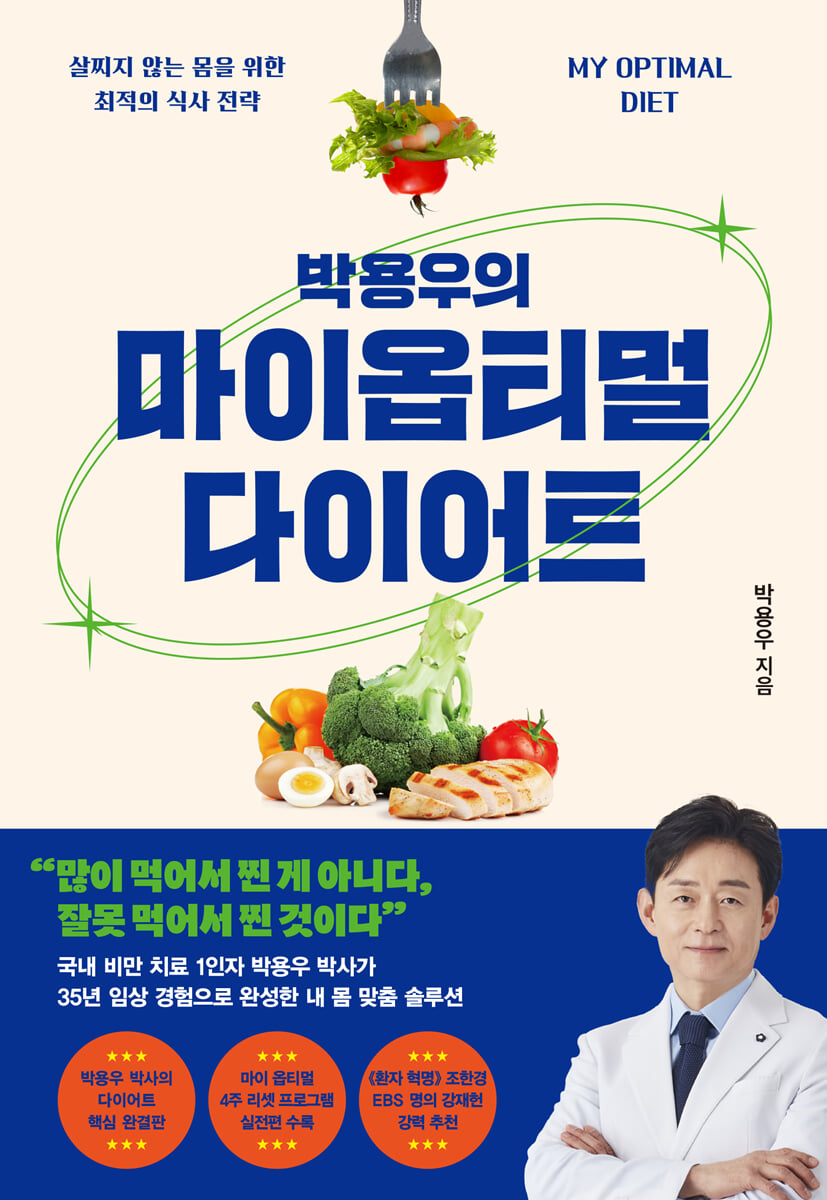
Park Yong-woo's My Optimal Diet
 |
Description
Book Introduction
★★★ Dr. Park Yong-woo's Complete Diet Guide
★★★ "Patient Revolution" strongly recommended by Jo Han-kyung and EBS doctor Kang Jae-heon.
★★★ Includes My Optimal 4-Week Reset Program Practical Edition
Is dieting just about losing weight? A healthy diet is a lifelong pursuit.
A health solution developed by Dr. Yongwoo Park through 35 years of clinical experience and scientific methodology.
A sustainable, personalized strategy for your body, now with Optimal Hara!
It's not that you gain weight because you eat too much, it's because you eat wrong! Dr. Yongwoo Park, Korea's leading authority on obesity treatment and a veteran of over 20,000 patients over 35 years, has returned with an upgraded diet solution, "Park Yongwoo's My Optimal Diet."
Having helped countless readers and patients escape obesity and established himself as the "Korean Diet Mentor," he proposes a dining revolution.
Optimal isn't a standardized diet that applies to everyone, but a personalized health strategy tailored to your individual metabolic state, constitution, and lifestyle. Beyond simple weight loss techniques, it encompasses everything from metabolic treatments that address fatty liver disease, insulin resistance, and chronic inflammation to scientific methods for regaining your own health. It encompasses essential information for a healthy, weight-free body.
Now, design your lifelong health with individualization, not standardization.
★★★ "Patient Revolution" strongly recommended by Jo Han-kyung and EBS doctor Kang Jae-heon.
★★★ Includes My Optimal 4-Week Reset Program Practical Edition
Is dieting just about losing weight? A healthy diet is a lifelong pursuit.
A health solution developed by Dr. Yongwoo Park through 35 years of clinical experience and scientific methodology.
A sustainable, personalized strategy for your body, now with Optimal Hara!
It's not that you gain weight because you eat too much, it's because you eat wrong! Dr. Yongwoo Park, Korea's leading authority on obesity treatment and a veteran of over 20,000 patients over 35 years, has returned with an upgraded diet solution, "Park Yongwoo's My Optimal Diet."
Having helped countless readers and patients escape obesity and established himself as the "Korean Diet Mentor," he proposes a dining revolution.
Optimal isn't a standardized diet that applies to everyone, but a personalized health strategy tailored to your individual metabolic state, constitution, and lifestyle. Beyond simple weight loss techniques, it encompasses everything from metabolic treatments that address fatty liver disease, insulin resistance, and chronic inflammation to scientific methods for regaining your own health. It encompasses essential information for a healthy, weight-free body.
Now, design your lifelong health with individualization, not standardization.
- You can preview some of the book's contents.
Preview
index
Prologue_ Finding the 'optimal diet' for my body
[Part 1] Bad Diet, Created Disease
Chapter 1: Why Soil is More Important Than Seeds
Chapter 2: Sweet Poison: Fatty Liver Caused by Fructose
Chapter 3: The Price of Eating Without Rest: Insulin Resistance
Chapter 4: Chronic Inflammation Caused by Energy Excess
Chapter 5: Lifelong Management or Treatment Now?
[Part 2] Basic Knowledge for Correcting Metabolism
Chapter 1: I am what I eat.
Chapter 2: Redefining Nutrients
Chapter 3: Energy Excess and Essential Nutrient Deficiencies: Why They Matter
Chapter 4: How to Control Appetite and Gluttony
[Part 3] The Optimal Eating Strategy for a Fat-Free Body
Chapter 1: Turn the Table Over
Chapter 2: Intermittent Fasting
Chapter 3: Restore the Balance of Gut Microbiota
Chapter 4: Avoid Ultra-Processed Foods
[Part 4] From Theory to Habit
Chapter 1: My Optimal Diet Meal Guide
Chapter 2: How to Increase Your Ambassadorial Flexibility
Chapter 3: How to Break Free from Hedonistic Eating
[Appendix] My Optimal 4-Week Reset Program: Practical Guide
Preparation period 1 week ago
Days 1-3: Detoxify your intestines and limit carbohydrates.
Days 4-7: Low-Carb Diet
Week 2: 24-hour fast once a week
Week 3: 24-hour fasting twice a week
Week 4: Fast for 18-24 hours, 2-3 times a week
Maintenance period after 4 weeks
List of foods for a slim body
Epilogue_ My Optimal Diet for a Lifetime Weight-Free Body
References
[Part 1] Bad Diet, Created Disease
Chapter 1: Why Soil is More Important Than Seeds
Chapter 2: Sweet Poison: Fatty Liver Caused by Fructose
Chapter 3: The Price of Eating Without Rest: Insulin Resistance
Chapter 4: Chronic Inflammation Caused by Energy Excess
Chapter 5: Lifelong Management or Treatment Now?
[Part 2] Basic Knowledge for Correcting Metabolism
Chapter 1: I am what I eat.
Chapter 2: Redefining Nutrients
Chapter 3: Energy Excess and Essential Nutrient Deficiencies: Why They Matter
Chapter 4: How to Control Appetite and Gluttony
[Part 3] The Optimal Eating Strategy for a Fat-Free Body
Chapter 1: Turn the Table Over
Chapter 2: Intermittent Fasting
Chapter 3: Restore the Balance of Gut Microbiota
Chapter 4: Avoid Ultra-Processed Foods
[Part 4] From Theory to Habit
Chapter 1: My Optimal Diet Meal Guide
Chapter 2: How to Increase Your Ambassadorial Flexibility
Chapter 3: How to Break Free from Hedonistic Eating
[Appendix] My Optimal 4-Week Reset Program: Practical Guide
Preparation period 1 week ago
Days 1-3: Detoxify your intestines and limit carbohydrates.
Days 4-7: Low-Carb Diet
Week 2: 24-hour fast once a week
Week 3: 24-hour fasting twice a week
Week 4: Fast for 18-24 hours, 2-3 times a week
Maintenance period after 4 weeks
List of foods for a slim body
Epilogue_ My Optimal Diet for a Lifetime Weight-Free Body
References
Detailed image

Into the book
So which is better: letting the weight continue to gain without any effort, or trying to lose weight and then regaining it due to the yo-yo effect? The answer is clear.
Even if the yo-yo effect occurs, it is much more advantageous to repeatedly challenge yourself to prevent further weight gain from your current weight.
As we will discuss in more detail later, our bodies have 'carbohydrate storage depots' and 'fat storage depots'.
The size of this storage warehouse varies from person to person and does not increase indefinitely.
Regularly emptying this space is one of the key strategies for building a lean body.
Of course, it is ideal to manage it well to avoid the yo-yo effect.
But even if you go back to your original weight, it's a hundred times better than not dieting at all.
--- p.29
Even when energy sources are no longer needed to obtain essential nutrients, excess nutrients that provide energy are stored in the body.
Even the food we eat is significantly lacking in essential nutrients compared to the past.
Foods that have been refined and processed for the convenience of the food industry for distribution and storage actually lack essential fatty acids and essential minerals.
As a result, the intake of energy-producing carbohydrates and fats has increased compared to the past, leading to a significant increase in the number of patients with obesity, metabolic syndrome, and cardiovascular disease.
Meanwhile, the number of patients suffering from chronic inflammation, sarcopenia, osteoporosis, and degenerative neurological diseases due to essential nutrient deficiencies is also increasing significantly.
As the balance of nutrients is disrupted, health is also threatened.
Now, nutrients should be divided into two categories to suit the modern environment rather than the classical classification.
It is an essential nutrient that our body absolutely needs, and an energy source that only produces energy.
--- p.78
Australian researchers David Lobenheimer and Stephen Simpson published a paper titled “Obesity: The Protein Lever Hypothesis.”
Although protein intake is relatively small compared to carbohydrates and fat, animals precisely control their intake.
In other words, animals eat food until they obtain the amount of protein their bodies require.
This hypothesis states that humans have a strong physiological mechanism to maintain protein intake at a certain level, and when the proportion of protein in the diet is low, they eat more food to compensate, increasing total energy intake, which ultimately leads to obesity.
The protein lever hypothesis suggests that the primary cause of obesity may not be simply excessive intake of fat or carbohydrates, but rather excess energy intake resulting from a reduced proportion of protein in the diet.
--- pp.145-146
What should we do as we live in the 21st century, with our Paleolithic genes largely intact? First, we must intentionally consume protein and dietary fiber.
First, let's consume essential nutrients.
And there is a need for skill in consuming carbohydrates and fats, which are sources of energy.
The strategy is to consume high-fat foods with low-carbohydrate options, and high-carbohydrate foods with low-fat options.
When eating with rice, avoid eating fatty meats and eat with tofu, eggs, fish, or seafood.
It is a high-carbohydrate, low-fat diet.
When having a company dinner at a meat restaurant with pork belly or chadolbagi, try to avoid eating naengmyeon or gonggitbap for dessert.
Additionally, a strategy of occasionally emptying the carbohydrate storage and fat storage warehouses is also necessary.
This is why intermittent fasting and exercise are essential.
--- p.192
When we think of 'diet', we only think of diet and exercise.
I think that if I sign up for a gym, work out hard for an hour, and order chicken breast salad or salmon poke, I will definitely lose weight.
This is also the 'fallacy of blind faith in calories'.
They believe that if they eat fewer calories than usual and burn more calories through exercise, they will lose weight.
But our bodies are not that easy.
While diet and exercise are important, you should also consider your regular physical activity level.
Above all, sleep and stress management are important.
Lack of sleep and chronic stress go beyond simply leaving you feeling tired, lethargic, or irritable; they're also major culprits in disrupting our body's hormonal systems.
It manipulates our appetites like an invisible hand, making us crave sweet and fatty foods.
To make matters worse, it worsens insulin resistance, which reduces our body's ability to control blood sugar, making us more prone to gaining weight even if we eat the same amount.
--- p.253
It may also be helpful to take nutritional supplements to supplement any nutrients you may be lacking.
To improve gut microbiota imbalance, take products containing probiotics (good bacteria) or prebiotics (food for good bacteria).
Synbiotics are products that contain both probiotics and prebiotics.
A multivitamin that contains a balanced mix of vitamins and minerals is a relatively cost-effective nutritional supplement.
At this time, we recommend products fortified with vitamin B complex.
Additionally, it is beneficial to take omega-3 fatty acids, which are lacking in modern people, in the form of nutritional supplements.
Vitamin D is a nutrient that most modern people are deficient in.
People with metabolic disorders in particular must take it.
Taking calcium and magnesium after dinner can help you lose body fat and get a good night's sleep.
Taking high doses of vitamin C, 1 to 3 grams per day, is also good for burning body fat.
People who are severely obese or over 50 years of age should take additional supplements such as coenzyme Q10 or alpha-lipoic acid, which have a strong antioxidant effect and help activate mitochondria.
Even if the yo-yo effect occurs, it is much more advantageous to repeatedly challenge yourself to prevent further weight gain from your current weight.
As we will discuss in more detail later, our bodies have 'carbohydrate storage depots' and 'fat storage depots'.
The size of this storage warehouse varies from person to person and does not increase indefinitely.
Regularly emptying this space is one of the key strategies for building a lean body.
Of course, it is ideal to manage it well to avoid the yo-yo effect.
But even if you go back to your original weight, it's a hundred times better than not dieting at all.
--- p.29
Even when energy sources are no longer needed to obtain essential nutrients, excess nutrients that provide energy are stored in the body.
Even the food we eat is significantly lacking in essential nutrients compared to the past.
Foods that have been refined and processed for the convenience of the food industry for distribution and storage actually lack essential fatty acids and essential minerals.
As a result, the intake of energy-producing carbohydrates and fats has increased compared to the past, leading to a significant increase in the number of patients with obesity, metabolic syndrome, and cardiovascular disease.
Meanwhile, the number of patients suffering from chronic inflammation, sarcopenia, osteoporosis, and degenerative neurological diseases due to essential nutrient deficiencies is also increasing significantly.
As the balance of nutrients is disrupted, health is also threatened.
Now, nutrients should be divided into two categories to suit the modern environment rather than the classical classification.
It is an essential nutrient that our body absolutely needs, and an energy source that only produces energy.
--- p.78
Australian researchers David Lobenheimer and Stephen Simpson published a paper titled “Obesity: The Protein Lever Hypothesis.”
Although protein intake is relatively small compared to carbohydrates and fat, animals precisely control their intake.
In other words, animals eat food until they obtain the amount of protein their bodies require.
This hypothesis states that humans have a strong physiological mechanism to maintain protein intake at a certain level, and when the proportion of protein in the diet is low, they eat more food to compensate, increasing total energy intake, which ultimately leads to obesity.
The protein lever hypothesis suggests that the primary cause of obesity may not be simply excessive intake of fat or carbohydrates, but rather excess energy intake resulting from a reduced proportion of protein in the diet.
--- pp.145-146
What should we do as we live in the 21st century, with our Paleolithic genes largely intact? First, we must intentionally consume protein and dietary fiber.
First, let's consume essential nutrients.
And there is a need for skill in consuming carbohydrates and fats, which are sources of energy.
The strategy is to consume high-fat foods with low-carbohydrate options, and high-carbohydrate foods with low-fat options.
When eating with rice, avoid eating fatty meats and eat with tofu, eggs, fish, or seafood.
It is a high-carbohydrate, low-fat diet.
When having a company dinner at a meat restaurant with pork belly or chadolbagi, try to avoid eating naengmyeon or gonggitbap for dessert.
Additionally, a strategy of occasionally emptying the carbohydrate storage and fat storage warehouses is also necessary.
This is why intermittent fasting and exercise are essential.
--- p.192
When we think of 'diet', we only think of diet and exercise.
I think that if I sign up for a gym, work out hard for an hour, and order chicken breast salad or salmon poke, I will definitely lose weight.
This is also the 'fallacy of blind faith in calories'.
They believe that if they eat fewer calories than usual and burn more calories through exercise, they will lose weight.
But our bodies are not that easy.
While diet and exercise are important, you should also consider your regular physical activity level.
Above all, sleep and stress management are important.
Lack of sleep and chronic stress go beyond simply leaving you feeling tired, lethargic, or irritable; they're also major culprits in disrupting our body's hormonal systems.
It manipulates our appetites like an invisible hand, making us crave sweet and fatty foods.
To make matters worse, it worsens insulin resistance, which reduces our body's ability to control blood sugar, making us more prone to gaining weight even if we eat the same amount.
--- p.253
It may also be helpful to take nutritional supplements to supplement any nutrients you may be lacking.
To improve gut microbiota imbalance, take products containing probiotics (good bacteria) or prebiotics (food for good bacteria).
Synbiotics are products that contain both probiotics and prebiotics.
A multivitamin that contains a balanced mix of vitamins and minerals is a relatively cost-effective nutritional supplement.
At this time, we recommend products fortified with vitamin B complex.
Additionally, it is beneficial to take omega-3 fatty acids, which are lacking in modern people, in the form of nutritional supplements.
Vitamin D is a nutrient that most modern people are deficient in.
People with metabolic disorders in particular must take it.
Taking calcium and magnesium after dinner can help you lose body fat and get a good night's sleep.
Taking high doses of vitamin C, 1 to 3 grams per day, is also good for burning body fat.
People who are severely obese or over 50 years of age should take additional supplements such as coenzyme Q10 or alpha-lipoic acid, which have a strong antioxidant effect and help activate mitochondria.
--- pp.299-300
Publisher's Review
“Design lifelong health through individualization, not standardization!”
Dr. Yongwoo Park, the leading obesity treatment expert in Korea
A customized solution for your body, perfected through 35 years of clinical experience.
“Each person’s constitution and health are different.
But what if we force the same "standard" clothes on some people? For others, it's just too tight, and for others, it's just too loose.
The answer to obesity lies in an individualized approach.
A diet that is not a passing fad, but one that is chosen based on understanding your body's metabolism.
“Only when the balance of metabolism is corrected can healthy change begin.” _From the text
Dr. Yongwoo Park, the leading authority on obesity treatment in Korea and a veteran of over 20,000 patients over 35 years, has returned with an upgraded diet solution, “Yongwoo Park’s My Optimal Diet.”
Having established himself as the "Korean Diet Mentor" by helping countless readers and patients escape obesity, he now proposes a revolution on the dining table.
The question most frequently asked of Dr. Park Yong-woo was this:
"How can I maintain a healthy body after dieting?" This book, which started with this question, comprehensively covers the optimal eating strategies for restoring metabolic balance and creating a body that doesn't gain weight.
'Optimal' literally means 'optimization'.
'My Optimal Diet' is not a standard diet that applies equally to everyone, but rather an individualized health strategy tailored to each person's metabolic state, constitution, and lifestyle.
The author states that “dieting is not about abstinence, but about recovery,” and introduces a scientific methodology that resets the body’s metabolism and restores one’s own health, rather than simply a technique for losing weight.
Based on the latest physiological and clinical research, it provides a clear answer to the question, "Why do we gain weight?" through scientific mechanisms. It explains key concepts in modern nutrition and metabolic medicine, such as the "protein lever hypothesis," "blood sugar control and fat metabolism," and "intermittent fasting," in language that anyone can understand, and connects them to realistic eating principles and routines.
Dr. Park Yong-woo explains that the order and composition of meals are key to revitalizing the body's metabolism.
It emphasizes a lifestyle routine that includes avoiding ultra-processed foods, eating protein and dietary fiber first, filling up on essential nutrients with natural foods, taking light walks after meals, and maintaining a regular fasting schedule.
Furthermore, for him, obesity is 'the result of an imbalance between metabolism and mind.'
So, it goes beyond how to eat well, and includes how to sleep well, how to rest well, and how to manage stress.
This book is the most scientific and realistic guide to designing lifelong, sustainable health through the principles of "individual diet" that allows you to understand and self-regulate your body, rather than following temporary fads or uniform diets.
“It’s not that I gained weight because I ate too much, it’s that I gained weight because I ate wrong.”
From a new concept of nutrition that redefines essential nutrients and energy sources
Complete metabolic treatment that corrects fatty liver, insulin resistance, and chronic inflammation with Optimal!
Obesity is not the result of laziness or gluttony, but a symptom of a broken metabolism.
The root cause lies in the modern person's dining table.
It may appear to be rich on the outside, but it points out that there are hidden pitfalls that can ruin your health.
These include a high-calorie diet centered on carbohydrates and fat, a lack of protein and dietary fiber, and an overabundance of sweet, stimulating, ultra-processed foods.
A diet that is rich in energy sources and lacks essential nutrients causes insulin resistance and inflammation, leading to "manufactured diseases" such as obesity, fatty liver, and diabetes. These diseases are not an externally imposed fate, but rather a result of the diet choices we make every day.
“Park Yong-woo’s My Optimal Diet” suggests a way to break this vicious cycle.
★ Throw away carbohydrates! A new concept in nutrition that redefines them as essential nutrients and energy sources.
Going beyond the existing ‘carbohydrates, carbohydrates, and fats’ classification, we are redefining the framework of nutrition with two axes: ‘essential nutrients’ and ‘energy sources.’
He emphasizes that “modern people’s tables are overflowing with energy sources, but they are absolutely lacking in essential nutrients that drive the body’s metabolism.”
In reality, our diet is heavily concentrated in carbohydrates and fat, and is deficient in key nutrients such as protein, vitamins, minerals, and dietary fiber.
This imbalance acts as the starting point for metabolic dysfunction.
Dr. Park Yong-woo says, “Eating smarter is more important than eating less,” and presents the perspective of “metabolic nutrition,” which redesigns the quality and combination of nutrients.
Rice is no longer a 'staple food'.
It is a source of excess energy for modern people who have reduced physical activity and increased sitting time.
Its place should be taken by natural ingredients rich in high-quality protein and micronutrients.
Additionally, it is emphasized that carbohydrates should not simply be reduced, but rather approached functionally by dividing them into simple sugars, complex sugars, and dietary fiber.
★ Flip the Table! A Metabolic Revolution Seen Through the Protein Lever Hypothesis
The human body is designed to seek food until it has sufficient protein intake.
Dr. Yongwoo Park explains this principle as the 'Protein Leverage Hypothesis'.
This means that until the body reaches its protein needs, it does not feel full, leading to overeating, which ultimately leads to obesity and metabolic disease.
In the past, diets centered on natural foods were rich in protein, but today's diets centered on ultra-processed foods are low in protein and high in calories.
As a result, you are left with plenty of energy, but your cells are starving.
Dr. Park Yong-woo suggests a realistic way to change these bad eating habits: eat protein first, get enough fiber and water, and then eat carbohydrates.
Starting with protein will help you feel full faster and prevent your blood sugar from rising too quickly.
Afterwards, you can ease digestion by eating vegetables rich in dietary fiber and water, and by consuming carbohydrates at the end, you can stabilize insulin secretion and minimize fat accumulation.
No complicated calculations or extreme dieting are required.
Just by following these simple principles, your body's metabolism will recover and you will have a routine that will help you regain your balance.
★ Understanding your body's condition is the starting point, the optimal health strategy.
Dr. Park Yong-woo says, “The factor that determines health is not the food, that is, the seeds, but the soil of the body that accepts the food.”
The same apple can be medicine to some people and poison to others.
The differences stem from each person's metabolic state, including muscle mass, insulin resistance, and gut microbiota.
All diets begin with ‘knowing your body.’
There is no one food that is good for everyone, only the food that is right for my body will restore my health.
To put this into practice, the book includes 'My Optimal 4-Week Reset Program'.
It is designed to help you recover your broken metabolism and reset yourself to your optimal state by gradually adjusting your diet and lifestyle habits over a four-week period.
We guide readers to create a "personalized strategy for my body" that can be maintained for life through small but sustainable changes such as a protein-rich diet, sufficient sleep, stress management, and reducing ultra-processed foods.
Dr. Yongwoo Park, the leading obesity treatment expert in Korea
A customized solution for your body, perfected through 35 years of clinical experience.
“Each person’s constitution and health are different.
But what if we force the same "standard" clothes on some people? For others, it's just too tight, and for others, it's just too loose.
The answer to obesity lies in an individualized approach.
A diet that is not a passing fad, but one that is chosen based on understanding your body's metabolism.
“Only when the balance of metabolism is corrected can healthy change begin.” _From the text
Dr. Yongwoo Park, the leading authority on obesity treatment in Korea and a veteran of over 20,000 patients over 35 years, has returned with an upgraded diet solution, “Yongwoo Park’s My Optimal Diet.”
Having established himself as the "Korean Diet Mentor" by helping countless readers and patients escape obesity, he now proposes a revolution on the dining table.
The question most frequently asked of Dr. Park Yong-woo was this:
"How can I maintain a healthy body after dieting?" This book, which started with this question, comprehensively covers the optimal eating strategies for restoring metabolic balance and creating a body that doesn't gain weight.
'Optimal' literally means 'optimization'.
'My Optimal Diet' is not a standard diet that applies equally to everyone, but rather an individualized health strategy tailored to each person's metabolic state, constitution, and lifestyle.
The author states that “dieting is not about abstinence, but about recovery,” and introduces a scientific methodology that resets the body’s metabolism and restores one’s own health, rather than simply a technique for losing weight.
Based on the latest physiological and clinical research, it provides a clear answer to the question, "Why do we gain weight?" through scientific mechanisms. It explains key concepts in modern nutrition and metabolic medicine, such as the "protein lever hypothesis," "blood sugar control and fat metabolism," and "intermittent fasting," in language that anyone can understand, and connects them to realistic eating principles and routines.
Dr. Park Yong-woo explains that the order and composition of meals are key to revitalizing the body's metabolism.
It emphasizes a lifestyle routine that includes avoiding ultra-processed foods, eating protein and dietary fiber first, filling up on essential nutrients with natural foods, taking light walks after meals, and maintaining a regular fasting schedule.
Furthermore, for him, obesity is 'the result of an imbalance between metabolism and mind.'
So, it goes beyond how to eat well, and includes how to sleep well, how to rest well, and how to manage stress.
This book is the most scientific and realistic guide to designing lifelong, sustainable health through the principles of "individual diet" that allows you to understand and self-regulate your body, rather than following temporary fads or uniform diets.
“It’s not that I gained weight because I ate too much, it’s that I gained weight because I ate wrong.”
From a new concept of nutrition that redefines essential nutrients and energy sources
Complete metabolic treatment that corrects fatty liver, insulin resistance, and chronic inflammation with Optimal!
Obesity is not the result of laziness or gluttony, but a symptom of a broken metabolism.
The root cause lies in the modern person's dining table.
It may appear to be rich on the outside, but it points out that there are hidden pitfalls that can ruin your health.
These include a high-calorie diet centered on carbohydrates and fat, a lack of protein and dietary fiber, and an overabundance of sweet, stimulating, ultra-processed foods.
A diet that is rich in energy sources and lacks essential nutrients causes insulin resistance and inflammation, leading to "manufactured diseases" such as obesity, fatty liver, and diabetes. These diseases are not an externally imposed fate, but rather a result of the diet choices we make every day.
“Park Yong-woo’s My Optimal Diet” suggests a way to break this vicious cycle.
★ Throw away carbohydrates! A new concept in nutrition that redefines them as essential nutrients and energy sources.
Going beyond the existing ‘carbohydrates, carbohydrates, and fats’ classification, we are redefining the framework of nutrition with two axes: ‘essential nutrients’ and ‘energy sources.’
He emphasizes that “modern people’s tables are overflowing with energy sources, but they are absolutely lacking in essential nutrients that drive the body’s metabolism.”
In reality, our diet is heavily concentrated in carbohydrates and fat, and is deficient in key nutrients such as protein, vitamins, minerals, and dietary fiber.
This imbalance acts as the starting point for metabolic dysfunction.
Dr. Park Yong-woo says, “Eating smarter is more important than eating less,” and presents the perspective of “metabolic nutrition,” which redesigns the quality and combination of nutrients.
Rice is no longer a 'staple food'.
It is a source of excess energy for modern people who have reduced physical activity and increased sitting time.
Its place should be taken by natural ingredients rich in high-quality protein and micronutrients.
Additionally, it is emphasized that carbohydrates should not simply be reduced, but rather approached functionally by dividing them into simple sugars, complex sugars, and dietary fiber.
★ Flip the Table! A Metabolic Revolution Seen Through the Protein Lever Hypothesis
The human body is designed to seek food until it has sufficient protein intake.
Dr. Yongwoo Park explains this principle as the 'Protein Leverage Hypothesis'.
This means that until the body reaches its protein needs, it does not feel full, leading to overeating, which ultimately leads to obesity and metabolic disease.
In the past, diets centered on natural foods were rich in protein, but today's diets centered on ultra-processed foods are low in protein and high in calories.
As a result, you are left with plenty of energy, but your cells are starving.
Dr. Park Yong-woo suggests a realistic way to change these bad eating habits: eat protein first, get enough fiber and water, and then eat carbohydrates.
Starting with protein will help you feel full faster and prevent your blood sugar from rising too quickly.
Afterwards, you can ease digestion by eating vegetables rich in dietary fiber and water, and by consuming carbohydrates at the end, you can stabilize insulin secretion and minimize fat accumulation.
No complicated calculations or extreme dieting are required.
Just by following these simple principles, your body's metabolism will recover and you will have a routine that will help you regain your balance.
★ Understanding your body's condition is the starting point, the optimal health strategy.
Dr. Park Yong-woo says, “The factor that determines health is not the food, that is, the seeds, but the soil of the body that accepts the food.”
The same apple can be medicine to some people and poison to others.
The differences stem from each person's metabolic state, including muscle mass, insulin resistance, and gut microbiota.
All diets begin with ‘knowing your body.’
There is no one food that is good for everyone, only the food that is right for my body will restore my health.
To put this into practice, the book includes 'My Optimal 4-Week Reset Program'.
It is designed to help you recover your broken metabolism and reset yourself to your optimal state by gradually adjusting your diet and lifestyle habits over a four-week period.
We guide readers to create a "personalized strategy for my body" that can be maintained for life through small but sustainable changes such as a protein-rich diet, sufficient sleep, stress management, and reducing ultra-processed foods.
GOODS SPECIFICS
- Date of issue: November 3, 2025
- Page count, weight, size: 340 pages | 490g | 145*210*20mm
- ISBN13: 9791173323881
- ISBN10: 1173323880
You may also like
카테고리
korean


korean

![GQ KOREA Mark (Monthly): December [2025]](http://librairie.coreenne.fr/cdn/shop/files/8ef265dbbfbf186523ed75ba7319009d.jpg?v=1765340328&width=3840)


