

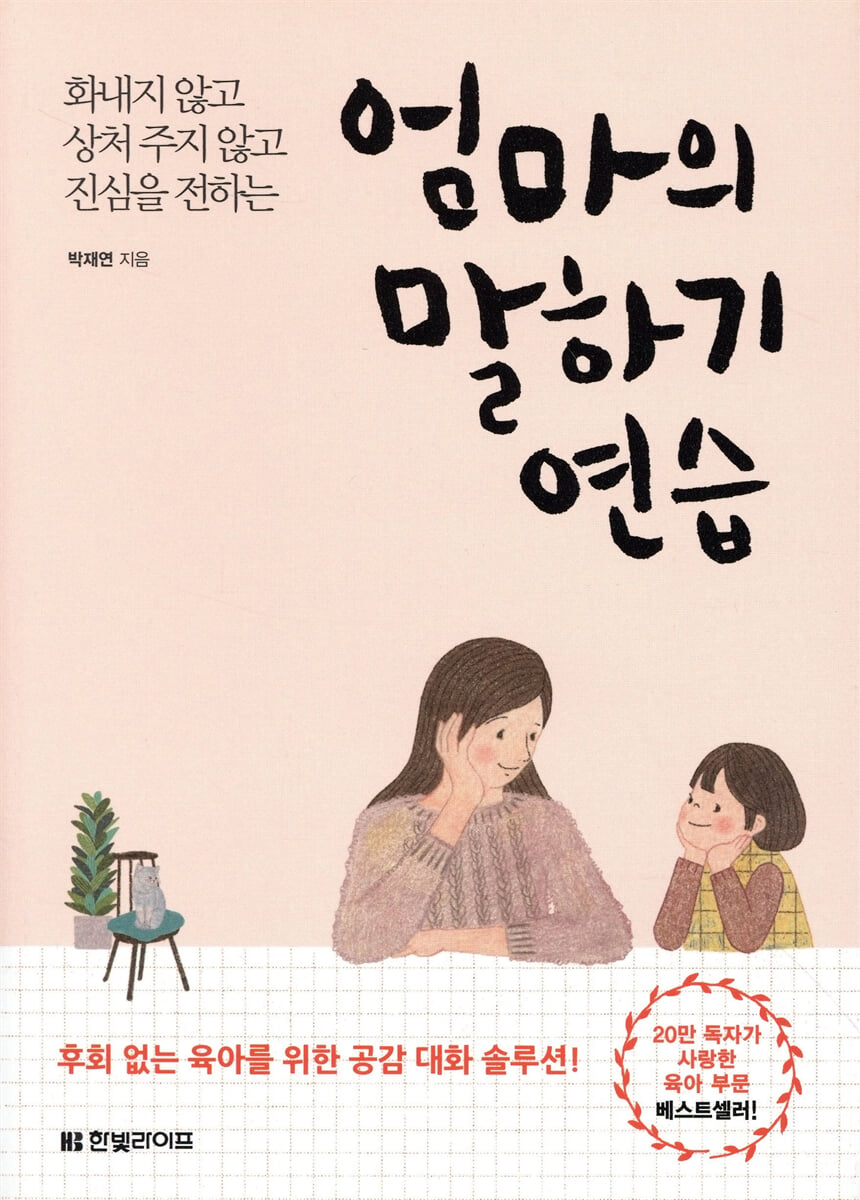
Mom's speaking practice
 |
Description
Book Introduction
Comforting me as a mother Empathetic conversation techniques to restore a child's self-esteem If you continue to have conversations that wisely soothe your child's heart and help them develop high self-esteem in the many situations they encounter while raising a child, parenting will become a little easier. To do that, first of all, the mother must be able to see herself clearly. This book first introduces ways to understand and empathize with mothers who have lost themselves due to exhaustion from raising children. Then, it provides practical minimum course of action and communication methods for various problems encountered while raising a child. You will be able to obtain parenting tips that can be applied to real life, centered around the author's long-term conversation training cases for parents and teachers and episodes introduced through 'Moms Radio - Park Jae-yeon's Empathy Talk'. |
- You can preview some of the book's contents.
Preview
index
prolog.
What Makes Us a 'Good Mom'
Chapter 1.
Understand and empathize with me as a mother
01.
Are you living with enough love now? _The Power of Love to Protect Yourself, Mom
02.
What's the hardest thing for you right now? _Automatic thoughts and patterns that block conversations.
03.
How much do you know about yourself? _Jo Hae-ri's Window
04.
Have you ever suffered from the wounds you received from your parents? _Freeing Yourself from the Wounds You Received from Your Parents
05.
Want to be a mom who never gets angry? _Recognizing the other emotions within anger
06.
'Side conversation' to help you build a new relationship with your child
07.
The Laws of Conversation for New Relationships
08.
Helpful Conversation Exercise 1: Observing What You See and Hear
09.
Helpful Conversation Exercise 2: Understanding Your True Feelings
10.
Helpful Conversation Exercise 3: Understanding and Finding the Root Cause of Your Emotions
11.
Helpful Conversation Exercise 4: Figuring Out What You Want
Chapter 2.
Understanding and empathizing with our children
01.
Expressing gratitude to your child _ Instead of saying “good job”
02.
Be honest about your regrets - instead of saying, "I couldn't help it."
03.
Give clear feedback to your child's needs - instead of saying "later."
04.
Protecting your child and letting them know what is theirs and what is not _ Instead of saying, “I have to go to the police!”
05.
Teach the importance of honesty _ Instead of saying, “Are you going to lie again?”
06.
Understand what your child wants before blaming him/her - Instead of saying, “He/she takes after someone!”
07.
Help your child become confident and independent by asking questions about anything - Instead of saying, "You figure it out yourself!"
08.
Developing the power to take care of yourself _ Instead of saying, “If you act like that, you’ll be taken advantage of.”
09.
Acknowledge and wait for your child's differences _ Instead of saying, "Other kids are doing it, why aren't you?"
10.
Use your child's mistakes as opportunities for growth _ Instead of saying, "Mom told you to be careful!"
11.
Teach healthy ways to express yourself instead of swearing _ Instead of saying, “I told you not to swear,”
12.
When you want to ask for your child's cooperation, the attitude and method of asking _ Instead of saying, "Mom clearly told me not to do that!"
13.
Overcoming Problems with Your Child When You're Tired of Being a Parent _ Instead of saying, "Now do what you want, I'm giving up too."
14.
Changing the mindset of a child struggling with a label attached to him or her _ When a child says, “The teacher told me I was in trouble.”
15.
Helping children accept and interpret rejection in a healthy way _ When a child says, “Mom, my friend hates me.”
16.
Teaching other children wisely _ Instead of saying, “You shouldn’t play with that friend who says bad things,”
17.
Help them find intrinsic motivation instead of rewards _ Instead of saying, “I’ll turn on the TV when you eat.”
18.
Understand the child's feelings of envy for other environments, and teach them to be grateful for what they have been given - When a child says, "I want to live in a house like that too."
19.
Understanding a child's desire to confirm their mother's love - When a child says, "Mom, am I prettier or is my younger sibling prettier?"
20.
Conflict Mediation Skills Between Children - When a child says, "Mom only takes my younger sibling's side."
21.
When a child is afraid of death, accept and empathize with their feelings. When a child says, “What if Mommy dies?”
22.
Apologizing to a child who is anxious due to a fight between parents - Instead of saying, "Mom lives because of you,"
23.
The most important thing in a divorced family is to understand the child's feelings - Instead of saying, "Didn't you talk about Mom at Dad's house?"
What Makes Us a 'Good Mom'
Chapter 1.
Understand and empathize with me as a mother
01.
Are you living with enough love now? _The Power of Love to Protect Yourself, Mom
02.
What's the hardest thing for you right now? _Automatic thoughts and patterns that block conversations.
03.
How much do you know about yourself? _Jo Hae-ri's Window
04.
Have you ever suffered from the wounds you received from your parents? _Freeing Yourself from the Wounds You Received from Your Parents
05.
Want to be a mom who never gets angry? _Recognizing the other emotions within anger
06.
'Side conversation' to help you build a new relationship with your child
07.
The Laws of Conversation for New Relationships
08.
Helpful Conversation Exercise 1: Observing What You See and Hear
09.
Helpful Conversation Exercise 2: Understanding Your True Feelings
10.
Helpful Conversation Exercise 3: Understanding and Finding the Root Cause of Your Emotions
11.
Helpful Conversation Exercise 4: Figuring Out What You Want
Chapter 2.
Understanding and empathizing with our children
01.
Expressing gratitude to your child _ Instead of saying “good job”
02.
Be honest about your regrets - instead of saying, "I couldn't help it."
03.
Give clear feedback to your child's needs - instead of saying "later."
04.
Protecting your child and letting them know what is theirs and what is not _ Instead of saying, “I have to go to the police!”
05.
Teach the importance of honesty _ Instead of saying, “Are you going to lie again?”
06.
Understand what your child wants before blaming him/her - Instead of saying, “He/she takes after someone!”
07.
Help your child become confident and independent by asking questions about anything - Instead of saying, "You figure it out yourself!"
08.
Developing the power to take care of yourself _ Instead of saying, “If you act like that, you’ll be taken advantage of.”
09.
Acknowledge and wait for your child's differences _ Instead of saying, "Other kids are doing it, why aren't you?"
10.
Use your child's mistakes as opportunities for growth _ Instead of saying, "Mom told you to be careful!"
11.
Teach healthy ways to express yourself instead of swearing _ Instead of saying, “I told you not to swear,”
12.
When you want to ask for your child's cooperation, the attitude and method of asking _ Instead of saying, "Mom clearly told me not to do that!"
13.
Overcoming Problems with Your Child When You're Tired of Being a Parent _ Instead of saying, "Now do what you want, I'm giving up too."
14.
Changing the mindset of a child struggling with a label attached to him or her _ When a child says, “The teacher told me I was in trouble.”
15.
Helping children accept and interpret rejection in a healthy way _ When a child says, “Mom, my friend hates me.”
16.
Teaching other children wisely _ Instead of saying, “You shouldn’t play with that friend who says bad things,”
17.
Help them find intrinsic motivation instead of rewards _ Instead of saying, “I’ll turn on the TV when you eat.”
18.
Understand the child's feelings of envy for other environments, and teach them to be grateful for what they have been given - When a child says, "I want to live in a house like that too."
19.
Understanding a child's desire to confirm their mother's love - When a child says, "Mom, am I prettier or is my younger sibling prettier?"
20.
Conflict Mediation Skills Between Children - When a child says, "Mom only takes my younger sibling's side."
21.
When a child is afraid of death, accept and empathize with their feelings. When a child says, “What if Mommy dies?”
22.
Apologizing to a child who is anxious due to a fight between parents - Instead of saying, "Mom lives because of you,"
23.
The most important thing in a divorced family is to understand the child's feelings - Instead of saying, "Didn't you talk about Mom at Dad's house?"
Detailed image

Into the book
Because we are mothers, we experience the most important things possible.
Learn the joy of giving and the value of contributing, and feel happiness through the laughter of children.
Before becoming a mother, did we ever truly suffer and feel heartache for others? When our children are sick, we suffer even more than we do ourselves, and we often lose sleep.
Sometimes I act immaturely and regret it, but I sincerely wish for my child's happiness without any pretense.
Because I'm a mom.
There is no such thing as a good mother.
If you can listen to your child's worries right now and make them cry and tell you about their pain, you are already the best mother.
---From "Prologue, What Makes Us a 'Good Mother'"
Chapter 1.
Understand and empathize with me as a mother
One of the reasons people easily get caught up in conflict and struggle in it is because of their own thoughts that automatically pop up.
It took me a long time to realize this, but we're constantly talking to each other, and most of what we say is actually thoughtless.
It's just saying the thoughts that come to mind automatically, not by thinking about it.
---From "02. What is the most difficult thing right now? Automatic thoughts that block conversation"
But there are certainly words that can restore love.
It may take a lot of time and effort, but learning to communicate differently is more rewarding than painful.
The first step to starting a conversation that heals your relationship is to let go of your worries, anxieties, and impatience and acknowledge and notice your own feelings.
'Ah, so that's how I've lived my life talking.
So, sometimes, it's enough to think, 'I was hurt, the other person was hurt, and we were both hurting each other.'
And maybe try to comfort yourself first, as you may be regretting it now and feeling sorry to someone.
---From "02. What's the most difficult thing right now? Automatic thoughts that block conversation."
I hope that mothers who read this book will also be able to recover and heal the painful memories of their childhood.
It is important to believe that you have the ability to heal from past pain.
If you do that, you will be able to leave your wounds as just one story.
Even if you find love too late, you can start now.
I offer my condolences and encouragement to all the mothers in the world who grew up with painful childhood memories.
You struggled to survive.
---「04.
Have you ever suffered from the wounds you received from your parents? From "Freeing Yourself from the Wounds You Received from Your Parents"
If a mother judges her child to be 'lazy and thoughtless,' she may say, 'Look at that child lying still on the sofa.
It's easy to see your child as a truly lazy person, thinking, 'He's just lying around lazy.'
If we judge someone by our own standards and believe that to be true, will it be possible to have a conversation that allows us to deeply empathize and connect with each other, and maintain our hearts?
It will probably be difficult.
So, at least while talking with your beloved child, you need to put aside these thoughts and judgments for a moment and recall what you saw and heard.
This is the beginning of a conversation.
Because successful conversation begins with the ability to observe.
---「08.
From “Useful Conversation Exercise 1: Observing What You See and Hear”
Chapter 2.
Understanding and empathizing with our children
If you think about it, it's a miracle of life that a child who went out in the morning comes back.
If you take things for granted, there is nothing to be thankful for, but if you think about them one by one, everything becomes a miracle and you will be thankful for it.
So, training is necessary.
It may be embarrassing to say everything, but parents can describe to their children what they see and hear and be thankful.
Then you can reach the child's heart much more deeply.
---From “01. Expressing gratitude to children instead of saying “good job””
One of the most important skills in a relationship is the ability to coordinate what each other wants rather than judging each other's rights and wrongs.
It's not easy even among adults, but when conflicts arise with young children, it's even harder to find a mutually satisfactory solution and find a compromise.
If your child is very young, prioritize making sure the needs of the weaker child are met appropriately.
Because the child cannot yet consider the mother's position.
Children who have their needs met in this way naturally come to trust others, and as they grow up, they develop the ability to understand others' positions.
---「02. Honestly admitting your regrets, instead of saying, “I couldn’t help it.”」
“Children are not afraid of shame and fear,
“Grow up healthy and upright through opportunities to think.”
---「04. Protecting children and letting them know what is theirs and what is not, instead of saying, “I have to go to the police!”」
Just as we instinctively know, children also know the discomfort of lying.
So we have to help the children.
“Hey, anyone can say something that is different from the truth.
But because someone could be harmed by that lie, you have to have the courage to correct it.”
If you say, “If you lie one more time, you’ll get in trouble,” children might miss the chance to turn back.
But, “If you feel uneasy at any time, tell me honestly.
If you say, “Then Mommy will help you,” children feel reassured.
As your mind becomes more at peace, your faith is restored.
'Oh, my mom would understand and help me if I was honest,' he said.
That's when children begin to express themselves.
When we are afraid, we remain silent, but when we are comfortable, we confess.
Help children have the courage to confess.
The power of children to live honestly does not come from growing up without ever telling a lie, but from fostering the courage to return to honesty.
---From "05. Telling the Importance of Honesty Instead of Saying "Are you going to lie again?""
It's natural to feel good as a mother when your child does better than other children.
But when you focus on your child's growth rather than comparing them to other children, you discover the joy in the process, not the outcome.
It would be good to remember that the standard for my child's growth should be strictly my child of yesterday, not other children.
---「09. Recognize and wait for your child's differences. Instead of saying, "Other kids are doing it, so why aren't you?"」
“As a mother, if I could see myself making mistakes every day,
“You can be more forgiving of your child’s mistakes.”
---「10. Turning a child's mistakes into opportunities for growth Instead of saying, "Mom told you to be careful!"」
Even adults can be left with lasting emotional scars when they are told, “You have a problem.”
Of course, it is quite discouraging, and if you admit to that evaluation, it becomes even more painful and your confidence drops.
Everyone is vulnerable to criticism, but being told, “You’re wrong, you’re wrong,” leaves a lasting wound.
So never do this to children.
Don't cause such hurt and pain in the hearts of children.
There are so many good gifts out there, so why give someone such annoying and tragic words that could scar them for the rest of their life?
---「13. Overcoming problems with your child when you are tired of being a parent, instead of saying, “Now do as you please, I’m giving up too.”」
When your child suddenly becomes afraid that their parents may die, try the following conversation:
Child: “Mom, what will happen to me if you die?”
1.
Accept your child's feelings rather than denying or teaching them.
“Why did you die?”
→ “I suddenly had that thought and felt anxious.”
2.
Show empathy to your child through physical contact and words.
“Don’t die.
“Mom, you’re strong and healthy.”, “Don’t say things like that because words can become seeds.”
→ “I am so grateful that my mother is able to live healthily today.
Right? Let's stay healthy so we can be together tomorrow too.
“Come here, Mommy will hug you.”
_21. When a child is afraid of death, accept and empathize with their feelings. When a child says, “What if Mom dies?”, use “Empathy Talk”
Learn the joy of giving and the value of contributing, and feel happiness through the laughter of children.
Before becoming a mother, did we ever truly suffer and feel heartache for others? When our children are sick, we suffer even more than we do ourselves, and we often lose sleep.
Sometimes I act immaturely and regret it, but I sincerely wish for my child's happiness without any pretense.
Because I'm a mom.
There is no such thing as a good mother.
If you can listen to your child's worries right now and make them cry and tell you about their pain, you are already the best mother.
---From "Prologue, What Makes Us a 'Good Mother'"
Chapter 1.
Understand and empathize with me as a mother
One of the reasons people easily get caught up in conflict and struggle in it is because of their own thoughts that automatically pop up.
It took me a long time to realize this, but we're constantly talking to each other, and most of what we say is actually thoughtless.
It's just saying the thoughts that come to mind automatically, not by thinking about it.
---From "02. What is the most difficult thing right now? Automatic thoughts that block conversation"
But there are certainly words that can restore love.
It may take a lot of time and effort, but learning to communicate differently is more rewarding than painful.
The first step to starting a conversation that heals your relationship is to let go of your worries, anxieties, and impatience and acknowledge and notice your own feelings.
'Ah, so that's how I've lived my life talking.
So, sometimes, it's enough to think, 'I was hurt, the other person was hurt, and we were both hurting each other.'
And maybe try to comfort yourself first, as you may be regretting it now and feeling sorry to someone.
---From "02. What's the most difficult thing right now? Automatic thoughts that block conversation."
I hope that mothers who read this book will also be able to recover and heal the painful memories of their childhood.
It is important to believe that you have the ability to heal from past pain.
If you do that, you will be able to leave your wounds as just one story.
Even if you find love too late, you can start now.
I offer my condolences and encouragement to all the mothers in the world who grew up with painful childhood memories.
You struggled to survive.
---「04.
Have you ever suffered from the wounds you received from your parents? From "Freeing Yourself from the Wounds You Received from Your Parents"
If a mother judges her child to be 'lazy and thoughtless,' she may say, 'Look at that child lying still on the sofa.
It's easy to see your child as a truly lazy person, thinking, 'He's just lying around lazy.'
If we judge someone by our own standards and believe that to be true, will it be possible to have a conversation that allows us to deeply empathize and connect with each other, and maintain our hearts?
It will probably be difficult.
So, at least while talking with your beloved child, you need to put aside these thoughts and judgments for a moment and recall what you saw and heard.
This is the beginning of a conversation.
Because successful conversation begins with the ability to observe.
---「08.
From “Useful Conversation Exercise 1: Observing What You See and Hear”
Chapter 2.
Understanding and empathizing with our children
If you think about it, it's a miracle of life that a child who went out in the morning comes back.
If you take things for granted, there is nothing to be thankful for, but if you think about them one by one, everything becomes a miracle and you will be thankful for it.
So, training is necessary.
It may be embarrassing to say everything, but parents can describe to their children what they see and hear and be thankful.
Then you can reach the child's heart much more deeply.
---From “01. Expressing gratitude to children instead of saying “good job””
One of the most important skills in a relationship is the ability to coordinate what each other wants rather than judging each other's rights and wrongs.
It's not easy even among adults, but when conflicts arise with young children, it's even harder to find a mutually satisfactory solution and find a compromise.
If your child is very young, prioritize making sure the needs of the weaker child are met appropriately.
Because the child cannot yet consider the mother's position.
Children who have their needs met in this way naturally come to trust others, and as they grow up, they develop the ability to understand others' positions.
---「02. Honestly admitting your regrets, instead of saying, “I couldn’t help it.”」
“Children are not afraid of shame and fear,
“Grow up healthy and upright through opportunities to think.”
---「04. Protecting children and letting them know what is theirs and what is not, instead of saying, “I have to go to the police!”」
Just as we instinctively know, children also know the discomfort of lying.
So we have to help the children.
“Hey, anyone can say something that is different from the truth.
But because someone could be harmed by that lie, you have to have the courage to correct it.”
If you say, “If you lie one more time, you’ll get in trouble,” children might miss the chance to turn back.
But, “If you feel uneasy at any time, tell me honestly.
If you say, “Then Mommy will help you,” children feel reassured.
As your mind becomes more at peace, your faith is restored.
'Oh, my mom would understand and help me if I was honest,' he said.
That's when children begin to express themselves.
When we are afraid, we remain silent, but when we are comfortable, we confess.
Help children have the courage to confess.
The power of children to live honestly does not come from growing up without ever telling a lie, but from fostering the courage to return to honesty.
---From "05. Telling the Importance of Honesty Instead of Saying "Are you going to lie again?""
It's natural to feel good as a mother when your child does better than other children.
But when you focus on your child's growth rather than comparing them to other children, you discover the joy in the process, not the outcome.
It would be good to remember that the standard for my child's growth should be strictly my child of yesterday, not other children.
---「09. Recognize and wait for your child's differences. Instead of saying, "Other kids are doing it, so why aren't you?"」
“As a mother, if I could see myself making mistakes every day,
“You can be more forgiving of your child’s mistakes.”
---「10. Turning a child's mistakes into opportunities for growth Instead of saying, "Mom told you to be careful!"」
Even adults can be left with lasting emotional scars when they are told, “You have a problem.”
Of course, it is quite discouraging, and if you admit to that evaluation, it becomes even more painful and your confidence drops.
Everyone is vulnerable to criticism, but being told, “You’re wrong, you’re wrong,” leaves a lasting wound.
So never do this to children.
Don't cause such hurt and pain in the hearts of children.
There are so many good gifts out there, so why give someone such annoying and tragic words that could scar them for the rest of their life?
---「13. Overcoming problems with your child when you are tired of being a parent, instead of saying, “Now do as you please, I’m giving up too.”」
When your child suddenly becomes afraid that their parents may die, try the following conversation:
Child: “Mom, what will happen to me if you die?”
1.
Accept your child's feelings rather than denying or teaching them.
“Why did you die?”
→ “I suddenly had that thought and felt anxious.”
2.
Show empathy to your child through physical contact and words.
“Don’t die.
“Mom, you’re strong and healthy.”, “Don’t say things like that because words can become seeds.”
→ “I am so grateful that my mother is able to live healthily today.
Right? Let's stay healthy so we can be together tomorrow too.
“Come here, Mommy will hug you.”
_21. When a child is afraid of death, accept and empathize with their feelings. When a child says, “What if Mom dies?”, use “Empathy Talk”
--- From the text
Publisher's Review
There are no perfect parents.
- As a mother, I understand and hug you first.
When relationships with children and families become difficult and challenging, mothers always blame themselves.
“I am a lacking mother.”
“I am such a bad mother.”
I feel frustrated when I say things like this.
A mother who worries that she loves her child but cannot express it as much as she wants, but there is already a deep love in her heart.
To say that you are lacking means that you have a deep desire to love someone.
However, in order for a mother to firmly believe in the love within herself and to recover that love, she must first learn to look at her own wounds and understand herself.
Only when you learn to let go of past wounds and comfort yourself can you understand your child's feelings.
This book first introduces how to properly understand and empathize with oneself as a mother, and then teaches real communication methods that enter into the heart of a child.
Empathy Talk: Improving Your Relationship with Your Precious Child
The more we raise children, the less certain we become about whether we are raising them well.
Contrary to my initial intention to only give love, I am increasingly reacting sharply to my child's small mistakes and scolding them harshly for things that could have been handled with ease.
Most of the time, the reason our conversations with our children are superficial is because we are following the automatic thoughts that come to our minds.
This book introduces methods of conversation with oneself and with children that can be applied in real life, focusing on numerous conversation training cases that the author has conducted for parents and teachers over a long period of time and episodes introduced through 'Moms Radio - Park Jae-yeon's Empathy Talk'.
"later."
“Mom told me to be careful!”
“Other kids are doing it, so why can’t you?”
If you follow these 34 empathetic messages instead of the ones that mothers often say without thinking, you will be able to take care of your own heart as a mother and become much closer to your child.
※ All royalties from this book will be used to help children who are victims of child abuse recover mentally and physically.
- As a mother, I understand and hug you first.
When relationships with children and families become difficult and challenging, mothers always blame themselves.
“I am a lacking mother.”
“I am such a bad mother.”
I feel frustrated when I say things like this.
A mother who worries that she loves her child but cannot express it as much as she wants, but there is already a deep love in her heart.
To say that you are lacking means that you have a deep desire to love someone.
However, in order for a mother to firmly believe in the love within herself and to recover that love, she must first learn to look at her own wounds and understand herself.
Only when you learn to let go of past wounds and comfort yourself can you understand your child's feelings.
This book first introduces how to properly understand and empathize with oneself as a mother, and then teaches real communication methods that enter into the heart of a child.
Empathy Talk: Improving Your Relationship with Your Precious Child
The more we raise children, the less certain we become about whether we are raising them well.
Contrary to my initial intention to only give love, I am increasingly reacting sharply to my child's small mistakes and scolding them harshly for things that could have been handled with ease.
Most of the time, the reason our conversations with our children are superficial is because we are following the automatic thoughts that come to our minds.
This book introduces methods of conversation with oneself and with children that can be applied in real life, focusing on numerous conversation training cases that the author has conducted for parents and teachers over a long period of time and episodes introduced through 'Moms Radio - Park Jae-yeon's Empathy Talk'.
"later."
“Mom told me to be careful!”
“Other kids are doing it, so why can’t you?”
If you follow these 34 empathetic messages instead of the ones that mothers often say without thinking, you will be able to take care of your own heart as a mother and become much closer to your child.
※ All royalties from this book will be used to help children who are victims of child abuse recover mentally and physically.
GOODS SPECIFICS
- Date of publication: February 26, 2018
- Page count, weight, size: 280 pages | 462g | 150*210*17mm
- ISBN13: 9791188007134
- ISBN10: 1188007130
You may also like
카테고리
korean


korean

![ELLE 엘르 스페셜 에디션 A형 : 12월 [2025]](http://librairie.coreenne.fr/cdn/shop/files/b8e27a3de6c9538896439686c6b0e8fb.jpg?v=1766436872&width=3840)


