

Slow Jogging Revolution
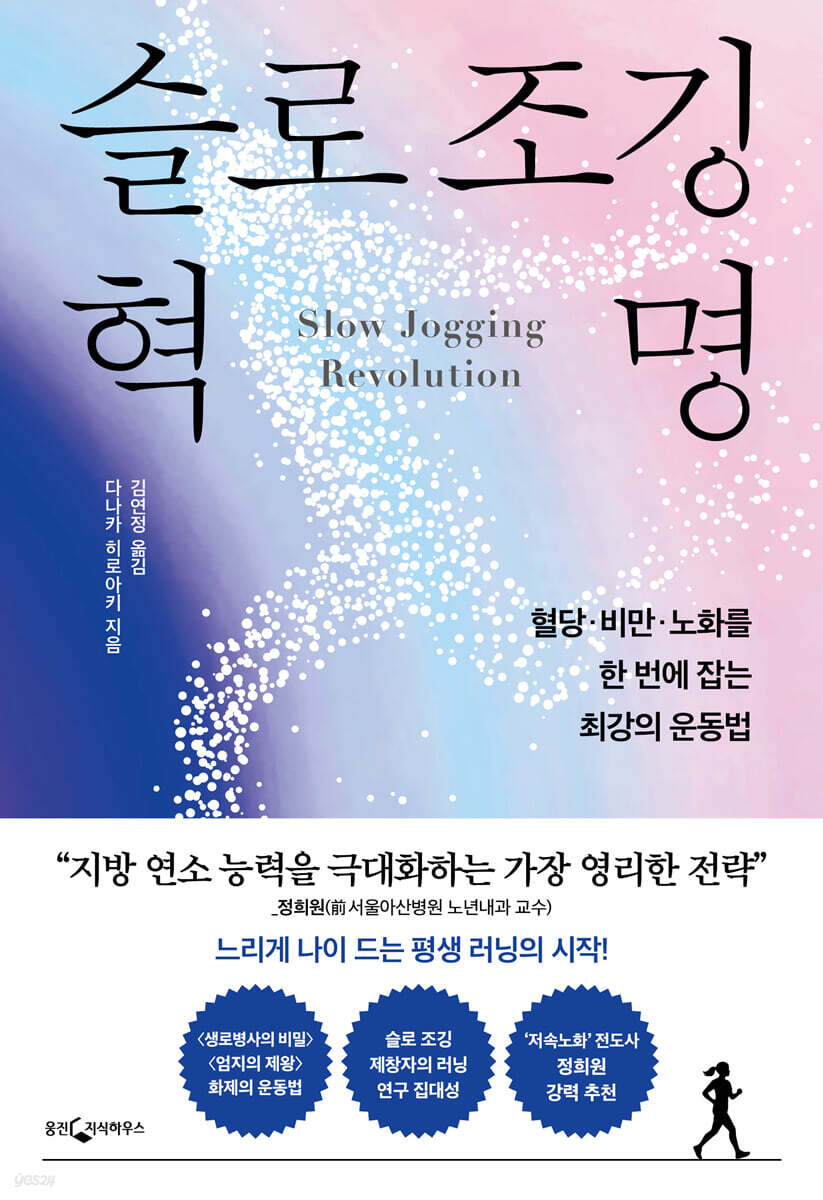 |
Description
Book Introduction
★ KBS's "Secret of Birth, Aging, Illness, and Death" Hot Topic Exercise Method ★
★ A compilation of running research from the creator of slow jogging ★
★ Highly recommended by Professor Jeong Hee-won, a preacher of 'slow aging' ★
“If you have failed at every exercise so far,
The answer is slow jogging!”
From dieting to anti-aging and lifestyle disease management
The ultimate exercise solution that finally gets your body responding
The era of 10 million running people.
Everyone has thought at least once, 'Should I try running?', but actually getting started is not easy.
Knee strain, lack of time, and vagueness are holding me back.
So, many people choose to walk, but walking alone has limitations in reducing body fat or improving metabolism.
The effect is disappointing, and running is burdensome.
A new exercise method called 'slow jogging' is gaining attention as it promises to alleviate all these worries.
Slow jogging at a walking pace is effective for burning fat, strengthening cardiopulmonary function, maintaining muscle mass, and improving metabolic function.
Significant changes, such as reduction in body fat, improvement in blood pressure and blood sugar levels, and increased endurance, were repeatedly observed in programs targeting various target groups, including the elderly, hypertensive patients, and middle-aged people who had stopped exercising. These effects were also introduced in international academic journals and broadcast documentaries.
"Slow Jogging Revolution" is a compilation of 47 years of research and practical examples from Professor Hiroaki Tanaka, the creator of slow jogging.
It is structured so that it can be used according to the exercise level and purpose, including step-by-step content from the basic theory of slow jogging to practical running techniques such as 'narrow stride' and 'toe landing', and even marathon challenges.
This book provides the ultimate exercise solution for everyone: middle-aged people who want to age healthily, beginners who are just starting to exercise, and the general public who need to improve their lifestyle habits.
★ A compilation of running research from the creator of slow jogging ★
★ Highly recommended by Professor Jeong Hee-won, a preacher of 'slow aging' ★
“If you have failed at every exercise so far,
The answer is slow jogging!”
From dieting to anti-aging and lifestyle disease management
The ultimate exercise solution that finally gets your body responding
The era of 10 million running people.
Everyone has thought at least once, 'Should I try running?', but actually getting started is not easy.
Knee strain, lack of time, and vagueness are holding me back.
So, many people choose to walk, but walking alone has limitations in reducing body fat or improving metabolism.
The effect is disappointing, and running is burdensome.
A new exercise method called 'slow jogging' is gaining attention as it promises to alleviate all these worries.
Slow jogging at a walking pace is effective for burning fat, strengthening cardiopulmonary function, maintaining muscle mass, and improving metabolic function.
Significant changes, such as reduction in body fat, improvement in blood pressure and blood sugar levels, and increased endurance, were repeatedly observed in programs targeting various target groups, including the elderly, hypertensive patients, and middle-aged people who had stopped exercising. These effects were also introduced in international academic journals and broadcast documentaries.
"Slow Jogging Revolution" is a compilation of 47 years of research and practical examples from Professor Hiroaki Tanaka, the creator of slow jogging.
It is structured so that it can be used according to the exercise level and purpose, including step-by-step content from the basic theory of slow jogging to practical running techniques such as 'narrow stride' and 'toe landing', and even marathon challenges.
This book provides the ultimate exercise solution for everyone: middle-aged people who want to age healthily, beginners who are just starting to exercise, and the general public who need to improve their lifestyle habits.
- You can preview some of the book's contents.
Preview
index
Recommended Reading: A book that turns conventional wisdom about running on its head with science!
Introduction: Anyone can run
Chapter 1: Why Slow Running is Better than Walking: The Basics of Slow Jogging
All humans are born with a "running talent." · Why do we run? · The mechanical differences between walking and running. · Fast walking is difficult and less efficient. · Excess energy is consumed twice as much. · Muscle mass decreases if you don't run. · Walking and slow jogging use different muscles. · Muscle mass can be maintained in your 20s. · Strength training is not necessary.
Chapter 2: Slow Jogging: How to Run: Slow Jogging Practical Lessons
A full marathon course challenge at age 60 · Basic principles of slow jogging · How to find the pace that suits you · A smiling pace that 'doesn't accumulate lactic acid' · How to find a smiling pace with your heart rate · Heel landing or forefoot landing · A gold medal won by forefoot landing · Increase your pitch · Why you shouldn't pull your chin in · Learning the forefoot landing technique · Things to keep in mind when running · Breathing method and where to run · No warm-up required · Clothing and running shoes
Chapter 3: The Most Realistic Way to Lose Weight Without Stress: Slow Jogging and Dieting
Have you ever seen an obese marathon runner? · The basic premise of weight loss · The best diet method · The formula for calculating exercise and calorie consumption · Will walking 10,000 steps a day help you lose weight? · It's more effective than walking · Weight loss habits · Exercise volume and appetite · How to eat · The mindset that prevents yo-yoing · Do I need to exercise for more than 20 minutes to burn fat? · Exercising for 1 minute at a time is enough · Weight loss makes you run faster · 'Health Tourism' is effective for weight loss
※Level Up Point 1: How fast can you run if you lose weight?
Chapter 4: The Science of Running: Building an Endless Body: Slow Jogging and Exercise Physiology
Where is energy produced? · The key is collaboration with mitochondria · Slow jogging that efficiently uses fat · The principle of lactic acid accumulation · The real reason why you get tired when running · Short distances use that energy · What makes fast runners different? · Aging and VO2max · Improve mitochondrial function · Tips for completing a marathon based on lactate threshold and VO2max · Why do you get heavier during a marathon? · How are energy sources stored in the body? · Run efficiently like a hybrid car · Use slow-twitch fibers · Why do my sides hurt when I run? · The secret of the runner's high
※Level Up Point 2: How to accurately measure my single-faced face?
Chapter 5: 42.195km, Challenge Yourself to Finish: Training for the Marathon
How far should you run? · How to set a target time · A workout routine to prepare for a race · Where should you run? · Interval training · Eat well to run well · Avoid exercising after a meal · The benefits of exercising on an empty stomach in the morning · Develop the ability to burn fat · Double the effect by combining diet and exercising every other day · Three indoor workouts · Which race should I enter?
Chapter 6: Things to Know Before You Start: Pre- and Post-race Precautions
Avoid overtraining · Beware of hyponatremia · Adequate water intake · Secrets to good performance · How to effectively load glycogen · Things to do 3 days before the race · Precautions the day before the race · If your body feels heavy, the race will go well · Things to do before going to bed · Unexpected precautions on the day of the race · Final check before the race · Simple tips to maintain speed · Overcoming the 30 km limit · After the race · When should I start practicing again?
※Level Up Point 3: How fast can humans run?
Chapter 7: Running Habits that Revive My Body: Slow Jogging and Lifelong Health
Is running bad for your knees? · Is running bad for your heart? · Running improves cardiopulmonary function · Improves mitochondrial function · Improves body temperature regulation · VO2max is an important indicator of health · Do runners live long and healthy lives? · A smiley pace that controls blood pressure · Increases good cholesterol · Lowers blood sugar levels · Increases brain cells
※Level Up Point 4: Can degenerative knee arthritis be cured by striking on the front heel?
Coming out: You can run too
Introduction: Anyone can run
Chapter 1: Why Slow Running is Better than Walking: The Basics of Slow Jogging
All humans are born with a "running talent." · Why do we run? · The mechanical differences between walking and running. · Fast walking is difficult and less efficient. · Excess energy is consumed twice as much. · Muscle mass decreases if you don't run. · Walking and slow jogging use different muscles. · Muscle mass can be maintained in your 20s. · Strength training is not necessary.
Chapter 2: Slow Jogging: How to Run: Slow Jogging Practical Lessons
A full marathon course challenge at age 60 · Basic principles of slow jogging · How to find the pace that suits you · A smiling pace that 'doesn't accumulate lactic acid' · How to find a smiling pace with your heart rate · Heel landing or forefoot landing · A gold medal won by forefoot landing · Increase your pitch · Why you shouldn't pull your chin in · Learning the forefoot landing technique · Things to keep in mind when running · Breathing method and where to run · No warm-up required · Clothing and running shoes
Chapter 3: The Most Realistic Way to Lose Weight Without Stress: Slow Jogging and Dieting
Have you ever seen an obese marathon runner? · The basic premise of weight loss · The best diet method · The formula for calculating exercise and calorie consumption · Will walking 10,000 steps a day help you lose weight? · It's more effective than walking · Weight loss habits · Exercise volume and appetite · How to eat · The mindset that prevents yo-yoing · Do I need to exercise for more than 20 minutes to burn fat? · Exercising for 1 minute at a time is enough · Weight loss makes you run faster · 'Health Tourism' is effective for weight loss
※Level Up Point 1: How fast can you run if you lose weight?
Chapter 4: The Science of Running: Building an Endless Body: Slow Jogging and Exercise Physiology
Where is energy produced? · The key is collaboration with mitochondria · Slow jogging that efficiently uses fat · The principle of lactic acid accumulation · The real reason why you get tired when running · Short distances use that energy · What makes fast runners different? · Aging and VO2max · Improve mitochondrial function · Tips for completing a marathon based on lactate threshold and VO2max · Why do you get heavier during a marathon? · How are energy sources stored in the body? · Run efficiently like a hybrid car · Use slow-twitch fibers · Why do my sides hurt when I run? · The secret of the runner's high
※Level Up Point 2: How to accurately measure my single-faced face?
Chapter 5: 42.195km, Challenge Yourself to Finish: Training for the Marathon
How far should you run? · How to set a target time · A workout routine to prepare for a race · Where should you run? · Interval training · Eat well to run well · Avoid exercising after a meal · The benefits of exercising on an empty stomach in the morning · Develop the ability to burn fat · Double the effect by combining diet and exercising every other day · Three indoor workouts · Which race should I enter?
Chapter 6: Things to Know Before You Start: Pre- and Post-race Precautions
Avoid overtraining · Beware of hyponatremia · Adequate water intake · Secrets to good performance · How to effectively load glycogen · Things to do 3 days before the race · Precautions the day before the race · If your body feels heavy, the race will go well · Things to do before going to bed · Unexpected precautions on the day of the race · Final check before the race · Simple tips to maintain speed · Overcoming the 30 km limit · After the race · When should I start practicing again?
※Level Up Point 3: How fast can humans run?
Chapter 7: Running Habits that Revive My Body: Slow Jogging and Lifelong Health
Is running bad for your knees? · Is running bad for your heart? · Running improves cardiopulmonary function · Improves mitochondrial function · Improves body temperature regulation · VO2max is an important indicator of health · Do runners live long and healthy lives? · A smiley pace that controls blood pressure · Increases good cholesterol · Lowers blood sugar levels · Increases brain cells
※Level Up Point 4: Can degenerative knee arthritis be cured by striking on the front heel?
Coming out: You can run too
Detailed image

Into the book
Slow jogging starts with running slowly at a pace similar to walking.
It's not difficult at all because it's a speed at which you can run while laughing and chatting.
At the same time, you can easily lose weight and naturally improve your physical strength by consuming energy similar to that of running at a fast pace.
If you keep jogging slowly without overdoing it, your speed will gradually increase and you will be able to enjoy running.
--- From the "User's Manual for This Book"
If you are a beginner, you can find out the right pace for you by looking at your heart rate.
First, determine the level at which your subjective exercise intensity (see Table 2-1) is 10 to 12, run at that speed for 3 to 4 minutes, and then check your heart rate.
At this time, the heart rate per minute will be close to the number calculated as '138 ? (age ÷ 2)'.
When running with a goal of '138 ? (age ÷ 2)', there are some people whose subjective exercise intensity exceeds 13. In that case, the goal is the number derived by multiplying '128 ? (age ÷ 2)'.
Conversely, if the subjective exercise intensity is 9 or higher when running at a speed of '138 ? (age ÷ 2)', run with the number obtained by multiplying '148 ? (age ÷ 2)' as your target (Figure 2-2).
--- From "Chapter 2 Slow Jogging, How to Run"
The energy expenditure of walking is approximately 0.5 calories per kilogram of body weight per kilometer (see Figure 1-3).
For example, if a person weighing 70 kilograms walks 5 kilometers, he or she will have consumed approximately 175 calories of energy.
However, as seen in Figure 1-3, the energy consumption of running is approximately 1 calorie per kilogram of body weight per kilometer, regardless of speed.
This means that if you run the same 5 kilometers at a slow jog instead of walking, you can burn a whopping 350 calories, which is twice as much as walking.
If you introduce slow jogging to someone who hates running and explain that it can burn about twice as much energy as walking, most people will undoubtedly start to like running.
Because running at a walking pace for the same distance consumes more energy and is not even more difficult than walking.
If you don't have time to exercise properly, it's okay to break up your time into small runs.
Running a total of 3 to 5 kilometers a day is sufficient.
Slow jogging is a much better exercise than walking, even if you do it for the same amount of time.
--- From "Chapter 3: The Most Realistic Way to Lose Weight Without Stress"
As exercise intensity increases, there is a point at which lactic acid increases rapidly. This rate is called the lactic acid threshold.
Looking at the picture, you can see that at this speed, the percentage of fat used as an energy source decreases, and instead, the percentage of sugar used as energy begins to increase.
Lactate threshold speed is roughly the speed at which you can run comfortably while smiling, i.e., your single-smile pace.
Running at this pace allows your body to use fat most efficiently, conserving glycogen while still running as fast as possible.
Just as hybrid cars use electricity and fuel appropriately to achieve the best fuel economy, our bodies can use energy most efficiently by maintaining a single-speed pace.
--- From "Chapter 4: The Science of Running: Building a Body That Never Gets Tired"
To conclude that single-faced exercise lowers blood pressure, we would have to use a 'random assignment' method to divide hypertensive patients into exercise and non-exercise groups and demonstrate a difference in the blood pressure-reducing effect.
As expected, the study found that the group that ran at a brisk pace experienced a reduction in blood pressure.
Also, when comparing the blood pressure reduction effect at the single-bungle pace and the faster, intense pace, interestingly, blood pressure was lowered at the single-bungle pace, but no blood pressure reduction effect was observed at the intense pace.
Based on these research results, in 1991, the global hypertension treatment guidelines included the single-faced exercise as an effective treatment.
It's not difficult at all because it's a speed at which you can run while laughing and chatting.
At the same time, you can easily lose weight and naturally improve your physical strength by consuming energy similar to that of running at a fast pace.
If you keep jogging slowly without overdoing it, your speed will gradually increase and you will be able to enjoy running.
--- From the "User's Manual for This Book"
If you are a beginner, you can find out the right pace for you by looking at your heart rate.
First, determine the level at which your subjective exercise intensity (see Table 2-1) is 10 to 12, run at that speed for 3 to 4 minutes, and then check your heart rate.
At this time, the heart rate per minute will be close to the number calculated as '138 ? (age ÷ 2)'.
When running with a goal of '138 ? (age ÷ 2)', there are some people whose subjective exercise intensity exceeds 13. In that case, the goal is the number derived by multiplying '128 ? (age ÷ 2)'.
Conversely, if the subjective exercise intensity is 9 or higher when running at a speed of '138 ? (age ÷ 2)', run with the number obtained by multiplying '148 ? (age ÷ 2)' as your target (Figure 2-2).
--- From "Chapter 2 Slow Jogging, How to Run"
The energy expenditure of walking is approximately 0.5 calories per kilogram of body weight per kilometer (see Figure 1-3).
For example, if a person weighing 70 kilograms walks 5 kilometers, he or she will have consumed approximately 175 calories of energy.
However, as seen in Figure 1-3, the energy consumption of running is approximately 1 calorie per kilogram of body weight per kilometer, regardless of speed.
This means that if you run the same 5 kilometers at a slow jog instead of walking, you can burn a whopping 350 calories, which is twice as much as walking.
If you introduce slow jogging to someone who hates running and explain that it can burn about twice as much energy as walking, most people will undoubtedly start to like running.
Because running at a walking pace for the same distance consumes more energy and is not even more difficult than walking.
If you don't have time to exercise properly, it's okay to break up your time into small runs.
Running a total of 3 to 5 kilometers a day is sufficient.
Slow jogging is a much better exercise than walking, even if you do it for the same amount of time.
--- From "Chapter 3: The Most Realistic Way to Lose Weight Without Stress"
As exercise intensity increases, there is a point at which lactic acid increases rapidly. This rate is called the lactic acid threshold.
Looking at the picture, you can see that at this speed, the percentage of fat used as an energy source decreases, and instead, the percentage of sugar used as energy begins to increase.
Lactate threshold speed is roughly the speed at which you can run comfortably while smiling, i.e., your single-smile pace.
Running at this pace allows your body to use fat most efficiently, conserving glycogen while still running as fast as possible.
Just as hybrid cars use electricity and fuel appropriately to achieve the best fuel economy, our bodies can use energy most efficiently by maintaining a single-speed pace.
--- From "Chapter 4: The Science of Running: Building a Body That Never Gets Tired"
To conclude that single-faced exercise lowers blood pressure, we would have to use a 'random assignment' method to divide hypertensive patients into exercise and non-exercise groups and demonstrate a difference in the blood pressure-reducing effect.
As expected, the study found that the group that ran at a brisk pace experienced a reduction in blood pressure.
Also, when comparing the blood pressure reduction effect at the single-bungle pace and the faster, intense pace, interestingly, blood pressure was lowered at the single-bungle pace, but no blood pressure reduction effect was observed at the intense pace.
Based on these research results, in 1991, the global hypertension treatment guidelines included the single-faced exercise as an effective treatment.
--- From "Chapter 7: Running Habits that Revive My Body"
Publisher's Review
More effective than walking and easier than running
The world is now experiencing a 'slow jogging' craze!
Slow jogging is a type of exercise where you run slowly, similar to a walking pace. The key is to run at a "single-faced pace" that allows you to smile and have a conversation.
It is effective in burning body fat by activating fat metabolism and reducing fatigue due to the intensity without lactic acid accumulation.
Because it mainly uses slow-twitch muscle fibers, it helps prevent metabolic syndrome by improving cardiopulmonary endurance, mitochondrial function, and reducing insulin resistance.
The biggest advantage of slow jogging is that anyone, regardless of age or gender, can easily do it.
Even beginners who are just starting out in running, those with poor physical condition, the elderly, and those who are obese can start without any burden.
Anyone can follow along regardless of age, health, or running experience, and with consistent practice, they can build the stamina to complete a full marathon.
Thanks to these effects, slow jogging has been popularized throughout Japan since the 2000s through NHK broadcasts, campaigns by the Ministry of Health, Labour and Welfare, and local public health center projects. It has also become known in Europe and the United States, attracting attention worldwide.
Recently, in Korea, it was introduced on KBS's "Secret of Birth, Aging, Illness, and Death" and MBC's "I Live Alone," and has spread rapidly among middle-aged and older people and those interested in dieting.
It has become established as a lifelong health habit suitable for an aging society that can be effective without being overly strenuous.
And this book, "The Slow Jogging Revolution," is the definitive version of slow jogging practice, completed based on the creator's 47 years of research.
From slow jogging to a full marathon at age 60!
Scientific Running: Lose Fat and Build Muscle
There is a man who started slow jogging for the first time at the age of 60, completed a full marathon course in just four months, and set a record approaching 'sub-3' three years later.
He lost 6kg through slow jogging and achieved his first marathon time of 3 hours and 42 minutes.
"The Slow Jogging Revolution" explains why this change is possible based on the principles of exercise physiology and energy metabolism.
Based on the principle that 'the slower you run, the more fat becomes your main energy source,' it scientifically explains why running slowly is more efficient and how you can burn body fat while minimizing fatigue.
How should you run? Based on the author's extensive clinical experience and experimental data, the exercise methods, including "toe-strike," "pitch-centered running," and "glycogen depletion prevention," are designed to be implemented in everyday life without the need for special equipment or high-intensity training.
Additionally, the effects of slow jogging on key health indicators, such as blood pressure and blood sugar control, improvement of neutral fat, and reduction of body fat, have been proven through various studies.
This book offers practical methods based on the reader's physical strength, exercise experience, and health goals, and guides them through the process of regaining their sense of body and rhythm of life.
Fat people, sick people, busy people
The Best Anti-Aging Exercise Anyone Can Do
Even if you have the desire to start exercising, it is not easy to find a way to do it in your daily life.
For those who have hesitated because of knee pain, heaviness, or not knowing where to start, this book offers new exercise common sense that enables consistency.
Slow jogging is a sport that requires no special equipment and can be done simply by running at your own pace in a familiar space, such as an apartment complex or park.
Above all, the simple requirement of just putting on sneakers and going outside lowers the high barrier to entry and gives anyone the courage to start practicing today.
Sustainability is more important than speed or records.
"The Slow Jogging Revolution" opens the way to a lifelong running journey, not just a fast one.
As the author says, “Everyone is born with the talent to run,” let’s run at a speed and in a way that works for us right now.
If you accumulate small repetitions, change will inevitably come.
The world is now experiencing a 'slow jogging' craze!
Slow jogging is a type of exercise where you run slowly, similar to a walking pace. The key is to run at a "single-faced pace" that allows you to smile and have a conversation.
It is effective in burning body fat by activating fat metabolism and reducing fatigue due to the intensity without lactic acid accumulation.
Because it mainly uses slow-twitch muscle fibers, it helps prevent metabolic syndrome by improving cardiopulmonary endurance, mitochondrial function, and reducing insulin resistance.
The biggest advantage of slow jogging is that anyone, regardless of age or gender, can easily do it.
Even beginners who are just starting out in running, those with poor physical condition, the elderly, and those who are obese can start without any burden.
Anyone can follow along regardless of age, health, or running experience, and with consistent practice, they can build the stamina to complete a full marathon.
Thanks to these effects, slow jogging has been popularized throughout Japan since the 2000s through NHK broadcasts, campaigns by the Ministry of Health, Labour and Welfare, and local public health center projects. It has also become known in Europe and the United States, attracting attention worldwide.
Recently, in Korea, it was introduced on KBS's "Secret of Birth, Aging, Illness, and Death" and MBC's "I Live Alone," and has spread rapidly among middle-aged and older people and those interested in dieting.
It has become established as a lifelong health habit suitable for an aging society that can be effective without being overly strenuous.
And this book, "The Slow Jogging Revolution," is the definitive version of slow jogging practice, completed based on the creator's 47 years of research.
From slow jogging to a full marathon at age 60!
Scientific Running: Lose Fat and Build Muscle
There is a man who started slow jogging for the first time at the age of 60, completed a full marathon course in just four months, and set a record approaching 'sub-3' three years later.
He lost 6kg through slow jogging and achieved his first marathon time of 3 hours and 42 minutes.
"The Slow Jogging Revolution" explains why this change is possible based on the principles of exercise physiology and energy metabolism.
Based on the principle that 'the slower you run, the more fat becomes your main energy source,' it scientifically explains why running slowly is more efficient and how you can burn body fat while minimizing fatigue.
How should you run? Based on the author's extensive clinical experience and experimental data, the exercise methods, including "toe-strike," "pitch-centered running," and "glycogen depletion prevention," are designed to be implemented in everyday life without the need for special equipment or high-intensity training.
Additionally, the effects of slow jogging on key health indicators, such as blood pressure and blood sugar control, improvement of neutral fat, and reduction of body fat, have been proven through various studies.
This book offers practical methods based on the reader's physical strength, exercise experience, and health goals, and guides them through the process of regaining their sense of body and rhythm of life.
Fat people, sick people, busy people
The Best Anti-Aging Exercise Anyone Can Do
Even if you have the desire to start exercising, it is not easy to find a way to do it in your daily life.
For those who have hesitated because of knee pain, heaviness, or not knowing where to start, this book offers new exercise common sense that enables consistency.
Slow jogging is a sport that requires no special equipment and can be done simply by running at your own pace in a familiar space, such as an apartment complex or park.
Above all, the simple requirement of just putting on sneakers and going outside lowers the high barrier to entry and gives anyone the courage to start practicing today.
Sustainability is more important than speed or records.
"The Slow Jogging Revolution" opens the way to a lifelong running journey, not just a fast one.
As the author says, “Everyone is born with the talent to run,” let’s run at a speed and in a way that works for us right now.
If you accumulate small repetitions, change will inevitably come.
GOODS SPECIFICS
- Date of issue: July 21, 2025
- Page count, weight, size: 280 pages | 428g | 140*204*18mm
- ISBN13: 9788901296579
- ISBN10: 8901296578
You may also like
카테고리
korean


korean

![ELLE 엘르 스페셜 에디션 A형 : 12월 [2025]](http://librairie.coreenne.fr/cdn/shop/files/b8e27a3de6c9538896439686c6b0e8fb.jpg?v=1766436872&width=3840)


