

risk taker
 |
Description
Book Introduction
- A word from MD
-
The world of calculated risk takingThe Signal and the Noise, Nate Silver's new book.
We delve into the mindset of risk takers, or risk-takers, who are creating a new order in an era of heightened uncertainty and risk.
From poker players to cryptocurrency investors, we sharply analyze the strategies of those calculating risk and seeking a lasting edge.
July 15, 2025. Economics and Management PD Oh Da-eun
Who moves the markets and changes the structure of society behind the scenes?
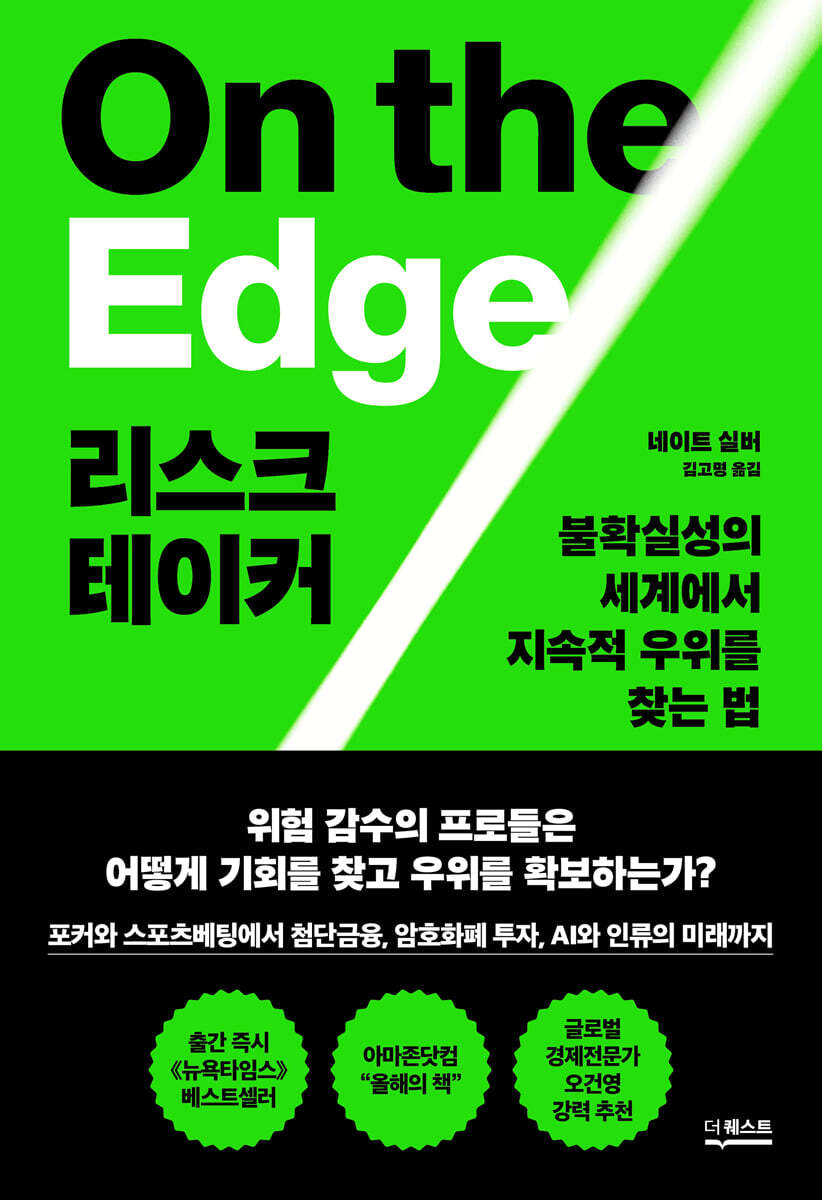
Nate Silver, a statistical analysis expert and political analyst who suggested 'how to find meaningful signals in a world full of noise' in the global bestseller 《The Signal and the Noise》, has returned with his second book 《On the Edge》 (original title) after 10 years.
In this timely and engaging book, Silver refers to the community of people who, with their distinctive mindset and high risk-taking abilities, shape and dominate much of modern society as "the river."
And with in-depth interviews with professional risk-takers—poker players, hedge fund managers, cryptocurrency enthusiasts, and blue-chip art collectors—Silver adds his signature insights to help you navigate the fog of uncertainty in the 21st century.
In this book, I try to go back to my roots.
I've spent the last three years living primarily in a world I call 'River'.
The river is still expanding as an ecosystem where like-minded people gather.
Its members range from professional players trying to make a living playing small-stakes poker to cryptocurrency kings and venture capital billionaires.
A river is a way of thinking and a way of life.
People don't know much about rivers, but now they should.
Most Riverians are not wealthy and powerful.
However, the proportion of strong people among the wealthy and powerful is much higher than that among other people.
_'prolog.
motive'
Nate Silver, a statistical analysis expert and political analyst who suggested 'how to find meaningful signals in a world full of noise' in the global bestseller 《The Signal and the Noise》, has returned with his second book 《On the Edge》 (original title) after 10 years.
In this timely and engaging book, Silver refers to the community of people who, with their distinctive mindset and high risk-taking abilities, shape and dominate much of modern society as "the river."
And with in-depth interviews with professional risk-takers—poker players, hedge fund managers, cryptocurrency enthusiasts, and blue-chip art collectors—Silver adds his signature insights to help you navigate the fog of uncertainty in the 21st century.
In this book, I try to go back to my roots.
I've spent the last three years living primarily in a world I call 'River'.
The river is still expanding as an ecosystem where like-minded people gather.
Its members range from professional players trying to make a living playing small-stakes poker to cryptocurrency kings and venture capital billionaires.
A river is a way of thinking and a way of life.
People don't know much about rivers, but now they should.
Most Riverians are not wealthy and powerful.
However, the proportion of strong people among the wealthy and powerful is much higher than that among other people.
_'prolog.
motive'
- You can preview some of the book's contents.
Preview
index
|Prologue|
Motivation│A Guide for Experienced and Challenged Travelers in the World of Risk
Chapter 0.
Introduction│The World of Calculated Risk
Expected Value: Why Rivers Are Different from Other Regions
Welcome to the river
River vs. Village
Thank you for boarding! Here's the schedule for flight OTE001.
Part 1.
gambling
Chapter 1.
Optimization│Expected Value and the Evolution of Game Theory
Game theory expert
Just because it's indiscriminate doesn't mean I don't care
Decoding the Secrets of Poker
A high-stakes showdown between GTO play and exploitative play.
Bluffing with a 'dirty diaper'
Chapter 2.
Awareness│Risk Takers on the Poker Table
Risk, reward, and excitement
Intuition and white magic
Essential Elements of the Poker Personality Type
Presumption of innocence
Chapter 3.
Consumption│How Casinos Beat Gamblers
A Brief History of Las Vegas
The Age of Win
The 'Moneyball' Effect of the Casino Business
Are they seeking action or escape?
Chapter 4.
Competition│The World of Sports Betting
The Wizards of Westgate
If you've created such a great model, why not bet on it yourself?
Two Types of Sportsbooks
The Four Core Competencies of a Sports Bettor
Winner's envoy
How to spend money
Halftime
Chapter 13.
Inspiration│13 Habits of Highly Successful Risk Takers
Part 2.
danger
Chapter 5.
Acceleration│On the Way We Take Risk and Its Limits
A Brief History of Silicon Valley
Two important characteristics of Silicon Valley
Fox-like VCs, hedgehog-like founders
Criticism of Silicon Valley
Finite mind and boundless ambition
Chapter 6.
Hallucination│When do river people become dangerous?
Act 1: New Providence Island, Bahamas, December 2022
Act 2: Miami, Florida, November–December 2021
The Perfect Storm: The Bubble's Three Factors
Bitcoin from Mars, Ethereum from Venus
Focal Point and Tokyo-based Economy
Chapter 7.
Quantity│Can we bet on morality too?
Act 3.
Flatiron District, New York, August 2022
How to measure the immeasurable
So what exactly is effective altruism?
Trolley Problem Difficult Mode
Act 4: Berkeley, California, September 2023
More Things to Consider About EA
Chapter 8.
Osan│The Limits of Utilitarian Gambling
Act 5: Lower Manhattan, October–November 2023
What's completely wrong with SBF's fact check
Four hypotheses about SBF
Never gamble with an overconfident utilitarian.
Chapter ∞.
End│Future Betting, the Future of Betting
Game theory and reality
What Large-Scale Language Models and Poker Players Have in Common
Transformers: Seeing is Not Everything
Two ways to think about p(destruction)
The Best Arguments for and Against AI Risks
Chapter 1776.
Basics│Three Principles We Must Follow
Subjectivity, plurality, and reciprocity
Acknowledgements, Interview Methods, and Sources
Glossary of Terms
annotation
Motivation│A Guide for Experienced and Challenged Travelers in the World of Risk
Chapter 0.
Introduction│The World of Calculated Risk
Expected Value: Why Rivers Are Different from Other Regions
Welcome to the river
River vs. Village
Thank you for boarding! Here's the schedule for flight OTE001.
Part 1.
gambling
Chapter 1.
Optimization│Expected Value and the Evolution of Game Theory
Game theory expert
Just because it's indiscriminate doesn't mean I don't care
Decoding the Secrets of Poker
A high-stakes showdown between GTO play and exploitative play.
Bluffing with a 'dirty diaper'
Chapter 2.
Awareness│Risk Takers on the Poker Table
Risk, reward, and excitement
Intuition and white magic
Essential Elements of the Poker Personality Type
Presumption of innocence
Chapter 3.
Consumption│How Casinos Beat Gamblers
A Brief History of Las Vegas
The Age of Win
The 'Moneyball' Effect of the Casino Business
Are they seeking action or escape?
Chapter 4.
Competition│The World of Sports Betting
The Wizards of Westgate
If you've created such a great model, why not bet on it yourself?
Two Types of Sportsbooks
The Four Core Competencies of a Sports Bettor
Winner's envoy
How to spend money
Halftime
Chapter 13.
Inspiration│13 Habits of Highly Successful Risk Takers
Part 2.
danger
Chapter 5.
Acceleration│On the Way We Take Risk and Its Limits
A Brief History of Silicon Valley
Two important characteristics of Silicon Valley
Fox-like VCs, hedgehog-like founders
Criticism of Silicon Valley
Finite mind and boundless ambition
Chapter 6.
Hallucination│When do river people become dangerous?
Act 1: New Providence Island, Bahamas, December 2022
Act 2: Miami, Florida, November–December 2021
The Perfect Storm: The Bubble's Three Factors
Bitcoin from Mars, Ethereum from Venus
Focal Point and Tokyo-based Economy
Chapter 7.
Quantity│Can we bet on morality too?
Act 3.
Flatiron District, New York, August 2022
How to measure the immeasurable
So what exactly is effective altruism?
Trolley Problem Difficult Mode
Act 4: Berkeley, California, September 2023
More Things to Consider About EA
Chapter 8.
Osan│The Limits of Utilitarian Gambling
Act 5: Lower Manhattan, October–November 2023
What's completely wrong with SBF's fact check
Four hypotheses about SBF
Never gamble with an overconfident utilitarian.
Chapter ∞.
End│Future Betting, the Future of Betting
Game theory and reality
What Large-Scale Language Models and Poker Players Have in Common
Transformers: Seeing is Not Everything
Two ways to think about p(destruction)
The Best Arguments for and Against AI Risks
Chapter 1776.
Basics│Three Principles We Must Follow
Subjectivity, plurality, and reciprocity
Acknowledgements, Interview Methods, and Sources
Glossary of Terms
annotation
Detailed image

Into the book
Remember how competitive the river people were? They worry that the villagers are destroying competition by increasingly prioritizing equality of outcome over equality of opportunity.
Most of the people in power hold to the traditional capitalist belief that free markets are better at distinguishing winners and losers than central planners.
Furthermore, we believe that market competition is beneficial to society as a whole because it leads to technological innovation, economic growth, and improved quality of life.
Conversely, there are also numerous examples of villages deviating from the principle of meritocracy.
---「Chapter 0.
From the "Preface"
First of all, I would like you to learn how to think probabilistically.
The point of my first book, The Signal and the Noise, was that probabilistic prediction is not a display of arrogance but of humility.
The world is complicated.
A small ripple can lead to a big change.
(syncopation)
Play thousands of hands of poker, watch hundreds of sports games with your own money, or invest in dozens of startups, and you'll see that the vagaries of fate and our uncertain knowledge of the world make it difficult to even get a good guess, let alone hit it.
In most cases, calculating the probability is the best we can do.
---「Chapter 0.
From the "Preface"
Finally, Chapter 1776 explains the three principles of subjectivity, plurality, and reciprocity.
These principles are the result of a combination of the most robust values of the lecture with the 18th-century ideas that gave birth to liberal democracy and the market economy.
I would argue that these three principles are essential for navigating this perilous time for our civilization, this "game" in which everyone, whether they like it or not, is at stake.
---「Chapter 0.
From the "Preface"
EV maximizers use their analytical and strategic skills in various areas of life, including gambling and investing, to calculate the optimal "play" in a given situation.
If everyone else is playing correctly, how should I play? Of course, people don't always use optimal strategies, and often they don't even use rational strategies.
However, I think that acknowledging other people's skills to some extent is a better attitude than treating them as nonplayer characters, or NPCs for short.
(syncopation)
If you can match up well when your opponent is at their best, you will win virtually any game.
However, if you develop a strategy that exploits the weaknesses of someone who is inferior to you, it is unlikely to become a winning strategy outside of that specific, narrow situation.
---「Chapter 1.
Among the "Optimization"
Randomizing strategies is an essential element of game theory beyond poker.
For example, in game theory there is a concept called mutually assured destruction.
The gist of it is that war is unlikely to break out between fully armed nuclear powers because mutual destruction is certain.
One of the key elements of mutually assured destruction is what economist Thomas Schelling called “the threat of leaving something to chance.”
Simply put, it means that it is better not to provoke the other party unnecessarily because you never know what will happen if war breaks out.
---「Chapter 1.
Among the "Optimization"
In 2022, Verlander, at nearly 40, ranked third in the league in fastballs.
On the other hand, his breaking balls (slider and curve) are slightly above average.
But Verlander only throws his fastball about 50 percent of the time.
Why is that? Because major league hitters are so good.
Although Verlander's fastball is a difficult pitch to hit, it becomes much easier to hit once you know it's coming.
(syncopation)
The important thing is that if Betts uses the right combination, his fastball and curveball will have a batting average of 'the same' .252.
To put it in precise terms, Betts is saying that Verlander is "indifferent" to his pitches.
This means that the expected values of fastballs and curveballs are the same.
So, there are times when it's actually better for pitchers to just randomly choose their pitches, like poker players.
---「Chapter 1.
Among the "Optimization"
What if we could replace traders or poker players with AI systems, so you wouldn't have to worry about those icky body chemistry issues?
I don't think that's a very good idea.
We get a lot of feedback from our bodies.
That's why some experts believe that it will be difficult for AI without a human body to have human-like intelligence.
In fact, Coates's study found that the most successful traders experienced "greater" changes in their body chemistry when faced with risk.
“This phenomenon has been observed among the most capable traders.
The endocrine response was the exact opposite of what I initially expected.
You might think that a person who is good at keeping their composure would have a very calm physiological response when taking risks.
But in fact, the opposite is true.”
---「Chapter 2.
From "Recognition"
How can we increase our "constant exposure to serendipitous opportunities"? This is, in fact, another way of expressing hindsight.
In other words, it means choosing the option that will give you more options later.
If I were you, I would call it EV maximization.
But if you express it in a self-development format, it would be like this.
Choosing a hallway with more doors increases your chances of finding an open door.
---「Chapter 2.
From "Recognition"
In poker, if you want to exploit someone else's weakness, you have to be prepared to take the same risk yourself.
So, poker players typically assume that their opponents are also trying to make the best play possible and think about what the right play is in the abstract.
---「Chapter 2.
From "Recognition"
Casinos can change the way winnings are paid out, or in other words, the probability distribution of the machines.
Guests are naturally drawn to the patterns that best match their risk tolerance, or those that most stimulate their sense of odds.
---「Chapter 3.
Among “consumption”
Bulgaria's betting style doesn't fit neatly into Spanky's bottom-up/top-down classification.
Bulgarians mainly look for angles [edges secured with a unique eye].
He basically explores hidden gems like Castellon.
In other words, we uncover gambling opportunities that have the potential to generate large profits but are somehow being ignored by the market.
(Omitted) These days, hidden gems are neither as big nor as shiny as the ones Bulgaria found 20 years ago.
Still, I often wonder why some factors are reflected in the betting line and others are not.
And the only way to discover angles is to explore a lot.
Spanky and Peabody said they don't watch much, but Bulgaris is a huge NBA fan.
---「Chapter 4.
Among the "competition"
Walters believes that the most important quality, along with diligence, is the ability to understand consensus (the collective opinion of the public or sharp bettors in sports betting).
Domain knowledge? Betting knowledge? Analytical skills? Walters appreciates it all.
Even now, in his late 70s, Walters tells me that he and his partners “experiment with deep learning algorithms and look at random forests.”
This is also a machine learning technique used in AI systems such as ChatGPT.
He felt he had no choice, that if he failed to keep up with the changes, he would be left behind in the competition.
“We never stop exploring new angles.
I know for sure.
“Our competition is the smartest people in the world.”
---「Chapter 4.
Among the "competition"
There are two main reasons why someone might make an -EV bet.
First, because it's fun.
Second, because they think they are making a 'good bet'.
Sportsbooks like DraftKings market themselves as "entertainment products" and target the first type of customer.
But I don't necessarily encourage the second type.
So, if a sportsbook known for actively limiting winning players is accepting your action, you should consider why.
It essentially means that you are considered a loser.
---「Chapter 4.
Among the "competition"
When investing in early-stage companies, you need to quickly hear the investment explanation and screen out companies that are not worth investing in.
First impressions are very important at this time.
A heuristic Cuban often uses is to look at the company from the founder's perspective.
“I have a good sense of what it takes for a business to succeed.
So when I'm listening to a business pitch, I put myself in their shoes and ask them the tough questions they need to answer if I think of their company as my own.” He applies the same tactic to his own business, thinking from the other side of the coin.
“I always get asked this question about my company.
“How can you destroy me?”
---「Chapter 13.
From "Inspiration"
Galfond said, “What I have repeatedly emphasized is logic, psychology, and statistics.
“In order of importance,” he said, referring to skills he once considered important for a poker player.
But after experiencing the above, my ranking has now changed.
“I think self-awareness and humility are more important now than psychology and statistics.”
---「Chapter 13.
From "Inspiration"
I'm not saying you should shoot indiscriminately.
However, successful risk takers are always on the lookout for +EV opportunities and are ready to pull the trigger at any moment.
(syncopation)
This attitude is what differentiates the United States from other countries.
“That’s the case in the US,” says Vinod Khosla, founder of Khosla Ventures, which invests primarily in technologies with little chance of success, such as artificial meat and artificial intelligence.
“How can I challenge myself to go for 100x without being fixated on a mere 3x gain?” he said.
According to Khosla, most countries, including his native India, face different circumstances, with social pressure to protect the underprivileged.
“It’s still like that.
What's your title? How stable is your company? So you can't operate in an uncertain area.
“Uncertainty means that the upside is wide open, but the downside is also wide open.”
---「Chapter 13.
From "Inspiration"
Quants judged SpaceX to be a reckless bet.
Musk thought differently.
“Elon had a drive to get it done, no matter what,” Thiel said.
It was said that everything would be fine if you just assembled it correctly.
But strangely enough, no one does that because everyone thinks probabilistically,” he said.
(syncopation)
Technologies that have the potential to change the world fall into an interesting category.
When you build a portfolio of low-probability bets with such technologies, like a VC firm, you gain a probabilistic perspective.
At this point, if you're a top tier VC firm, your long-term profits are virtually guaranteed.
But the same technology can be a matter of livelihood for entrepreneurs.
Silicon Valley needs probabilists, rational people who calculate odds.
But we also need irrational people: determinists, fanatics, and people who write 5,000-word manifestos.
---「Chapter 5.
From "Acceleration"
I think that this concern about inaction and the absence of concern about action are important characteristics of Silicon Valley.
Silicon Valley's method of calculating expected value is easy to understand.
I think a 5% chance of success times 100x the reward makes it a worthwhile bet.
There's no magic sauce in Silicon Valley's math.
There are no particularly quantitative techniques used when investing in early-stage companies.
“I don’t think people in Silicon Valley are particularly better at math,” Collison said.
Instead, they are better at 'executing'.
In other words, they are more likely to pull the trigger on investments that have a 'very' high chance of failure, and sometimes end up embarrassing themselves by doing so.
“I think there’s something about me that’s more developed than others.”
---「Chapter 5.
From "Acceleration"
Experts with personality traits that Tetlock calls foxlike, that is, experts with a lot of miscellaneous knowledge, were relatively more accurate in their predictions.
These clever foxes were the main characters of "Signal and Noise."
So, can a fox be a good entrepreneur? (Omitted)
Consider someone like Elon Musk.
Almost all of the characteristics listed in the hedgehog box in the table below fit.
Musk is very opinionated.
If you don't like that kind of thing, you could say you're incredibly stubborn.
It is also a hedgehog's characteristic that he thinks like an engineer and seeks order.
Til, who is a founder, can be seen as a hedgehog team.
He pursues order and thinks ideologically.
While Thiel's risk tolerance may not be as strong as Musk's (and Musk's is rare), hedgehogs have a fundamentally unusual sense of risk.
What this means is that because they are not very good at estimating risk, they may calculate the odds differently than others and do things that others would consider extremely risky.
Or, Oz may make something his life's work without even considering it.
On the other hand, fox-like habits can work very well for VCs.
When choosing where to invest, VCs make predictions.
According to Tetlock's research, foxes are better at forecasting. VCs don't necessarily focus on statistics when making forecasts.
However, since my job involves listening to business presentations from hundreds of companies across various industries, I need to know a little bit about various fields.
---「Chapter 5.
From "Acceleration"
Successful entrepreneurs may be, on average, unpopular.
Because dislike is correlated with competitiveness and independence.
But dislike is a bug, not a feature.
If you use dislike as a 'criterion' when choosing a founder, you may end up choosing the wrong person.
This is especially true if founders deliberately mimic certain archetypes that VCs seem to like.
For example, Sam Bankman-Fried (who we will talk about in the next chapter).
---「Chapter 5.
From "Acceleration"
Is Donald Trump a strongman? No.
Trump's analytical skills are so lacking that his experience in the casino business pales in comparison.
Is Elon Musk a strong man? Yes.
Although his unique impulsive personality is not very typical of a riverman, his risk-taking ability is characteristic of a riverman, and he has already become the object of admiration for many rivermen, so he cannot be excluded from the river.
But there was absolutely nothing confusing about SBF.
He was more than just a river resident; he was the river's president.
That doesn't mean that all strong people are like SBF.
He is an outlier among the powerful in that he has lost his moral compass and his gambling tendencies are so strong that even Elon Musk looks timid.
However, it is an outlier that cannot be denied that the river people are of the same race.
---「Chapter 6.
From "Hallucination"
When I met him, Mashinsky was considered a senior figure in the cryptocurrency world.
(Omitted) What is the difference between successful traders and unsuccessful traders?
His answers were both cynical and humorous, thanks to his characteristically self-deprecating style.
“Poker is all about skill.
But this job has nothing to do with skill.
You can just take the bus.
The bus has arrived at the stop.
But everyone didn't ride it.
'Hey, it's strange that there's a bus here and it smells strange too.
“I don’t want to ride! Those people are weird!” he said, pointing to his T-shirt.
It said 'HODL' on it.
Johnber is an abbreviation for 'hold on for dear life', and can be seen as a warning phrase not to ruin the party by selling cryptocurrency too early.
“No one asked me to drive that bus.
You don't even need to know the destination of that bus.
You can just take a nap on that bus.
Look at my t-shirt.
Johnber! Johnber is just a word that grows in the backseat of the bus.
And when you wake up at the end, you're a millionaire."
I bit into that part and hung on.
Shouldn't we at least acknowledge the foresight of cryptocurrency early adopters? He didn't back down an inch.
“Let’s compare the person who bought a pizza with Bitcoin to the person who forgot they had Bitcoin on their computer and then realized 10 years later that it was valuable and became a billionaire.
In fact, they are both the same person.
The only difference was that one person knew where the coin was and the other didn't.
“Skill has nothing to do with anything! Not at all! It has absolutely nothing to do with anything!”
---「Chapter 6.
From "Hallucination"
“As recently as 2014 or 2016, I thought there was only a 10 to 20 percent chance this space would ever get even remotely interesting,” Buterin told me.
Still, he calculated the expected value.
At the time, Bitcoin had a market capitalization of about $7 billion, while gold's market capitalization was a whopping $7 trillion.
Even if there was only a 5 percent chance that Bitcoin's value would rise to 10 percent of gold's, its market capitalization would have been $35 billion, five times its current value.
“I did the math and thought it was worth a try.” So Buterin decided to go all-in on cryptocurrency and dropped out of school in 2014 to receive $100,000 from Peter Thiel’s foundation to begin developing Ethereum in earnest.
---「Chapter 6.
From "Hallucination"
Much the same principle applies to Bitcoin.
Bitcoin is the focal point.
Like Grand Central, Bitcoin isn't entirely a random choice.
Bitcoin is the first cryptocurrency, and originality is crucial when finding a focal point.
And Bitcoin has a characteristic that gives it an aura of permanence.
First, Bitcoin's total supply is limited to 21 million.
Second, Bitcoin's protocol (the rules governing its functions and operations - translator's note) is famous for not being easily changed.
But the fact that there must be one (or at most two) cryptocurrencies that serve as a standard also works in Bitcoin's favor.
If I want to trade with Natecoin, you want to trade with Bitcoin, and another friend wants to trade with Dogecoin, the trade will not go through and we will both lose the game.
---「Chapter 6.
From "Hallucination"
There is an intersection of interests between EA and rationalists.
They are particularly interested in technologies that could pose an existential threat to humanity, such as AI and nuclear weapons (a topic addressed in the final chapter of this book), and they share concepts from other areas of the book, such as expected value and Bayesian inference.
However, even if there is a common ground between EA and rationalists, there is a hidden conflict of opinion, and even confrontation, behind the scenes.
---「Chapter 7.
Among the "measurements"
Effective altruists do not make rough calculations like this, but pursue more precise calculations.
I asked McCaskill what sets EAs apart and how they compare to other types of people you might encounter on the river. Listening to EAs speak, they're surprisingly similar to poker players.
(In fact, there are several famous poker players who became EAs, such as Kurganov and his partner Liv Boeree, who are mentioned in McCaskill's book.) "The common thread seems to be cognitive style.
I think the concept of expected value is important.
We are trying to measure the unmeasurable.
“It defies common sense and rejects the first instinctive thought that comes to mind when presented with an idea.” Of course, there are differences.
Poker is not an altruistic act.
“There are a lot of people, whether poker players or people in finance, who don’t care about other people.
But there are also people who are the opposite.
Such people fall into effective altruism.”
---「Chapter 7.
Among the "measurements"
Why does a book about gambling and risk delve so deeply into moral philosophy? First of all, it's because Singer is a very influential figure in the EA camp.
When McCaskill says that EA must do good based on "unfair" evaluations, this is precisely what Singer's principle means.
But the reason we discuss utilitarianism here is, above all, because this idea, often defined as “the greatest happiness for the greatest number,” is easy to express mathematically, and thus will appeal to those who like quantitative thinking.
Under utilitarianism, morality becomes a kind of EV maximization problem.
The reason we must rescue a drowning child is because the loss of soiled clothes is only worth 800 utils (units of utility), say, the price of a new Brooks Brothers suit, but the child's life is worth 10 million utils (statistical life values).
---「Chapter 7.
Among the "measurements"
The Kelly formula is often described as a formula that maximizes long-term expected value.
Of course, you also need to save up cash in case you fall into a losing streak.
No matter how good your college football prediction model is, you can't make money without a betting platform.
But to tell the truth, this is a misunderstanding.
The real function of the Kelly formula is as mentioned above.
The Kelly formula maximizes profits while simultaneously minimizing the risk of ruin.
If you're not afraid of ruin, you can bet more.
Then EV will also increase.
But if you do that, you will most likely be ruined.
---「Chapter 8.
From "Osan"
Some people may find it absurd to say that AI could lead to the extinction of humanity.
While I'm not a doomsday theorist, and I don't think p(doomsday) is the best way to answer this question, I hope to convince readers that doomsday theorists are at least not talking nonsense.
Their thinking may be wrong.
I hope I'm wrong, and I 'probably' am.
But they are not thinking absurdly.
We must embrace at least the most moderate form of doomsdayism.
It is expressed in the form of a declaration highlighting the risks of AI in one sentence.
“Mitigating the risk of AI-induced extinction must be a top priority for the international community, alongside addressing other societal risks like pandemics and nuclear war.” In 2023, the declaration was signed by the CEOs of the three largest AI companies (Altman’s OpenAI, Anthropic, and Google DeepMind)18 and prominent AI experts.
---「∞ Chapter.
From "End"
When 'extinction' was defined as 'the event in which all but 5,000 humans die by 2100,' the p(extinction) of AI predicted by experts in the field was a truncated average of 8.8 percent.
Generalists' forecast was only 0.7 percent.
Not only did the two groups differ in the number of orders of magnitude in their predictions, they also did not get along well.
Tetlock says, “Superforecasters see doomsayers as pretentious, narcissistic, and saviors of the world.
On the other hand, those concerned about AI find superforecasters frustrating.
(…) You can’t see the big picture.
“I don’t know about exponential takeoff,” he said.
---「∞ Chapter.
From "End"
The last is reciprocity.
Reciprocity is the strongest of the three principles, as it comes directly from game theory.
What it means is treating others as intelligent beings capable of rational and strategic action.
We live in a dynamic world, and people, even if they are not strictly rational, generally adapt intelligently to situations and achieve what matters most to them.
We have to fight a long war.
Of course, there are times when someone gives us an opportunity to exploit their vulnerabilities.
However, in Nash equilibrium, we must keep in mind that if we try to exploit the other party, we inevitably run the risk of being exploited ourselves.
---「Chapter 1776.
From "Basics"
Let us remember the lesson of the prisoner's dilemma.
Even if people act rationally, if they cannot trust each other, everyone will suffer worse outcomes.
There has been a significant loss of trust in all of America's major institutions and systems, and I think that's understandable.
(Omitted) Perhaps a new institutional foundation is now needed.
But I'm not sure how much longer we can survive if we lose hope in a democracy, in a system where there's even a modicum of possibility for rational choices for the public good.
Most of the people in power hold to the traditional capitalist belief that free markets are better at distinguishing winners and losers than central planners.
Furthermore, we believe that market competition is beneficial to society as a whole because it leads to technological innovation, economic growth, and improved quality of life.
Conversely, there are also numerous examples of villages deviating from the principle of meritocracy.
---「Chapter 0.
From the "Preface"
First of all, I would like you to learn how to think probabilistically.
The point of my first book, The Signal and the Noise, was that probabilistic prediction is not a display of arrogance but of humility.
The world is complicated.
A small ripple can lead to a big change.
(syncopation)
Play thousands of hands of poker, watch hundreds of sports games with your own money, or invest in dozens of startups, and you'll see that the vagaries of fate and our uncertain knowledge of the world make it difficult to even get a good guess, let alone hit it.
In most cases, calculating the probability is the best we can do.
---「Chapter 0.
From the "Preface"
Finally, Chapter 1776 explains the three principles of subjectivity, plurality, and reciprocity.
These principles are the result of a combination of the most robust values of the lecture with the 18th-century ideas that gave birth to liberal democracy and the market economy.
I would argue that these three principles are essential for navigating this perilous time for our civilization, this "game" in which everyone, whether they like it or not, is at stake.
---「Chapter 0.
From the "Preface"
EV maximizers use their analytical and strategic skills in various areas of life, including gambling and investing, to calculate the optimal "play" in a given situation.
If everyone else is playing correctly, how should I play? Of course, people don't always use optimal strategies, and often they don't even use rational strategies.
However, I think that acknowledging other people's skills to some extent is a better attitude than treating them as nonplayer characters, or NPCs for short.
(syncopation)
If you can match up well when your opponent is at their best, you will win virtually any game.
However, if you develop a strategy that exploits the weaknesses of someone who is inferior to you, it is unlikely to become a winning strategy outside of that specific, narrow situation.
---「Chapter 1.
Among the "Optimization"
Randomizing strategies is an essential element of game theory beyond poker.
For example, in game theory there is a concept called mutually assured destruction.
The gist of it is that war is unlikely to break out between fully armed nuclear powers because mutual destruction is certain.
One of the key elements of mutually assured destruction is what economist Thomas Schelling called “the threat of leaving something to chance.”
Simply put, it means that it is better not to provoke the other party unnecessarily because you never know what will happen if war breaks out.
---「Chapter 1.
Among the "Optimization"
In 2022, Verlander, at nearly 40, ranked third in the league in fastballs.
On the other hand, his breaking balls (slider and curve) are slightly above average.
But Verlander only throws his fastball about 50 percent of the time.
Why is that? Because major league hitters are so good.
Although Verlander's fastball is a difficult pitch to hit, it becomes much easier to hit once you know it's coming.
(syncopation)
The important thing is that if Betts uses the right combination, his fastball and curveball will have a batting average of 'the same' .252.
To put it in precise terms, Betts is saying that Verlander is "indifferent" to his pitches.
This means that the expected values of fastballs and curveballs are the same.
So, there are times when it's actually better for pitchers to just randomly choose their pitches, like poker players.
---「Chapter 1.
Among the "Optimization"
What if we could replace traders or poker players with AI systems, so you wouldn't have to worry about those icky body chemistry issues?
I don't think that's a very good idea.
We get a lot of feedback from our bodies.
That's why some experts believe that it will be difficult for AI without a human body to have human-like intelligence.
In fact, Coates's study found that the most successful traders experienced "greater" changes in their body chemistry when faced with risk.
“This phenomenon has been observed among the most capable traders.
The endocrine response was the exact opposite of what I initially expected.
You might think that a person who is good at keeping their composure would have a very calm physiological response when taking risks.
But in fact, the opposite is true.”
---「Chapter 2.
From "Recognition"
How can we increase our "constant exposure to serendipitous opportunities"? This is, in fact, another way of expressing hindsight.
In other words, it means choosing the option that will give you more options later.
If I were you, I would call it EV maximization.
But if you express it in a self-development format, it would be like this.
Choosing a hallway with more doors increases your chances of finding an open door.
---「Chapter 2.
From "Recognition"
In poker, if you want to exploit someone else's weakness, you have to be prepared to take the same risk yourself.
So, poker players typically assume that their opponents are also trying to make the best play possible and think about what the right play is in the abstract.
---「Chapter 2.
From "Recognition"
Casinos can change the way winnings are paid out, or in other words, the probability distribution of the machines.
Guests are naturally drawn to the patterns that best match their risk tolerance, or those that most stimulate their sense of odds.
---「Chapter 3.
Among “consumption”
Bulgaria's betting style doesn't fit neatly into Spanky's bottom-up/top-down classification.
Bulgarians mainly look for angles [edges secured with a unique eye].
He basically explores hidden gems like Castellon.
In other words, we uncover gambling opportunities that have the potential to generate large profits but are somehow being ignored by the market.
(Omitted) These days, hidden gems are neither as big nor as shiny as the ones Bulgaria found 20 years ago.
Still, I often wonder why some factors are reflected in the betting line and others are not.
And the only way to discover angles is to explore a lot.
Spanky and Peabody said they don't watch much, but Bulgaris is a huge NBA fan.
---「Chapter 4.
Among the "competition"
Walters believes that the most important quality, along with diligence, is the ability to understand consensus (the collective opinion of the public or sharp bettors in sports betting).
Domain knowledge? Betting knowledge? Analytical skills? Walters appreciates it all.
Even now, in his late 70s, Walters tells me that he and his partners “experiment with deep learning algorithms and look at random forests.”
This is also a machine learning technique used in AI systems such as ChatGPT.
He felt he had no choice, that if he failed to keep up with the changes, he would be left behind in the competition.
“We never stop exploring new angles.
I know for sure.
“Our competition is the smartest people in the world.”
---「Chapter 4.
Among the "competition"
There are two main reasons why someone might make an -EV bet.
First, because it's fun.
Second, because they think they are making a 'good bet'.
Sportsbooks like DraftKings market themselves as "entertainment products" and target the first type of customer.
But I don't necessarily encourage the second type.
So, if a sportsbook known for actively limiting winning players is accepting your action, you should consider why.
It essentially means that you are considered a loser.
---「Chapter 4.
Among the "competition"
When investing in early-stage companies, you need to quickly hear the investment explanation and screen out companies that are not worth investing in.
First impressions are very important at this time.
A heuristic Cuban often uses is to look at the company from the founder's perspective.
“I have a good sense of what it takes for a business to succeed.
So when I'm listening to a business pitch, I put myself in their shoes and ask them the tough questions they need to answer if I think of their company as my own.” He applies the same tactic to his own business, thinking from the other side of the coin.
“I always get asked this question about my company.
“How can you destroy me?”
---「Chapter 13.
From "Inspiration"
Galfond said, “What I have repeatedly emphasized is logic, psychology, and statistics.
“In order of importance,” he said, referring to skills he once considered important for a poker player.
But after experiencing the above, my ranking has now changed.
“I think self-awareness and humility are more important now than psychology and statistics.”
---「Chapter 13.
From "Inspiration"
I'm not saying you should shoot indiscriminately.
However, successful risk takers are always on the lookout for +EV opportunities and are ready to pull the trigger at any moment.
(syncopation)
This attitude is what differentiates the United States from other countries.
“That’s the case in the US,” says Vinod Khosla, founder of Khosla Ventures, which invests primarily in technologies with little chance of success, such as artificial meat and artificial intelligence.
“How can I challenge myself to go for 100x without being fixated on a mere 3x gain?” he said.
According to Khosla, most countries, including his native India, face different circumstances, with social pressure to protect the underprivileged.
“It’s still like that.
What's your title? How stable is your company? So you can't operate in an uncertain area.
“Uncertainty means that the upside is wide open, but the downside is also wide open.”
---「Chapter 13.
From "Inspiration"
Quants judged SpaceX to be a reckless bet.
Musk thought differently.
“Elon had a drive to get it done, no matter what,” Thiel said.
It was said that everything would be fine if you just assembled it correctly.
But strangely enough, no one does that because everyone thinks probabilistically,” he said.
(syncopation)
Technologies that have the potential to change the world fall into an interesting category.
When you build a portfolio of low-probability bets with such technologies, like a VC firm, you gain a probabilistic perspective.
At this point, if you're a top tier VC firm, your long-term profits are virtually guaranteed.
But the same technology can be a matter of livelihood for entrepreneurs.
Silicon Valley needs probabilists, rational people who calculate odds.
But we also need irrational people: determinists, fanatics, and people who write 5,000-word manifestos.
---「Chapter 5.
From "Acceleration"
I think that this concern about inaction and the absence of concern about action are important characteristics of Silicon Valley.
Silicon Valley's method of calculating expected value is easy to understand.
I think a 5% chance of success times 100x the reward makes it a worthwhile bet.
There's no magic sauce in Silicon Valley's math.
There are no particularly quantitative techniques used when investing in early-stage companies.
“I don’t think people in Silicon Valley are particularly better at math,” Collison said.
Instead, they are better at 'executing'.
In other words, they are more likely to pull the trigger on investments that have a 'very' high chance of failure, and sometimes end up embarrassing themselves by doing so.
“I think there’s something about me that’s more developed than others.”
---「Chapter 5.
From "Acceleration"
Experts with personality traits that Tetlock calls foxlike, that is, experts with a lot of miscellaneous knowledge, were relatively more accurate in their predictions.
These clever foxes were the main characters of "Signal and Noise."
So, can a fox be a good entrepreneur? (Omitted)
Consider someone like Elon Musk.
Almost all of the characteristics listed in the hedgehog box in the table below fit.
Musk is very opinionated.
If you don't like that kind of thing, you could say you're incredibly stubborn.
It is also a hedgehog's characteristic that he thinks like an engineer and seeks order.
Til, who is a founder, can be seen as a hedgehog team.
He pursues order and thinks ideologically.
While Thiel's risk tolerance may not be as strong as Musk's (and Musk's is rare), hedgehogs have a fundamentally unusual sense of risk.
What this means is that because they are not very good at estimating risk, they may calculate the odds differently than others and do things that others would consider extremely risky.
Or, Oz may make something his life's work without even considering it.
On the other hand, fox-like habits can work very well for VCs.
When choosing where to invest, VCs make predictions.
According to Tetlock's research, foxes are better at forecasting. VCs don't necessarily focus on statistics when making forecasts.
However, since my job involves listening to business presentations from hundreds of companies across various industries, I need to know a little bit about various fields.
---「Chapter 5.
From "Acceleration"
Successful entrepreneurs may be, on average, unpopular.
Because dislike is correlated with competitiveness and independence.
But dislike is a bug, not a feature.
If you use dislike as a 'criterion' when choosing a founder, you may end up choosing the wrong person.
This is especially true if founders deliberately mimic certain archetypes that VCs seem to like.
For example, Sam Bankman-Fried (who we will talk about in the next chapter).
---「Chapter 5.
From "Acceleration"
Is Donald Trump a strongman? No.
Trump's analytical skills are so lacking that his experience in the casino business pales in comparison.
Is Elon Musk a strong man? Yes.
Although his unique impulsive personality is not very typical of a riverman, his risk-taking ability is characteristic of a riverman, and he has already become the object of admiration for many rivermen, so he cannot be excluded from the river.
But there was absolutely nothing confusing about SBF.
He was more than just a river resident; he was the river's president.
That doesn't mean that all strong people are like SBF.
He is an outlier among the powerful in that he has lost his moral compass and his gambling tendencies are so strong that even Elon Musk looks timid.
However, it is an outlier that cannot be denied that the river people are of the same race.
---「Chapter 6.
From "Hallucination"
When I met him, Mashinsky was considered a senior figure in the cryptocurrency world.
(Omitted) What is the difference between successful traders and unsuccessful traders?
His answers were both cynical and humorous, thanks to his characteristically self-deprecating style.
“Poker is all about skill.
But this job has nothing to do with skill.
You can just take the bus.
The bus has arrived at the stop.
But everyone didn't ride it.
'Hey, it's strange that there's a bus here and it smells strange too.
“I don’t want to ride! Those people are weird!” he said, pointing to his T-shirt.
It said 'HODL' on it.
Johnber is an abbreviation for 'hold on for dear life', and can be seen as a warning phrase not to ruin the party by selling cryptocurrency too early.
“No one asked me to drive that bus.
You don't even need to know the destination of that bus.
You can just take a nap on that bus.
Look at my t-shirt.
Johnber! Johnber is just a word that grows in the backseat of the bus.
And when you wake up at the end, you're a millionaire."
I bit into that part and hung on.
Shouldn't we at least acknowledge the foresight of cryptocurrency early adopters? He didn't back down an inch.
“Let’s compare the person who bought a pizza with Bitcoin to the person who forgot they had Bitcoin on their computer and then realized 10 years later that it was valuable and became a billionaire.
In fact, they are both the same person.
The only difference was that one person knew where the coin was and the other didn't.
“Skill has nothing to do with anything! Not at all! It has absolutely nothing to do with anything!”
---「Chapter 6.
From "Hallucination"
“As recently as 2014 or 2016, I thought there was only a 10 to 20 percent chance this space would ever get even remotely interesting,” Buterin told me.
Still, he calculated the expected value.
At the time, Bitcoin had a market capitalization of about $7 billion, while gold's market capitalization was a whopping $7 trillion.
Even if there was only a 5 percent chance that Bitcoin's value would rise to 10 percent of gold's, its market capitalization would have been $35 billion, five times its current value.
“I did the math and thought it was worth a try.” So Buterin decided to go all-in on cryptocurrency and dropped out of school in 2014 to receive $100,000 from Peter Thiel’s foundation to begin developing Ethereum in earnest.
---「Chapter 6.
From "Hallucination"
Much the same principle applies to Bitcoin.
Bitcoin is the focal point.
Like Grand Central, Bitcoin isn't entirely a random choice.
Bitcoin is the first cryptocurrency, and originality is crucial when finding a focal point.
And Bitcoin has a characteristic that gives it an aura of permanence.
First, Bitcoin's total supply is limited to 21 million.
Second, Bitcoin's protocol (the rules governing its functions and operations - translator's note) is famous for not being easily changed.
But the fact that there must be one (or at most two) cryptocurrencies that serve as a standard also works in Bitcoin's favor.
If I want to trade with Natecoin, you want to trade with Bitcoin, and another friend wants to trade with Dogecoin, the trade will not go through and we will both lose the game.
---「Chapter 6.
From "Hallucination"
There is an intersection of interests between EA and rationalists.
They are particularly interested in technologies that could pose an existential threat to humanity, such as AI and nuclear weapons (a topic addressed in the final chapter of this book), and they share concepts from other areas of the book, such as expected value and Bayesian inference.
However, even if there is a common ground between EA and rationalists, there is a hidden conflict of opinion, and even confrontation, behind the scenes.
---「Chapter 7.
Among the "measurements"
Effective altruists do not make rough calculations like this, but pursue more precise calculations.
I asked McCaskill what sets EAs apart and how they compare to other types of people you might encounter on the river. Listening to EAs speak, they're surprisingly similar to poker players.
(In fact, there are several famous poker players who became EAs, such as Kurganov and his partner Liv Boeree, who are mentioned in McCaskill's book.) "The common thread seems to be cognitive style.
I think the concept of expected value is important.
We are trying to measure the unmeasurable.
“It defies common sense and rejects the first instinctive thought that comes to mind when presented with an idea.” Of course, there are differences.
Poker is not an altruistic act.
“There are a lot of people, whether poker players or people in finance, who don’t care about other people.
But there are also people who are the opposite.
Such people fall into effective altruism.”
---「Chapter 7.
Among the "measurements"
Why does a book about gambling and risk delve so deeply into moral philosophy? First of all, it's because Singer is a very influential figure in the EA camp.
When McCaskill says that EA must do good based on "unfair" evaluations, this is precisely what Singer's principle means.
But the reason we discuss utilitarianism here is, above all, because this idea, often defined as “the greatest happiness for the greatest number,” is easy to express mathematically, and thus will appeal to those who like quantitative thinking.
Under utilitarianism, morality becomes a kind of EV maximization problem.
The reason we must rescue a drowning child is because the loss of soiled clothes is only worth 800 utils (units of utility), say, the price of a new Brooks Brothers suit, but the child's life is worth 10 million utils (statistical life values).
---「Chapter 7.
Among the "measurements"
The Kelly formula is often described as a formula that maximizes long-term expected value.
Of course, you also need to save up cash in case you fall into a losing streak.
No matter how good your college football prediction model is, you can't make money without a betting platform.
But to tell the truth, this is a misunderstanding.
The real function of the Kelly formula is as mentioned above.
The Kelly formula maximizes profits while simultaneously minimizing the risk of ruin.
If you're not afraid of ruin, you can bet more.
Then EV will also increase.
But if you do that, you will most likely be ruined.
---「Chapter 8.
From "Osan"
Some people may find it absurd to say that AI could lead to the extinction of humanity.
While I'm not a doomsday theorist, and I don't think p(doomsday) is the best way to answer this question, I hope to convince readers that doomsday theorists are at least not talking nonsense.
Their thinking may be wrong.
I hope I'm wrong, and I 'probably' am.
But they are not thinking absurdly.
We must embrace at least the most moderate form of doomsdayism.
It is expressed in the form of a declaration highlighting the risks of AI in one sentence.
“Mitigating the risk of AI-induced extinction must be a top priority for the international community, alongside addressing other societal risks like pandemics and nuclear war.” In 2023, the declaration was signed by the CEOs of the three largest AI companies (Altman’s OpenAI, Anthropic, and Google DeepMind)18 and prominent AI experts.
---「∞ Chapter.
From "End"
When 'extinction' was defined as 'the event in which all but 5,000 humans die by 2100,' the p(extinction) of AI predicted by experts in the field was a truncated average of 8.8 percent.
Generalists' forecast was only 0.7 percent.
Not only did the two groups differ in the number of orders of magnitude in their predictions, they also did not get along well.
Tetlock says, “Superforecasters see doomsayers as pretentious, narcissistic, and saviors of the world.
On the other hand, those concerned about AI find superforecasters frustrating.
(…) You can’t see the big picture.
“I don’t know about exponential takeoff,” he said.
---「∞ Chapter.
From "End"
The last is reciprocity.
Reciprocity is the strongest of the three principles, as it comes directly from game theory.
What it means is treating others as intelligent beings capable of rational and strategic action.
We live in a dynamic world, and people, even if they are not strictly rational, generally adapt intelligently to situations and achieve what matters most to them.
We have to fight a long war.
Of course, there are times when someone gives us an opportunity to exploit their vulnerabilities.
However, in Nash equilibrium, we must keep in mind that if we try to exploit the other party, we inevitably run the risk of being exploited ourselves.
---「Chapter 1776.
From "Basics"
Let us remember the lesson of the prisoner's dilemma.
Even if people act rationally, if they cannot trust each other, everyone will suffer worse outcomes.
There has been a significant loss of trust in all of America's major institutions and systems, and I think that's understandable.
(Omitted) Perhaps a new institutional foundation is now needed.
But I'm not sure how much longer we can survive if we lose hope in a democracy, in a system where there's even a modicum of possibility for rational choices for the public good.
---「Chapter 1776.
From "Basics"
From "Basics"
Publisher's Review
How will a new order be created in an era of heightened risk?
We live in an era where everyone is competing for that slim 'long-term advantage', the so-called 'edge'.
How will we navigate the fog of uncertainty that is the 21st century? According to Nate Silver, a forecasting expert, professional sports fanatic, and poker player, it's those who "think like gamblers" who are creating a new world order based on risk, mathematics, and ambition.
Poker legends, hedge fund magnates, cryptocurrency speculators, and even those who bet the world's future on AI.
They operate in casinos, venture capital firms, the backrooms of FTX, and the "effective altruism" camp, influencing the future of everything from cutting-edge finance to the future shaped by AI.
Why are the "strong" people increasingly accumulating wealth and power?
Silver calls the community of risk takers, or risk takers with expertise, a "gang."
The 'strong people' are leading the next era of finance, technology, and politics.
Risk takers make no secret of their thirst for volatility and their relentless desire to gain an edge.
They love numbers, betting based on 'expected value' and don't avoid risk and uncertainty.
He is quick-witted, makes big bets, and sometimes gets caught up in his own myths.
They instinctively reject convention, are competitive, and take complexity for granted but focus on how to deal with it.
Only when we understand their flaws beyond their way of thinking can we foresee what will drive the world in the future.
A Guide for Challengers and Strivers Seeking an Edge (Sustainable Advantage)
In the 2020 revised edition of The Signal and the Noise, Nate Silver expressed his reflections, reflections, and determination as a forecasting expert, saying, “Most of us still don’t quite understand probability and uncertainty.”
After leaving fivethirtyeight.com, the political analysis and polling site he founded in 2023, Silver now runs the Substack blog Silver Bulletin, where his insightful analysis and comments consistently capture media and public attention during election season and whenever major issues arise.
Now, Silver has stepped into the highly sophisticated world of the 21st century, analyzing the strategies and mindsets of leading risk-takers to provide updated insights on risk and uncertainty.
What he's done by diving headfirst into the worlds of Doyle Brunson (poker player), Peter Thiel (PayPal founder and venture capitalist), Sam Bankman-Fried (former cryptocurrency entrepreneur accused of fraud), Sam Altman (OpenAI founder), and many others is his insight into issues that have profound implications for everyone, from cutting-edge finance to the future of AI.
Game Theory Fundamentals and How to Think Like a Gambler
Silver, who is also a professional poker player, opens the book with stories about poker and its legendary players.
Chapter 1.
In 'Optimization', Silver discusses the battle between man and machine and highlights the emergence of Solver, a computer program that revolutionized poker.
But the foundation of all this talk is game theory, which, along with expected value, is one of the most important concepts in the river.
Chapter 2.
In 'Awareness', the author thoroughly analyzes the cheating scandal that rocked the high-stakes poker world while writing this book.
We'll also introduce the world's best poker players—legendary risk-takers—and explain where their traits come from. Based on this, we'll explore the physical impact of risk-taking, how to spot bluffs and cheaters, and more.
Chapter 3.
In "Consumption," we delve into the modern casino industry and trace how Las Vegas, once a desert wasteland, became the beating heart of a massive industry that showcases the raw power of American capitalism.
In the casino industry, the thing that best shows the strong mindset is the 'house'.
This is because casinos are using AI algorithms to encourage customers to gamble more.
Chapter 4.
'Competition' covers sports betting and provides an insider's account of its sudden rise to popularity in the United States.
Sports betting is the ultimate battle of nerves on the river, with bettors and sportsbooks using their statistical knowledge and practicality to exploit each other's weaknesses.
Silver meets with world-class bookmakers and bettors and shares their stories in detail.
13 Habits of Highly Effective Risk Takers: Halftime
Chapter 13, which corresponds to 'halftime'.
In "Inspiration" (the fact that Chapter 13 appears at this point is not a book error but entirely the author's intention), the topic "13 Habits of Highly Effective Risk Takers" highlights commonalities between quantitative risk takers and other professionals who take physical risks.
Silver interviews astronauts, explorers, NFL players, and more to reveal what's unique about the psychology of those who seek and successfully navigate risk.
Today's Risk: Based on Risk, Mathematics, and Ambition
How is the new world order being created?
When we get into Part 2, which deals with risks in earnest, Chapter 5.
In 'Acceleration', the unstoppable sprint of VC (venture capital) unfolds before our eyes.
Despite all its obvious shortcomings, Silicon Valley has achieved remarkable success in its own way.
Through conversations with some of the world's most successful VCs—and their harshest critics—we explore why founders like Elon Musk behave the way they do, why venture capital and the village are sworn enemies, and how top VC firms can so effortlessly reap outsized returns without taking significant risks.
Chapter 6.
From 'Hallucination' to 'Chapter 7.
'Weighting', 'Chapter 8.
In three chapters, we explore the mindset of Sam Bankman-Fried, who went from being a $26.5 billionaire to a prisoner, along with various tributaries of the river, such as VC, cryptocurrency, and effective altruism, to see when the thoughts of river people become "dangerous."
Drawing on game theory and sociology, we explain why cryptocurrency investors are easily scammed, and introduce some clever individuals who successfully avoided such traps.
Chapter 7.
In 'Quantification', we trace the intellectual lineage of effective altruism (EA) and rationalism, and discuss why these two seemingly divergent movements share a common concern with existential risk and the possibility of civilization being destroyed by unaligned artificial intelligence.
Chapter 8.
'Osan' is a sort of mini-finale, bringing us back to SBF's story and ending it on a strong note (not a spoiler, but) with him making another bad bet before a fateful verdict in a New York courtroom.
Chapter ∞, the first of two chapters that serve as the conclusion to the book.
In 'End', we introduce people who develop large-scale language models, such as OpenAI CEO Sam Altman and ChatGPT.
Unlike the government-led Manhattan Project, the movement to forge ahead into uncharted territory in AI is spearheaded by Silicon Valley's "techno-optimists," armed with a strong perspective on risk and reward.
In a world that appears to be in a state of stagnation, AI optimists like Altman, as well as AI "doomsdayers," believe that civilization is on the verge of a turning point unlike anything seen since the atomic bomb, and that AI is a technological bet to secure existential capital.
Chapter 1776, which concludes the book.
In 'Basics', Silver proposes three principles: subjectivity, plurality, and reciprocity.
These principles are the result of a combination of the most robust values of the lecture with the 18th-century ideas that gave birth to liberal democracy and the market economy.
Silver argues that these three principles are essential for navigating this perilous time for our civilization, a "game" in which everyone's life is at stake, whether they like it or not.
We live in an era where everyone is competing for that slim 'long-term advantage', the so-called 'edge'.
How will we navigate the fog of uncertainty that is the 21st century? According to Nate Silver, a forecasting expert, professional sports fanatic, and poker player, it's those who "think like gamblers" who are creating a new world order based on risk, mathematics, and ambition.
Poker legends, hedge fund magnates, cryptocurrency speculators, and even those who bet the world's future on AI.
They operate in casinos, venture capital firms, the backrooms of FTX, and the "effective altruism" camp, influencing the future of everything from cutting-edge finance to the future shaped by AI.
Why are the "strong" people increasingly accumulating wealth and power?
Silver calls the community of risk takers, or risk takers with expertise, a "gang."
The 'strong people' are leading the next era of finance, technology, and politics.
Risk takers make no secret of their thirst for volatility and their relentless desire to gain an edge.
They love numbers, betting based on 'expected value' and don't avoid risk and uncertainty.
He is quick-witted, makes big bets, and sometimes gets caught up in his own myths.
They instinctively reject convention, are competitive, and take complexity for granted but focus on how to deal with it.
Only when we understand their flaws beyond their way of thinking can we foresee what will drive the world in the future.
A Guide for Challengers and Strivers Seeking an Edge (Sustainable Advantage)
In the 2020 revised edition of The Signal and the Noise, Nate Silver expressed his reflections, reflections, and determination as a forecasting expert, saying, “Most of us still don’t quite understand probability and uncertainty.”
After leaving fivethirtyeight.com, the political analysis and polling site he founded in 2023, Silver now runs the Substack blog Silver Bulletin, where his insightful analysis and comments consistently capture media and public attention during election season and whenever major issues arise.
Now, Silver has stepped into the highly sophisticated world of the 21st century, analyzing the strategies and mindsets of leading risk-takers to provide updated insights on risk and uncertainty.
What he's done by diving headfirst into the worlds of Doyle Brunson (poker player), Peter Thiel (PayPal founder and venture capitalist), Sam Bankman-Fried (former cryptocurrency entrepreneur accused of fraud), Sam Altman (OpenAI founder), and many others is his insight into issues that have profound implications for everyone, from cutting-edge finance to the future of AI.
Game Theory Fundamentals and How to Think Like a Gambler
Silver, who is also a professional poker player, opens the book with stories about poker and its legendary players.
Chapter 1.
In 'Optimization', Silver discusses the battle between man and machine and highlights the emergence of Solver, a computer program that revolutionized poker.
But the foundation of all this talk is game theory, which, along with expected value, is one of the most important concepts in the river.
Chapter 2.
In 'Awareness', the author thoroughly analyzes the cheating scandal that rocked the high-stakes poker world while writing this book.
We'll also introduce the world's best poker players—legendary risk-takers—and explain where their traits come from. Based on this, we'll explore the physical impact of risk-taking, how to spot bluffs and cheaters, and more.
Chapter 3.
In "Consumption," we delve into the modern casino industry and trace how Las Vegas, once a desert wasteland, became the beating heart of a massive industry that showcases the raw power of American capitalism.
In the casino industry, the thing that best shows the strong mindset is the 'house'.
This is because casinos are using AI algorithms to encourage customers to gamble more.
Chapter 4.
'Competition' covers sports betting and provides an insider's account of its sudden rise to popularity in the United States.
Sports betting is the ultimate battle of nerves on the river, with bettors and sportsbooks using their statistical knowledge and practicality to exploit each other's weaknesses.
Silver meets with world-class bookmakers and bettors and shares their stories in detail.
13 Habits of Highly Effective Risk Takers: Halftime
Chapter 13, which corresponds to 'halftime'.
In "Inspiration" (the fact that Chapter 13 appears at this point is not a book error but entirely the author's intention), the topic "13 Habits of Highly Effective Risk Takers" highlights commonalities between quantitative risk takers and other professionals who take physical risks.
Silver interviews astronauts, explorers, NFL players, and more to reveal what's unique about the psychology of those who seek and successfully navigate risk.
Today's Risk: Based on Risk, Mathematics, and Ambition
How is the new world order being created?
When we get into Part 2, which deals with risks in earnest, Chapter 5.
In 'Acceleration', the unstoppable sprint of VC (venture capital) unfolds before our eyes.
Despite all its obvious shortcomings, Silicon Valley has achieved remarkable success in its own way.
Through conversations with some of the world's most successful VCs—and their harshest critics—we explore why founders like Elon Musk behave the way they do, why venture capital and the village are sworn enemies, and how top VC firms can so effortlessly reap outsized returns without taking significant risks.
Chapter 6.
From 'Hallucination' to 'Chapter 7.
'Weighting', 'Chapter 8.
In three chapters, we explore the mindset of Sam Bankman-Fried, who went from being a $26.5 billionaire to a prisoner, along with various tributaries of the river, such as VC, cryptocurrency, and effective altruism, to see when the thoughts of river people become "dangerous."
Drawing on game theory and sociology, we explain why cryptocurrency investors are easily scammed, and introduce some clever individuals who successfully avoided such traps.
Chapter 7.
In 'Quantification', we trace the intellectual lineage of effective altruism (EA) and rationalism, and discuss why these two seemingly divergent movements share a common concern with existential risk and the possibility of civilization being destroyed by unaligned artificial intelligence.
Chapter 8.
'Osan' is a sort of mini-finale, bringing us back to SBF's story and ending it on a strong note (not a spoiler, but) with him making another bad bet before a fateful verdict in a New York courtroom.
Chapter ∞, the first of two chapters that serve as the conclusion to the book.
In 'End', we introduce people who develop large-scale language models, such as OpenAI CEO Sam Altman and ChatGPT.
Unlike the government-led Manhattan Project, the movement to forge ahead into uncharted territory in AI is spearheaded by Silicon Valley's "techno-optimists," armed with a strong perspective on risk and reward.
In a world that appears to be in a state of stagnation, AI optimists like Altman, as well as AI "doomsdayers," believe that civilization is on the verge of a turning point unlike anything seen since the atomic bomb, and that AI is a technological bet to secure existential capital.
Chapter 1776, which concludes the book.
In 'Basics', Silver proposes three principles: subjectivity, plurality, and reciprocity.
These principles are the result of a combination of the most robust values of the lecture with the 18th-century ideas that gave birth to liberal democracy and the market economy.
Silver argues that these three principles are essential for navigating this perilous time for our civilization, a "game" in which everyone's life is at stake, whether they like it or not.
GOODS SPECIFICS
- Date of issue: July 10, 2025
- Format: Hardcover book binding method guide
- Page count, weight, size: 784 pages | 152*225*40mm
- ISBN13: 9791140714582
- ISBN10: 1140714589
You may also like
카테고리
korean


korean

![ELLE 엘르 스페셜 에디션 A형 : 12월 [2025]](http://librairie.coreenne.fr/cdn/shop/files/b8e27a3de6c9538896439686c6b0e8fb.jpg?v=1766436872&width=3840)


