

Running & Marathon Just Follow
 |
Description
Book Introduction
- A word from MD
-
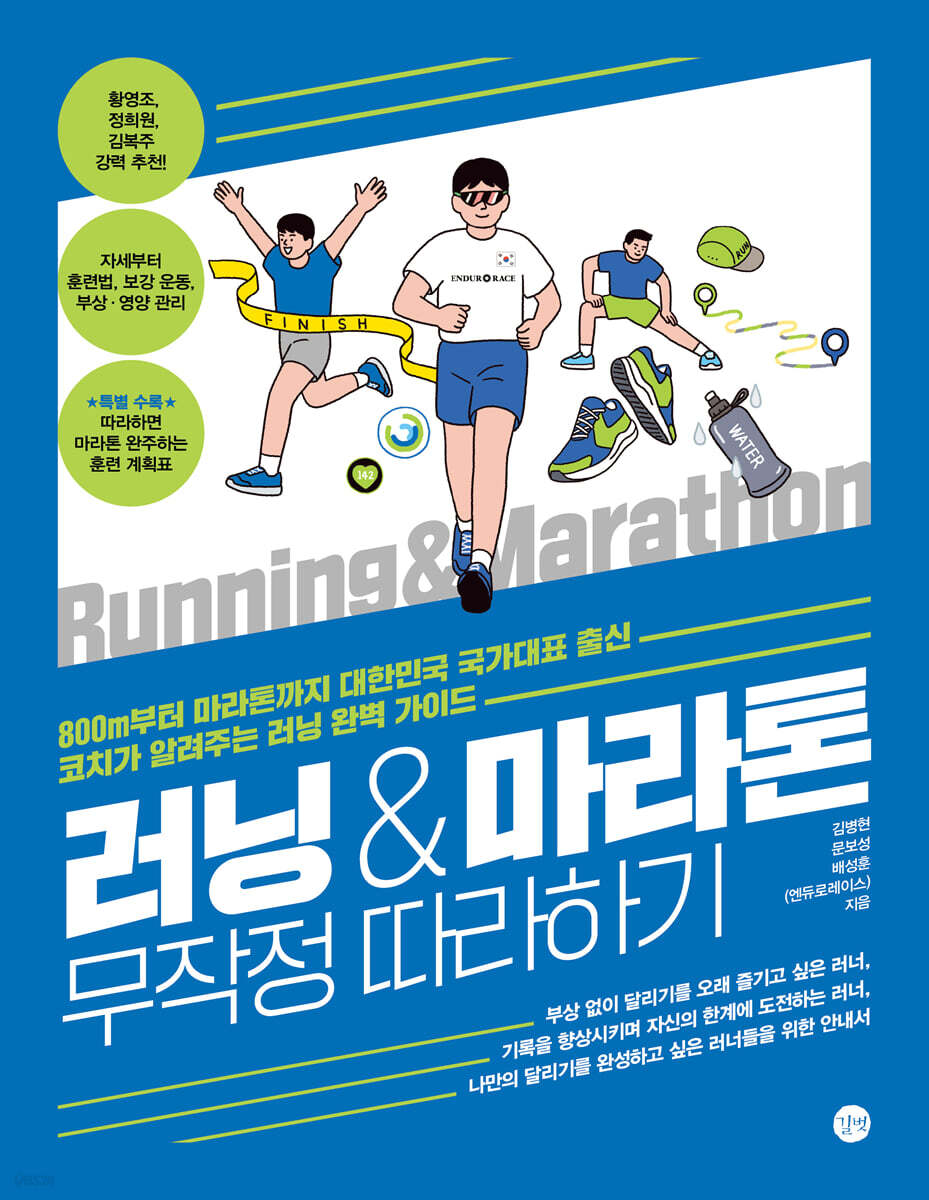
A Complete Guide to Running from a National Team CoachA book that will serve as a clear milestone for those who are just starting to run and those who dream of completing a race.
A complete guide to running, covering everything from proper posture and level-based training to strengthening exercises and injury recovery.
Based on practical experience and professional training, it provides the joy of completion for beginners and the sense of accomplishment of improving records for experts.
August 5, 2025. Health and Hobbies PD Ahn Hyun-jae
From correct posture to level-based training,
From strengthening exercises, injury recovery, nutrition, and mental health management.
Everything you need to know about running in one book
Running is now a common sight throughout the city, with people running at various paces. It's no longer just a specific training method, but a part of everyday life, a way to manage one's own life. However, many people who actually start running often find themselves feeling fatigued, sore, or limited by their physical strength, and end up quitting.
If you want to enjoy running consistently, it is most important to focus on the basics and learn the correct posture and technique.
This book is a practical guidebook and the culmination of years of practical experience and professional training by three national team running coaches.
It's designed to allow you to design your training according to your individual level and goals, making it truly helpful for everyone, from beginners just starting out to intermediate runners aiming to improve their times.
From strengthening exercises, injury recovery, nutrition, and mental health management.
Everything you need to know about running in one book
Running is now a common sight throughout the city, with people running at various paces. It's no longer just a specific training method, but a part of everyday life, a way to manage one's own life. However, many people who actually start running often find themselves feeling fatigued, sore, or limited by their physical strength, and end up quitting.
If you want to enjoy running consistently, it is most important to focus on the basics and learn the correct posture and technique.
This book is a practical guidebook and the culmination of years of practical experience and professional training by three national team running coaches.
It's designed to allow you to design your training according to your individual level and goals, making it truly helpful for everyone, from beginners just starting out to intermediate runners aiming to improve their times.
- You can preview some of the book's contents.
Preview
index
To you who are taking your first steps at the West Gate
How to use this book
Essential Running Terms
PART 1 The Basics of Running
First yard.
Posture and Techniques for Efficient Running
01 Gaze
02 Breathing
03 Arm wrestling
04 Lower body
05 Landing
[In-Depth Learning] The Most Effective Way to Analyze Running Posture
Second yard.
Breathing and rhythm that create a steady pace
06 Breathing and Cadence
07 How to Find Your Own Running Rhythm
Third yard.
Equipment and supplies for a comfortable run
08 Choosing Running Shoes
09 Choosing Running Apparel
10 Tips for Choosing Sports Watches and Other Gear
Fourth yard.
3 Key Metrics to Know to Improve Running Performance
11 Top 3 Metrics Every Runner Should Know
12 VO₂max: The Science of Breathing and Pacing
[In-depth Learning] If you're a runner, take the CPET at least once.
[In-depth Learning] Understanding the Respiratory Exchange Rate (RER), Which Determines Energy Metabolism
13 Ventilatory Threshold (VT): Master Fatigue Beyond Breathing
[In-Depth Learning] Rediscovering Lactic Acid: The Relationship Between Running and Lactic Acid
14 Running Economy: The Power to Go Far with Less Effort
[In-Depth Learning] 10 Common Misconceptions About Running
PART 2: Practice! Running
Fifth yard.
Types of Running Training
15 Jogging: The First Step to Running
16 Heart Rate Training: Easy for Every Runner
17 LSD Training: Running for Long Periods Without Getting Tired
18 Fartlek Training: Rhythm to Speed
19 Interval Training: To Run Faster, Faster
20 Endurance Training: The Power to Run Without Stopping
21 Tempo Run Training: The Key to Lowering Your Times
[Advanced Learning] High Altitude Training
[In-depth Learning] Remember This 1. Types of Training and Comparison
[In-depth Learning] Remember This 2: Warm-up and Cool-down Methods Before and After Training
Sixth yard.
Goal-based training program
22 Keys to Running Training Design
23 6-Week Training Program for Beginners
6-Week Training Program for Completing 24 10km
10-Week Training Program for a Half Marathon
12-Week Training Program for Completing a Full Marathon
[In-depth Learning] Can we use a treadmill for systematic running training?
[Advanced Learning] Practical! Treadmill Training Methods for Each Level
PART3 Level Up Running
Seventh yard.
Running reinforcement exercises
27 Hidden Secrets of Running Performance
28 Full-Body Core Strengthening Exercises Essential for Running
29 Balance Exercises to Improve Your Running Sense
30 Keys to Injury Prevention and Recovery: Flexibility Exercises and Stretches
31. Reinforcement Exercises Using Small Tools to Correct Running Posture
32 Cross Training
[Advanced Learning] Continue! 6 Additional Strengthening Exercises
- ① Compound resistance exercise ② Stair exercise ③ Circuit training ④ Pitch exercise ⑤ Skip exercise ⑥ Rhythm exercise
Eighth yard.
Injury Prevention and Conditioning
33 Common Injuries Runners Experience
34 6 Steps to Overcoming Injury and Recovering
[Advanced Learning] 6 Mental Strategies for Overcoming Injuries
35 The Optimal Recovery Strategy for Runners
36 The Key to Muscle Recovery: Massage and Foam Rolling
37 Massage Points and Care Tips for Each Area
The ninth yard.
Nutrition and Diet
38 Basic Nutrition for Runners
39 How to Carb Load Before a Competition
40 Good Supplements for Runners
The tenth yard.
Mental management
41 Goal Setting and Motivation to Keep Running
42 Stress Management and Concentration Improvement
43 Pre-Game Relaxation Techniques
44 Training for Mental Strengthening
Appendix What is data-driven learning?
Appendix Recommended Apps and Equipment
Appendix Representative Marathon Competitions
Appendix Running Community Information
How to use this book
Essential Running Terms
PART 1 The Basics of Running
First yard.
Posture and Techniques for Efficient Running
01 Gaze
02 Breathing
03 Arm wrestling
04 Lower body
05 Landing
[In-Depth Learning] The Most Effective Way to Analyze Running Posture
Second yard.
Breathing and rhythm that create a steady pace
06 Breathing and Cadence
07 How to Find Your Own Running Rhythm
Third yard.
Equipment and supplies for a comfortable run
08 Choosing Running Shoes
09 Choosing Running Apparel
10 Tips for Choosing Sports Watches and Other Gear
Fourth yard.
3 Key Metrics to Know to Improve Running Performance
11 Top 3 Metrics Every Runner Should Know
12 VO₂max: The Science of Breathing and Pacing
[In-depth Learning] If you're a runner, take the CPET at least once.
[In-depth Learning] Understanding the Respiratory Exchange Rate (RER), Which Determines Energy Metabolism
13 Ventilatory Threshold (VT): Master Fatigue Beyond Breathing
[In-Depth Learning] Rediscovering Lactic Acid: The Relationship Between Running and Lactic Acid
14 Running Economy: The Power to Go Far with Less Effort
[In-Depth Learning] 10 Common Misconceptions About Running
PART 2: Practice! Running
Fifth yard.
Types of Running Training
15 Jogging: The First Step to Running
16 Heart Rate Training: Easy for Every Runner
17 LSD Training: Running for Long Periods Without Getting Tired
18 Fartlek Training: Rhythm to Speed
19 Interval Training: To Run Faster, Faster
20 Endurance Training: The Power to Run Without Stopping
21 Tempo Run Training: The Key to Lowering Your Times
[Advanced Learning] High Altitude Training
[In-depth Learning] Remember This 1. Types of Training and Comparison
[In-depth Learning] Remember This 2: Warm-up and Cool-down Methods Before and After Training
Sixth yard.
Goal-based training program
22 Keys to Running Training Design
23 6-Week Training Program for Beginners
6-Week Training Program for Completing 24 10km
10-Week Training Program for a Half Marathon
12-Week Training Program for Completing a Full Marathon
[In-depth Learning] Can we use a treadmill for systematic running training?
[Advanced Learning] Practical! Treadmill Training Methods for Each Level
PART3 Level Up Running
Seventh yard.
Running reinforcement exercises
27 Hidden Secrets of Running Performance
28 Full-Body Core Strengthening Exercises Essential for Running
29 Balance Exercises to Improve Your Running Sense
30 Keys to Injury Prevention and Recovery: Flexibility Exercises and Stretches
31. Reinforcement Exercises Using Small Tools to Correct Running Posture
32 Cross Training
[Advanced Learning] Continue! 6 Additional Strengthening Exercises
- ① Compound resistance exercise ② Stair exercise ③ Circuit training ④ Pitch exercise ⑤ Skip exercise ⑥ Rhythm exercise
Eighth yard.
Injury Prevention and Conditioning
33 Common Injuries Runners Experience
34 6 Steps to Overcoming Injury and Recovering
[Advanced Learning] 6 Mental Strategies for Overcoming Injuries
35 The Optimal Recovery Strategy for Runners
36 The Key to Muscle Recovery: Massage and Foam Rolling
37 Massage Points and Care Tips for Each Area
The ninth yard.
Nutrition and Diet
38 Basic Nutrition for Runners
39 How to Carb Load Before a Competition
40 Good Supplements for Runners
The tenth yard.
Mental management
41 Goal Setting and Motivation to Keep Running
42 Stress Management and Concentration Improvement
43 Pre-Game Relaxation Techniques
44 Training for Mental Strengthening
Appendix What is data-driven learning?
Appendix Recommended Apps and Equipment
Appendix Representative Marathon Competitions
Appendix Running Community Information
Detailed image

Into the book
*Appropriate eye contact*
When I run alone
: Run while looking at the ground 10 to 15 meters ahead of you.
When we run together
: If I'm running behind someone taller than me, I look at the waist of the person in front of me.
: If you are running behind someone who is shorter than you, look at the shoulder of the person in front of you.
: When running with someone of similar height, look at the back of the person in front of you.
--- “First yard.
From “Posture and Techniques for Efficient Running”
Is it always best to aim for a cadence of 180? While it's widely believed that a cadence of 180 is ideal for running, this is simply an average.
In reality, the appropriate cadence will vary depending on the individual's physical condition, muscle strength, stride length, and pace.
If you try to force a 180, you will end up running unnaturally and may cause injury.
The important thing is to find a natural cadence that feels comfortable for your body.
--- “Second yard.
From "Breathing and Rhythm that Create a Stable Pace"
You can set training goals based on your VO₂max value or design appropriate training intensity and direction.
For example, an intermediate runner with a VO₂max of 45 mL/kg/min could easily complete a half marathon, but might not be able to aim for a sub-4 full marathon.
In this case, a mid-term goal is to increase VO₂max to over 50 by combining Zone 2 training and threshold interval training.
It is effective to design a training schedule with the structure of ‘aerobic endurance + interval stimulation.’
Anyone can challenge themselves to run a marathon, but a low VO₂max can be interpreted as a sign of a lack of aerobic basal fitness.
Even if your goal is simply to 'finish' the race, you need a certain level of VO₂max to run comfortably and healthily.
--- “Fourth yard.
Among the “3 Key Indicators to Know to Improve Running Performance”
Fartlek training is a training method that allows you to freely vary your pace and intensity while running.
After running at a near-power pace for a certain section, you will then recover by running slowly or walking briskly.
Because there is no clear distance or time limit like with interval training, you can control your heart rate and perceived exertion intensity (RPE) and stimulate both the aerobic and anaerobic systems simultaneously.
Fartlek allows for natural pace changes on a variety of terrain, including roads, hills, and forest trails, making it effective for developing speed adaptability and endurance, as well as the ability to cope with unpredictable situations that may arise during a race.
Above all, you can enjoy training without getting bored, which helps maintain motivation and psychological recovery.
--- “Fifth yard.
Among the types of running training
The 12-week full-course marathon program is divided into 5-hour, 4-hour 30-minute, 4-hour, 3-hour 30-minute, and 3-hour completion time targets.
Training is conducted five times a week, with Mondays featuring light jogging and running drills, and Tuesdays featuring a combination of stair climbing, hill training, and fartlek training.
Thursdays are structured around LSD training during the base phase, and interval training or medium- to high-intensity technical training once you get into the race-oriented phase.
Saturday is the core session for combined strength training, including circuit, shift, and endurance training.
Wednesday and Friday (or Sunday) are designated as recovery days and you should get plenty of rest.
--- “The sixth yard.
Among the “Training Programs by Goal”
Stretching is divided into static, dynamic, active, and passive methods, and it is important to select each method appropriately depending on the time and purpose of application.
Since they are used differently before and after exercise or for recovery and flexibility enhancement, it is important to understand and utilize the characteristics and differences of each.
Dynamic stretching is the most effective warm-up before starting a run to increase muscle temperature, increase joint range of motion, and activate the nervous system.
--- “The seventh yard.
From "Running Reinforcement Exercise"
Circuit training is a high-intensity training method that improves both full-body strength and cardiorespiratory endurance by performing a variety of movements in a short period of time.
It includes all the lower body strength, core stability, rhythm, and agility required for running, and efficiently trains the entire body by connecting eight movements without rest.
The key is to minimize rest periods between movements, adjust the intensity based on your fitness level, and gradually increase it.
(▶ Recommended number of repetitions: 30 seconds for each movement + 10 seconds of rest, 1-3 sets)
--- “The seventh yard.
From "Running Reinforcement Exercise"
Carbohydrate loading is a strategy to maximize your body's glycogen stores by increasing your carbohydrate intake for 2-3 days before a competition.
This allows for a sustained supply of energy during long distance runs, helps delay the accumulation of fatigue in the latter half of the run, and improves pace maintenance.
Carbohydrates are broken down into glucose in the body and then stored in the liver and muscles as glycogen.
During running, glycogen is the primary energy source used first, and if stores are low, it becomes difficult to maintain a steady pace in the second half of the run.
Carbohydrate loading allows you to store 1.2 to 1.5 times more glycogen than usual, which has a positive effect on maintaining late-game performance and speeding up recovery.
When I run alone
: Run while looking at the ground 10 to 15 meters ahead of you.
When we run together
: If I'm running behind someone taller than me, I look at the waist of the person in front of me.
: If you are running behind someone who is shorter than you, look at the shoulder of the person in front of you.
: When running with someone of similar height, look at the back of the person in front of you.
--- “First yard.
From “Posture and Techniques for Efficient Running”
Is it always best to aim for a cadence of 180? While it's widely believed that a cadence of 180 is ideal for running, this is simply an average.
In reality, the appropriate cadence will vary depending on the individual's physical condition, muscle strength, stride length, and pace.
If you try to force a 180, you will end up running unnaturally and may cause injury.
The important thing is to find a natural cadence that feels comfortable for your body.
--- “Second yard.
From "Breathing and Rhythm that Create a Stable Pace"
You can set training goals based on your VO₂max value or design appropriate training intensity and direction.
For example, an intermediate runner with a VO₂max of 45 mL/kg/min could easily complete a half marathon, but might not be able to aim for a sub-4 full marathon.
In this case, a mid-term goal is to increase VO₂max to over 50 by combining Zone 2 training and threshold interval training.
It is effective to design a training schedule with the structure of ‘aerobic endurance + interval stimulation.’
Anyone can challenge themselves to run a marathon, but a low VO₂max can be interpreted as a sign of a lack of aerobic basal fitness.
Even if your goal is simply to 'finish' the race, you need a certain level of VO₂max to run comfortably and healthily.
--- “Fourth yard.
Among the “3 Key Indicators to Know to Improve Running Performance”
Fartlek training is a training method that allows you to freely vary your pace and intensity while running.
After running at a near-power pace for a certain section, you will then recover by running slowly or walking briskly.
Because there is no clear distance or time limit like with interval training, you can control your heart rate and perceived exertion intensity (RPE) and stimulate both the aerobic and anaerobic systems simultaneously.
Fartlek allows for natural pace changes on a variety of terrain, including roads, hills, and forest trails, making it effective for developing speed adaptability and endurance, as well as the ability to cope with unpredictable situations that may arise during a race.
Above all, you can enjoy training without getting bored, which helps maintain motivation and psychological recovery.
--- “Fifth yard.
Among the types of running training
The 12-week full-course marathon program is divided into 5-hour, 4-hour 30-minute, 4-hour, 3-hour 30-minute, and 3-hour completion time targets.
Training is conducted five times a week, with Mondays featuring light jogging and running drills, and Tuesdays featuring a combination of stair climbing, hill training, and fartlek training.
Thursdays are structured around LSD training during the base phase, and interval training or medium- to high-intensity technical training once you get into the race-oriented phase.
Saturday is the core session for combined strength training, including circuit, shift, and endurance training.
Wednesday and Friday (or Sunday) are designated as recovery days and you should get plenty of rest.
--- “The sixth yard.
Among the “Training Programs by Goal”
Stretching is divided into static, dynamic, active, and passive methods, and it is important to select each method appropriately depending on the time and purpose of application.
Since they are used differently before and after exercise or for recovery and flexibility enhancement, it is important to understand and utilize the characteristics and differences of each.
Dynamic stretching is the most effective warm-up before starting a run to increase muscle temperature, increase joint range of motion, and activate the nervous system.
--- “The seventh yard.
From "Running Reinforcement Exercise"
Circuit training is a high-intensity training method that improves both full-body strength and cardiorespiratory endurance by performing a variety of movements in a short period of time.
It includes all the lower body strength, core stability, rhythm, and agility required for running, and efficiently trains the entire body by connecting eight movements without rest.
The key is to minimize rest periods between movements, adjust the intensity based on your fitness level, and gradually increase it.
(▶ Recommended number of repetitions: 30 seconds for each movement + 10 seconds of rest, 1-3 sets)
--- “The seventh yard.
From "Running Reinforcement Exercise"
Carbohydrate loading is a strategy to maximize your body's glycogen stores by increasing your carbohydrate intake for 2-3 days before a competition.
This allows for a sustained supply of energy during long distance runs, helps delay the accumulation of fatigue in the latter half of the run, and improves pace maintenance.
Carbohydrates are broken down into glucose in the body and then stored in the liver and muscles as glycogen.
During running, glycogen is the primary energy source used first, and if stores are low, it becomes difficult to maintain a steady pace in the second half of the run.
Carbohydrate loading allows you to store 1.2 to 1.5 times more glycogen than usual, which has a positive effect on maintaining late-game performance and speeding up recovery.
--- “The ninth yard.
From “Nutrition and Diet”
From “Nutrition and Diet”
Publisher's Review
Based on national team experience
Accurate and practical running guide
The authors of this book are all running coaches who are former members of the South Korean national track and field team.
The practical know-how accumulated through countless training sessions and trial and error goes beyond mere experience and helps you approach the sport of running in the most fundamental way.
The two things they emphasize in particular are ‘correct posture’ and ‘efficient running.’
Proper posture helps reduce injuries and allow you to run longer, and efficient running allows you to perform at your best with your given fitness level.
Additionally, we have included training programs that utilize key running data such as VO₂Max (maximum oxygen uptake), lactate threshold (LT), and running economy (RE) so that readers can design and implement training tailored to their individual levels.
This helps readers find the optimal running method that suits them.
“If you’re a complete beginner, start with the basics step by step.”
Complete guide from choosing running shoes to correct posture and your first workout!
This book guides beginner runners step by step through the basic knowledge they need to know before running.
It covers how to wear running shoes, proper posture, core strengthening, and even points out common mistakes made when first starting out.
Also, rather than simply repeating 'how to run', we introduce various training methods such as LSD, continuous running, tempo running, and interval running so that you can learn the correct posture and pace that suits your body while still having fun.
“If you are an intermediate player, aim for efficient record improvement!”
Master the three key running metrics! Includes training programs for completing 10km, half-marathons, and full marathons!
For intermediate runners who have accumulated some running skills, the biggest concerns are 'improving records' and 'sustainability'.
This book specifically explains how to apply VO₂Max (maximum oxygen uptake), lactate threshold (LT), and running economy (RE), scientific training indicators that intermediate runners must know, to actual training.
Additionally, it offers training methods tailored to each goal, such as 10km, half marathon, and full course marathon, designed to simultaneously improve physical strength and pace maintenance ability.
Whether you're a runner who wants to enjoy running for a long time without injury, a runner who wants to improve your records and challenge your limits, or a runner who wants to perfect your own running style, this book will provide the most systematic and practical running guide.
Accurate and practical running guide
The authors of this book are all running coaches who are former members of the South Korean national track and field team.
The practical know-how accumulated through countless training sessions and trial and error goes beyond mere experience and helps you approach the sport of running in the most fundamental way.
The two things they emphasize in particular are ‘correct posture’ and ‘efficient running.’
Proper posture helps reduce injuries and allow you to run longer, and efficient running allows you to perform at your best with your given fitness level.
Additionally, we have included training programs that utilize key running data such as VO₂Max (maximum oxygen uptake), lactate threshold (LT), and running economy (RE) so that readers can design and implement training tailored to their individual levels.
This helps readers find the optimal running method that suits them.
“If you’re a complete beginner, start with the basics step by step.”
Complete guide from choosing running shoes to correct posture and your first workout!
This book guides beginner runners step by step through the basic knowledge they need to know before running.
It covers how to wear running shoes, proper posture, core strengthening, and even points out common mistakes made when first starting out.
Also, rather than simply repeating 'how to run', we introduce various training methods such as LSD, continuous running, tempo running, and interval running so that you can learn the correct posture and pace that suits your body while still having fun.
“If you are an intermediate player, aim for efficient record improvement!”
Master the three key running metrics! Includes training programs for completing 10km, half-marathons, and full marathons!
For intermediate runners who have accumulated some running skills, the biggest concerns are 'improving records' and 'sustainability'.
This book specifically explains how to apply VO₂Max (maximum oxygen uptake), lactate threshold (LT), and running economy (RE), scientific training indicators that intermediate runners must know, to actual training.
Additionally, it offers training methods tailored to each goal, such as 10km, half marathon, and full course marathon, designed to simultaneously improve physical strength and pace maintenance ability.
Whether you're a runner who wants to enjoy running for a long time without injury, a runner who wants to improve your records and challenge your limits, or a runner who wants to perfect your own running style, this book will provide the most systematic and practical running guide.
GOODS SPECIFICS
- Date of issue: August 8, 2025
- Page count, weight, size: 396 pages | 1,004g | 188*243*22mm
- ISBN13: 9791140714896
- ISBN10: 1140714899
You may also like
카테고리
korean


korean

![GQ KOREA Mark (Monthly): December [2025]](http://librairie.coreenne.fr/cdn/shop/files/8ef265dbbfbf186523ed75ba7319009d.jpg?v=1765340328&width=3840)


