

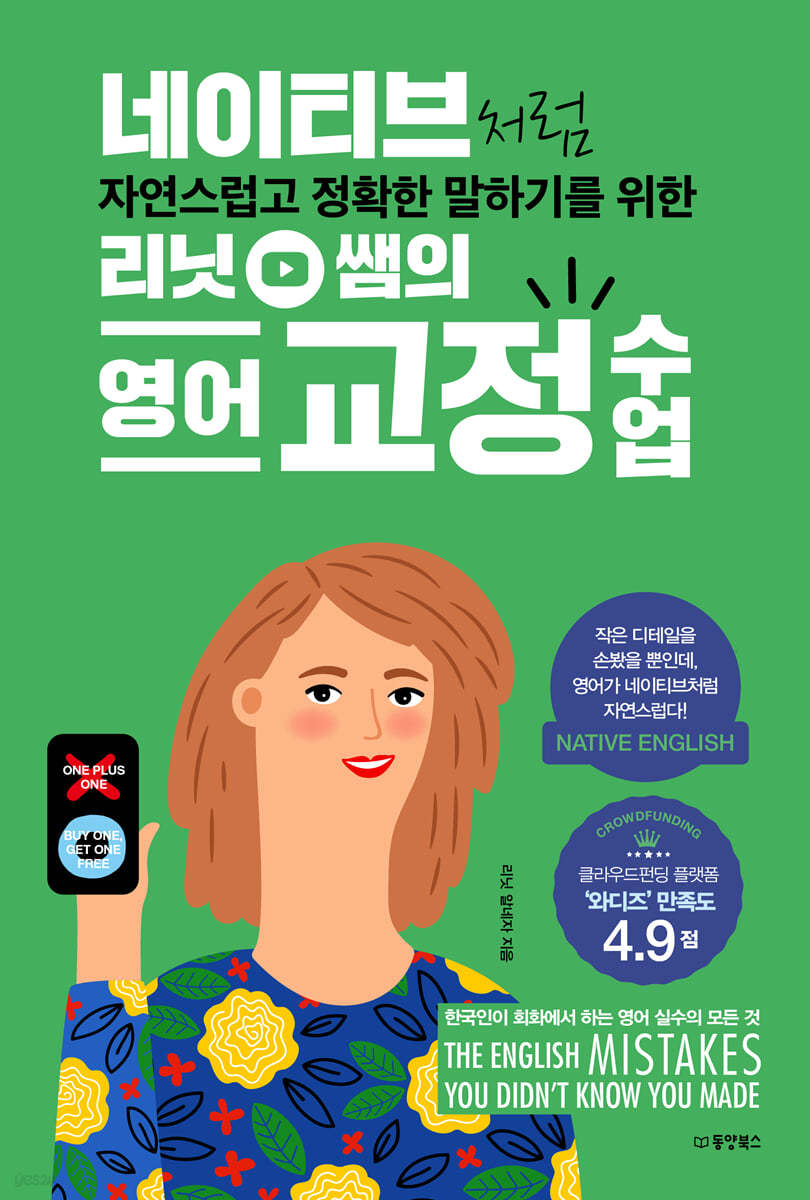
Linnet's English correction class for speaking naturally and accurately like a native speaker.
 |
Description
Book Introduction
Many Korean learners reach a certain level of English proficiency, but then feel frustrated and find themselves unable to progress any further.
If you've studied grammar, memorized vocabulary, and practiced conversation repeatedly, but still find yourself speaking awkwardly, the problem isn't simply a lack of skill.
The biggest obstacle is the 'bad habits' that arise from the structural differences between the Korean way of thinking and English.
The problem is that these awkward expressions become a habit as they are repeated, and eventually it becomes difficult to recognize your own mistakes.
If you don't correct these ingrained bad habits, it will be difficult to speak English naturally like a native speaker, no matter how long you study it.
This book is the result of the author's compilation of 100 of the most common awkward English expressions discovered while teaching approximately 1,000 Korean English learners, ranging from students to CEOs of large corporations, over the past decade.
Rather than simply listing 'incorrect expressions', it clearly explains the structural differences between Korean and English, why these mistakes occur, and even suggests how to change them to make them sound more natural.
Before its publication, this book received a high satisfaction rating of 4.9 points on the cloud funding platform Wadiz, and was praised by many learners as an "English textbook to refer to for life."
This book will be the surefire solution to take your English skills to the next level!
If you've studied grammar, memorized vocabulary, and practiced conversation repeatedly, but still find yourself speaking awkwardly, the problem isn't simply a lack of skill.
The biggest obstacle is the 'bad habits' that arise from the structural differences between the Korean way of thinking and English.
The problem is that these awkward expressions become a habit as they are repeated, and eventually it becomes difficult to recognize your own mistakes.
If you don't correct these ingrained bad habits, it will be difficult to speak English naturally like a native speaker, no matter how long you study it.
This book is the result of the author's compilation of 100 of the most common awkward English expressions discovered while teaching approximately 1,000 Korean English learners, ranging from students to CEOs of large corporations, over the past decade.
Rather than simply listing 'incorrect expressions', it clearly explains the structural differences between Korean and English, why these mistakes occur, and even suggests how to change them to make them sound more natural.
Before its publication, this book received a high satisfaction rating of 4.9 points on the cloud funding platform Wadiz, and was praised by many learners as an "English textbook to refer to for life."
This book will be the surefire solution to take your English skills to the next level!
- You can preview some of the book's contents.
Preview
index
Prologue 4
Structure of this book 6
Reader Reviews 8
1 I have plans with friends 16
I HAVE A PROMISE WITH MY FRIENDS.
2 I'm going to go buy some coffee.
18
I'M GOING TO GO TO A CAFE TO BUY A COFFEE.
3 Except this.
21
BESIDES THIS ONE…
4 It was neither good nor bad.
24
IT WAS SO-SO.
5 The ginger is too spicy.
27
THE GINGER IS TOO SPICY.
6 I didn't hear you correctly.
30
I COULDN'T HEAR WELL.
7 What do you think about the movie? 33
HOW DO YOU THINK ABOUT THE MOVIE?
8 I played with my friends 36
I PLAYED WITH MY FRIENDS.
9 It takes a long time to learn the guitar.
39
IT NEEDS A LONG TIME TO LEARN THE GUITAR.
10 The more the better.
42
MORE IS GOOD.
11 What is the difference between A and B? 45
HOW DIFFERENT ARE A AND B?
12 My head hurts.
48
MY HEAD IS IN PAIN.
13 I'm thinking of buying my own apartment. 50
I'M TRYING TO BUY MY APARTMENT.
There are three teams ahead of us.
53
THERE ARE THREE TEAMS AHEAD OF YOU.
15 There are a few more items to discuss.
55
THERE ARE A FEW MORE AGENDAS WE NEED TO DISCUSS.
16 How far is the next rest area? 58
HOW FAR IS THE NEXT REST STOP?
17 I had lunch with my senior.
61
I HAD LUNCH WITH MY SENIOR.
18 I am not feeling well.
64
MY CONDITION IS NOT GOOD.
Let's throw a 19th birthday party.
67
I'M OPENING MY BIRTHDAY PARTY.
20 She is attending university.
70
SHE'S ATTENDING UNIVERSITY.
21 I play badminton every weekend.
73
I DO BADMINTON ON WEEKENDS.
22 Are you good at skiing? 76
DO YOU SKI WELL?
23 It's near my house.
79
IT'S LOCATED NEARBY MY HOUSE.
24 I'm lying.
82
THAT'S A HOLLYWOOD ACTION.
25 Do you have a minute? 84
DO YOU HAVE TIME FOR A MOMENT?
26 Have you seen my wallet? 87
DID YOU LOOK AT MY WALLET?
27 I don't know.
90
I DON'T KNOW WELL.
28 She is the same age as me.
93
SHE'S THE SAME WITH ME IN AGE.
29 I went on a trip to LA.
96
I WENT TO TRAVEL TO LA.
30 Please remember.
99
PLEASE REMEMBER.
31 That's the first time I've heard that.
102
THAT'S A STORY I'M HEARING FOR THE FIRST TIME.
32 There is too much butter in French cuisine.
105
FRENCH FOOD HAS SO MUCH BUTTER.
33 I'll tell you more later.
108
I WILL TELL YOU THAT AGAIN LATER.
34 He's a really funny guy.
111
HE'S A SO FUNNY GUY.
35 I worked overtime yesterday.
114
I OVERWORKED YESTERDAY.
36 It's still early evening, and you're already leaving? 117
IT'S STILL EARLY EVENING!
37 I didn't expect that.
120
I COULDN'T SEE THAT COMING.
38 Let's have lunch together next week.
123
LET'S HAVE LUNCH NEXT WEEK.
39 It's worth a try.
126
IT HAS VALUE TO TRY.
40 The food is too spicy.
128
IT IS TOO MUCH SPICY.
41 These strawberries are spoiled.
132
THESE STRAWBERRIES ARE SPOILED.
42 One advantage is...
135
ONE GOOD POINT IS...
43 Don't forget to apply sunscreen when you go to the beach.
138
DON'T FORGET TO WEAR SUNCREAM AT THE BEACH.
44 I'm on my way to the gym.
141
I'M GOING TO THE HEALTH CLUB.
45 I can't help it.
144
IT CAN'T BE HELPED.
46 That's not it.
147
THAT'S NOT IT.
47 I don't feel like it right now.
150
I DON'T HAVE THAT FEELING RIGHT NOW.
I was going to do 48.
153
I WAS ABOUT TO DO.
49 Do you have a pen? 156
BY THE WAY, DO YOU HAVE A PEN?
I'm looking for 50 new summer dresses.
159
I'M LOOKING FOR A NEW SUMMER ONE-PIECE.
51 That's a service.
162
IT IS SERVICE.
52 I'm going on a staycation this weekend.
165
I'M TAKING A HOCANCE THIS WEEKEND.
53 Good value for money.
168
IT'S GOOD FOR THE PRICE.
54 Cup ramen is perfect on busy days.
171
CUP NOODLES ARE PERFECT FOR A BUSY DAY.
55 Where are the wet wipes? 174
WHERE ARE THE WATER TISSUES?
56 What time does the flight arrive? 177
WHAT TIME DOES YOUR FLIGHT ARRIVE?
57 I'm going to the sauna to relax.
180
I'M GOING TO THE SAUNA TO RELAX.
58 About Food… 183
ABOUT THE FOOD…
59 Don't overdo it.
187
DON'T OVERWORK.
60 I can do it by myself.
190
I CAN DO IT ALONE.
61 I live in an officetel.
193
I LIVE IN AN OFFICE-TEL.
62 I apologize for my poor English skills.
196
SORRY FOR MY LACK OF ENGLISH.
63 I'm so frustrated.
199
I FEEL STUFFY.
64 I knew it.
202
I THOUGHT LIKE THAT.
65 1 + 1 discount 205
ONE PLUS ONE
66 It's my fault.
208
IT'S MY FAULT.
67 likes.
211
I LIKE THAT.
68 That doesn't make sense.
214
I DON'T UNDERSTAND YOUR WORDS.
69 Enjoy your meal.
217
EAT DELICIOUSLY.
70 Let's eat together.
220
LET'S EAT TOGETHER.
71 The clothes suit you well.
223
THOSE CLOTHES FIT YOU.
72 Don't get me wrong.
226
DON'T MISUNDERSTAND.
73 We're leaving now.
229
I'M DEPARTING NOW.
74 Where is my phone? 232
WHERE'S MY HAND PHONE?
I have 75 puppies.
235
I RAISE A DOG.
76 Where do I get off? 238
WHERE DO YOU GET OFF?
77 Do you understand? 241
CAN YOU UNDERSTAND?
I like 78 rock music.
244
I LIKE ROCK MUSIC.
79 What drama are you watching these days? 247
WHAT DRAMAS ARE YOU WATCHING THESE DAYS?
80 I'll contact you soon.
250
I WILL CONTACT YOU SOON.
81 What did you say? 253
WHAT DID YOU SAY?
82 Please wait a moment.
256
PLEASE WAIT.
83 I'm jealous! 259
ENVY YOU!
84 Be careful not to catch a cold.
262
BE CAREFUL FOR COLD.
85 I am concentrating my mind.
265
I'M FOCUSING MY MIND.
86 I'll go.
268
I WILL GO.
87 Where am I? 271
WHERE IS HERE?
88 I'm lost.
274
I LOST MY WAY.
89 I can't afford to buy that.
277
I CAN'T BUY IT.
90 I want revenge.
280
I WANT TO REVENGE.
91 Do you know BTS? 283
DO YOU KNOW BTS?
92 Orange juice, please.
286
I WANT AN ORANGE JUICE.
93 This happens every day.
289
IT'S SOMETHING THAT HAPPENS EVERY DAY.
94 Something is strong.
292
SOMETHING IS COLD.
95 It was late, but I caught the bus anyway.
295
I WAS LATE, BUT ANYWAY, I CAUGHT THE BUS.
96 It doesn't matter what.
298
I DON'T CARE.
97 Take your time.
301
DO IT SLOWLY.
98 She is really hard-working.
304
SHE'S SO DILIGENT.
99 A 24-hour supermarket is convenient.
307
A 24-HOUR SUPERMARKET IS COMFORTABLE.
I am 100% satisfied.
310
I'M SATISFIED.
Structure of this book 6
Reader Reviews 8
1 I have plans with friends 16
I HAVE A PROMISE WITH MY FRIENDS.
2 I'm going to go buy some coffee.
18
I'M GOING TO GO TO A CAFE TO BUY A COFFEE.
3 Except this.
21
BESIDES THIS ONE…
4 It was neither good nor bad.
24
IT WAS SO-SO.
5 The ginger is too spicy.
27
THE GINGER IS TOO SPICY.
6 I didn't hear you correctly.
30
I COULDN'T HEAR WELL.
7 What do you think about the movie? 33
HOW DO YOU THINK ABOUT THE MOVIE?
8 I played with my friends 36
I PLAYED WITH MY FRIENDS.
9 It takes a long time to learn the guitar.
39
IT NEEDS A LONG TIME TO LEARN THE GUITAR.
10 The more the better.
42
MORE IS GOOD.
11 What is the difference between A and B? 45
HOW DIFFERENT ARE A AND B?
12 My head hurts.
48
MY HEAD IS IN PAIN.
13 I'm thinking of buying my own apartment. 50
I'M TRYING TO BUY MY APARTMENT.
There are three teams ahead of us.
53
THERE ARE THREE TEAMS AHEAD OF YOU.
15 There are a few more items to discuss.
55
THERE ARE A FEW MORE AGENDAS WE NEED TO DISCUSS.
16 How far is the next rest area? 58
HOW FAR IS THE NEXT REST STOP?
17 I had lunch with my senior.
61
I HAD LUNCH WITH MY SENIOR.
18 I am not feeling well.
64
MY CONDITION IS NOT GOOD.
Let's throw a 19th birthday party.
67
I'M OPENING MY BIRTHDAY PARTY.
20 She is attending university.
70
SHE'S ATTENDING UNIVERSITY.
21 I play badminton every weekend.
73
I DO BADMINTON ON WEEKENDS.
22 Are you good at skiing? 76
DO YOU SKI WELL?
23 It's near my house.
79
IT'S LOCATED NEARBY MY HOUSE.
24 I'm lying.
82
THAT'S A HOLLYWOOD ACTION.
25 Do you have a minute? 84
DO YOU HAVE TIME FOR A MOMENT?
26 Have you seen my wallet? 87
DID YOU LOOK AT MY WALLET?
27 I don't know.
90
I DON'T KNOW WELL.
28 She is the same age as me.
93
SHE'S THE SAME WITH ME IN AGE.
29 I went on a trip to LA.
96
I WENT TO TRAVEL TO LA.
30 Please remember.
99
PLEASE REMEMBER.
31 That's the first time I've heard that.
102
THAT'S A STORY I'M HEARING FOR THE FIRST TIME.
32 There is too much butter in French cuisine.
105
FRENCH FOOD HAS SO MUCH BUTTER.
33 I'll tell you more later.
108
I WILL TELL YOU THAT AGAIN LATER.
34 He's a really funny guy.
111
HE'S A SO FUNNY GUY.
35 I worked overtime yesterday.
114
I OVERWORKED YESTERDAY.
36 It's still early evening, and you're already leaving? 117
IT'S STILL EARLY EVENING!
37 I didn't expect that.
120
I COULDN'T SEE THAT COMING.
38 Let's have lunch together next week.
123
LET'S HAVE LUNCH NEXT WEEK.
39 It's worth a try.
126
IT HAS VALUE TO TRY.
40 The food is too spicy.
128
IT IS TOO MUCH SPICY.
41 These strawberries are spoiled.
132
THESE STRAWBERRIES ARE SPOILED.
42 One advantage is...
135
ONE GOOD POINT IS...
43 Don't forget to apply sunscreen when you go to the beach.
138
DON'T FORGET TO WEAR SUNCREAM AT THE BEACH.
44 I'm on my way to the gym.
141
I'M GOING TO THE HEALTH CLUB.
45 I can't help it.
144
IT CAN'T BE HELPED.
46 That's not it.
147
THAT'S NOT IT.
47 I don't feel like it right now.
150
I DON'T HAVE THAT FEELING RIGHT NOW.
I was going to do 48.
153
I WAS ABOUT TO DO.
49 Do you have a pen? 156
BY THE WAY, DO YOU HAVE A PEN?
I'm looking for 50 new summer dresses.
159
I'M LOOKING FOR A NEW SUMMER ONE-PIECE.
51 That's a service.
162
IT IS SERVICE.
52 I'm going on a staycation this weekend.
165
I'M TAKING A HOCANCE THIS WEEKEND.
53 Good value for money.
168
IT'S GOOD FOR THE PRICE.
54 Cup ramen is perfect on busy days.
171
CUP NOODLES ARE PERFECT FOR A BUSY DAY.
55 Where are the wet wipes? 174
WHERE ARE THE WATER TISSUES?
56 What time does the flight arrive? 177
WHAT TIME DOES YOUR FLIGHT ARRIVE?
57 I'm going to the sauna to relax.
180
I'M GOING TO THE SAUNA TO RELAX.
58 About Food… 183
ABOUT THE FOOD…
59 Don't overdo it.
187
DON'T OVERWORK.
60 I can do it by myself.
190
I CAN DO IT ALONE.
61 I live in an officetel.
193
I LIVE IN AN OFFICE-TEL.
62 I apologize for my poor English skills.
196
SORRY FOR MY LACK OF ENGLISH.
63 I'm so frustrated.
199
I FEEL STUFFY.
64 I knew it.
202
I THOUGHT LIKE THAT.
65 1 + 1 discount 205
ONE PLUS ONE
66 It's my fault.
208
IT'S MY FAULT.
67 likes.
211
I LIKE THAT.
68 That doesn't make sense.
214
I DON'T UNDERSTAND YOUR WORDS.
69 Enjoy your meal.
217
EAT DELICIOUSLY.
70 Let's eat together.
220
LET'S EAT TOGETHER.
71 The clothes suit you well.
223
THOSE CLOTHES FIT YOU.
72 Don't get me wrong.
226
DON'T MISUNDERSTAND.
73 We're leaving now.
229
I'M DEPARTING NOW.
74 Where is my phone? 232
WHERE'S MY HAND PHONE?
I have 75 puppies.
235
I RAISE A DOG.
76 Where do I get off? 238
WHERE DO YOU GET OFF?
77 Do you understand? 241
CAN YOU UNDERSTAND?
I like 78 rock music.
244
I LIKE ROCK MUSIC.
79 What drama are you watching these days? 247
WHAT DRAMAS ARE YOU WATCHING THESE DAYS?
80 I'll contact you soon.
250
I WILL CONTACT YOU SOON.
81 What did you say? 253
WHAT DID YOU SAY?
82 Please wait a moment.
256
PLEASE WAIT.
83 I'm jealous! 259
ENVY YOU!
84 Be careful not to catch a cold.
262
BE CAREFUL FOR COLD.
85 I am concentrating my mind.
265
I'M FOCUSING MY MIND.
86 I'll go.
268
I WILL GO.
87 Where am I? 271
WHERE IS HERE?
88 I'm lost.
274
I LOST MY WAY.
89 I can't afford to buy that.
277
I CAN'T BUY IT.
90 I want revenge.
280
I WANT TO REVENGE.
91 Do you know BTS? 283
DO YOU KNOW BTS?
92 Orange juice, please.
286
I WANT AN ORANGE JUICE.
93 This happens every day.
289
IT'S SOMETHING THAT HAPPENS EVERY DAY.
94 Something is strong.
292
SOMETHING IS COLD.
95 It was late, but I caught the bus anyway.
295
I WAS LATE, BUT ANYWAY, I CAUGHT THE BUS.
96 It doesn't matter what.
298
I DON'T CARE.
97 Take your time.
301
DO IT SLOWLY.
98 She is really hard-working.
304
SHE'S SO DILIGENT.
99 A 24-hour supermarket is convenient.
307
A 24-HOUR SUPERMARKET IS COMFORTABLE.
I am 100% satisfied.
310
I'M SATISFIED.
Detailed image
.jpg)
Publisher's Review
There are limits to what you can do alone.
Get expert feedback.
Many Korean English learners feel that their English is somewhat awkward, despite putting in a lot of time and effort.
This is not a simple vocabulary or grammar issue, but rather a problem that arises from the structural differences between Korean and English, and is a phenomenon that occurs when Korean ways of thinking are directly applied to English.
For example, in Korean we say "I don't have enough time," but if you translate it directly as "Time is not enough," it sounds awkward to a native speaker.
It's natural for native speakers to say "I don't have enough time."
Understanding these crucial structural differences between the two languages and acquiring an English way of thinking are key to speaking English naturally.
This book is the result of the author's experience teaching approximately 1,000 Korean learners over the past decade, analyzing common, recurring error patterns and offering practical methods for overcoming them.
In particular, we will cover in detail strategies for changing awkward expressions that arise due to Korean sentence structure into a natural, native-like expression.
We also focus on analyzing linguistic awkwardness resulting from cultural differences.
For example, if you directly translate the commonly used Korean expression "고능하다" as "You worked hard," it may sound awkward to native speakers.
In these cases, it's much more natural to say something like, "I appreciate your effort" or "That must have been tough."
This book is not just a grammar manual.
This practical textbook accurately identifies common errors Korean learners make and helps them communicate more effectively in English.
This book will be a powerful solution for learners who have studied English for a long time but still feel awkward with their sentences, learners who know where their problems lie but don't know how to fix them, and anyone who wants to break free from Korean-style English and speak English naturally and fluently like a native speaker.
In Korean, the word "promise" is used in a wide variety of contexts. However, in English, the concept of "promise" requires different words depending on when and under what circumstances it's being made.
This is also the fun of learning English.
Promise is usually interpreted as 'agreement' in Korean, but in fact, in English, promise has a more serious meaning.
It's a word that's mainly used when making an oath or a promise to keep something.
For example, it is perfect when used to express a commitment to keep something, as in the sentence, "I will never break my promise to you."
On the other hand, when expressing a light promise, such as meeting a friend, using promise can sound a little awkward.
In this case, it is more natural to use the word plans.
Plans is a word that is often used to express social arrangements, usually with friends or family.
For example, I have plans with friends tonight.
You can use it like this: (I decided to meet my friends tonight).
The subtle charm of the English language is that it uses different words depending on the type of promise and the situation.
Be careful!
In English, it is more natural to use the plural form "plans" rather than the singular form "plan" when expressing an appointment with a friend.
Why is that? Because meeting friends usually involves more than just one activity: having dinner, going to a cafe, and chatting.
So, if you say, "I have plans with a friend," it sounds natural, meaning, "I have plans for various activities with a friend." On the other hand, what if you say, "I have a plan with a friend?" This expression might sound a bit awkward, implying a specific, single plan rather than a promise with a friend.
In fact, "I have a plan." is mainly used to emphasize a big goal or a specific plan.
For example, if I say, "I have a plan to study abroad," it means that I have a specific plan to study abroad.
Get expert feedback.
Many Korean English learners feel that their English is somewhat awkward, despite putting in a lot of time and effort.
This is not a simple vocabulary or grammar issue, but rather a problem that arises from the structural differences between Korean and English, and is a phenomenon that occurs when Korean ways of thinking are directly applied to English.
For example, in Korean we say "I don't have enough time," but if you translate it directly as "Time is not enough," it sounds awkward to a native speaker.
It's natural for native speakers to say "I don't have enough time."
Understanding these crucial structural differences between the two languages and acquiring an English way of thinking are key to speaking English naturally.
This book is the result of the author's experience teaching approximately 1,000 Korean learners over the past decade, analyzing common, recurring error patterns and offering practical methods for overcoming them.
In particular, we will cover in detail strategies for changing awkward expressions that arise due to Korean sentence structure into a natural, native-like expression.
We also focus on analyzing linguistic awkwardness resulting from cultural differences.
For example, if you directly translate the commonly used Korean expression "고능하다" as "You worked hard," it may sound awkward to native speakers.
In these cases, it's much more natural to say something like, "I appreciate your effort" or "That must have been tough."
This book is not just a grammar manual.
This practical textbook accurately identifies common errors Korean learners make and helps them communicate more effectively in English.
This book will be a powerful solution for learners who have studied English for a long time but still feel awkward with their sentences, learners who know where their problems lie but don't know how to fix them, and anyone who wants to break free from Korean-style English and speak English naturally and fluently like a native speaker.
In Korean, the word "promise" is used in a wide variety of contexts. However, in English, the concept of "promise" requires different words depending on when and under what circumstances it's being made.
This is also the fun of learning English.
Promise is usually interpreted as 'agreement' in Korean, but in fact, in English, promise has a more serious meaning.
It's a word that's mainly used when making an oath or a promise to keep something.
For example, it is perfect when used to express a commitment to keep something, as in the sentence, "I will never break my promise to you."
On the other hand, when expressing a light promise, such as meeting a friend, using promise can sound a little awkward.
In this case, it is more natural to use the word plans.
Plans is a word that is often used to express social arrangements, usually with friends or family.
For example, I have plans with friends tonight.
You can use it like this: (I decided to meet my friends tonight).
The subtle charm of the English language is that it uses different words depending on the type of promise and the situation.
Be careful!
In English, it is more natural to use the plural form "plans" rather than the singular form "plan" when expressing an appointment with a friend.
Why is that? Because meeting friends usually involves more than just one activity: having dinner, going to a cafe, and chatting.
So, if you say, "I have plans with a friend," it sounds natural, meaning, "I have plans for various activities with a friend." On the other hand, what if you say, "I have a plan with a friend?" This expression might sound a bit awkward, implying a specific, single plan rather than a promise with a friend.
In fact, "I have a plan." is mainly used to emphasize a big goal or a specific plan.
For example, if I say, "I have a plan to study abroad," it means that I have a specific plan to study abroad.
GOODS SPECIFICS
- Date of issue: March 20, 2025
- Page count, weight, size: 312 pages | 152*225*30mm
- ISBN13: 9791172100988
- ISBN10: 1172100985
You may also like
카테고리
korean


korean

![GQ KOREA Mark (Monthly): December [2025]](http://librairie.coreenne.fr/cdn/shop/files/8ef265dbbfbf186523ed75ba7319009d.jpg?v=1765340328&width=3840)


