

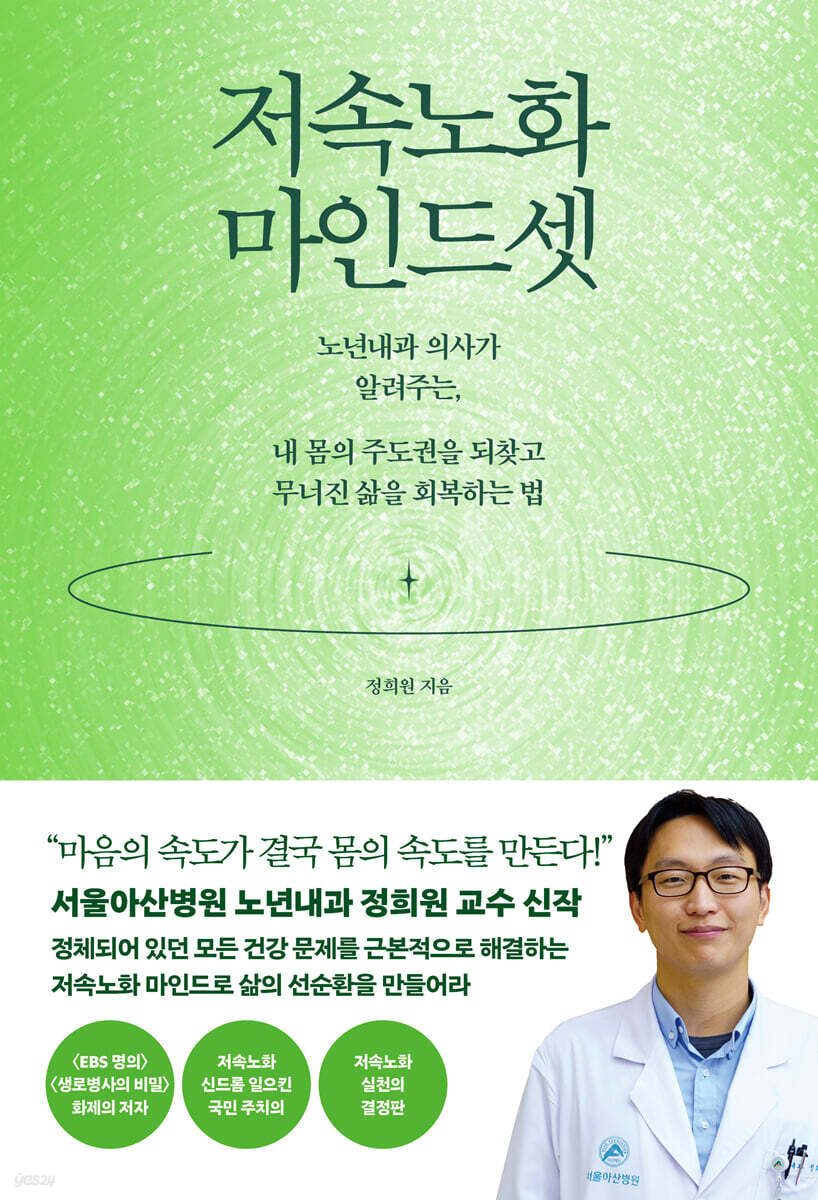
Slow Aging Mindset
 |
Description
Book Introduction
- A word from MD
-
The speed of the mind creates the speed of the body.A new book by Professor Jeong Hee-won, who created the 'slow aging' craze.
It emphasizes that slowing down the mind is the essential solution to slow aging, and suggests a mindset to regain control of life and avoid exhaustion.
In the midst of our breathlessly swept away daily lives, this book presents a blueprint for recovery and the ability to age well.
June 24, 2025. Health and Hobbies PD Ahn Hyun-jae
A new work by Professor Jeong Hee-won of the Department of Geriatrics at Seoul Asan Medical Center
“The speed of the mind ultimately creates the speed of the body!”
Fundamentally solves all stagnant health problems
Create a virtuous cycle in life with a slow-aging mindset.
“Just having negative thoughts about aging can shorten your lifespan by more than seven years.
“How do you feel about aging now?” According to research by Harvard University social epidemiologist Professor Becca Levy, people who have a negative perception of aging live, on average, 7.5 years shorter than those who have a positive perception.
These statistics are not simply a matter of mindset.
This means that the direction of your thoughts affects the actual physiological speed of aging.
Aging is not simply the decline of cells; it can be accelerated or delayed depending on how individuals and society perceive that decline.
Professor Jeong Hee-won of the Department of Geriatrics at Seoul Asan Medical Center focuses on the ‘speed of the mind’ in his book ‘Slow Aging Mindset.’
The reason we fail to practice good health every time is not because of our body but because of our mind, so we need to slow down our mind first.
Slowing down is a declaration of taking back control of my body, and by extension, my life.
‘Mindset’ is a shift in perspective from body to mind.
《Slow Aging Mindset》 delves into the most fundamental conditions that lead us to practice health: internal inertia and the structure of society.
In an accelerating society, what we need most is not more practical methods.
A mindset that allows you to recover the strength to live without getting tired should be a priority.
Today, we are not just losing our health, but we are losing the ability to age well.
The 'Slow Aging Mindset' provides a blueprint for recovery that will help you regain that strength and create a virtuous cycle in life.
The author, an expert in slow aging and a person who has painfully experienced accelerated aging through burnout, goes beyond simple medical advice to offer heartfelt advice to help people understand the fatigue of reality and slowly recover from it.
We also reveal various mindsets and our own know-how that will help us stop the breathless flow of time.
For those who want to rethink their health and readers who are searching for reasons why they don't change even though they know they do, this book will help you cultivate a strong mindset that will enable you to practice slow aging starting today.
“The speed of the mind ultimately creates the speed of the body!”
Fundamentally solves all stagnant health problems
Create a virtuous cycle in life with a slow-aging mindset.
“Just having negative thoughts about aging can shorten your lifespan by more than seven years.
“How do you feel about aging now?” According to research by Harvard University social epidemiologist Professor Becca Levy, people who have a negative perception of aging live, on average, 7.5 years shorter than those who have a positive perception.
These statistics are not simply a matter of mindset.
This means that the direction of your thoughts affects the actual physiological speed of aging.
Aging is not simply the decline of cells; it can be accelerated or delayed depending on how individuals and society perceive that decline.
Professor Jeong Hee-won of the Department of Geriatrics at Seoul Asan Medical Center focuses on the ‘speed of the mind’ in his book ‘Slow Aging Mindset.’
The reason we fail to practice good health every time is not because of our body but because of our mind, so we need to slow down our mind first.
Slowing down is a declaration of taking back control of my body, and by extension, my life.
‘Mindset’ is a shift in perspective from body to mind.
《Slow Aging Mindset》 delves into the most fundamental conditions that lead us to practice health: internal inertia and the structure of society.
In an accelerating society, what we need most is not more practical methods.
A mindset that allows you to recover the strength to live without getting tired should be a priority.
Today, we are not just losing our health, but we are losing the ability to age well.
The 'Slow Aging Mindset' provides a blueprint for recovery that will help you regain that strength and create a virtuous cycle in life.
The author, an expert in slow aging and a person who has painfully experienced accelerated aging through burnout, goes beyond simple medical advice to offer heartfelt advice to help people understand the fatigue of reality and slowly recover from it.
We also reveal various mindsets and our own know-how that will help us stop the breathless flow of time.
For those who want to rethink their health and readers who are searching for reasons why they don't change even though they know they do, this book will help you cultivate a strong mindset that will enable you to practice slow aging starting today.
- You can preview some of the book's contents.
Preview
index
Slow aging is a mindset that creates a virtuous cycle in life.
Chapter 1 For those who do not want to practice slow aging
Common Misconceptions About Slow Aging
Misconception 1: “Warren Buffett lives a long life by drinking cola.”
The human psychology of avoiding health care
Myth 2: “Healthy routines are boring and uninteresting.”
The Two Faces of Dopamine We Don't Know About
Myth 3: “Slow aging is against nature.”
Koreans' aversion to the appearance of old age
Myth 4: “Children and aging are not related.”
Children who mature prematurely due to accelerated aging
Myth 5: “All the health information on YouTube is correct.”
How to Avoid Being Fooled by Health Myths
Chapter 2 For those who want to practice slow aging
Misconceptions about health
Myth 1: “Even if you don’t get enough sleep, you can endure it.”
Sleep is not an option, it's the starting point of a virtuous cycle.
Myth 2: “A balanced life is just following the middle ground.”
Moderation is not passive averaging, but active coordination.
Myth 3: “To be healthy, you have to buy more and do more.”
Health isn't something you buy, it's something you do.
Myth 4: “Practice is a matter of information and will.”
We need personalization, not a one-size-fits-all solution.
Myth 5: “You can survive your entire life just by studying during your school days.”
Comfort leads to accelerated aging, not slow aging.
Chapter 3: A Society That Encourages Accelerated Aging
Realities that prevent us from practicing health
Reality 1: Even I, who used to talk about health, collapsed.
Don't rely on individual knowledge; face the social structure.
Reality 2: We can no longer even choose our health.
Secure your own disposable time
Reality 3: Achievement or Pleasure! I'm not in between.
Be process-oriented when it comes to self-care.
Reality 4: The way we work is making us older.
Reset your portfolio according to your life cycle.
Reality 5: Our free time has become a consumer activity.
Break free from the shackles of accelerated aging rest.
Chapter 4: A Slow-Aging Mindset
Scenes of slow aging that have become a part of life
Routine 1: Moving Meditation, Running
A sustainable pace sustains life.
Filling in for Routine 2, practicing your instrument
Consistency builds the muscles for immersion.
Routine 3: The Beginning of Self-Care: Writing
A writer is someone who takes care of and nurtures himself.
Routine 4: The Right Eating Mindset for Me
Your attitude toward food is the same as your attitude toward yourself.
Routine 5: A Structure That Allows You to Return Even If Practice Fails
Ordinary actions create extraordinary results.
A heart to nurture the tree of life healthily as we go out
Chapter 1 For those who do not want to practice slow aging
Common Misconceptions About Slow Aging
Misconception 1: “Warren Buffett lives a long life by drinking cola.”
The human psychology of avoiding health care
Myth 2: “Healthy routines are boring and uninteresting.”
The Two Faces of Dopamine We Don't Know About
Myth 3: “Slow aging is against nature.”
Koreans' aversion to the appearance of old age
Myth 4: “Children and aging are not related.”
Children who mature prematurely due to accelerated aging
Myth 5: “All the health information on YouTube is correct.”
How to Avoid Being Fooled by Health Myths
Chapter 2 For those who want to practice slow aging
Misconceptions about health
Myth 1: “Even if you don’t get enough sleep, you can endure it.”
Sleep is not an option, it's the starting point of a virtuous cycle.
Myth 2: “A balanced life is just following the middle ground.”
Moderation is not passive averaging, but active coordination.
Myth 3: “To be healthy, you have to buy more and do more.”
Health isn't something you buy, it's something you do.
Myth 4: “Practice is a matter of information and will.”
We need personalization, not a one-size-fits-all solution.
Myth 5: “You can survive your entire life just by studying during your school days.”
Comfort leads to accelerated aging, not slow aging.
Chapter 3: A Society That Encourages Accelerated Aging
Realities that prevent us from practicing health
Reality 1: Even I, who used to talk about health, collapsed.
Don't rely on individual knowledge; face the social structure.
Reality 2: We can no longer even choose our health.
Secure your own disposable time
Reality 3: Achievement or Pleasure! I'm not in between.
Be process-oriented when it comes to self-care.
Reality 4: The way we work is making us older.
Reset your portfolio according to your life cycle.
Reality 5: Our free time has become a consumer activity.
Break free from the shackles of accelerated aging rest.
Chapter 4: A Slow-Aging Mindset
Scenes of slow aging that have become a part of life
Routine 1: Moving Meditation, Running
A sustainable pace sustains life.
Filling in for Routine 2, practicing your instrument
Consistency builds the muscles for immersion.
Routine 3: The Beginning of Self-Care: Writing
A writer is someone who takes care of and nurtures himself.
Routine 4: The Right Eating Mindset for Me
Your attitude toward food is the same as your attitude toward yourself.
Routine 5: A Structure That Allows You to Return Even If Practice Fails
Ordinary actions create extraordinary results.
A heart to nurture the tree of life healthily as we go out
Detailed image

Into the book
Aging should be understood as a concept of speed, and it remains true that a combination of various lifestyle habits significantly determines the speed of my aging.
But there is something else we must not miss.
We must understand the fundamental principles of human functioning and take care to create an environment where our bodies can naturally choose optimal lifestyle habits.
To do that, we need to start with our mindset.
Simply put, mindset is a set of thoughts that lead to a certain situation.
So, at this point, let's go back to the original question.
Now, if someone were to ask me, “So what is slow aging?” I would answer like this.
“Slow aging is a mindset that creates a virtuous cycle in life.”
--- From "Entering"
In psychology, there is a concept called future self-continuity.
This indicates how closely and continuously people feel their future selves are connected to their present selves.
Research shows that we often perceive our future "selves" as someone else, and we tend not to fully consider future benefits in our current decisions.
As British philosopher Derek Parfit points out, if my future self feels like a stranger to me, my present self will be less motivated to make efforts for that future self.
(Omitted) Abraham M. of California State University, USA
Dr. Rootich's team directly tested the relationship between how similar people think their future self is to themselves and health-related behaviors through experiments.
When participants self-reported their present-future self-similarity, those with higher continuity reported better subjective health across a variety of measures and tended to have healthier habits in their lives.
Meanwhile, when some participants were given the task of writing a letter to themselves 20 years in the future, which artificially increased their sense of connection with their future selves, they also found that these participants exercised more during the following two weeks.
That is, even simple interventions that make the future self feel more realistic and closer to one's self can lead to significant changes in health behavior (exercise practice).
Other studies suggest similar results in the area of eating habits.
For example, in one experiment, reminding participants of long-term health consequences just before making a food choice increased the likelihood that they would choose lower-calorie, more nutritious foods than usual, and reduced the amount of time they hesitated, resulting in faster decisions.
On the other hand, when people are induced to think only of short-term values such as immediate taste, they are more likely to lean toward unhealthy foods.
These results show that how realistically you think about your future self can influence your everyday eating choices.
--- 「Misunderstanding 1.
“Even Warren Buffett lives a long life by drinking cola, right?”
Research shows that a positive psychological attitude toward aging has a significant impact on actual health and longevity.
The long-term follow-up study (2002) by Professor Becca Levy's team at Yale University, mentioned above, showed that elderly people who accepted their aging positively lived an average of 7.5 years longer than those who accepted it negatively.
The study followed 660 adults aged 50 and older for up to 23 years, and found that even after adjusting for socioeconomic status and health status, positive perceptions of aging themselves were associated with longer lifespan.
The research team interpreted that a positive self-perception that regards aging as a process of life rather than something to be feared or averse to, reduces stress and enhances the will to live, thereby contributing to longevity.
But there is something else we must not miss.
We must understand the fundamental principles of human functioning and take care to create an environment where our bodies can naturally choose optimal lifestyle habits.
To do that, we need to start with our mindset.
Simply put, mindset is a set of thoughts that lead to a certain situation.
So, at this point, let's go back to the original question.
Now, if someone were to ask me, “So what is slow aging?” I would answer like this.
“Slow aging is a mindset that creates a virtuous cycle in life.”
--- From "Entering"
In psychology, there is a concept called future self-continuity.
This indicates how closely and continuously people feel their future selves are connected to their present selves.
Research shows that we often perceive our future "selves" as someone else, and we tend not to fully consider future benefits in our current decisions.
As British philosopher Derek Parfit points out, if my future self feels like a stranger to me, my present self will be less motivated to make efforts for that future self.
(Omitted) Abraham M. of California State University, USA
Dr. Rootich's team directly tested the relationship between how similar people think their future self is to themselves and health-related behaviors through experiments.
When participants self-reported their present-future self-similarity, those with higher continuity reported better subjective health across a variety of measures and tended to have healthier habits in their lives.
Meanwhile, when some participants were given the task of writing a letter to themselves 20 years in the future, which artificially increased their sense of connection with their future selves, they also found that these participants exercised more during the following two weeks.
That is, even simple interventions that make the future self feel more realistic and closer to one's self can lead to significant changes in health behavior (exercise practice).
Other studies suggest similar results in the area of eating habits.
For example, in one experiment, reminding participants of long-term health consequences just before making a food choice increased the likelihood that they would choose lower-calorie, more nutritious foods than usual, and reduced the amount of time they hesitated, resulting in faster decisions.
On the other hand, when people are induced to think only of short-term values such as immediate taste, they are more likely to lean toward unhealthy foods.
These results show that how realistically you think about your future self can influence your everyday eating choices.
--- 「Misunderstanding 1.
“Even Warren Buffett lives a long life by drinking cola, right?”
Research shows that a positive psychological attitude toward aging has a significant impact on actual health and longevity.
The long-term follow-up study (2002) by Professor Becca Levy's team at Yale University, mentioned above, showed that elderly people who accepted their aging positively lived an average of 7.5 years longer than those who accepted it negatively.
The study followed 660 adults aged 50 and older for up to 23 years, and found that even after adjusting for socioeconomic status and health status, positive perceptions of aging themselves were associated with longer lifespan.
The research team interpreted that a positive self-perception that regards aging as a process of life rather than something to be feared or averse to, reduces stress and enhances the will to live, thereby contributing to longevity.
--- 「Routine 4.
From “The Eating Mindset That Fits Me”
From “The Eating Mindset That Fits Me”
Publisher's Review
Author of the topics covered on EBS's "Myung-ui," "The Secret of Birth, Aging, Illness, and Death," and "You Quiz"
The national doctor of our time who caused the slow aging syndrome
A new work by Professor Jeong Hee-won of the Department of Geriatrics at Seoul Asan Medical Center
The definitive guide to slow aging that reveals misunderstandings and truths and suggests a new direction.
“It is our mind, not our genes or our environment, that determines our aging.”
Start with your mindset before health information, routines, or diet.
“Why do people know about slow aging but fail to put it into practice?” Professor Jeong Hee-won of the Department of Geriatrics at Seoul Asan Medical Center, who brought the topic of “slow aging” to Korean society, returns with a new question in “Slow Aging Mindset.”
The author, who has studied the mechanisms of aging and recovery for a long time, has met countless patients and readers and witnessed the reality of the concept of slow aging being misused or abused.
Above all, we faced an environment where it was difficult to practice slow aging, and realized that a new perspective was urgent.
Certainly, slow aging has become a trend in recent years, and people now say “I want to age less” instead of “I want to live longer.”
However, numerous misunderstandings and common beliefs surrounding the wind are actually hindering slow aging.
The obsession with maintaining a youthful appearance, unrealistic routines, unrealistic standards, and performance-focused health management are quietly but surely aging us.
Professor Jeong Hee-won diagnoses this point as a 'failure of the perspective itself in understanding health.'
《Slow Aging Mindset》 starts from that diagnosis.
Those the author met both inside and outside the hospital were always tired, had difficulty recovering, let alone staying healthy, and were constantly trying and giving up.
The author finds the core cause of this vicious cycle in ‘the mind getting tired before the body.’
It's not that we're failing to practice health, it's that we live in a mindset that prevents recovery.
Changing the way you view your body and life is the mindset needed for truly slow aging.
This book asks questions of people who want to start taking care of their health again.
Could it be that your failure to change was due to a lack of willpower? Or could it be that your mind was already flowing in a way that didn't allow for health in the first place? "The Slow Aging Mindset" answers this question by examining the inner workings of individuals and the structure of society.
Negative perceptions of aging shorten lifespan and accelerate aging.
Let's start by correcting misconceptions about slow aging and common health beliefs.
Even the way we plan our healthy lives is efficiency-focused.
People who work hard mistakenly believe they are healthy, they disguise overwork and lack of sleep as self-care, and even their downtime is spent as liberation rather than recovery.
In these times, recovery becomes another project, and health becomes a stage set to look good, not for me.
The author calls this an 'accelerated aging mindset.'
The attitude of wanting to do more, faster, and better actually silences the body and mind.
It is difficult to live a long life without aging with this kind of mindset.
Where on earth did it all go wrong? The author first delves into the individual's inner self.
We analyze two types of people who have distorted views on health and point out the mindset they need.
One type is the type that misunderstands and avoids slow aging.
“Even Warren Buffett lives to be over 90 years old, drinking cola?” This is a common misconception the author hears when talking about slow aging.
They attribute health to genetics or luck, using Warren Buffett's example.
But genetic lottery is less than 30%, and slow aging is determined by daily choices, not genetics or environment.
There is a common misconception that slow aging is artificial, but the author points out that hidden within this lies a unique aversion to superficial aging in Korean society.
Slow aging is not an artificial concept for appearance, but a natural concept for function, and it warns that a negative view of aging shortens lifespan by an average of 7.5 years.
The author refutes every myth, from the misconception that healthy routines are boring to the stereotype that children and aging are unrelated.
It also provides guidance on how to identify incorrect health information.
The following are types of people who become exhausted while practicing health management.
They are typically obsessed with reducing sleep, focusing on health methods, and focusing on consumption-oriented health management.
However, sleep is a complex process that involves emotional regulation, immune recovery, and memory consolidation, and is not an option but the starting point of slow aging.
Also, the basis of slow aging is to reduce by subtracting rather than adding, such as buying nutritional supplements and sneakers.
The author suggests a correct mindset, including a proactive sense of moderation, personalized health management, and cognitive reserve, which is a mental reserve, to counter the complacent common belief that a balanced life is achieved by simply following the routines of others.
"True slow aging begins with a shift in mindset."
Change the subject of the question to a problem of reality, not a matter of personal will.
But can the repeated failures of healthy practices simply be explained by a lack of personal will? The author firmly argues otherwise.
The very society we live in is designed in a way that does not allow for recovery.
Even the author, a so-called 'slow aging' person, experienced his life crumbling as he fell into the shackles of accelerated aging due to work and fatigue.
Then the author realized.
That there is a system in place that does not allow you to choose health even if you have the knowledge and will.
The author now delves into the problem of social structure.
Korean society, while steeped in efficiency and performance-oriented thinking, ranks among the OECD countries with the longest commuting and working hours.
As the pace of life has accelerated, the time to recover has drastically decreased.
For those living in time poverty, healthy choices become impossible.
How absurd is the demand to recover oneself in a structure that cannot be recovered?
We live in a society where even self-care has become a privilege only available to those with the time and leisure.
The author does not seek a simple solution here.
Rather, it changes the question.
Instead of asking, “Why can’t we practice slow aging?”, ask, “Why are we so tired and take it for granted?”
This shift in question is the starting point of a truly slow-aging mindset.
It shakes us up and tells us to look back on our inner selves and reality to regain our own rhythm of life, rather than helplessly following the flow of an accelerating society.
We call for a fundamental design of the mind for truly slow aging through mindset.
To achieve this, the author suggests creating disposable time for yourself, process-oriented thinking, a new-age portfolio, and, finally, breaking free from the shackles of accelerated aging leisure.
"We need a daily structure that allows us to embrace our imperfect selves."
How to design a mindset that moves, fills, and cares for you
The author, who has harshly experienced and overcome the so-called 'brain rot' phenomenon, shares how he has actually practiced slow aging in his own life.
Running is another mental activity for him.
It's a moving meditation that gets your brain running, not your heart.
Practicing an instrument is practicing the sense of life that fills you up to write.
Writing is an act of looking into one's own state.
The entire process the author implements is a metaphor for slow aging itself.
It is a matter of writing one's own narrative slowly and properly.
For diet and habits, create a structure that can be implemented without willpower, like lowering the height of a staircase, and a structure that allows you to return to it even if you fail.
It is based on the belief that those who recover quickly are not those with strong willpower, but those who have created structures that make themselves less painful.
In fact, the author also recovered within this structure during a one-month sabbatical, and completed writing this book during that time.
Slow aging should begin with designing a daily routine that can embrace the imperfect self, rather than designing a perfect routine.
In this way, the author shows the possibility of slow aging through stories from his own experience and practice.
The slow aging mindset is not just a mindset.
It is a comprehensive shift in thinking that includes the ability to detect signs of body and mind, the sense to design daily life, and even the cognitive freedom to choose the direction of one's life.
It's impossible to stop the relentless flow of time, but if we put ourselves at the center of our lives, we can control its pace.
The Slow Aging Mindset is a profound exploration of the mind that can orchestrate and sustain youthfulness and health.
And that quest raises a vital question for all of us weary souls:
“At what pace of mind am I living now?”
The national doctor of our time who caused the slow aging syndrome
A new work by Professor Jeong Hee-won of the Department of Geriatrics at Seoul Asan Medical Center
The definitive guide to slow aging that reveals misunderstandings and truths and suggests a new direction.
“It is our mind, not our genes or our environment, that determines our aging.”
Start with your mindset before health information, routines, or diet.
“Why do people know about slow aging but fail to put it into practice?” Professor Jeong Hee-won of the Department of Geriatrics at Seoul Asan Medical Center, who brought the topic of “slow aging” to Korean society, returns with a new question in “Slow Aging Mindset.”
The author, who has studied the mechanisms of aging and recovery for a long time, has met countless patients and readers and witnessed the reality of the concept of slow aging being misused or abused.
Above all, we faced an environment where it was difficult to practice slow aging, and realized that a new perspective was urgent.
Certainly, slow aging has become a trend in recent years, and people now say “I want to age less” instead of “I want to live longer.”
However, numerous misunderstandings and common beliefs surrounding the wind are actually hindering slow aging.
The obsession with maintaining a youthful appearance, unrealistic routines, unrealistic standards, and performance-focused health management are quietly but surely aging us.
Professor Jeong Hee-won diagnoses this point as a 'failure of the perspective itself in understanding health.'
《Slow Aging Mindset》 starts from that diagnosis.
Those the author met both inside and outside the hospital were always tired, had difficulty recovering, let alone staying healthy, and were constantly trying and giving up.
The author finds the core cause of this vicious cycle in ‘the mind getting tired before the body.’
It's not that we're failing to practice health, it's that we live in a mindset that prevents recovery.
Changing the way you view your body and life is the mindset needed for truly slow aging.
This book asks questions of people who want to start taking care of their health again.
Could it be that your failure to change was due to a lack of willpower? Or could it be that your mind was already flowing in a way that didn't allow for health in the first place? "The Slow Aging Mindset" answers this question by examining the inner workings of individuals and the structure of society.
Negative perceptions of aging shorten lifespan and accelerate aging.
Let's start by correcting misconceptions about slow aging and common health beliefs.
Even the way we plan our healthy lives is efficiency-focused.
People who work hard mistakenly believe they are healthy, they disguise overwork and lack of sleep as self-care, and even their downtime is spent as liberation rather than recovery.
In these times, recovery becomes another project, and health becomes a stage set to look good, not for me.
The author calls this an 'accelerated aging mindset.'
The attitude of wanting to do more, faster, and better actually silences the body and mind.
It is difficult to live a long life without aging with this kind of mindset.
Where on earth did it all go wrong? The author first delves into the individual's inner self.
We analyze two types of people who have distorted views on health and point out the mindset they need.
One type is the type that misunderstands and avoids slow aging.
“Even Warren Buffett lives to be over 90 years old, drinking cola?” This is a common misconception the author hears when talking about slow aging.
They attribute health to genetics or luck, using Warren Buffett's example.
But genetic lottery is less than 30%, and slow aging is determined by daily choices, not genetics or environment.
There is a common misconception that slow aging is artificial, but the author points out that hidden within this lies a unique aversion to superficial aging in Korean society.
Slow aging is not an artificial concept for appearance, but a natural concept for function, and it warns that a negative view of aging shortens lifespan by an average of 7.5 years.
The author refutes every myth, from the misconception that healthy routines are boring to the stereotype that children and aging are unrelated.
It also provides guidance on how to identify incorrect health information.
The following are types of people who become exhausted while practicing health management.
They are typically obsessed with reducing sleep, focusing on health methods, and focusing on consumption-oriented health management.
However, sleep is a complex process that involves emotional regulation, immune recovery, and memory consolidation, and is not an option but the starting point of slow aging.
Also, the basis of slow aging is to reduce by subtracting rather than adding, such as buying nutritional supplements and sneakers.
The author suggests a correct mindset, including a proactive sense of moderation, personalized health management, and cognitive reserve, which is a mental reserve, to counter the complacent common belief that a balanced life is achieved by simply following the routines of others.
"True slow aging begins with a shift in mindset."
Change the subject of the question to a problem of reality, not a matter of personal will.
But can the repeated failures of healthy practices simply be explained by a lack of personal will? The author firmly argues otherwise.
The very society we live in is designed in a way that does not allow for recovery.
Even the author, a so-called 'slow aging' person, experienced his life crumbling as he fell into the shackles of accelerated aging due to work and fatigue.
Then the author realized.
That there is a system in place that does not allow you to choose health even if you have the knowledge and will.
The author now delves into the problem of social structure.
Korean society, while steeped in efficiency and performance-oriented thinking, ranks among the OECD countries with the longest commuting and working hours.
As the pace of life has accelerated, the time to recover has drastically decreased.
For those living in time poverty, healthy choices become impossible.
How absurd is the demand to recover oneself in a structure that cannot be recovered?
We live in a society where even self-care has become a privilege only available to those with the time and leisure.
The author does not seek a simple solution here.
Rather, it changes the question.
Instead of asking, “Why can’t we practice slow aging?”, ask, “Why are we so tired and take it for granted?”
This shift in question is the starting point of a truly slow-aging mindset.
It shakes us up and tells us to look back on our inner selves and reality to regain our own rhythm of life, rather than helplessly following the flow of an accelerating society.
We call for a fundamental design of the mind for truly slow aging through mindset.
To achieve this, the author suggests creating disposable time for yourself, process-oriented thinking, a new-age portfolio, and, finally, breaking free from the shackles of accelerated aging leisure.
"We need a daily structure that allows us to embrace our imperfect selves."
How to design a mindset that moves, fills, and cares for you
The author, who has harshly experienced and overcome the so-called 'brain rot' phenomenon, shares how he has actually practiced slow aging in his own life.
Running is another mental activity for him.
It's a moving meditation that gets your brain running, not your heart.
Practicing an instrument is practicing the sense of life that fills you up to write.
Writing is an act of looking into one's own state.
The entire process the author implements is a metaphor for slow aging itself.
It is a matter of writing one's own narrative slowly and properly.
For diet and habits, create a structure that can be implemented without willpower, like lowering the height of a staircase, and a structure that allows you to return to it even if you fail.
It is based on the belief that those who recover quickly are not those with strong willpower, but those who have created structures that make themselves less painful.
In fact, the author also recovered within this structure during a one-month sabbatical, and completed writing this book during that time.
Slow aging should begin with designing a daily routine that can embrace the imperfect self, rather than designing a perfect routine.
In this way, the author shows the possibility of slow aging through stories from his own experience and practice.
The slow aging mindset is not just a mindset.
It is a comprehensive shift in thinking that includes the ability to detect signs of body and mind, the sense to design daily life, and even the cognitive freedom to choose the direction of one's life.
It's impossible to stop the relentless flow of time, but if we put ourselves at the center of our lives, we can control its pace.
The Slow Aging Mindset is a profound exploration of the mind that can orchestrate and sustain youthfulness and health.
And that quest raises a vital question for all of us weary souls:
“At what pace of mind am I living now?”
GOODS SPECIFICS
- Date of issue: June 24, 2025
- Page count, weight, size: 358 pages | 150*220*30mm
- ISBN13: 9791194627074
- ISBN10: 1194627072
You may also like
카테고리
korean


korean

![ELLE 엘르 스페셜 에디션 A형 : 12월 [2025]](http://librairie.coreenne.fr/cdn/shop/files/b8e27a3de6c9538896439686c6b0e8fb.jpg?v=1766436872&width=3840)


