

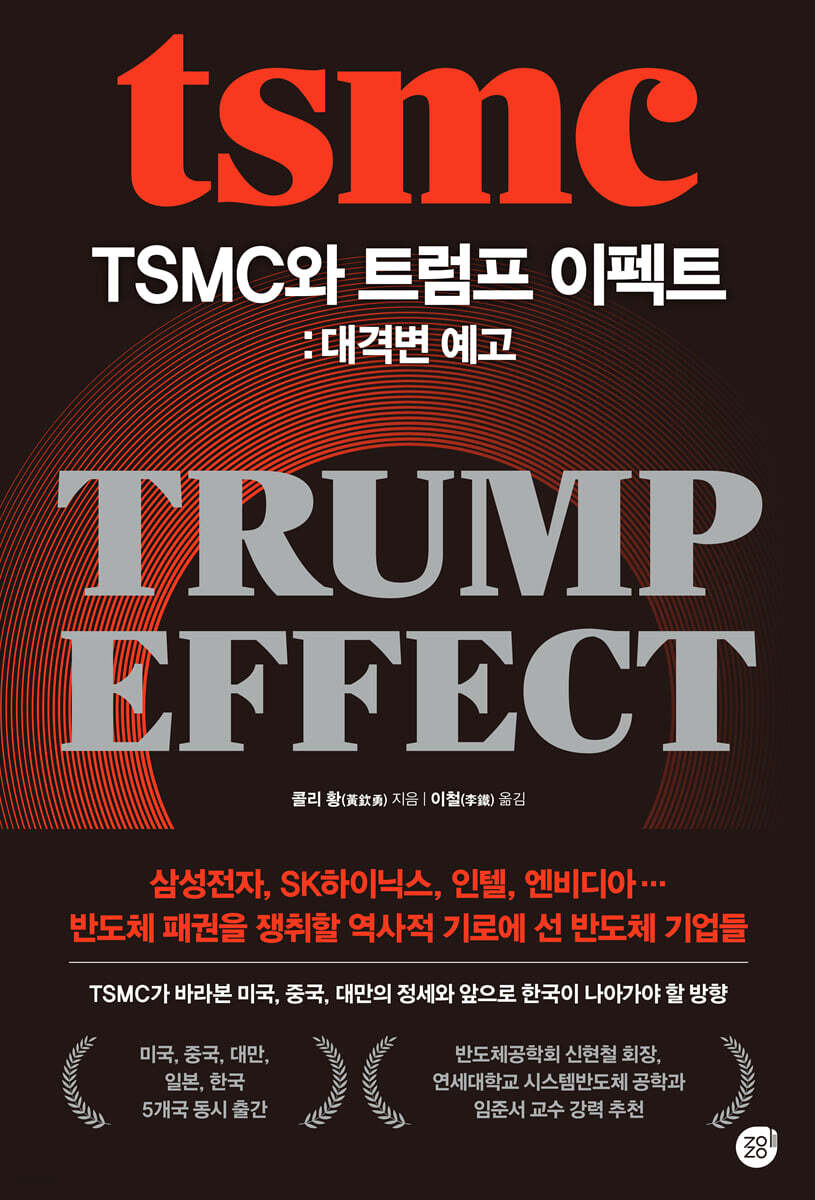
TSMC and the Trump Effect: A Promising Upheaval
 |
Description
Book Introduction
- A word from MD
-
Finally, TSMC has spoken.Amid the Trump administration's semiconductor supply chain restructuring, the world is watching TSMC closely. With the competition for AI technology sovereignty and the cutting-edge semiconductor industry intensifying, we offer insightful insights into the strategies global semiconductor companies should adopt to prepare for the future, focusing on TSMC.April 15, 2025. Economics and Management PD Oh Da-eun
**Simultaneously published in 5 countries: USA, China, Taiwan, Japan, and Korea!
**Highly recommended by Shin Hyun-chul, President of the Korean Society of Semiconductor Engineers, and Professor Lim Jun-seo of the Department of Systems Semiconductor Engineering at Yonsei University!
“Finally, TSMC has spoken!”
Semiconductor hegemony clashes in the Trump 2.0 era.
The world is watching Taiwan's strategy and TSMC's choices!
TSMC, a semiconductor company that symbolized Taiwan, has become a global semiconductor company today.
In the era of Trump 2.0 and America First, semiconductors have become a key geopolitical weapon, and the world's attention is focused on TSMC, which stands at the center of the global supply chain.
Colley Huang is the CEO of DIGITIMES, which he co-founded with Morris Chang, former CEO of TSMC, and is a global ICT industry analyst with 40 years of experience.
He is also the person who has most closely experienced Taiwan's growth and the US-China semiconductor hegemony competition in a strategic location.
Colley Huang's "TSMC and the Trump Effect: A Prelude to a Great Upheaval" is a strategic book that looks into the Trump 2.0 era, where semiconductor technology, often called the "oil of the 21st century," and geopolitical risks intersect.
Semiconductors, which didn't exist even 70 years ago, have become the heart of human civilization. No area—AI, data, national defense, the economy, or industry—can be explained without semiconductors.
This book captures the movement toward a new order through Taiwan's TSMC, which stands at the very center of the global semiconductor supply chain.
Collier Huang's meticulous analysis of the global semiconductor hegemony and the strategies that follow is remarkably clear.
He says that companies that faithfully implement these two principles—"Strategy over efficiency, value over price" and "Whoever dominates AI dominates the future"—will seize the semiconductor hegemony.
Silicon Valley, the symbol of software, and Taiwan, the symbol of hardware. In Taiwan, the company that leads technological hegemony and the industrial ecosystem is TSMC. If TSMC falters, Apple, Nvidia, Google, and even Tesla will be shaken.
This behavior raises the question, "Who is really setting the rules for the semiconductor hegemony race?"
While the world was focused on semiconductor technology, TSMC was setting the rules for the semiconductor industry.
This book predicts that the future direction of semiconductor hegemony will be determined by the United States pressuring its allies to create a supply chain centered on its own, while China will attempt to achieve technological breakthroughs on its own despite sanctions.
Europe is belatedly moving to secure AI sovereignty, while Taiwan is highlighting its value as an ecosystem strategy based on cutting-edge technology for survival.
On the other hand, Korea remains at an intermediate level in its industrial structure and is swaying left and right without strategic initiative.
So what should Korea do? While Korea once held the distinction of being an ICT powerhouse and a leading semiconductor nation, that position is now being shaken. Therefore, rather than focusing on "catching up" with TSMC, Korea should consider an ecosystem-centered strategy, value-driven competitiveness, and a technology alliance-focused cooperation model to "stand alongside TSMC."
The era has arrived where Samsung alone can no longer design the future of semiconductors.
"TSMC and the Trump Effect: A Prelude to a Great Upheaval" is a valuable strategic book that explains how companies and nations can survive amidst the global semiconductor industry, the AI technology transition, and the hegemony battle between the United States and China.
This book will serve as an excellent compass for entrepreneurs curious about the future of semiconductors, investors in the AI industry, policymakers concerned about technological sovereignty, and anyone at a crossroads of change.
**Highly recommended by Shin Hyun-chul, President of the Korean Society of Semiconductor Engineers, and Professor Lim Jun-seo of the Department of Systems Semiconductor Engineering at Yonsei University!
“Finally, TSMC has spoken!”
Semiconductor hegemony clashes in the Trump 2.0 era.
The world is watching Taiwan's strategy and TSMC's choices!
TSMC, a semiconductor company that symbolized Taiwan, has become a global semiconductor company today.
In the era of Trump 2.0 and America First, semiconductors have become a key geopolitical weapon, and the world's attention is focused on TSMC, which stands at the center of the global supply chain.
Colley Huang is the CEO of DIGITIMES, which he co-founded with Morris Chang, former CEO of TSMC, and is a global ICT industry analyst with 40 years of experience.
He is also the person who has most closely experienced Taiwan's growth and the US-China semiconductor hegemony competition in a strategic location.
Colley Huang's "TSMC and the Trump Effect: A Prelude to a Great Upheaval" is a strategic book that looks into the Trump 2.0 era, where semiconductor technology, often called the "oil of the 21st century," and geopolitical risks intersect.
Semiconductors, which didn't exist even 70 years ago, have become the heart of human civilization. No area—AI, data, national defense, the economy, or industry—can be explained without semiconductors.
This book captures the movement toward a new order through Taiwan's TSMC, which stands at the very center of the global semiconductor supply chain.
Collier Huang's meticulous analysis of the global semiconductor hegemony and the strategies that follow is remarkably clear.
He says that companies that faithfully implement these two principles—"Strategy over efficiency, value over price" and "Whoever dominates AI dominates the future"—will seize the semiconductor hegemony.
Silicon Valley, the symbol of software, and Taiwan, the symbol of hardware. In Taiwan, the company that leads technological hegemony and the industrial ecosystem is TSMC. If TSMC falters, Apple, Nvidia, Google, and even Tesla will be shaken.
This behavior raises the question, "Who is really setting the rules for the semiconductor hegemony race?"
While the world was focused on semiconductor technology, TSMC was setting the rules for the semiconductor industry.
This book predicts that the future direction of semiconductor hegemony will be determined by the United States pressuring its allies to create a supply chain centered on its own, while China will attempt to achieve technological breakthroughs on its own despite sanctions.
Europe is belatedly moving to secure AI sovereignty, while Taiwan is highlighting its value as an ecosystem strategy based on cutting-edge technology for survival.
On the other hand, Korea remains at an intermediate level in its industrial structure and is swaying left and right without strategic initiative.
So what should Korea do? While Korea once held the distinction of being an ICT powerhouse and a leading semiconductor nation, that position is now being shaken. Therefore, rather than focusing on "catching up" with TSMC, Korea should consider an ecosystem-centered strategy, value-driven competitiveness, and a technology alliance-focused cooperation model to "stand alongside TSMC."
The era has arrived where Samsung alone can no longer design the future of semiconductors.
"TSMC and the Trump Effect: A Prelude to a Great Upheaval" is a valuable strategic book that explains how companies and nations can survive amidst the global semiconductor industry, the AI technology transition, and the hegemony battle between the United States and China.
This book will serve as an excellent compass for entrepreneurs curious about the future of semiconductors, investors in the AI industry, policymakers concerned about technological sovereignty, and anyone at a crossroads of change.
- You can preview some of the book's contents.
Preview
index
Recommendation - Seeing Us Through Taiwan's Semiconductor Industry - Shin Hyun-chul (President, Korean Society of Semiconductor Engineers)
Recommendation - Reading Taiwan as an Innovative Nation _ Lim Jun-seo (Professor, Department of Systems Semiconductor Engineering, Yonsei University)
Translator's Note - Looking at the Forgotten Progress of Taiwan
Introduction - Sixty Turbulent Years
Part 1: A Preview of Cataclysm
Chapter 1 The wind blows and the rain falls
- Make the destination the starting point
- A technological revolution that changes the world and the birth of a new universe
- Hardware that dominates AI technology
- Endless opportunities that can only be seen when you cross the line
Chapter 2 AI and Soyouyu
- The era of great division that came again after the 17th century
- New rules, new competitors
- Understanding investment attraction methods
- Establishing a strategic framework for sustainability
- The digital transformation era and America's dominance
Part 2: 100 Years of Semiconductors: A Journey Without Loneliness
Chapter 3: The Selected Country
- Let's go far, let's go together
- The wind and rain are howling and the roosters are crowing without stopping.
- The new wave pushes out the old wave
- The era of mass production and cost supremacy
- The mountains and rivers are so beautiful that heroes rush to them.
Chapter 4: From the Rise of China to the East Sea
- The new international order that China dreams of
The Dilemma of China's Semiconductor Industry
- Kickstarting the drive to dominate the global automobile market
Chapter 5: Semiconductors and Taiwan's Future
Semiconductor Industry Outlook 2024-2030
- How to dance with two wolves?
Conclusion - Black Swan, Flying in the Sky
Recommendation - Reading Taiwan as an Innovative Nation _ Lim Jun-seo (Professor, Department of Systems Semiconductor Engineering, Yonsei University)
Translator's Note - Looking at the Forgotten Progress of Taiwan
Introduction - Sixty Turbulent Years
Part 1: A Preview of Cataclysm
Chapter 1 The wind blows and the rain falls
- Make the destination the starting point
- A technological revolution that changes the world and the birth of a new universe
- Hardware that dominates AI technology
- Endless opportunities that can only be seen when you cross the line
Chapter 2 AI and Soyouyu
- The era of great division that came again after the 17th century
- New rules, new competitors
- Understanding investment attraction methods
- Establishing a strategic framework for sustainability
- The digital transformation era and America's dominance
Part 2: 100 Years of Semiconductors: A Journey Without Loneliness
Chapter 3: The Selected Country
- Let's go far, let's go together
- The wind and rain are howling and the roosters are crowing without stopping.
- The new wave pushes out the old wave
- The era of mass production and cost supremacy
- The mountains and rivers are so beautiful that heroes rush to them.
Chapter 4: From the Rise of China to the East Sea
- The new international order that China dreams of
The Dilemma of China's Semiconductor Industry
- Kickstarting the drive to dominate the global automobile market
Chapter 5: Semiconductors and Taiwan's Future
Semiconductor Industry Outlook 2024-2030
- How to dance with two wolves?
Conclusion - Black Swan, Flying in the Sky
Detailed image

Into the book
TSMC, with its superior technological prowess, bold capital investment, and economies of scale, serves as a facilitator, helping numerous large technology companies create greater value.
If the current balanced supply and demand system collapses and global industrial chaos occurs, the biggest victims will be American technology companies such as Nvidia, Amazon, Apple, Microsoft, Tesla, Google, and Meta.
Separating jade from stone cannot be a merchant's calculation, and profits that are squeezed out are not sustainable.
The real value lies in who sets the rules of the game.
--- p.17
By 2024, TSMC will have 13 12-inch wafer fabs and nine 6-inch and 8-inch fabs.
In addition, we have five factories with OSAT capabilities and plan to establish at least 10 new factories worldwide by 2025.
These plants will serve 528 customers with diverse process requirements.
“To be a foundry for everyone” is TSMC’s motto.
TSMC's 76,000 employees are committed to being a harmless partner to the industry by adhering to the principle of not competing with customers.
--- pp.53-54
When Samsung Electronics President Kyung-Hyun Kyung made an official visit to Taiwan, I, as a Korean industry expert, had the opportunity to have a meaningful breakfast meeting with him at the Mandarin Hotel in Taipei.
Since I arrived in Taiwan in 1985 as a dedicated industry researcher for Korea, I have continuously observed and analyzed the development of the Korean electronics industry over the past 40 years.
During this period, I met several times with three South Korean Ministers of Science and Technology: Oh Myung, Bae Soon-hoon, and Jin Dae-je, and maintained informal exchanges whenever Samsung's senior executives, Lee Jun-woo, Jin Dae-je, Young-son, and President Kyung Kyung-hyun, visited Taiwan.
--- p.126
Through the tireless efforts of our ancestors over many generations, it has developed into a center of cultural and trade exchange between the East and the West.
As a descendant of Taiwan, I cannot help but admire the combination of innate strength and acquired hard work that has made Taiwan a prosperous and wealthy "heaven-protected island."
More than 80% of the world's cutting-edge chips, servers, and laptops are produced by Taiwanese manufacturers, and Taiwanese entrepreneurs demonstrate outstanding technological prowess and competitiveness in all areas of the IT industry, including power supplies, connectors, printed circuit boards, and electronic circuits.
--- p.212
China strongly demands that its neighbors unconditionally accept the rules of the game it has independently established. However, China itself, which constantly breaks the international framework, displays a dualistic attitude by refusing to accept universal international norms.
It is precisely because of this duality in China that a U.S. government spokesperson cautiously stated, “We listen to China seriously, but everything must be objectively verified.”
--- p.269
China is seeking to transform its currency through digital currencies and electronic transactions while maintaining friendly relations with oil-producing countries.
However, digital currencies are likely to be a double-edged sword.
As the yuan becomes digital, China will need to track its movements to prevent Chinese citizens from freely smuggling their money out of the country.
The newly inaugurated Trump administration will inevitably use the US dollar as a weapon, and any country that abandons the US dollar will face strong pressure from the US government.
If the current balanced supply and demand system collapses and global industrial chaos occurs, the biggest victims will be American technology companies such as Nvidia, Amazon, Apple, Microsoft, Tesla, Google, and Meta.
Separating jade from stone cannot be a merchant's calculation, and profits that are squeezed out are not sustainable.
The real value lies in who sets the rules of the game.
--- p.17
By 2024, TSMC will have 13 12-inch wafer fabs and nine 6-inch and 8-inch fabs.
In addition, we have five factories with OSAT capabilities and plan to establish at least 10 new factories worldwide by 2025.
These plants will serve 528 customers with diverse process requirements.
“To be a foundry for everyone” is TSMC’s motto.
TSMC's 76,000 employees are committed to being a harmless partner to the industry by adhering to the principle of not competing with customers.
--- pp.53-54
When Samsung Electronics President Kyung-Hyun Kyung made an official visit to Taiwan, I, as a Korean industry expert, had the opportunity to have a meaningful breakfast meeting with him at the Mandarin Hotel in Taipei.
Since I arrived in Taiwan in 1985 as a dedicated industry researcher for Korea, I have continuously observed and analyzed the development of the Korean electronics industry over the past 40 years.
During this period, I met several times with three South Korean Ministers of Science and Technology: Oh Myung, Bae Soon-hoon, and Jin Dae-je, and maintained informal exchanges whenever Samsung's senior executives, Lee Jun-woo, Jin Dae-je, Young-son, and President Kyung Kyung-hyun, visited Taiwan.
--- p.126
Through the tireless efforts of our ancestors over many generations, it has developed into a center of cultural and trade exchange between the East and the West.
As a descendant of Taiwan, I cannot help but admire the combination of innate strength and acquired hard work that has made Taiwan a prosperous and wealthy "heaven-protected island."
More than 80% of the world's cutting-edge chips, servers, and laptops are produced by Taiwanese manufacturers, and Taiwanese entrepreneurs demonstrate outstanding technological prowess and competitiveness in all areas of the IT industry, including power supplies, connectors, printed circuit boards, and electronic circuits.
--- p.212
China strongly demands that its neighbors unconditionally accept the rules of the game it has independently established. However, China itself, which constantly breaks the international framework, displays a dualistic attitude by refusing to accept universal international norms.
It is precisely because of this duality in China that a U.S. government spokesperson cautiously stated, “We listen to China seriously, but everything must be objectively verified.”
--- p.269
China is seeking to transform its currency through digital currencies and electronic transactions while maintaining friendly relations with oil-producing countries.
However, digital currencies are likely to be a double-edged sword.
As the yuan becomes digital, China will need to track its movements to prevent Chinese citizens from freely smuggling their money out of the country.
The newly inaugurated Trump administration will inevitably use the US dollar as a weapon, and any country that abandons the US dollar will face strong pressure from the US government.
--- p.313
Publisher's Review
The future of semiconductors hinges not on who makes them better, but on who sets the rules of the game.
Geopolitical risks, semiconductor hegemony, and AI sovereignty
Whoever wins in the semiconductor industry will reap the rewards.
"TSMC and the Trump Effect: A Prediction of a Great Upheaval" is not a book analyzing TSMC.
This book awakens those concerned about where to focus their attention between AI and semiconductors, geopolitics and the semiconductor ecosystem, and technological advancement and optimization, to the essential mechanisms at play.
Semiconductor hegemony isn't simply a technological competition. Demand for AI servers, the expansion of data centers, and the emergence of LLM technology are generating new demand for semiconductors. However, geopolitical conflicts between the US and China, and between China and Taiwan, are increasingly politicizing the semiconductor industry.
The US CHIPS and Science Act, China's attempts at technological independence, and Europe's declaration of AI sovereignty are not movements aimed at technological advancement. Rather, they are all preliminary battles to "set the rules" for the semiconductor hegemony war.
The author argues that Taiwan's international standing is built on its "technological independence" found in hardware.
This study analyzes how nations and companies achieve technological sovereignty, focusing on TSMC, the center of this hardware industry, through its growth strategy. It also emphasizes that the global trust TSMC has built is not based solely on technological prowess, but rather on strategic neutrality and customer-centric value design.
Accordingly, Taiwan was chosen by major powers including the United States and China.
From the perspective of the chosen Taiwan, the author asks, "Why did Taiwan not become the chosen nation?"
By 2030, semiconductors will become a trillion-dollar industry and a key player in global order.
The global market will be reorganized around AI laptops, AI phones, electric vehicles, cloud computing, and edge computing. Countries or companies that secure AI technology sovereignty through cutting-edge semiconductor technology and high computing power will emerge as industrial and political winners.
The author emphasizes that the current trend will ultimately be toward AI, and that in an AI-driven era, "dominance" will no longer lie in manufacturing prowess, but in ecosystem design. AI technology has become a tool to exacerbate capitalism's pursuit of efficiency, which in turn accelerates the monopolization of capital and technology.
The data center expansion race and AI infrastructure led by Google, Meta, and Microsoft can be seen as a new form of imperialism.
The author says the global semiconductor industry is now in the midst of a historic cataclysm.
With the explosive demand for AI added to the battle for technological supremacy, semiconductors have become more than just industrial goods; they have become strategic assets that determine national security and future sovereignty.
In this trend, semiconductor companies in all countries have emerged as key companies responsible for the nation's economic and national defense power.
Therefore, it is of great significance to meticulously analyze the growth process and strategy of TSMC, the world's leading semiconductor foundry, as well as the expected tectonic shifts following Trump's re-election. We hope you'll hear TSMC's story firsthand and gain in-depth insights into the global semiconductor hegemony from the author, who has analyzed the semiconductor and IT industries for 40 years.
Geopolitical risks, semiconductor hegemony, and AI sovereignty
Whoever wins in the semiconductor industry will reap the rewards.
"TSMC and the Trump Effect: A Prediction of a Great Upheaval" is not a book analyzing TSMC.
This book awakens those concerned about where to focus their attention between AI and semiconductors, geopolitics and the semiconductor ecosystem, and technological advancement and optimization, to the essential mechanisms at play.
Semiconductor hegemony isn't simply a technological competition. Demand for AI servers, the expansion of data centers, and the emergence of LLM technology are generating new demand for semiconductors. However, geopolitical conflicts between the US and China, and between China and Taiwan, are increasingly politicizing the semiconductor industry.
The US CHIPS and Science Act, China's attempts at technological independence, and Europe's declaration of AI sovereignty are not movements aimed at technological advancement. Rather, they are all preliminary battles to "set the rules" for the semiconductor hegemony war.
The author argues that Taiwan's international standing is built on its "technological independence" found in hardware.
This study analyzes how nations and companies achieve technological sovereignty, focusing on TSMC, the center of this hardware industry, through its growth strategy. It also emphasizes that the global trust TSMC has built is not based solely on technological prowess, but rather on strategic neutrality and customer-centric value design.
Accordingly, Taiwan was chosen by major powers including the United States and China.
From the perspective of the chosen Taiwan, the author asks, "Why did Taiwan not become the chosen nation?"
By 2030, semiconductors will become a trillion-dollar industry and a key player in global order.
The global market will be reorganized around AI laptops, AI phones, electric vehicles, cloud computing, and edge computing. Countries or companies that secure AI technology sovereignty through cutting-edge semiconductor technology and high computing power will emerge as industrial and political winners.
The author emphasizes that the current trend will ultimately be toward AI, and that in an AI-driven era, "dominance" will no longer lie in manufacturing prowess, but in ecosystem design. AI technology has become a tool to exacerbate capitalism's pursuit of efficiency, which in turn accelerates the monopolization of capital and technology.
The data center expansion race and AI infrastructure led by Google, Meta, and Microsoft can be seen as a new form of imperialism.
The author says the global semiconductor industry is now in the midst of a historic cataclysm.
With the explosive demand for AI added to the battle for technological supremacy, semiconductors have become more than just industrial goods; they have become strategic assets that determine national security and future sovereignty.
In this trend, semiconductor companies in all countries have emerged as key companies responsible for the nation's economic and national defense power.
Therefore, it is of great significance to meticulously analyze the growth process and strategy of TSMC, the world's leading semiconductor foundry, as well as the expected tectonic shifts following Trump's re-election. We hope you'll hear TSMC's story firsthand and gain in-depth insights into the global semiconductor hegemony from the author, who has analyzed the semiconductor and IT industries for 40 years.
GOODS SPECIFICS
- Date of issue: April 17, 2025
- Format: Hardcover book binding method guide
- Page count, weight, size: 360 pages | 754g | 152*225*27mm
- ISBN13: 9791194508168
- ISBN10: 1194508162
You may also like
카테고리
korean


korean

![GQ KOREA Mark (Monthly): December [2025]](http://librairie.coreenne.fr/cdn/shop/files/8ef265dbbfbf186523ed75ba7319009d.jpg?v=1765340328&width=3840)


