

Free your appetite
 |
Description
Book Introduction
- A word from MD
-
Breaking the vicious cycle of gluttonyMy constant craving for food—is this okay? The author, an addiction psychologist and neuroscientist, defines food cravings as an addictive habit stemming from emotional hunger.
Based on this, he emphasizes that the key to diet management is not willpower but 'brain learning', and proposes a diet plan to break free from fake appetite.
May 20, 2025. Health and Hobbies PD Ahn Hyun-jae
★ Highly recommended by Jeong Hee-won (Professor of Geriatrics, Seoul Asan Medical Center) and Choi Gyeom (Diet Scientist)
★ Publishing contracts completed in 10 countries worldwide, Amazon rating 4.5!
When you keep wanting to eat something, open this book!
The Eating Revolution That Creates a Fat-Free Brain
***What are your 'eating habits'?***
□ When I'm angry or stressed, I want to eat something.
□ I think there are separate 'bread stomachs' and 'rice stomachs'.
□ The moment you see the bag of chips, your hand reaches for it.
□ Once you start eating, you can't stop, so you'll finish it all.
□ I have blamed myself, thinking, 'Why did I eat it again? Why couldn't I resist?'
If you checked even one, it's time to 'freeze your appetite'!
We live in an age of abundance where we are tempted by dizzyingly sweet and salty foods, and where all the food we want is right before our eyes 24 hours a day with a click of a finger.
Even when you're not hungry, you want to eat something, and even when you're already full, you habitually snack, and you make resolutions that will crumble tomorrow, saying, "Just until today..."
Is there really a modern person who has never suffered from the problem of ‘appetite’?
Is there no ultimate secret to ending repeated failures?
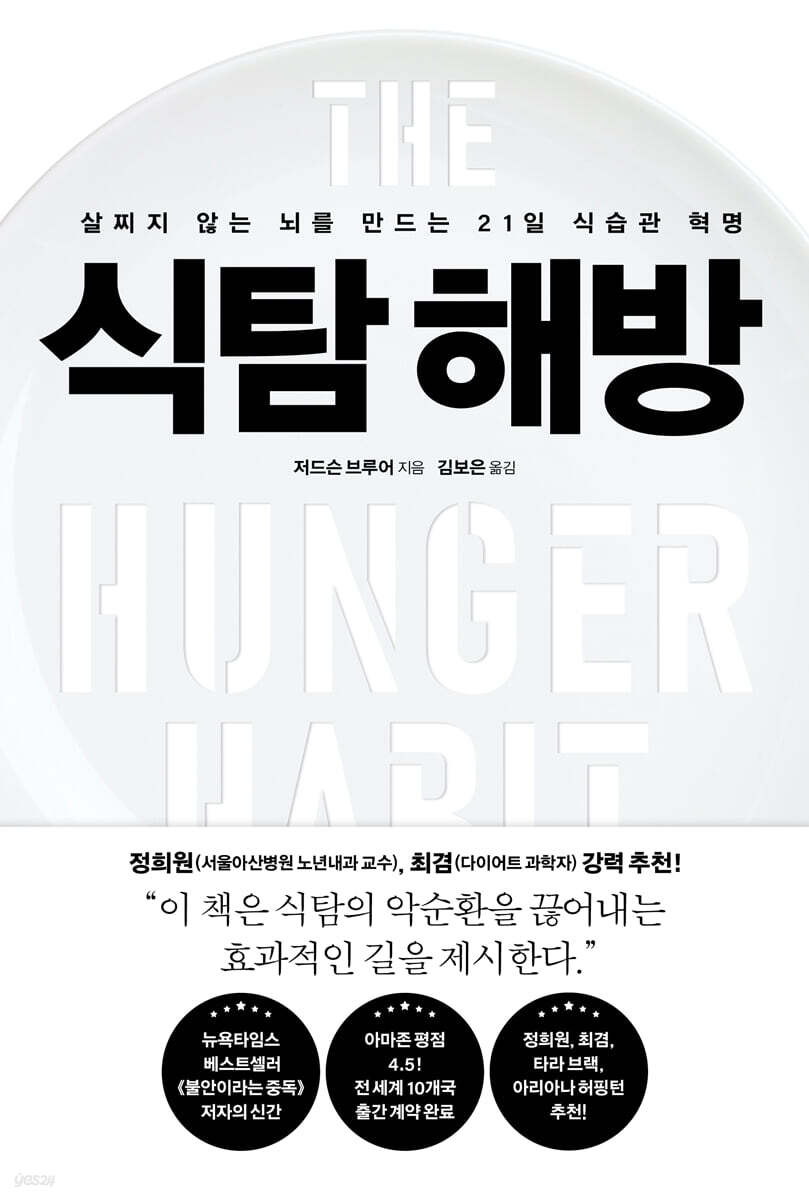
“Liberation of Appetite,” which “provides an effective way to break the vicious cycle of gluttony,” has been published by Purunsup Publishing.
Dr. Judson Brewer, one of the world's leading addiction psychologists and neuroscientists, asserts in this book that 'food cravings' are addictive 'habits' that arise from emotional hunger.
The author clearly diagnoses that, through the latest brain science, neuroscience, and psychological theories, as well as abundant clinical cases, in order to break the 'eating habit', we must understand how our brains work and our eating patterns, and learn to listen to the signals our body sends.
Furthermore, instead of short-term and unsustainable conventional diets that rely on the willpower to “not eat,” the “21-Day Challenge” program introduces fundamental and sustainable strategies based on practical mindfulness.
This way, we can find a way to not only break unhealthy habits, but also start developing healthier ones.
If you want to break free from the cycle of 'eating, blaming, and eating again,' you will find many answers in this book.
This is the one book you must read if you want to restore your relationship with yourself and create the life you want.
★ Publishing contracts completed in 10 countries worldwide, Amazon rating 4.5!
When you keep wanting to eat something, open this book!
The Eating Revolution That Creates a Fat-Free Brain
***What are your 'eating habits'?***
□ When I'm angry or stressed, I want to eat something.
□ I think there are separate 'bread stomachs' and 'rice stomachs'.
□ The moment you see the bag of chips, your hand reaches for it.
□ Once you start eating, you can't stop, so you'll finish it all.
□ I have blamed myself, thinking, 'Why did I eat it again? Why couldn't I resist?'
If you checked even one, it's time to 'freeze your appetite'!
We live in an age of abundance where we are tempted by dizzyingly sweet and salty foods, and where all the food we want is right before our eyes 24 hours a day with a click of a finger.
Even when you're not hungry, you want to eat something, and even when you're already full, you habitually snack, and you make resolutions that will crumble tomorrow, saying, "Just until today..."
Is there really a modern person who has never suffered from the problem of ‘appetite’?
Is there no ultimate secret to ending repeated failures?
“Liberation of Appetite,” which “provides an effective way to break the vicious cycle of gluttony,” has been published by Purunsup Publishing.
Dr. Judson Brewer, one of the world's leading addiction psychologists and neuroscientists, asserts in this book that 'food cravings' are addictive 'habits' that arise from emotional hunger.
The author clearly diagnoses that, through the latest brain science, neuroscience, and psychological theories, as well as abundant clinical cases, in order to break the 'eating habit', we must understand how our brains work and our eating patterns, and learn to listen to the signals our body sends.
Furthermore, instead of short-term and unsustainable conventional diets that rely on the willpower to “not eat,” the “21-Day Challenge” program introduces fundamental and sustainable strategies based on practical mindfulness.
This way, we can find a way to not only break unhealthy habits, but also start developing healthier ones.
If you want to break free from the cycle of 'eating, blaming, and eating again,' you will find many answers in this book.
This is the one book you must read if you want to restore your relationship with yourself and create the life you want.
- You can preview some of the book's contents.
Preview
index
Preface: When your eating habits change, your life changes too.
Part 1: How Eating Habits Are Created
Chapter 1 Why do we eat even though we regret it?
Chapter 2 How are eating habits formed?
Chapter 3: Why Traditional Diet Theories Don't Work
Part 2: A 21-Day Challenge to Reset Your Eating Habits
-Step 1 [Days 1-5] Armed with curiosity and self-kindness, understand your eating habits.
Day 1: Establish realistic and actionable eating habits
Day 2: Understanding Your Eating Patterns
Day 3: Analyzing Your Eating Habits
Day 4: Listen to Your Body's Signals
Day 5: Identifying Hunger and Cravings
-Step 2 [Days 6-16] Awareness Techniques to Break Old Eating Habits
Day 6: Changes in the orbitofrontal cortex when you focus your attention
Day 7: Mindful Eating: Facing Appetite and Cravings
Day 8 Body Scan Meditation to Reconnect with Your Body
Day 9: Exploring the Pleasure Plateau and the Cliff of Indulgence
Day 10: Breaking Out of the Overeating Trap: Craving Tools 1
Day 11: Disillusionment that will save our brains from the "three-day resolution"
Day 12: The Art of Looking Back to Move Forward
Day 13: Imagine, Change: Tools of Longing 2
Day 14: RAIN Training: The Art of Soothing Cravings
Day 15 The Power of Attention
Day 16: Distance Yourself from the Mental Committee
-Step 3 [Days 17-21] The power of the brain and the wisdom of the body to regain control of your eating habits
Day 17 Freedom of Choice Makes Changing Habits Easier
Day 18 The food we eat determines how we feel.
Day 19 The Gift of Kindness
Day 20: Trust Your Experiences Fully
Day 21 The Greatest and Most Excellent Proposal
Acknowledgements
References
Part 1: How Eating Habits Are Created
Chapter 1 Why do we eat even though we regret it?
Chapter 2 How are eating habits formed?
Chapter 3: Why Traditional Diet Theories Don't Work
Part 2: A 21-Day Challenge to Reset Your Eating Habits
-Step 1 [Days 1-5] Armed with curiosity and self-kindness, understand your eating habits.
Day 1: Establish realistic and actionable eating habits
Day 2: Understanding Your Eating Patterns
Day 3: Analyzing Your Eating Habits
Day 4: Listen to Your Body's Signals
Day 5: Identifying Hunger and Cravings
-Step 2 [Days 6-16] Awareness Techniques to Break Old Eating Habits
Day 6: Changes in the orbitofrontal cortex when you focus your attention
Day 7: Mindful Eating: Facing Appetite and Cravings
Day 8 Body Scan Meditation to Reconnect with Your Body
Day 9: Exploring the Pleasure Plateau and the Cliff of Indulgence
Day 10: Breaking Out of the Overeating Trap: Craving Tools 1
Day 11: Disillusionment that will save our brains from the "three-day resolution"
Day 12: The Art of Looking Back to Move Forward
Day 13: Imagine, Change: Tools of Longing 2
Day 14: RAIN Training: The Art of Soothing Cravings
Day 15 The Power of Attention
Day 16: Distance Yourself from the Mental Committee
-Step 3 [Days 17-21] The power of the brain and the wisdom of the body to regain control of your eating habits
Day 17 Freedom of Choice Makes Changing Habits Easier
Day 18 The food we eat determines how we feel.
Day 19 The Gift of Kindness
Day 20: Trust Your Experiences Fully
Day 21 The Greatest and Most Excellent Proposal
Acknowledgements
References
Detailed image

Into the book
If food-related problems are due to habitual behavior, this means that applying this method to the habits of patients who struggle with eating habits can help them change their eating habits, and thus their self-evaluations.
By leveraging neuroscience principles to understand how the human mind works, we can help patients overcome long-standing eating patterns, from boredom eating to binge eating.
Maybe we can rewire our brains to permanently change our relationship with food.
Break old habits and break the vicious cycle.
If you make peace with yourself, the war will naturally stop.
It was a very exciting event.
--- From the "Preface"
I thought that hunger, the most basic human survival mechanism, was so solid, so clear, so certain that I would recognize it immediately.
But I was completely wrong.
Hunger could be created, transformed, cleverly disguised, and combined with other desires.
For those who have long ignored real physical hunger through dieting and restrictive eating, the brain-body disconnect is especially significant.
All the cravings flowing in from various places converged here, that is, into the impulse to eat.
Just because I can distinguish between hunger and stress-induced cravings doesn't mean everyone else can.
At that moment, I had an epiphany that forever changed my perspective on eating.
This realization led me on a path of continuous discovery, transforming how I treat common clinical problems like anxiety and depression.
--- 「Chapter 1.
From "Why do we eat even though we regret it?"
Once our brain finds a strategy that seems to work, it switches to exploitation mode if it can't find a better strategy.
Then the strategy becomes solid and the existing behavior hardens into a habit that is difficult to change.
This is a process shared by Jack, Jackie, and Rob, all three of whom have burned with a sense of duty and willpower to change, but all have failed (many times).
They didn't understand how the brain worked.
Crucially, I didn't realize that the solution was right in front of me and at the same time 'behind my eyes'.
If they were to harness the power of the orbitofrontal cortex, they first had to learn how to use awareness.
But more than that, the three of them (and we) needed to know why willpower fails in the first place.
--- 「Chapter 2.
From "How are eating habits formed?"
Tracking food (calorie intake) or exercise (calorie expenditure) gives us the illusion of control.
I chose the low-calorie tortilla myself.
I, and no one else, chose to walk 10,000 steps.
Most people try to control their eating because they feel social pressure to maintain a healthy weight.
For many, the reward for this effort is the promise of better health.
Still, when many people feel they have lost control of their lives, they look for something stable, reliable, and certain that they can control.
--- 「Chapter 3.
From “Why Existing Diet Theories Are Useless”
Through qualitative research and observations from eating habits groups that have been running for many years, we have also discovered that there is a specific process for changing eating habits.
This process can be divided into three stages.
1. Analyze and diagram habitual eating patterns and eating habits circuits.
2. Change the reward value of eating habits in the brain.
3. Find behaviors with higher reward value and establish new eating habits.
The three steps above are also useful guidelines and can serve as a guide on your journey to change.
The 21-day challenge plan is broken down into realistic, actionable steps, each of which will reshape your relationship with food, eating, and yourself.
It doesn't require any special skills, exceptional willpower, or genes inherited by a lucky few.
There's no need to buy expensive accessories or tracking apps.
All you need is a willingness to practice awareness, the most important element in the process of change.
--- 「Day 1.
From “Setting Realistic and Practical Eating Habits”
Our bodies already know which foods or portion sizes are better and more beneficial.
You just have to listen.
You'll find yourself drawn to this practice because every time you listen to your body and focus on the results, you'll feel better.
By leveraging neuroscience principles to understand how the human mind works, we can help patients overcome long-standing eating patterns, from boredom eating to binge eating.
Maybe we can rewire our brains to permanently change our relationship with food.
Break old habits and break the vicious cycle.
If you make peace with yourself, the war will naturally stop.
It was a very exciting event.
--- From the "Preface"
I thought that hunger, the most basic human survival mechanism, was so solid, so clear, so certain that I would recognize it immediately.
But I was completely wrong.
Hunger could be created, transformed, cleverly disguised, and combined with other desires.
For those who have long ignored real physical hunger through dieting and restrictive eating, the brain-body disconnect is especially significant.
All the cravings flowing in from various places converged here, that is, into the impulse to eat.
Just because I can distinguish between hunger and stress-induced cravings doesn't mean everyone else can.
At that moment, I had an epiphany that forever changed my perspective on eating.
This realization led me on a path of continuous discovery, transforming how I treat common clinical problems like anxiety and depression.
--- 「Chapter 1.
From "Why do we eat even though we regret it?"
Once our brain finds a strategy that seems to work, it switches to exploitation mode if it can't find a better strategy.
Then the strategy becomes solid and the existing behavior hardens into a habit that is difficult to change.
This is a process shared by Jack, Jackie, and Rob, all three of whom have burned with a sense of duty and willpower to change, but all have failed (many times).
They didn't understand how the brain worked.
Crucially, I didn't realize that the solution was right in front of me and at the same time 'behind my eyes'.
If they were to harness the power of the orbitofrontal cortex, they first had to learn how to use awareness.
But more than that, the three of them (and we) needed to know why willpower fails in the first place.
--- 「Chapter 2.
From "How are eating habits formed?"
Tracking food (calorie intake) or exercise (calorie expenditure) gives us the illusion of control.
I chose the low-calorie tortilla myself.
I, and no one else, chose to walk 10,000 steps.
Most people try to control their eating because they feel social pressure to maintain a healthy weight.
For many, the reward for this effort is the promise of better health.
Still, when many people feel they have lost control of their lives, they look for something stable, reliable, and certain that they can control.
--- 「Chapter 3.
From “Why Existing Diet Theories Are Useless”
Through qualitative research and observations from eating habits groups that have been running for many years, we have also discovered that there is a specific process for changing eating habits.
This process can be divided into three stages.
1. Analyze and diagram habitual eating patterns and eating habits circuits.
2. Change the reward value of eating habits in the brain.
3. Find behaviors with higher reward value and establish new eating habits.
The three steps above are also useful guidelines and can serve as a guide on your journey to change.
The 21-day challenge plan is broken down into realistic, actionable steps, each of which will reshape your relationship with food, eating, and yourself.
It doesn't require any special skills, exceptional willpower, or genes inherited by a lucky few.
There's no need to buy expensive accessories or tracking apps.
All you need is a willingness to practice awareness, the most important element in the process of change.
--- 「Day 1.
From “Setting Realistic and Practical Eating Habits”
Our bodies already know which foods or portion sizes are better and more beneficial.
You just have to listen.
You'll find yourself drawn to this practice because every time you listen to your body and focus on the results, you'll feel better.
--- 「Day 18.
From "The food we eat is how we feel"
From "The food we eat is how we feel"
Publisher's Review
“Your hunger is a habit.”
In the fight against gluttony
A book for people who have never won!
“This book presents an effective way to break the vicious cycle of gluttony.”
Jeong Hee-won (Professor of Geriatrics, Seoul Asan Medical Center, author of "Slow Aging Diet")
“If you're looking for a sustainable solution to recurring binge eating, frustration, or a 'magic pill,' this book is the starting point.”
-Choi Kyeom (operator of the YouTube channel "Diet Scientist" and author of "Diet Science 2022")
“A life-giving book that offers insight and solutions to those struggling with food cravings.”
—Tara Brach, clinical psychologist and author of Acceptance
“Stop fighting with food and read this book!”
-Ariana Huffington (founder of The Huffington Post)
We've all probably had the experience of feeling a strong craving for something to eat when we're stressed, or of reaching for a bag of chips when we're full.
Haven't you ever finished a bag of chips in the blink of an eye, then berated yourself, thinking, "Why did I eat this again? Why couldn't I resist again? What could possibly be the problem?" and then reached for another?
Bloating, a feeling of fullness, overwhelming regret… Can I ever break this relentless "gluttony" that does absolutely nothing for my body or mind?
Dr. Judson Brewer, a neuroscientist and authority on addiction psychology, asserts that blaming our willpower or trying to control it won't help us break the vicious cycle of food cravings.
The problem isn't your weak willpower.
It's simply because of the 'habit circuits that are ingrained in the brain'.
In other words, eating habits such as 'I eat cake when I'm stressed' are a product of what our brains have learned.
So how can we change our eating behavior? Simply identify the brain's operating patterns and change the "reward value" that drives us to repeat these behaviors!
《Liberation of Appetite》 is largely divided into a theory part and a practical part.
First, 'Part 1.
In 'How Are Eating Habits Made?', we first examine the mechanisms by which our brain determines eating habits from the perspective of brain science and neuroscience, and then point out the tricks of the food industry that lead us to food addiction by stimulating the so-called bliss point, and the paradox of calorie-restricted diet planning, measurement, and tracking that give us the illusion of 'control', thereby breaking the common belief that 'willpower is important in dieting and managing healthy eating habits'.
'Part 2.
"The 21-Day Challenge to Reset Your Eating Habits" offers solutions to replace your existing eating habits with healthier, more sustainable ones, based on the author's personal experience and clinical case studies.
After analyzing problematic eating habits, the book guides you step-by-step on how to establish new, healthy eating habits to replace them. In particular, the author, who has proven the effectiveness of 'mindfulness' through research and clinical trials and served as a professor at the Mindfulness Center at Yale University and the Massachusetts Institute of Technology, introduces specific practices that are simple enough to follow right away, but their effects are outstanding.
How much willpower does it take to stop eating?
If you know how your brain works, you can succeed without having to fight it!
Intermittent fasting, detox diets, ketogenic diets (low-carb, high-fat diets), the Emperor diet, the Danish diet… countless diets continue to dazzle us today.
These diets have something in common.
The idea is that you need to ‘limit your calorie intake’ based on ‘willpower.’
Even without mentioning diet methods, most modern people suffer from eating habits related to 'gluttony'.
I resolve not to eat today, but before I know it, I end up eating again and blaming myself.
Here, ‘appetite’ is different from physical hunger.
It is a craving or urge for a specific food (unrelated to actual hunger), rather than the natural appetite that arises when the stomach is empty.
Feeling drawn to food when in a certain emotional state, unconsciously and habitually seeking out food, and eating more than the appropriate amount of food are all included in the 'eating habit'.
All human habits, including eating habits, are established based on the brain's mechanism of 'cue-action-result-reward'.
For example, if you eat cake (behavior) when you are stressed (trigger/cue) and it makes you feel good (outcome/reward), your brain will associate cake with good feelings and habitually reach for cake the next time a similar situation arises.
The first step to breaking free from the vicious cycle of gluttony begins with carefully analyzing the eating habits circuit based on the trigger (cue) - action - result (reward).
When you're stressed or depressed, eating cake can make you feel better in the moment.
But we already know that eating isn't the ultimate solution to stress or depression.
Fortunately, understanding this habit circuit allows us to establish new, beneficial habits instead of being stuck in useless habit circuits.
The author also details the research process behind the "Eat Right Now" eating habit change program, revealing that the mechanisms by which habits are formed in our brains are the same.
The author, an addiction psychology expert, was developing a mindfulness-based smoking cessation program when he discovered that subjects had a five-fold higher success rate in quitting smoking than a control group.
What's even more surprising is that the subjects also showed changes in their eating habits in addition to changes in their smoking cessation habits.
The author has repeatedly demonstrated through experiments that the brain's habit mechanisms involved in smoking cessation are also involved in eating habits, and has developed a program to change eating habits called 'Eat Right Now' that applies this knowledge.
In an online experiment with the general public, 'Eat Right Now' found that more than 40 percent of participants reduced their cravings.
The author presents a variety of cases of patients who are unable to fully enjoy life due to eating habits, such as Tracy, who always lost the 'battle with herself'; Jackie, who looked for something to chew whenever she got absorbed in something; Jack, who habitually ate cornflakes when he had the urge to eat; Rob, who relied on fast food binge eating to suppress anxiety; and participants in 'Eat Right Now', an app-based eating habit change program developed by the author's research team. This helps anyone discover the eating problems they are experiencing and understand the cause of them.
Understanding how your brain works allows you to succeed without having to fight it! Let go of the guilt of "I shouldn't have eaten..." and the obligation of "I shouldn't have eaten."
Discovered by the world's leading addiction psychologist and neuroscientist
The Ultimate 21-Day Diet Plan to Break Free from Fake Appetite
So how can we "carefully" analyze our eating habits? It's possible through the awareness emphasized by mindfulness.
Some people might think that ‘mindfulness’ is somehow religious and mystical.
However, the power of mindfulness has been passed down through many practitioners over many years, and its positive effects on our bodies, brains, and minds are being proven by the latest data and modern science.
There are no tricky or special conditions required.
It doesn't even take that long.
When you feel a craving for something to eat, or when you find yourself repeatedly eating because you can't overcome the craving, all you have to do is pay attention to what's happening in your body and mind and recognize the consequences of your eating behavior.
If you repeat this from time to time, you will be able to reconnect with your body, which has been disconnected from you, and hear the signals your body is sending you more clearly.
To change your brain patterns, it's important to listen to your body's signals.
Let's remember.
“The feeling body is stronger than the thinking brain.”
*3 steps to change your eating habits
1.
Diagram and analyze habitual eating patterns and eating habits circuits.
2.
Change the reward value of eating habits in the brain.
3.
Find behaviors with higher reward value and establish new eating habits.
The author clearly outlines the process of changing eating habits in three steps, then divides it into a '21-day' plan and guides it step-by-step so that anyone can try it.
There are many training methods that you can put into practice in your daily life right now, such as the food appreciation method using the 'raisin practice' that represents the mindful eating method, the body scan to feel the body's sensations and reconnect with it, the craving tool to recognize the signals of my body by asking myself questions when a craving comes, and the RAIN training to accept and soothe the craving itself instead of fighting it.
What is important in this process, along with awareness, is ‘self-kindness’, which is the effort to be generous to yourself.
Most of us with gluttony habits repeat the cycle of 'eating, berating ourselves, eating again' because we are emotionally dissatisfied, either with the specific situation that triggers the craving or with ourselves.
In these situations, even reprimanding becomes a habit.
But as I said before, if I listen to my body's signals properly, it's only a matter of time before I change my brain patterns and establish new, beneficial habits.
《Freeing Appetite》 is not a diet book that shouts, "If you do this, you're guaranteed to lose weight right away."
It shows how vain conventional diets, which require self-control and willpower, are, and it speaks forcefully about more fundamental and sustainable changes by awakening awareness, a capacity that everyone possesses.
Professor Jeong Hee-won of the Department of Geriatrics at Seoul Asan Medical Center also sent a recommendation, saying that the various strategies in this book can be applied not only to “improving appetite, but also ‘accelerated aging’ lifestyle habits.”
Wouldn't you like to break the unhealthy habits that are eating away at your precious life and cultivate a positive relationship with yourself? Join this amazing revolution where changing your eating habits leads to changes in your body and mind, ultimately leading to a change in your life.
“The act of eating can be a source of self-care, health, joy, and opportunities to connect with others, rather than an evaluation of one’s own existence.
This book has one goal.
It's about changing your relationship with food.
You will learn how your mind works and become one with it.
As you reconnect with your body, you will awaken to the vast wisdom stored within it.
You will also be free from the control of food and enjoy the rest of your life at your leisure.
“There is not much time left until the war ends and peace comes.”
-From the preface
In the fight against gluttony
A book for people who have never won!
“This book presents an effective way to break the vicious cycle of gluttony.”
Jeong Hee-won (Professor of Geriatrics, Seoul Asan Medical Center, author of "Slow Aging Diet")
“If you're looking for a sustainable solution to recurring binge eating, frustration, or a 'magic pill,' this book is the starting point.”
-Choi Kyeom (operator of the YouTube channel "Diet Scientist" and author of "Diet Science 2022")
“A life-giving book that offers insight and solutions to those struggling with food cravings.”
—Tara Brach, clinical psychologist and author of Acceptance
“Stop fighting with food and read this book!”
-Ariana Huffington (founder of The Huffington Post)
We've all probably had the experience of feeling a strong craving for something to eat when we're stressed, or of reaching for a bag of chips when we're full.
Haven't you ever finished a bag of chips in the blink of an eye, then berated yourself, thinking, "Why did I eat this again? Why couldn't I resist again? What could possibly be the problem?" and then reached for another?
Bloating, a feeling of fullness, overwhelming regret… Can I ever break this relentless "gluttony" that does absolutely nothing for my body or mind?
Dr. Judson Brewer, a neuroscientist and authority on addiction psychology, asserts that blaming our willpower or trying to control it won't help us break the vicious cycle of food cravings.
The problem isn't your weak willpower.
It's simply because of the 'habit circuits that are ingrained in the brain'.
In other words, eating habits such as 'I eat cake when I'm stressed' are a product of what our brains have learned.
So how can we change our eating behavior? Simply identify the brain's operating patterns and change the "reward value" that drives us to repeat these behaviors!
《Liberation of Appetite》 is largely divided into a theory part and a practical part.
First, 'Part 1.
In 'How Are Eating Habits Made?', we first examine the mechanisms by which our brain determines eating habits from the perspective of brain science and neuroscience, and then point out the tricks of the food industry that lead us to food addiction by stimulating the so-called bliss point, and the paradox of calorie-restricted diet planning, measurement, and tracking that give us the illusion of 'control', thereby breaking the common belief that 'willpower is important in dieting and managing healthy eating habits'.
'Part 2.
"The 21-Day Challenge to Reset Your Eating Habits" offers solutions to replace your existing eating habits with healthier, more sustainable ones, based on the author's personal experience and clinical case studies.
After analyzing problematic eating habits, the book guides you step-by-step on how to establish new, healthy eating habits to replace them. In particular, the author, who has proven the effectiveness of 'mindfulness' through research and clinical trials and served as a professor at the Mindfulness Center at Yale University and the Massachusetts Institute of Technology, introduces specific practices that are simple enough to follow right away, but their effects are outstanding.
How much willpower does it take to stop eating?
If you know how your brain works, you can succeed without having to fight it!
Intermittent fasting, detox diets, ketogenic diets (low-carb, high-fat diets), the Emperor diet, the Danish diet… countless diets continue to dazzle us today.
These diets have something in common.
The idea is that you need to ‘limit your calorie intake’ based on ‘willpower.’
Even without mentioning diet methods, most modern people suffer from eating habits related to 'gluttony'.
I resolve not to eat today, but before I know it, I end up eating again and blaming myself.
Here, ‘appetite’ is different from physical hunger.
It is a craving or urge for a specific food (unrelated to actual hunger), rather than the natural appetite that arises when the stomach is empty.
Feeling drawn to food when in a certain emotional state, unconsciously and habitually seeking out food, and eating more than the appropriate amount of food are all included in the 'eating habit'.
All human habits, including eating habits, are established based on the brain's mechanism of 'cue-action-result-reward'.
For example, if you eat cake (behavior) when you are stressed (trigger/cue) and it makes you feel good (outcome/reward), your brain will associate cake with good feelings and habitually reach for cake the next time a similar situation arises.
The first step to breaking free from the vicious cycle of gluttony begins with carefully analyzing the eating habits circuit based on the trigger (cue) - action - result (reward).
When you're stressed or depressed, eating cake can make you feel better in the moment.
But we already know that eating isn't the ultimate solution to stress or depression.
Fortunately, understanding this habit circuit allows us to establish new, beneficial habits instead of being stuck in useless habit circuits.
The author also details the research process behind the "Eat Right Now" eating habit change program, revealing that the mechanisms by which habits are formed in our brains are the same.
The author, an addiction psychology expert, was developing a mindfulness-based smoking cessation program when he discovered that subjects had a five-fold higher success rate in quitting smoking than a control group.
What's even more surprising is that the subjects also showed changes in their eating habits in addition to changes in their smoking cessation habits.
The author has repeatedly demonstrated through experiments that the brain's habit mechanisms involved in smoking cessation are also involved in eating habits, and has developed a program to change eating habits called 'Eat Right Now' that applies this knowledge.
In an online experiment with the general public, 'Eat Right Now' found that more than 40 percent of participants reduced their cravings.
The author presents a variety of cases of patients who are unable to fully enjoy life due to eating habits, such as Tracy, who always lost the 'battle with herself'; Jackie, who looked for something to chew whenever she got absorbed in something; Jack, who habitually ate cornflakes when he had the urge to eat; Rob, who relied on fast food binge eating to suppress anxiety; and participants in 'Eat Right Now', an app-based eating habit change program developed by the author's research team. This helps anyone discover the eating problems they are experiencing and understand the cause of them.
Understanding how your brain works allows you to succeed without having to fight it! Let go of the guilt of "I shouldn't have eaten..." and the obligation of "I shouldn't have eaten."
Discovered by the world's leading addiction psychologist and neuroscientist
The Ultimate 21-Day Diet Plan to Break Free from Fake Appetite
So how can we "carefully" analyze our eating habits? It's possible through the awareness emphasized by mindfulness.
Some people might think that ‘mindfulness’ is somehow religious and mystical.
However, the power of mindfulness has been passed down through many practitioners over many years, and its positive effects on our bodies, brains, and minds are being proven by the latest data and modern science.
There are no tricky or special conditions required.
It doesn't even take that long.
When you feel a craving for something to eat, or when you find yourself repeatedly eating because you can't overcome the craving, all you have to do is pay attention to what's happening in your body and mind and recognize the consequences of your eating behavior.
If you repeat this from time to time, you will be able to reconnect with your body, which has been disconnected from you, and hear the signals your body is sending you more clearly.
To change your brain patterns, it's important to listen to your body's signals.
Let's remember.
“The feeling body is stronger than the thinking brain.”
*3 steps to change your eating habits
1.
Diagram and analyze habitual eating patterns and eating habits circuits.
2.
Change the reward value of eating habits in the brain.
3.
Find behaviors with higher reward value and establish new eating habits.
The author clearly outlines the process of changing eating habits in three steps, then divides it into a '21-day' plan and guides it step-by-step so that anyone can try it.
There are many training methods that you can put into practice in your daily life right now, such as the food appreciation method using the 'raisin practice' that represents the mindful eating method, the body scan to feel the body's sensations and reconnect with it, the craving tool to recognize the signals of my body by asking myself questions when a craving comes, and the RAIN training to accept and soothe the craving itself instead of fighting it.
What is important in this process, along with awareness, is ‘self-kindness’, which is the effort to be generous to yourself.
Most of us with gluttony habits repeat the cycle of 'eating, berating ourselves, eating again' because we are emotionally dissatisfied, either with the specific situation that triggers the craving or with ourselves.
In these situations, even reprimanding becomes a habit.
But as I said before, if I listen to my body's signals properly, it's only a matter of time before I change my brain patterns and establish new, beneficial habits.
《Freeing Appetite》 is not a diet book that shouts, "If you do this, you're guaranteed to lose weight right away."
It shows how vain conventional diets, which require self-control and willpower, are, and it speaks forcefully about more fundamental and sustainable changes by awakening awareness, a capacity that everyone possesses.
Professor Jeong Hee-won of the Department of Geriatrics at Seoul Asan Medical Center also sent a recommendation, saying that the various strategies in this book can be applied not only to “improving appetite, but also ‘accelerated aging’ lifestyle habits.”
Wouldn't you like to break the unhealthy habits that are eating away at your precious life and cultivate a positive relationship with yourself? Join this amazing revolution where changing your eating habits leads to changes in your body and mind, ultimately leading to a change in your life.
“The act of eating can be a source of self-care, health, joy, and opportunities to connect with others, rather than an evaluation of one’s own existence.
This book has one goal.
It's about changing your relationship with food.
You will learn how your mind works and become one with it.
As you reconnect with your body, you will awaken to the vast wisdom stored within it.
You will also be free from the control of food and enjoy the rest of your life at your leisure.
“There is not much time left until the war ends and peace comes.”
-From the preface
GOODS SPECIFICS
- Date of issue: May 9, 2025
- Page count, weight, size: 380 pages | 532g | 145*215*24mm
- ISBN13: 9791172540586
- ISBN10: 1172540586
You may also like
카테고리
korean


korean

![ELLE 엘르 스페셜 에디션 A형 : 12월 [2025]](http://librairie.coreenne.fr/cdn/shop/files/b8e27a3de6c9538896439686c6b0e8fb.jpg?v=1766436872&width=3840)


