

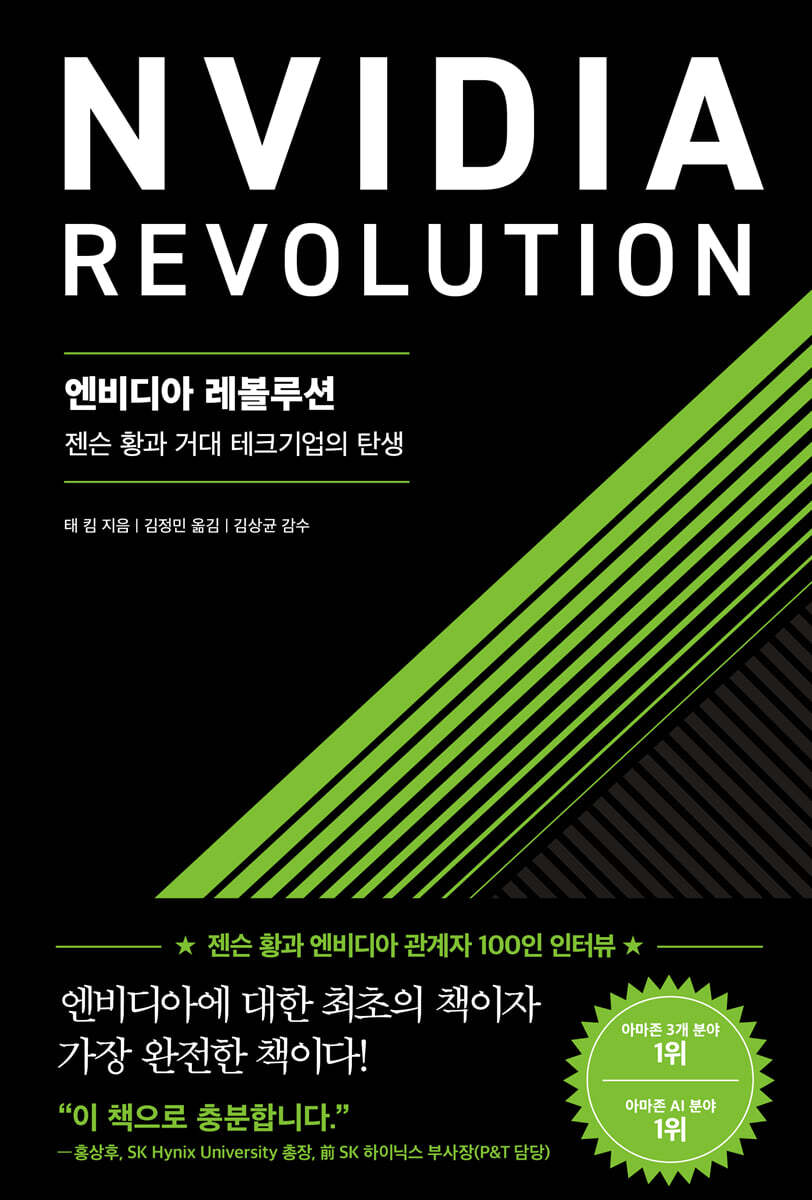
NVIDIA Revolution
 |
Description
Book Introduction
- A word from MD
-
The most complete NVIDIA storyA 31-year business history of NVIDIA, a key player in the AI era.
This book delves into Jensen Huang's unique and powerful leadership and the creative yet fierce organizational culture that shaped NVIDIA's robust management world.
The most realistic and complete book on NVIDIA.
March 21, 2025. Economics and Management PD Oh Da-eun
“Jensen, aren’t you a genius?” “Am I a genius? Well, I guess so.
There are many people in the world who are smarter than me.
But what is clear is that there is absolutely no one who works harder than me.” This book is a compilation of vivid voices and NVIDIA history through direct interviews with Jensen Huang and over 100 NVIDIA executives.
This is a documentary story that summarizes the 31-year story of NVIDIA in its most complete form, spanning 448 pages, after more than a year of in-depth research, and a management book that captures Jensen Huang's corporate philosophy.
Barron's senior reporter Tae Kim interviewed over 100 people, including Jensen Huang, co-founders Malachowski and Priem, early venture investors, and representatives from competitors.
As a result, the incidents and accidents of the time, the behind-the-scenes development, and the horrific and thrilling anecdotes that went back and forth between the extremes of 'bankruptcy crisis' and 'market dominance' were realistically depicted down to every single conversation.
From the day in 1993 when three entrepreneurs dreamed of starting a business while drinking unlimited refill coffee at Denny's restaurant to today, the story of how they opened the 'GPU era' after repeated failures and successes, successes and failures, is incredibly fascinating.
You can get a glimpse into various episodes that have never been exposed in any book or article, Jensen Huang's characteristically straightforward speech that combines humor and decisiveness, whiteboards and top 5 emails, public criticism of internal politics, and a unique and fierce organizational culture represented by the "speed of light."
There are many people in the world who are smarter than me.
But what is clear is that there is absolutely no one who works harder than me.” This book is a compilation of vivid voices and NVIDIA history through direct interviews with Jensen Huang and over 100 NVIDIA executives.
This is a documentary story that summarizes the 31-year story of NVIDIA in its most complete form, spanning 448 pages, after more than a year of in-depth research, and a management book that captures Jensen Huang's corporate philosophy.
Barron's senior reporter Tae Kim interviewed over 100 people, including Jensen Huang, co-founders Malachowski and Priem, early venture investors, and representatives from competitors.
As a result, the incidents and accidents of the time, the behind-the-scenes development, and the horrific and thrilling anecdotes that went back and forth between the extremes of 'bankruptcy crisis' and 'market dominance' were realistically depicted down to every single conversation.
From the day in 1993 when three entrepreneurs dreamed of starting a business while drinking unlimited refill coffee at Denny's restaurant to today, the story of how they opened the 'GPU era' after repeated failures and successes, successes and failures, is incredibly fascinating.
You can get a glimpse into various episodes that have never been exposed in any book or article, Jensen Huang's characteristically straightforward speech that combines humor and decisiveness, whiteboards and top 5 emails, public criticism of internal politics, and a unique and fierce organizational culture represented by the "speed of light."
- You can preview some of the book's contents.
Preview
index
Part 1: Zero: A World of Possibility (~1993)
1.
Boy and Young Man
“I don’t pick fights first.
But once I start, I never back down.”
2.
Priem, Malachovsky, and Jensen
“Let’s make a demo chip for Samsung.
For that, we need him, Jensen!”
3.
Valentine's Trial
“NVIDIA, what the hell are you guys?”
Part 2: One: From Concept to Reality (1993–2003)
4.
Hell and Heaven
“I thought we had created great technology and a great product.
As it turns out, all we've created is great technology.
“It wasn’t a great product.”
5.
We are a hyper-active company
“At the speed of light, 80 hours a week, under tremendous pressure.”
6.
Win unconditionally
“It was a game of who could run faster and cover all the land.”
7.
GeForce and the Innovator's Dilemma
“August 1999.
“Folks, I present to you the world’s first GPU.”
Part 3: Exponential Growth (2002–2013)
8. The Age of GPUs, the Empire of CUDA
“We preached a religion called GPU computing.
And that was a really big success.”
9.
Top 5 Emails and Whiteboards
“I’m the guy who drinks scotch and does email work.”
10.
A manager with an engineer's brain
“Jensen was really creepy.
“At every meeting, there was nothing he didn’t know.”
Part 4: Infinite: Infinite Expansion and Domination (2013–present)
11. AI Shock
“Deep learning is going to be huge.
“We have to put everything on the line here.”
12.
Hedge funds and Mellanox
“I wish I hadn’t sold my Nvidia shares back then.”
13.
Moonshot of Light
“It was clear that ray tracing and AI would change the game.
“I knew this was an inevitable future.”
14.
Big Bang
“While NVIDIA’s success may seem like a miracle to outsiders, to our employees it was a natural evolution.”
1.
Boy and Young Man
“I don’t pick fights first.
But once I start, I never back down.”
2.
Priem, Malachovsky, and Jensen
“Let’s make a demo chip for Samsung.
For that, we need him, Jensen!”
3.
Valentine's Trial
“NVIDIA, what the hell are you guys?”
Part 2: One: From Concept to Reality (1993–2003)
4.
Hell and Heaven
“I thought we had created great technology and a great product.
As it turns out, all we've created is great technology.
“It wasn’t a great product.”
5.
We are a hyper-active company
“At the speed of light, 80 hours a week, under tremendous pressure.”
6.
Win unconditionally
“It was a game of who could run faster and cover all the land.”
7.
GeForce and the Innovator's Dilemma
“August 1999.
“Folks, I present to you the world’s first GPU.”
Part 3: Exponential Growth (2002–2013)
8. The Age of GPUs, the Empire of CUDA
“We preached a religion called GPU computing.
And that was a really big success.”
9.
Top 5 Emails and Whiteboards
“I’m the guy who drinks scotch and does email work.”
10.
A manager with an engineer's brain
“Jensen was really creepy.
“At every meeting, there was nothing he didn’t know.”
Part 4: Infinite: Infinite Expansion and Domination (2013–present)
11. AI Shock
“Deep learning is going to be huge.
“We have to put everything on the line here.”
12.
Hedge funds and Mellanox
“I wish I hadn’t sold my Nvidia shares back then.”
13.
Moonshot of Light
“It was clear that ray tracing and AI would change the game.
“I knew this was an inevitable future.”
14.
Big Bang
“While NVIDIA’s success may seem like a miracle to outsiders, to our employees it was a natural evolution.”
Detailed image

Into the book
However, it has now grown into a major company that provides high-performance processors for the era of AI.
NVIDIA's processor architecture is optimized for AI tasks because it excels at performing massive, concurrent computations essential for training and executing large language models.
NVIDIA recognized the importance of AI early on and has been investing proactively for over a decade, including hardware enhancements, AI software tool development, and network performance optimization.
Thanks to this foresight, NVIDIA's technology platform is perfectly positioned to capitalize on today's AI era.
--- p.15, from “Meeting Jensen, June 14, 2024”
I introduced myself as a PC gaming enthusiast who had been building my own computers since the 1990s.
He said that he first learned about NVIDIA when he was looking for a graphics card for his PC, and that he always chose NVIDIA products.
And he said that his first success was his choice to invest in Nvidia early in his career while working for a fund on Wall Street.
“Well done,” Jensen joked, his expression unwavering.
“NVIDIA was my first success too.”
--- pp.18-19
But sometimes communication devolved into outright conflict.
“Chris and I used to have very rough and ruthless arguments.
“We didn’t have any physical conversations, but we fought, yelling and screaming at each other,” Priem recalled.
“Chris was trying to get something out of me about the chip decision.
At some point, I couldn't calm down even after he gave me the answer he wanted, so I tried to continue the fight.
Then Chris says, 'Stop, stop, it's over now.
“I used to say, ‘I got the answer I wanted.’”
Then, Priem stormed out of the office, leaving the other team members to look at Malachovsky with worried eyes.
Whenever one of them hesitated and asked if the team was now disbanding, Malachovsky would always reply:
“This team is fine.”
--- p.64
“I used to tell people at AMD, Intel, and other companies that if they wanted to see how Nvidia was doing, they should come to the Nvidia office parking lot on the weekend.
“It was always packed with people’s cars going to work,” said Riva.
Even the marketing department came in every Saturday, and working 60 to 80 hours a week was common.
Andrew Logan, a marketing director at Nvidia, remembers leaving the office with his wife at 9:30 p.m. to go see the movie Titanic.
On the way out the door, a colleague shouted.
“Hey, Andy, are you taking your half day off today?”
--- p.147
But on the other hand, the saying, “We have 30 days left until we go under” was also true.
In the tech industry, a single wrong decision or product launch can be devastating.
NVIDIA was lucky enough to survive the disasters of NV1 and NV2 twice, and succeeded with RIVA 128 with only a few months left in its lifespan.
But this luck couldn't last forever.
A good corporate culture can protect your company from the serious consequences of most mistakes.
However, risks such as mistakes and market downturns were unavoidable.
--- p.150
As Steve Jobs prepared to leave, he told the NVIDIA attendees:
"You definitely need to do more in the notebook market. ATI is giving Nvidia a hard time in that market," he said, referring to ATI, which has become Nvidia's main rival since the demise of 3dfx.
Chris Diskin answered without a moment's hesitation.
“Steve, to be honest, I think you’re wrong.”
The conference room was plunged into silence.
Jobs looked at Diskin with his characteristically intense gaze and said:
“Can you tell me why?” Diskin could tell that not many people had dared to contradict Steve Jobs at that moment.
Jobs was clearly expecting a compelling answer, and Diskin had one.
--- pp.226-227
NVIDIA called this chip programming model "Compute Unified Device Architecture," or CUDA for short. CUDA allowed not only graphics programming experts but also scientists and engineers to harness the GPU's computational power.
With the help of CUDA, they were able to manage the complex combination of technical instructions to execute parallel calculations across the hundreds (and later thousands) of compute cores of a GPU.
Jensen believed that CUDA would allow Nvidia to expand its market reach into every corner of the tech industry.
It wasn't new hardware, but new software that was going to change Nvidia.
--- p.247
It seemed to Ernst that Jensen was growing weary of the investors' aggressive questioning and would soon leave.
So he decided to ask another question.
“Jensen, I have a two-year-old daughter.
So I just bought a new Sony A100 DSLR camera, and I periodically download photos to my Mac and lightly edit them in Photoshop.
But every time I open a high-resolution image, my Mac computer immediately slows down.
“It’s worse on my ThinkPad laptop. Can the GPU help with this?” Jensen’s eyes lit up.
“Please don’t write about this story, it hasn’t been released yet.
Adobe is also our partner. With CUDA support, Adobe Photoshop can instruct the CPU to offload work to the GPU, resulting in significantly faster performance.
This is what I call the ‘age of GPUs.’”
--- p.254
Nvidia has been aggressively expanding into new market segments to diversify its revenue streams so that its overall business is not swayed by weak demand in certain areas.
One of them was console graphics, and even though Microsoft had already signed a deal with another company to build the graphics chips for its Xbox console, Nvidia pushed for the contract again.
And despite having virtually no experience with Apple's Macintosh architecture, Nvidia managed to break into the Mac lineup.
Additionally, NVIDIA was able to enter the professional workstation market with the Quadro line of products aimed at the CAD market that it had originally intentionally avoided.
Now, Jensen has created an entirely new computing technology based on GPUs.
--- p.263
Catanzaro said.
“The AlexNet paper by Alex Krizhevsky and Ilya Suzkever really shook the world.
One thing people often forget is that this paper was fundamentally a systems paper.
It wasn't about some cool new mathematical concept of how to implement artificial intelligence.
What they've done is leverage accelerated computing to dramatically scale the datasets and models that can be applied to specific tasks.
that
And the results have been remarkable.” This research has ignited Jensen’s interest in artificial intelligence.
he is
I started talking to Bill Daly frequently and focused on how deep learning, especially GPU-based deep learning, could be a huge opportunity for NVIDIA.
There was considerable debate within management over this issue.
Even among Jensen's key executives, some opposed further investment, saying deep learning was just a passing fad.
But CEO Jensen decided to ignore these opinions.
“Deep learning is going to be huge,” Jensen said at a 2013 executive meeting.
“We have to put everything on the line here.”
--- pp.344-345
Nvidia's second, and lesser-known, strength is its pricing power.
Nvidia doesn't have high hopes for a mass-market product.
This is because popular products face pressure to lower their prices as competition intensifies.
Rather, Nvidia has been pursuing the opposite strategy of raising prices since its inception.
“Jensen always said, ‘We have to do what other people can’t do.
We have been saying, 'We have to provide special value to the market.'
And he thought he could attract top talent to the company by doing revolutionary work in cutting-edge areas,” said Nvidia executive Jay Puri.
“Our corporate culture isn’t just about chasing market share.
Rather, it is about creating a market.”
--- p.392
Dierks was overcome with excitement.
He resigned the next day and told Pellucid's top executives that he was going to Nvidia.
Then the executive got mad as hell.
“I knew you could go! I’m going to sue you and Nvidia.
“I won’t let you ever set foot in Silicon Valley again.”
He told Dierks that Nvidia would be scared away by these legal threats.
Nvidia was only a one-year-old company at the time and its financial situation was limited.
But when Dierks told Jensen about this threat, the Nvidia CEO was completely unfazed.
“Try it,” Jensen replied.
At that moment, Dierks realized what kind of boss he wanted to work with.
He accepted NVIDIA's offer and has been working for NVIDIA for over 30 years.
--- pp.414-415
Jensen rewards performance with stock grants based on how valuable the employee is to the company.
Former HR chief John McSorley said.
“Jensen treated Nvidia stock like his own blood.
He examines stock allocation reports meticulously, as if looking at them under a microscope.”
Stock compensation is in the form of restricted stock.
When an employee joins a company, they are provided with a securities account.
After the first year, the employee receives a lump sum of stock equivalent to one-fourth of the initial stock grant.
For example, if the total promised amount was 1,000 shares, the employee would receive 250 shares at this time.
After that, employees will receive one-fourth of their assigned annual stock grant regularly every quarter.
NVIDIA's processor architecture is optimized for AI tasks because it excels at performing massive, concurrent computations essential for training and executing large language models.
NVIDIA recognized the importance of AI early on and has been investing proactively for over a decade, including hardware enhancements, AI software tool development, and network performance optimization.
Thanks to this foresight, NVIDIA's technology platform is perfectly positioned to capitalize on today's AI era.
--- p.15, from “Meeting Jensen, June 14, 2024”
I introduced myself as a PC gaming enthusiast who had been building my own computers since the 1990s.
He said that he first learned about NVIDIA when he was looking for a graphics card for his PC, and that he always chose NVIDIA products.
And he said that his first success was his choice to invest in Nvidia early in his career while working for a fund on Wall Street.
“Well done,” Jensen joked, his expression unwavering.
“NVIDIA was my first success too.”
--- pp.18-19
But sometimes communication devolved into outright conflict.
“Chris and I used to have very rough and ruthless arguments.
“We didn’t have any physical conversations, but we fought, yelling and screaming at each other,” Priem recalled.
“Chris was trying to get something out of me about the chip decision.
At some point, I couldn't calm down even after he gave me the answer he wanted, so I tried to continue the fight.
Then Chris says, 'Stop, stop, it's over now.
“I used to say, ‘I got the answer I wanted.’”
Then, Priem stormed out of the office, leaving the other team members to look at Malachovsky with worried eyes.
Whenever one of them hesitated and asked if the team was now disbanding, Malachovsky would always reply:
“This team is fine.”
--- p.64
“I used to tell people at AMD, Intel, and other companies that if they wanted to see how Nvidia was doing, they should come to the Nvidia office parking lot on the weekend.
“It was always packed with people’s cars going to work,” said Riva.
Even the marketing department came in every Saturday, and working 60 to 80 hours a week was common.
Andrew Logan, a marketing director at Nvidia, remembers leaving the office with his wife at 9:30 p.m. to go see the movie Titanic.
On the way out the door, a colleague shouted.
“Hey, Andy, are you taking your half day off today?”
--- p.147
But on the other hand, the saying, “We have 30 days left until we go under” was also true.
In the tech industry, a single wrong decision or product launch can be devastating.
NVIDIA was lucky enough to survive the disasters of NV1 and NV2 twice, and succeeded with RIVA 128 with only a few months left in its lifespan.
But this luck couldn't last forever.
A good corporate culture can protect your company from the serious consequences of most mistakes.
However, risks such as mistakes and market downturns were unavoidable.
--- p.150
As Steve Jobs prepared to leave, he told the NVIDIA attendees:
"You definitely need to do more in the notebook market. ATI is giving Nvidia a hard time in that market," he said, referring to ATI, which has become Nvidia's main rival since the demise of 3dfx.
Chris Diskin answered without a moment's hesitation.
“Steve, to be honest, I think you’re wrong.”
The conference room was plunged into silence.
Jobs looked at Diskin with his characteristically intense gaze and said:
“Can you tell me why?” Diskin could tell that not many people had dared to contradict Steve Jobs at that moment.
Jobs was clearly expecting a compelling answer, and Diskin had one.
--- pp.226-227
NVIDIA called this chip programming model "Compute Unified Device Architecture," or CUDA for short. CUDA allowed not only graphics programming experts but also scientists and engineers to harness the GPU's computational power.
With the help of CUDA, they were able to manage the complex combination of technical instructions to execute parallel calculations across the hundreds (and later thousands) of compute cores of a GPU.
Jensen believed that CUDA would allow Nvidia to expand its market reach into every corner of the tech industry.
It wasn't new hardware, but new software that was going to change Nvidia.
--- p.247
It seemed to Ernst that Jensen was growing weary of the investors' aggressive questioning and would soon leave.
So he decided to ask another question.
“Jensen, I have a two-year-old daughter.
So I just bought a new Sony A100 DSLR camera, and I periodically download photos to my Mac and lightly edit them in Photoshop.
But every time I open a high-resolution image, my Mac computer immediately slows down.
“It’s worse on my ThinkPad laptop. Can the GPU help with this?” Jensen’s eyes lit up.
“Please don’t write about this story, it hasn’t been released yet.
Adobe is also our partner. With CUDA support, Adobe Photoshop can instruct the CPU to offload work to the GPU, resulting in significantly faster performance.
This is what I call the ‘age of GPUs.’”
--- p.254
Nvidia has been aggressively expanding into new market segments to diversify its revenue streams so that its overall business is not swayed by weak demand in certain areas.
One of them was console graphics, and even though Microsoft had already signed a deal with another company to build the graphics chips for its Xbox console, Nvidia pushed for the contract again.
And despite having virtually no experience with Apple's Macintosh architecture, Nvidia managed to break into the Mac lineup.
Additionally, NVIDIA was able to enter the professional workstation market with the Quadro line of products aimed at the CAD market that it had originally intentionally avoided.
Now, Jensen has created an entirely new computing technology based on GPUs.
--- p.263
Catanzaro said.
“The AlexNet paper by Alex Krizhevsky and Ilya Suzkever really shook the world.
One thing people often forget is that this paper was fundamentally a systems paper.
It wasn't about some cool new mathematical concept of how to implement artificial intelligence.
What they've done is leverage accelerated computing to dramatically scale the datasets and models that can be applied to specific tasks.
that
And the results have been remarkable.” This research has ignited Jensen’s interest in artificial intelligence.
he is
I started talking to Bill Daly frequently and focused on how deep learning, especially GPU-based deep learning, could be a huge opportunity for NVIDIA.
There was considerable debate within management over this issue.
Even among Jensen's key executives, some opposed further investment, saying deep learning was just a passing fad.
But CEO Jensen decided to ignore these opinions.
“Deep learning is going to be huge,” Jensen said at a 2013 executive meeting.
“We have to put everything on the line here.”
--- pp.344-345
Nvidia's second, and lesser-known, strength is its pricing power.
Nvidia doesn't have high hopes for a mass-market product.
This is because popular products face pressure to lower their prices as competition intensifies.
Rather, Nvidia has been pursuing the opposite strategy of raising prices since its inception.
“Jensen always said, ‘We have to do what other people can’t do.
We have been saying, 'We have to provide special value to the market.'
And he thought he could attract top talent to the company by doing revolutionary work in cutting-edge areas,” said Nvidia executive Jay Puri.
“Our corporate culture isn’t just about chasing market share.
Rather, it is about creating a market.”
--- p.392
Dierks was overcome with excitement.
He resigned the next day and told Pellucid's top executives that he was going to Nvidia.
Then the executive got mad as hell.
“I knew you could go! I’m going to sue you and Nvidia.
“I won’t let you ever set foot in Silicon Valley again.”
He told Dierks that Nvidia would be scared away by these legal threats.
Nvidia was only a one-year-old company at the time and its financial situation was limited.
But when Dierks told Jensen about this threat, the Nvidia CEO was completely unfazed.
“Try it,” Jensen replied.
At that moment, Dierks realized what kind of boss he wanted to work with.
He accepted NVIDIA's offer and has been working for NVIDIA for over 30 years.
--- pp.414-415
Jensen rewards performance with stock grants based on how valuable the employee is to the company.
Former HR chief John McSorley said.
“Jensen treated Nvidia stock like his own blood.
He examines stock allocation reports meticulously, as if looking at them under a microscope.”
Stock compensation is in the form of restricted stock.
When an employee joins a company, they are provided with a securities account.
After the first year, the employee receives a lump sum of stock equivalent to one-fourth of the initial stock grant.
For example, if the total promised amount was 1,000 shares, the employee would receive 250 shares at this time.
After that, employees will receive one-fourth of their assigned annual stock grant regularly every quarter.
--- p.415
Publisher's Review
Interviews with Jensen Huang and 100 NVIDIA Executives
The first book about Nvidia
This is the most complete book!
- Amazon ranks first in three categories · Amazon ranks first in AI -
“This book is enough.”
- Hong Sang-hoo, President of SK Hynix University, former Vice President of SK Hynix (P&T) -
■ “The first book compiled through direct interviews with Jensen Huang and over 100 associates.”
The world's only book that realistically captures NVIDIA's 31-year history and the intimate world of management.
This book provides an in-depth look at the business history of Nvidia, a chip design company that has emerged as one of the world's most valuable companies since its founding in 1993.
Drawing on over 100 first-hand interviews with Jensen Huang and his co-founder, early venture capital investors, former early employees, current senior executives, and CEOs of competing industries, this book reveals how NVIDIA has been playing games for over 30 years, capturing new markets and outperforming competitors.
Having compiled the book after interviewing key figures for over a year, it received praise as “the first and most complete book on NVIDIA!” and was ranked #1 in three categories on Amazon and #1 in the Amazon AI category.
It is no exaggeration to say that this book, which lives up to such rave reviews, contains almost all the episodes related to Jensen Huang and NVIDIA's important turning points and events.
The conversations and scenes from that time unfold as if watching a drama: the process by which co-founders Curtis Priem and Chris Malochowski recruited Jensen Huang, the interesting name candidates discussed before coming up with the name 'Nvdia', the extraordinary measures Jensen took to recover from the disasters of N1 and N2, Chris Malachowski staying up all night for weeks to develop a counter chip when Intel's i740 was on the verge of market exit, Jensen Huang's tenacity in fighting investors who opposed the development of CUDA, and the history leading up to the era of GPU and the empire of CUDA.
“We followed Jensen’s decisions from day one,” said Priem.
He told Jensen, “You run the company.
“All the things Chris and I don’t know how to do,” he said.
Jensen remembered that Priem's words were much more explicit.
“Jensen, you are the CEO.
Right? Okay, that's the end of the discussion!" (pp. 103-104)
-Then one day at 2 a.m., the moment came when all the puzzle pieces fell into place.
Malachovsky shouted.
"Enough! Enough! Now Nvidia can survive!" (p.154)
-Jensen decided to stick with his chosen path even as investors demanded a strategic change.
“I believed in CUDA.
We believed that accelerated computing would solve problems that regular computers could not solve.
I had no choice but to make sacrifices.
“I was confident in its potential.” (p.254)
■ “Why NVIDIA Became the Best and Only One”
A gathering place for geniuses, an atmosphere that doesn't tolerate anyone less than first place, an intense 80-hour workweek, an aversion to internal politics, and a flat organizational culture where survival hinges on meeting Jensen Huang alone.
“Isn’t it because he has foresight?” “Isn’t it because Jensen Huang is a genius that he succeeded?”
People ask this question about Nvidia's achievements, which are so far beyond the simple word success.
The author of this book, Tae Kim, has been closely following NVIDIA for over 30 years, from its inception in 1993 to today. After recently interviewing key executives, he gives a firm “No” answer to these questions.
“After going through this incredible interview, I came to understand what makes NVIDIA special.
Nvidia's technological prowess is more of an effect than a cause.
It wasn't financial resources or new opportunities that came from high market value, or the ability to predict the future, or any luck.
That's because of NVIDIA's unique organizational structure and corporate culture.
“At the center of it all, of course, is a man named Jensen Huang.”
As many of the interviews in this book reveal, working with Jensen was no easy task.
He wanted the best, and if it wasn't the best, he was out.
Andrew Logan, Nvidia's director of corporate marketing, recalled one of Nvidia's chips landing second place in a computer magazine.
“When I first came in second, Jensen called me over and spoke to me sternly.
'Second place is the first loser'.
Even after that, I couldn't forget those words.
That's when I realized I had a boss who believed in winning at everything.
“It was a tremendous amount of pressure.” (p.156)
Jensen is also a strategist and executor, having direct visibility and control over everyone and every situation within the company.
Jensen remembered the names and careers of all his former employees.
His pressure demanded almost superhuman levels of effort and mental strength from his employees.
Kenneth Hurley, a technical marketing engineer, was standing at the urinal in the bathroom doing his business when Jensen came in to use the urinal next to him.
“Is everything okay?” a greeting came flying in.
Hurley answered vaguely, “Nothing special,” which resulted in the CEO glancing at him coldly from the side.
"I'm going crazy," thought Hurley, feeling goosebumps run down his spine.
'What should I do?
I guess they think I'm doing nothing.
"I'm going to get fired," Hurley said, explaining the twenty things he does, from persuading developers to buy Nvidia's latest graphics cards to teaching them how to program new features using the cards.
“I see,” Jensen replied.
The poor engineer looked satisfied with his answer.
(pp.148-149)
Jensen believed that "NVIDIA's biggest enemy is not its competitors, but itself."
He was extremely wary of internal sniping, evaluation metrics battles, and political infighting.
We blocked everything that got in the way of innovative ideas.
In addition to direct pressure, we used operational practices such as public direct feedback, top-five emails, and impromptu whiteboard presentations to keep employees focused on innovative ideas and work.
■ “The history of NVIDIA, as revealed by Jensen Huang himself, is, in a word, a story of overcoming pain and recovery.”
Success and failure, failure and success, and success.
The story of those who survived the extreme tug-of-war between "bankruptcy crisis" and "market dominance."
“When I was young, there were many things I wasn’t good at.
Nvidia wasn't a great company from day one.
We've made this company great over the past 31 years.
If it was great from the start, they wouldn't have made the NV1.
“If it had been great from the start, we wouldn’t have made NV2.”
As Jensen says, Nvidia didn't take over the world in just a few years.
The company is over 30 years old and has had some major failures that they themselves call 'disasters', such as N1, N2, and N30.
Nvidia has been on the verge of failure several times.
But each time, I overcame the extreme stress and pressure.
“We have overcome ourselves.
“We were our own greatest enemies.”
Certainly luck played a part, but talent and skill were also important.
However, Jensen described the success factor as follows:
“The biggest factor that propelled me from scrubbing toilets as a child to managing an entire department of a microchip manufacturing company was my will and resilience to put in more effort and endure more pain than anyone else.”
Nvidia never forgot the pain.
The results were definitely reflected in the future.
As a result, Jensen Huang and key officials have developed a state of near-paranoid anxiety.
I always assumed the worst, always tried to prepare for the threat of competitors, and always prepared for the future.
-Still, as Dwight Dierks said, there was anxiety at Nvidia.
“I always felt like I had zero dollars in my balance.
No matter how much money he had in the bank right now, Jensen could always explain why just three things could happen in the future and his balance would be zero.
He used to say:
'Now look.
This can happen, this can happen, this can happen.
“Then all this money will be gone.” (p.150)
“While NVIDIA’s success may seem like a miracle to outsiders, it was seen as a natural evolution to those inside,” said Jeff Fisher.
Nvidia didn't just get lucky.
Because we have been anticipating the wave of demand for years and preparing for this very moment.
Nvidia has expanded its production capacity by working with manufacturing partners including Foxconn, Wistron, and TSMC.
NVIDIA dispatches what it calls "teams of problem solvers" to its partners to do whatever it takes to make them more efficient.
(p.388)
From chapter to chapter, NVIDIA Revolution shows how NVIDIA built something from nothing and waged war against the semiconductor giants.
As a result, NVIDIA chips are leading the generative AI revolution, giving new forms of life to all of humanity beyond the IT industry.
Jensen Huang, the longest-serving CEO in an industry marked by constant turmoil and failure, shares vivid anecdotes about his blunt words, near-mad workaholism, charismatic leadership and problem-solving skills, negotiation and fighting spirit that somehow pushes investors and competitors forward, and bold bets on an unseen future. These vivid episodes explain why Jensen Huang is one of the greatest leaders in history and why NVIDIA is at the center of the advancement of artificial intelligence.
This book faithfully portrays NVIDIA's unique culture and Jensen's management principles better than any movie or article, and will become a classic in business history and a book for our time, offering meaningful lessons to entrepreneurs, managers, and IT professionals alike.
The first book about Nvidia
This is the most complete book!
- Amazon ranks first in three categories · Amazon ranks first in AI -
“This book is enough.”
- Hong Sang-hoo, President of SK Hynix University, former Vice President of SK Hynix (P&T) -
■ “The first book compiled through direct interviews with Jensen Huang and over 100 associates.”
The world's only book that realistically captures NVIDIA's 31-year history and the intimate world of management.
This book provides an in-depth look at the business history of Nvidia, a chip design company that has emerged as one of the world's most valuable companies since its founding in 1993.
Drawing on over 100 first-hand interviews with Jensen Huang and his co-founder, early venture capital investors, former early employees, current senior executives, and CEOs of competing industries, this book reveals how NVIDIA has been playing games for over 30 years, capturing new markets and outperforming competitors.
Having compiled the book after interviewing key figures for over a year, it received praise as “the first and most complete book on NVIDIA!” and was ranked #1 in three categories on Amazon and #1 in the Amazon AI category.
It is no exaggeration to say that this book, which lives up to such rave reviews, contains almost all the episodes related to Jensen Huang and NVIDIA's important turning points and events.
The conversations and scenes from that time unfold as if watching a drama: the process by which co-founders Curtis Priem and Chris Malochowski recruited Jensen Huang, the interesting name candidates discussed before coming up with the name 'Nvdia', the extraordinary measures Jensen took to recover from the disasters of N1 and N2, Chris Malachowski staying up all night for weeks to develop a counter chip when Intel's i740 was on the verge of market exit, Jensen Huang's tenacity in fighting investors who opposed the development of CUDA, and the history leading up to the era of GPU and the empire of CUDA.
“We followed Jensen’s decisions from day one,” said Priem.
He told Jensen, “You run the company.
“All the things Chris and I don’t know how to do,” he said.
Jensen remembered that Priem's words were much more explicit.
“Jensen, you are the CEO.
Right? Okay, that's the end of the discussion!" (pp. 103-104)
-Then one day at 2 a.m., the moment came when all the puzzle pieces fell into place.
Malachovsky shouted.
"Enough! Enough! Now Nvidia can survive!" (p.154)
-Jensen decided to stick with his chosen path even as investors demanded a strategic change.
“I believed in CUDA.
We believed that accelerated computing would solve problems that regular computers could not solve.
I had no choice but to make sacrifices.
“I was confident in its potential.” (p.254)
■ “Why NVIDIA Became the Best and Only One”
A gathering place for geniuses, an atmosphere that doesn't tolerate anyone less than first place, an intense 80-hour workweek, an aversion to internal politics, and a flat organizational culture where survival hinges on meeting Jensen Huang alone.
“Isn’t it because he has foresight?” “Isn’t it because Jensen Huang is a genius that he succeeded?”
People ask this question about Nvidia's achievements, which are so far beyond the simple word success.
The author of this book, Tae Kim, has been closely following NVIDIA for over 30 years, from its inception in 1993 to today. After recently interviewing key executives, he gives a firm “No” answer to these questions.
“After going through this incredible interview, I came to understand what makes NVIDIA special.
Nvidia's technological prowess is more of an effect than a cause.
It wasn't financial resources or new opportunities that came from high market value, or the ability to predict the future, or any luck.
That's because of NVIDIA's unique organizational structure and corporate culture.
“At the center of it all, of course, is a man named Jensen Huang.”
As many of the interviews in this book reveal, working with Jensen was no easy task.
He wanted the best, and if it wasn't the best, he was out.
Andrew Logan, Nvidia's director of corporate marketing, recalled one of Nvidia's chips landing second place in a computer magazine.
“When I first came in second, Jensen called me over and spoke to me sternly.
'Second place is the first loser'.
Even after that, I couldn't forget those words.
That's when I realized I had a boss who believed in winning at everything.
“It was a tremendous amount of pressure.” (p.156)
Jensen is also a strategist and executor, having direct visibility and control over everyone and every situation within the company.
Jensen remembered the names and careers of all his former employees.
His pressure demanded almost superhuman levels of effort and mental strength from his employees.
Kenneth Hurley, a technical marketing engineer, was standing at the urinal in the bathroom doing his business when Jensen came in to use the urinal next to him.
“Is everything okay?” a greeting came flying in.
Hurley answered vaguely, “Nothing special,” which resulted in the CEO glancing at him coldly from the side.
"I'm going crazy," thought Hurley, feeling goosebumps run down his spine.
'What should I do?
I guess they think I'm doing nothing.
"I'm going to get fired," Hurley said, explaining the twenty things he does, from persuading developers to buy Nvidia's latest graphics cards to teaching them how to program new features using the cards.
“I see,” Jensen replied.
The poor engineer looked satisfied with his answer.
(pp.148-149)
Jensen believed that "NVIDIA's biggest enemy is not its competitors, but itself."
He was extremely wary of internal sniping, evaluation metrics battles, and political infighting.
We blocked everything that got in the way of innovative ideas.
In addition to direct pressure, we used operational practices such as public direct feedback, top-five emails, and impromptu whiteboard presentations to keep employees focused on innovative ideas and work.
■ “The history of NVIDIA, as revealed by Jensen Huang himself, is, in a word, a story of overcoming pain and recovery.”
Success and failure, failure and success, and success.
The story of those who survived the extreme tug-of-war between "bankruptcy crisis" and "market dominance."
“When I was young, there were many things I wasn’t good at.
Nvidia wasn't a great company from day one.
We've made this company great over the past 31 years.
If it was great from the start, they wouldn't have made the NV1.
“If it had been great from the start, we wouldn’t have made NV2.”
As Jensen says, Nvidia didn't take over the world in just a few years.
The company is over 30 years old and has had some major failures that they themselves call 'disasters', such as N1, N2, and N30.
Nvidia has been on the verge of failure several times.
But each time, I overcame the extreme stress and pressure.
“We have overcome ourselves.
“We were our own greatest enemies.”
Certainly luck played a part, but talent and skill were also important.
However, Jensen described the success factor as follows:
“The biggest factor that propelled me from scrubbing toilets as a child to managing an entire department of a microchip manufacturing company was my will and resilience to put in more effort and endure more pain than anyone else.”
Nvidia never forgot the pain.
The results were definitely reflected in the future.
As a result, Jensen Huang and key officials have developed a state of near-paranoid anxiety.
I always assumed the worst, always tried to prepare for the threat of competitors, and always prepared for the future.
-Still, as Dwight Dierks said, there was anxiety at Nvidia.
“I always felt like I had zero dollars in my balance.
No matter how much money he had in the bank right now, Jensen could always explain why just three things could happen in the future and his balance would be zero.
He used to say:
'Now look.
This can happen, this can happen, this can happen.
“Then all this money will be gone.” (p.150)
“While NVIDIA’s success may seem like a miracle to outsiders, it was seen as a natural evolution to those inside,” said Jeff Fisher.
Nvidia didn't just get lucky.
Because we have been anticipating the wave of demand for years and preparing for this very moment.
Nvidia has expanded its production capacity by working with manufacturing partners including Foxconn, Wistron, and TSMC.
NVIDIA dispatches what it calls "teams of problem solvers" to its partners to do whatever it takes to make them more efficient.
(p.388)
From chapter to chapter, NVIDIA Revolution shows how NVIDIA built something from nothing and waged war against the semiconductor giants.
As a result, NVIDIA chips are leading the generative AI revolution, giving new forms of life to all of humanity beyond the IT industry.
Jensen Huang, the longest-serving CEO in an industry marked by constant turmoil and failure, shares vivid anecdotes about his blunt words, near-mad workaholism, charismatic leadership and problem-solving skills, negotiation and fighting spirit that somehow pushes investors and competitors forward, and bold bets on an unseen future. These vivid episodes explain why Jensen Huang is one of the greatest leaders in history and why NVIDIA is at the center of the advancement of artificial intelligence.
This book faithfully portrays NVIDIA's unique culture and Jensen's management principles better than any movie or article, and will become a classic in business history and a book for our time, offering meaningful lessons to entrepreneurs, managers, and IT professionals alike.
GOODS SPECIFICS
- Date of issue: March 18, 2025
- Format: Hardcover book binding method guide
- Page count, weight, size: 448 pages | 690g | 148*217*32mm
- ISBN13: 9791193904305
- ISBN10: 1193904307
You may also like
카테고리
korean


korean

![ELLE 엘르 스페셜 에디션 A형 : 12월 [2025]](http://librairie.coreenne.fr/cdn/shop/files/b8e27a3de6c9538896439686c6b0e8fb.jpg?v=1766436872&width=3840)


