

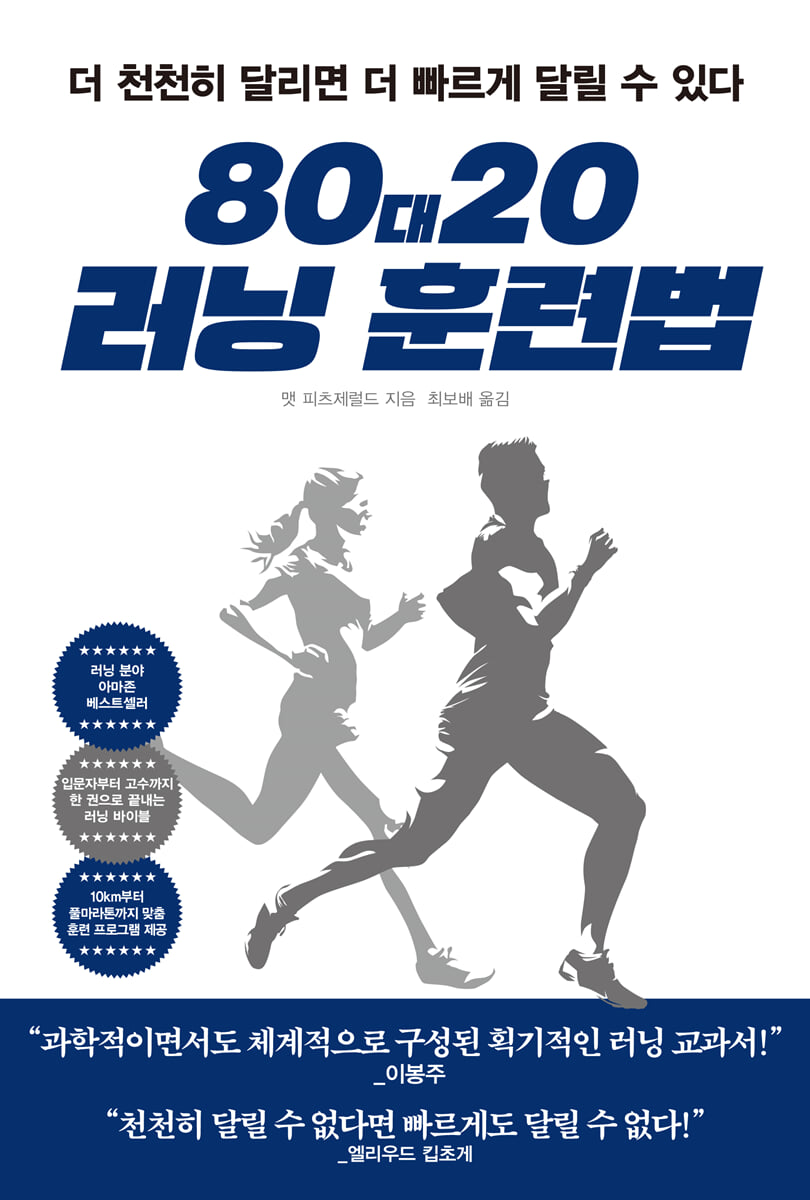
80/20 Running Training Method
 |
Description
Book Introduction
Increase your running economy
Revealing the proven training methods of runners around the world.
Recommended by Korean record holder Bong-ju Lee!
Recommended by Masters Runners Robert Hudson, Lee Byeong-do, Yoo Moon-jin, and Kim Bo-geon!
"The 80/20 Running Method" is the latest running training book by Matt Fitzgerald, a runner and endurance sports coach.
It breaks the stereotypes of high-intensity exercise, extreme intervals, and running form, and reveals the importance of 'low intensity, high training volume'.
Based on scientific research and the training methods of real runners, it shows that running 80% slowly and 20% hard leads to the fastest improvement in performance.
It also proves to be the most effective rule for developing endurance and stamina, which are the most important in a marathon.
Marathon runner Bong-ju Lee also says to always run happily when you run.
Especially for beginners, it is emphasized that you should not be greedy about speed, and that you should gradually increase both exercise time and intensity.
In other words, it is like saying, 'Run 80% slowly and 20% strongly.'
Arthur Lydiard became a world-renowned coach for his "slow distance" approach, and exercise physiologist Steven Siler has also proven that an "80/20 intensity balance" is optimal and produces better results than any other alternative.
Every runner dreams of breaking their personal best.
However, if you run too fast without thinking, you will often end up giving up running due to injuries and burnout.
From beginners to professional runners, it systematically organizes everything from running theory to training programs so that everyone can read and understand it.
If you've been running and training every day but haven't seen any improvement, this could be an opportunity to identify your issues and improve them.
This method has been tried and proven by elite runners as well as running coaches around the world, so you can trust and follow it.
Running is not just about building stamina.
Through the process of setting, achieving, and solving goals, you learn to overcome life's challenges and have the courage to face new challenges again.
I hope to run beyond the limitations of the past.
This book will be your most reliable running mate.
Revealing the proven training methods of runners around the world.
Recommended by Korean record holder Bong-ju Lee!
Recommended by Masters Runners Robert Hudson, Lee Byeong-do, Yoo Moon-jin, and Kim Bo-geon!
"The 80/20 Running Method" is the latest running training book by Matt Fitzgerald, a runner and endurance sports coach.
It breaks the stereotypes of high-intensity exercise, extreme intervals, and running form, and reveals the importance of 'low intensity, high training volume'.
Based on scientific research and the training methods of real runners, it shows that running 80% slowly and 20% hard leads to the fastest improvement in performance.
It also proves to be the most effective rule for developing endurance and stamina, which are the most important in a marathon.
Marathon runner Bong-ju Lee also says to always run happily when you run.
Especially for beginners, it is emphasized that you should not be greedy about speed, and that you should gradually increase both exercise time and intensity.
In other words, it is like saying, 'Run 80% slowly and 20% strongly.'
Arthur Lydiard became a world-renowned coach for his "slow distance" approach, and exercise physiologist Steven Siler has also proven that an "80/20 intensity balance" is optimal and produces better results than any other alternative.
Every runner dreams of breaking their personal best.
However, if you run too fast without thinking, you will often end up giving up running due to injuries and burnout.
From beginners to professional runners, it systematically organizes everything from running theory to training programs so that everyone can read and understand it.
If you've been running and training every day but haven't seen any improvement, this could be an opportunity to identify your issues and improve them.
This method has been tried and proven by elite runners as well as running coaches around the world, so you can trust and follow it.
Running is not just about building stamina.
Through the process of setting, achieving, and solving goals, you learn to overcome life's challenges and have the courage to face new challenges again.
I hope to run beyond the limitations of the past.
This book will be your most reliable running mate.
- You can preview some of the book's contents.
Preview
index
Recommendation
Preface: Run 80% lightly, 20% hard.
Key Terms
Chapter 1: First, run slowly.
The problem is the habit of running fast.
Why Humans Run at Moderate Intensity
Runners who have never tried running slowly and lightly
Slow Running Week
Chapter 2: The Evolution of 80/20 Running
The golden age of intervals
The Beginning of the 80/20 Training Method
Boston Renaissance
Kenya's leap forward
80/20 Running: The Optimal Training Method
Chapter 3: The Scientific Basis of the 80/20 Rule
The Secret of Endurance Training
The key is to do a lot of low-intensity training.
The Pitfalls of Moderate-Intensity and High-Intensity Training
Chapter 4: 80/20 Running Improves Fitness
Key factors in improving aerobic capacity
The relationship between aerobic capacity and fatigue resistance
The Psychology of Fatigue Resistance
The relationship between the brain and fatigue resistance
Chapter 5: 80/20 Running Improves Skills
Don't worry about the details
Efficient running is learned naturally.
Factors that determine a runner's movement
The difference between a walking robot and a running human
The more you run, the more experienced you become.
Chapter 6: How to Measure and Control Exercise Intensity
Perceived exercise intensity
heart rate
Face
Key points of exercise intensity
Chapter 7: Getting Started with 80/20 Running
Rule 1: 80/20 Balance
Rule 2: Train regularly.
Rule 3: Run a little more
Rule 4: Train with a proven method.
Rule 5: Follow the principle of dynamic moderation.
Rule 6: Increase Running Efficiency with Recovery Cycles
Rule 7: Create Your Own Training Schedule
Chapter 8 80/20 Training Plan: 5km
Level 1: Introductory Training Plan
Level 2: Intermediate Training Plan
Level 3: Advanced Training Plan
Chapter 9 80/20 Training Plan: 10km
Level 1: Introductory Training Plan
Level 2: Intermediate Training Plan
Level 3: Advanced Training Plan
Chapter 10: The 80/20 Training Plan: The Half Marathon
Level 1: Introductory Training Plan
Level 2: Intermediate Training Plan
Level 3: Advanced Training Plan
Chapter 11: The 80/20 Training Plan: A Full Marathon
Level 1: Introductory Training Plan
Level 2: Intermediate Training Plan
Level 3: Advanced Training Plan
Chapter 12 Strengthening Exercises to Reduce Injury Risk
Two Ways to Use Reinforcement Exercises
Best Strengthening Exercises for Runners
Chapter 13: Applying the 80/20 Rule to Other Exercises
Weight Loss Using 80/20 Running
Triathlon using 80/20 running
The 80/20 rule has its limits.
Appendix_Detailed Training Guide for 80/20 Running
Preface: Run 80% lightly, 20% hard.
Key Terms
Chapter 1: First, run slowly.
The problem is the habit of running fast.
Why Humans Run at Moderate Intensity
Runners who have never tried running slowly and lightly
Slow Running Week
Chapter 2: The Evolution of 80/20 Running
The golden age of intervals
The Beginning of the 80/20 Training Method
Boston Renaissance
Kenya's leap forward
80/20 Running: The Optimal Training Method
Chapter 3: The Scientific Basis of the 80/20 Rule
The Secret of Endurance Training
The key is to do a lot of low-intensity training.
The Pitfalls of Moderate-Intensity and High-Intensity Training
Chapter 4: 80/20 Running Improves Fitness
Key factors in improving aerobic capacity
The relationship between aerobic capacity and fatigue resistance
The Psychology of Fatigue Resistance
The relationship between the brain and fatigue resistance
Chapter 5: 80/20 Running Improves Skills
Don't worry about the details
Efficient running is learned naturally.
Factors that determine a runner's movement
The difference between a walking robot and a running human
The more you run, the more experienced you become.
Chapter 6: How to Measure and Control Exercise Intensity
Perceived exercise intensity
heart rate
Face
Key points of exercise intensity
Chapter 7: Getting Started with 80/20 Running
Rule 1: 80/20 Balance
Rule 2: Train regularly.
Rule 3: Run a little more
Rule 4: Train with a proven method.
Rule 5: Follow the principle of dynamic moderation.
Rule 6: Increase Running Efficiency with Recovery Cycles
Rule 7: Create Your Own Training Schedule
Chapter 8 80/20 Training Plan: 5km
Level 1: Introductory Training Plan
Level 2: Intermediate Training Plan
Level 3: Advanced Training Plan
Chapter 9 80/20 Training Plan: 10km
Level 1: Introductory Training Plan
Level 2: Intermediate Training Plan
Level 3: Advanced Training Plan
Chapter 10: The 80/20 Training Plan: The Half Marathon
Level 1: Introductory Training Plan
Level 2: Intermediate Training Plan
Level 3: Advanced Training Plan
Chapter 11: The 80/20 Training Plan: A Full Marathon
Level 1: Introductory Training Plan
Level 2: Intermediate Training Plan
Level 3: Advanced Training Plan
Chapter 12 Strengthening Exercises to Reduce Injury Risk
Two Ways to Use Reinforcement Exercises
Best Strengthening Exercises for Runners
Chapter 13: Applying the 80/20 Rule to Other Exercises
Weight Loss Using 80/20 Running
Triathlon using 80/20 running
The 80/20 rule has its limits.
Appendix_Detailed Training Guide for 80/20 Running
Detailed image

Publisher's Review
Run slower and you'll get there faster.
A must-read for running, highly recommended by coaches and runners.
How did Kenyan runners, today's world-record marathoners, become so successful? Interestingly, Kenyan runners weren't always so good from the start.
The secret to Kenya becoming the world's number one athlete in athletics despite not having any special coaching or a good environment is 'low intensity, high training volume'.
Since they were young, they walked or ran dozens of kilometers to and from school every day.
The daily routine of walking and running for long periods of time eventually made me good at running.
World-renowned marathoners Mo Farah, Mab Keflezighi, Ryan Hall, and Radcliffe, among others, also became marathon legends thanks to the 80/20 rule.
The 80/20 Running Training Method doesn't say you have to blindly follow the qualities, posture, stride, etc. of great runners.
Rather, it helps you run well by providing practical methods to adjust the intensity of exercise and find your pace according to your skill level.
After all, a runner who grows is a runner who runs slowly and for a long time in a comfortable posture.
From 5km to full marathon
Providing a running program that can be applied to your goals
"The 80/20 Running Workout" reveals the training methods of runners around the world, from the past to the latest.
The first half of the book explains in an easy and fun way the comparison and history of running training methods, why you should run 80% slowly and 20% strongly, and how to adjust training volume.
By following the interesting narrative of running, you can acquire essential specialized knowledge about running, such as maximal oxygen uptake, lactate threshold, respiratory compensation point, perceived exertion, and running mileage, and apply it to real-life situations.
The second half provides detailed training programs tailored to each runner's situation, including race goals, current fitness level, distance-based training methods, flat and hilly courses, recovery runs, and strengthening exercises.
The training process is divided into basic, fake, and tapering stages, and the training cycle and time gradually increase according to intensity and distance.
It is of great help to runners who aim to improve their records by building up their basic physical strength and securing time for recovery, and they can enjoy running for a long time without burnout or injury.
If you are a beginner runner, I strongly recommend that you start with the 5km training method and follow it step by step.
If you periodize your training process, you will eventually be able to run well with strong stamina.
5 Powerful Benefits of Slow Running
Overcome injuries, slumps, and burnout to achieve your best results.
The ultimate goal of the 80/20 Running Training Method is to create a running program that anyone can implement, making exercise time efficient and leading to optimal athletic performance.
"Slow, long-distance running" not only develops the three marathon elements—stamina, mental fortitude, and speed—but is also the most powerful way to achieve optimal results. The first benefit of 80/20 running is that it improves your base fitness, allowing you to run longer.
In the case of a marathon, the 30km mark is called the magic zone.
Because it is easy to give up no matter how much practice you do due to energy depletion.
The only strength that can endure at that time is endurance and patience.
Second, it reduces the risk of injury.
Running too fast puts a strain on your body, which can lead to knee or ankle injuries, and naturally makes it difficult to achieve good results in competitions.
However, if you run slowly, you can run steadily with efficient energy consumption.
Third, it improves fat burning and heart function.
You can run longer and more safely by maintaining cardiovascular function while reducing the burden on your heart.
Fourth, it increases maximal oxygen uptake, an important indicator of aerobic exercise capacity, which leads to improved running performance.
Fifth, the ability to recover quickly allows you to perform better in subsequent high-intensity training sessions.
World-renowned marathoner Eliud Kipchoge also said, "If you can't run slowly, you can't run faster."
By gradually training using the 80/20 running rule, you can build the motivation to run until the end.
I hope you will overcome your limitations and cross the finish line.
A must-read for running, highly recommended by coaches and runners.
How did Kenyan runners, today's world-record marathoners, become so successful? Interestingly, Kenyan runners weren't always so good from the start.
The secret to Kenya becoming the world's number one athlete in athletics despite not having any special coaching or a good environment is 'low intensity, high training volume'.
Since they were young, they walked or ran dozens of kilometers to and from school every day.
The daily routine of walking and running for long periods of time eventually made me good at running.
World-renowned marathoners Mo Farah, Mab Keflezighi, Ryan Hall, and Radcliffe, among others, also became marathon legends thanks to the 80/20 rule.
The 80/20 Running Training Method doesn't say you have to blindly follow the qualities, posture, stride, etc. of great runners.
Rather, it helps you run well by providing practical methods to adjust the intensity of exercise and find your pace according to your skill level.
After all, a runner who grows is a runner who runs slowly and for a long time in a comfortable posture.
From 5km to full marathon
Providing a running program that can be applied to your goals
"The 80/20 Running Workout" reveals the training methods of runners around the world, from the past to the latest.
The first half of the book explains in an easy and fun way the comparison and history of running training methods, why you should run 80% slowly and 20% strongly, and how to adjust training volume.
By following the interesting narrative of running, you can acquire essential specialized knowledge about running, such as maximal oxygen uptake, lactate threshold, respiratory compensation point, perceived exertion, and running mileage, and apply it to real-life situations.
The second half provides detailed training programs tailored to each runner's situation, including race goals, current fitness level, distance-based training methods, flat and hilly courses, recovery runs, and strengthening exercises.
The training process is divided into basic, fake, and tapering stages, and the training cycle and time gradually increase according to intensity and distance.
It is of great help to runners who aim to improve their records by building up their basic physical strength and securing time for recovery, and they can enjoy running for a long time without burnout or injury.
If you are a beginner runner, I strongly recommend that you start with the 5km training method and follow it step by step.
If you periodize your training process, you will eventually be able to run well with strong stamina.
5 Powerful Benefits of Slow Running
Overcome injuries, slumps, and burnout to achieve your best results.
The ultimate goal of the 80/20 Running Training Method is to create a running program that anyone can implement, making exercise time efficient and leading to optimal athletic performance.
"Slow, long-distance running" not only develops the three marathon elements—stamina, mental fortitude, and speed—but is also the most powerful way to achieve optimal results. The first benefit of 80/20 running is that it improves your base fitness, allowing you to run longer.
In the case of a marathon, the 30km mark is called the magic zone.
Because it is easy to give up no matter how much practice you do due to energy depletion.
The only strength that can endure at that time is endurance and patience.
Second, it reduces the risk of injury.
Running too fast puts a strain on your body, which can lead to knee or ankle injuries, and naturally makes it difficult to achieve good results in competitions.
However, if you run slowly, you can run steadily with efficient energy consumption.
Third, it improves fat burning and heart function.
You can run longer and more safely by maintaining cardiovascular function while reducing the burden on your heart.
Fourth, it increases maximal oxygen uptake, an important indicator of aerobic exercise capacity, which leads to improved running performance.
Fifth, the ability to recover quickly allows you to perform better in subsequent high-intensity training sessions.
World-renowned marathoner Eliud Kipchoge also said, "If you can't run slowly, you can't run faster."
By gradually training using the 80/20 running rule, you can build the motivation to run until the end.
I hope you will overcome your limitations and cross the finish line.
GOODS SPECIFICS
- Date of issue: April 15, 2025
- Page count, weight, size: 317 pages | 586g | 152*225*20mm
- ISBN13: 9791192999753
- ISBN10: 1192999754
You may also like
카테고리
korean


korean

![ELLE 엘르 스페셜 에디션 A형 : 12월 [2025]](http://librairie.coreenne.fr/cdn/shop/files/b8e27a3de6c9538896439686c6b0e8fb.jpg?v=1766436872&width=3840)


