

Poor Charlie's Almanac
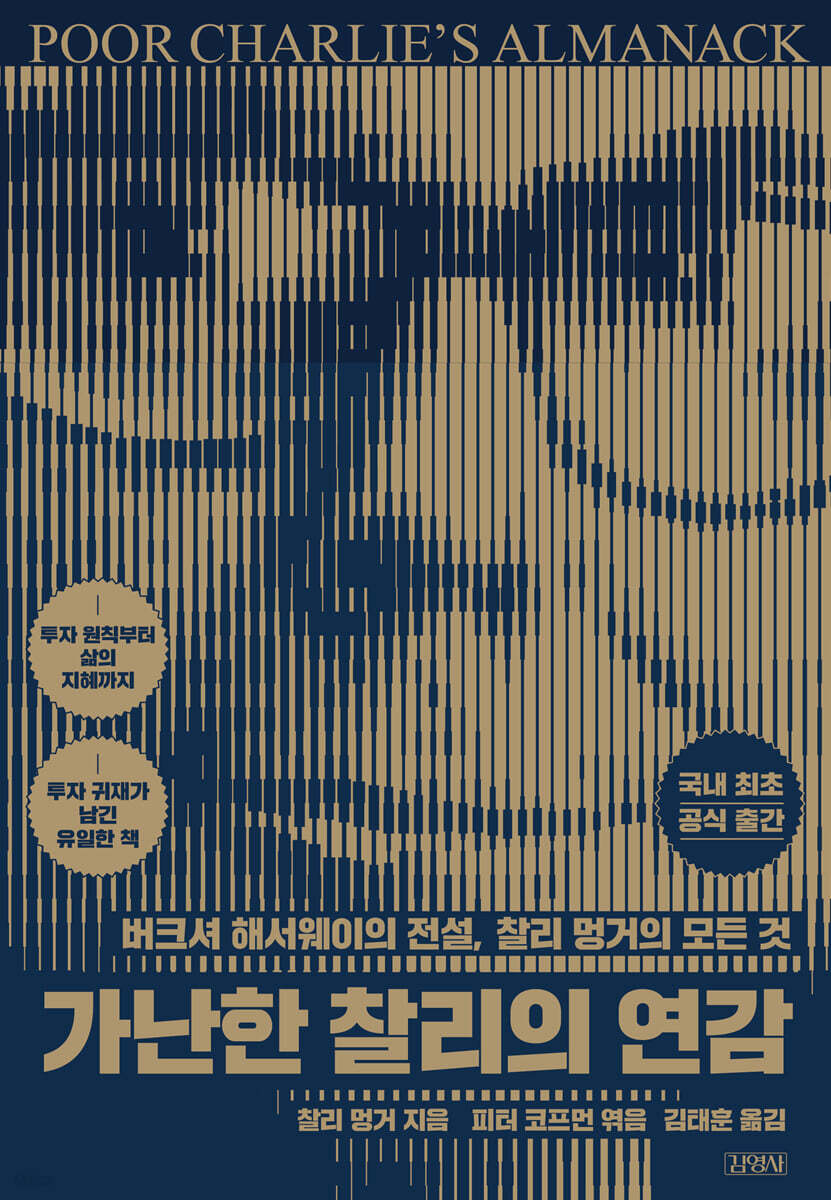 |
Description
Book Introduction
- A word from MD
-
The story everyone's been waiting for: Charlie MungerThis is the only and final book officially published in Korea to commemorate the 100th anniversary of the birth of Charlie Munger, the legend of Berkshire Hathaway.
Based on his extensive knowledge, he has developed his own philosophy, offering wisdom and insight into investing and life.
A life guide that compiles Charlie Munger's thoughts and ideas across generations.November 1, 2024. Economics and Management PD Oh Da-eun
"Reading this book is the ultimate value investment!"
The only and last book left behind by Berkshire Hathaway legend Charlie Munger,
Charlie Munger's 100th birthday, first official publication in Korea!
Wisdom and insight on investing and life from a value investing genius who remained active until the age of 99.
The sage of sages, a genius of value investing, a giant of the corporate world… These are the words used to describe Charlie Munger, who, along with Warren Buffett, grew Berkshire Hathaway into a holding company with a market capitalization exceeding $1 trillion (as of September 2024).
Charlie Munger, Warren Buffett's most trusted and relied-on friend and business partner, whom he "blindly followed," passed away on November 28, 2023, a little over a month before his 100th birthday.
But his insight remained in the form of Poor Charlie's Almanack.
Since its first publication in 2005, Poor Charlie's Almanac has been read as a bible by investors around the world. However, at the author's request, publication in any language other than Chinese has been blocked.
This Korean edition is the final version (4th edition) in which Charlie Munger added his own views right up until his death and completely revised his last lecture, "The Psychology of Human Misjudgment," which is considered a highlight.
Ahead of the 100th anniversary of Charlie Munger's birth, it was finally officially published in Korea for the first time through an official copyright contract.
Charlie Munger developed his own unique system of thinking on life, study, and decision-making based on his extensive knowledge of business, finance, philosophy, physics, and psychology, and he preached this system through lectures.
Poor Charlie's Almanac is a collection of 11 of Charlie Munger's best lectures given between 1986 and 2007. It is the only book written by Charlie Munger himself, and it is his last book.
From identifying blue chip stocks like Coca-Cola and Apple to a mental model that helps minimize errors and avoid worst-case judgments, to a rigorous evaluation process for successful investing, this book contains insights Charlie Munger has gleaned over a lifetime.
The only and last book left behind by Berkshire Hathaway legend Charlie Munger,
Charlie Munger's 100th birthday, first official publication in Korea!
Wisdom and insight on investing and life from a value investing genius who remained active until the age of 99.
The sage of sages, a genius of value investing, a giant of the corporate world… These are the words used to describe Charlie Munger, who, along with Warren Buffett, grew Berkshire Hathaway into a holding company with a market capitalization exceeding $1 trillion (as of September 2024).
Charlie Munger, Warren Buffett's most trusted and relied-on friend and business partner, whom he "blindly followed," passed away on November 28, 2023, a little over a month before his 100th birthday.
But his insight remained in the form of Poor Charlie's Almanack.
Since its first publication in 2005, Poor Charlie's Almanac has been read as a bible by investors around the world. However, at the author's request, publication in any language other than Chinese has been blocked.
This Korean edition is the final version (4th edition) in which Charlie Munger added his own views right up until his death and completely revised his last lecture, "The Psychology of Human Misjudgment," which is considered a highlight.
Ahead of the 100th anniversary of Charlie Munger's birth, it was finally officially published in Korea for the first time through an official copyright contract.
Charlie Munger developed his own unique system of thinking on life, study, and decision-making based on his extensive knowledge of business, finance, philosophy, physics, and psychology, and he preached this system through lectures.
Poor Charlie's Almanac is a collection of 11 of Charlie Munger's best lectures given between 1986 and 2007. It is the only book written by Charlie Munger himself, and it is his last book.
From identifying blue chip stocks like Coca-Cola and Apple to a mental model that helps minimize errors and avoid worst-case judgments, to a rigorous evaluation process for successful investing, this book contains insights Charlie Munger has gleaned over a lifetime.
- You can preview some of the book's contents.
Preview
index
Preface to the revised edition.
Insights That Will Last a Lifetime for Investors_John Collison
Preface to the first edition.
Advice on Choosing a Partner_Warren Buffett
Munger's rebuttal.
A partner who does not need enlightenment
Before reading this book.
Munger's Decision and the Reasons Behind It_Peter Kaufman
Chapter 1.
On Charlie Munger's 99 Years_Michael Broggy
Chapter 2.
About my father, Charlie Munger
Chapter 3.
About life, learning, and decision making
Munger's revenge accident model
Munger's Investment Evaluation Procedure
Munger's Investment Principles Checklist
Chapter 4.
Charlie Munger's 11 Lessons
Lecture 1.
A Prescription Guaranteed to Misery: Harvard School Commencement Address (1986)
Lecture 2.
The Principles of Life Are the Principles of Investing: Lessons in Basic, Worldly Wisdom (1994)
3rd lecture.
The Philosophy and Art of Stock Selection: A Sequel to Lessons in Basic and Worldly Wisdom (1996)
Semifinals.
Five Ways to Solve Different Problems: Practical Thinking About Practical Thinking? (1996)
Lecture 5.
How to Achieve Worldly Success Through Academics: The Need for Multidisciplinary Skills in Professionals (1998)
Lecture 6.
Investments with Significantly Low Returns: Investment Practices of Major Charitable Foundations (1998)
Lesson 7.
Incentives for Embezzlement and Waste: A Philanthropy Roundtable Breakfast Lecture (2000)
Quarterfinals.
The consequences of misusing stock options: The massive financial scandal of 2003 (2000)
Lesson 9.
The Impact of Disciplinary Disconnects on Economic Growth: The Strengths and Weaknesses of Academic Economics (2003)
Lesson 10.
The Moral Obligation to Succeed: Commencement Address, University of Southern California Gould School of Law (2007)
Lesson 11.
Psychological Tendencies That Are Very Useful But Sometimes Lead to Wrong Conclusions: The Psychology of Human Misjudgment (2005+2023)
main
Books recommended by Munger
Acknowledgements
Search
Insights That Will Last a Lifetime for Investors_John Collison
Preface to the first edition.
Advice on Choosing a Partner_Warren Buffett
Munger's rebuttal.
A partner who does not need enlightenment
Before reading this book.
Munger's Decision and the Reasons Behind It_Peter Kaufman
Chapter 1.
On Charlie Munger's 99 Years_Michael Broggy
Chapter 2.
About my father, Charlie Munger
Chapter 3.
About life, learning, and decision making
Munger's revenge accident model
Munger's Investment Evaluation Procedure
Munger's Investment Principles Checklist
Chapter 4.
Charlie Munger's 11 Lessons
Lecture 1.
A Prescription Guaranteed to Misery: Harvard School Commencement Address (1986)
Lecture 2.
The Principles of Life Are the Principles of Investing: Lessons in Basic, Worldly Wisdom (1994)
3rd lecture.
The Philosophy and Art of Stock Selection: A Sequel to Lessons in Basic and Worldly Wisdom (1996)
Semifinals.
Five Ways to Solve Different Problems: Practical Thinking About Practical Thinking? (1996)
Lecture 5.
How to Achieve Worldly Success Through Academics: The Need for Multidisciplinary Skills in Professionals (1998)
Lecture 6.
Investments with Significantly Low Returns: Investment Practices of Major Charitable Foundations (1998)
Lesson 7.
Incentives for Embezzlement and Waste: A Philanthropy Roundtable Breakfast Lecture (2000)
Quarterfinals.
The consequences of misusing stock options: The massive financial scandal of 2003 (2000)
Lesson 9.
The Impact of Disciplinary Disconnects on Economic Growth: The Strengths and Weaknesses of Academic Economics (2003)
Lesson 10.
The Moral Obligation to Succeed: Commencement Address, University of Southern California Gould School of Law (2007)
Lesson 11.
Psychological Tendencies That Are Very Useful But Sometimes Lead to Wrong Conclusions: The Psychology of Human Misjudgment (2005+2023)
main
Books recommended by Munger
Acknowledgements
Search
Detailed image

Into the book
·Be an untrustworthy person.
Do not faithfully carry out the tasks assigned to you.
If you acquire just this one habit, it will more than offset the combined effect of all your virtues, no matter how great they may be.
If you want to be distrusted by people and alienate yourself from your best contributions and good people, follow this prescription.
--- 「Lecture 1.
From "A Prescription Guaranteed to Unhappiness: Harvard School Commencement Address (1986)"
·What is basic, worldly wisdom? It requires a "model" in your head.
You need to arrange your direct and indirect experiences within the framework of this model.
(…) You shouldn’t just use one or two models.
Because of the nature of human psychology, we will distort reality to fit our own model, or at least think that it is correct.
It's like the old saying, "To a man with a hammer, every problem looks like a nail."
But that's completely wrong as a way to live in the world.
--- 「Lecture 2.
From "The Principles of Life Are the Principles of Investment: Lessons on Basic and Worldly Wisdom (1994)"
·You must play the game while considering your own marginal utility and psychological tendencies.
Some losses are inevitable, but if those losses make you miserable, it would be wise to escape hell by utilizing a very conservative investment pattern.
There is no one-size-fits-all investment strategy I can offer you.
My investment strategy works for me.
Part of the reason is that I know how to take losses.
--- 「3rd lecture.
From the book "The Philosophy and Technique of Stock Selection: A Sequel to Lessons on Basic and Worldly Wisdom" (1996)
·The third thought that was helpful to me is that it is not enough to only think about the problem going forward.
You have to be able to think backwards too.
Like a country bumpkin who wants to know where he will die, never going there.
In reality, many problems cannot be solved by moving forward.
--- 「4th round.
Five Ways to Solve Different Problems: Practical Thinking About Practical Thinking (1996)
·Law schools and other academic disciplines that utilize more multidisciplinary approaches to many problems will reap enormous worldly rewards, as I have.
You will also enjoy more fun and achievements.
The happier mental world I recommend is one from which no one would willingly return.
Coming back from there is like cutting off your own hand.
--- 「5th lecture.
From "How to Achieve Worldly Success through Academics: The Need for Multidisciplinary Skills in Professionals (1998)"
·All stock investors are bound to lose returns each year equal to the total cost of the dealer's share that they jointly bear.
This is an inevitable reality.
It is also inevitable that exactly half of the investors will get a result lower than the median result after subtracting the dealer's share.
The problem is that the intermediate results may fall somewhere between unpleasant and poor.
--- 「6th class.
From "Investing with Significantly Low Returns: Investment Practices of Major Charitable Foundations (1998)"
·If there is any additional return gap, it is likely due in large part to the foolish practice of continuing to pull assets out of underperforming funds.
In this case, the investment manager has no choice but to dispose of the stock holdings.
The foundations then entrust their assets to new investment managers who are under intense pressure to swell their portfolios.
However, adding to new funds at a very rapid pace does not necessarily improve investment performance.
--- 「Lecture 7.
Incentives to Allow Embezzlement and Waste: A Lecture at the Philanthropy Roundtable Breakfast Meeting (2000)
A massive fraud of modern financial engineering has unfolded, leading quant tech to tragedy.
Of all the notorious scams, few have achieved their intended purpose more effectively than this one.
Quant Tech's net profit, as recognized by accountants, has steadily increased by 28 percent year over year.
No one criticized QuantTech's financial reports.
(…) The sheer volume of cash held by quant tech often triggers a simple Pavlovian association effect that hinders perception of reality.
This played a major role in making it difficult to detect false elements included in net profits.
--- "Quarterfinals.
From "The Consequences of Misapplying Stock Options: The Great Financial Scandal of 2003 (2000)"
·I often mention cases where a captain is kicked out of the Navy even if he is not at fault when a ship runs aground.
The unfair harm suffered by one innocent person is more than offset by the greater benefit of reducing grounding accidents by making other ships' captains more alert.
I encourage you to tolerate some unfairness if it means achieving greater fairness for all.
--- 「Lecture 9.
The Impact of Disciplinary Separation on Economic Growth: Strengths and Weaknesses of Academic Economics (2003)
·Benjamin Franklin presented a technique for effectively persuading people in such situations.
He said, “To persuade, appeal to interests, not reason.”
Human self-serving bias is extreme.
You have to take advantage of that to get the right results.
Legal advice should have advised:
“This issue has the potential to bring you down, cost you money and status, and severely damage your reputation.
So I recommend that you prevent irreversible disasters in advance.” This approach would have worked.
Even if your motives are noble, you must appeal to self-interest, not reason.
--- 「10th class.
From "The Moral Obligations of Success: Commencement Address, Gould School of Law, University of Southern California (2007)"
·The answer is that these psychological tendencies probably have far more beneficial aspects than detrimental ones.
Otherwise, given the human condition and limited brain capacity, there would be no reason for it to exist.
Moreover, it works very well in a way that helps humans.
So these psychological tendencies cannot and should not disappear on their own.
(…) some tendencies do not always solidify into destiny.
Knowing the trends and their solutions can help you avoid problems that might otherwise arise.
Do not faithfully carry out the tasks assigned to you.
If you acquire just this one habit, it will more than offset the combined effect of all your virtues, no matter how great they may be.
If you want to be distrusted by people and alienate yourself from your best contributions and good people, follow this prescription.
--- 「Lecture 1.
From "A Prescription Guaranteed to Unhappiness: Harvard School Commencement Address (1986)"
·What is basic, worldly wisdom? It requires a "model" in your head.
You need to arrange your direct and indirect experiences within the framework of this model.
(…) You shouldn’t just use one or two models.
Because of the nature of human psychology, we will distort reality to fit our own model, or at least think that it is correct.
It's like the old saying, "To a man with a hammer, every problem looks like a nail."
But that's completely wrong as a way to live in the world.
--- 「Lecture 2.
From "The Principles of Life Are the Principles of Investment: Lessons on Basic and Worldly Wisdom (1994)"
·You must play the game while considering your own marginal utility and psychological tendencies.
Some losses are inevitable, but if those losses make you miserable, it would be wise to escape hell by utilizing a very conservative investment pattern.
There is no one-size-fits-all investment strategy I can offer you.
My investment strategy works for me.
Part of the reason is that I know how to take losses.
--- 「3rd lecture.
From the book "The Philosophy and Technique of Stock Selection: A Sequel to Lessons on Basic and Worldly Wisdom" (1996)
·The third thought that was helpful to me is that it is not enough to only think about the problem going forward.
You have to be able to think backwards too.
Like a country bumpkin who wants to know where he will die, never going there.
In reality, many problems cannot be solved by moving forward.
--- 「4th round.
Five Ways to Solve Different Problems: Practical Thinking About Practical Thinking (1996)
·Law schools and other academic disciplines that utilize more multidisciplinary approaches to many problems will reap enormous worldly rewards, as I have.
You will also enjoy more fun and achievements.
The happier mental world I recommend is one from which no one would willingly return.
Coming back from there is like cutting off your own hand.
--- 「5th lecture.
From "How to Achieve Worldly Success through Academics: The Need for Multidisciplinary Skills in Professionals (1998)"
·All stock investors are bound to lose returns each year equal to the total cost of the dealer's share that they jointly bear.
This is an inevitable reality.
It is also inevitable that exactly half of the investors will get a result lower than the median result after subtracting the dealer's share.
The problem is that the intermediate results may fall somewhere between unpleasant and poor.
--- 「6th class.
From "Investing with Significantly Low Returns: Investment Practices of Major Charitable Foundations (1998)"
·If there is any additional return gap, it is likely due in large part to the foolish practice of continuing to pull assets out of underperforming funds.
In this case, the investment manager has no choice but to dispose of the stock holdings.
The foundations then entrust their assets to new investment managers who are under intense pressure to swell their portfolios.
However, adding to new funds at a very rapid pace does not necessarily improve investment performance.
--- 「Lecture 7.
Incentives to Allow Embezzlement and Waste: A Lecture at the Philanthropy Roundtable Breakfast Meeting (2000)
A massive fraud of modern financial engineering has unfolded, leading quant tech to tragedy.
Of all the notorious scams, few have achieved their intended purpose more effectively than this one.
Quant Tech's net profit, as recognized by accountants, has steadily increased by 28 percent year over year.
No one criticized QuantTech's financial reports.
(…) The sheer volume of cash held by quant tech often triggers a simple Pavlovian association effect that hinders perception of reality.
This played a major role in making it difficult to detect false elements included in net profits.
--- "Quarterfinals.
From "The Consequences of Misapplying Stock Options: The Great Financial Scandal of 2003 (2000)"
·I often mention cases where a captain is kicked out of the Navy even if he is not at fault when a ship runs aground.
The unfair harm suffered by one innocent person is more than offset by the greater benefit of reducing grounding accidents by making other ships' captains more alert.
I encourage you to tolerate some unfairness if it means achieving greater fairness for all.
--- 「Lecture 9.
The Impact of Disciplinary Separation on Economic Growth: Strengths and Weaknesses of Academic Economics (2003)
·Benjamin Franklin presented a technique for effectively persuading people in such situations.
He said, “To persuade, appeal to interests, not reason.”
Human self-serving bias is extreme.
You have to take advantage of that to get the right results.
Legal advice should have advised:
“This issue has the potential to bring you down, cost you money and status, and severely damage your reputation.
So I recommend that you prevent irreversible disasters in advance.” This approach would have worked.
Even if your motives are noble, you must appeal to self-interest, not reason.
--- 「10th class.
From "The Moral Obligations of Success: Commencement Address, Gould School of Law, University of Southern California (2007)"
·The answer is that these psychological tendencies probably have far more beneficial aspects than detrimental ones.
Otherwise, given the human condition and limited brain capacity, there would be no reason for it to exist.
Moreover, it works very well in a way that helps humans.
So these psychological tendencies cannot and should not disappear on their own.
(…) some tendencies do not always solidify into destiny.
Knowing the trends and their solutions can help you avoid problems that might otherwise arise.
--- 「Lecture 11.
Psychological Tendencies That Are Very Useful But Sometimes Lead to Wrong Conclusions: The Psychology of Human Misjudgments (2005+2023)
Psychological Tendencies That Are Very Useful But Sometimes Lead to Wrong Conclusions: The Psychology of Human Misjudgments (2005+2023)
Publisher's Review
*From investment principles to life wisdom*
*The only and final book left behind by Berkshire Hathaway legend Charlie Munger*
*Charlie Munger's 100th Birthday, First Officially Published in Korea*
“In every way, my only partner was Charlie.
This book is a miracle in the publishing world.
“It’s never been advertised, yet it sells thousands of copies every year.”_Warren Buffett
“Reading this book is the ultimate value investment!”
Wisdom and insight on investing and life from a value investing genius who remained active until the age of 99.
The sage of sages, a genius of value investing, a giant of the corporate world… These are the words used to describe Charlie Munger, who, along with Warren Buffett, grew Berkshire Hathaway into a holding company with a market capitalization exceeding $1 trillion (as of September 2024).
Charlie Munger, Warren Buffett's most trusted and relied-on friend and business partner, whom he "blindly followed," passed away on November 28, 2023, a little over a month before his 100th birthday.
But his insight remained in the form of Poor Charlie's Almanack.
This book confirms why Charlie Munger is called a legend, and it is his final legacy to the world.
Since its first publication in 2005, Poor Charlie's Almanac has been read as a bible by investors around the world. However, at the author's request, publication in any language other than Chinese has been blocked.
This Korean edition is the final version (4th edition) in which Charlie Munger added his own views right up until his death and completely revised his last lecture, "The Psychology of Human Misjudgment," which is considered a highlight.
Ahead of the 100th anniversary of Charlie Munger's birth, it was finally officially published in Korea for the first time through an official copyright contract.
In addition to 11 of Charlie Munger's finest lectures, this book includes audience Q&As, reflections from his lifelong partner Warren Buffett and Charlie Munger's children, and a look back at Charlie Munger's life from his humble Omaha days to his extraordinary financial success, along with his investment evaluation process and principles.
At breakfast meetings, graduations, reunions, and university lecture halls, Charlie Munger preached insights about life, learning, decision-making, and investing through compelling case studies, his signature humor, and his own irony.
He likes to use expressions like "like a one-legged person in a butt-kicking contest" and "to a man with a hammer, every problem looks like a nail."
This is a metaphorical way of explaining the deep knowledge and broad perspective that those who want to succeed must have.
It also persuades the audience and readers to go down the right path by specifically telling them about the miserable end caused by embezzlement or drug addiction.
Even, rather than faithfully carrying out one's assigned duties, they are advised very seriously to "be unreliable" or to "stay put" when adversity strikes.
This is a sure recipe for unhappiness.
Charlie Munger named this book Poor Charlie's Almanac, inspired by Benjamin Franklin's book Poor Richard's Almanac.
Because he hoped to include timeless advice in his book.
“Whether you're a seasoned investor, an aspiring novice, a business owner, or just looking to improve your decision-making skills in everyday life, I encourage you to read Charlie's talk with an open mind and curiosity.
Then you will be rewarded with insights that will last a lifetime.
“Reading this book is the ultimate value investment.” (p. 11, John Collinson) The first reader to encounter this book said that if he could read only one book to help him succeed in life and business, it would be this one.
“The principles of investing are the principles of life.”
11 of Charlie Munger's Best Lectures
All about life, learning, and decision-making
· Move your life graph upward, not just your investments!: An investment guide and a life guide.
“Charlie can analyze and evaluate any transaction faster and more accurately than anyone else.
“He can spot any potential weakness in 60 seconds.” (Page 54, Warren Buffett) Why did Warren Buffett praise Charlie Munger so highly? The reason lies in Munger’s distinctly unique approach to decision-making.
The oldest lecture included in this book is a full 40 years old.
Yet, Charlie Munger's ideas remain as valid today as they were that day.
Because his views and conclusions are based on a deep understanding of human nature and core principles of various disciplines.
Therefore, Poor Charlie's Almanac is not just a simple investment guide.
It is a life guide that teaches you how to think for yourself and solve problems.
Charlie Munger prioritized life decisions over investment decisions.
For him, successful investing was simply a byproduct of his approach to life's problems.
On the surface, it seems simple and straightforward, so readers might think Charlie Munger's insights are easily derived.
But simplicity is the hard-won fruit of Charlie Munger's lifelong study of human behavior patterns, business systems, and countless other scientific disciplines.
The 11 lectures cover Charlie Munger's wide range of interests.
The content ranges from how to gain worldly wisdom, to applying multiple thought models to business, to how to use investment strategies to improve the work of charities.
Charlie Munger will be giving a special lecture for those who want to create an upward graph not only in their investments but also in their lives.
· How can you spot promising stocks like Coca-Cola and Apple from the ground up? : "Investment principles" for identifying high-potential companies and "investment evaluation procedures" for achieving outstanding performance.
First, Charlie Munger carefully identified areas where he could best utilize his abilities.
He rarely ventured into the high-tech field, citing his lack of capabilities.
Once you've chosen a field, invest a lot of money.
Charlie Munger viewed the stock market as a game with very low odds of winning, but huge payouts when you do win.
“You’re not smart enough to find thousands of those boards in your lifetime.
So when those rare editions do come up, you really have to go big.
“A wise man bets big when the world gives him that opportunity.” (p. 144) This leads to Charlie Munger’s well-known investment tendencies.
It is not traded frequently.
“It is beneficial for an individual to invest in a small number of outstanding stocks and just sit back and do nothing.
“You’ll pay less commissions to brokers and hear less nonsense.” (p. 124)
As Charlie Munger repeatedly notes, these are all simple, straightforward principles.
But it's not easy to put into practice, as there are very few entrepreneurs as successful as Charlie Munger.
He calls those who take the idea that the stock market is perfectly efficient "those who go to extremes."
If markets were that efficient, no one could outperform the market.
Charlie Munger viewed the stock market as a "manic-depressive patient who comes every day."
There are certainly those who see significantly higher profits than others, and this is the same in life.
Successful investing depends on a clear competitive advantage!: A "multidisciplinary thinking model" approach that helps minimize errors and avoid worst-case judgments.
People have been looking for a magic formula or easy secret to striking it rich.
Charlie Munger's outstanding performance is not based on any magic formula or secret recipe.
Rather than evaluating individual company financial information, we comprehensively analyze the larger, more integrated ecosystem to which the company belongs.
Charlie Munger calls the tool he uses for these reviews the "multiple-thinking model."
In the fourth quarter, we assume that Coca-Cola was founded in 1884, and neither the owners nor the investors knew the current situation, and we take on the challenge of growing a $2 million company into a $2 trillion company.
Although it is a hypothetical challenge, it presents specific methods for securing a deep and wide moat (垓子) that competitors cannot dare to cross, that is, a competitive advantage that only Coca-Cola can secure.
It encompasses virtually everything you need to consider to achieve absolute success in the business world, from finding an attractive brand name to patenting a superior taste, managing talent, controlling prices, and securing a global distribution network.
There is no reason not to invest in a company with these conditions.
The Psychology of Investing: Why We Make Mistakes
25 Psychological Tendencies That Are Very Useful But Sometimes Lead to Wrong Decisions
The final 11th lecture, "The Psychology of Human Misjudgment," was written specifically for this book by Charlie Munger and is the essence of his Charlie Munger-style perspective.
Just before the publication of the fourth edition, Charlie Munger wanted to make "slight" revisions to the manuscript, but ended up doing a "complete" rewrite that was so thorough it had to be stopped from printing.
What was the message he was trying to convey to us, pouring so much effort into revising his manuscript? Humans are easily fooled by chance, simply follow convention, and make absurd and bizarre mistakes.
Charlie Munger believes that such behavior, sometimes with such devastating consequences, should never be taken lightly.
If you realize the irrationality of human beings, you can “understand the way life deceives people.”
The first of the 25 psychological tendencies, "Reward/Punishment Overreaction," begins with a case of a misaligned incentive.
From a business standpoint, the worst outcome from incentives is embezzlement.
Knowing that bad behavior can be easily rationalized solely for the sake of reward, we should not reward things that can easily be manipulated for performance, imparting the lesson that “when persuading, appeal to self-interest, not reason.”
The saying that it is better to tell people the tragic consequences of not doing something than to insist on a moral obligation to do it applies not only to business.
'Excessive self-esteem' describes an excessive affection for the decisions one makes.
They are optimistic about bad markets and even favor bad people because they have decided to invest in that market and vote for that person.
In addition, he mentions the 'suspicion-avoidance tendency', which is the tendency to jump to conclusions quickly in stressful situations, and the 'inconsistency-avoidance tendency', which is the inability to accept evidence that contradicts that conclusion.
The biggest problem is the "Lolapalooza tendency," where several psychological tendencies combine to produce extreme results.
*The only and final book left behind by Berkshire Hathaway legend Charlie Munger*
*Charlie Munger's 100th Birthday, First Officially Published in Korea*
“In every way, my only partner was Charlie.
This book is a miracle in the publishing world.
“It’s never been advertised, yet it sells thousands of copies every year.”_Warren Buffett
“Reading this book is the ultimate value investment!”
Wisdom and insight on investing and life from a value investing genius who remained active until the age of 99.
The sage of sages, a genius of value investing, a giant of the corporate world… These are the words used to describe Charlie Munger, who, along with Warren Buffett, grew Berkshire Hathaway into a holding company with a market capitalization exceeding $1 trillion (as of September 2024).
Charlie Munger, Warren Buffett's most trusted and relied-on friend and business partner, whom he "blindly followed," passed away on November 28, 2023, a little over a month before his 100th birthday.
But his insight remained in the form of Poor Charlie's Almanack.
This book confirms why Charlie Munger is called a legend, and it is his final legacy to the world.
Since its first publication in 2005, Poor Charlie's Almanac has been read as a bible by investors around the world. However, at the author's request, publication in any language other than Chinese has been blocked.
This Korean edition is the final version (4th edition) in which Charlie Munger added his own views right up until his death and completely revised his last lecture, "The Psychology of Human Misjudgment," which is considered a highlight.
Ahead of the 100th anniversary of Charlie Munger's birth, it was finally officially published in Korea for the first time through an official copyright contract.
In addition to 11 of Charlie Munger's finest lectures, this book includes audience Q&As, reflections from his lifelong partner Warren Buffett and Charlie Munger's children, and a look back at Charlie Munger's life from his humble Omaha days to his extraordinary financial success, along with his investment evaluation process and principles.
At breakfast meetings, graduations, reunions, and university lecture halls, Charlie Munger preached insights about life, learning, decision-making, and investing through compelling case studies, his signature humor, and his own irony.
He likes to use expressions like "like a one-legged person in a butt-kicking contest" and "to a man with a hammer, every problem looks like a nail."
This is a metaphorical way of explaining the deep knowledge and broad perspective that those who want to succeed must have.
It also persuades the audience and readers to go down the right path by specifically telling them about the miserable end caused by embezzlement or drug addiction.
Even, rather than faithfully carrying out one's assigned duties, they are advised very seriously to "be unreliable" or to "stay put" when adversity strikes.
This is a sure recipe for unhappiness.
Charlie Munger named this book Poor Charlie's Almanac, inspired by Benjamin Franklin's book Poor Richard's Almanac.
Because he hoped to include timeless advice in his book.
“Whether you're a seasoned investor, an aspiring novice, a business owner, or just looking to improve your decision-making skills in everyday life, I encourage you to read Charlie's talk with an open mind and curiosity.
Then you will be rewarded with insights that will last a lifetime.
“Reading this book is the ultimate value investment.” (p. 11, John Collinson) The first reader to encounter this book said that if he could read only one book to help him succeed in life and business, it would be this one.
“The principles of investing are the principles of life.”
11 of Charlie Munger's Best Lectures
All about life, learning, and decision-making
· Move your life graph upward, not just your investments!: An investment guide and a life guide.
“Charlie can analyze and evaluate any transaction faster and more accurately than anyone else.
“He can spot any potential weakness in 60 seconds.” (Page 54, Warren Buffett) Why did Warren Buffett praise Charlie Munger so highly? The reason lies in Munger’s distinctly unique approach to decision-making.
The oldest lecture included in this book is a full 40 years old.
Yet, Charlie Munger's ideas remain as valid today as they were that day.
Because his views and conclusions are based on a deep understanding of human nature and core principles of various disciplines.
Therefore, Poor Charlie's Almanac is not just a simple investment guide.
It is a life guide that teaches you how to think for yourself and solve problems.
Charlie Munger prioritized life decisions over investment decisions.
For him, successful investing was simply a byproduct of his approach to life's problems.
On the surface, it seems simple and straightforward, so readers might think Charlie Munger's insights are easily derived.
But simplicity is the hard-won fruit of Charlie Munger's lifelong study of human behavior patterns, business systems, and countless other scientific disciplines.
The 11 lectures cover Charlie Munger's wide range of interests.
The content ranges from how to gain worldly wisdom, to applying multiple thought models to business, to how to use investment strategies to improve the work of charities.
Charlie Munger will be giving a special lecture for those who want to create an upward graph not only in their investments but also in their lives.
· How can you spot promising stocks like Coca-Cola and Apple from the ground up? : "Investment principles" for identifying high-potential companies and "investment evaluation procedures" for achieving outstanding performance.
First, Charlie Munger carefully identified areas where he could best utilize his abilities.
He rarely ventured into the high-tech field, citing his lack of capabilities.
Once you've chosen a field, invest a lot of money.
Charlie Munger viewed the stock market as a game with very low odds of winning, but huge payouts when you do win.
“You’re not smart enough to find thousands of those boards in your lifetime.
So when those rare editions do come up, you really have to go big.
“A wise man bets big when the world gives him that opportunity.” (p. 144) This leads to Charlie Munger’s well-known investment tendencies.
It is not traded frequently.
“It is beneficial for an individual to invest in a small number of outstanding stocks and just sit back and do nothing.
“You’ll pay less commissions to brokers and hear less nonsense.” (p. 124)
As Charlie Munger repeatedly notes, these are all simple, straightforward principles.
But it's not easy to put into practice, as there are very few entrepreneurs as successful as Charlie Munger.
He calls those who take the idea that the stock market is perfectly efficient "those who go to extremes."
If markets were that efficient, no one could outperform the market.
Charlie Munger viewed the stock market as a "manic-depressive patient who comes every day."
There are certainly those who see significantly higher profits than others, and this is the same in life.
Successful investing depends on a clear competitive advantage!: A "multidisciplinary thinking model" approach that helps minimize errors and avoid worst-case judgments.
People have been looking for a magic formula or easy secret to striking it rich.
Charlie Munger's outstanding performance is not based on any magic formula or secret recipe.
Rather than evaluating individual company financial information, we comprehensively analyze the larger, more integrated ecosystem to which the company belongs.
Charlie Munger calls the tool he uses for these reviews the "multiple-thinking model."
In the fourth quarter, we assume that Coca-Cola was founded in 1884, and neither the owners nor the investors knew the current situation, and we take on the challenge of growing a $2 million company into a $2 trillion company.
Although it is a hypothetical challenge, it presents specific methods for securing a deep and wide moat (垓子) that competitors cannot dare to cross, that is, a competitive advantage that only Coca-Cola can secure.
It encompasses virtually everything you need to consider to achieve absolute success in the business world, from finding an attractive brand name to patenting a superior taste, managing talent, controlling prices, and securing a global distribution network.
There is no reason not to invest in a company with these conditions.
The Psychology of Investing: Why We Make Mistakes
25 Psychological Tendencies That Are Very Useful But Sometimes Lead to Wrong Decisions
The final 11th lecture, "The Psychology of Human Misjudgment," was written specifically for this book by Charlie Munger and is the essence of his Charlie Munger-style perspective.
Just before the publication of the fourth edition, Charlie Munger wanted to make "slight" revisions to the manuscript, but ended up doing a "complete" rewrite that was so thorough it had to be stopped from printing.
What was the message he was trying to convey to us, pouring so much effort into revising his manuscript? Humans are easily fooled by chance, simply follow convention, and make absurd and bizarre mistakes.
Charlie Munger believes that such behavior, sometimes with such devastating consequences, should never be taken lightly.
If you realize the irrationality of human beings, you can “understand the way life deceives people.”
The first of the 25 psychological tendencies, "Reward/Punishment Overreaction," begins with a case of a misaligned incentive.
From a business standpoint, the worst outcome from incentives is embezzlement.
Knowing that bad behavior can be easily rationalized solely for the sake of reward, we should not reward things that can easily be manipulated for performance, imparting the lesson that “when persuading, appeal to self-interest, not reason.”
The saying that it is better to tell people the tragic consequences of not doing something than to insist on a moral obligation to do it applies not only to business.
'Excessive self-esteem' describes an excessive affection for the decisions one makes.
They are optimistic about bad markets and even favor bad people because they have decided to invest in that market and vote for that person.
In addition, he mentions the 'suspicion-avoidance tendency', which is the tendency to jump to conclusions quickly in stressful situations, and the 'inconsistency-avoidance tendency', which is the inability to accept evidence that contradicts that conclusion.
The biggest problem is the "Lolapalooza tendency," where several psychological tendencies combine to produce extreme results.
GOODS SPECIFICS
- Date of issue: November 8, 2024
- Format: Hardcover book binding method guide
- Page count, weight, size: 460 pages | 152*225*20mm
- ISBN13: 9788934911388
- ISBN10: 8934911387
You may also like
카테고리
korean


korean

![ELLE 엘르 스페셜 에디션 A형 : 12월 [2025]](http://librairie.coreenne.fr/cdn/shop/files/b8e27a3de6c9538896439686c6b0e8fb.jpg?v=1766436872&width=3840)


