

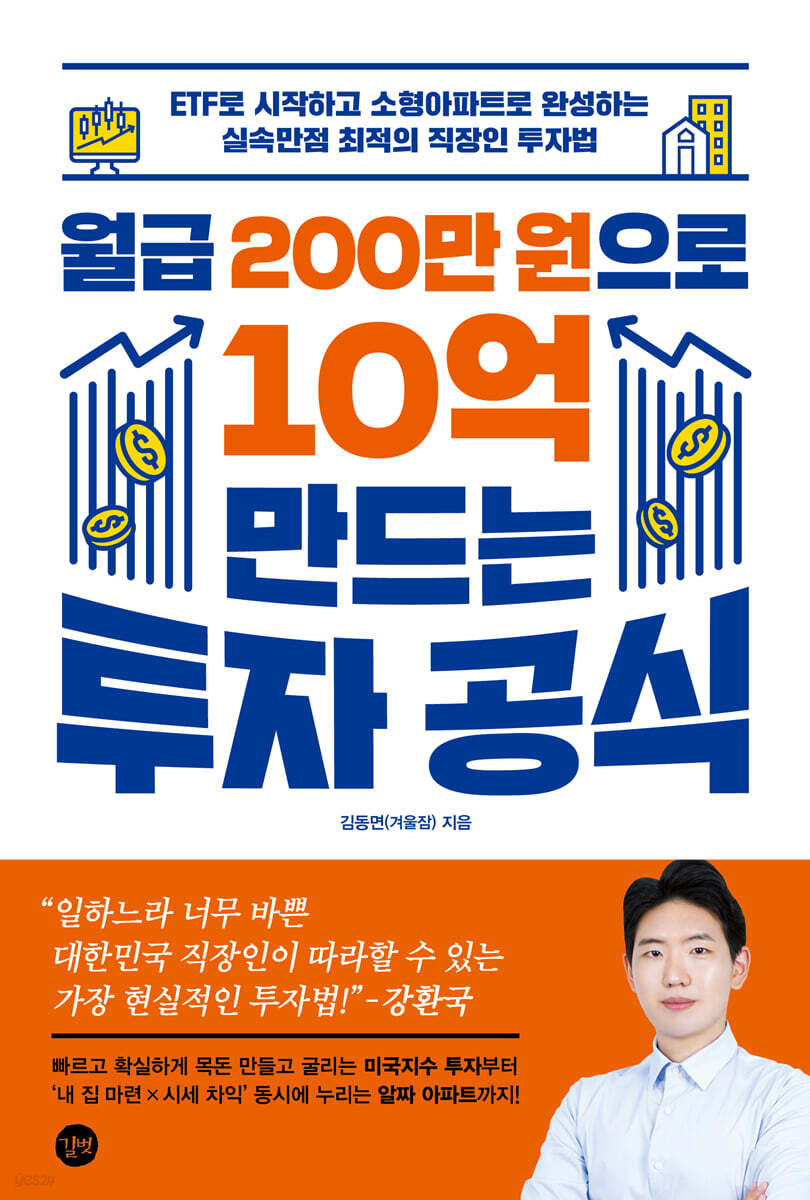
The investment formula for making 1 billion won with a monthly salary of 2 million won
 |
Description
Book Introduction
Starting with investing in US indexes to quickly and reliably make and manage your money. From investing in a great apartment to simultaneously enjoying the benefits of owning a home and profiting from price differences. I want to prepare for the future even if I don't have money. A Confident Investment Strategy for a Smart 2030 This book contains the investment method of 'Employee Kim', who worked at a small to medium-sized company and made 1 billion won in 5 years with a monthly salary of 2 million won. The author, who had no savings and only barely enough to cover living expenses, wanted to be a reliable presence for his parents who had supported him and his girlfriend who had promised him a future together. This book is based on his real-life experience of making investments and struggling to build up assets worth 1.56 billion won. The author, who couldn't tolerate even a single penny of loss because his salary was so small, decided to invest in two strategies: US ETFs and high-quality apartments, to generate large profits without losing money. The goal is to quickly and reliably make money with US ETFs, and to achieve a quantum jump in assets with quality apartments. If you're a 2030-something who wants to build a future free from financial worries by managing your small income properly and diligently, this book will provide the most realistic roadmap and specific know-how for ordinary Korean office workers to earn 1 billion won. |
- You can preview some of the book's contents.
Preview
index
Prologue: Even Ordinary Office Workers Can Become Rich
This book's user manual
Chapter 1 | Why We Must Invest
Everyone has a plausible plan, and I had one too.
Open your eyes, and you will become rich.
The Real Reason You Should Become an Investor
Investment principles that only the rich know, but you don't
The first investment I chose
How to maximize your investment capital
Chapter 2 | Make and Roll Money Quickly and Surely!
US ETF portfolio investment
To make the most of the magic of compound interest:
The more beginners you are, the more likely you are to choose the S&P 500.
Two Ways to Invest in S&P 500 ETFs
What stocks are in ETFs?
Build a strategy and portfolio to avoid losing money.
Portfolio Strategy 1 | 6:4 Stock/Bond Portfolio
Portfolio Strategy 2 | A Permanent Portfolio That Lasts Forever
Portfolio Strategy 3 | K-All Weather Portfolio
What is the best investment portfolio for me?
Practice! Trading ETFs
Recommended US Stock ETF Investment Roadmap
Chapter 3 | Enjoy the benefits of capital gains and owning your own home at the same time!
A great apartment investment
Why You Should Invest in Real Estate
The Power of Study to Lead Real Estate Investment Success
Where to Buy 1 | How to Choose an Investment Area
Where to Buy 2 | How to Choose an Investment Apartment
When to Buy | Investment Timing
What to Invest in | 5 Steps to Verifying Investment Areas and Apartments
Tip 1 for Buying or Selling Real Estate | Forestry Manual
Tip 2 for Buying or Selling Real Estate | Essential Knowledge for Real Estate Contracts
Real-World Real Estate Investing: Investing in a Smart Apartment
Chapter 4 | An Investment System for Making 1 Billion Won with a Monthly Salary of 2 Million Won
Invest in US ETFs and apartments in parallel.
A two-track investment roadmap recommended for each situation.
Investment Value Up 1 | Taxes: A Must-Know When Investing
| Investment Value Up 2 | How to Prepare for an Asset Crash: Utilizing the Decline Rate Compared to the MDD Peak
Investment Value Up 3 | Returns Vary Depending on Your Purchase Method
| Investment Value Up 4 | Helpful Resources to Review Regularly
| Investment Value Up 5 | How to Earn Small but Sure Money with IPO Investing
This book's user manual
Chapter 1 | Why We Must Invest
Everyone has a plausible plan, and I had one too.
Open your eyes, and you will become rich.
The Real Reason You Should Become an Investor
Investment principles that only the rich know, but you don't
The first investment I chose
How to maximize your investment capital
Chapter 2 | Make and Roll Money Quickly and Surely!
US ETF portfolio investment
To make the most of the magic of compound interest:
The more beginners you are, the more likely you are to choose the S&P 500.
Two Ways to Invest in S&P 500 ETFs
What stocks are in ETFs?
Build a strategy and portfolio to avoid losing money.
Portfolio Strategy 1 | 6:4 Stock/Bond Portfolio
Portfolio Strategy 2 | A Permanent Portfolio That Lasts Forever
Portfolio Strategy 3 | K-All Weather Portfolio
What is the best investment portfolio for me?
Practice! Trading ETFs
Recommended US Stock ETF Investment Roadmap
Chapter 3 | Enjoy the benefits of capital gains and owning your own home at the same time!
A great apartment investment
Why You Should Invest in Real Estate
The Power of Study to Lead Real Estate Investment Success
Where to Buy 1 | How to Choose an Investment Area
Where to Buy 2 | How to Choose an Investment Apartment
When to Buy | Investment Timing
What to Invest in | 5 Steps to Verifying Investment Areas and Apartments
Tip 1 for Buying or Selling Real Estate | Forestry Manual
Tip 2 for Buying or Selling Real Estate | Essential Knowledge for Real Estate Contracts
Real-World Real Estate Investing: Investing in a Smart Apartment
Chapter 4 | An Investment System for Making 1 Billion Won with a Monthly Salary of 2 Million Won
Invest in US ETFs and apartments in parallel.
A two-track investment roadmap recommended for each situation.
Investment Value Up 1 | Taxes: A Must-Know When Investing
| Investment Value Up 2 | How to Prepare for an Asset Crash: Utilizing the Decline Rate Compared to the MDD Peak
Investment Value Up 3 | Returns Vary Depending on Your Purchase Method
| Investment Value Up 4 | Helpful Resources to Review Regularly
| Investment Value Up 5 | How to Earn Small but Sure Money with IPO Investing
Detailed image

Into the book
If you think about the game Blue Marble, it's easy to understand how the rich think.
The way to win in the game of Blue Marble is to have the most assets by the end of the game.
There are two ways to increase your assets.
As you go around the game board, you can invest in cities that you can buy with the assets you have and make a profit, or you can go around the game board once and receive a monthly salary of 200,000 won.
As anyone who has played the game knows, the winning strategy in this game is to secure the asset called land.
Even if you roll the dice well, go around the game board many times, and get a lot of salary, you can never win.
Anyway, everyone gets a 'salary' every time they turn the game board.
The key is to win by earning a lot of income other than salary, such as by buying land and collecting a lot of 'tolls'.
Trying to become rich through earned income is similar to the strategy of playing the game many times to get a large salary.
You can build wealth, but it will take longer than others.
Plus, it requires more wheels to turn.
--- p.39, from “Chapter 1: Why We Must Invest”
Investment experts consider 'not losing' to be important.
Because they completely understand.
Investing is a world of multiplication, that is, compound interest.
Berkshire Hathaway, run by Warren Buffett, has an annual compound return of approximately 20%.
However, Berkshire Hathaway's total return, disclosed at its annual shareholders' meeting in March 2022, reached a whopping 3,787,464% over approximately 60 years from 1964 to 2022.
How was this possible? It's all because of compound interest.
Even if you don't achieve 20% annual returns like legendary investors, the power of compounding is powerful.
If an ordinary office worker saves 1 million won per month for 30 years, he or she will have a total of 360 million won.
If this money were to grow at a 10% compound interest rate each year, the return would be 2 billion won over 30 years, resulting in a final balance of 2.39 billion won.
--- p.57, from “Chapter 1: Why We Must Invest”
I believe that a realistically possible and appropriate target investment return for office workers is 8-10% per year.
At an average annual growth rate of 8%, your assets can more than double every 9 years.
Surprisingly, there is a way to consistently increase these returns.
Passive investing is investing in ETFs that track market returns, specifically, U.S. indices such as the S&P 500.
--- p.93, from "Chapter 2: Making and Rolling Money Quickly and Surely! ETF Investment"
To fully enjoy this 'power of compound interest', you must continue to generate profits, big or small, and invest consistently.
If you invest all-in on one asset class and it fails, it will be difficult to continue investing for a certain period of time.
Specifically, it took 4 years and 9 months to recover the principal and turn a profit after investing in the S&P 500 right before the dot-com bubble burst in 2000.
Meanwhile, Korea's KOSPI also suffered a major crash following the 2008 global financial crisis, and it took 12 years and 7 months to recover the principal and break out of the trading range to generate profits.
This means that you may not be able to make the investment itself for a period of 4 or 12 years.
We must always pursue safe investments.
To do so, you must be able to appropriately utilize various investment assets that suit market conditions.
And there is a way to make this happen.
This is 'portfolio investment', which invests in various asset classes by distributing them most advantageously in terms of stability and profitability.
--- p.112, from "Chapter 2: Making and Rolling Money Quickly and Surely! ETF Investment"
Large institutions such as the National Pension Service of Korea, the Federal Reserve System of the United States, the California Public Employees' Pension Fund, and the Norwegian Sovereign Wealth Fund are pursuing stability through asset allocation and are utilizing a 6:4 stock-bond portfolio strategy as one of their management methods.
Therefore, if the 6:4 stock-bond portfolio leads to investment failure, it could also affect the asset management of many institutions and countries.
This means that this portfolio is established as a stable and reliable strategy.
--- p.121, from "Chapter 2: Making and Rolling Money Quickly and Surely! ETF Investment"
At that time, it was possible to invest in apartments without a loan.
The sale price (sale price minus lease price) of an apartment in Sanbon New Town, Gunpo-si, Gyeonggi-do, located a little further south from Pyeongchon New Town, was around 50 million won.
Sanbon New Town was also a good place to live as one of the first new towns in the metropolitan area, so I was looking at it as an investment area. In the end, I took out an additional loan and bought an apartment in Pyeongchon New Town.
"Price reflects location." I believed that apartments in Pyeongchon, with their higher price per pyeong, were more desirable and sought after than apartments in Sanbon, and that more sought-after locations offered greater returns and liquidity.
--- p.236, from "Chapter 3: Enjoying Price Differences and Owning Your Own Home Simultaneously! Affordable Apartment Investment"
Many people think that owning a home means living there yourself.
However, if you only consider buying a home for actual residence, you may never be able to buy a good apartment in a good location.
In order to buy an apartment that I will actually live in, I need to have funds equivalent to the sale price of the apartment, but while I am saving up that money, the apartment price rises even faster.
However, if you put up a deposit, the required funds will be deducted as much as the deposit, so you can purchase it with less money.
So, I recommend that you use the jeonse system to 'register' the best apartment that you can invest in with your current funds to buy your own home.
--- p.246, from "Chapter 3: Enjoying Price Differences and Owning Your Own Home Simultaneously! Affordable Apartment Investment"
Around that time, I changed jobs and my salary increased.
The monthly investable amount has increased.
I invested in an ETF portfolio on a monthly basis, and purchased ETFs whenever dividends were paid (some ETFs pay dividends) or whenever I received performance bonuses.
Because of this, I got a return higher than my deposit.
At this time, I steadily purchased 60% of the 'TIGER US S&P 500' and 'TIGER US Nasdaq 100', and 40% of the 'KODEX US 10-Year Treasury Bond Futures', following the 6:4 stock-bond portfolio strategy.
--- p.261, from “Chapter 4: Two-track investment system to make 1 billion won with a monthly salary of 2 million won”
If possible, I think it would be better to purchase real estate first.
This is because real estate allows for the use of leverage, allowing for rapid growth in assets.
However, real estate investment requires an initial investment of at least 50 million won.
So, for those who lack investment funds, I recommend investing in an ETF portfolio first.
It takes time to save 50 million won, and it takes too long to save money simply through savings.
Moreover, while you are gradually saving money, you may experience a huge 'FOMO (fear of being left out)' if other people around you make profits from real estate and stocks.
If you are also investing in stock ETFs, you won't feel like you're falling behind the market.
The way to win in the game of Blue Marble is to have the most assets by the end of the game.
There are two ways to increase your assets.
As you go around the game board, you can invest in cities that you can buy with the assets you have and make a profit, or you can go around the game board once and receive a monthly salary of 200,000 won.
As anyone who has played the game knows, the winning strategy in this game is to secure the asset called land.
Even if you roll the dice well, go around the game board many times, and get a lot of salary, you can never win.
Anyway, everyone gets a 'salary' every time they turn the game board.
The key is to win by earning a lot of income other than salary, such as by buying land and collecting a lot of 'tolls'.
Trying to become rich through earned income is similar to the strategy of playing the game many times to get a large salary.
You can build wealth, but it will take longer than others.
Plus, it requires more wheels to turn.
--- p.39, from “Chapter 1: Why We Must Invest”
Investment experts consider 'not losing' to be important.
Because they completely understand.
Investing is a world of multiplication, that is, compound interest.
Berkshire Hathaway, run by Warren Buffett, has an annual compound return of approximately 20%.
However, Berkshire Hathaway's total return, disclosed at its annual shareholders' meeting in March 2022, reached a whopping 3,787,464% over approximately 60 years from 1964 to 2022.
How was this possible? It's all because of compound interest.
Even if you don't achieve 20% annual returns like legendary investors, the power of compounding is powerful.
If an ordinary office worker saves 1 million won per month for 30 years, he or she will have a total of 360 million won.
If this money were to grow at a 10% compound interest rate each year, the return would be 2 billion won over 30 years, resulting in a final balance of 2.39 billion won.
--- p.57, from “Chapter 1: Why We Must Invest”
I believe that a realistically possible and appropriate target investment return for office workers is 8-10% per year.
At an average annual growth rate of 8%, your assets can more than double every 9 years.
Surprisingly, there is a way to consistently increase these returns.
Passive investing is investing in ETFs that track market returns, specifically, U.S. indices such as the S&P 500.
--- p.93, from "Chapter 2: Making and Rolling Money Quickly and Surely! ETF Investment"
To fully enjoy this 'power of compound interest', you must continue to generate profits, big or small, and invest consistently.
If you invest all-in on one asset class and it fails, it will be difficult to continue investing for a certain period of time.
Specifically, it took 4 years and 9 months to recover the principal and turn a profit after investing in the S&P 500 right before the dot-com bubble burst in 2000.
Meanwhile, Korea's KOSPI also suffered a major crash following the 2008 global financial crisis, and it took 12 years and 7 months to recover the principal and break out of the trading range to generate profits.
This means that you may not be able to make the investment itself for a period of 4 or 12 years.
We must always pursue safe investments.
To do so, you must be able to appropriately utilize various investment assets that suit market conditions.
And there is a way to make this happen.
This is 'portfolio investment', which invests in various asset classes by distributing them most advantageously in terms of stability and profitability.
--- p.112, from "Chapter 2: Making and Rolling Money Quickly and Surely! ETF Investment"
Large institutions such as the National Pension Service of Korea, the Federal Reserve System of the United States, the California Public Employees' Pension Fund, and the Norwegian Sovereign Wealth Fund are pursuing stability through asset allocation and are utilizing a 6:4 stock-bond portfolio strategy as one of their management methods.
Therefore, if the 6:4 stock-bond portfolio leads to investment failure, it could also affect the asset management of many institutions and countries.
This means that this portfolio is established as a stable and reliable strategy.
--- p.121, from "Chapter 2: Making and Rolling Money Quickly and Surely! ETF Investment"
At that time, it was possible to invest in apartments without a loan.
The sale price (sale price minus lease price) of an apartment in Sanbon New Town, Gunpo-si, Gyeonggi-do, located a little further south from Pyeongchon New Town, was around 50 million won.
Sanbon New Town was also a good place to live as one of the first new towns in the metropolitan area, so I was looking at it as an investment area. In the end, I took out an additional loan and bought an apartment in Pyeongchon New Town.
"Price reflects location." I believed that apartments in Pyeongchon, with their higher price per pyeong, were more desirable and sought after than apartments in Sanbon, and that more sought-after locations offered greater returns and liquidity.
--- p.236, from "Chapter 3: Enjoying Price Differences and Owning Your Own Home Simultaneously! Affordable Apartment Investment"
Many people think that owning a home means living there yourself.
However, if you only consider buying a home for actual residence, you may never be able to buy a good apartment in a good location.
In order to buy an apartment that I will actually live in, I need to have funds equivalent to the sale price of the apartment, but while I am saving up that money, the apartment price rises even faster.
However, if you put up a deposit, the required funds will be deducted as much as the deposit, so you can purchase it with less money.
So, I recommend that you use the jeonse system to 'register' the best apartment that you can invest in with your current funds to buy your own home.
--- p.246, from "Chapter 3: Enjoying Price Differences and Owning Your Own Home Simultaneously! Affordable Apartment Investment"
Around that time, I changed jobs and my salary increased.
The monthly investable amount has increased.
I invested in an ETF portfolio on a monthly basis, and purchased ETFs whenever dividends were paid (some ETFs pay dividends) or whenever I received performance bonuses.
Because of this, I got a return higher than my deposit.
At this time, I steadily purchased 60% of the 'TIGER US S&P 500' and 'TIGER US Nasdaq 100', and 40% of the 'KODEX US 10-Year Treasury Bond Futures', following the 6:4 stock-bond portfolio strategy.
--- p.261, from “Chapter 4: Two-track investment system to make 1 billion won with a monthly salary of 2 million won”
If possible, I think it would be better to purchase real estate first.
This is because real estate allows for the use of leverage, allowing for rapid growth in assets.
However, real estate investment requires an initial investment of at least 50 million won.
So, for those who lack investment funds, I recommend investing in an ETF portfolio first.
It takes time to save 50 million won, and it takes too long to save money simply through savings.
Moreover, while you are gradually saving money, you may experience a huge 'FOMO (fear of being left out)' if other people around you make profits from real estate and stocks.
If you are also investing in stock ETFs, you won't feel like you're falling behind the market.
--- p.274, from “Chapter 4: Two-track investment system to make 1 billion won with a monthly salary of 2 million won”
Publisher's Review
Kim, an employee at a small business who received his first monthly salary of 1.46 million won
A two-track investment roadmap that will help you become a billionaire in just five years.
Now investing is survival!
You can't get rich on salary alone.
It became difficult to even buy a house of my own by diligently saving my monthly salary.
Over the past 10 years, wages have risen by an average of 3.5% per year, and house prices have risen by 5.3%.
As the data shows, the rise in housing prices that outpaces wage increases is not something new.
As long as we live in a capitalist society, prices, including housing prices, will continue to rise.
It would be fortunate if you could work for a long time, but the average retirement age for Korean workers is 52, and the average life expectancy of Koreans is 83, so you have to live off the money you earned in the past 20 years (in your 30s and 40s) for over 30 years after retirement.
The author of this book realized this reality only after being faced with the number 1.46 million won, his first monthly salary.
The future is bleak, as I have to pay off my student loans, get married, buy a house, and do other things with this salary.
Even if you calculate it roughly, it would be difficult to save 1 million won every month, and if this continued, I would have to work until I was 80 to barely be able to buy an 18 pyeong apartment in the metropolitan area.
To make matters worse, not long after joining the company, I witnessed a situation where even assistant managers started to apply for voluntary retirement.
The author, who felt that he could not just watch the bleak future unfold, came to the conclusion that 'we cannot remain with earned income' and 'we must create another source of income besides earned income'.
An ordinary office worker reads 100 books
The amazing changes that occurred after blindly following the rich!
On that road, the author bought 100 books by wealthy people and investment experts who live without worrying about money.
Every evening, I read books, looked for commonalities among rich people, and organized their know-how.
The two things the rich people identified had in common were, ‘They don’t lose money’ and ‘They utilize the power of compound interest.’
We vaguely think that investment masters are making huge returns like 100% or 1000%, but even the annual compound return of Berkshire Hathaway, run by the most famous investor Warren Buffett, is around 20%.
At first glance, it may seem like a small amount, but the total return that Buffett's Berkshire Hathaway earned over the 60 years from 1964 to 2022 is approximately 3,800,000%.
This is what happens when a 20% return meets the magic of compound interest.
Warren Buffett became a legend because he knew how to harness the power of compounding.
What does it take to harness the power of compound interest? You need to consistently generate profits without losing money, regardless of market conditions.
So, investment experts did not go all-in on one asset or make risky investments.
Realizing this, the author applied the principles and know-how of world-class wealthy individuals, wealthy people, and investment masters, and began investing consistently, utilizing the magic of compound interest without losing money.
Specifically, based on the investment principles of the wealthy, I invested in two things: ETFs and apartments.
By investing in US index ETFs, I was able to quickly and reliably raise funds and then use the funds to invest in undervalued, attractive apartments.
"The Investment Formula for Making 1 Billion Won with a Monthly Salary of 2 Million Won" is a book that contains investment methods that created assets worth 1 billion won in just 5 years through such investments.
If you live in a capitalist world, you'll discover how to grow your wealth easily, from why investing is essential to quickly and reliably generating seed money, to ETF investment methods and portfolio construction based on your tendencies and circumstances, to how to find undervalued, valuable apartments through a five-step verification process, to an investment roadmap tailored to your current assets.
The secret to saving and rolling over money twice as fast as a 5-year veteran who only invested in savings: ETF investment.
So, is there a way to consistently generate 10% annual returns? Yes! Invest in the S&P 500, a stock index comprising the 500 largest U.S. companies that has risen approximately 10.5% annually since 1920.
Anyone can easily make this investment through an ETF (exchange-traded fund) product that tracks the S&P 500 index.
Investing in the S&P 500 ETF itself allows you to diversify your investments across hundreds of stocks, making it more stable than investing in individual stocks. It also yields returns above the market average, making it an effective way to quickly and reliably generate and manage a large sum of money.
Moreover, it can be used by busy office workers with peace of mind.
Investing using a portfolio strategy that combines ETFs from other asset classes, such as bonds and gold, can provide much greater stability.
A Quantum Jump Method for Assets as Sure as Lottery: Real Estate Investment
In addition to the world's wealthy, the author also looked at the wealthy in Korea and discovered that 'real estate' played a major role in their wealth.
This is because a quantum jump in assets can only be achieved when utilizing real estate, which has a large absolute size.
Among them, Korea's wealthy preferred apartment investment.
Because it is the most in-demand type of investment and an essential item that is convenient for living in in many ways.
Accordingly, the author also decides to increase the speed of asset growth through apartment investment.
As soon as he secured the seed money of 50 million won, he purchased a small apartment in the metropolitan area. Starting with this, he now owns a total of three apartments: two in the first new town and one in the metropolitan area adjacent to Seoul.
It is realistically difficult for people in their 20s and 30s, who are just starting out in society and have little seed money, to invest in a high-end area of Seoul all at once.
Therefore, the author believed that it was very important to invest in prime apartments in the metropolitan area that could be purchased with a small initial investment and that had good locations and were expected to increase in value.
So, I put the most effort into selecting the best apartments and organized my know-how.
"Buying a house worth 1 billion won" seemed like someone else's problem, but I did it! You can do it too!
The author no longer worries about the future.
He says.
Now I can live without worrying about money.
He emphasizes that the phrase "no need to worry about money" does not mean that one has achieved financial freedom by accumulating enough assets to live without having to work, but rather that one has now learned how to protect and grow one's money, something one previously only knew how to save.
It is a confidence and confirmation that you can create greater assets.
Whether you're a fresh graduate just starting out in the workforce, a 2030-something working professional looking to prepare for the future without financial constraints, or a newlywed looking to build a happy future with your spouse, this book will provide you with the optimal investment method for consistently generating profits without losing money, and crucial hints for creating a future free from financial worries.
A two-track investment roadmap that will help you become a billionaire in just five years.
Now investing is survival!
You can't get rich on salary alone.
It became difficult to even buy a house of my own by diligently saving my monthly salary.
Over the past 10 years, wages have risen by an average of 3.5% per year, and house prices have risen by 5.3%.
As the data shows, the rise in housing prices that outpaces wage increases is not something new.
As long as we live in a capitalist society, prices, including housing prices, will continue to rise.
It would be fortunate if you could work for a long time, but the average retirement age for Korean workers is 52, and the average life expectancy of Koreans is 83, so you have to live off the money you earned in the past 20 years (in your 30s and 40s) for over 30 years after retirement.
The author of this book realized this reality only after being faced with the number 1.46 million won, his first monthly salary.
The future is bleak, as I have to pay off my student loans, get married, buy a house, and do other things with this salary.
Even if you calculate it roughly, it would be difficult to save 1 million won every month, and if this continued, I would have to work until I was 80 to barely be able to buy an 18 pyeong apartment in the metropolitan area.
To make matters worse, not long after joining the company, I witnessed a situation where even assistant managers started to apply for voluntary retirement.
The author, who felt that he could not just watch the bleak future unfold, came to the conclusion that 'we cannot remain with earned income' and 'we must create another source of income besides earned income'.
An ordinary office worker reads 100 books
The amazing changes that occurred after blindly following the rich!
On that road, the author bought 100 books by wealthy people and investment experts who live without worrying about money.
Every evening, I read books, looked for commonalities among rich people, and organized their know-how.
The two things the rich people identified had in common were, ‘They don’t lose money’ and ‘They utilize the power of compound interest.’
We vaguely think that investment masters are making huge returns like 100% or 1000%, but even the annual compound return of Berkshire Hathaway, run by the most famous investor Warren Buffett, is around 20%.
At first glance, it may seem like a small amount, but the total return that Buffett's Berkshire Hathaway earned over the 60 years from 1964 to 2022 is approximately 3,800,000%.
This is what happens when a 20% return meets the magic of compound interest.
Warren Buffett became a legend because he knew how to harness the power of compounding.
What does it take to harness the power of compound interest? You need to consistently generate profits without losing money, regardless of market conditions.
So, investment experts did not go all-in on one asset or make risky investments.
Realizing this, the author applied the principles and know-how of world-class wealthy individuals, wealthy people, and investment masters, and began investing consistently, utilizing the magic of compound interest without losing money.
Specifically, based on the investment principles of the wealthy, I invested in two things: ETFs and apartments.
By investing in US index ETFs, I was able to quickly and reliably raise funds and then use the funds to invest in undervalued, attractive apartments.
"The Investment Formula for Making 1 Billion Won with a Monthly Salary of 2 Million Won" is a book that contains investment methods that created assets worth 1 billion won in just 5 years through such investments.
If you live in a capitalist world, you'll discover how to grow your wealth easily, from why investing is essential to quickly and reliably generating seed money, to ETF investment methods and portfolio construction based on your tendencies and circumstances, to how to find undervalued, valuable apartments through a five-step verification process, to an investment roadmap tailored to your current assets.
The secret to saving and rolling over money twice as fast as a 5-year veteran who only invested in savings: ETF investment.
So, is there a way to consistently generate 10% annual returns? Yes! Invest in the S&P 500, a stock index comprising the 500 largest U.S. companies that has risen approximately 10.5% annually since 1920.
Anyone can easily make this investment through an ETF (exchange-traded fund) product that tracks the S&P 500 index.
Investing in the S&P 500 ETF itself allows you to diversify your investments across hundreds of stocks, making it more stable than investing in individual stocks. It also yields returns above the market average, making it an effective way to quickly and reliably generate and manage a large sum of money.
Moreover, it can be used by busy office workers with peace of mind.
Investing using a portfolio strategy that combines ETFs from other asset classes, such as bonds and gold, can provide much greater stability.
A Quantum Jump Method for Assets as Sure as Lottery: Real Estate Investment
In addition to the world's wealthy, the author also looked at the wealthy in Korea and discovered that 'real estate' played a major role in their wealth.
This is because a quantum jump in assets can only be achieved when utilizing real estate, which has a large absolute size.
Among them, Korea's wealthy preferred apartment investment.
Because it is the most in-demand type of investment and an essential item that is convenient for living in in many ways.
Accordingly, the author also decides to increase the speed of asset growth through apartment investment.
As soon as he secured the seed money of 50 million won, he purchased a small apartment in the metropolitan area. Starting with this, he now owns a total of three apartments: two in the first new town and one in the metropolitan area adjacent to Seoul.
It is realistically difficult for people in their 20s and 30s, who are just starting out in society and have little seed money, to invest in a high-end area of Seoul all at once.
Therefore, the author believed that it was very important to invest in prime apartments in the metropolitan area that could be purchased with a small initial investment and that had good locations and were expected to increase in value.
So, I put the most effort into selecting the best apartments and organized my know-how.
"Buying a house worth 1 billion won" seemed like someone else's problem, but I did it! You can do it too!
The author no longer worries about the future.
He says.
Now I can live without worrying about money.
He emphasizes that the phrase "no need to worry about money" does not mean that one has achieved financial freedom by accumulating enough assets to live without having to work, but rather that one has now learned how to protect and grow one's money, something one previously only knew how to save.
It is a confidence and confirmation that you can create greater assets.
Whether you're a fresh graduate just starting out in the workforce, a 2030-something working professional looking to prepare for the future without financial constraints, or a newlywed looking to build a happy future with your spouse, this book will provide you with the optimal investment method for consistently generating profits without losing money, and crucial hints for creating a future free from financial worries.
GOODS SPECIFICS
- Date of issue: October 1, 2024
- Page count, weight, size: 330 pages | 572g | 152*225*21mm
- ISBN13: 9791140711086
- ISBN10: 1140711083
You may also like
카테고리
korean


korean

![ELLE 엘르 스페셜 에디션 A형 : 12월 [2025]](http://librairie.coreenne.fr/cdn/shop/files/b8e27a3de6c9538896439686c6b0e8fb.jpg?v=1766436872&width=3840)


