

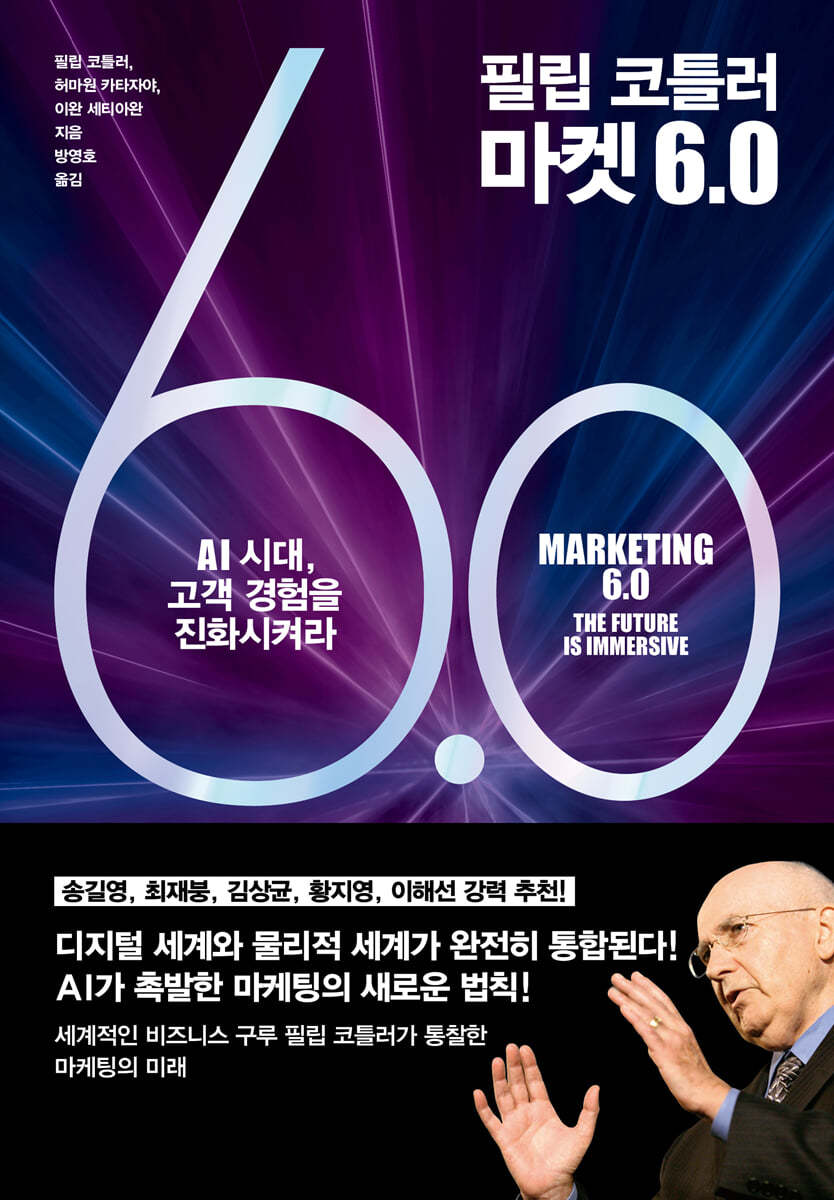
Philip Kotler Markets 6.0
 |
Description
Book Introduction
- A word from MD
-
Marketing Strategies in the AI EraContains new marketing insights from business guru Philip Kotler.
It conveys the changing marketing paradigm brought about by the emergence of a generation that values experience and the advancement of technology.
Let's explore metamarketing strategies that provide customers with new experiences and interactions in a rapidly changing business environment.
May 24, 2024. Economics and Management PD Kim Sang-geun
The complete edition of the "Market Series," a unique future strategy book that presents a marketing paradigm.
New technologies such as further evolved AI, spatial computing, AR, VR, XR, and the metaverse are increasingly penetrating our daily lives.
By moving between the real and virtual worlds and using AI as a tool, we can do more things.
Today's customers are more immersive and engaged with brands, enabling them to have engaging experiences.
The customer journey is also evolving into more diverse paths.
What should companies do to dominate future markets? How should marketing evolve to meet rapidly evolving customer needs?
Dr. Philip Kotler, known as the father of marketing and a business guru, and authors Hermawon Katajaya and Iwan Setiawan, renowned for their unique marketing insights, have teamed up again to publish "Philip Kotler Marketing 6.0."
The authors argue that we must create fully immersive customer experiences that transcend the boundaries between digital and physical spaces.
Anyone seeking to stay ahead in the ever-evolving, complex world of technology, markets, and business will gain insights into the emerging marketing paradigm and its strategies from this book.
New technologies such as further evolved AI, spatial computing, AR, VR, XR, and the metaverse are increasingly penetrating our daily lives.
By moving between the real and virtual worlds and using AI as a tool, we can do more things.
Today's customers are more immersive and engaged with brands, enabling them to have engaging experiences.
The customer journey is also evolving into more diverse paths.
What should companies do to dominate future markets? How should marketing evolve to meet rapidly evolving customer needs?
Dr. Philip Kotler, known as the father of marketing and a business guru, and authors Hermawon Katajaya and Iwan Setiawan, renowned for their unique marketing insights, have teamed up again to publish "Philip Kotler Marketing 6.0."
The authors argue that we must create fully immersive customer experiences that transcend the boundaries between digital and physical spaces.
Anyone seeking to stay ahead in the ever-evolving, complex world of technology, markets, and business will gain insights into the emerging marketing paradigm and its strategies from this book.
- You can preview some of the book's contents.
Preview
index
Part 1: The Era of Market 6.0
Chapter 1: Market 6.0: From Multi to Omni, from Omni to Meta
Chapter 2: The Emergence of the Digital Native: Children Who Became Old
Chapter 3: Why Immersive Marketing: Five Microtrends Leading to Metamarketing
Chapter 4 The Future of Customer Experience: Complete Immersion Blending the Physical and Digital
Part 2: Factors and Environment for Market 6.0
Chapter 5: Understanding the Technology Factors: The Five Core Technologies That Power Metamarketing
Chapter 6 Building Augmented Reality: Immersive Experiences in the Real World
Chapter 7: Leveraging the Metaverse: The Future of Social Media Platforms
Part 3 Market 6.0 Experience
Chapter 8: Multisensory Marketing: Delivering Immersive Experiences That Stimulate the Five Senses
Chapter 9: Spatial Marketing: Implementing Human-Machine Interaction
Chapter 10: Metaverse Marketing: Understanding the Needs Behind It
Chapter 1: Market 6.0: From Multi to Omni, from Omni to Meta
Chapter 2: The Emergence of the Digital Native: Children Who Became Old
Chapter 3: Why Immersive Marketing: Five Microtrends Leading to Metamarketing
Chapter 4 The Future of Customer Experience: Complete Immersion Blending the Physical and Digital
Part 2: Factors and Environment for Market 6.0
Chapter 5: Understanding the Technology Factors: The Five Core Technologies That Power Metamarketing
Chapter 6 Building Augmented Reality: Immersive Experiences in the Real World
Chapter 7: Leveraging the Metaverse: The Future of Social Media Platforms
Part 3 Market 6.0 Experience
Chapter 8: Multisensory Marketing: Delivering Immersive Experiences That Stimulate the Five Senses
Chapter 9: Spatial Marketing: Implementing Human-Machine Interaction
Chapter 10: Metaverse Marketing: Understanding the Needs Behind It
Detailed image
.jpg)
Into the book
A notable shift in technological advancements in recent years is the increased immersive interaction between customers and brands.
This change has been further accelerated by the emergence of digital natives, namely Generation Z and Generation Alpha.
These two generations were born into a world where the Internet was already widespread and are deeply accustomed to immersive experiences that blend physical and digital elements.
---From "Chapter 1: Market 6.0"
Even though the internet is the primary means of communication and we've been through several pandemics, most customers still gravitate towards human contact.
According to the U.S. Department of Commerce, e-commerce accounted for only about 15% of total retail sales in the United States in 2022.
Euromonitor, a global market research firm, estimates that while e-commerce penetration in China has expanded significantly (and is the highest in the world), it still remains below 30%.
So, companies cannot make the transition from traditional marketing to digital marketing overnight.
---From "Chapter 1: Market 6.0"
Although Generation Z and Generation Alpha are young, they represent a sophisticated customer base that requires advanced marketing management methods.
They take interactive, immersive customer experiences seriously, both online and offline, and this generation is called physital natives.
Marketers must embrace both physical touchpoints and next-generation digital technologies to effectively engage both generations.
---From "Chapter 2: The Emergence of Digital Natives"
Another reason customer experience has become a successful marketing strategy is because product life cycles have shortened.
The influence of social media is rapidly changing the product preferences of the younger generation, and as a result, product life cycles are gradually shortening.
What's trending and valuable these days is often determined by social media.
When a product's popularity rapidly wanes, the window of opportunity to generate revenue from the product narrows, so companies must frequently launch new products.
However, if you can provide a unique customer experience, you can extend the product life cycle.
---From "Chapter 4: The Future of Customer Experience"
The advantages of augmented reality and virtual reality are often combined with mixed reality (MR).
While augmented reality superimposes digital content onto the physical world, mixed reality goes one step further, allowing digital elements to interact with physical spaces to create a more immersive experience.
Mixed reality sits somewhere between augmented reality and fully immersive virtual reality, evoking more complex physical-digital interactions than augmented reality while maintaining the context of the real world that disappears in virtual reality.
---From "Chapter 5: Understanding Technical Factors"
The trend of purchasing items in physical stores is also evident among younger demographics.
According to McKinsey, while Gen Z frequently purchases items online, they purchase more offline than Gen Y across 25 categories.
Moreover, according to research by global retailer AS Watson, when social interaction is essential, such as in the beauty industry, Generation Z primarily purchases products in offline stores.
These statistics show that physical retail space still plays a significant role in the majority of customer experiences.
---From "Chapter 6 Building Extended Reality"
In many cases, advanced technologies attempt to mimic human capabilities.
Technology can replicate cognitive functions, enable communication, mimic human senses, enable physical movements, create imaginative experiences, and enhance interconnectedness.
These cutting-edge technologies open up new possibilities for natural interactions between humans and human-like machines, including voice commands, facial recognition, and hand gestures.
An emerging field that can leverage these advanced technologies is spatial computing, which allows humans to interact with machines and digital content within physical space.
This change has been further accelerated by the emergence of digital natives, namely Generation Z and Generation Alpha.
These two generations were born into a world where the Internet was already widespread and are deeply accustomed to immersive experiences that blend physical and digital elements.
---From "Chapter 1: Market 6.0"
Even though the internet is the primary means of communication and we've been through several pandemics, most customers still gravitate towards human contact.
According to the U.S. Department of Commerce, e-commerce accounted for only about 15% of total retail sales in the United States in 2022.
Euromonitor, a global market research firm, estimates that while e-commerce penetration in China has expanded significantly (and is the highest in the world), it still remains below 30%.
So, companies cannot make the transition from traditional marketing to digital marketing overnight.
---From "Chapter 1: Market 6.0"
Although Generation Z and Generation Alpha are young, they represent a sophisticated customer base that requires advanced marketing management methods.
They take interactive, immersive customer experiences seriously, both online and offline, and this generation is called physital natives.
Marketers must embrace both physical touchpoints and next-generation digital technologies to effectively engage both generations.
---From "Chapter 2: The Emergence of Digital Natives"
Another reason customer experience has become a successful marketing strategy is because product life cycles have shortened.
The influence of social media is rapidly changing the product preferences of the younger generation, and as a result, product life cycles are gradually shortening.
What's trending and valuable these days is often determined by social media.
When a product's popularity rapidly wanes, the window of opportunity to generate revenue from the product narrows, so companies must frequently launch new products.
However, if you can provide a unique customer experience, you can extend the product life cycle.
---From "Chapter 4: The Future of Customer Experience"
The advantages of augmented reality and virtual reality are often combined with mixed reality (MR).
While augmented reality superimposes digital content onto the physical world, mixed reality goes one step further, allowing digital elements to interact with physical spaces to create a more immersive experience.
Mixed reality sits somewhere between augmented reality and fully immersive virtual reality, evoking more complex physical-digital interactions than augmented reality while maintaining the context of the real world that disappears in virtual reality.
---From "Chapter 5: Understanding Technical Factors"
The trend of purchasing items in physical stores is also evident among younger demographics.
According to McKinsey, while Gen Z frequently purchases items online, they purchase more offline than Gen Y across 25 categories.
Moreover, according to research by global retailer AS Watson, when social interaction is essential, such as in the beauty industry, Generation Z primarily purchases products in offline stores.
These statistics show that physical retail space still plays a significant role in the majority of customer experiences.
---From "Chapter 6 Building Extended Reality"
In many cases, advanced technologies attempt to mimic human capabilities.
Technology can replicate cognitive functions, enable communication, mimic human senses, enable physical movements, create imaginative experiences, and enhance interconnectedness.
These cutting-edge technologies open up new possibilities for natural interactions between humans and human-like machines, including voice commands, facial recognition, and hand gestures.
An emerging field that can leverage these advanced technologies is spatial computing, which allows humans to interact with machines and digital content within physical space.
---From "Chapter 9: Space Marketing"
Publisher's Review
Insights from marketing guru Philip Kotler on the 'Marketing 6.0' era!
The customer experience is evolving and the customer journey is shifting.
“Rethink your branding and marketing strategy!”
New technologies such as advanced AI, spatial computing, AR, VR, XR, and the metaverse are increasingly penetrating our daily lives.
The business environment has changed yet again, and the result is the next revolution in marketing.
By moving between the real and virtual worlds and using AI as a tool, we can do more things.
Today's customers want to interact with brands in a more immersive way and have more engaging experiences.
Customers' purchasing journeys are also evolving into more diverse paths.
Amidst this turbulent landscape, what should companies do to dominate future markets? How are our customers evolving? What changes should we make to our marketing framework?
Dr. Philip Kotler, known as the father of marketing and a guru in the business world, and authors Hermawon Katajaya and Iwan Setiawan, famous for sharing their unique marketing insights, have teamed up again to publish "Philip Kotler Marketing 6.0."
The authors argue that in the era of Market 6.0, where digital space and offline experiences are truly merging, we must transcend spatial boundaries and create fully immersive customer experiences.
This book closely examines the reality we face in the era of Market 6.0 (the emergence of physical natives, further evolved technological changes and trends), presents a paradigm to pursue (creating an immersive customer experience that merges the digital and physical realms), and tells us how to create a dazzling future through appropriate methodologies (multi-sensory, spatial, metaverse marketing, etc.).
Converging the Digital and Physical Realms: Now's the Time to Unfold Your Market 6.0 Strategy
Market 1.0 - The Product-Centric Marketing Era
Market 2.0 - The Era of Consumer-Centric Marketing
Market 3.0 - The Era of Human-Centered Marketing (Value and Story-Driven)
Marketing 4.0 - The Era of Transition to Digital Marketing (From Traditional Marketing to Digital Marketing)
Market 5.0: The Era of Humanity-Oriented Technology
Market 6.0 - The Era of Metamarketing, Erasing Spatial Boundaries (Focusing on Immersive Customer Experience)
The authors have closely examined changes in technology and customers, and have presented new discourses and insights into the market from the product-centered marketing era (Market 1.0) to the present (Market 6.0).
In today's era, where digital natives like Generation Z and Generation Alpha are emerging as key customers, product differentiation is shrinking, and product life cycles are shortening, competing solely on product is no longer enough to dominate the market and attract customers.
Accordingly, the authors emphasize that a new approach called 'metamarketing' should be considered.
Metamarketing is a strategy that achieves the ultimate fusion of the physical and digital realms to provide an interactive, immersive customer experience.
There are three main ways to implement this strategy:
· Multisensory marketing: Delivering immersive experiences that stimulate all five senses.
· Spatial Marketing: Adding digital experiences to offline areas and offline experiences to digital areas.
· Metaverse Marketing: Embracing and leveraging future social media platforms.
Metamarketing enables deeper customer interactions and creates fully immersive customer journeys, providing customers with unique and special experiences.
Although it's a relatively new concept, it holds immense and significant potential for companies seeking to stay ahead in one of the most complex and challenging marketing environments of all time.
Optimal Insights for Responding to a Rapidly Evolving World
Philip Kotler's Markets 6.0 provides a method for integrating the changes in consumer behavior over the past decade with advancements in technology and business models.
Specifically, readers will gain:
· Generation Z and Generation Alpha, and the technologies they use on a daily basis
· Components of metamarketing that target new consumers
· How to integrate and implement extended reality and the metaverse into your marketing strategy.
· Conditions and solutions for creating immersive customer experiences
Professors Song Gil-young, Choi Jae-boong, Kim Sang-gyun, and Hwang Ji-young, who read the Korean version first, praised this book as the best book for preparing for future business and setting the right direction.
In today's world, where the success or failure of a company hinges on how quickly it can grasp the rapidly evolving world and how clearly it can establish its business focus, Philip Kotler's Markets 6.0 clearly shows us where we should be heading and what we should do.
The customer experience is evolving and the customer journey is shifting.
“Rethink your branding and marketing strategy!”
New technologies such as advanced AI, spatial computing, AR, VR, XR, and the metaverse are increasingly penetrating our daily lives.
The business environment has changed yet again, and the result is the next revolution in marketing.
By moving between the real and virtual worlds and using AI as a tool, we can do more things.
Today's customers want to interact with brands in a more immersive way and have more engaging experiences.
Customers' purchasing journeys are also evolving into more diverse paths.
Amidst this turbulent landscape, what should companies do to dominate future markets? How are our customers evolving? What changes should we make to our marketing framework?
Dr. Philip Kotler, known as the father of marketing and a guru in the business world, and authors Hermawon Katajaya and Iwan Setiawan, famous for sharing their unique marketing insights, have teamed up again to publish "Philip Kotler Marketing 6.0."
The authors argue that in the era of Market 6.0, where digital space and offline experiences are truly merging, we must transcend spatial boundaries and create fully immersive customer experiences.
This book closely examines the reality we face in the era of Market 6.0 (the emergence of physical natives, further evolved technological changes and trends), presents a paradigm to pursue (creating an immersive customer experience that merges the digital and physical realms), and tells us how to create a dazzling future through appropriate methodologies (multi-sensory, spatial, metaverse marketing, etc.).
Converging the Digital and Physical Realms: Now's the Time to Unfold Your Market 6.0 Strategy
Market 1.0 - The Product-Centric Marketing Era
Market 2.0 - The Era of Consumer-Centric Marketing
Market 3.0 - The Era of Human-Centered Marketing (Value and Story-Driven)
Marketing 4.0 - The Era of Transition to Digital Marketing (From Traditional Marketing to Digital Marketing)
Market 5.0: The Era of Humanity-Oriented Technology
Market 6.0 - The Era of Metamarketing, Erasing Spatial Boundaries (Focusing on Immersive Customer Experience)
The authors have closely examined changes in technology and customers, and have presented new discourses and insights into the market from the product-centered marketing era (Market 1.0) to the present (Market 6.0).
In today's era, where digital natives like Generation Z and Generation Alpha are emerging as key customers, product differentiation is shrinking, and product life cycles are shortening, competing solely on product is no longer enough to dominate the market and attract customers.
Accordingly, the authors emphasize that a new approach called 'metamarketing' should be considered.
Metamarketing is a strategy that achieves the ultimate fusion of the physical and digital realms to provide an interactive, immersive customer experience.
There are three main ways to implement this strategy:
· Multisensory marketing: Delivering immersive experiences that stimulate all five senses.
· Spatial Marketing: Adding digital experiences to offline areas and offline experiences to digital areas.
· Metaverse Marketing: Embracing and leveraging future social media platforms.
Metamarketing enables deeper customer interactions and creates fully immersive customer journeys, providing customers with unique and special experiences.
Although it's a relatively new concept, it holds immense and significant potential for companies seeking to stay ahead in one of the most complex and challenging marketing environments of all time.
Optimal Insights for Responding to a Rapidly Evolving World
Philip Kotler's Markets 6.0 provides a method for integrating the changes in consumer behavior over the past decade with advancements in technology and business models.
Specifically, readers will gain:
· Generation Z and Generation Alpha, and the technologies they use on a daily basis
· Components of metamarketing that target new consumers
· How to integrate and implement extended reality and the metaverse into your marketing strategy.
· Conditions and solutions for creating immersive customer experiences
Professors Song Gil-young, Choi Jae-boong, Kim Sang-gyun, and Hwang Ji-young, who read the Korean version first, praised this book as the best book for preparing for future business and setting the right direction.
In today's world, where the success or failure of a company hinges on how quickly it can grasp the rapidly evolving world and how clearly it can establish its business focus, Philip Kotler's Markets 6.0 clearly shows us where we should be heading and what we should do.
GOODS SPECIFICS
- Date of issue: May 16, 2024
- Format: Hardcover book binding method guide
- Page count, weight, size: 296 pages | 584g | 150*216*20mm
- ISBN13: 9791140709946
- ISBN10: 1140709941
You may also like
카테고리
korean


korean

![ELLE 엘르 스페셜 에디션 A형 : 12월 [2025]](http://librairie.coreenne.fr/cdn/shop/files/b8e27a3de6c9538896439686c6b0e8fb.jpg?v=1766436872&width=3840)


