

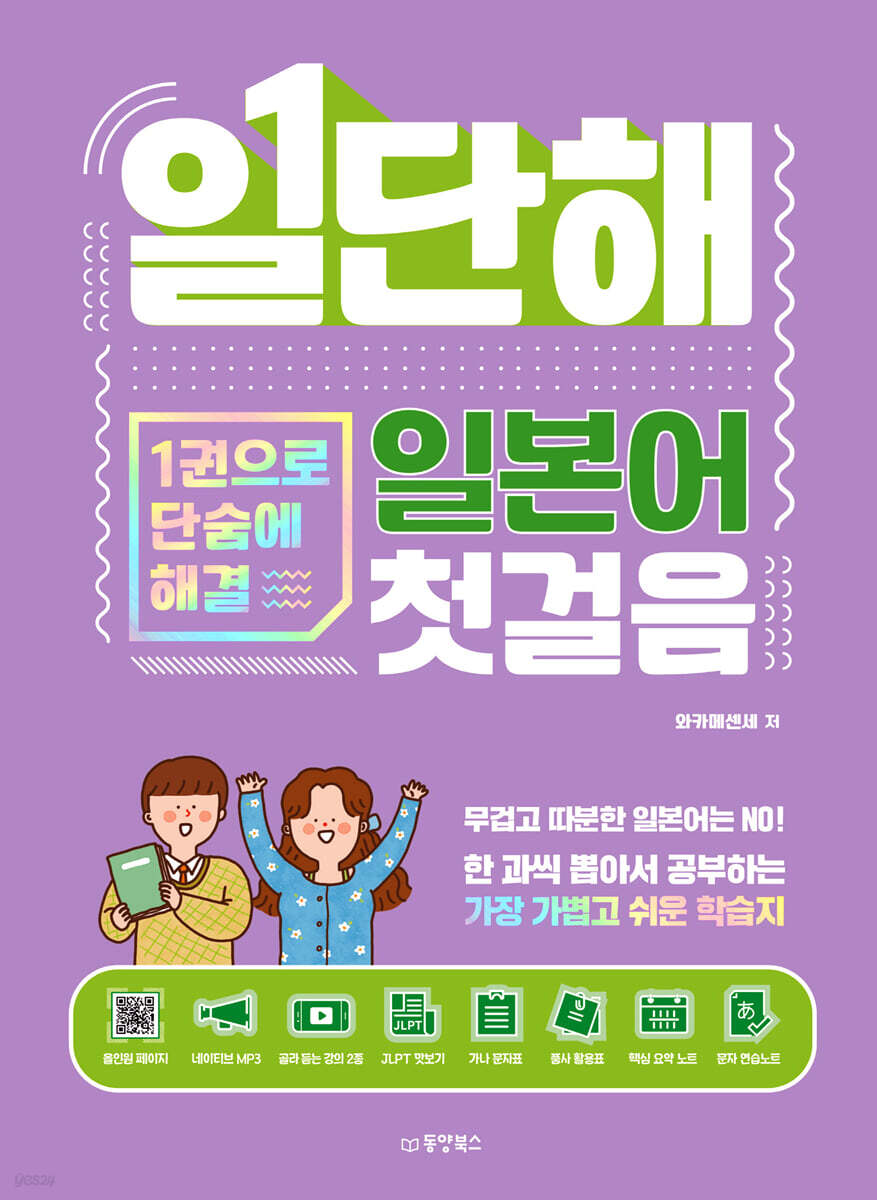
First Steps in Japanese
 |
Description
Book Introduction
The thickness of the book is up to you! The lecture style is up to you!
The easiest and lightest first step is to study one subject at a time!
- 2 lectures + native speaker MP3 + all-in-one QR page with answers at a glance
- A systematic learning method that starts with the easiest words and progresses to sentences and conversations.
- Includes a test paper that will help you take the Japanese Language Proficiency Test (JLPT) N5 right away.
- Two online lectures are provided, allowing you to choose the one that best suits your taste.
“The more you learn Japanese, the more difficult it becomes.” This legend, which has been passed down like a legend, is actually a lie.
I thought it would be easier than other foreign languages because the word order is similar to Korean, but it is difficult from the very beginning to memorize the characters.
Just when you think you've barely memorized hiragana and katakana, a terrifying kanji awaits you.
If you put your mind to it, you can see and hear Japanese through social media and media, but you need to build a foundation, so it will take some effort at first.
〈First Steps in Japanese〉 is designed to be as easy and fun as possible so that you can continue your efforts.
YouTuber Wakame Sensei not only systematically organized basic grammar with his many years of know-how, but also made a groundbreaking attempt to teach informal speech instead of formal speech in the first lesson, unlike other books on the market.
The vocabulary and expressions learned in this course are structured so that you can study them repeatedly so that you never forget them.
The easiest and lightest first step is to study one subject at a time!
- 2 lectures + native speaker MP3 + all-in-one QR page with answers at a glance
- A systematic learning method that starts with the easiest words and progresses to sentences and conversations.
- Includes a test paper that will help you take the Japanese Language Proficiency Test (JLPT) N5 right away.
- Two online lectures are provided, allowing you to choose the one that best suits your taste.
“The more you learn Japanese, the more difficult it becomes.” This legend, which has been passed down like a legend, is actually a lie.
I thought it would be easier than other foreign languages because the word order is similar to Korean, but it is difficult from the very beginning to memorize the characters.
Just when you think you've barely memorized hiragana and katakana, a terrifying kanji awaits you.
If you put your mind to it, you can see and hear Japanese through social media and media, but you need to build a foundation, so it will take some effort at first.
〈First Steps in Japanese〉 is designed to be as easy and fun as possible so that you can continue your efforts.
YouTuber Wakame Sensei not only systematically organized basic grammar with his many years of know-how, but also made a groundbreaking attempt to teach informal speech instead of formal speech in the first lesson, unlike other books on the market.
The vocabulary and expressions learned in this course are structured so that you can study them repeatedly so that you never forget them.
- You can preview some of the book's contents.
Preview
index
Lesson 1 How are you? What is hello in Japanese?
Lesson 2 したしい ともだちは だれ? Who is your close friend?
Lesson 3 What is your favorite fruit?
Lesson 4 What time are we meeting?
Lesson 5 なんにん かぞくですか。 How many people are in the family?
Lesson 6 It's a bit expensive.
Lesson 7 ? is a good artist. You draw well.
Lesson 8 Telework, work from home.
Lesson 9 I fell in love at first sight.
Lesson 10 The trip was fun. The trip was fun.
Lesson 11 I am working on self-improvement. I am working on self-improvement.
Lesson 12 We went on a date this weekend.
Appendix: Review Lessons 1-12
Appendix JLPT N5 Preview
Appendix Hiragana & Katakana Practice Notes
Lesson 2 したしい ともだちは だれ? Who is your close friend?
Lesson 3 What is your favorite fruit?
Lesson 4 What time are we meeting?
Lesson 5 なんにん かぞくですか。 How many people are in the family?
Lesson 6 It's a bit expensive.
Lesson 7 ? is a good artist. You draw well.
Lesson 8 Telework, work from home.
Lesson 9 I fell in love at first sight.
Lesson 10 The trip was fun. The trip was fun.
Lesson 11 I am working on self-improvement. I am working on self-improvement.
Lesson 12 We went on a date this weekend.
Appendix: Review Lessons 1-12
Appendix JLPT N5 Preview
Appendix Hiragana & Katakana Practice Notes
Detailed image

Publisher's Review
Story 1.
Mr. A, whose book is too heavy
The first step book I bought with determination.
Workbooks, vocabulary lists, CDs, writing notebooks, mini-books...
With this kind of package, it seemed like I would be able to have a conversation with Japanese people in three months.
'It's 300 pages, so if I do 10 pages a day, I'll finish it in exactly 30 days!' My bag became like a brick when I put the 300-page book in it, and it was too heavy to carry around, so I decided to study only at home.
In the end, it ended up spending more time on the bookshelf than it did in my hands.
Story 2. Mr. B was curious about the Japanese comments he saw on social media.
I bought the book "First Steps in Japanese" because I wanted to communicate with Japanese people through social media such as Instagram and Youtube.
Finally the first day.
In Lesson 1, we studied “はじめまして。 (Nice to meet you.)”
As I was about to fall asleep with a satisfied heart, I thought about it and realized that I had never said "Nice to meet you" in Korean before.
I started to doubt whether I had really studied practical Japanese.
Story 3.
Mr. C, who started learning Japanese casually but ended up becoming a debt slave
I looked into study content for 'Mastering Japanese,' one of the items on my bucket list this year.
Although 200,000 won is a bit of a burden, I thought I could do something systematically, and since it would only cost 20,000 won per month if I paid in installments for 12 months, it seemed like a good investment for self-development.
But there was so much of me inside me that I got a little sick of it after two months.
There are still 10 months left on the installment… .
"First Steps in Japanese" is a book for the protagonists of such unfortunate stories.
* A simple study guide for those of us who are physically and mentally burdened by our busy daily lives.
A person with a lot of miscellaneous things in his bag.
A person who has a lot to do every day.
A person who wants to do a lot but lacks perseverance.
For those who want to start studying Japanese.
People who want to learn the basics of a foreign language in the shortest possible time.
People whose New Year's bucket list still remains a list.
If any of these apply to you, I strongly recommend that you 'open' this book first.
We can't be sure that we'll be studying consistently even after a few months because of the 'annoyance' that feels like a part of our body.
So, 『First Steps in Japanese』 was created so that you can take one easy step at a time.
If you pack too much luggage for the first step of climbing the mountain called 'Japanese', you will quickly become tired.
Just one book! Studying it thoroughly and then deciding what to do next is a more efficient use of time and money.
* A study guide that solves everything in one go in one volume
“The more you learn Japanese, the more difficult it becomes.” This legend, which has been passed down like a legend, is actually a lie.
I thought it would be easier than other foreign languages because the word order is similar to Korean, but it is difficult from the very beginning to memorize the characters.
Just when you think you've barely memorized hiragana and katakana, a terrifying kanji awaits you.
If you put your mind to it, you can see and hear Japanese through social media and media, but you need to build a foundation, so it will take some effort at first.
"First Steps in Japanese" is designed to be as easy and fun as possible to help you continue your efforts.
YouTuber Wakame Sensei not only systematically organized basic grammar with his many years of know-how, but also made a groundbreaking attempt to teach informal speech instead of formal speech in the first lesson, unlike other books on the market.
The vocabulary and expressions learned in this course are structured so that you can study them repeatedly so that you never forget them.
Learning a foreign language is not a 50-meter dash.
You must not get tired, you must not get bored.
If you feel obligated to be consistent, you can easily become tired.
The "First Step Series" sets "never giving up" as the first criterion for studying a foreign language.
So, I organized the book into a workbook format and included fun puzzle types in the practice problems.
As you feel a sense of accomplishment as you complete each lesson, your Japanese skills will improve before you know it.
I recommend this book to anyone who has ever wanted to study Japanese, or to anyone who has put Japanese aside for various reasons, as a good guide to help them think about what comes next.
The structure of the text of "First Steps in Japanese"
〉〉 Review of the past lesson
Just like the workbooks you used to use when you were young, you can review the key grammar, sentences, and vocabulary you learned in the previous lesson by solving problems.
〉〉 Words & Word Practice
First, learn the 'words' that fit the subject.
Because it is frequently used, it is also good for application.
You can use the words you've learned to solve problems right away in 'Word Practice' (the pages are intentionally turned to help you think for yourself).
The types of problems are diverse, including mazes, string games, and puzzles.
〉〉 Sentence & Sentence Practice
Moving beyond short words, you will learn 'sentences' that are good to use in situations related to parts of conversation or topics that will appear later.
You can use the sentences you learned to solve problems right away in 'Sentence Practice' (the pages are intentionally turned to allow you to think for yourself).
〉〉 Conversation & Conversation Practice
Learn the text of 'Conversation' that corresponds to the topic.
There is a Korean commentary at the bottom, and both male and female native speaker voices are provided.
You can learn the expressions and grammar you need to know, sentence by sentence, in detail in the 'Conversation Practice' on the next page.
The meaning of each word is written right next to the sentence, making it easy to interpret.
〉〉 Grammar & Grammar Practice
Study 'grammar' based on expressions that appear in sentences and conversations.
It is neatly organized with colorful grammar tables so that it stays in your memory longer.
You can learn grammar through repeated study in 'Grammar Practice' by turning the next page.
〉〉 Speaking & Listening & Reading & Writing
I will make the Japanese I have learned so far my own by studying it once more through ‘speaking’, ‘listening’, ‘reading’, and ‘writing’.
〉〉 Culture & All-purpose Japanese
In the 'Culture' section, you can learn about traditional Japanese culture and perceptions that are different from those of Korea, as well as current Japanese trends in social media and Korean travel souvenirs.
On the last page of each lesson, "All-purpose Japanese," you'll learn the literal all-purpose Japanese that you can be sure you'll be able to speak or hear 100% of the time when you go to Japan.
★ Appendix (character table & grammar table)
Before studying the worksheet, it would be a good idea to memorize a character table that shows hiragana and katakana at a glance.
As Wakame Sensei said, there is no need to memorize everything from the beginning.
It's made portable so you can look at it right away whenever you forget.
Mr. A, whose book is too heavy
The first step book I bought with determination.
Workbooks, vocabulary lists, CDs, writing notebooks, mini-books...
With this kind of package, it seemed like I would be able to have a conversation with Japanese people in three months.
'It's 300 pages, so if I do 10 pages a day, I'll finish it in exactly 30 days!' My bag became like a brick when I put the 300-page book in it, and it was too heavy to carry around, so I decided to study only at home.
In the end, it ended up spending more time on the bookshelf than it did in my hands.
Story 2. Mr. B was curious about the Japanese comments he saw on social media.
I bought the book "First Steps in Japanese" because I wanted to communicate with Japanese people through social media such as Instagram and Youtube.
Finally the first day.
In Lesson 1, we studied “はじめまして。 (Nice to meet you.)”
As I was about to fall asleep with a satisfied heart, I thought about it and realized that I had never said "Nice to meet you" in Korean before.
I started to doubt whether I had really studied practical Japanese.
Story 3.
Mr. C, who started learning Japanese casually but ended up becoming a debt slave
I looked into study content for 'Mastering Japanese,' one of the items on my bucket list this year.
Although 200,000 won is a bit of a burden, I thought I could do something systematically, and since it would only cost 20,000 won per month if I paid in installments for 12 months, it seemed like a good investment for self-development.
But there was so much of me inside me that I got a little sick of it after two months.
There are still 10 months left on the installment… .
"First Steps in Japanese" is a book for the protagonists of such unfortunate stories.
* A simple study guide for those of us who are physically and mentally burdened by our busy daily lives.
A person with a lot of miscellaneous things in his bag.
A person who has a lot to do every day.
A person who wants to do a lot but lacks perseverance.
For those who want to start studying Japanese.
People who want to learn the basics of a foreign language in the shortest possible time.
People whose New Year's bucket list still remains a list.
If any of these apply to you, I strongly recommend that you 'open' this book first.
We can't be sure that we'll be studying consistently even after a few months because of the 'annoyance' that feels like a part of our body.
So, 『First Steps in Japanese』 was created so that you can take one easy step at a time.
If you pack too much luggage for the first step of climbing the mountain called 'Japanese', you will quickly become tired.
Just one book! Studying it thoroughly and then deciding what to do next is a more efficient use of time and money.
* A study guide that solves everything in one go in one volume
“The more you learn Japanese, the more difficult it becomes.” This legend, which has been passed down like a legend, is actually a lie.
I thought it would be easier than other foreign languages because the word order is similar to Korean, but it is difficult from the very beginning to memorize the characters.
Just when you think you've barely memorized hiragana and katakana, a terrifying kanji awaits you.
If you put your mind to it, you can see and hear Japanese through social media and media, but you need to build a foundation, so it will take some effort at first.
"First Steps in Japanese" is designed to be as easy and fun as possible to help you continue your efforts.
YouTuber Wakame Sensei not only systematically organized basic grammar with his many years of know-how, but also made a groundbreaking attempt to teach informal speech instead of formal speech in the first lesson, unlike other books on the market.
The vocabulary and expressions learned in this course are structured so that you can study them repeatedly so that you never forget them.
Learning a foreign language is not a 50-meter dash.
You must not get tired, you must not get bored.
If you feel obligated to be consistent, you can easily become tired.
The "First Step Series" sets "never giving up" as the first criterion for studying a foreign language.
So, I organized the book into a workbook format and included fun puzzle types in the practice problems.
As you feel a sense of accomplishment as you complete each lesson, your Japanese skills will improve before you know it.
I recommend this book to anyone who has ever wanted to study Japanese, or to anyone who has put Japanese aside for various reasons, as a good guide to help them think about what comes next.
The structure of the text of "First Steps in Japanese"
〉〉 Review of the past lesson
Just like the workbooks you used to use when you were young, you can review the key grammar, sentences, and vocabulary you learned in the previous lesson by solving problems.
〉〉 Words & Word Practice
First, learn the 'words' that fit the subject.
Because it is frequently used, it is also good for application.
You can use the words you've learned to solve problems right away in 'Word Practice' (the pages are intentionally turned to help you think for yourself).
The types of problems are diverse, including mazes, string games, and puzzles.
〉〉 Sentence & Sentence Practice
Moving beyond short words, you will learn 'sentences' that are good to use in situations related to parts of conversation or topics that will appear later.
You can use the sentences you learned to solve problems right away in 'Sentence Practice' (the pages are intentionally turned to allow you to think for yourself).
〉〉 Conversation & Conversation Practice
Learn the text of 'Conversation' that corresponds to the topic.
There is a Korean commentary at the bottom, and both male and female native speaker voices are provided.
You can learn the expressions and grammar you need to know, sentence by sentence, in detail in the 'Conversation Practice' on the next page.
The meaning of each word is written right next to the sentence, making it easy to interpret.
〉〉 Grammar & Grammar Practice
Study 'grammar' based on expressions that appear in sentences and conversations.
It is neatly organized with colorful grammar tables so that it stays in your memory longer.
You can learn grammar through repeated study in 'Grammar Practice' by turning the next page.
〉〉 Speaking & Listening & Reading & Writing
I will make the Japanese I have learned so far my own by studying it once more through ‘speaking’, ‘listening’, ‘reading’, and ‘writing’.
〉〉 Culture & All-purpose Japanese
In the 'Culture' section, you can learn about traditional Japanese culture and perceptions that are different from those of Korea, as well as current Japanese trends in social media and Korean travel souvenirs.
On the last page of each lesson, "All-purpose Japanese," you'll learn the literal all-purpose Japanese that you can be sure you'll be able to speak or hear 100% of the time when you go to Japan.
★ Appendix (character table & grammar table)
Before studying the worksheet, it would be a good idea to memorize a character table that shows hiragana and katakana at a glance.
As Wakame Sensei said, there is no need to memorize everything from the beginning.
It's made portable so you can look at it right away whenever you forget.
GOODS SPECIFICS
- Date of issue: July 5, 2023
- Page count, weight, size: 240 pages | 544g | 188*257*10mm
- ISBN13: 9791157689224
- ISBN10: 1157689221
You may also like
카테고리
korean


korean

![GQ KOREA Mark (Monthly): December [2025]](http://librairie.coreenne.fr/cdn/shop/files/8ef265dbbfbf186523ed75ba7319009d.jpg?v=1765340328&width=3840)


