

Kanji to become a Japanese master
 |
Description
Book Introduction
A comprehensive guide to Japanese kanji essential for learning Japanese.
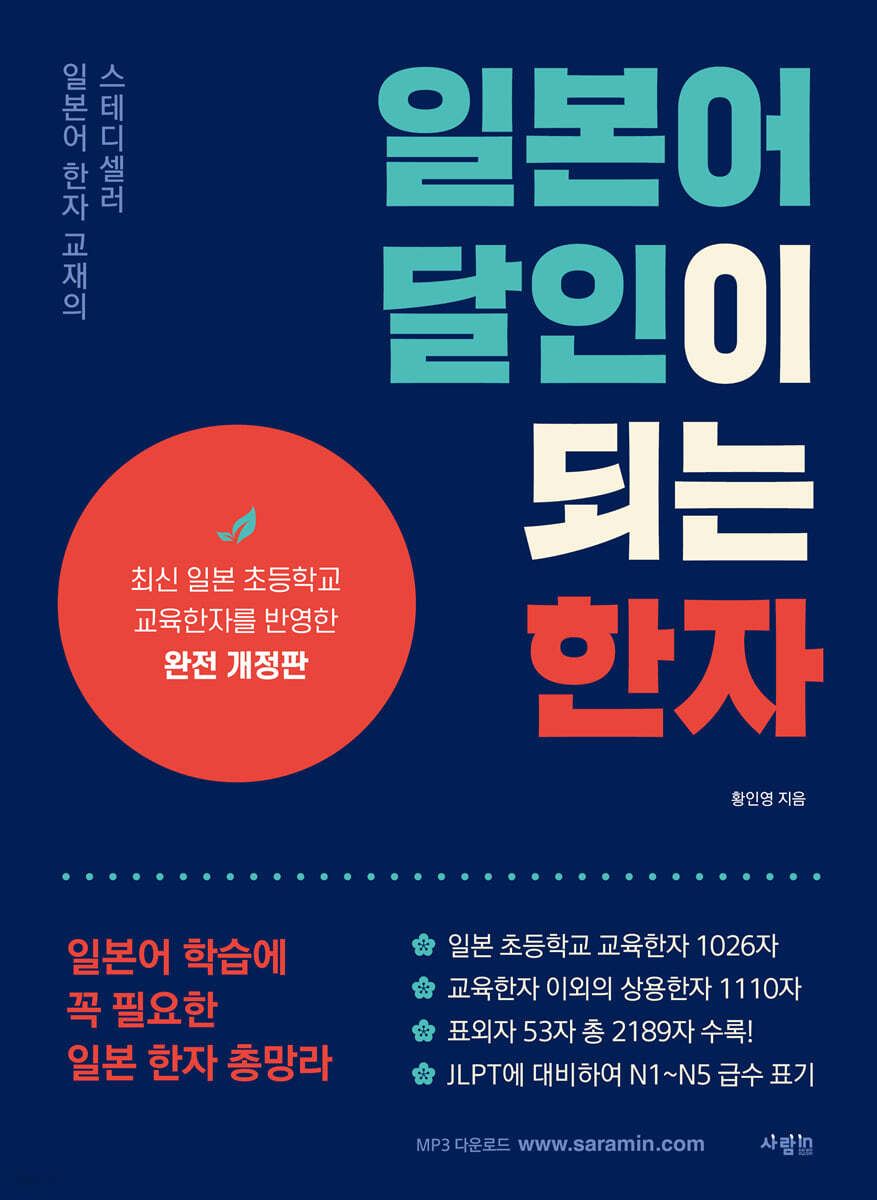
"Kanji to Become a Japanese Master" is the ultimate Japanese kanji study book that perfectly organizes all the kanji necessary for learning Japanese from beginner to advanced levels.
In this completely revised edition, the Ministry of Education, Culture, Sports, Science and Technology announced the "New Commonly Used Kanji Designation Plan," which includes the latest Japanese elementary school educational kanji. Of the 1,945 existing commonly used kanji, five characters were deleted and 196 new characters were added.
Additionally, 2,136 Japanese common kanji characters are arranged into 'educational kanji (1,026 characters),' 'common kanji excluding educational kanji (1,110 characters),' and 'separately permitted non-standard characters (53 characters),' so that learners can learn according to level and stage.
The individual kanji characters in the educational kanji and major commercial kanji sections are marked with levels N1 to N5 for the Japanese Language Proficiency Test (JLPT), allowing you to fully prepare for the test.
"Kanji to Become a Japanese Master" is the ultimate Japanese kanji study book that perfectly organizes all the kanji necessary for learning Japanese from beginner to advanced levels.
In this completely revised edition, the Ministry of Education, Culture, Sports, Science and Technology announced the "New Commonly Used Kanji Designation Plan," which includes the latest Japanese elementary school educational kanji. Of the 1,945 existing commonly used kanji, five characters were deleted and 196 new characters were added.
Additionally, 2,136 Japanese common kanji characters are arranged into 'educational kanji (1,026 characters),' 'common kanji excluding educational kanji (1,110 characters),' and 'separately permitted non-standard characters (53 characters),' so that learners can learn according to level and stage.
The individual kanji characters in the educational kanji and major commercial kanji sections are marked with levels N1 to N5 for the Japanese Language Proficiency Test (JLPT), allowing you to fully prepare for the test.
- You can preview some of the book's contents.
Preview
index
preface
Structure of this book
Study tips
Learning Objectives
Overview of Japanese Kanji
Educational Chinese characters
1st grade (80 characters)
2nd grade (160 characters)
3rd grade (200 characters)
4th grade (202 characters)
5th grade (193 characters)
6th grade (191 characters)
Common Chinese characters other than educational characters
Main commonly used Chinese characters (908 characters)
Additional common Chinese characters (185 characters)
Commonly used Chinese characters (17 characters)
Extra characters (53 characters)
supplement
Similar and easily confused Japanese kanji _ 256
Basic Chinese Characters for Education in Korea _ 263
Keyword Interpretation _ 274
Search _ 302
Structure of this book
Study tips
Learning Objectives
Overview of Japanese Kanji
Educational Chinese characters
1st grade (80 characters)
2nd grade (160 characters)
3rd grade (200 characters)
4th grade (202 characters)
5th grade (193 characters)
6th grade (191 characters)
Common Chinese characters other than educational characters
Main commonly used Chinese characters (908 characters)
Additional common Chinese characters (185 characters)
Commonly used Chinese characters (17 characters)
Extra characters (53 characters)
supplement
Similar and easily confused Japanese kanji _ 256
Basic Chinese Characters for Education in Korea _ 263
Keyword Interpretation _ 274
Search _ 302
Detailed image

Publisher's Review
The most systematic and effective step-by-step Japanese kanji learning method
You can never become a master of Japanese without knowing Japanese kanji.
Because 47% of Japanese components are made up of Chinese characters.
No matter how well you speak, if you can't read kanji, you're no different from an illiterate person, and you won't be able to speak high-level Japanese.
Even among Japanese people, there are many who only read the kanji when reading the newspaper, and the story is that they can understand the meaning just by skimming the kanji.
As such, the importance of kanji in learning Japanese cannot be overstated.
However, it is also true that studying Chinese characters is not easy due to the vast amount of material to learn.
The fully revised edition of "Kanji for Mastering Japanese," which covers all essential Japanese kanji, presents the most systematic and effective learning know-how.
Check the difference between Japanese and Korean kanji.
There is over 90% overlap between the 1,800 basic Chinese characters of our country and the commonly used Chinese characters of Japan.
However, there are quite a few differences in some parts, so they cannot be mixed together indiscriminately.
For readers who unknowingly mix Chinese characters, we present the differences between the Chinese characters of the two countries so that they can be used accurately.
Understand the Korean meaning of Chinese characters and learn the pronunciation and kun reading of Japanese Chinese characters.
It is best to learn Chinese characters by focusing on their pronunciation.
This is because Chinese characters are originally centered on sound reading, and if you focus on the various reading methods, you will not be able to make any progress.
Check the difference between Gothic and cursive (textbook) fonts and practice writing Chinese characters.
The Chinese characters in the text are written in two fonts: ‘Gothic’ and ‘Cursive (Textbook)’.
Japanese kanji differs in its Gothic and cursive forms, but recently, Gothic has been increasingly used in general publications, including newspapers and magazines.
However, the Japanese Ministry of Education uses cursive writing as a standard font for school education and teaches kanji.
Practice writing cleanly and accurately according to the stroke order based on the textbook font presented in this book.
Another effective method is to purchase a Chinese character notebook and practice.
Learn the cultural background of vocabulary naturally through various texts and pictures.
Vocabulary is created against the backdrop of that country's culture.
With that in mind, we've included plenty of explanations and photos to help you understand Japanese culture through example words.
You can never become a master of Japanese without knowing Japanese kanji.
Because 47% of Japanese components are made up of Chinese characters.
No matter how well you speak, if you can't read kanji, you're no different from an illiterate person, and you won't be able to speak high-level Japanese.
Even among Japanese people, there are many who only read the kanji when reading the newspaper, and the story is that they can understand the meaning just by skimming the kanji.
As such, the importance of kanji in learning Japanese cannot be overstated.
However, it is also true that studying Chinese characters is not easy due to the vast amount of material to learn.
The fully revised edition of "Kanji for Mastering Japanese," which covers all essential Japanese kanji, presents the most systematic and effective learning know-how.
Check the difference between Japanese and Korean kanji.
There is over 90% overlap between the 1,800 basic Chinese characters of our country and the commonly used Chinese characters of Japan.
However, there are quite a few differences in some parts, so they cannot be mixed together indiscriminately.
For readers who unknowingly mix Chinese characters, we present the differences between the Chinese characters of the two countries so that they can be used accurately.
Understand the Korean meaning of Chinese characters and learn the pronunciation and kun reading of Japanese Chinese characters.
It is best to learn Chinese characters by focusing on their pronunciation.
This is because Chinese characters are originally centered on sound reading, and if you focus on the various reading methods, you will not be able to make any progress.
Check the difference between Gothic and cursive (textbook) fonts and practice writing Chinese characters.
The Chinese characters in the text are written in two fonts: ‘Gothic’ and ‘Cursive (Textbook)’.
Japanese kanji differs in its Gothic and cursive forms, but recently, Gothic has been increasingly used in general publications, including newspapers and magazines.
However, the Japanese Ministry of Education uses cursive writing as a standard font for school education and teaches kanji.
Practice writing cleanly and accurately according to the stroke order based on the textbook font presented in this book.
Another effective method is to purchase a Chinese character notebook and practice.
Learn the cultural background of vocabulary naturally through various texts and pictures.
Vocabulary is created against the backdrop of that country's culture.
With that in mind, we've included plenty of explanations and photos to help you understand Japanese culture through example words.
GOODS SPECIFICS
- Date of issue: July 15, 2024
- Page count, weight, size: 312 pages | 744g | 188*257*15mm
- ISBN13: 9791171010905
- ISBN10: 1171010907
You may also like
카테고리
korean


korean

![GQ KOREA Mark (Monthly): December [2025]](http://librairie.coreenne.fr/cdn/shop/files/8ef265dbbfbf186523ed75ba7319009d.jpg?v=1765340328&width=3840)


