

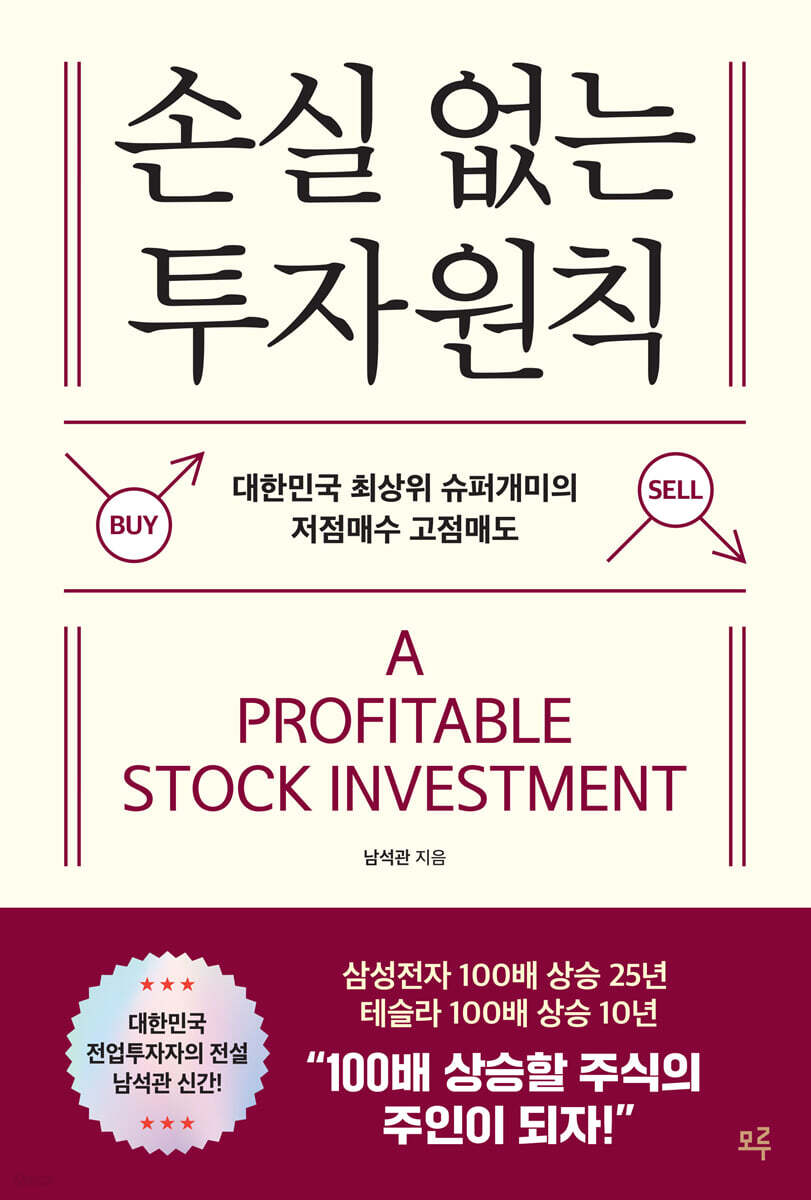
No-loss investment principles
 |
Description
Book Introduction
A new book by Nam Seok-kwan, known as the 'Legend of Professional Investors'! This is the third book by author Nam Seok-gwan, a legend among professional investors in Korea and a top super ant who has been investing in stocks for a whopping 37 years, including 23 years as a professional investor. While the previous book, "Stock Investment: A Lifetime of Wealth," focused on establishing a stock investment mindset, the new book, "Investment Principles Without Losses," focuses on how to minimize losses and generate profits in the stock market, and on the author's stock investment know-how. The author, who has achieved enormous profits every year regardless of market conditions, has become a role model for all stock investors. He shares with readers advice on buying low and selling high, trading strategies for mid- to long-term and short-term investments, and his long-term experience and insights in the stock market, without exaggeration or exaggeration. |
- You can preview some of the book's contents.
Preview
index
Introduction
PART 1
Two Ways to Grow Your Wealth Through Stock Investment
CHAPTER 1 Dividends
1.
Definition of dividend
Stock Investment Tips for Getting Rich Part 1: Understanding Activist Funds
2.
Types of dividends
Stock Investment Tips for Getting Rich Part 2: Did Dividends Create the Stock Market?
3.
Dividend record date
4.
Dividend Stock Investment Strategy
5.
Is Warren Buffett Pro-Dividend or Anti-Dividend? (Feat. Warren Buffett)
CHAPTER 2 Market profit
1.
Definition and Understanding of Market Arbitrage
Stock Investment Tips for Getting Rich ③ (Profit Structure of Short Selling, Futures Selling, and Put Options)
2.
small price difference
3.
large price difference [large price difference]
Stock Investment Tips for Getting Rich ④ "Don't Be Ashamed of Failure, But Don't Repeat It!"
PART 2
Preparing for Big Profits (Looking at the Market)
CHAPTER 1: OVERVIEWING THE MARKET SITUATION (MARKET ANALYSIS)
1.
Why you need to know the market situation
2.
The basics of understanding the market: interest rates
3.
Stock investment during interest rate hikes
4.
Stock investment during interest rate cuts
CHAPTER 2 Examining Individual Companies (Fundamental Analysis)
1. Everything is in the company's financial statements.
Stock Investment Tips for Getting Rich ⑤ "The Impact of Convertible Bonds and Bonds with Warrants on Stock Prices"
2.
Essential indicators for examining individual companies
Stock Investment Tips for Getting Rich Part 6: What Do You Think About Value Investing?
CHAPTER 3 Examining Charts (Technical Analysis)
1.
Chart basics (resistance lines, support lines, trend lines, breakouts)
2.
moving average
3.
The golden cross, the starting point of a major market surge, and the dead cross, a harbinger of a crash.
4.
Limitations of technical analysis
PART 3
The art of medium- to long-term investment trading
CHAPTER 1
Types of stock markets
1.
bear market (sudden decline)
2.
rebound after confirming the bottom
3.
Sideways (box rights)
4.
bull market
CHAPTER 2 Stock Purchases in Mid- to Long-Term Investments
1.
Determining the right time to buy
2.
Stock selection for mid- to long-term investment
3.
Chasing Buying Method When You Miss a Low Price
CHAPTER 3: Selling Stocks in Mid- to Long-Term Investments
1.
Maximizing returns on mid- to long-term investments
2.
Fantastic sell-off in mid- to long-term investing
3.
Long-term investment isn't the answer.
CHAPTER 4: Investing in Stocks in a Bear Market (How to Respond)
1.
There is no stock that beats the index.
2.
Securing cash is a survival strategy
3.
Waiting for the next opportunity is also an investment
PART 4
Making money with short-term investments (getting rich)
CHAPTER 1 Understanding Short-Term Investments
1.
The temptation of short-term investing
2.
Transaction costs greater than revenue
3.
Advantages of short-term investing
Stock Investment Tips for Getting Rich Part 7: "Real Investment Competition: Finding Your Lost Short-Term Investing Sense"
CHAPTER 2 Elements Necessary for Short-Term Investment
1.
Investment mindset required for short-term investment
2.
Short-term investments that anyone can do but have a low probability of success
3.
Preliminary checks required for short-term investment
CHAPTER 3 Short-Term Investment Trading Methods
1.
Finding Stocks for Short-Term Investments
2.
Buying in short-term investment
3.
Selling in short-term investment
Stock Investment Tips for Getting Rich ⑧: Understanding the Market Alert System
4.
Don't be foolish
CHAPTER 4 The Risks of Short-Term Investments
1.
Risks of rising and falling stocks
2.
Be sure to check the market situation (trend)
3.
Stocks you shouldn't pay attention to
Stock Investment Tips for Getting Rich Part 10: How to Check a Company's Unpaid CBs and BWs
CHAPTER 5 Investing in Thematic Stocks (Related Stocks)
1.
Types of theme stocks (related stocks)
Stock Investment Tips for Getting Rich Part 11: "Distinction between Mid- to Long-Term Themes"
2.
Theme Stock (Related Stock) Trading Method
3.
Theme stock: Flower does not bloom for ten days, stock (柱式) impermanence
PART 5
Stock investment that creates a large price difference (large price difference)
Types of stocks that generate CHAPTRT 1 price
1.
Pioneer of a new era, a central player in the new era (new industrial revolution)
2.
Sector-focused stocks following industrial transformation
3.
From internal combustion engine vehicles to electric vehicles
Stock Investment Tips for Becoming Rich ⑫ 〈Changes in lifestyle, health, and consumption due to rising income are also a trend of the times!〉
4.
Market-driven stocks based on issues and themes
CHAPTER 2 Trading Stocks That Create Trends
1.
Early purchase of stocks with high prices
2.
Selling stocks that are showing a high price
Stock Investment Tips for Getting Rich Part 13: "The 'Delayed Reaction Effect of Information': A Key That Can Never Be Overemphasized"
3.
Classification and reorganization of stocks that showed significant price increases
PART 6
The final piece of the puzzle to making money through stock investing
CHAPTER 1: Wrong Buying Leads to Loss
1.
Buy when the price is high
2.
Buying the bottom (entering the basement)
Stock Investment Tips for Getting Rich Part 14: The Main Causes of Stock Price Declines
CHAPTER 2 Don't Hesitate or Fear 'Cutting Off'
Create and maintain a minus 5% loss-cutting rate rule.
CHAPTER 3 Stocks Engaged in Unfair Practices Also Get a Blast
Scammers Preying on Honest Investors
CHAPTER 4: US MEME Stocks and Korea's FOMO Syndrome
1.
MEME stocks
2.
FOME syndrome
Stock Investment Tips for Getting Rich Part 15: Is an Algorithm Behind the Plunge in Superconductor Stock Prices?
Outgoing post
PART 1
Two Ways to Grow Your Wealth Through Stock Investment
CHAPTER 1 Dividends
1.
Definition of dividend
Stock Investment Tips for Getting Rich Part 1: Understanding Activist Funds
2.
Types of dividends
Stock Investment Tips for Getting Rich Part 2: Did Dividends Create the Stock Market?
3.
Dividend record date
4.
Dividend Stock Investment Strategy
5.
Is Warren Buffett Pro-Dividend or Anti-Dividend? (Feat. Warren Buffett)
CHAPTER 2 Market profit
1.
Definition and Understanding of Market Arbitrage
Stock Investment Tips for Getting Rich ③ (Profit Structure of Short Selling, Futures Selling, and Put Options)
2.
small price difference
3.
large price difference [large price difference]
Stock Investment Tips for Getting Rich ④ "Don't Be Ashamed of Failure, But Don't Repeat It!"
PART 2
Preparing for Big Profits (Looking at the Market)
CHAPTER 1: OVERVIEWING THE MARKET SITUATION (MARKET ANALYSIS)
1.
Why you need to know the market situation
2.
The basics of understanding the market: interest rates
3.
Stock investment during interest rate hikes
4.
Stock investment during interest rate cuts
CHAPTER 2 Examining Individual Companies (Fundamental Analysis)
1. Everything is in the company's financial statements.
Stock Investment Tips for Getting Rich ⑤ "The Impact of Convertible Bonds and Bonds with Warrants on Stock Prices"
2.
Essential indicators for examining individual companies
Stock Investment Tips for Getting Rich Part 6: What Do You Think About Value Investing?
CHAPTER 3 Examining Charts (Technical Analysis)
1.
Chart basics (resistance lines, support lines, trend lines, breakouts)
2.
moving average
3.
The golden cross, the starting point of a major market surge, and the dead cross, a harbinger of a crash.
4.
Limitations of technical analysis
PART 3
The art of medium- to long-term investment trading
CHAPTER 1
Types of stock markets
1.
bear market (sudden decline)
2.
rebound after confirming the bottom
3.
Sideways (box rights)
4.
bull market
CHAPTER 2 Stock Purchases in Mid- to Long-Term Investments
1.
Determining the right time to buy
2.
Stock selection for mid- to long-term investment
3.
Chasing Buying Method When You Miss a Low Price
CHAPTER 3: Selling Stocks in Mid- to Long-Term Investments
1.
Maximizing returns on mid- to long-term investments
2.
Fantastic sell-off in mid- to long-term investing
3.
Long-term investment isn't the answer.
CHAPTER 4: Investing in Stocks in a Bear Market (How to Respond)
1.
There is no stock that beats the index.
2.
Securing cash is a survival strategy
3.
Waiting for the next opportunity is also an investment
PART 4
Making money with short-term investments (getting rich)
CHAPTER 1 Understanding Short-Term Investments
1.
The temptation of short-term investing
2.
Transaction costs greater than revenue
3.
Advantages of short-term investing
Stock Investment Tips for Getting Rich Part 7: "Real Investment Competition: Finding Your Lost Short-Term Investing Sense"
CHAPTER 2 Elements Necessary for Short-Term Investment
1.
Investment mindset required for short-term investment
2.
Short-term investments that anyone can do but have a low probability of success
3.
Preliminary checks required for short-term investment
CHAPTER 3 Short-Term Investment Trading Methods
1.
Finding Stocks for Short-Term Investments
2.
Buying in short-term investment
3.
Selling in short-term investment
Stock Investment Tips for Getting Rich ⑧: Understanding the Market Alert System
4.
Don't be foolish
CHAPTER 4 The Risks of Short-Term Investments
1.
Risks of rising and falling stocks
2.
Be sure to check the market situation (trend)
3.
Stocks you shouldn't pay attention to
Stock Investment Tips for Getting Rich Part 10: How to Check a Company's Unpaid CBs and BWs
CHAPTER 5 Investing in Thematic Stocks (Related Stocks)
1.
Types of theme stocks (related stocks)
Stock Investment Tips for Getting Rich Part 11: "Distinction between Mid- to Long-Term Themes"
2.
Theme Stock (Related Stock) Trading Method
3.
Theme stock: Flower does not bloom for ten days, stock (柱式) impermanence
PART 5
Stock investment that creates a large price difference (large price difference)
Types of stocks that generate CHAPTRT 1 price
1.
Pioneer of a new era, a central player in the new era (new industrial revolution)
2.
Sector-focused stocks following industrial transformation
3.
From internal combustion engine vehicles to electric vehicles
Stock Investment Tips for Becoming Rich ⑫ 〈Changes in lifestyle, health, and consumption due to rising income are also a trend of the times!〉
4.
Market-driven stocks based on issues and themes
CHAPTER 2 Trading Stocks That Create Trends
1.
Early purchase of stocks with high prices
2.
Selling stocks that are showing a high price
Stock Investment Tips for Getting Rich Part 13: "The 'Delayed Reaction Effect of Information': A Key That Can Never Be Overemphasized"
3.
Classification and reorganization of stocks that showed significant price increases
PART 6
The final piece of the puzzle to making money through stock investing
CHAPTER 1: Wrong Buying Leads to Loss
1.
Buy when the price is high
2.
Buying the bottom (entering the basement)
Stock Investment Tips for Getting Rich Part 14: The Main Causes of Stock Price Declines
CHAPTER 2 Don't Hesitate or Fear 'Cutting Off'
Create and maintain a minus 5% loss-cutting rate rule.
CHAPTER 3 Stocks Engaged in Unfair Practices Also Get a Blast
Scammers Preying on Honest Investors
CHAPTER 4: US MEME Stocks and Korea's FOMO Syndrome
1.
MEME stocks
2.
FOME syndrome
Stock Investment Tips for Getting Rich Part 15: Is an Algorithm Behind the Plunge in Superconductor Stock Prices?
Outgoing post
Detailed image

Into the book
It wasn't easy to explain in writing the trading method that I have been accustomed to for a long time and that I sometimes respond to intuitively.
You have no choice but to read it over and over again and apply it to your investments to create your own investment method with a high probability of success.
I hope you have the confidence that you too can make big profits and see great market prices by learning and practicing proper stock investment methods.
The world is changing rapidly.
The stock market is where all of this change is reflected.
Discussing value investing or growth investing has become a cliché in the stock market.
Since the 2020 coronavirus pandemic, many new investors have entered the stock market.
It is a world where it is difficult to live a happy life with just labor income.
Of course, money isn't everything in life, but if you don't have enough money, your quality of life will inevitably decline.
Nowadays, investing has become a daily routine and a central topic of conversation for people of all ages and genders.
I think more people will become interested in stock investment in the future.
In this way, investment behavior is also essential for adapting to and surviving in the capitalist system.
---From "Introductory Remarks"
There are risks to keep in mind when investing in dividend stocks.
If an investor invests in a stock expecting a dividend payment at the end of the year, but the market conditions and atmosphere are not favorable for investors, the stock price may plummet, resulting in a loss.
This is a very common occurrence.
At this time, as the dividend record date approaches, investors cannot help but worry about whether to sell or hold their stocks.
Holding stocks to collect dividend income may be advantageous, but conversely, if the market sentiment is unfavorable and stock prices are expected to fall significantly, the loss from holding stocks may be greater than the dividend income.
Therefore, when investing with the expectation of dividend income, you should keep in mind that the loss due to a decline in stock price may be much greater than the dividend income.
This judgment is the most important in dividend stock investment.
Samsung Electronics' stock price at the end of 2021 is a good reference case.
Samsung Electronics' closing price at the year-end dividend on December 28, 2021 was 80,200 won.
And the opening price on the ex-dividend date, December 29, was 80,100 won.
Since then, the year has changed, and throughout 2022, Samsung Electronics' stock price has shown a steady decline.
And in the second half of 2022, the stock price fell to the 52,000 won range, a significant drop from the early 80,000 won range a year ago.
It has never recovered to the closing price of 80,000 won on the dividend reference date in 2021.
As of August 2023, it is still hovering around the late 60,000 won to early 70,000 won range.
---From "Dividend Stock Investment Strategy"
If you want to buy a stock, but the price is too high, it is difficult to expect capital gains.
Even if you expect to make a profit, there is a greater chance of incurring a loss.
Therefore, it is important to buy stocks when the price is as cheap as possible.
So how do I determine whether the stock I want to buy is overpriced or underpriced? This is closely related to timing the purchase.
Determining the right time to buy is very, very important in stock investing.
There are several criteria and factors that investors consider when evaluating whether the stock price of a stock they wish to purchase is appropriate.
Naturally, each investor has different criteria for judgment, and the reference materials and weightings are bound to be different.
And it is important to note that the materials each person references are bound to be very different.
However, there are three data points that many investors, including myself, use most to judge stock prices.
It may be a well-known, perhaps even unremarkable criterion.
① Overall market analysis (KOSPI, KOSDAQ, etc.)
② Fundamental analysis (individual stock financial statement analysis, etc.)
③ Technical analysis (individual stock chart analysis, etc.)
The reason for checking whether the stock price is appropriate is to buy the stock at a low price.
Strictly speaking, we analyze data to determine the optimal buying timing.
Therefore, a detailed explanation of the three items above will be provided later in CHAPTER 2, 'Preparing to Make Big Price Gains'.
I also plan to share my real-world investment experience and know-how to help you profit from price fluctuations (I'm sure many of you are curious about that story).
---From “Definition and Understanding of Price Difference”
In Korea, the KOSPI index finally rose to 3,300 points around June 2021, but the market soon turned downward due to the aftermath of interest rate hikes in the United States.
And in October 2022, just over a year later, the index fell significantly to 2,150 points.
This is a 35% drop from the KOSPI index's peak of 3,300 points in June 2021.
The reason stock prices continued to fall and the bottom was unpredictable was because no one knew the duration and intensity of the US interest rate hikes.
These are things you only know after the fact.
The first interest rate hike in the United States since the coronavirus pandemic occurred in 2021.
Initially, it was at the 0.25% level, but as inflation failed to be controlled, it was raised by 0.75 percentage points four times in 2022.
These measures rapidly reduced the liquidity that had been flooding the market, and the stock market was forced to continue its decline.
And as the US interest rate hike reached its final stage, stock prices hit bottom and began to rebound. When the KOSPI index in Korea and the NASDAQ index in the US technically occur a dead cross*, you should stop new purchases and wait and see until the index hits its 'bottom'.
And no matter how much you want to place a buy order, it is a wise investment strategy to boldly take a break from investing.
In the rebound section after confirming the bottom, the rebound occurs first in the sector with performance.
In the Korean stock market, secondary battery stocks and automobile stocks such as Kia (00270) showed the biggest rebound.
---From "Stock Investment During a Period of Interest Rate Hikes"
While CB and BW issuances certainly have their positive aspects, they mostly send negative signals to the market (increased stock supply leads to a decline in stock prices).
Therefore, it is crucial to understand the real purpose of a company issuing CBs and BWs and the reasons for raising funds.
All of that information is included in the company's public disclosure.
Before investing, it is important to understand the purpose of the company's CB or BW issuance, the conversion claim period, and the date. If the company intends to use the funds to expand or build a factory to produce new products, this will naturally be positive news. However, if the company needs the money to cover operating expenses or repay debt, this will be negative news.
However, it is true that companies that frequently issue CB and BW are inherently reluctant to invest.
---From "The Impact of CB (Convertible Bonds) and BW (Bonds with Warrants) on Stock Prices"
There are three things you must remember when buying short-term investments.
I will introduce the contents one by one.
First, the most important prerequisite for buying in short-term investment is the market atmosphere of KOSPI and KOSDAQ.
This is only possible when the market atmosphere is favorable.
This method cannot be applied if the overall market sentiment is plummeting or in a bear market.
So, under the premise that the market atmosphere is favorable, in short-term investments including trading, if a stock that has been moving sideways and then forms a long bullish candlestick (pole) for the first time catches my eye, I unconditionally buy it.
Most stocks that do not show much volatility but then gradually rise with a slight increase in trading volume are bought by those who have access to positive information or news.
The author just said, 'You should always buy stocks that have been moving sideways and then make a long bullish candlestick on the same day.'
But here too, there is a condition.
You can buy if the daily increase rate is around 10%.
However, if the rate of increase exceeds 15%, you should be cautious about buying.
If you bought a stock that rose more than 15%, you need to check the chart after buying.
And we need to find out the real reason why the stock price went up.
If you believe that the news or issue related to the stock is strong, it is a good idea to wait for it to rise to the upper limit.
But what if the stock fails to close at the upper limit after rising by more than 20%? In this case, I'd monitor the situation closely and, if it fails to reach the upper limit after 2 p.m., I'd sell without hesitation.
In summary, even if a stock has risen significantly by more than 20%, if there are strong issues, news, or positive factors, we wait until the upper limit.
The prerequisite to remember here is that 'buy when the rate of increase is in the 10% range and the news and issues appear strong.'
---From "Purchasing in Short-Term Investment"
Depending on the type of thematic stock, the buying and selling methods are slightly different.
The basic principle of theme stock trading is to buy when an issue arises and sell before the issue disappears.
Of course, when investing in theme stocks, you should focus on purchasing major stocks and top-tier stocks.
The key to purchasing a stock targeted at a theme is to check whether it is directly related to the theme issue.
Long-term theme stocks, such as coronavirus or presidential election theme stocks, are often the leading stocks in the theme stocks that initially show a sharp rise thanks to large trading volume.
However, it is common for the leading stocks of long-running theme stocks (related stocks) to change.
Typically, when the leading stock or the number one stock in a theme stock stops rising and falls, the number two or number three stocks tend to plummet.
Please note that it is very difficult to respond to one-time or short-term thematic stocks.
So, it is better to ignore it as much as possible.
A representative example is the urea crisis that occurred in 2021.
The element water theme is an example of a theme that only lasted a short time and disappeared from investors' interest in just a few days.
And you may remember the salt-related stock Insanga (277410) that surged as a theme stock for several days in June 2023, fueled by concerns about the release of contaminated water from Fukushima.
You have no choice but to read it over and over again and apply it to your investments to create your own investment method with a high probability of success.
I hope you have the confidence that you too can make big profits and see great market prices by learning and practicing proper stock investment methods.
The world is changing rapidly.
The stock market is where all of this change is reflected.
Discussing value investing or growth investing has become a cliché in the stock market.
Since the 2020 coronavirus pandemic, many new investors have entered the stock market.
It is a world where it is difficult to live a happy life with just labor income.
Of course, money isn't everything in life, but if you don't have enough money, your quality of life will inevitably decline.
Nowadays, investing has become a daily routine and a central topic of conversation for people of all ages and genders.
I think more people will become interested in stock investment in the future.
In this way, investment behavior is also essential for adapting to and surviving in the capitalist system.
---From "Introductory Remarks"
There are risks to keep in mind when investing in dividend stocks.
If an investor invests in a stock expecting a dividend payment at the end of the year, but the market conditions and atmosphere are not favorable for investors, the stock price may plummet, resulting in a loss.
This is a very common occurrence.
At this time, as the dividend record date approaches, investors cannot help but worry about whether to sell or hold their stocks.
Holding stocks to collect dividend income may be advantageous, but conversely, if the market sentiment is unfavorable and stock prices are expected to fall significantly, the loss from holding stocks may be greater than the dividend income.
Therefore, when investing with the expectation of dividend income, you should keep in mind that the loss due to a decline in stock price may be much greater than the dividend income.
This judgment is the most important in dividend stock investment.
Samsung Electronics' stock price at the end of 2021 is a good reference case.
Samsung Electronics' closing price at the year-end dividend on December 28, 2021 was 80,200 won.
And the opening price on the ex-dividend date, December 29, was 80,100 won.
Since then, the year has changed, and throughout 2022, Samsung Electronics' stock price has shown a steady decline.
And in the second half of 2022, the stock price fell to the 52,000 won range, a significant drop from the early 80,000 won range a year ago.
It has never recovered to the closing price of 80,000 won on the dividend reference date in 2021.
As of August 2023, it is still hovering around the late 60,000 won to early 70,000 won range.
---From "Dividend Stock Investment Strategy"
If you want to buy a stock, but the price is too high, it is difficult to expect capital gains.
Even if you expect to make a profit, there is a greater chance of incurring a loss.
Therefore, it is important to buy stocks when the price is as cheap as possible.
So how do I determine whether the stock I want to buy is overpriced or underpriced? This is closely related to timing the purchase.
Determining the right time to buy is very, very important in stock investing.
There are several criteria and factors that investors consider when evaluating whether the stock price of a stock they wish to purchase is appropriate.
Naturally, each investor has different criteria for judgment, and the reference materials and weightings are bound to be different.
And it is important to note that the materials each person references are bound to be very different.
However, there are three data points that many investors, including myself, use most to judge stock prices.
It may be a well-known, perhaps even unremarkable criterion.
① Overall market analysis (KOSPI, KOSDAQ, etc.)
② Fundamental analysis (individual stock financial statement analysis, etc.)
③ Technical analysis (individual stock chart analysis, etc.)
The reason for checking whether the stock price is appropriate is to buy the stock at a low price.
Strictly speaking, we analyze data to determine the optimal buying timing.
Therefore, a detailed explanation of the three items above will be provided later in CHAPTER 2, 'Preparing to Make Big Price Gains'.
I also plan to share my real-world investment experience and know-how to help you profit from price fluctuations (I'm sure many of you are curious about that story).
---From “Definition and Understanding of Price Difference”
In Korea, the KOSPI index finally rose to 3,300 points around June 2021, but the market soon turned downward due to the aftermath of interest rate hikes in the United States.
And in October 2022, just over a year later, the index fell significantly to 2,150 points.
This is a 35% drop from the KOSPI index's peak of 3,300 points in June 2021.
The reason stock prices continued to fall and the bottom was unpredictable was because no one knew the duration and intensity of the US interest rate hikes.
These are things you only know after the fact.
The first interest rate hike in the United States since the coronavirus pandemic occurred in 2021.
Initially, it was at the 0.25% level, but as inflation failed to be controlled, it was raised by 0.75 percentage points four times in 2022.
These measures rapidly reduced the liquidity that had been flooding the market, and the stock market was forced to continue its decline.
And as the US interest rate hike reached its final stage, stock prices hit bottom and began to rebound. When the KOSPI index in Korea and the NASDAQ index in the US technically occur a dead cross*, you should stop new purchases and wait and see until the index hits its 'bottom'.
And no matter how much you want to place a buy order, it is a wise investment strategy to boldly take a break from investing.
In the rebound section after confirming the bottom, the rebound occurs first in the sector with performance.
In the Korean stock market, secondary battery stocks and automobile stocks such as Kia (00270) showed the biggest rebound.
---From "Stock Investment During a Period of Interest Rate Hikes"
While CB and BW issuances certainly have their positive aspects, they mostly send negative signals to the market (increased stock supply leads to a decline in stock prices).
Therefore, it is crucial to understand the real purpose of a company issuing CBs and BWs and the reasons for raising funds.
All of that information is included in the company's public disclosure.
Before investing, it is important to understand the purpose of the company's CB or BW issuance, the conversion claim period, and the date. If the company intends to use the funds to expand or build a factory to produce new products, this will naturally be positive news. However, if the company needs the money to cover operating expenses or repay debt, this will be negative news.
However, it is true that companies that frequently issue CB and BW are inherently reluctant to invest.
---From "The Impact of CB (Convertible Bonds) and BW (Bonds with Warrants) on Stock Prices"
There are three things you must remember when buying short-term investments.
I will introduce the contents one by one.
First, the most important prerequisite for buying in short-term investment is the market atmosphere of KOSPI and KOSDAQ.
This is only possible when the market atmosphere is favorable.
This method cannot be applied if the overall market sentiment is plummeting or in a bear market.
So, under the premise that the market atmosphere is favorable, in short-term investments including trading, if a stock that has been moving sideways and then forms a long bullish candlestick (pole) for the first time catches my eye, I unconditionally buy it.
Most stocks that do not show much volatility but then gradually rise with a slight increase in trading volume are bought by those who have access to positive information or news.
The author just said, 'You should always buy stocks that have been moving sideways and then make a long bullish candlestick on the same day.'
But here too, there is a condition.
You can buy if the daily increase rate is around 10%.
However, if the rate of increase exceeds 15%, you should be cautious about buying.
If you bought a stock that rose more than 15%, you need to check the chart after buying.
And we need to find out the real reason why the stock price went up.
If you believe that the news or issue related to the stock is strong, it is a good idea to wait for it to rise to the upper limit.
But what if the stock fails to close at the upper limit after rising by more than 20%? In this case, I'd monitor the situation closely and, if it fails to reach the upper limit after 2 p.m., I'd sell without hesitation.
In summary, even if a stock has risen significantly by more than 20%, if there are strong issues, news, or positive factors, we wait until the upper limit.
The prerequisite to remember here is that 'buy when the rate of increase is in the 10% range and the news and issues appear strong.'
---From "Purchasing in Short-Term Investment"
Depending on the type of thematic stock, the buying and selling methods are slightly different.
The basic principle of theme stock trading is to buy when an issue arises and sell before the issue disappears.
Of course, when investing in theme stocks, you should focus on purchasing major stocks and top-tier stocks.
The key to purchasing a stock targeted at a theme is to check whether it is directly related to the theme issue.
Long-term theme stocks, such as coronavirus or presidential election theme stocks, are often the leading stocks in the theme stocks that initially show a sharp rise thanks to large trading volume.
However, it is common for the leading stocks of long-running theme stocks (related stocks) to change.
Typically, when the leading stock or the number one stock in a theme stock stops rising and falls, the number two or number three stocks tend to plummet.
Please note that it is very difficult to respond to one-time or short-term thematic stocks.
So, it is better to ignore it as much as possible.
A representative example is the urea crisis that occurred in 2021.
The element water theme is an example of a theme that only lasted a short time and disappeared from investors' interest in just a few days.
And you may remember the salt-related stock Insanga (277410) that surged as a theme stock for several days in June 2023, fueled by concerns about the release of contaminated water from Fukushima.
---From "Theme Stock Trading Method"
Publisher's Review
If we compare it to the stock market, it is very similar to looking into the market.
This is because the psychology, thoughts, and greed of all investors participating in the market come together to create a myriad of different situations.
Investing in stocks seems like something everyone knows, but not everyone understands it. It looks easy, but it's actually difficult when you actually try it.
Investing in stocks is a confusing, complex, and vague business.
Ultimately, is stock investing a game where profits only come when a strong individual with a strong stomach is struck by great luck? What are the author's unique investment methods, his secrets, that have generated profits that surpass the average person's imagination year after year in this by no means easy market? People are curious to hear the story.
This book is a highly reliable source of stock investment advice for readers with such questions and curiosity.
The author's story, often called the legend of professional investors in Korea, may not be the perfect answer or absolute standard for making money through stock investment, but it will at least help prevent people from losing their precious investment funds and going bankrupt due to speculation rather than investment.
Furthermore, the author's trading methods and investment advice, acquired through his long experience as a full-time investor, are statistically and probabilistically significant.
You can learn from the author the commonly-cited "investing with your own principles and standards," and apply it to your own stock investments.
As the title of the book suggests, the "No Loss Investment Principle" may be easy to say, but difficult to implement.
However, the author's rich and diverse stock investment experience, his market trends based on nearly 40 years of observation, and his trading strategies that must change depending on the situation or conditions are worth learning and following.
Of course, there is no set answer to making a profit from stock investment, and there are many ways to make a profit from stock investment.
Even when investing in the same stock, returns can vary greatly depending on the investor's tendencies, investment size, market view, and response.
Even so, I hope that by referring to the stories of authoritative sources and reviewing and revising your own trading methods, you will increase your chances of profit.
This is because the psychology, thoughts, and greed of all investors participating in the market come together to create a myriad of different situations.
Investing in stocks seems like something everyone knows, but not everyone understands it. It looks easy, but it's actually difficult when you actually try it.
Investing in stocks is a confusing, complex, and vague business.
Ultimately, is stock investing a game where profits only come when a strong individual with a strong stomach is struck by great luck? What are the author's unique investment methods, his secrets, that have generated profits that surpass the average person's imagination year after year in this by no means easy market? People are curious to hear the story.
This book is a highly reliable source of stock investment advice for readers with such questions and curiosity.
The author's story, often called the legend of professional investors in Korea, may not be the perfect answer or absolute standard for making money through stock investment, but it will at least help prevent people from losing their precious investment funds and going bankrupt due to speculation rather than investment.
Furthermore, the author's trading methods and investment advice, acquired through his long experience as a full-time investor, are statistically and probabilistically significant.
You can learn from the author the commonly-cited "investing with your own principles and standards," and apply it to your own stock investments.
As the title of the book suggests, the "No Loss Investment Principle" may be easy to say, but difficult to implement.
However, the author's rich and diverse stock investment experience, his market trends based on nearly 40 years of observation, and his trading strategies that must change depending on the situation or conditions are worth learning and following.
Of course, there is no set answer to making a profit from stock investment, and there are many ways to make a profit from stock investment.
Even when investing in the same stock, returns can vary greatly depending on the investor's tendencies, investment size, market view, and response.
Even so, I hope that by referring to the stories of authoritative sources and reviewing and revising your own trading methods, you will increase your chances of profit.
GOODS SPECIFICS
- Date of issue: October 30, 2023
- Page count, weight, size: 280 pages | 434g | 152*225*17mm
- ISBN13: 9791198207777
- ISBN10: 1198207779
You may also like
카테고리
korean


korean

![ELLE 엘르 스페셜 에디션 A형 : 12월 [2025]](http://librairie.coreenne.fr/cdn/shop/files/b8e27a3de6c9538896439686c6b0e8fb.jpg?v=1766436872&width=3840)


