

Complete Japanese Imitation Guide
 |
Description
Book Introduction
Even if you don't know hiragana,
Even without memorizing grammar,
If you just follow along, you'll be able to speak.
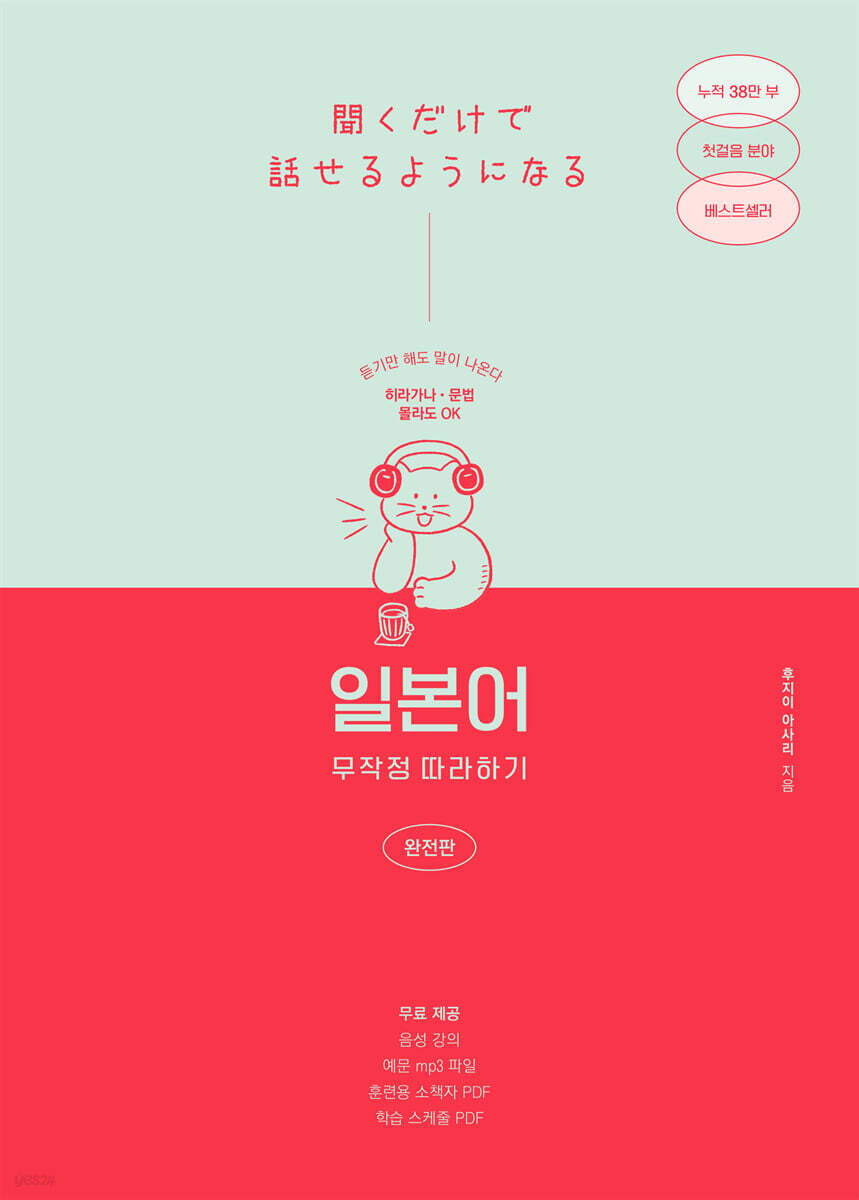
"Just Follow Japanese," which has been a Japanese bestseller and steady seller for 18 years and has been loved by 380,000 readers, is now presented in its complete form by combining with "Just Follow Japanese Advanced Edition."
Since its first publication in 2004, "Just Follow Japanese" has been so well-received that it has been called a "generational shift in Japanese language textbooks." It is still widely supported as a first step textbook with a unique style.
《Just Follow Japanese》 proposes a 'sound pattern learning method' that starts with listening, breaking away from the typical Japanese learning method of memorizing hiragana.
'Open your ears first, and when your ears are open, your mouth will open, and your eyes will open too.' This is the core of the sound pattern learning method.
For 18 years, this book has been the best in the Japanese language field, and the effectiveness of this learning method has been proven through word-of-mouth from readers who studied with it and reviews on online bookstores.
It provides systematic learning through step-by-step structure that maximizes the effectiveness of learning sound patterns, and provides various services such as MP3 files specialized for listening and speaking, author audio lectures that kindly guide learning, and training booklet PDF that can be put on a smartphone and studied anytime, anywhere.
It also provides practical and detailed tips that are practically necessary for learners studying Japanese, satisfying the curiosity of self-study students.
If you want to watch Japanese dramas without subtitles and travel to Japan and speak like a native, this book could be the best choice.
Even without memorizing grammar,
If you just follow along, you'll be able to speak.
"Just Follow Japanese," which has been a Japanese bestseller and steady seller for 18 years and has been loved by 380,000 readers, is now presented in its complete form by combining with "Just Follow Japanese Advanced Edition."
Since its first publication in 2004, "Just Follow Japanese" has been so well-received that it has been called a "generational shift in Japanese language textbooks." It is still widely supported as a first step textbook with a unique style.
《Just Follow Japanese》 proposes a 'sound pattern learning method' that starts with listening, breaking away from the typical Japanese learning method of memorizing hiragana.
'Open your ears first, and when your ears are open, your mouth will open, and your eyes will open too.' This is the core of the sound pattern learning method.
For 18 years, this book has been the best in the Japanese language field, and the effectiveness of this learning method has been proven through word-of-mouth from readers who studied with it and reviews on online bookstores.
It provides systematic learning through step-by-step structure that maximizes the effectiveness of learning sound patterns, and provides various services such as MP3 files specialized for listening and speaking, author audio lectures that kindly guide learning, and training booklet PDF that can be put on a smartphone and studied anytime, anywhere.
It also provides practical and detailed tips that are practically necessary for learners studying Japanese, satisfying the curiosity of self-study students.
If you want to watch Japanese dramas without subtitles and travel to Japan and speak like a native, this book could be the best choice.
- You can preview some of the book's contents.
Preview
index
First Yard? Japanese Nouns, Let's Listen and Say Them!
01 Informal speech かれし。- My boyfriend.
02 Honorific expression せんせいですか。- Are you a teacher?
03 Informal speech だれの? - Whose is this?
04 Honorific words わたしのじゃありません。- It's not mine.
05 Informal speech Who is that person? - Who is that person?
06 Honorific expressions じょんさんの おくには どちらですか。- Mr. John, where is your hometown?
07 Informal speech これ、なに? - What is this?
08 Honorifics えきは どこですか。- Where is the station?
09 informal language のみかいだった。- It was a drinking party.
10 Honorifics 10 o'clock. - The meeting started at 10 o'clock.
Second Yard? Japanese Adjectives. Knowing this is all you need to know the basics!
First word - na-adjective similar to noun
11. Informal speech 有名な歌す。- A famous singer.
12 Honorifics 親切な人です。 - A kind person.
13 informal language 日本語が上手だった。- You spoke Japanese well.
14 Honorifics ? It was a disappointing result. - It was a disappointing result.
Second word - The i-adjective, which is clearly different from the na-adjective
15 Informal speech That person is a good person. - That person is a good person.
16 Honorific expression 暑いですね。- It’s hot.
17 informal language すごくおいしかった! - It was so delicious!
18 It was fun. - It was fun.
Third yard? The confusing present tense of verbs, ending it neatly!
Third verse - single-minded present tense verb
19 Informal speech ご飯、食べる? - Do you want to eat?
20 Honorifics 映?を見ます。- I watch a movie.
Fourth verse - present tense of the irregular verb "capricious"
21. Are you coming to school? - Are you coming to school?
22 Honorific words 連絡します。- I will contact you.
Fifth verse - present tense of the five-stage verb "rule-maker"
23 I'm going to Japan. - I'm going to Japan.
24 Honorifics 早くうちへ?ります。- I'm going home early.
Sixth verse - Let's speak using the present tense of the verb!
25 Informal speech ?? Don't you want to take a picture? - Don't you want to take a picture?
26 Honorific expression チョコレ?トを渡すんですか。- Are you giving me chocolate?
27 Informal speech I'm thinking of getting married. - I'm thinking of getting married.
28 I plan to wake up early. - I plan to wake up early.
29 informal language 日本語を話すことができる。- I can speak Japanese.
30. I do laundry before cleaning.
Fourth Yard? Conquering the difficult verbs and past tense!
Seventh verse - single-mindedness, past tense
31 Informal speech Are you up? - Are you up?
32 Honorifics I woke up at 7 this morning. - I woke up at 7 this morning.
Eighth verse - Irregular verb past tense of fickle
33 Informal speech 宿題、持って?た? - Did you bring your homework?
34 Honorific words 大阪へ行って?ました。- I went and came back with おおさか.
Ninth verse - Rule-taker 5-stage verb past tense
35 Arrived at the airport. - Arrived at the airport.
36 I was interested in informal speech.
37 Honorifics The first snow has fallen. - The first snow has fallen.
38 Informal speech すごく?んだ。- There's a huge line.
39 I had a fight with my boyfriend. - I had a fight with my boyfriend.
40 Honorifics 切符を無くしました。- I lost my ticket.
Tenth verse - Let's speak using the past tense of verbs!
41 informal language 日本に行ったことがない。- I’ve never been to Japan.
42 Honorific expression 富士山に登ったんですか。- Did you climb Mt. Fuji?
43 Informal speech I like exercising. - I like exercising.
44 It's better not to apply the medicine. - It's better not to apply the medicine.
Fifth Yard? Let's get rid of the Korean-ness!
Eleventh verse - Express what I want!
45 informal language それ、ちょうだい。- Give me that.
46 Honorifics そのりんごをください。 - Please give me that apple.
47 Informal speech ? I miss you! - I miss you!
48 I want to go out for a drink. - I want to go out for a drink.
Twelfth Phrase - Expressions Koreans Often Get Wrong
49 Informal speech Who is there? - Who is there?
50 Honorifics 兄弟がますか。- Do you have any brothers?
51 I gave a ring to my girlfriend. - I gave a ring to my girlfriend.
52 Honorifics おばにもらいました。 - I received it from my aunt.
Sixth yard? Conquer the verb te form!
Thirteenth verse - Basic て form
53 Informal speech The road was dark and scary. - The road was dark and scary.
54 I was in trouble because I lost my phone. - I was in trouble because I lost my phone.
55 Informal speech I took an umbrella with me. - I took an umbrella with me.
56 Honorifics 立たないでください。- Please don't stand up.
Fourteenth verse - て-shaped development
57 Informal speech: I fixed the PC.
58 Honorifics 母がほめてくれました。 - My mother praised me.
59 Informal speech 計?はもう立ててある。- The plan has already been made.
60 I parked my car in the parking lot. - I parked my car in the parking lot.
Special appendix?
01 Hiragana Table/Katakana Table
02 Hiragana/Katakana Writing Notes
03 Words related to time and numbers
04 Various greetings
05 Summary of usage of each part of speech
06 Practice Problem Answers
07 Word Search - Korean / Japanese
08 Sentence Pattern Lookup - Korean / Japanese
01 Informal speech かれし。- My boyfriend.
02 Honorific expression せんせいですか。- Are you a teacher?
03 Informal speech だれの? - Whose is this?
04 Honorific words わたしのじゃありません。- It's not mine.
05 Informal speech Who is that person? - Who is that person?
06 Honorific expressions じょんさんの おくには どちらですか。- Mr. John, where is your hometown?
07 Informal speech これ、なに? - What is this?
08 Honorifics えきは どこですか。- Where is the station?
09 informal language のみかいだった。- It was a drinking party.
10 Honorifics 10 o'clock. - The meeting started at 10 o'clock.
Second Yard? Japanese Adjectives. Knowing this is all you need to know the basics!
First word - na-adjective similar to noun
11. Informal speech 有名な歌す。- A famous singer.
12 Honorifics 親切な人です。 - A kind person.
13 informal language 日本語が上手だった。- You spoke Japanese well.
14 Honorifics ? It was a disappointing result. - It was a disappointing result.
Second word - The i-adjective, which is clearly different from the na-adjective
15 Informal speech That person is a good person. - That person is a good person.
16 Honorific expression 暑いですね。- It’s hot.
17 informal language すごくおいしかった! - It was so delicious!
18 It was fun. - It was fun.
Third yard? The confusing present tense of verbs, ending it neatly!
Third verse - single-minded present tense verb
19 Informal speech ご飯、食べる? - Do you want to eat?
20 Honorifics 映?を見ます。- I watch a movie.
Fourth verse - present tense of the irregular verb "capricious"
21. Are you coming to school? - Are you coming to school?
22 Honorific words 連絡します。- I will contact you.
Fifth verse - present tense of the five-stage verb "rule-maker"
23 I'm going to Japan. - I'm going to Japan.
24 Honorifics 早くうちへ?ります。- I'm going home early.
Sixth verse - Let's speak using the present tense of the verb!
25 Informal speech ?? Don't you want to take a picture? - Don't you want to take a picture?
26 Honorific expression チョコレ?トを渡すんですか。- Are you giving me chocolate?
27 Informal speech I'm thinking of getting married. - I'm thinking of getting married.
28 I plan to wake up early. - I plan to wake up early.
29 informal language 日本語を話すことができる。- I can speak Japanese.
30. I do laundry before cleaning.
Fourth Yard? Conquering the difficult verbs and past tense!
Seventh verse - single-mindedness, past tense
31 Informal speech Are you up? - Are you up?
32 Honorifics I woke up at 7 this morning. - I woke up at 7 this morning.
Eighth verse - Irregular verb past tense of fickle
33 Informal speech 宿題、持って?た? - Did you bring your homework?
34 Honorific words 大阪へ行って?ました。- I went and came back with おおさか.
Ninth verse - Rule-taker 5-stage verb past tense
35 Arrived at the airport. - Arrived at the airport.
36 I was interested in informal speech.
37 Honorifics The first snow has fallen. - The first snow has fallen.
38 Informal speech すごく?んだ。- There's a huge line.
39 I had a fight with my boyfriend. - I had a fight with my boyfriend.
40 Honorifics 切符を無くしました。- I lost my ticket.
Tenth verse - Let's speak using the past tense of verbs!
41 informal language 日本に行ったことがない。- I’ve never been to Japan.
42 Honorific expression 富士山に登ったんですか。- Did you climb Mt. Fuji?
43 Informal speech I like exercising. - I like exercising.
44 It's better not to apply the medicine. - It's better not to apply the medicine.
Fifth Yard? Let's get rid of the Korean-ness!
Eleventh verse - Express what I want!
45 informal language それ、ちょうだい。- Give me that.
46 Honorifics そのりんごをください。 - Please give me that apple.
47 Informal speech ? I miss you! - I miss you!
48 I want to go out for a drink. - I want to go out for a drink.
Twelfth Phrase - Expressions Koreans Often Get Wrong
49 Informal speech Who is there? - Who is there?
50 Honorifics 兄弟がますか。- Do you have any brothers?
51 I gave a ring to my girlfriend. - I gave a ring to my girlfriend.
52 Honorifics おばにもらいました。 - I received it from my aunt.
Sixth yard? Conquer the verb te form!
Thirteenth verse - Basic て form
53 Informal speech The road was dark and scary. - The road was dark and scary.
54 I was in trouble because I lost my phone. - I was in trouble because I lost my phone.
55 Informal speech I took an umbrella with me. - I took an umbrella with me.
56 Honorifics 立たないでください。- Please don't stand up.
Fourteenth verse - て-shaped development
57 Informal speech: I fixed the PC.
58 Honorifics 母がほめてくれました。 - My mother praised me.
59 Informal speech 計?はもう立ててある。- The plan has already been made.
60 I parked my car in the parking lot. - I parked my car in the parking lot.
Special appendix?
01 Hiragana Table/Katakana Table
02 Hiragana/Katakana Writing Notes
03 Words related to time and numbers
04 Various greetings
05 Summary of usage of each part of speech
06 Practice Problem Answers
07 Word Search - Korean / Japanese
08 Sentence Pattern Lookup - Korean / Japanese
Detailed image
.jpg)
Publisher's Review
You can actually speak Japanese just by listening.
Just listen to the audio and follow along, and your ears and mouth will open.
If you want to watch Japanese dramas, travel to Japan, and speak like a native, start by learning sound patterns!
First, learn the informal language frequently used in daily life.
Learn short and simple informal speech first, and then learn long and difficult formal speech later.
You can learn Japanese more easily and enjoyably.
We will definitely answer any questions you may have as a Japanese learner.
Fujii, the top Japanese language expert recognized by 600,000 readers, has gathered all of his know-how and provides essential information for beginners to learn Japanese.
※ This book is a 'complete edition' that combines the contents of 'Just Follow Japanese' and 'Just Follow Japanese Advanced Edition' into one volume.
Now, learn the 'sound learning method' proven by 380,000 Japanese learners in just one book.
You can experience the experience of your ears and mouth opening at the same time.
★ Features of this book
“
Think back to when we learned to sing.
Usually, you don't learn by looking at sheet music and writing lyrics, right?
If you listen to a song over and over again and follow along,
The song just comes out of your mouth naturally.
Foreign languages should be learned like songs.
This way, you will be able to speak Japanese with natural pronunciation and intonation from the beginning.
"
1.
You don't need to know hiragana or memorize grammar!
Most beginner textbooks are designed to teach you Hiragana first.
When learning Japanese, it was natural to start by memorizing the 50 sounds.
However, "Just Follow Japanese" suggests that you learn hiragana slowly and start by listening first.
'Open your ears first, and when your ears are open, your mouth will open, and your eyes will open too.' This is the core of the sound pattern learning method.
This book neither adds Korean pronunciation to Japanese nor furigana to Chinese characters.
If you focus too much on the letters, you may end up learning awkward pronunciations.
Instead, we provide mp3 files optimized for listening/speaking training to ensure sound pattern learning.
For the first time in a Japanese textbook, intonation is indicated for every word, allowing you to learn natural Japanese intonation.
2.
Learn easy and simple informal speech first!
In everyday life, you need to know how to use both formal and informal speech appropriately depending on the situation, but most beginner textbooks are mainly composed of formal speech.
《Just Follow Japanese》 is structured to break the mold of Japanese textbooks that always start with formal speech and to help you learn informal speech first.
This is because, in addition to being able to respond to various situations in daily life, learning Japanese first with short, easy informal speech and then with long, difficult formal speech is an easier way to learn Japanese.
The course is designed to be paired with a course that teaches informal speech and a course that teaches formal speech, so that students learn informal speech first and then learn the corresponding formal speech.
Because you learn by comparing informal and formal speech, you can naturally learn the differences in usage.
3.
It provides a refreshing solution to the difficulties and questions of self-study learners!
This book contains all of the know-how that Mr. Fujii accumulated while teaching Korean students at Seoul National University's Language Education Center for 10 years and communicating closely with readers in various ways after the publication of "Ilmutta."
With various corners such as [Katakana Practice] and [Challenge Long Sentences], which are well-placed, it helps Japanese learners to thoroughly learn even the parts that are easily overlooked. In the corners [This is Japanese!], [Just a moment!], and [Aha, in Japan!], you can experience detailed and meticulous explanations on a whole new level, such as parts that Koreans often make mistakes or need to be careful about, a summary of expressions that are easy to confuse, subtle nuance differences, and differences between Korean and Japanese.
※ Highly recommended for these people! ※
1.
For those who want to start studying Japanese for conversational purposes
2.
For those who want to learn correct Japanese pronunciation from the beginning
3.
People who gave up halfway through memorizing only Hiragana
4.
For those who want to learn Japanese seriously
#FujiiAsari #SoundPatternLearningMethod #Ilmutta #BasicJapanese #FirstStepToJapanese #JapaneseConversation
※ How to use mp3 files
We provide mp3 files that can be used for speaking training as well as listening to ensure accurate sound pattern learning.
Focus on sounds, not words! Native speaker voice recordings are meticulously checked by the author for pronunciation and intonation.
Scan the QR code at the top of each lesson to listen directly on your smartphone, or download the entire file from the Gilbut website (www.gilbut.co.kr).
Just listen to the audio and follow along, and your ears and mouth will open.
If you want to watch Japanese dramas, travel to Japan, and speak like a native, start by learning sound patterns!
First, learn the informal language frequently used in daily life.
Learn short and simple informal speech first, and then learn long and difficult formal speech later.
You can learn Japanese more easily and enjoyably.
We will definitely answer any questions you may have as a Japanese learner.
Fujii, the top Japanese language expert recognized by 600,000 readers, has gathered all of his know-how and provides essential information for beginners to learn Japanese.
※ This book is a 'complete edition' that combines the contents of 'Just Follow Japanese' and 'Just Follow Japanese Advanced Edition' into one volume.
Now, learn the 'sound learning method' proven by 380,000 Japanese learners in just one book.
You can experience the experience of your ears and mouth opening at the same time.
★ Features of this book
“
Think back to when we learned to sing.
Usually, you don't learn by looking at sheet music and writing lyrics, right?
If you listen to a song over and over again and follow along,
The song just comes out of your mouth naturally.
Foreign languages should be learned like songs.
This way, you will be able to speak Japanese with natural pronunciation and intonation from the beginning.
"
1.
You don't need to know hiragana or memorize grammar!
Most beginner textbooks are designed to teach you Hiragana first.
When learning Japanese, it was natural to start by memorizing the 50 sounds.
However, "Just Follow Japanese" suggests that you learn hiragana slowly and start by listening first.
'Open your ears first, and when your ears are open, your mouth will open, and your eyes will open too.' This is the core of the sound pattern learning method.
This book neither adds Korean pronunciation to Japanese nor furigana to Chinese characters.
If you focus too much on the letters, you may end up learning awkward pronunciations.
Instead, we provide mp3 files optimized for listening/speaking training to ensure sound pattern learning.
For the first time in a Japanese textbook, intonation is indicated for every word, allowing you to learn natural Japanese intonation.
2.
Learn easy and simple informal speech first!
In everyday life, you need to know how to use both formal and informal speech appropriately depending on the situation, but most beginner textbooks are mainly composed of formal speech.
《Just Follow Japanese》 is structured to break the mold of Japanese textbooks that always start with formal speech and to help you learn informal speech first.
This is because, in addition to being able to respond to various situations in daily life, learning Japanese first with short, easy informal speech and then with long, difficult formal speech is an easier way to learn Japanese.
The course is designed to be paired with a course that teaches informal speech and a course that teaches formal speech, so that students learn informal speech first and then learn the corresponding formal speech.
Because you learn by comparing informal and formal speech, you can naturally learn the differences in usage.
3.
It provides a refreshing solution to the difficulties and questions of self-study learners!
This book contains all of the know-how that Mr. Fujii accumulated while teaching Korean students at Seoul National University's Language Education Center for 10 years and communicating closely with readers in various ways after the publication of "Ilmutta."
With various corners such as [Katakana Practice] and [Challenge Long Sentences], which are well-placed, it helps Japanese learners to thoroughly learn even the parts that are easily overlooked. In the corners [This is Japanese!], [Just a moment!], and [Aha, in Japan!], you can experience detailed and meticulous explanations on a whole new level, such as parts that Koreans often make mistakes or need to be careful about, a summary of expressions that are easy to confuse, subtle nuance differences, and differences between Korean and Japanese.
※ Highly recommended for these people! ※
1.
For those who want to start studying Japanese for conversational purposes
2.
For those who want to learn correct Japanese pronunciation from the beginning
3.
People who gave up halfway through memorizing only Hiragana
4.
For those who want to learn Japanese seriously
#FujiiAsari #SoundPatternLearningMethod #Ilmutta #BasicJapanese #FirstStepToJapanese #JapaneseConversation
※ How to use mp3 files
We provide mp3 files that can be used for speaking training as well as listening to ensure accurate sound pattern learning.
Focus on sounds, not words! Native speaker voice recordings are meticulously checked by the author for pronunciation and intonation.
Scan the QR code at the top of each lesson to listen directly on your smartphone, or download the entire file from the Gilbut website (www.gilbut.co.kr).
GOODS SPECIFICS
- Date of issue: August 5, 2022
- Page count, weight, size: 660 pages | 1,152g | 174*243*35mm
- ISBN13: 9791165219956
- ISBN10: 1165219956
You may also like
카테고리
korean


korean

![GQ KOREA Mark (Monthly): December [2025]](http://librairie.coreenne.fr/cdn/shop/files/8ef265dbbfbf186523ed75ba7319009d.jpg?v=1765340328&width=3840)


