

Trend Korea 2024
 |
Description
Book Introduction
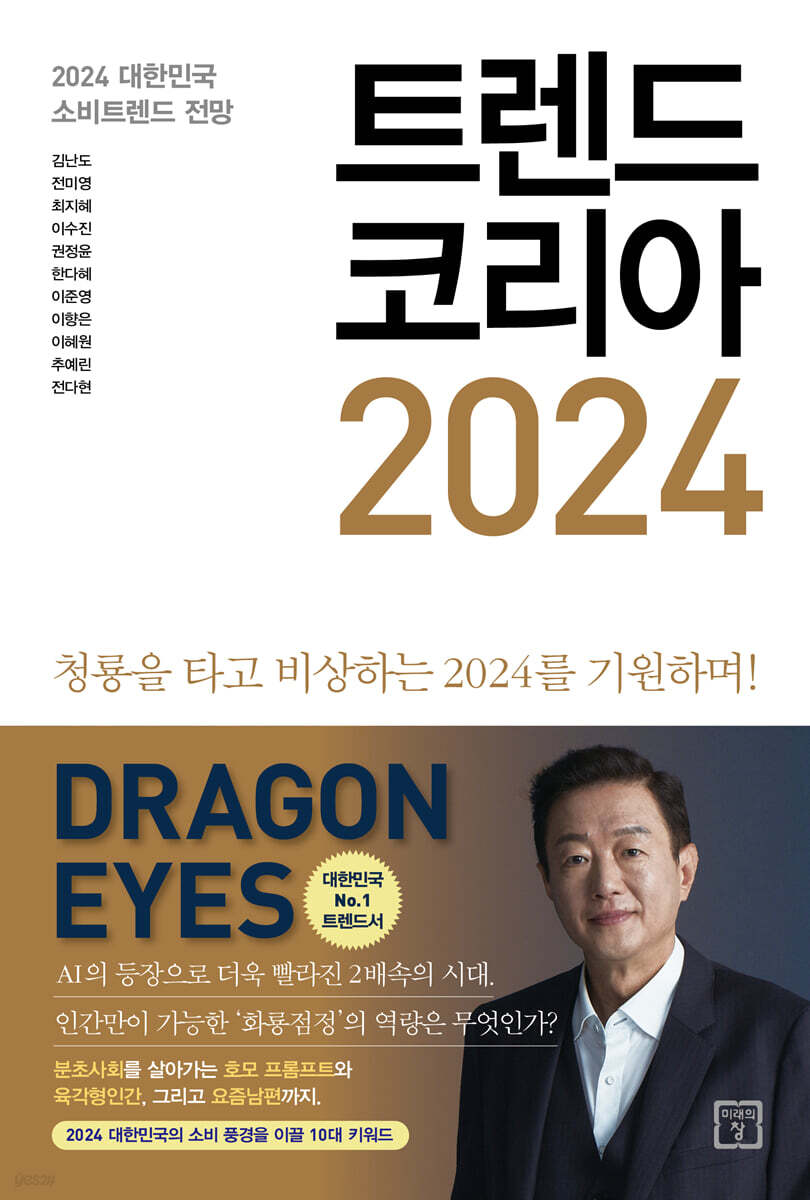
DRAGON EYES Wishing you a 2024 that soars on the Blue Dragon! Everything is slowly being prepared and then suddenly appears. ChatGPT did that. There have been countless stories about artificial intelligence technology, but nothing has shocked us as much as ChatGPT. What was different? It was the ability to communicate in "natural language." That's why people say, "The most popular new programming language is English." The 'English' mentioned here can be either Korean or Japanese. So, we have entered an era of artificial intelligence that is simply made up of ordinary speech and writing. At a time when all scholars and all books are talking about 'AI', 'artificial intelligence', and 'Chat GPT', 'Trend Korea 2024' focuses on the role or capabilities of humans. The important point is this. In other words, AI cannot evaluate the results it produces. It is ultimately up to humans to score it and decide whether to adopt the results or not. No matter how fantastic the Midjourney picture may be, the final touch is left to humans. It is 'Hwalongjeomjeong'. It is about maximizing human capabilities. What do we need to know and prepare for this? What are the necessary resources to find balance in a double-speed society? This year's Trend Korea is particularly recommended for slow reading. |
- You can preview some of the book's contents.
Preview
index
Introduction 5
Top 10 Consumer Trend Keywords for 2024
1 2023 Republic of Korea
27 places where the average disappeared
Emerging Consumers 42
Post-Reopening Space Strategy 58
Reinterpreting Relationships 73
The Power of Innovation to Overcome Recession 89
Trend Korea's Top 10 Trend Products for 2023
2 2024 Trends
Don't Waste a Single Second: Time-Efficient Society 132
Rise of 'Homo Promptus' 156
Aspiring to Be a Hexagonal Human 182
Getting the Price Right: Variable Pricing Strategy 212
On Dopamine Farming Dopaming 240
Not Like Old Daddies, Millennial Hubbies 262
Expanding Your Horizons: Spin-off Projects 288
You Choose, I'll Follow: Ditto Consumption 316
ElastiCity.
Liquidpolitan 344
Supporting One Another: ‘Care-based Economy’ Care Economy 372
Week 397
Appendix 410
Top 10 Consumer Trend Keywords for 2024
1 2023 Republic of Korea
27 places where the average disappeared
Emerging Consumers 42
Post-Reopening Space Strategy 58
Reinterpreting Relationships 73
The Power of Innovation to Overcome Recession 89
Trend Korea's Top 10 Trend Products for 2023
2 2024 Trends
Don't Waste a Single Second: Time-Efficient Society 132
Rise of 'Homo Promptus' 156
Aspiring to Be a Hexagonal Human 182
Getting the Price Right: Variable Pricing Strategy 212
On Dopamine Farming Dopaming 240
Not Like Old Daddies, Millennial Hubbies 262
Expanding Your Horizons: Spin-off Projects 288
You Choose, I'll Follow: Ditto Consumption 316
ElastiCity.
Liquidpolitan 344
Supporting One Another: ‘Care-based Economy’ Care Economy 372
Week 397
Appendix 410
Detailed image
Into the book
Through my personal experience using AI in publishing this book, I have become convinced of this.
This means that for a considerable period of time, there will still be areas where humans alone cannot compete with AI. While AI can significantly increase machine-like productivity, the human role will still be essential to meeting the demanding expectations of consumers.
Maybe it has become more important.
This is because the level of similar results produced by artificial intelligence will be determined by the 'human touch' added at the end.
--- p.7
The British economic weekly magazine The Economist used the expression, “The post-pandemic global economy is like the ‘Mona Lisa.’”
Leonardo da Vinci's painting, Mona Lisa, is famous for its mysterious smile that makes it difficult to tell whether she is smiling, sad, or frowning. This is precisely how the post-pandemic global economy will be ambiguous.
Maeil Business Newspaper diagnoses that our economy is showing the "Mona Lisa's ambiguity" in that employment is increasing, especially in the service industry, and the stock market is booming even in a recession, but there is also the possibility of a slowdown in consumption and potential problems with real estate insolvency.
The key is how to overcome this hurdle of uncertainty.
In situations where crisis and opportunity intersect, the distinction between those who easily jump over the obstacles and those who stumble will become clear.
The difference lies in the ability to respond to change, and the first step is to understand what trends are currently emerging.
--- p.10~11
Although Koreans, accustomed to the 'hurry hurry culture', are said to be always busy, people's sense of time these days is clearly different from the past.
The 'cost-effectiveness of time' is given extreme importance, and the density of usage time has become very high.
It's not just because I'm busy.
This is because as the economic paradigm shifts from an ownership economy to an experience economy, time has become a resource as important as money.
In the past, showing off expensive possessions was important, but now it's an era where people brag about their travel destinations, restaurants, and hot places with certified shots.
In the past, we would enjoy one "weekend classic" per week, but now, with the abundance of OTT platforms, we watch "content" for hours a day.
All of this takes a tremendous amount of time.
In modern society, time is by far the most precious resource, and it has become natural to use it sparingly and pursue cost-effectiveness.
--- p.133
The pace of technological development is not linear but accelerating.
A representative example is Moore's Law, which states that the capacity of microchips doubles every two years.
But the pace of development of artificial intelligence far exceeds this.
Given that the computing power of chatbots is improving 100-fold every two years, it seems entirely possible that Nvidia CEO Jensen Huang predicted that in 10 years, chatbots will be a million times more powerful than they are today.
It's dizzying.
Even though it's been a year since 'ChatGPT' was introduced, it's already undergoing amazing changes, but how can it grow 100-fold every two years?
--- p.159
If you have to give over 900 prompts to draw a single picture, you might think, "I might as well just draw it myself."
This is the key.
It wasn't artificial intelligence, it was Alan who drew the picture using prompts.
To use an analogy, if artificial intelligence is the canvas, then the prompts are the brush and paint.
The emphasis in the creative process is on prompts, not artificial intelligence.
Even if we don't aim for the job of 'prompt engineer,' understanding prompts is essential if we want to navigate the new wave of artificial intelligence as 'homo prompt.'
--- p.169
The "myth of hard work" is collapsing as wealth polarization deepens during the 2008 global financial crisis and the 2020 COVID-19 pandemic.
Meanwhile, Korean society has grown based on individualism and meritocracy, emphasizing that “all success or failure depends on individual effort.”
But these days, the belief that success can be achieved through individual effort is fading.
According to social analysis by Conan Technology, Korea's 2030 generation has a strong tendency to view success as an 'innate' asset (brain, study, talent).
As upward mobility becomes more difficult, the value of effort is being shaken.
The myth of hard work has disappeared, replaced by things that are innate, such as family background, looks, and talent, things that not everyone can easily possess.
--- p.204~205
'The law of one price.' William Jevons, a 19th-century British economist, argued that identical goods can only have the same price, and that there can be no price discrimination.
We have been producing, selling, and purchasing goods under the premise that “one thing has one fixed price,” even if it is not strictly one thing.
Examples include concepts such as ‘regular price’ or ‘recommended retail price.’
But today, this premise is collapsing.
There is a saying in the airline industry that “even on the same plane, the price of each seat is different.”
Just like playing a game of ladders, consumers are more likely to pay different prices for the same products and services depending on when and which path they choose.
--- p.214
In anthropology, there is an expression called 'the stream of culture.'
This means that culture is not stagnant, but constantly changing, like a flowing stream.
We dip our feet into a stream somewhere and experience what the water is like now, but in reality, after some time, the culture I belong to is no longer the same as before.
The same may be true of the culture of marriage and family life, which is the most conservative and seems unchangeable.
Men and women have also changed from before.
--- p.283~284
Unlike consumers of the past, who had no choice but to listen to brands' stories in exclusive markets, today's consumers are offered a variety of options from a variety of sources.
Moreover, as quality has become more standardized, there is no longer any reason to insist on branded products.
According to research by consulting firm McKinsey, consumers are switching brands at an unprecedented rate.
The number of US consumers who have tried a new brand increased by a whopping 13%, from 33% in September 2020 to 46% in February 2022.
--- p.338
Considering South Korea's rapidly declining birth rate, the emergence of Liquid Polytan is inevitable.
As the low birth rate and aging population rapidly progress, the number of deaths has already surpassed the number of births, passing the "population deadcross" in 2020.
It is projected that by 2060, people aged 65 and older will account for half of the total population, and there are even statistics that predict that by 2750, Korea's population will be 0.
During periods of rapid population growth, it was efficient to build new cities or carry out reconstruction through large-scale master plans.
Once a city is created and buildings are built, demand is supported.
Regarding this, Professor Yoon Joo-seon of the Department of Architecture at Chungnam National University said, “Until now, the business model of the Republic of Korea Corporation has been ‘population.’”
However, in a situation where the population is decreasing, rather than standardized redevelopment, efforts to reinterpret the characteristics of the region and fill it with diverse content appropriate to that have become urgent.
--- p.362~363
It's time to look at care from a new perspective.
Caring for a ‘child’ is caring for a ‘parent’s career’, and caring for the ‘elderly’ through technology is protecting their ‘human dignity’.
Caring for your employees is an investment in the future of your organization.
In the increasingly individualistic and hectic pace of our 'minute-by-minute society,' we have all become beings in need of each other's care.
As an infrastructure that enables people to rise and live economically, the care economy will become the most important economic issue of our time, with enormous policy and industrial ramifications.
This means that for a considerable period of time, there will still be areas where humans alone cannot compete with AI. While AI can significantly increase machine-like productivity, the human role will still be essential to meeting the demanding expectations of consumers.
Maybe it has become more important.
This is because the level of similar results produced by artificial intelligence will be determined by the 'human touch' added at the end.
--- p.7
The British economic weekly magazine The Economist used the expression, “The post-pandemic global economy is like the ‘Mona Lisa.’”
Leonardo da Vinci's painting, Mona Lisa, is famous for its mysterious smile that makes it difficult to tell whether she is smiling, sad, or frowning. This is precisely how the post-pandemic global economy will be ambiguous.
Maeil Business Newspaper diagnoses that our economy is showing the "Mona Lisa's ambiguity" in that employment is increasing, especially in the service industry, and the stock market is booming even in a recession, but there is also the possibility of a slowdown in consumption and potential problems with real estate insolvency.
The key is how to overcome this hurdle of uncertainty.
In situations where crisis and opportunity intersect, the distinction between those who easily jump over the obstacles and those who stumble will become clear.
The difference lies in the ability to respond to change, and the first step is to understand what trends are currently emerging.
--- p.10~11
Although Koreans, accustomed to the 'hurry hurry culture', are said to be always busy, people's sense of time these days is clearly different from the past.
The 'cost-effectiveness of time' is given extreme importance, and the density of usage time has become very high.
It's not just because I'm busy.
This is because as the economic paradigm shifts from an ownership economy to an experience economy, time has become a resource as important as money.
In the past, showing off expensive possessions was important, but now it's an era where people brag about their travel destinations, restaurants, and hot places with certified shots.
In the past, we would enjoy one "weekend classic" per week, but now, with the abundance of OTT platforms, we watch "content" for hours a day.
All of this takes a tremendous amount of time.
In modern society, time is by far the most precious resource, and it has become natural to use it sparingly and pursue cost-effectiveness.
--- p.133
The pace of technological development is not linear but accelerating.
A representative example is Moore's Law, which states that the capacity of microchips doubles every two years.
But the pace of development of artificial intelligence far exceeds this.
Given that the computing power of chatbots is improving 100-fold every two years, it seems entirely possible that Nvidia CEO Jensen Huang predicted that in 10 years, chatbots will be a million times more powerful than they are today.
It's dizzying.
Even though it's been a year since 'ChatGPT' was introduced, it's already undergoing amazing changes, but how can it grow 100-fold every two years?
--- p.159
If you have to give over 900 prompts to draw a single picture, you might think, "I might as well just draw it myself."
This is the key.
It wasn't artificial intelligence, it was Alan who drew the picture using prompts.
To use an analogy, if artificial intelligence is the canvas, then the prompts are the brush and paint.
The emphasis in the creative process is on prompts, not artificial intelligence.
Even if we don't aim for the job of 'prompt engineer,' understanding prompts is essential if we want to navigate the new wave of artificial intelligence as 'homo prompt.'
--- p.169
The "myth of hard work" is collapsing as wealth polarization deepens during the 2008 global financial crisis and the 2020 COVID-19 pandemic.
Meanwhile, Korean society has grown based on individualism and meritocracy, emphasizing that “all success or failure depends on individual effort.”
But these days, the belief that success can be achieved through individual effort is fading.
According to social analysis by Conan Technology, Korea's 2030 generation has a strong tendency to view success as an 'innate' asset (brain, study, talent).
As upward mobility becomes more difficult, the value of effort is being shaken.
The myth of hard work has disappeared, replaced by things that are innate, such as family background, looks, and talent, things that not everyone can easily possess.
--- p.204~205
'The law of one price.' William Jevons, a 19th-century British economist, argued that identical goods can only have the same price, and that there can be no price discrimination.
We have been producing, selling, and purchasing goods under the premise that “one thing has one fixed price,” even if it is not strictly one thing.
Examples include concepts such as ‘regular price’ or ‘recommended retail price.’
But today, this premise is collapsing.
There is a saying in the airline industry that “even on the same plane, the price of each seat is different.”
Just like playing a game of ladders, consumers are more likely to pay different prices for the same products and services depending on when and which path they choose.
--- p.214
In anthropology, there is an expression called 'the stream of culture.'
This means that culture is not stagnant, but constantly changing, like a flowing stream.
We dip our feet into a stream somewhere and experience what the water is like now, but in reality, after some time, the culture I belong to is no longer the same as before.
The same may be true of the culture of marriage and family life, which is the most conservative and seems unchangeable.
Men and women have also changed from before.
--- p.283~284
Unlike consumers of the past, who had no choice but to listen to brands' stories in exclusive markets, today's consumers are offered a variety of options from a variety of sources.
Moreover, as quality has become more standardized, there is no longer any reason to insist on branded products.
According to research by consulting firm McKinsey, consumers are switching brands at an unprecedented rate.
The number of US consumers who have tried a new brand increased by a whopping 13%, from 33% in September 2020 to 46% in February 2022.
--- p.338
Considering South Korea's rapidly declining birth rate, the emergence of Liquid Polytan is inevitable.
As the low birth rate and aging population rapidly progress, the number of deaths has already surpassed the number of births, passing the "population deadcross" in 2020.
It is projected that by 2060, people aged 65 and older will account for half of the total population, and there are even statistics that predict that by 2750, Korea's population will be 0.
During periods of rapid population growth, it was efficient to build new cities or carry out reconstruction through large-scale master plans.
Once a city is created and buildings are built, demand is supported.
Regarding this, Professor Yoon Joo-seon of the Department of Architecture at Chungnam National University said, “Until now, the business model of the Republic of Korea Corporation has been ‘population.’”
However, in a situation where the population is decreasing, rather than standardized redevelopment, efforts to reinterpret the characteristics of the region and fill it with diverse content appropriate to that have become urgent.
--- p.362~363
It's time to look at care from a new perspective.
Caring for a ‘child’ is caring for a ‘parent’s career’, and caring for the ‘elderly’ through technology is protecting their ‘human dignity’.
Caring for your employees is an investment in the future of your organization.
In the increasingly individualistic and hectic pace of our 'minute-by-minute society,' we have all become beings in need of each other's care.
As an infrastructure that enables people to rise and live economically, the care economy will become the most important economic issue of our time, with enormous policy and industrial ramifications.
--- p.373
Publisher's Review
South Korea, which used to shout 'hurry, hurry', has now entered a double-speed society.
People who are immersed in the content that YouTube, OTT platforms, and various social media platforms produce cannot tolerate even a single second of boredom and pursue a life of do-farming with a "rise, development, climax, and fun."
The lines that once separated us are becoming blurred.
A representative example is the disappearance of the distinction between the wife and the husband within the family.
In a society with a hyper-gap, people who pursue perfection set standards that are simply too high and enjoy playing the 'hexagonal man' game.
The motto of these people, “I want to succeed without effort,” has lost its place in the world of hard work and self-made success.
Generative AI, which struck humanity with the advent of ChatGPT.
We are faced with a huge question posed by AI, which sucks in all the world's topics like a black hole.
“What is the unique capacity of humans?” We must seek the answer from Homo Prompt, a human being capable of asking questions that elicit clear answers.
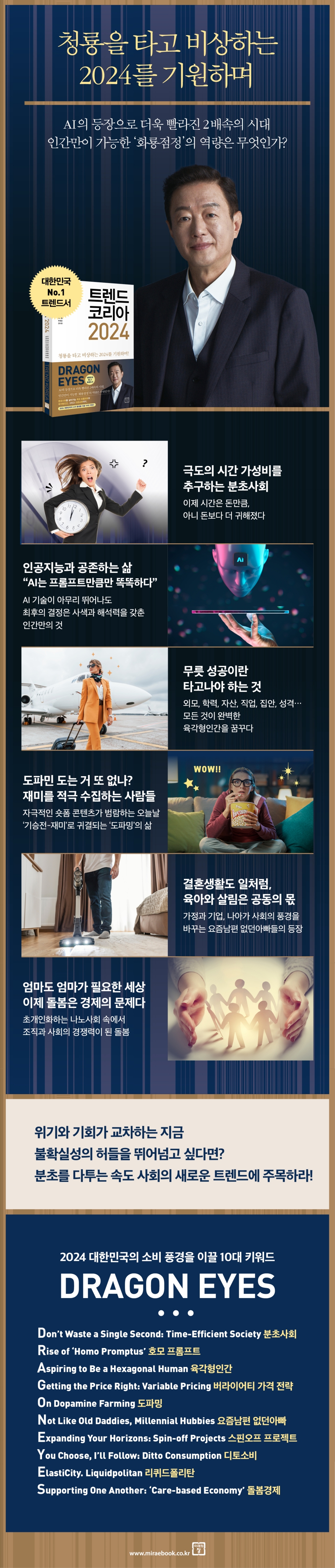
Top 10 Consumer Trend Keywords for 2024
● Don’t Waste a Single Second: Time-Efficient Society
It's a world where every minute and every second is precious.
As time has become a resource as important as or more important than money, the 'cost-effectiveness of time' has become important.
It's not just because I'm busy.
As we transition from an ownership economy to an experience economy, people today have so much to see, do, and enjoy.
In the modern platform economy, where time moves in fractions of a second, the density of time is increasing, and we are rapidly moving into an era of acceleration.
● Rise of 'Homo Promptus'
A prompt is a question that a human asks to get a desired answer from AI.
“AI is only as smart as its prompts.” This is because the results AI produces change depending on the questions humans ask.
It's important to note that this keyword begins with "homo," or human. No matter how advanced AI technology, the ability to "point the point" ultimately belongs only to humans, possessing both the ability to think and interpret.
● Aspiring to Be a Hexagonal Human
The number of people dreaming of perfection is increasing.
The term 'hexagonal man', which refers to a person who is perfect in every way, including appearance, education, assets, occupation, family background, and personality, serves as a reflection of the obsessive perfection that our society strives for today.
If it is an unreachable goal, it is a game of giving up and using it as a yardstick to measure others.
The hexagonal human trend is both a form of energy and despair for young people living in a society where the ladder of social mobility is shaky, and a form of play.
● Getting the Price Right: Variable Pricing Variety Pricing Strategy
Today, the law of 'one thing, one price' has disappeared.
The use of big data to accurately understand consumers' willingness to pay and the development of AI to measure all variables in real time have opened up a world of "one product, N prices," where prices vary depending on time, location, and distribution channel.
Consumers are also responding quickly to this.
Now, the ‘best price’ is becoming more important than the ‘lowest price’.
● On Dopamine Farming
What's something that gets your dopamine pumping? Fun has always been a human preoccupation, but never has the pursuit of it become so prevalent as it is today.
Just as gamers 'farm' to collect items, people collect fun.
The odd, the quirky, the downright pointless, the things that grab attention and the 'all-time dopamine' hits break records every time.
In today's world, where provocative short-form content is overflowing, dophamming is an unavoidable trend.
● Not Like Old Daddies, Millennial Hubbies
Today, when marriage has become the biggest choice in life, the roles expected of men after marriage have changed like never before.
The balance between housework, childcare, and family relationships is shifting.
These days, husbands are changing their roles from authoritarian heads of households to equal partners, and fathers who call themselves "6 o'clock Cinderellas" to spend time with their children are changing the landscape of homes, businesses, and even consumption.
● Expanding Your Horizons: Spin-off Projects
Spin-offs, which were often used in movies and dramas, are now spreading across industries.
Spin-offs, which attempt new businesses with relatively low budgets and flexible strategies, offer companies less risk of failure and can expect unexpected results if they succeed.
Individuals also pursue side projects to develop their curries.
In an era of change, spin-offs are a new growth engine.
● You Choose, I'll Follow: Ditto Consumption Ditto Consumption
'Ditto', which means 'me too', is gaining popularity in the consumer market.
Ditto consumption, which involves choosing people, content, and distribution channels that truly reflect your values and tastes, is a way to skip the complex and time-consuming purchasing decisions and make optimal choices.
Amidst the plethora of choices, a simple way to reduce FOBO, or fear of failure, emerges: detoxification.
● ElastiCity.
Liquidpolitan
In modern society, where population is decreasing and metropolitan transportation is developing, the number of consumers who pursue a nomadic lifestyle is increasing, and regions are no longer fixed spaces but rather flexible spaces that move and flow.
Liquid Politan, a flexible city that focuses on the relationship population rather than the permanent population, is attracting attention.
In this era of concern over unbalanced development and regional extinction, Liquidpolitan offers a new solution.
● Supporting One Another: ‘Care-based Economy’ Care Economy
All humans are beings that need care.
In a hyper-personalized nano-society, where every second counts, systematizing care has become crucial.
Care is no longer just a matter of compassion, but of economics.
It is evolving into a service that applies to everyone, not just the socially disadvantaged due to age and health conditions.
This is a world where mothers need mothers too.
The care economy is not only my problem, but also the competitiveness of our organization and society.
People who are immersed in the content that YouTube, OTT platforms, and various social media platforms produce cannot tolerate even a single second of boredom and pursue a life of do-farming with a "rise, development, climax, and fun."
The lines that once separated us are becoming blurred.
A representative example is the disappearance of the distinction between the wife and the husband within the family.
In a society with a hyper-gap, people who pursue perfection set standards that are simply too high and enjoy playing the 'hexagonal man' game.
The motto of these people, “I want to succeed without effort,” has lost its place in the world of hard work and self-made success.
Generative AI, which struck humanity with the advent of ChatGPT.
We are faced with a huge question posed by AI, which sucks in all the world's topics like a black hole.
“What is the unique capacity of humans?” We must seek the answer from Homo Prompt, a human being capable of asking questions that elicit clear answers.
Top 10 Consumer Trend Keywords for 2024
● Don’t Waste a Single Second: Time-Efficient Society
It's a world where every minute and every second is precious.
As time has become a resource as important as or more important than money, the 'cost-effectiveness of time' has become important.
It's not just because I'm busy.
As we transition from an ownership economy to an experience economy, people today have so much to see, do, and enjoy.
In the modern platform economy, where time moves in fractions of a second, the density of time is increasing, and we are rapidly moving into an era of acceleration.
● Rise of 'Homo Promptus'
A prompt is a question that a human asks to get a desired answer from AI.
“AI is only as smart as its prompts.” This is because the results AI produces change depending on the questions humans ask.
It's important to note that this keyword begins with "homo," or human. No matter how advanced AI technology, the ability to "point the point" ultimately belongs only to humans, possessing both the ability to think and interpret.
● Aspiring to Be a Hexagonal Human
The number of people dreaming of perfection is increasing.
The term 'hexagonal man', which refers to a person who is perfect in every way, including appearance, education, assets, occupation, family background, and personality, serves as a reflection of the obsessive perfection that our society strives for today.
If it is an unreachable goal, it is a game of giving up and using it as a yardstick to measure others.
The hexagonal human trend is both a form of energy and despair for young people living in a society where the ladder of social mobility is shaky, and a form of play.
● Getting the Price Right: Variable Pricing Variety Pricing Strategy
Today, the law of 'one thing, one price' has disappeared.
The use of big data to accurately understand consumers' willingness to pay and the development of AI to measure all variables in real time have opened up a world of "one product, N prices," where prices vary depending on time, location, and distribution channel.
Consumers are also responding quickly to this.
Now, the ‘best price’ is becoming more important than the ‘lowest price’.
● On Dopamine Farming
What's something that gets your dopamine pumping? Fun has always been a human preoccupation, but never has the pursuit of it become so prevalent as it is today.
Just as gamers 'farm' to collect items, people collect fun.
The odd, the quirky, the downright pointless, the things that grab attention and the 'all-time dopamine' hits break records every time.
In today's world, where provocative short-form content is overflowing, dophamming is an unavoidable trend.
● Not Like Old Daddies, Millennial Hubbies
Today, when marriage has become the biggest choice in life, the roles expected of men after marriage have changed like never before.
The balance between housework, childcare, and family relationships is shifting.
These days, husbands are changing their roles from authoritarian heads of households to equal partners, and fathers who call themselves "6 o'clock Cinderellas" to spend time with their children are changing the landscape of homes, businesses, and even consumption.
● Expanding Your Horizons: Spin-off Projects
Spin-offs, which were often used in movies and dramas, are now spreading across industries.
Spin-offs, which attempt new businesses with relatively low budgets and flexible strategies, offer companies less risk of failure and can expect unexpected results if they succeed.
Individuals also pursue side projects to develop their curries.
In an era of change, spin-offs are a new growth engine.
● You Choose, I'll Follow: Ditto Consumption Ditto Consumption
'Ditto', which means 'me too', is gaining popularity in the consumer market.
Ditto consumption, which involves choosing people, content, and distribution channels that truly reflect your values and tastes, is a way to skip the complex and time-consuming purchasing decisions and make optimal choices.
Amidst the plethora of choices, a simple way to reduce FOBO, or fear of failure, emerges: detoxification.
● ElastiCity.
Liquidpolitan
In modern society, where population is decreasing and metropolitan transportation is developing, the number of consumers who pursue a nomadic lifestyle is increasing, and regions are no longer fixed spaces but rather flexible spaces that move and flow.
Liquid Politan, a flexible city that focuses on the relationship population rather than the permanent population, is attracting attention.
In this era of concern over unbalanced development and regional extinction, Liquidpolitan offers a new solution.
● Supporting One Another: ‘Care-based Economy’ Care Economy
All humans are beings that need care.
In a hyper-personalized nano-society, where every second counts, systematizing care has become crucial.
Care is no longer just a matter of compassion, but of economics.
It is evolving into a service that applies to everyone, not just the socially disadvantaged due to age and health conditions.
This is a world where mothers need mothers too.
The care economy is not only my problem, but also the competitiveness of our organization and society.
GOODS SPECIFICS
- Date of issue: October 5, 2023
- Page count, weight, size: 416 pages | 618g | 152*225*21mm
- ISBN13: 9788959897179
- ISBN10: 8959897175
You may also like
카테고리
korean


korean

![ELLE 엘르 스페셜 에디션 A형 : 12월 [2025]](http://librairie.coreenne.fr/cdn/shop/files/b8e27a3de6c9538896439686c6b0e8fb.jpg?v=1766436872&width=3840)


