

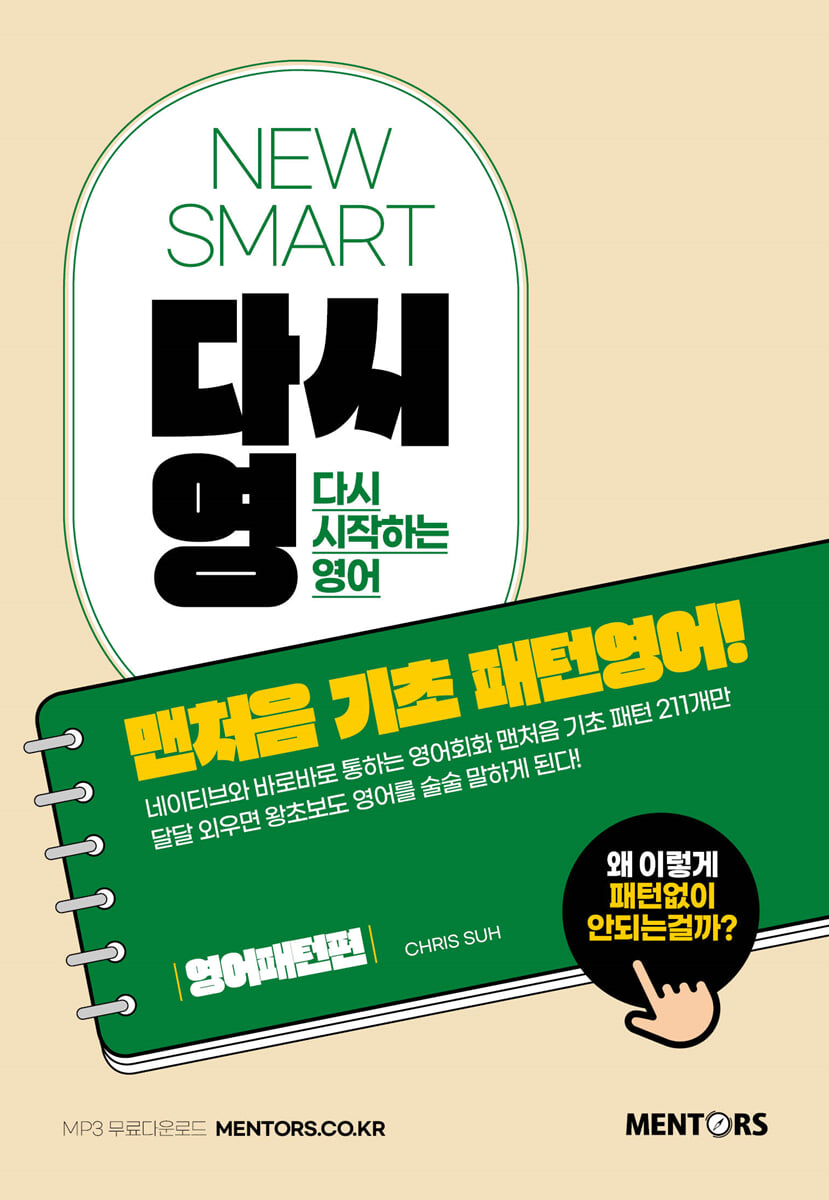
NEW SMART Dasikyoung: The very first basic pattern English!
 |
Description
Book Introduction
『NEW SMART Dasiyoung: The Very First Basic Pattern English!』is an English conversation study book designed to help beginners who are trying English conversation for the first time, or those who have tried many times but have been stuck in a rut without being able to say a single word, to actually speak English.
We have selected 211 of the most basic and frequently used English conversational phrases.
If you familiarize yourself with the purpose of each pattern through a concise summary of key points, memorize the essential sentences read by native speakers, and practice conversation, you will have the know-how to create many English conversational sentences firmly stored in your head.
Moreover, it is designed so that you can faithfully practice creating new English sentences using the pattern at the end of each pattern, making it possible to learn the patterns more effectively.
Since we've collected only the patterns that you can't avoid when speaking English, if you learn all 211 of these patterns and repeat them endlessly until they become ingrained in your mouth, you'll find yourself speaking English conversation sentences fluently.
We have selected 211 of the most basic and frequently used English conversational phrases.
If you familiarize yourself with the purpose of each pattern through a concise summary of key points, memorize the essential sentences read by native speakers, and practice conversation, you will have the know-how to create many English conversational sentences firmly stored in your head.
Moreover, it is designed so that you can faithfully practice creating new English sentences using the pattern at the end of each pattern, making it possible to learn the patterns more effectively.
Since we've collected only the patterns that you can't avoid when speaking English, if you learn all 211 of these patterns and repeat them endlessly until they become ingrained in your mouth, you'll find yourself speaking English conversation sentences fluently.
- You can preview some of the book's contents.
Preview
index
Chapter 01
English Conversation Basic Pattern 001-029: You and Me
001 I'm + noun~ I am... 016
002 I'm + adjective I... 017
003 I'm happy with ~ … so I'm happy 018
004 I'm + past participle I... 019
005 I'm married to ~ I married ... 020
006 I'm + preposition + noun I... 021
007 I'm sure~ … is certain, … is certain 022
008 I'm afraid~ I'm sorry, but... Hey 023
009 I'm glad~ … I'm glad to do it 024
010 I'm sorry about~ … I'm sorry 025
011 I'm sorry to~ … I'm sorry [it didn't work out] 026
012 I'm sorry~ … I'm sorry 027
013 I'm ~ing I'm doing... 028
014 He's ~ing He's doing... 029
015 I'm going to~ … 030
016 I'm going to~ … 031
017 Am I~? … Sun? 032
018 Am I ~ing/pp? Am I… doing? 033
019 You are~ You… 034
020 You're such a~ You really… 035
021 You are + adjective you … do 036
022 You're+~pp You... do 037
023 You're+~ing You're doing ~ right now 038
024 Are you + noun ~? Are you…? 039
025 Are you + adjective ~? Do you...? 040
026 Are you ready~? ... Are you ready? 041
027 Are you sure~? … Are you sure? 042
028 Are you + past participle ~? Did you…? 043
029 Are you+~ing? Are you ~ing now? 044
Chapter 02
Very, very easy patterns starting with This/That/It~ 030-070
030 This is + person noun This guy is… Hey 046
031 This is + noun This is… 047
032 This is + adjective This is… 048
033 This is+ ~ing/pp This is… 049
034 This is what~ This is exactly what I did 050
035 This is not~ This is not ~ doing... 051
036 This is going to~ … will be one thing 052
037 Is this + adjective? Is this... ya? 053
038 Is this + noun? Is this... ya? 054
039 Is this for~? Is this... ya? 055
040 That is + adjective … 056
041 That is + noun … 057
042 That's what~ That's what... is... doing 058
043 That's why~ So... I'm doing... 059
044 That's because~ That's because... 060
045 That will[would] be~ … 061
046 That + regular verb … 062
047 That sounds~ … I think so 063
048 That sounds like~ … I think so 064
049 It is + adjective … hey, … sea 065
050 It is + noun … 066
051 It's + prepositional phrase That's in ... 067
052 It is~ to~ … to do… 068
053 It's~ that~ … doing… 069
054 Is it~? … What? 070
055 Is it~ to~? … to do…? 071
056 Is it okay~? ... Can I do it? 072
057 It + Verb … 073
058 It takes + time + to ~ … to do … 074
059 It takes + noun + to ~ … but … is needed 075
060 It seems ~ … 076
061 It seems like~ … 077
062 He seems~ He seems to have done it 078
063 Subject + Verb … 079
064 Object subject don't [doesn't] + verb … don't do 080
065 Object subject + be ~ … do 081
066 The subject of the object is being ~ing… 082
067 Subject be+pp… is in a state 083
068 Here is~ here [this] … 084
069 There is~ … 085
070 There are~ … 086
Chapter 03
Various Patterns Using Auxiliary Verbs 071-103
071 I'd like~ … I want 088
072 I'd like to~ … want to 089
073 I'd like to, but~ I want to, but… 090
074 I'd rather~ (rather) … 091
075 I'd rather~ than~ … 092
076 Would you~? … Would you do it? 093
077 Would you like~? … Do you want to?, … Should I give you? 094
078 Would you like to~? … Do you want to do it? 095
079 Would you mind~ ? … Is it okay if I do that? 096
080 Would you mind if~ ? … Is it okay if I do that? 097
081 I can~ I can do… 098
082 I can't~ I can't... 099
083 You can~ You can do… You can… 100
084 You can't~ … You shouldn't do that 101
085 Can I~? ... Can I do it?, ... Can I do it? 102
086 Can I have ~? … Would you like to give me 103
087 Can you~? … Will you do it? 104
088 May I~? …Can I? 105
089 She may~ … It could be 106
090 I will~ … I will do it 107
091 You will~ You will… 108
092 I won't~ … I won't do it 109
093 Will you~? … Will you do it? 110
094 Shall we~? … Shall we?, … Let's do it 111
095 Shall I~ ? Shall I... do it for you? 112
096 You should~ … 113
097 Should I~? Should I…? 114
098 I have to~ … I have to 115
099 We have to~ We have to… 116
100 Do I have to~? 117
101 You have to~ You have to… 118
102 You don't have to~ … You don't have to 119
103 Do you have to~? 120
Chapter 04
Have & Get: The King's Basic Patterns 104-124
104 I have~ … I have … 122
105 I have + indefinite noun … 123
106 I have+disease … I have, … I am sick 124
107 I have~ … eat 125
108 I have no~ … 126
109 I have ~pp … did … 127
110 have+noun+verb/~ing … make 128
111 You have~ You... this,... 129
112 Do you have~? Do you have…? 130
113 Do you have any~? What… do you have? 131
114 I got~ … I got it, I got it 132
115 I got + place noun … arrived at 133
116 I got + other noun … did 134
117 get+adjective… to cancel 135
118 get+pp… done 136
119 get+person+thing… to give… to… 137
120 get+noun+adjective … make … 138
121 get+noun+pp … to receive, to be subjected to 139
122 get+noun+to~ … make 140
123 I've got~ … 141
124 I've got to~ … I have to 142
Chapter 05
Practical patterns using like, think, know, need, and mean 125-158
125 I like~ … I like 144
126 I like to~ … 145
127 I don't like~ … I don't like 146
128 I don't like to~ … I don't want to do it 147
129 Do you like~ ? … Do you like? 148
130 Do you like to~? …? 149
131 I know~ … I know 150
132 I know that~ … I know 151
133 I don't know~ … I don't know 152
134 I don't know about~ … I don't know about 153
135 I don't know what~ … I don't know 154
136 Do you know~? Do you know…? 155
137 Do you know anything about~?
…what do you know about? 156
138 Do you know that/what~? … know 157
139 I think~ … I think so 158
140 I don't think~ … I don't think so 159
141 Do you think~ ? … Do you think so? 160
142 I enjoyed~ … I enjoyed it 161
143 I enjoyed ~ing … 162
144 I feel~ … I feel that way, … 163
145 I feel like ~ing… I want to do that 164
146 I need~ … 165
147 I need to~ … I have to 166
148 I don't need to~ I don't have to… 167
149 I hope~ … I hope to do that 168
150 I hope ~ not … I hope you don't do that 169
151 I wonder~ … I wonder if it is 170
152 I wonder if~ … I don't know if it is or not 171
153 I was wondering if you could~ … Can you do it? 172
154 I used to~ I used to… 173
155 You look~ You look… 174
156 (Do) You mean~? … That's what you mean? 175
157 (Do) You mean subject+verb? … right? 176
158 I mean~ I mean… 177
Chapter 06
Interrogative patterns that can provide a variety of information 159-189159 What is~? What is…? 180
160 What are you~? What are you doing now? 181
161 What do you~? What are you doing? 182
162 What can~? What can you do? 183
163 What time~? What time is it? 184
164 What kind of~? What kind of…do…do? 185
165 What makes you~? Why are you doing this? 186
166 What brings you~ ? … What's going on? 187
167 When is~? … When is it? 188
168 When do ~? When do … do …? 189
169 When can~? When can…? 190
170 Where is ~ ? … Where is it? 191
171 Where do you do~? Where do you do…? 192
172 Where can~? Where can I…? 193
173 Who is~? … Who is this? 194
174 Who's going to~? Who's going to…? 195
175 Who did you~? Who did…? 196
176 Why do you~? why … sun? 197
177 Why don’t you~? … let's do it 198
178 How is~? … How is it? 199
179 How do you~? How do you…? 200
180 How about~? ... How about doing that? 201
181 How many~? How many…? 202
182 How much~? How much…? 203
183 How often~? How often…? 204
184 Which~? Which one is…? 205
185 Which+(pro)noun~? Which…? 206
186 Which~, A or B? Which is better? 207
187 Can you tell me~ ? … Can you tell me? 208
188 Can you tell me what~? … Can you tell me? 209
189 Can you tell me where~? … Can you tell me where it is? 210
Chapter 07
Other Simple and Convenient Patterns to Know 190-211
190 Thank you for~ … so thank you 212
191 I appreciate~ … I appreciate 213
192 Excuse me ~ Excuse me, but… 214
193 Please excuse~ … Please understand 215
194 It is ~, isn't it? … Right? 216
195 It's not~, is it? … Right? 217
196 What a~! Really… 218
197 Be~ … Year 219
198 Take~ … 220
199 Don't be~ … Don't do it 221
200 Don't~ … Don't do it 222
201 Never~ … Don't do it 223
202 Let's~ … Let's do it 224
203 Let me~ … I'll do it 225
204 Let me know~ … 226
205 I have+pp~ … did 227
206 If+present~ I will~ … then I will do… 228
207 If I + past, I could~ … then I would … 229
208 If I had~, I would have~ … I would have done ~ 230
209 I wish~ … 231
210 If I were you~, I would~ 232
211 I should have~ … I should have 234
English Conversation Basic Pattern 001-029: You and Me
001 I'm + noun~ I am... 016
002 I'm + adjective I... 017
003 I'm happy with ~ … so I'm happy 018
004 I'm + past participle I... 019
005 I'm married to ~ I married ... 020
006 I'm + preposition + noun I... 021
007 I'm sure~ … is certain, … is certain 022
008 I'm afraid~ I'm sorry, but... Hey 023
009 I'm glad~ … I'm glad to do it 024
010 I'm sorry about~ … I'm sorry 025
011 I'm sorry to~ … I'm sorry [it didn't work out] 026
012 I'm sorry~ … I'm sorry 027
013 I'm ~ing I'm doing... 028
014 He's ~ing He's doing... 029
015 I'm going to~ … 030
016 I'm going to~ … 031
017 Am I~? … Sun? 032
018 Am I ~ing/pp? Am I… doing? 033
019 You are~ You… 034
020 You're such a~ You really… 035
021 You are + adjective you … do 036
022 You're+~pp You... do 037
023 You're+~ing You're doing ~ right now 038
024 Are you + noun ~? Are you…? 039
025 Are you + adjective ~? Do you...? 040
026 Are you ready~? ... Are you ready? 041
027 Are you sure~? … Are you sure? 042
028 Are you + past participle ~? Did you…? 043
029 Are you+~ing? Are you ~ing now? 044
Chapter 02
Very, very easy patterns starting with This/That/It~ 030-070
030 This is + person noun This guy is… Hey 046
031 This is + noun This is… 047
032 This is + adjective This is… 048
033 This is+ ~ing/pp This is… 049
034 This is what~ This is exactly what I did 050
035 This is not~ This is not ~ doing... 051
036 This is going to~ … will be one thing 052
037 Is this + adjective? Is this... ya? 053
038 Is this + noun? Is this... ya? 054
039 Is this for~? Is this... ya? 055
040 That is + adjective … 056
041 That is + noun … 057
042 That's what~ That's what... is... doing 058
043 That's why~ So... I'm doing... 059
044 That's because~ That's because... 060
045 That will[would] be~ … 061
046 That + regular verb … 062
047 That sounds~ … I think so 063
048 That sounds like~ … I think so 064
049 It is + adjective … hey, … sea 065
050 It is + noun … 066
051 It's + prepositional phrase That's in ... 067
052 It is~ to~ … to do… 068
053 It's~ that~ … doing… 069
054 Is it~? … What? 070
055 Is it~ to~? … to do…? 071
056 Is it okay~? ... Can I do it? 072
057 It + Verb … 073
058 It takes + time + to ~ … to do … 074
059 It takes + noun + to ~ … but … is needed 075
060 It seems ~ … 076
061 It seems like~ … 077
062 He seems~ He seems to have done it 078
063 Subject + Verb … 079
064 Object subject don't [doesn't] + verb … don't do 080
065 Object subject + be ~ … do 081
066 The subject of the object is being ~ing… 082
067 Subject be+pp… is in a state 083
068 Here is~ here [this] … 084
069 There is~ … 085
070 There are~ … 086
Chapter 03
Various Patterns Using Auxiliary Verbs 071-103
071 I'd like~ … I want 088
072 I'd like to~ … want to 089
073 I'd like to, but~ I want to, but… 090
074 I'd rather~ (rather) … 091
075 I'd rather~ than~ … 092
076 Would you~? … Would you do it? 093
077 Would you like~? … Do you want to?, … Should I give you? 094
078 Would you like to~? … Do you want to do it? 095
079 Would you mind~ ? … Is it okay if I do that? 096
080 Would you mind if~ ? … Is it okay if I do that? 097
081 I can~ I can do… 098
082 I can't~ I can't... 099
083 You can~ You can do… You can… 100
084 You can't~ … You shouldn't do that 101
085 Can I~? ... Can I do it?, ... Can I do it? 102
086 Can I have ~? … Would you like to give me 103
087 Can you~? … Will you do it? 104
088 May I~? …Can I? 105
089 She may~ … It could be 106
090 I will~ … I will do it 107
091 You will~ You will… 108
092 I won't~ … I won't do it 109
093 Will you~? … Will you do it? 110
094 Shall we~? … Shall we?, … Let's do it 111
095 Shall I~ ? Shall I... do it for you? 112
096 You should~ … 113
097 Should I~? Should I…? 114
098 I have to~ … I have to 115
099 We have to~ We have to… 116
100 Do I have to~? 117
101 You have to~ You have to… 118
102 You don't have to~ … You don't have to 119
103 Do you have to~? 120
Chapter 04
Have & Get: The King's Basic Patterns 104-124
104 I have~ … I have … 122
105 I have + indefinite noun … 123
106 I have+disease … I have, … I am sick 124
107 I have~ … eat 125
108 I have no~ … 126
109 I have ~pp … did … 127
110 have+noun+verb/~ing … make 128
111 You have~ You... this,... 129
112 Do you have~? Do you have…? 130
113 Do you have any~? What… do you have? 131
114 I got~ … I got it, I got it 132
115 I got + place noun … arrived at 133
116 I got + other noun … did 134
117 get+adjective… to cancel 135
118 get+pp… done 136
119 get+person+thing… to give… to… 137
120 get+noun+adjective … make … 138
121 get+noun+pp … to receive, to be subjected to 139
122 get+noun+to~ … make 140
123 I've got~ … 141
124 I've got to~ … I have to 142
Chapter 05
Practical patterns using like, think, know, need, and mean 125-158
125 I like~ … I like 144
126 I like to~ … 145
127 I don't like~ … I don't like 146
128 I don't like to~ … I don't want to do it 147
129 Do you like~ ? … Do you like? 148
130 Do you like to~? …? 149
131 I know~ … I know 150
132 I know that~ … I know 151
133 I don't know~ … I don't know 152
134 I don't know about~ … I don't know about 153
135 I don't know what~ … I don't know 154
136 Do you know~? Do you know…? 155
137 Do you know anything about~?
…what do you know about? 156
138 Do you know that/what~? … know 157
139 I think~ … I think so 158
140 I don't think~ … I don't think so 159
141 Do you think~ ? … Do you think so? 160
142 I enjoyed~ … I enjoyed it 161
143 I enjoyed ~ing … 162
144 I feel~ … I feel that way, … 163
145 I feel like ~ing… I want to do that 164
146 I need~ … 165
147 I need to~ … I have to 166
148 I don't need to~ I don't have to… 167
149 I hope~ … I hope to do that 168
150 I hope ~ not … I hope you don't do that 169
151 I wonder~ … I wonder if it is 170
152 I wonder if~ … I don't know if it is or not 171
153 I was wondering if you could~ … Can you do it? 172
154 I used to~ I used to… 173
155 You look~ You look… 174
156 (Do) You mean~? … That's what you mean? 175
157 (Do) You mean subject+verb? … right? 176
158 I mean~ I mean… 177
Chapter 06
Interrogative patterns that can provide a variety of information 159-189159 What is~? What is…? 180
160 What are you~? What are you doing now? 181
161 What do you~? What are you doing? 182
162 What can~? What can you do? 183
163 What time~? What time is it? 184
164 What kind of~? What kind of…do…do? 185
165 What makes you~? Why are you doing this? 186
166 What brings you~ ? … What's going on? 187
167 When is~? … When is it? 188
168 When do ~? When do … do …? 189
169 When can~? When can…? 190
170 Where is ~ ? … Where is it? 191
171 Where do you do~? Where do you do…? 192
172 Where can~? Where can I…? 193
173 Who is~? … Who is this? 194
174 Who's going to~? Who's going to…? 195
175 Who did you~? Who did…? 196
176 Why do you~? why … sun? 197
177 Why don’t you~? … let's do it 198
178 How is~? … How is it? 199
179 How do you~? How do you…? 200
180 How about~? ... How about doing that? 201
181 How many~? How many…? 202
182 How much~? How much…? 203
183 How often~? How often…? 204
184 Which~? Which one is…? 205
185 Which+(pro)noun~? Which…? 206
186 Which~, A or B? Which is better? 207
187 Can you tell me~ ? … Can you tell me? 208
188 Can you tell me what~? … Can you tell me? 209
189 Can you tell me where~? … Can you tell me where it is? 210
Chapter 07
Other Simple and Convenient Patterns to Know 190-211
190 Thank you for~ … so thank you 212
191 I appreciate~ … I appreciate 213
192 Excuse me ~ Excuse me, but… 214
193 Please excuse~ … Please understand 215
194 It is ~, isn't it? … Right? 216
195 It's not~, is it? … Right? 217
196 What a~! Really… 218
197 Be~ … Year 219
198 Take~ … 220
199 Don't be~ … Don't do it 221
200 Don't~ … Don't do it 222
201 Never~ … Don't do it 223
202 Let's~ … Let's do it 224
203 Let me~ … I'll do it 225
204 Let me know~ … 226
205 I have+pp~ … did 227
206 If+present~ I will~ … then I will do… 228
207 If I + past, I could~ … then I would … 229
208 If I had~, I would have~ … I would have done ~ 230
209 I wish~ … 231
210 If I were you~, I would~ 232
211 I should have~ … I should have 234
Publisher's Review
[1] Preface
The main reason for not being able to speak a word of English even after studying it for 10 years is the absolute lack of time invested in English conversation, but it is equally due to a lack of skills in learning English conversation.
Another reason cannot be ignored is that, under the strong belief that you have to hear to speak, you spend a lot of time listening, memorize short English sentences in an attempt to speak English, or focus on situational English conversation.
Even though it may be a foolish perfectionism(?), there are cases where people start over from grammar with the determination to start over from the beginning of English.
It's admirable that you want to build a solid foundation from the ground up, but if you do that, you'll just end up joining a typical bad English club where you can't speak English no matter what.
It would be like someone who keeps practicing starting the 100m race to get the start right.
Let's not step on that kind of train anymore.
We should end the warm-up with a warm-up and now get to the main topic.
You can speak English even if you don't know grammar or can't hear well.
The most important thing is to study English conversation using basic English conversation textbooks.
There is grammar in it, and if you keep doing it, you will hear it naturally.
On the other hand, the biggest harm is probably the resignation that no matter how much you try to speak English, you won't be able to do it and the grumbling that your English skills are too poor.
Now, with the confidence that I can do it, let's challenge myself to speak English right away.
So, what's the best way to learn English conversation for a complete beginner who can't speak a word of English? The answer, of course, is the pattern-based learning method.
As with all languages, English has many recurring patterns.
Among these many patterns, there are some that create the most basic English conversational sentences.
A pattern is not a sentence, but rather a formula for creating many different sentences. It can be said that it is not a single fish, but a method for catching fish.
Of course, you can't patternize every sentence, but if you learn the patterns that are frequently used in conversation and can use them well, it will be a huge help in speaking English for the first time.
It will help.
This book, "Basic English Patterns for Beginners," is an English conversation study book designed to help beginners who are trying English conversation for the first time, or those who have tried many times but have been stuck in place without being able to say a single word, to actually speak English.
We have selected 211 of the most basic and frequently used English conversational phrases.
If you familiarize yourself with the purpose of each pattern through a concise summary of key points, memorize the essential sentences read by native speakers, and practice conversation, you will have the know-how to create many English conversational sentences firmly stored in your head.
Moreover, it is designed so that you can faithfully practice creating new English sentences using the pattern at the end of each pattern, making it possible to learn the patterns more effectively.
Since we've collected only the patterns that you can't avoid when speaking English, if you learn all 211 of these patterns and repeat them endlessly until they become ingrained in your mouth, you'll find yourself speaking English conversation sentences fluently.
The best way to learn is to make any book you choose your own by repeating it over and over again.
If you don't forget the 211 patterns you've learned, and continue to review them repeatedly, and practice using them to create sentences while walking or on the subway, you will no longer be called a complete beginner in English conversation.
[2] Composition and features
[characteristic]
01 We have collected 211 essential basic patterns essential for speaking English.
02 If you memorize only the key sentences of each pattern,
03 Even beginners can speak English like native speakers.
04 You can immediately apply the patterns you have learned through CHECK!
05 You can vividly remember each pattern through vivid recordings by native speakers.
[composition]
Chapter 01
It is divided into a total of 7 chapters according to the structural characteristics of each pattern.
02 Beginner Escape Pattern 211
We have carefully selected 211 essential English conversation patterns that beginners must know so that those who are starting English conversation from scratch (again) can speak English.
03 CHECK NOW!
After memorizing the core sentences of the beginner escape pattern and imitating the lively conversations of native speakers, practice creating your own English sentences by applying each pattern.
By practicing creating your own English sentences rather than passively memorizing and following along, you will not only remember each pattern for a long time, but you will also gain confidence in each pattern, and your English conversation skills will naturally improve without you even realizing it.
04 MP3 files
All 211 core sentences and conversations in the beginner escape pattern are recorded by native speakers, allowing you to acquire vivid and realistic English.
The main reason for not being able to speak a word of English even after studying it for 10 years is the absolute lack of time invested in English conversation, but it is equally due to a lack of skills in learning English conversation.
Another reason cannot be ignored is that, under the strong belief that you have to hear to speak, you spend a lot of time listening, memorize short English sentences in an attempt to speak English, or focus on situational English conversation.
Even though it may be a foolish perfectionism(?), there are cases where people start over from grammar with the determination to start over from the beginning of English.
It's admirable that you want to build a solid foundation from the ground up, but if you do that, you'll just end up joining a typical bad English club where you can't speak English no matter what.
It would be like someone who keeps practicing starting the 100m race to get the start right.
Let's not step on that kind of train anymore.
We should end the warm-up with a warm-up and now get to the main topic.
You can speak English even if you don't know grammar or can't hear well.
The most important thing is to study English conversation using basic English conversation textbooks.
There is grammar in it, and if you keep doing it, you will hear it naturally.
On the other hand, the biggest harm is probably the resignation that no matter how much you try to speak English, you won't be able to do it and the grumbling that your English skills are too poor.
Now, with the confidence that I can do it, let's challenge myself to speak English right away.
So, what's the best way to learn English conversation for a complete beginner who can't speak a word of English? The answer, of course, is the pattern-based learning method.
As with all languages, English has many recurring patterns.
Among these many patterns, there are some that create the most basic English conversational sentences.
A pattern is not a sentence, but rather a formula for creating many different sentences. It can be said that it is not a single fish, but a method for catching fish.
Of course, you can't patternize every sentence, but if you learn the patterns that are frequently used in conversation and can use them well, it will be a huge help in speaking English for the first time.
It will help.
This book, "Basic English Patterns for Beginners," is an English conversation study book designed to help beginners who are trying English conversation for the first time, or those who have tried many times but have been stuck in place without being able to say a single word, to actually speak English.
We have selected 211 of the most basic and frequently used English conversational phrases.
If you familiarize yourself with the purpose of each pattern through a concise summary of key points, memorize the essential sentences read by native speakers, and practice conversation, you will have the know-how to create many English conversational sentences firmly stored in your head.
Moreover, it is designed so that you can faithfully practice creating new English sentences using the pattern at the end of each pattern, making it possible to learn the patterns more effectively.
Since we've collected only the patterns that you can't avoid when speaking English, if you learn all 211 of these patterns and repeat them endlessly until they become ingrained in your mouth, you'll find yourself speaking English conversation sentences fluently.
The best way to learn is to make any book you choose your own by repeating it over and over again.
If you don't forget the 211 patterns you've learned, and continue to review them repeatedly, and practice using them to create sentences while walking or on the subway, you will no longer be called a complete beginner in English conversation.
[2] Composition and features
[characteristic]
01 We have collected 211 essential basic patterns essential for speaking English.
02 If you memorize only the key sentences of each pattern,
03 Even beginners can speak English like native speakers.
04 You can immediately apply the patterns you have learned through CHECK!
05 You can vividly remember each pattern through vivid recordings by native speakers.
[composition]
Chapter 01
It is divided into a total of 7 chapters according to the structural characteristics of each pattern.
02 Beginner Escape Pattern 211
We have carefully selected 211 essential English conversation patterns that beginners must know so that those who are starting English conversation from scratch (again) can speak English.
03 CHECK NOW!
After memorizing the core sentences of the beginner escape pattern and imitating the lively conversations of native speakers, practice creating your own English sentences by applying each pattern.
By practicing creating your own English sentences rather than passively memorizing and following along, you will not only remember each pattern for a long time, but you will also gain confidence in each pattern, and your English conversation skills will naturally improve without you even realizing it.
04 MP3 files
All 211 core sentences and conversations in the beginner escape pattern are recorded by native speakers, allowing you to acquire vivid and realistic English.
GOODS SPECIFICS
- Date of issue: March 11, 2025
- Page count, weight, size: 236 pages | 130*188*20mm
- ISBN13: 9791194467571
- ISBN10: 1194467571
You may also like
카테고리
korean


korean

![GQ KOREA Mark (Monthly): December [2025]](http://librairie.coreenne.fr/cdn/shop/files/8ef265dbbfbf186523ed75ba7319009d.jpg?v=1765340328&width=3840)


