

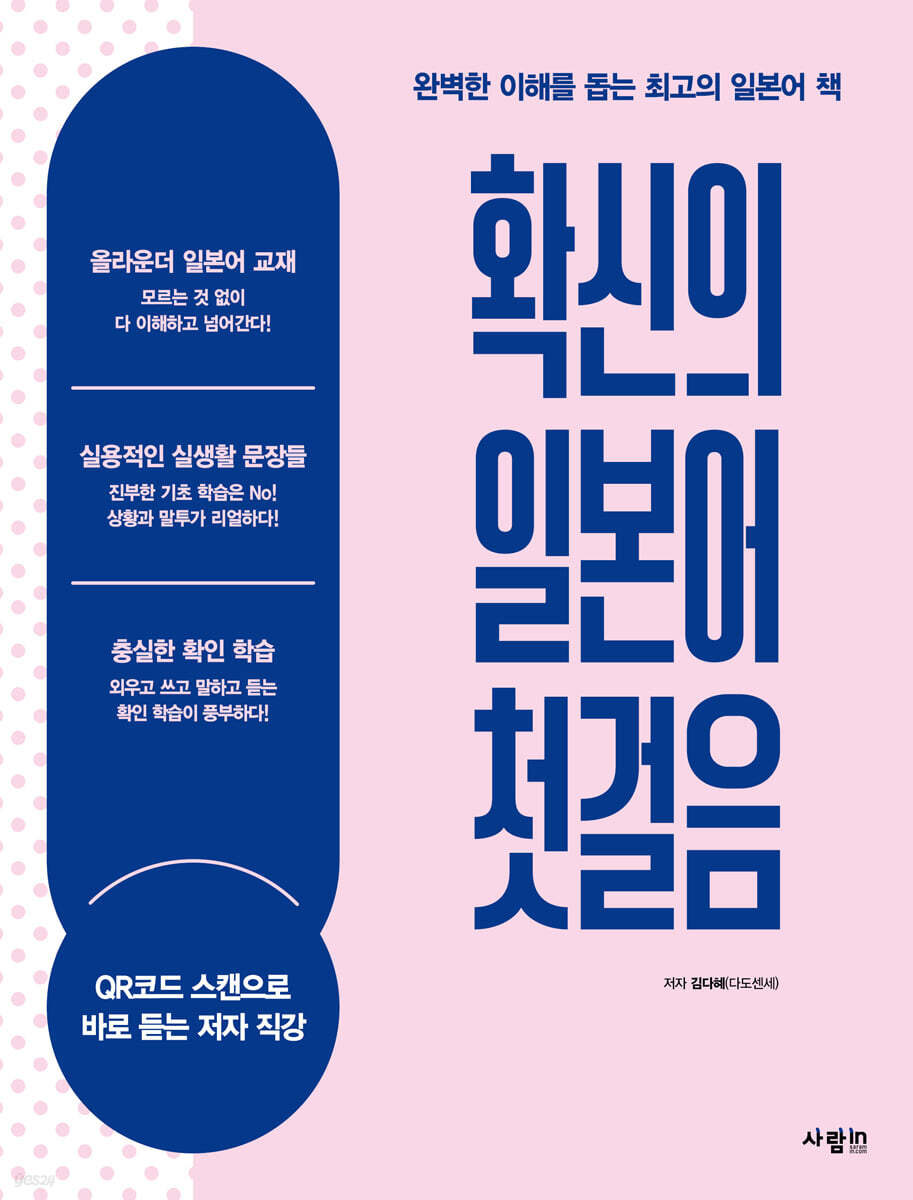
The first step to confident Japanese
 |
Description
Book Introduction
A solid foundation in Japanese that fills in the gaps and prevents learning regression.
Existing Japanese language basics books focus on providing concise and simple explanations.
"First Step to Confident Japanese" introduces all grammar usage without reservation, in an effort to prevent grammatical gaps that may arise later due to such concise explanations.
Considering the difficulties faced by readers who have difficulty finding solutions to their questions, you can sufficiently study basic Japanese on your own by listening to the author's lectures.
Existing Japanese language basics books focus on providing concise and simple explanations.
"First Step to Confident Japanese" introduces all grammar usage without reservation, in an effort to prevent grammatical gaps that may arise later due to such concise explanations.
Considering the difficulties faced by readers who have difficulty finding solutions to their questions, you can sufficiently study basic Japanese on your own by listening to the author's lectures.
- You can preview some of the book's contents.
Preview
index
preface
Structure of this book
Japanese characters and pronunciation
ひらがな Write
Write カタカナ
01 I am not an office worker.
ㆍLearn nouns related to occupations and nationalities
ㆍPositive polite form of noun: ~입니다
ㆍNegative polite form of noun: ~is not)
ㆍParticle "は"
ㆍPersonal pronouns
02 What is this?
ㆍLearning the directives 'this, that, that, which'
ㆍTypes of demonstrative nouns
ㆍAffirmative and negative sentences of nouns
ㆍParticle "の"
ㆍPersonal pronouns
03 It's time to do business. From what time to what time are the classes?
ㆍPosative particle 「から」·「まで」
ㆍPast formal form of noun: [Noun] + でした
ㆍReading numbers: 1 to 100
Reading a clock: Reading hours and minutes
04 Is this bag expensive?
ㆍDictionary form of the adjective い: ~da
ㆍFormal form of the i-adjective: ~입니다
ㆍNegative form of the adjective い: ~does not
ㆍConnecting the connective particle "が (=けど)" to the i-adjective
05 What is it like? That movie is scary and noisy.
ㆍConnection of i-adjectives 「~くて」: ~and, ~by
ㆍNoun modifier of i-adjective: [i-adjective] a noun
ㆍConjunctive particle 「から」: because of ~, because of ~
ㆍThe past tense of the i-adjective "katta desu": ~was
06 I don't like spicy food.
Basic and formal forms of the ㆍna adjective
Four negations of the adjective ㆍna
ㆍThe meaning of the inverse conjunction of the conjunction particle "~ga"
ㆍUse of particle "ga" in symbols and abilities
07 The building is great and pretty.
ㆍConnection of adjectives 「~で」: ~and, ~by
ㆍNoun modifier of na-adjective: [na-adjective] a noun
ㆍConjunctive particle 「から」: because of ~, because of ~ (cause, reason)
ㆍThe past form of the adjective "だった": ~ did
ㆍThe past formal form of the adjective "でした": ~ did
08 How much does this dress cost?
ㆍExpressing 'How much is it?'
ㆍ'Please give me ~' (ordinal number and request expression)
ㆍSaying the price
ㆍRead other calendars, days of the week, etc.
09 How to eat in Korea? It's cheaper in Japan than in Korea.
ㆍCompare between two (e.g. Which do you like better, A or B?)
ㆍCompare among three or more items in a large category (e.g., which fruit is the sweetest?)
ㆍExpressing comparisons using '~보다'
10 After lunch, eat lunch at a nearby cafe.
ㆍDivision of Japanese verbs into groups (groups 1, 2, and 3)
ㆍCreating the honorific form of the verb, "masu form"
ㆍLearning particles used with verbs (に、 で、 を、 と、 へ, etc.)
ㆍThe set of verbs and particles is different from Korean.
11 Let’s eat together and eat together.
I didn't eat it because I didn't want to gain weight.
ㆍFour conjugations of the polite form of the verb [masu] (positive present, negative present, positive past, negative past)
ㆍ[Masu-type] + に行いきます / ?きます : [Verb] I go/come to do something
ㆍLearning various suggestion expressions using the [masu] form
~ませんか: Shall we ~? / ~ましょう: Let's ~ / ~ましょうか: Shall we ~?
12 I want to buy a souvenir.
ㆍTalking about various expressions of hope
1) [masu-type] + たいです: [verb] I want to
2) [Noun] + I want [Noun]
ㆍExpression of a situation in which two actions are performed together
[Masu-type] + nagara: [verb] while
13 I drank too much alcohol at the company dinner.
ㆍ[Masu type] + yasui desu: ~ is easy to do / convenient
[Masu type] + にくいです : It is difficult / inconvenient to do ~
ㆍ[masu form] / [i-adjective stem] / [na-adjective stem] + sugimasu: excessively ~
ㆍNoun modifiers of nouns, verbs, and adjectives
14 What is it like to see it in the sky?
I'm going to go to a movie location and see some great scenery.
ㆍConjunctive form of verb [て form]: ~and, ~byeoseo, ~hae
ㆍ~tekudasai: [verb] Please do it (request, request, request)
ㆍ~ています: [verb] is doing (present progressive)
ㆍ~temimasu: [verb] I will try (to try)
15 Do you want to go alone? Can I go with you?
ㆍVerb te-form + しまいます: ~ is done, ~ is done (complete, regret)
ㆍVerb te-form + moi i desu: ~ may be done, ~ may be done (permission, permission)
ㆍVerb te-form + はいけません: ~ must not be done (prohibited)
ㆍVerb te-form + ほしいです: I want you to do ~ (hope, request)
16 Reheat it in the microwave and eat it.
ㆍVerb + formal noun 「の」: [verb] to do
ㆍTe-hyung + から: after doing ~
ㆍTe-hyung + おきます: ~ will be done, ~ will be done
ㆍTe type + も: ~even if
ㆍSummary of the worldview of the て form of nouns, adjectives, and verbs
17 What is it like to see it?
I watch television or read a book.
ㆍLearning the past tense of verbs, [た form]
ㆍ~tari、~tarishimasu : ~ or ~ or something (list, enumerate)
ㆍ [Ta-hyung] I just ~ : I just ~
ㆍ [ta-hyung] After : After ~
ㆍ [Dictionary form] 前まえに: before ~
18 What time is it? What time is it?
When I was in college, I worked at a cafe.
ㆍTa-hyung + ことがあります : I have done ~ (experience)
ㆍた type + 方ほうがいいです : It is better to do ~ (advice, counsel)
ㆍDictionary + ことができます: ~ is possible (possible)
19 It's cold. Please don't go out because it's cold.
ㆍThe negative form of the verb [nai form]
ㆍNo type + でください: Please don't do ~, don't do ~ (prohibition)
ㆍIt's better not to do it (advice, counsel)
20 When you speak at the right time, you can see it in the right place.
I do use it sometimes, but not often.
ㆍLearning the adverbial forms of i-adjectives and na-adjectives
ㆍSummary of four conjugations of verbs (informal, formal)
supplement
Answers & Scripts
Structure of this book
Japanese characters and pronunciation
ひらがな Write
Write カタカナ
01 I am not an office worker.
ㆍLearn nouns related to occupations and nationalities
ㆍPositive polite form of noun: ~입니다
ㆍNegative polite form of noun: ~is not)
ㆍParticle "は"
ㆍPersonal pronouns
02 What is this?
ㆍLearning the directives 'this, that, that, which'
ㆍTypes of demonstrative nouns
ㆍAffirmative and negative sentences of nouns
ㆍParticle "の"
ㆍPersonal pronouns
03 It's time to do business. From what time to what time are the classes?
ㆍPosative particle 「から」·「まで」
ㆍPast formal form of noun: [Noun] + でした
ㆍReading numbers: 1 to 100
Reading a clock: Reading hours and minutes
04 Is this bag expensive?
ㆍDictionary form of the adjective い: ~da
ㆍFormal form of the i-adjective: ~입니다
ㆍNegative form of the adjective い: ~does not
ㆍConnecting the connective particle "が (=けど)" to the i-adjective
05 What is it like? That movie is scary and noisy.
ㆍConnection of i-adjectives 「~くて」: ~and, ~by
ㆍNoun modifier of i-adjective: [i-adjective] a noun
ㆍConjunctive particle 「から」: because of ~, because of ~
ㆍThe past tense of the i-adjective "katta desu": ~was
06 I don't like spicy food.
Basic and formal forms of the ㆍna adjective
Four negations of the adjective ㆍna
ㆍThe meaning of the inverse conjunction of the conjunction particle "~ga"
ㆍUse of particle "ga" in symbols and abilities
07 The building is great and pretty.
ㆍConnection of adjectives 「~で」: ~and, ~by
ㆍNoun modifier of na-adjective: [na-adjective] a noun
ㆍConjunctive particle 「から」: because of ~, because of ~ (cause, reason)
ㆍThe past form of the adjective "だった": ~ did
ㆍThe past formal form of the adjective "でした": ~ did
08 How much does this dress cost?
ㆍExpressing 'How much is it?'
ㆍ'Please give me ~' (ordinal number and request expression)
ㆍSaying the price
ㆍRead other calendars, days of the week, etc.
09 How to eat in Korea? It's cheaper in Japan than in Korea.
ㆍCompare between two (e.g. Which do you like better, A or B?)
ㆍCompare among three or more items in a large category (e.g., which fruit is the sweetest?)
ㆍExpressing comparisons using '~보다'
10 After lunch, eat lunch at a nearby cafe.
ㆍDivision of Japanese verbs into groups (groups 1, 2, and 3)
ㆍCreating the honorific form of the verb, "masu form"
ㆍLearning particles used with verbs (に、 で、 を、 と、 へ, etc.)
ㆍThe set of verbs and particles is different from Korean.
11 Let’s eat together and eat together.
I didn't eat it because I didn't want to gain weight.
ㆍFour conjugations of the polite form of the verb [masu] (positive present, negative present, positive past, negative past)
ㆍ[Masu-type] + に行いきます / ?きます : [Verb] I go/come to do something
ㆍLearning various suggestion expressions using the [masu] form
~ませんか: Shall we ~? / ~ましょう: Let's ~ / ~ましょうか: Shall we ~?
12 I want to buy a souvenir.
ㆍTalking about various expressions of hope
1) [masu-type] + たいです: [verb] I want to
2) [Noun] + I want [Noun]
ㆍExpression of a situation in which two actions are performed together
[Masu-type] + nagara: [verb] while
13 I drank too much alcohol at the company dinner.
ㆍ[Masu type] + yasui desu: ~ is easy to do / convenient
[Masu type] + にくいです : It is difficult / inconvenient to do ~
ㆍ[masu form] / [i-adjective stem] / [na-adjective stem] + sugimasu: excessively ~
ㆍNoun modifiers of nouns, verbs, and adjectives
14 What is it like to see it in the sky?
I'm going to go to a movie location and see some great scenery.
ㆍConjunctive form of verb [て form]: ~and, ~byeoseo, ~hae
ㆍ~tekudasai: [verb] Please do it (request, request, request)
ㆍ~ています: [verb] is doing (present progressive)
ㆍ~temimasu: [verb] I will try (to try)
15 Do you want to go alone? Can I go with you?
ㆍVerb te-form + しまいます: ~ is done, ~ is done (complete, regret)
ㆍVerb te-form + moi i desu: ~ may be done, ~ may be done (permission, permission)
ㆍVerb te-form + はいけません: ~ must not be done (prohibited)
ㆍVerb te-form + ほしいです: I want you to do ~ (hope, request)
16 Reheat it in the microwave and eat it.
ㆍVerb + formal noun 「の」: [verb] to do
ㆍTe-hyung + から: after doing ~
ㆍTe-hyung + おきます: ~ will be done, ~ will be done
ㆍTe type + も: ~even if
ㆍSummary of the worldview of the て form of nouns, adjectives, and verbs
17 What is it like to see it?
I watch television or read a book.
ㆍLearning the past tense of verbs, [た form]
ㆍ~tari、~tarishimasu : ~ or ~ or something (list, enumerate)
ㆍ [Ta-hyung] I just ~ : I just ~
ㆍ [ta-hyung] After : After ~
ㆍ [Dictionary form] 前まえに: before ~
18 What time is it? What time is it?
When I was in college, I worked at a cafe.
ㆍTa-hyung + ことがあります : I have done ~ (experience)
ㆍた type + 方ほうがいいです : It is better to do ~ (advice, counsel)
ㆍDictionary + ことができます: ~ is possible (possible)
19 It's cold. Please don't go out because it's cold.
ㆍThe negative form of the verb [nai form]
ㆍNo type + でください: Please don't do ~, don't do ~ (prohibition)
ㆍIt's better not to do it (advice, counsel)
20 When you speak at the right time, you can see it in the right place.
I do use it sometimes, but not often.
ㆍLearning the adverbial forms of i-adjectives and na-adjectives
ㆍSummary of four conjugations of verbs (informal, formal)
supplement
Answers & Scripts
Detailed image

Publisher's Review
There are many questions you may have about your first steps in learning Japanese. With Tado Sensei, you can solve them all!
I think Japanese is easy to learn because the word order is similar to ours.
However, if you don't get your pronunciation and grammar system right, Japanese becomes more and more difficult the more you learn it.
The easier you think Japanese is, the more thorough you have to be. Tado Sensei will help you build a solid foundation!
Understand everything and move forward without knowing anything!
Each chapter explains important grammar points in detail and provides numerous examples to make them easy to understand.
Each grammar point is explained in detail, so you can study on your own, and you can study as if you were actually taking a class from a real teacher.
Practical real-life sentences
Rather than the stiff conversational structure of the past, it is composed of realistic conversational structure that can be used directly in actual conversations by utilizing the learned grammar.
And that's not all.
It guarantees a clear review effect by providing a secondary review of the grammar points of the corresponding lesson embedded in the conversational text.
Faithful Confirmation Learning
The questions are solidly structured with 'Word Guessing' to check how to read the kanji of the words you have learned, 'Sentence Creation' to complete sentences using the given words and grammar, 'Speaking and Writing' to actually speak based on what you have learned, and 'Listening' to improve your Japanese listening skills.
The extensive content helps students strengthen their Japanese skills in various ways.
Vivid lectures directly from the author
If you scan the QR code, you can listen to a lecture on 'Grammar Problems' in detail explained by the author.
With explanations that are easy to understand, you will have a solid foundation in Japanese.
Bonus pages to boost your interest in Japanese
At the end of each chapter, we provide a '+' (plus) learning page, which provides additional learning materials and useful information such as vocabulary, grammar, and tips for learning Japanese.
This allows learners to delve deeper into their studies and resolve any questions they may have as they learn, thereby increasing their interest in learning Japanese.
I think Japanese is easy to learn because the word order is similar to ours.
However, if you don't get your pronunciation and grammar system right, Japanese becomes more and more difficult the more you learn it.
The easier you think Japanese is, the more thorough you have to be. Tado Sensei will help you build a solid foundation!
Understand everything and move forward without knowing anything!
Each chapter explains important grammar points in detail and provides numerous examples to make them easy to understand.
Each grammar point is explained in detail, so you can study on your own, and you can study as if you were actually taking a class from a real teacher.
Practical real-life sentences
Rather than the stiff conversational structure of the past, it is composed of realistic conversational structure that can be used directly in actual conversations by utilizing the learned grammar.
And that's not all.
It guarantees a clear review effect by providing a secondary review of the grammar points of the corresponding lesson embedded in the conversational text.
Faithful Confirmation Learning
The questions are solidly structured with 'Word Guessing' to check how to read the kanji of the words you have learned, 'Sentence Creation' to complete sentences using the given words and grammar, 'Speaking and Writing' to actually speak based on what you have learned, and 'Listening' to improve your Japanese listening skills.
The extensive content helps students strengthen their Japanese skills in various ways.
Vivid lectures directly from the author
If you scan the QR code, you can listen to a lecture on 'Grammar Problems' in detail explained by the author.
With explanations that are easy to understand, you will have a solid foundation in Japanese.
Bonus pages to boost your interest in Japanese
At the end of each chapter, we provide a '+' (plus) learning page, which provides additional learning materials and useful information such as vocabulary, grammar, and tips for learning Japanese.
This allows learners to delve deeper into their studies and resolve any questions they may have as they learn, thereby increasing their interest in learning Japanese.
GOODS SPECIFICS
- Date of issue: February 17, 2025
- Page count, weight, size: 322 pages | 774g | 188*247*20mm
- ISBN13: 9791171011353
- ISBN10: 1171011350
You may also like
카테고리
korean


korean

![GQ KOREA Mark (Monthly): December [2025]](http://librairie.coreenne.fr/cdn/shop/files/8ef265dbbfbf186523ed75ba7319009d.jpg?v=1765340328&width=3840)


