

The Knitter's Twelve Months
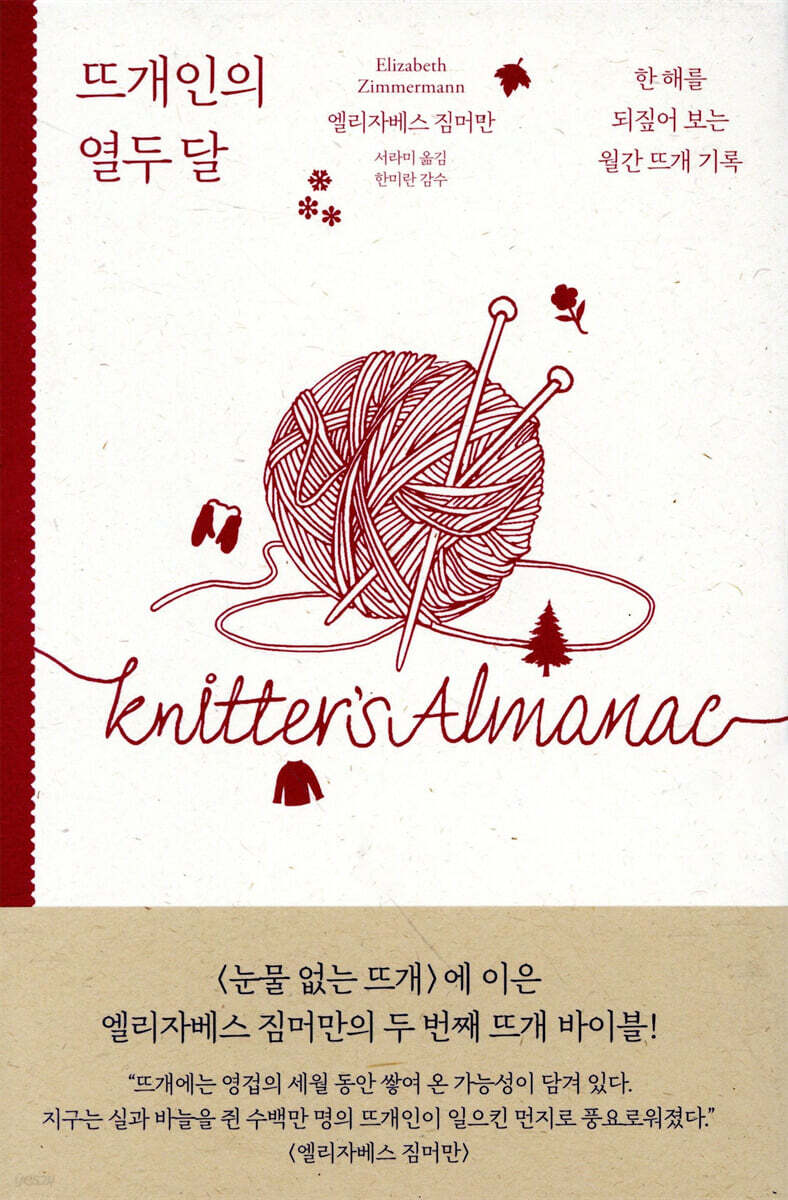 |
Description
Book Introduction
Following 『Knitting Without Tears』
Elizabeth Zimmerman's second knitting bible!
“Knitting contains possibilities accumulated over eons of time.
“The earth is enriched by the dust raised by millions of knitters with needles and thread.” Elizabeth Zimmerman
Knitter's Almanac is Elizabeth Zimmerman's second book.
Her first book, Knitting Without Tears, was a huge success, packed with both practical and innovative content, but it didn't capture everything she knew about knitting.
So she wrote another book, and it was called The Knitter's Twelve Months.
Elizabeth Zimmerman, born in England in 1910, immigrated to the United States in 1937 and founded Schoolhouse Press, selling knitting supplies such as wool yarn and knitting needles, and also began publishing a knitting newsletter.
In a time when proper knitting information was hard to come by, Zimmerman's newsletter, filled with original patterns and a strong knitting philosophy, created a huge sensation.
Since then, Zimmerman has held knitting camps every year and appeared on the PBS television series "The Busy Knitter," where she has become a beloved knitting icon with her easy-to-understand explanations and witty banter.
As the title suggests, this book is a monthly knitting journal that looks back on the year through the twelve months of a passionate knitter who knits day and night all year long.
There is no off-season for a true knitter.
From fall to winter, when the weather gets colder, I mainly knit warm clothes like sweaters and tights, but when spring comes and the hot summer arrives, passionate knitters can't put down their needles.
Knitted items are endless, regardless of the season: blankets made with repeating square motifs, gloves and hats for next winter, ornaments for the Christmas tree, and shawls perfect for traveling.
As shown in her previous work, Knitting Without Tears, "A Knitter's Twelve Months" is filled with Zimmerman's signature humor and philosophy, watercolor-like daily life, and precious knitting advice.
If you follow her guidance each month from January to December, you will soon complete a piece that is perfect for the season.
Her sweet chatter is an unmissable pleasure.
For readers accustomed to modern patterns, Zimmerman's "thinking knitter's guide" may be a bit difficult to understand.
For those people, I've included concise but precise instructions at the end of each chapter.
I hope you enjoy the joy of passing through the four seasons with “The Knitter’s Twelve Months.”
Elizabeth Zimmerman's second knitting bible!
“Knitting contains possibilities accumulated over eons of time.
“The earth is enriched by the dust raised by millions of knitters with needles and thread.” Elizabeth Zimmerman
Knitter's Almanac is Elizabeth Zimmerman's second book.
Her first book, Knitting Without Tears, was a huge success, packed with both practical and innovative content, but it didn't capture everything she knew about knitting.
So she wrote another book, and it was called The Knitter's Twelve Months.
Elizabeth Zimmerman, born in England in 1910, immigrated to the United States in 1937 and founded Schoolhouse Press, selling knitting supplies such as wool yarn and knitting needles, and also began publishing a knitting newsletter.
In a time when proper knitting information was hard to come by, Zimmerman's newsletter, filled with original patterns and a strong knitting philosophy, created a huge sensation.
Since then, Zimmerman has held knitting camps every year and appeared on the PBS television series "The Busy Knitter," where she has become a beloved knitting icon with her easy-to-understand explanations and witty banter.
As the title suggests, this book is a monthly knitting journal that looks back on the year through the twelve months of a passionate knitter who knits day and night all year long.
There is no off-season for a true knitter.
From fall to winter, when the weather gets colder, I mainly knit warm clothes like sweaters and tights, but when spring comes and the hot summer arrives, passionate knitters can't put down their needles.
Knitted items are endless, regardless of the season: blankets made with repeating square motifs, gloves and hats for next winter, ornaments for the Christmas tree, and shawls perfect for traveling.
As shown in her previous work, Knitting Without Tears, "A Knitter's Twelve Months" is filled with Zimmerman's signature humor and philosophy, watercolor-like daily life, and precious knitting advice.
If you follow her guidance each month from January to December, you will soon complete a piece that is perfect for the season.
Her sweet chatter is an unmissable pleasure.
For readers accustomed to modern patterns, Zimmerman's "thinking knitter's guide" may be a bit difficult to understand.
For those people, I've included concise but precise instructions at the end of each chapter.
I hope you enjoy the joy of passing through the four seasons with “The Knitter’s Twelve Months.”
- You can preview some of the book's contents.
Preview
index
January Aran Sweater
Some baby items for February
March's Difficult Sweater (Actually Not Difficult)
April Mystery Blanket
Gloves for next winter in May
June Border Knitting and Summer Projects
A great shawl to knit while traveling in July
Knitting Christmas Ornaments in August
September Tides
October open collar pullover
November Moccasin Socks
A sweater that is rushed at the end of December
Appendix: About Unfamiliar Terms and Special Knitting Techniques
Some baby items for February
March's Difficult Sweater (Actually Not Difficult)
April Mystery Blanket
Gloves for next winter in May
June Border Knitting and Summer Projects
A great shawl to knit while traveling in July
Knitting Christmas Ornaments in August
September Tides
October open collar pullover
November Moccasin Socks
A sweater that is rushed at the end of December
Appendix: About Unfamiliar Terms and Special Knitting Techniques
Detailed image

Into the book
For centuries, women in the Western Isles of Ireland have knitted Aran sweaters from unbleached, cream-colored, handspun yarn.
Most sweaters have turtlenecks that block the wind, and their sleeves don't stretch or get damp easily even when caught in the net.
Just as each Scottish clan has its own unique tartan pattern, each sweater also has its own unique pattern.
I'm not sure why each family in Scotland has a pattern, but I heard that in the case of Arran, it was so that drowning fishermen could be identified when they washed up on the shore.
It's a heartbreaking story.
--- p.14
Now let's move on to baby leggings.
I first saw these practical baby clothes in Germany and made them for my children who were born in the United States.
At that time we lived in an apartment without hot water (the term "without hot water" is a euphemism for the cold we experienced there), which was quite European in nature.
Leggings combine the functions of pants, diaper covers, and socks, allowing your child to move freely while wearing clothes.
Not long after I had my grandson, I started knitting leggings again.
I designed it in my own unique version.
Because this is formalized, no matter what kind of wool you use, no matter what gauge you use, the same result will be obtained, just with a different size.
--- pp.53-54
Many of us can relate to the immense pride we feel after knitting something that makes our knitting experts ask, "How did you knit that?"
Then he sits back a little with an arrogant, satisfied smile and gives a little hint.
With a wink.
--- p.92
There's a saying that you shouldn't mix wine and beer, and I took that to mean don't mix your knitting needles and your crochet hooks, and I still stick to it.
There's something about putting a crochet border on a knitted fabric that makes me uncomfortable (again, this is just my personal opinion).
Because there are borders that can be knitted beautifully even with a large needle, and I don't want to put too many techniques into one project.
You may have noticed that I am inconsistent.
I absolutely love and admire tweed jackets with a knitted border.
I've seen tweed jackets with leather trim, and conversely, leather jackets with tweed trim.
I just seem to have a low-level prejudice and superiority complex about crochet hooks.
However, many knitters will admit that they are not very skilled at crochet, and for them, I'm going to offer some tips to make their garter stitch borders look very professional.
--- pp.129-130
There's one thing I'd like to say.
There is a rumor that I hate being single and try to avoid it whenever possible, but that is not strictly true.
Ants have their place and are useful.
Without purl, so many beautiful knitting patterns would not be possible.
What can you put in the background of the Aran pattern if you don't have an anther?
If there is no purl, is it possible to block the nose when doing garter stitch and get a surprisingly neat edge?
However, it is true that many people knit slower than they knit, and for those who knit with the yarn on their left index finger, the purl can definitely be awkward.
Let's ask the knitter.
Perhaps they will admit that they prefer the purl when knitting with a plain knit.
Some people might prefer to not use any method as long as it has some function, is pretty, and has a noticeable effect.
But if you don't have to do it, why bother?
Most sweaters have turtlenecks that block the wind, and their sleeves don't stretch or get damp easily even when caught in the net.
Just as each Scottish clan has its own unique tartan pattern, each sweater also has its own unique pattern.
I'm not sure why each family in Scotland has a pattern, but I heard that in the case of Arran, it was so that drowning fishermen could be identified when they washed up on the shore.
It's a heartbreaking story.
--- p.14
Now let's move on to baby leggings.
I first saw these practical baby clothes in Germany and made them for my children who were born in the United States.
At that time we lived in an apartment without hot water (the term "without hot water" is a euphemism for the cold we experienced there), which was quite European in nature.
Leggings combine the functions of pants, diaper covers, and socks, allowing your child to move freely while wearing clothes.
Not long after I had my grandson, I started knitting leggings again.
I designed it in my own unique version.
Because this is formalized, no matter what kind of wool you use, no matter what gauge you use, the same result will be obtained, just with a different size.
--- pp.53-54
Many of us can relate to the immense pride we feel after knitting something that makes our knitting experts ask, "How did you knit that?"
Then he sits back a little with an arrogant, satisfied smile and gives a little hint.
With a wink.
--- p.92
There's a saying that you shouldn't mix wine and beer, and I took that to mean don't mix your knitting needles and your crochet hooks, and I still stick to it.
There's something about putting a crochet border on a knitted fabric that makes me uncomfortable (again, this is just my personal opinion).
Because there are borders that can be knitted beautifully even with a large needle, and I don't want to put too many techniques into one project.
You may have noticed that I am inconsistent.
I absolutely love and admire tweed jackets with a knitted border.
I've seen tweed jackets with leather trim, and conversely, leather jackets with tweed trim.
I just seem to have a low-level prejudice and superiority complex about crochet hooks.
However, many knitters will admit that they are not very skilled at crochet, and for them, I'm going to offer some tips to make their garter stitch borders look very professional.
--- pp.129-130
There's one thing I'd like to say.
There is a rumor that I hate being single and try to avoid it whenever possible, but that is not strictly true.
Ants have their place and are useful.
Without purl, so many beautiful knitting patterns would not be possible.
What can you put in the background of the Aran pattern if you don't have an anther?
If there is no purl, is it possible to block the nose when doing garter stitch and get a surprisingly neat edge?
However, it is true that many people knit slower than they knit, and for those who knit with the yarn on their left index finger, the purl can definitely be awkward.
Let's ask the knitter.
Perhaps they will admit that they prefer the purl when knitting with a plain knit.
Some people might prefer to not use any method as long as it has some function, is pretty, and has a noticeable effect.
But if you don't have to do it, why bother?
--- p.245
GOODS SPECIFICS
- Date of issue: June 1, 2024
- Format: Hardcover book binding method guide
- Page count, weight, size: 284 pages | 440g | 124*188*26mm
- ISBN13: 9791185676760
- ISBN10: 1185676767
You may also like
카테고리
korean


korean

![GQ KOREA Mark (Monthly): December [2025]](http://librairie.coreenne.fr/cdn/shop/files/8ef265dbbfbf186523ed75ba7319009d.jpg?v=1765340328&width=3840)


