

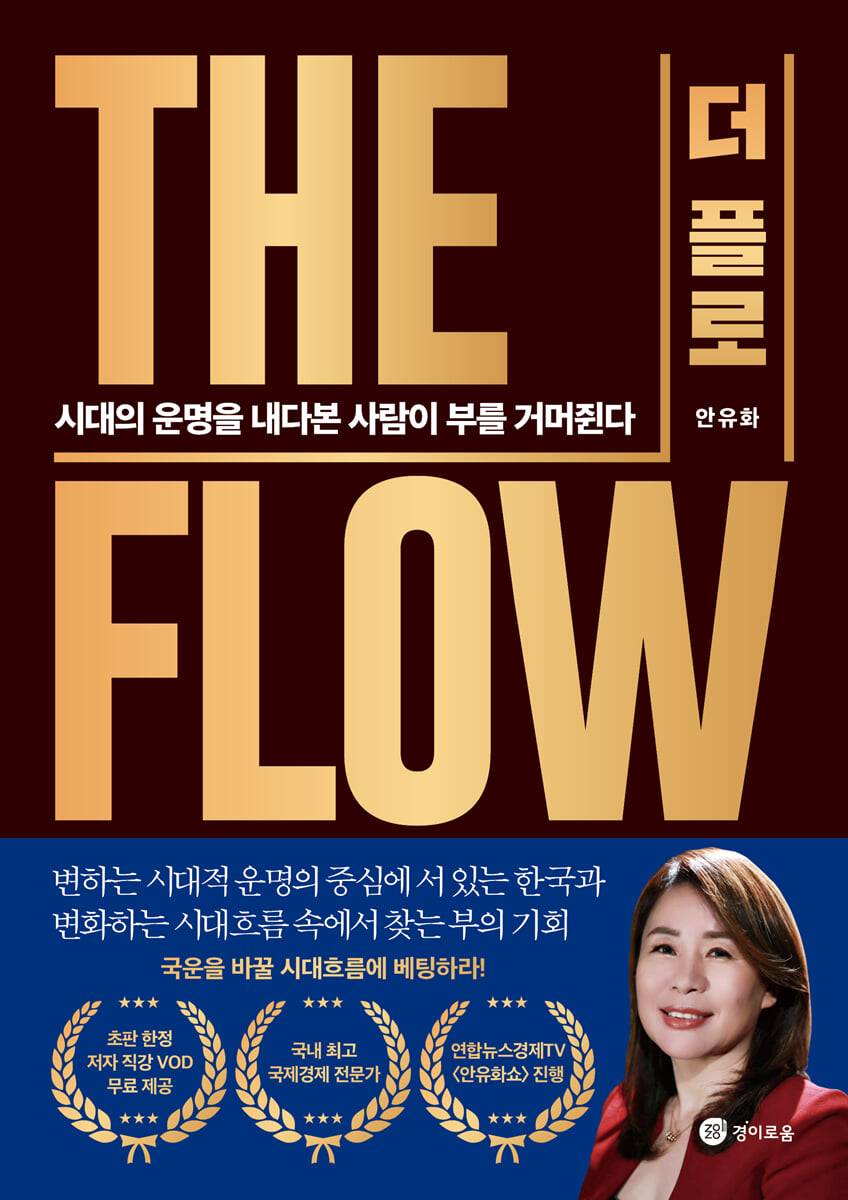
The Flow
 |
Description
Book Introduction
Korea's top international economic expert Professor Ahn Yu-hwa's first solo book! This book is the first solo work by Professor Ahn Yu-hwa, Korea's leading international economics expert. The author has deep and broad insight into the field of international economics, having studied economics and finance in various countries around the world, including Korea, China, the United States, Japan, and the United Kingdom. The author has met with various economic experts and the public through his unique insight and knowledge. This book summarizes the key points conveyed during the 10th An Yu-hwa Reading and Investment Club and the 1st Live Lecture on the Telescope. Reading the trends of the times that will lead the future Seize the opportunity to become rich Under a capitalist system, asset management through investment is essential to hedge against inflation, ensure a longer life after retirement due to increased average life expectancy, and enjoy financial freedom before retirement. The basic principle of investment is ‘understanding the trends of the times.’ As capital flows into industries that will lead the future, it is necessary to understand global trends in advance and utilize them for investment. In this book, the author discusses various perspectives necessary to understand the flow of the times, but emphasizes understanding the relationship between the economic powers of the United States and China and the "dopamine economy" centered around the MZ generation. The conflict between the G2 powers of the US and China is a complex web of interests that is reorganizing the international order and creating a new era. And the MZ generation, which leads future consumption, places more importance on their virtual selves than the older generation, which places more importance on their real selves. In this book, let's examine the author's objective and logical approach to the international economic trends and prospects, and come up with answers about the future of the economy. Capital feeds on the future Read the story that will lead the future and invest boldly! This book is organized into six parts, covering not only the basic theories of understanding the economy, but also the trends and prospects of the global economy. Part 1 explains why it is important to understand the trends of the times and why investment is necessary. Part 2 introduces how to use the ROE formula to predict the future trends of companies and nations and select investment targets. ROE is the return on equity, which indicates how much profit a company generates with its own capital. It is influenced by factors such as changes in the leading industry and technological innovation. ROE is a crucial concept for assessing the future potential of a country and a company. Part 3 introduces various business cycles and teaches us how to read future trends by applying the major trends of technological innovation achieved by mankind to the 50-year economic cycle, the "Kondratiev Wave." In addition, we will examine the economic trends of the two major economic powers, the United States and China, the G2. Part 4, following Part 3, examines the Chinese economy, which has grown into a G2, and adds a political and economic interpretation of it to forecast the future economy. Part 5 emphasizes the US-China conflict that drives the international order and the strategic stance that Korea should take within this current. Lastly, Part 6 talks about the sixth innovative technology that we will soon encounter and the trends of the times ahead, and especially emphasizes that the future will be a 'dopamine economy' centered around the MZ generation. The essence of investing is 'risk taking'. By understanding the author's profound knowledge and insight, you will be able to logically interpret the story of capital flows and boldly invest to seize opportunities for wealth. |
- You can preview some of the book's contents.
Preview
index
Prologue - Those who ride the wave of the times lead the future!
CHAPTER 1.
Investing is betting on the trends of the times.
Knowing the flow of the times
Finding the Goose That Lays the Golden Eggs
Even stories that the public is crazy about are ultimately a reflection of the times.
The investment psychology of those who ignore the trends of the times
Two social trends to watch
If you're lazy about studying the trends of the times, you'll only live that long.
Realization of wealth in a capitalist system
The importance of asset management to beat inflation
A life of willingness to take risks: a prerequisite for success, as realized belatedly.
CHAPTER 2. The Trends and Investment Directions Hidden in ROE
Fundamentals of Investment ① Understanding Intrinsic Value
Fundamentals of Investment ② Understanding the Concept of ROE
The national fortune and trends hidden in ROE
ROE in the Manufacturing Industry Decline
Currency volume and currency index included in ROE
A framework for analyzing corporate value from a historical perspective
CHAPTER 3.
Coupling the 50-Year Economic Cycle with the Technological Innovation Cycle
Business Cycle and GDP & Stock Prices
The 50-Year Economic Cycle and the Kondratiev Wave
Medium-term business cycles, the Jugla and Kitchen waves
The Chinese economy as seen through the lens of the Zugala wave
Where should I invest: the US or China?
The economic cycle is a kind of debt cycle.
Why the U.S. Stock Market Is on a Long-Term Uptrend
Is investing in US stocks a good idea?
CHAPTER 4.
Knowing China makes it easy to understand the flow of the times.
China's 70 Years of Reform and Openness - Deng Xiaoping's "Black Cat, White Cat Theory"
The First Step to Shared Wealth: Growing the Pie
The End of Shared Wealth: Sharing the Pie
How much wealth do Chinese people have?
The Significance of Xi Jinping's Third Term: The Path to "Chinese Modernization"
How globalization made China a G2 powerhouse.
A Political Economic Interpretation of China's Economic Growth
Is Chinese real estate a bubble?
What is the future of the Chinese economy?
CHAPTER 5.
Finding Investment Directions in the Age of US-China Conflict
How will the US-China conflict unfold?
Will the Biden administration's public restraint policies work?
The more the US attacks, the bigger China grows, and the US's response to China's exclusion.
Is it possible for China's semiconductor industry to achieve independence?
Is Taiwan the next Ukraine?
The possibility of US financial sanctions and China's preemptive response
Wall Street is not leaving China.
Can Vietnam Replace China as the World's Factory?
Finding Korea's Direction Amidst the US-China Conflict
Korea, facing its own destiny, is now entering the era of Korean manufacturing.
CHAPTER 6.
The flow of the times, the direction of the future, and our preparations
The Fate of FAANG and Son Jeong-ui
What is the sixth innovative technology that will lead the future?
Who is the next Apple?
A paradigm for the global automotive industry
An Eco-Friendly Future Driven by Digital Technology
Blockchain Technology Solves Credit Risk
Another space where I live, the metaverse
The Declining Economy of Material Desire, the Rising Economy of Dopamine
After semiconductors, is data the next leading industry?
Four Factors That Determine Corporate Competitiveness After the COVID-19 Pandemic
Korea is no longer an IT powerhouse.
Conditions for Korea to become a digital powerhouse
Epilogue - Break out of the 'chicken coop' and surpass your limits!
CHAPTER 1.
Investing is betting on the trends of the times.
Knowing the flow of the times
Finding the Goose That Lays the Golden Eggs
Even stories that the public is crazy about are ultimately a reflection of the times.
The investment psychology of those who ignore the trends of the times
Two social trends to watch
If you're lazy about studying the trends of the times, you'll only live that long.
Realization of wealth in a capitalist system
The importance of asset management to beat inflation
A life of willingness to take risks: a prerequisite for success, as realized belatedly.
CHAPTER 2. The Trends and Investment Directions Hidden in ROE
Fundamentals of Investment ① Understanding Intrinsic Value
Fundamentals of Investment ② Understanding the Concept of ROE
The national fortune and trends hidden in ROE
ROE in the Manufacturing Industry Decline
Currency volume and currency index included in ROE
A framework for analyzing corporate value from a historical perspective
CHAPTER 3.
Coupling the 50-Year Economic Cycle with the Technological Innovation Cycle
Business Cycle and GDP & Stock Prices
The 50-Year Economic Cycle and the Kondratiev Wave
Medium-term business cycles, the Jugla and Kitchen waves
The Chinese economy as seen through the lens of the Zugala wave
Where should I invest: the US or China?
The economic cycle is a kind of debt cycle.
Why the U.S. Stock Market Is on a Long-Term Uptrend
Is investing in US stocks a good idea?
CHAPTER 4.
Knowing China makes it easy to understand the flow of the times.
China's 70 Years of Reform and Openness - Deng Xiaoping's "Black Cat, White Cat Theory"
The First Step to Shared Wealth: Growing the Pie
The End of Shared Wealth: Sharing the Pie
How much wealth do Chinese people have?
The Significance of Xi Jinping's Third Term: The Path to "Chinese Modernization"
How globalization made China a G2 powerhouse.
A Political Economic Interpretation of China's Economic Growth
Is Chinese real estate a bubble?
What is the future of the Chinese economy?
CHAPTER 5.
Finding Investment Directions in the Age of US-China Conflict
How will the US-China conflict unfold?
Will the Biden administration's public restraint policies work?
The more the US attacks, the bigger China grows, and the US's response to China's exclusion.
Is it possible for China's semiconductor industry to achieve independence?
Is Taiwan the next Ukraine?
The possibility of US financial sanctions and China's preemptive response
Wall Street is not leaving China.
Can Vietnam Replace China as the World's Factory?
Finding Korea's Direction Amidst the US-China Conflict
Korea, facing its own destiny, is now entering the era of Korean manufacturing.
CHAPTER 6.
The flow of the times, the direction of the future, and our preparations
The Fate of FAANG and Son Jeong-ui
What is the sixth innovative technology that will lead the future?
Who is the next Apple?
A paradigm for the global automotive industry
An Eco-Friendly Future Driven by Digital Technology
Blockchain Technology Solves Credit Risk
Another space where I live, the metaverse
The Declining Economy of Material Desire, the Rising Economy of Dopamine
After semiconductors, is data the next leading industry?
Four Factors That Determine Corporate Competitiveness After the COVID-19 Pandemic
Korea is no longer an IT powerhouse.
Conditions for Korea to become a digital powerhouse
Epilogue - Break out of the 'chicken coop' and surpass your limits!
Detailed image

Into the book
I would like to say that we must first study the trends of the times.
In any era, there was a trend that dominated that era.
And people, companies, and countries that rode the wave of the times have led the world.
The trend of the times refers to the flow of technology, capital, and consumption that dominates the world.
Knowing the flow is essential to achieving wealth and financial freedom.
Throughout the history of human development, new technologies have always given rise to new industries, and the leading companies in those industries have always become the leading companies of their time.
--- p.23
While the benefits of information and communication technology are likely to continue for at least the next decade, until 2035, what is certain is that a new cycle of technological innovation will begin after 2035.
What innovative technologies will lead the way? I believe that biotechnology and AI will be the driving forces for the next 50 years. While AI technology was already developed in the 1970s and 1980s, its current flourishing stems from the vast amount of data available, which can be called the "rice of future industries."
In the future, the competitiveness of each country will be determined by its ability to secure a data environment, and a new world of digital wealth gap will emerge accordingly.
We must prepare for this world.
--- p.148
The ChatGPT case may sound like a sensational story, but even robots know that the era of earning money through labor is over.
So, we have to get on the changing trend.
The top 1% of wealthy people make most of their money from financial income.
Especially in an economy like today where money is being thrown around like a helicopter, if you don't want your income to be slashed by inflation, you need to have financial assets that hedge against inflation.
Because the money you spread will ultimately go to the person who holds the assets.
--- p.193
Ultimately, China surpassed the United States to become the world's largest trading nation in 2013.
As China's influence in the global economy grows, the United States begins to feel nervous.
As is well known, the Trump administration began to contain China in 2018 by imposing tariffs on $360 billion worth of Chinese products, and tensions between the two countries continue to this day.
For reference, China responded to the US tariff policy with a counter-tariff policy of $110 billion on US products.
There seems to be a widespread view that both countries suffered losses in a situation where there was no clear winner.
As I just mentioned, the US-China conflict is still ongoing.
What started as a trade conflict has since expanded into political and military issues.
--- p.244~245
In other words, the Chinese government is implementing policies to encourage funds invested in real estate to flow into high value-added manufacturing.
First, we are actively implementing preferential policies to lower loan interest rates as much as possible for companies in future industries such as renewable energy, batteries, and semiconductors, thereby enabling them to grow as leading industries.
In addition, efforts are being made to mitigate the risk of a hard landing for the Chinese economy by implementing interest rate support policies for real estate companies and ensuring that the economy runs smoothly before manufacturing becomes the leading industry.
In short, it is safe to say that the Xi Jinping administration, which must simultaneously achieve economic growth and stability, is at the most critical juncture in history.
The outcome will be decided in the second half of this year and next year.
If the replacement of leading players in the leading industries is successful, the Chinese economy will embark on a new growth path. If not, it could end up reminiscing about Japan's lost past.
--- p.271
We live in an era where things that were once difficult to imagine, where people and objects, reality and the virtual, and all things in the world are connected, have become reality.
In short, it is the era of smart convergence.
For example, we live in an era where competition between universities goes beyond the domestic border and competes with universities around the world.
Seoul National University competes with Harvard University.
Only by breaking out of the well and becoming competitive on the global stage can we become true winners.
Now, even industry must apply collective wisdom.
A platform must be established where collective wisdom can generate ideas and create new products.
Embedding metaverse platforms into all industries is a global industrial trend.
In any era, there was a trend that dominated that era.
And people, companies, and countries that rode the wave of the times have led the world.
The trend of the times refers to the flow of technology, capital, and consumption that dominates the world.
Knowing the flow is essential to achieving wealth and financial freedom.
Throughout the history of human development, new technologies have always given rise to new industries, and the leading companies in those industries have always become the leading companies of their time.
--- p.23
While the benefits of information and communication technology are likely to continue for at least the next decade, until 2035, what is certain is that a new cycle of technological innovation will begin after 2035.
What innovative technologies will lead the way? I believe that biotechnology and AI will be the driving forces for the next 50 years. While AI technology was already developed in the 1970s and 1980s, its current flourishing stems from the vast amount of data available, which can be called the "rice of future industries."
In the future, the competitiveness of each country will be determined by its ability to secure a data environment, and a new world of digital wealth gap will emerge accordingly.
We must prepare for this world.
--- p.148
The ChatGPT case may sound like a sensational story, but even robots know that the era of earning money through labor is over.
So, we have to get on the changing trend.
The top 1% of wealthy people make most of their money from financial income.
Especially in an economy like today where money is being thrown around like a helicopter, if you don't want your income to be slashed by inflation, you need to have financial assets that hedge against inflation.
Because the money you spread will ultimately go to the person who holds the assets.
--- p.193
Ultimately, China surpassed the United States to become the world's largest trading nation in 2013.
As China's influence in the global economy grows, the United States begins to feel nervous.
As is well known, the Trump administration began to contain China in 2018 by imposing tariffs on $360 billion worth of Chinese products, and tensions between the two countries continue to this day.
For reference, China responded to the US tariff policy with a counter-tariff policy of $110 billion on US products.
There seems to be a widespread view that both countries suffered losses in a situation where there was no clear winner.
As I just mentioned, the US-China conflict is still ongoing.
What started as a trade conflict has since expanded into political and military issues.
--- p.244~245
In other words, the Chinese government is implementing policies to encourage funds invested in real estate to flow into high value-added manufacturing.
First, we are actively implementing preferential policies to lower loan interest rates as much as possible for companies in future industries such as renewable energy, batteries, and semiconductors, thereby enabling them to grow as leading industries.
In addition, efforts are being made to mitigate the risk of a hard landing for the Chinese economy by implementing interest rate support policies for real estate companies and ensuring that the economy runs smoothly before manufacturing becomes the leading industry.
In short, it is safe to say that the Xi Jinping administration, which must simultaneously achieve economic growth and stability, is at the most critical juncture in history.
The outcome will be decided in the second half of this year and next year.
If the replacement of leading players in the leading industries is successful, the Chinese economy will embark on a new growth path. If not, it could end up reminiscing about Japan's lost past.
--- p.271
We live in an era where things that were once difficult to imagine, where people and objects, reality and the virtual, and all things in the world are connected, have become reality.
In short, it is the era of smart convergence.
For example, we live in an era where competition between universities goes beyond the domestic border and competes with universities around the world.
Seoul National University competes with Harvard University.
Only by breaking out of the well and becoming competitive on the global stage can we become true winners.
Now, even industry must apply collective wisdom.
A platform must be established where collective wisdom can generate ideas and create new products.
Embedding metaverse platforms into all industries is a global industrial trend.
--- p.405
GOODS SPECIFICS
- Date of issue: August 2, 2023
- Page count, weight, size: 448 pages | 152*215*30mm
- ISBN13: 9791192445403
- ISBN10: 1192445406
You may also like
카테고리
korean


korean

![GQ KOREA Mark (Monthly): December [2025]](http://librairie.coreenne.fr/cdn/shop/files/8ef265dbbfbf186523ed75ba7319009d.jpg?v=1765340328&width=3840)


