

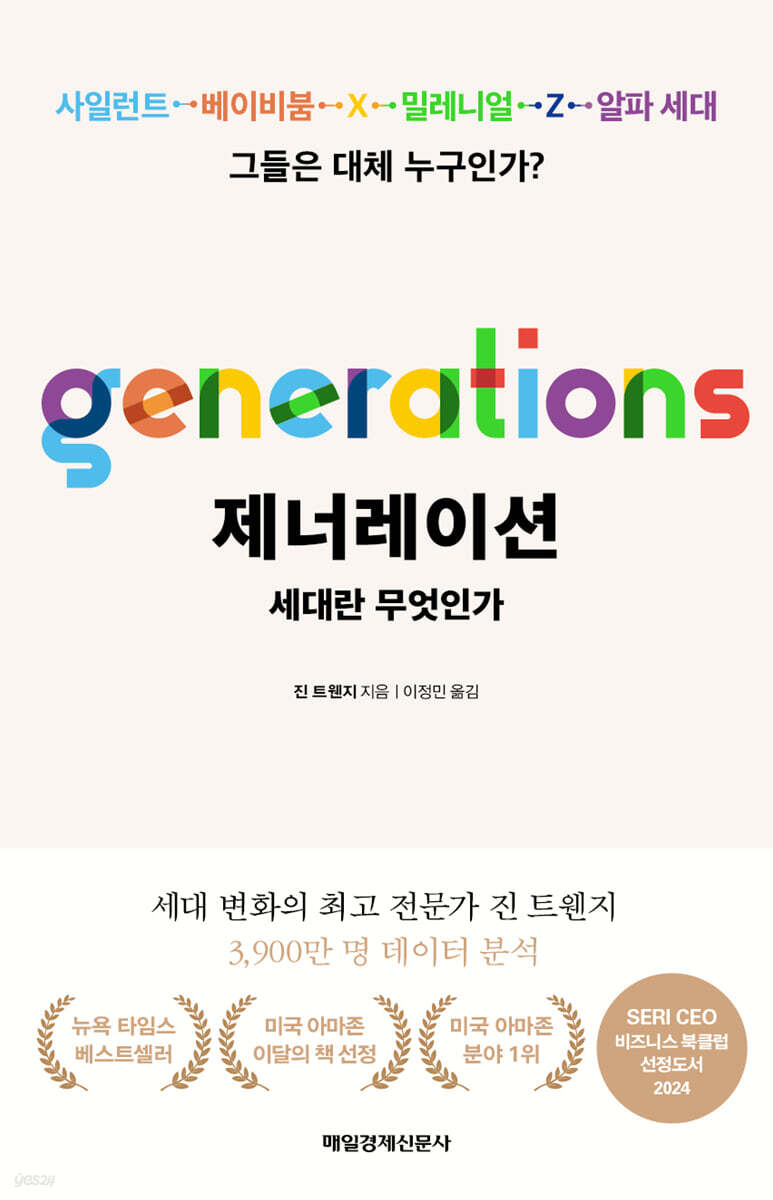
Generation: What is a generation?
 |
Description
Book Introduction
[New York Times] Bestseller, Amazon Book of the Month, #1 on Amazon Jin Twenge, the leading expert on generational change The One Book You Must Read to Start 2024 Silent, Baby Boomers, X, Millennials, Z, Generation Alpha, who are they? From the Silent Generation (1925-1945), Baby Boomers (1946-1964), Generation X (1965-1979), Millennials (1980-1994), Generation Z (1995-2012), to Generation Alpha (2013-2029), they have very different life experiences and therefore have different beliefs and pursue different behaviors. What are the differences between these six generations, what are their causes, and how deeply do they actually communicate and conflict? Professor Jean Twenge, a renowned American social psychologist, New York Times bestselling author, and leading expert on generational change, draws on decades of research and a vast database to identify their characteristics and relationships. This book provides a glimpse into how six generations living in this very moment are connected, how they differ in their personalities, and what they consider most important in life. It's a story that captures the era you lived in, and you'll nod and empathize with it, no matter what generation you belong to. Recognizing the differences between generations, ironically, is what brings us together. Through this book, your perspective on parents, children, and people you meet at work and in society will completely change and become clearer. |
- You can preview some of the book's contents.
Preview
index
Chapter 1 How can we divide generations?
· What causes the generation gap?
· How can we actually detect the generation gap?
· Are you a millennial even if you don't feel that way?
· Does generation really exist?
· Where do we go from here?
Chapter 2: The Silent Generation (born 1925–1945)
· Equality Revolution
: Pioneers of Civil Rights
· Don't be afraid to get married young.
: Early marriage and many children
· Rock and Roll High School
: Improving education standards
· Unsettled politics
: Continued political power and leadership
· Voting by the elderly silent generation
: Conservative attitude compared to other generations
· The surprising mental health of the silent generation
: Stability and calmness
Key events of this era: the AIDS epidemic
Chapter 3 Baby Boomers (born 1946–1964)
The Big Bang of Modern Individualism
: Self-centered traits
· Sex before marriage
: Breaking traditional norms
· Baby Boomer family
: Decrease in children, increase in divorce
· Items that make me shine even brighter
: Drugs, alcohol and tobacco
· Black America in the Baby Boomer Era after the Voting Rights Act
: Still imperfect racial equality
· Women, rabbit problem
: The struggle for gender equality
MeToo before MeToo
: Responding to sexual harassment or just coping
· Baby Boomer Politics
: Mastering Chameleon Politics
· Baby Boomer Blues
: Increased stress and depression
· Growing gap between rich and poor
: A scapegoat for income inequality
Key Events of Our Time: 9/11 and the New War
Chapter 4 Generation X (born 1965–1979)
· No one on the internet knows you're a dog
: Analog and digital communicator
· TV generation
: Love of pop culture, escapism
· Children of divorce
: Adaptability, fatigue
· The increase and decrease of children with front door keys
: Independence
· Marriage, sex and children, in no particular order
: A shortened childhood and a lengthened adolescence
· I'm the best!
: high self-esteem, self-centered
· Lifestyles of the rich and famous
: Materialism, external values
Welcome to the 1990s
: toughness, cynicism, negative attitude
From fast food clerk to tech millionaire
: High income, contrary to the image of a gangster
· A country addicted to antidepressants, perhaps?
High suicide rates vs. stable mental health
· Don't trust anyone
: Cynicism, skepticism about authority
· Can we get along?
: skepticism, racial awareness
· doesn't care
: political apathy
Every day is Earth Day
: Interested in environmental protection
· The Triumph of Love
: Recognize the difference
· You shouldn't say that!
: Shamelessness, open attitude
· Reagan generation
: Young and middle-aged people who support the Republican Party
· Excuse me, could you please step aside?
: Delayed Leadership
Key Events of the Era: The 2008 Financial Crisis and Its Aftermath
Chapter 5: Millennials (born 1980–1994)
· One man army
: confidence
· My world will be a much better place.
: Qualifications
· Continuous chat
: Digital Native
· Everyone should go to college
: long bag strap
· Are millennials poor?
: High-income earners
· Why do millennials feel poor?
: The widespread perception of poverty
· Avocado toast from the long-awaited wedding reception
: Delay in taking responsibility for the relationship
· The magic of declining birth rates
: Postponement or avoidance of childbirth
· Sex? Flood or drought?
: Passive sex life
· De-religionization
: Decrease in faith
· Indifference or being the leader?
: Adults who participate in politics
· Millennials' Voting Methods
: Progressive democrats and liberals
· #BlackLivesMatter
: Racial awareness enhancement
· Mental health of millennials
: Happy in your teens but depressed in adulthood
Key Events of Our Time: The COVID-19 Pandemic
Chapter 6: Generation Z (born 1995–2012)
· My gender is more fluid than yours.
: Gender Fluid
· LGBTQ+ for me
: The rise of lesbian, gay, and bisexual people
· Sexual stagnation
: Decrease in sex life
· slowly
: slow growth
· Later, marriage and childbirth
: Delayed adulthood
· You shouldn't say that!
: Media regulation
· Take care
: Concern for physical and emotional safety
· Race and censorship
: racial consciousness
· The dire mental health of Generation Z
: Dissatisfaction and depression
· What's happening to Generation Z's mental health?
: Increased online communication
· Unhealthy habits
: Decrease in physical health
· Everything is falling apart
: Pessimism
· Unfavorable conditions
: Perceived discrimination and external locus of control
· Negative to negotiation
: Political polarization
The end of political apathy
: Political activism and increased voter turnout
· Leftist anger
: The misfortune and depression of the progressive forces
Mental health during the COVID-19 era
: Impact of the pandemic
Chapter 7: Generation Alpha (born 2013–2029)
A world safer than you think
· Tablet is my friend
· Children's mental health during the pandemic
Chapter 8: The Future
· The future of work
· The future of the family
· The future of politics
· The future of the race
· The future of religion
· The future of the economy
· The future of the generation
References
· What causes the generation gap?
· How can we actually detect the generation gap?
· Are you a millennial even if you don't feel that way?
· Does generation really exist?
· Where do we go from here?
Chapter 2: The Silent Generation (born 1925–1945)
· Equality Revolution
: Pioneers of Civil Rights
· Don't be afraid to get married young.
: Early marriage and many children
· Rock and Roll High School
: Improving education standards
· Unsettled politics
: Continued political power and leadership
· Voting by the elderly silent generation
: Conservative attitude compared to other generations
· The surprising mental health of the silent generation
: Stability and calmness
Key events of this era: the AIDS epidemic
Chapter 3 Baby Boomers (born 1946–1964)
The Big Bang of Modern Individualism
: Self-centered traits
· Sex before marriage
: Breaking traditional norms
· Baby Boomer family
: Decrease in children, increase in divorce
· Items that make me shine even brighter
: Drugs, alcohol and tobacco
· Black America in the Baby Boomer Era after the Voting Rights Act
: Still imperfect racial equality
· Women, rabbit problem
: The struggle for gender equality
MeToo before MeToo
: Responding to sexual harassment or just coping
· Baby Boomer Politics
: Mastering Chameleon Politics
· Baby Boomer Blues
: Increased stress and depression
· Growing gap between rich and poor
: A scapegoat for income inequality
Key Events of Our Time: 9/11 and the New War
Chapter 4 Generation X (born 1965–1979)
· No one on the internet knows you're a dog
: Analog and digital communicator
· TV generation
: Love of pop culture, escapism
· Children of divorce
: Adaptability, fatigue
· The increase and decrease of children with front door keys
: Independence
· Marriage, sex and children, in no particular order
: A shortened childhood and a lengthened adolescence
· I'm the best!
: high self-esteem, self-centered
· Lifestyles of the rich and famous
: Materialism, external values
Welcome to the 1990s
: toughness, cynicism, negative attitude
From fast food clerk to tech millionaire
: High income, contrary to the image of a gangster
· A country addicted to antidepressants, perhaps?
High suicide rates vs. stable mental health
· Don't trust anyone
: Cynicism, skepticism about authority
· Can we get along?
: skepticism, racial awareness
· doesn't care
: political apathy
Every day is Earth Day
: Interested in environmental protection
· The Triumph of Love
: Recognize the difference
· You shouldn't say that!
: Shamelessness, open attitude
· Reagan generation
: Young and middle-aged people who support the Republican Party
· Excuse me, could you please step aside?
: Delayed Leadership
Key Events of the Era: The 2008 Financial Crisis and Its Aftermath
Chapter 5: Millennials (born 1980–1994)
· One man army
: confidence
· My world will be a much better place.
: Qualifications
· Continuous chat
: Digital Native
· Everyone should go to college
: long bag strap
· Are millennials poor?
: High-income earners
· Why do millennials feel poor?
: The widespread perception of poverty
· Avocado toast from the long-awaited wedding reception
: Delay in taking responsibility for the relationship
· The magic of declining birth rates
: Postponement or avoidance of childbirth
· Sex? Flood or drought?
: Passive sex life
· De-religionization
: Decrease in faith
· Indifference or being the leader?
: Adults who participate in politics
· Millennials' Voting Methods
: Progressive democrats and liberals
· #BlackLivesMatter
: Racial awareness enhancement
· Mental health of millennials
: Happy in your teens but depressed in adulthood
Key Events of Our Time: The COVID-19 Pandemic
Chapter 6: Generation Z (born 1995–2012)
· My gender is more fluid than yours.
: Gender Fluid
· LGBTQ+ for me
: The rise of lesbian, gay, and bisexual people
· Sexual stagnation
: Decrease in sex life
· slowly
: slow growth
· Later, marriage and childbirth
: Delayed adulthood
· You shouldn't say that!
: Media regulation
· Take care
: Concern for physical and emotional safety
· Race and censorship
: racial consciousness
· The dire mental health of Generation Z
: Dissatisfaction and depression
· What's happening to Generation Z's mental health?
: Increased online communication
· Unhealthy habits
: Decrease in physical health
· Everything is falling apart
: Pessimism
· Unfavorable conditions
: Perceived discrimination and external locus of control
· Negative to negotiation
: Political polarization
The end of political apathy
: Political activism and increased voter turnout
· Leftist anger
: The misfortune and depression of the progressive forces
Mental health during the COVID-19 era
: Impact of the pandemic
Chapter 7: Generation Alpha (born 2013–2029)
A world safer than you think
· Tablet is my friend
· Children's mental health during the pandemic
Chapter 8: The Future
· The future of work
· The future of the family
· The future of politics
· The future of the race
· The future of religion
· The future of the economy
· The future of the generation
References
Detailed image

Into the book
Technology has completely changed the way we live, think, act, and relate to others.
Unlike the cyclical nature of wars, pandemics, and economic crises, technological change is unidirectional.
While the system may change, such as the shift in viewing methods from TV to streaming video, the overall trend is that technology is moving in one direction: toward easier, faster, more convenient, and more enjoyable ways.
Technology and its impact on culture, behavior, and attitudes have broken long generational cycles and given rise to something novel.
Tablet PCs and mobile phones aren't the only technologies.
The first humans to control fire, invent the wheel, plant crops, and use writing also used 'technology'.
Technology is a term meaning 'science or knowledge that is practically used to solve problems or invent useful tools.'
Today's technology includes everything that makes modern life possible, from medicine to washing machines to multi-story buildings.
A large city with so many people living close together cannot survive without modern architecture, sanitation, and transportation, and technology makes all of this possible.
At first glance, technology may seem to have nothing to do with changes in lifestyle culture.
What does allowing same-sex marriage, wearing casual clothes to work instead of suits, and having children later in life have to do with technology? Yet, each of these changes was actually brought about by technology.
--- From "How can we divide generations?"
Sometimes some people don't feel like they belong to a generation.
Because they feel that they are far from the typical generation in terms of attitude, characteristics, and behavior.
But even those who say this are influenced by the generation they belong to.
Consider the following scenario:
Ethan, a 21-year-old college student in a big city, has decided to get married next year and have children soon after.
If it were 1961, it wouldn't have been difficult for Ethan to meet a young woman of his class who, like him, wanted to get married soon after graduating from college.
His family and friends also congratulate him and his choice is considered perfectly normal.
But in 2023, it would be difficult to find a woman of similar age and social class like Ethan who would consider getting married and having children in her early 20s.
His friends and family will also try to persuade him that marriage is too early.
Ethan's desire to get married at that age is perceived as odd, and he is unlikely to find a suitable partner.
Ethan may have different needs than your typical Gen Z, but he's influenced by the fact that he was born in the 2000s.
--- From "Are you a millennial even if you don't feel that way?"
The period from the 1920s to the mid-1940s, when the Silent Generation was born, was a turbulent time, seething with the fervor of change.
They are the generation that experienced life before the Great Depression and World War II.
Unlike the previous GI generation who experienced these events as adults, the Silent Generation were children or adolescents at the time.
Because they were all too young to fight in World War II, their experiences differed from those of previous generations.
The Silent Generation grew up during and was significantly influenced by the mid-20th century upheavals of the Great Depression and World War II, when prosperity and peace were no longer the norm.
Even the late Silent Generation, born in the early 1940s, lived through both the bombing and the rationed food eras of the 1950s, a time of rapid economic and technological development and a sense of hope that things would get better, forming a culture that blends these two memories.
--- From "The Silent Generation"
Young women of that time lived in a world like this.
I could find work, but it was mostly limited to typing work, and high salaries were out of the question.
This was the reality of the job market that the silent generation women had to enter and endure, sometimes for decades.
In 1968, the youngest member of the Silent Generation was 23, and the oldest was 43.
The 1960s were a time of ups and downs for women.
After World War II, gender discrimination was rampant and many women were even fired from their factories as "Rosie the Riveter," but the number of working women continued to increase.
Rosie the Riveter is a cultural icon representing the women who worked in American munitions factories during World War II.
Even in the 1950s, the prevailing culture was that women should stay home and take care of their families, but women could not do that.
The late Silent Generation was the first generation in which more than a third of their school-age children had working mothers.
Even in the 1950s, when housewives were highly regarded, these women continued the trend by remaining working mothers after marriage and childbirth.
As recently as 1948, the employment rate of women with school-age children was only 26%, but by 1959, it had increased to 40%.
Technology played a major role in bringing about this change.
In any case, the number of physical labor jobs that are advantageous to men has decreased, and the proportion of service and office jobs where women can demonstrate abilities that are no less than those of men has increased, rather than where women are necessarily superior to men.
But there's a harsh truth behind the rise in women's labor force participation during the 1950s and 1960s.
--- From "Women, Career Women Only in the Typing Field"
After Donald Trump's surprise victory in the 2016 US presidential election, many people began to search for the cause.
The most prominent explanation was the widening class gap in the United States, especially among whites.
According to this theory, white Americans without college degrees were becoming increasingly unhappy and economically struggling, while those with college education were enjoying increasingly greater happiness and economic prosperity.
Income inequality even divided the baby boomer generation into haves and have-nots when it came to death.
All things considered, the baby boomers were not the driving force behind this system, but rather its first victims.
It's not like they reached the top and then took the ladder away, leaving millennials penniless.
A significant number of baby boomers never even got on the ladder in the first place.
Some paid the price with their mental health, others ultimately paid the price with their lives.
--- From "The Growing Gap: The Victims of Income Inequality"
Compared to the two largest generations, Baby Boomers and Millennials, Generation X has not had much of a presence, but has been particularly labeled as the first or last generation.
They are the first generation to have been with TV since birth, the first generation to enter adolescence in the Internet age, and the last generation to experience analog culture such as cassette tapes, outdoor play, paper books, and 'time to be bored'.
As the Cold War reached its peak, it also grew up in a state of imminent nuclear war.
Moreover, unlike the baby boomers, they did not have the delusion that they were safe by hiding under the desk.
In the early 1990s, pessimism and the uncertainty of youth were prominent characteristics of Generation X, but the primary colors, Reagan era, materialism, and certainty of the 1980s were also undeniably their characteristics.
When asked in 1996 how the older generation viewed Generation X, Generation X responded that they seemed to see themselves as 'lazy', 'hesitant', and 'distracted'.
In contrast, when asked to describe himself, he said he was 'ambitious', 'strong-willed', and 'independent'.
They were cynical, but rather than feeling alienated, they considered themselves to be the most important.
Marketers had to pay a high price for realizing this truth, as in 1993, Coca-Cola tried and failed to launch "OK Soda" in a dull gray can that would have been a fitting tribute to the concept of alienation.
--- From "Generation X"
“Millennials can be called many things, but above all else, they are ‘killers,’” one news outlet jokingly declared, as the story of how millennials “killed” everything from napkins to breakfast cereal to marriage continued to resonate.
The title of the article was:
Obituaries: 70 Things Millennials Killed.
'Almost all of them!' It's certainly an exaggeration to say that millennials killed everything, but it's true that this generation has a different side.
Their parents, the baby boomers, were born in an era when contraception was readily available and abortion was legal, making them the most planned and voluntary births in American history.
Millennials grew up in an era of optimism and had high expectations of themselves.
If Generation X took the baby boomers' individualism for granted, the millennials have intensified it.
The individual's ego is not just important, it is of the utmost importance.
Not only that, it's almost always really cool.
This is not a perspective created by millennials themselves.
The culture that shaped millennials' upbringing created a self-centered atmosphere that continues to this day.
Growing up, millennials were surrounded by a hopeful environment, from a strong economy to the computer revolution to the end of the Cold War.
--- From "Millennial Generation"
The idea of handing out awards for outstanding participation, although it was further strengthened by the millennial generation, was not originally from the millennial generation.
So, should we blame the Baby Boomers or Generation X? Probably not.
It is rarely beneficial to hold someone accountable.
This is especially true when the change is large-scale, such as a culture, rather than a specific individual or generation.
Moreover, it is unlikely that parents or teachers intended to overinflate children's egos.
The culture of the time simply gave me the confidence that more praise, higher scores, and participation awards would be helpful, not harmful.
The high expectations of millennials naturally led to disappointment in adulthood.
The disappointment has been particularly strong since the financial crisis hit millennials hardest.
In American culture, millennials grew up hearing that they were inherently great.
According to people, they were kids who were good at everything, but in reality, it was obvious that they weren't that great.
While many millennials plead with their elders to stop being so harsh, they've come to realize that their unfounded confidence in childhood has left them unprepared for the realities they face as adults.
--- From "One Man's Army; Confidence"
For Generation Z, the concept of gender is more fluid.
People can be transgender, meaning they have a gender different from their assigned sex at birth, or they can have an identity that is neither male nor female.
This is commonly called 'nonbinary' and is also abbreviated as 'nb' after the pronunciation 'enby'.
There are also various terms such as 'gender fluid', 'gender queer', 'demiboy', and 'demigirl'.
The language Gen Z uses around gender is largely incomprehensible to their Gen X parents, even their Millennial parents, and was incomprehensible to most people just a few years ago.
For example, there is 'cisgender' (or 'cis', meaning someone who is not transgender but whose body and gender identity match), and there is also AMAB (assigned male at birth) and AFAB (assigned female at birth), which means that gender is nothing more than an assignment given to you by someone else and can be changed at will.
We cannot leave out 'agender' (a person who claims to not have a gender).
Because of this diversity in gender identities, Generation Z considers it important not to refer to others by the wrong gender.
--- From "Generation Z"
When asked why he didn't get his driver's license right away, 19-year-old Juan replied, "Because my parents didn't 'encourage' me to get a license."
If you're a member of Generation X or a baby boomer, you'll probably have to read this sentence twice to understand it.
Until recently, it was teenagers who were throwing tantrums about getting their driver's license, and later it was their parents who would nag them to get it.
That's not the case anymore.
Generation Z youth are putting off not only getting a driver's license, but also independence and all the activities that signify adulthood.
Even in their senior year of high school (age 17 or 18), they drink less, date less, and work less part-time than previous generations of teenagers.
Not to mention sexual intercourse.
In 1991, 67% of 12th graders, who were part of Generation X at the time, had had sexual experience, but by 2021, that percentage had dropped to 47%.
--- From "Slowly, Slower: Slow Growth"
The idea that language can cause harm and even violence has sparked controversy on numerous college campuses in recent years.
A new culture has emerged in which students seek refuge in "safe spaces" where they can retreat if they disagree with the views of campus speakers.
'Safe spaces' began with the belief that people should be protected from emotional harm.
According to the Google Books database, the concept of a "safe space" is a new concept that first appeared in the 1990s and only gained explosive popularity after 2012.
In the 2010s, a new trend emerged: students requesting a "trigger warning" indicating whether a text, video, or event contained "depicts of murder, death, family betrayal, or kidnapping" (as one university put it in Robert Louis Stevenson's novel, Kidnapping).
Why? "Because the classroom should always be a safe space for students," wrote Julia, a Temple University student in 2021.
“One way to ensure that students always feel comfortable in the classroom is for professors to issue a warning before teaching about potentially offensive material.” It is unclear whether this method actually works.
A significant number of psychology students found no evidence that water level warnings actually helped students emotionally or otherwise.
Whether effective or not, water level warnings are a fairly new concept.
Unlike the cyclical nature of wars, pandemics, and economic crises, technological change is unidirectional.
While the system may change, such as the shift in viewing methods from TV to streaming video, the overall trend is that technology is moving in one direction: toward easier, faster, more convenient, and more enjoyable ways.
Technology and its impact on culture, behavior, and attitudes have broken long generational cycles and given rise to something novel.
Tablet PCs and mobile phones aren't the only technologies.
The first humans to control fire, invent the wheel, plant crops, and use writing also used 'technology'.
Technology is a term meaning 'science or knowledge that is practically used to solve problems or invent useful tools.'
Today's technology includes everything that makes modern life possible, from medicine to washing machines to multi-story buildings.
A large city with so many people living close together cannot survive without modern architecture, sanitation, and transportation, and technology makes all of this possible.
At first glance, technology may seem to have nothing to do with changes in lifestyle culture.
What does allowing same-sex marriage, wearing casual clothes to work instead of suits, and having children later in life have to do with technology? Yet, each of these changes was actually brought about by technology.
--- From "How can we divide generations?"
Sometimes some people don't feel like they belong to a generation.
Because they feel that they are far from the typical generation in terms of attitude, characteristics, and behavior.
But even those who say this are influenced by the generation they belong to.
Consider the following scenario:
Ethan, a 21-year-old college student in a big city, has decided to get married next year and have children soon after.
If it were 1961, it wouldn't have been difficult for Ethan to meet a young woman of his class who, like him, wanted to get married soon after graduating from college.
His family and friends also congratulate him and his choice is considered perfectly normal.
But in 2023, it would be difficult to find a woman of similar age and social class like Ethan who would consider getting married and having children in her early 20s.
His friends and family will also try to persuade him that marriage is too early.
Ethan's desire to get married at that age is perceived as odd, and he is unlikely to find a suitable partner.
Ethan may have different needs than your typical Gen Z, but he's influenced by the fact that he was born in the 2000s.
--- From "Are you a millennial even if you don't feel that way?"
The period from the 1920s to the mid-1940s, when the Silent Generation was born, was a turbulent time, seething with the fervor of change.
They are the generation that experienced life before the Great Depression and World War II.
Unlike the previous GI generation who experienced these events as adults, the Silent Generation were children or adolescents at the time.
Because they were all too young to fight in World War II, their experiences differed from those of previous generations.
The Silent Generation grew up during and was significantly influenced by the mid-20th century upheavals of the Great Depression and World War II, when prosperity and peace were no longer the norm.
Even the late Silent Generation, born in the early 1940s, lived through both the bombing and the rationed food eras of the 1950s, a time of rapid economic and technological development and a sense of hope that things would get better, forming a culture that blends these two memories.
--- From "The Silent Generation"
Young women of that time lived in a world like this.
I could find work, but it was mostly limited to typing work, and high salaries were out of the question.
This was the reality of the job market that the silent generation women had to enter and endure, sometimes for decades.
In 1968, the youngest member of the Silent Generation was 23, and the oldest was 43.
The 1960s were a time of ups and downs for women.
After World War II, gender discrimination was rampant and many women were even fired from their factories as "Rosie the Riveter," but the number of working women continued to increase.
Rosie the Riveter is a cultural icon representing the women who worked in American munitions factories during World War II.
Even in the 1950s, the prevailing culture was that women should stay home and take care of their families, but women could not do that.
The late Silent Generation was the first generation in which more than a third of their school-age children had working mothers.
Even in the 1950s, when housewives were highly regarded, these women continued the trend by remaining working mothers after marriage and childbirth.
As recently as 1948, the employment rate of women with school-age children was only 26%, but by 1959, it had increased to 40%.
Technology played a major role in bringing about this change.
In any case, the number of physical labor jobs that are advantageous to men has decreased, and the proportion of service and office jobs where women can demonstrate abilities that are no less than those of men has increased, rather than where women are necessarily superior to men.
But there's a harsh truth behind the rise in women's labor force participation during the 1950s and 1960s.
--- From "Women, Career Women Only in the Typing Field"
After Donald Trump's surprise victory in the 2016 US presidential election, many people began to search for the cause.
The most prominent explanation was the widening class gap in the United States, especially among whites.
According to this theory, white Americans without college degrees were becoming increasingly unhappy and economically struggling, while those with college education were enjoying increasingly greater happiness and economic prosperity.
Income inequality even divided the baby boomer generation into haves and have-nots when it came to death.
All things considered, the baby boomers were not the driving force behind this system, but rather its first victims.
It's not like they reached the top and then took the ladder away, leaving millennials penniless.
A significant number of baby boomers never even got on the ladder in the first place.
Some paid the price with their mental health, others ultimately paid the price with their lives.
--- From "The Growing Gap: The Victims of Income Inequality"
Compared to the two largest generations, Baby Boomers and Millennials, Generation X has not had much of a presence, but has been particularly labeled as the first or last generation.
They are the first generation to have been with TV since birth, the first generation to enter adolescence in the Internet age, and the last generation to experience analog culture such as cassette tapes, outdoor play, paper books, and 'time to be bored'.
As the Cold War reached its peak, it also grew up in a state of imminent nuclear war.
Moreover, unlike the baby boomers, they did not have the delusion that they were safe by hiding under the desk.
In the early 1990s, pessimism and the uncertainty of youth were prominent characteristics of Generation X, but the primary colors, Reagan era, materialism, and certainty of the 1980s were also undeniably their characteristics.
When asked in 1996 how the older generation viewed Generation X, Generation X responded that they seemed to see themselves as 'lazy', 'hesitant', and 'distracted'.
In contrast, when asked to describe himself, he said he was 'ambitious', 'strong-willed', and 'independent'.
They were cynical, but rather than feeling alienated, they considered themselves to be the most important.
Marketers had to pay a high price for realizing this truth, as in 1993, Coca-Cola tried and failed to launch "OK Soda" in a dull gray can that would have been a fitting tribute to the concept of alienation.
--- From "Generation X"
“Millennials can be called many things, but above all else, they are ‘killers,’” one news outlet jokingly declared, as the story of how millennials “killed” everything from napkins to breakfast cereal to marriage continued to resonate.
The title of the article was:
Obituaries: 70 Things Millennials Killed.
'Almost all of them!' It's certainly an exaggeration to say that millennials killed everything, but it's true that this generation has a different side.
Their parents, the baby boomers, were born in an era when contraception was readily available and abortion was legal, making them the most planned and voluntary births in American history.
Millennials grew up in an era of optimism and had high expectations of themselves.
If Generation X took the baby boomers' individualism for granted, the millennials have intensified it.
The individual's ego is not just important, it is of the utmost importance.
Not only that, it's almost always really cool.
This is not a perspective created by millennials themselves.
The culture that shaped millennials' upbringing created a self-centered atmosphere that continues to this day.
Growing up, millennials were surrounded by a hopeful environment, from a strong economy to the computer revolution to the end of the Cold War.
--- From "Millennial Generation"
The idea of handing out awards for outstanding participation, although it was further strengthened by the millennial generation, was not originally from the millennial generation.
So, should we blame the Baby Boomers or Generation X? Probably not.
It is rarely beneficial to hold someone accountable.
This is especially true when the change is large-scale, such as a culture, rather than a specific individual or generation.
Moreover, it is unlikely that parents or teachers intended to overinflate children's egos.
The culture of the time simply gave me the confidence that more praise, higher scores, and participation awards would be helpful, not harmful.
The high expectations of millennials naturally led to disappointment in adulthood.
The disappointment has been particularly strong since the financial crisis hit millennials hardest.
In American culture, millennials grew up hearing that they were inherently great.
According to people, they were kids who were good at everything, but in reality, it was obvious that they weren't that great.
While many millennials plead with their elders to stop being so harsh, they've come to realize that their unfounded confidence in childhood has left them unprepared for the realities they face as adults.
--- From "One Man's Army; Confidence"
For Generation Z, the concept of gender is more fluid.
People can be transgender, meaning they have a gender different from their assigned sex at birth, or they can have an identity that is neither male nor female.
This is commonly called 'nonbinary' and is also abbreviated as 'nb' after the pronunciation 'enby'.
There are also various terms such as 'gender fluid', 'gender queer', 'demiboy', and 'demigirl'.
The language Gen Z uses around gender is largely incomprehensible to their Gen X parents, even their Millennial parents, and was incomprehensible to most people just a few years ago.
For example, there is 'cisgender' (or 'cis', meaning someone who is not transgender but whose body and gender identity match), and there is also AMAB (assigned male at birth) and AFAB (assigned female at birth), which means that gender is nothing more than an assignment given to you by someone else and can be changed at will.
We cannot leave out 'agender' (a person who claims to not have a gender).
Because of this diversity in gender identities, Generation Z considers it important not to refer to others by the wrong gender.
--- From "Generation Z"
When asked why he didn't get his driver's license right away, 19-year-old Juan replied, "Because my parents didn't 'encourage' me to get a license."
If you're a member of Generation X or a baby boomer, you'll probably have to read this sentence twice to understand it.
Until recently, it was teenagers who were throwing tantrums about getting their driver's license, and later it was their parents who would nag them to get it.
That's not the case anymore.
Generation Z youth are putting off not only getting a driver's license, but also independence and all the activities that signify adulthood.
Even in their senior year of high school (age 17 or 18), they drink less, date less, and work less part-time than previous generations of teenagers.
Not to mention sexual intercourse.
In 1991, 67% of 12th graders, who were part of Generation X at the time, had had sexual experience, but by 2021, that percentage had dropped to 47%.
--- From "Slowly, Slower: Slow Growth"
The idea that language can cause harm and even violence has sparked controversy on numerous college campuses in recent years.
A new culture has emerged in which students seek refuge in "safe spaces" where they can retreat if they disagree with the views of campus speakers.
'Safe spaces' began with the belief that people should be protected from emotional harm.
According to the Google Books database, the concept of a "safe space" is a new concept that first appeared in the 1990s and only gained explosive popularity after 2012.
In the 2010s, a new trend emerged: students requesting a "trigger warning" indicating whether a text, video, or event contained "depicts of murder, death, family betrayal, or kidnapping" (as one university put it in Robert Louis Stevenson's novel, Kidnapping).
Why? "Because the classroom should always be a safe space for students," wrote Julia, a Temple University student in 2021.
“One way to ensure that students always feel comfortable in the classroom is for professors to issue a warning before teaching about potentially offensive material.” It is unclear whether this method actually works.
A significant number of psychology students found no evidence that water level warnings actually helped students emotionally or otherwise.
Whether effective or not, water level warnings are a fairly new concept.
--- From "Take Care: Concerns About Physical and Emotional Safety"
Publisher's Review
Any generation can nod their head
A book that empathizes with the times you lived in
Based on an objective database of decades of research, at this very moment
A glance at the characteristics of six generations living together in the same era.
Some people worry that the word "generation" implies division, but ironically, that is precisely why we need to understand generations.
Based on major historical events and technological innovations that have brought about major changes in daily life, such as TV, the Internet, and smartphones, there are groups with homogeneous tendencies, and these groups are bound to be of similar age groups who experience the same life cycle.
Furthermore, events such as World War I and II, the Great Depression, the September 11 terrorist attacks, the 2008 financial crisis, and COVID-19, as well as technological innovations such as the emergence and spread of TV, the internet, and smartphones, occurred at the same time around the world and had a global impact, so the criteria for dividing generations are not limited to the United States or any specific country.
The content of this book directly reflects the experiences of our parents, children, and other family members, as well as those we encounter at work and in society, and it persuasively and distinctively describes the characteristics of each generation.
A hundred years ago, most people didn't have the energy to do anything else because household chores like cooking and laundry required so much time and effort.
But now, you can use an app to get food delivered anytime, throw your clothes in the washing machine, and sit in front of the TV for 40 minutes.
As recently as the 1990s, sharing your political views required attending a protest or sending a letter to a newspaper and hoping it would be published. Now, all you have to do is post on social media using your smartphone.
Women born in 1930 usually finished their higher education, got married at age 20, and devoted themselves to childbirth and childcare until age 25, but most women born in 1990 went on to university and did not marry, let alone have children, even by age 25.
This cultural shift cannot be viewed simply as the result of a specific event.
So, what is the fundamental cause of this shift in lifestyle culture, the root of the generational gap? The answer must be something that continually changes and evolves year after year, profoundly impacting our daily lives.
The strongest candidate is technology.
Technology has completely changed the way we live, think, act, and relate to others.
Tablet PCs and mobile phones aren't the only technologies.
The first humans to control fire, invent the wheel, plant crops, and use writing also used technology.
Technology is a term meaning 'science or knowledge that is practically used to solve problems or invent useful tools.'
At first glance, technology may seem unrelated to changes in lifestyle, but each and every change—from the acceptance of same-sex marriage to the practice of wearing casual clothes to work, and the gradual delay in having children—is in fact brought about by technology.
These technologies are also linked to 'individualism' and 'slow life,' which are core trends that define the generations of the 20th and 21st centuries and are consistent trends from the Silent Generation to Generation Z and even Generation Alpha.
Individualism means that oneself becomes more important than anything else, rather than the group, and slow life means that the life cycle is slowing down, that is, the age at which one begins to act as an adult, such as getting a job, getting married, and having children, is getting later and later.
The analysis of these six generations is organically structured around the fundamental cause of technological innovation, the two intermediary factors of individualism and slow living, and the secondary role of major events.
So what are the characteristics of each generation obtained through this analysis?
The Silent Generation (born 1925-1945) was characterized by a quiet generation that, as the name "Silent" suggests, did not actively express their opinions, to the point of not even going near the podium, unlike the previous generation, the GI generation that led the world wars.
But in reality, they were a generation that lived through a period of substantial change after the war, so the issue of making a living was of the utmost importance to them, and so they were the ones who brought about the most powerful social change in history.
Starting with the revolution of equality, although it is still only in the typing field, the career woman emerged and working mothers became the norm, and this generation married earlier and raised many children than any other generation in the 20th century.
The baby boom generation (born 1946-1964), which began with the naturalization of World War II veterans in 1945, can be said to be a huge generation with enormous influence.
One reason is scale.
Even if they make up just one-third of the baby boomer generation, their numbers are so enormous that they wield significant influence in all areas, including politics, industry, and culture.
This generation, which struggled for gender equality and faced gender discrimination, was a hippie in the 1960s, a time of social change such as the anti-war movement, and then became a yuppie in the 1980s. This generation benefited from the boom times, but they are also victims of the educational gap and income inequality that gave birth to President Trump.
Generation X (born 1965-1979)'s life cycle coincided with the rise of technology, individualism, and the slow-life. They were born after the invention of television, became adults when computers became widespread and the internet developed, and as adults, they embraced smartphones and social media.
Once proud of their technological savvy compared to baby boomers, Gen Zers are increasingly dismayed by their children's addiction to platforms like TikTok, and wonder if it wouldn't be better for them to become involved in real-world problems like their own.
This is a generation that experienced both the analog and digital eras simultaneously, and is the generation that gave rise to tech millionaires.
As people live longer and healthier lives, and retire later, they are still being overtaken by the baby boomer generation, who still hold a large share of leadership positions, including in politics.
Assuming that individualism is becoming stronger, even if the characteristics of the baby boomer generation are self-centered attitudes and those of Generation X are high self-esteem and cynicism, the generation that has been instilled with the proposition that "I am special" from birth on a daily basis was the millennial generation (born between 1980 and 1994).
With the declining birth rate, this generation, which has received the most four-year college degrees and is very accustomed to saying, "I love myself the most," is a generation that has gone beyond confidence to have a strong narcissistic tendency.
The high expectations that we never knew existed lead to disappointment as we become adults, and we also realize that we were not prepared for the reality that we would face.
This is a generation that is entering adulthood later than previous generations, including dating, marriage, and childbirth, due to their slow life style, which involves attending school for a long time and entering society later. Furthermore, their unique individualistic tendencies lead to a rejection of groups, and they also have a strong tendency to be politically apathetic and non-religious.
However, he is active on environmental issues, legalization of abortion, abolition of the death penalty, and racial issues that reflect the spirit of individualism.
Generation Z (born 1995-2012) uses smartphones and social media extensively, so they interact more socially online than in the 'real world'.
This generation has struggled with online learning due to the COVID-19 pandemic and is more familiar with online learning than offline learning.
There is unprecedented attention paid to the diversity of gender identity and sexual orientation, and the concept of gender is very fluid for them.
Generation Z, who are more accustomed to meeting people online, have a high level of understanding of having a gender different from the one assigned at birth, and believe that there is a need for new consideration of the concept of gender title preferred by the other person.
Expectations for the future, which had remained high throughout the Baby Boomers, Generation X, and Millennials, suddenly dropped as Generation Z entered their teenage years.
Compared to the boundless optimism of millennials, Generation Z is a generation with a strong sense of self-doubt, and even the strong self-confidence that accompanies individualism has diminished.
The phenomenon of adults slowing down is even more severe than that of the millennial generation.
Not only are you putting off getting a driver's license, you're also putting off independence and all the activities that signify becoming an adult.
Compared to previous generations of teenagers, they drink less, date less, and work less part-time.
Generation Z teenagers fight with their parents less often and attempt to run away from home less often than Generation X teenagers of the same age.
Also, compared to previous generations, they have grown up under the protection of their parents from a young age, so they have a strong desire for safety and tend to be very cautious. Emotional safety and a safe space are very important to them, as they value the right not to see or hear things they do not want to see or hear.
Generation Alpha (born between 2013 and 2029) has a unique relationship with technology, having been born after the smartphone and social media revolutions were fully underway.
This is a generation that has been holding a tablet PC in their hands since birth and has accepted social media and the digital world as a natural part of their lives.
Since the first alpha generation is still only elementary school students, more analysis is needed over time.
A book that empathizes with the times you lived in
Based on an objective database of decades of research, at this very moment
A glance at the characteristics of six generations living together in the same era.
Some people worry that the word "generation" implies division, but ironically, that is precisely why we need to understand generations.
Based on major historical events and technological innovations that have brought about major changes in daily life, such as TV, the Internet, and smartphones, there are groups with homogeneous tendencies, and these groups are bound to be of similar age groups who experience the same life cycle.
Furthermore, events such as World War I and II, the Great Depression, the September 11 terrorist attacks, the 2008 financial crisis, and COVID-19, as well as technological innovations such as the emergence and spread of TV, the internet, and smartphones, occurred at the same time around the world and had a global impact, so the criteria for dividing generations are not limited to the United States or any specific country.
The content of this book directly reflects the experiences of our parents, children, and other family members, as well as those we encounter at work and in society, and it persuasively and distinctively describes the characteristics of each generation.
A hundred years ago, most people didn't have the energy to do anything else because household chores like cooking and laundry required so much time and effort.
But now, you can use an app to get food delivered anytime, throw your clothes in the washing machine, and sit in front of the TV for 40 minutes.
As recently as the 1990s, sharing your political views required attending a protest or sending a letter to a newspaper and hoping it would be published. Now, all you have to do is post on social media using your smartphone.
Women born in 1930 usually finished their higher education, got married at age 20, and devoted themselves to childbirth and childcare until age 25, but most women born in 1990 went on to university and did not marry, let alone have children, even by age 25.
This cultural shift cannot be viewed simply as the result of a specific event.
So, what is the fundamental cause of this shift in lifestyle culture, the root of the generational gap? The answer must be something that continually changes and evolves year after year, profoundly impacting our daily lives.
The strongest candidate is technology.
Technology has completely changed the way we live, think, act, and relate to others.
Tablet PCs and mobile phones aren't the only technologies.
The first humans to control fire, invent the wheel, plant crops, and use writing also used technology.
Technology is a term meaning 'science or knowledge that is practically used to solve problems or invent useful tools.'
At first glance, technology may seem unrelated to changes in lifestyle, but each and every change—from the acceptance of same-sex marriage to the practice of wearing casual clothes to work, and the gradual delay in having children—is in fact brought about by technology.
These technologies are also linked to 'individualism' and 'slow life,' which are core trends that define the generations of the 20th and 21st centuries and are consistent trends from the Silent Generation to Generation Z and even Generation Alpha.
Individualism means that oneself becomes more important than anything else, rather than the group, and slow life means that the life cycle is slowing down, that is, the age at which one begins to act as an adult, such as getting a job, getting married, and having children, is getting later and later.
The analysis of these six generations is organically structured around the fundamental cause of technological innovation, the two intermediary factors of individualism and slow living, and the secondary role of major events.
So what are the characteristics of each generation obtained through this analysis?
The Silent Generation (born 1925-1945) was characterized by a quiet generation that, as the name "Silent" suggests, did not actively express their opinions, to the point of not even going near the podium, unlike the previous generation, the GI generation that led the world wars.
But in reality, they were a generation that lived through a period of substantial change after the war, so the issue of making a living was of the utmost importance to them, and so they were the ones who brought about the most powerful social change in history.
Starting with the revolution of equality, although it is still only in the typing field, the career woman emerged and working mothers became the norm, and this generation married earlier and raised many children than any other generation in the 20th century.
The baby boom generation (born 1946-1964), which began with the naturalization of World War II veterans in 1945, can be said to be a huge generation with enormous influence.
One reason is scale.
Even if they make up just one-third of the baby boomer generation, their numbers are so enormous that they wield significant influence in all areas, including politics, industry, and culture.
This generation, which struggled for gender equality and faced gender discrimination, was a hippie in the 1960s, a time of social change such as the anti-war movement, and then became a yuppie in the 1980s. This generation benefited from the boom times, but they are also victims of the educational gap and income inequality that gave birth to President Trump.
Generation X (born 1965-1979)'s life cycle coincided with the rise of technology, individualism, and the slow-life. They were born after the invention of television, became adults when computers became widespread and the internet developed, and as adults, they embraced smartphones and social media.
Once proud of their technological savvy compared to baby boomers, Gen Zers are increasingly dismayed by their children's addiction to platforms like TikTok, and wonder if it wouldn't be better for them to become involved in real-world problems like their own.
This is a generation that experienced both the analog and digital eras simultaneously, and is the generation that gave rise to tech millionaires.
As people live longer and healthier lives, and retire later, they are still being overtaken by the baby boomer generation, who still hold a large share of leadership positions, including in politics.
Assuming that individualism is becoming stronger, even if the characteristics of the baby boomer generation are self-centered attitudes and those of Generation X are high self-esteem and cynicism, the generation that has been instilled with the proposition that "I am special" from birth on a daily basis was the millennial generation (born between 1980 and 1994).
With the declining birth rate, this generation, which has received the most four-year college degrees and is very accustomed to saying, "I love myself the most," is a generation that has gone beyond confidence to have a strong narcissistic tendency.
The high expectations that we never knew existed lead to disappointment as we become adults, and we also realize that we were not prepared for the reality that we would face.
This is a generation that is entering adulthood later than previous generations, including dating, marriage, and childbirth, due to their slow life style, which involves attending school for a long time and entering society later. Furthermore, their unique individualistic tendencies lead to a rejection of groups, and they also have a strong tendency to be politically apathetic and non-religious.
However, he is active on environmental issues, legalization of abortion, abolition of the death penalty, and racial issues that reflect the spirit of individualism.
Generation Z (born 1995-2012) uses smartphones and social media extensively, so they interact more socially online than in the 'real world'.
This generation has struggled with online learning due to the COVID-19 pandemic and is more familiar with online learning than offline learning.
There is unprecedented attention paid to the diversity of gender identity and sexual orientation, and the concept of gender is very fluid for them.
Generation Z, who are more accustomed to meeting people online, have a high level of understanding of having a gender different from the one assigned at birth, and believe that there is a need for new consideration of the concept of gender title preferred by the other person.
Expectations for the future, which had remained high throughout the Baby Boomers, Generation X, and Millennials, suddenly dropped as Generation Z entered their teenage years.
Compared to the boundless optimism of millennials, Generation Z is a generation with a strong sense of self-doubt, and even the strong self-confidence that accompanies individualism has diminished.
The phenomenon of adults slowing down is even more severe than that of the millennial generation.
Not only are you putting off getting a driver's license, you're also putting off independence and all the activities that signify becoming an adult.
Compared to previous generations of teenagers, they drink less, date less, and work less part-time.
Generation Z teenagers fight with their parents less often and attempt to run away from home less often than Generation X teenagers of the same age.
Also, compared to previous generations, they have grown up under the protection of their parents from a young age, so they have a strong desire for safety and tend to be very cautious. Emotional safety and a safe space are very important to them, as they value the right not to see or hear things they do not want to see or hear.
Generation Alpha (born between 2013 and 2029) has a unique relationship with technology, having been born after the smartphone and social media revolutions were fully underway.
This is a generation that has been holding a tablet PC in their hands since birth and has accepted social media and the digital world as a natural part of their lives.
Since the first alpha generation is still only elementary school students, more analysis is needed over time.
GOODS SPECIFICS
- Date of issue: December 28, 2023
- Page count, weight, size: 584 pages | 826g | 145*225*35mm
- ISBN13: 9791164846467
You may also like
카테고리
korean


korean

![GQ KOREA Mark (Monthly): December [2025]](http://librairie.coreenne.fr/cdn/shop/files/8ef265dbbfbf186523ed75ba7319009d.jpg?v=1765340328&width=3840)


