

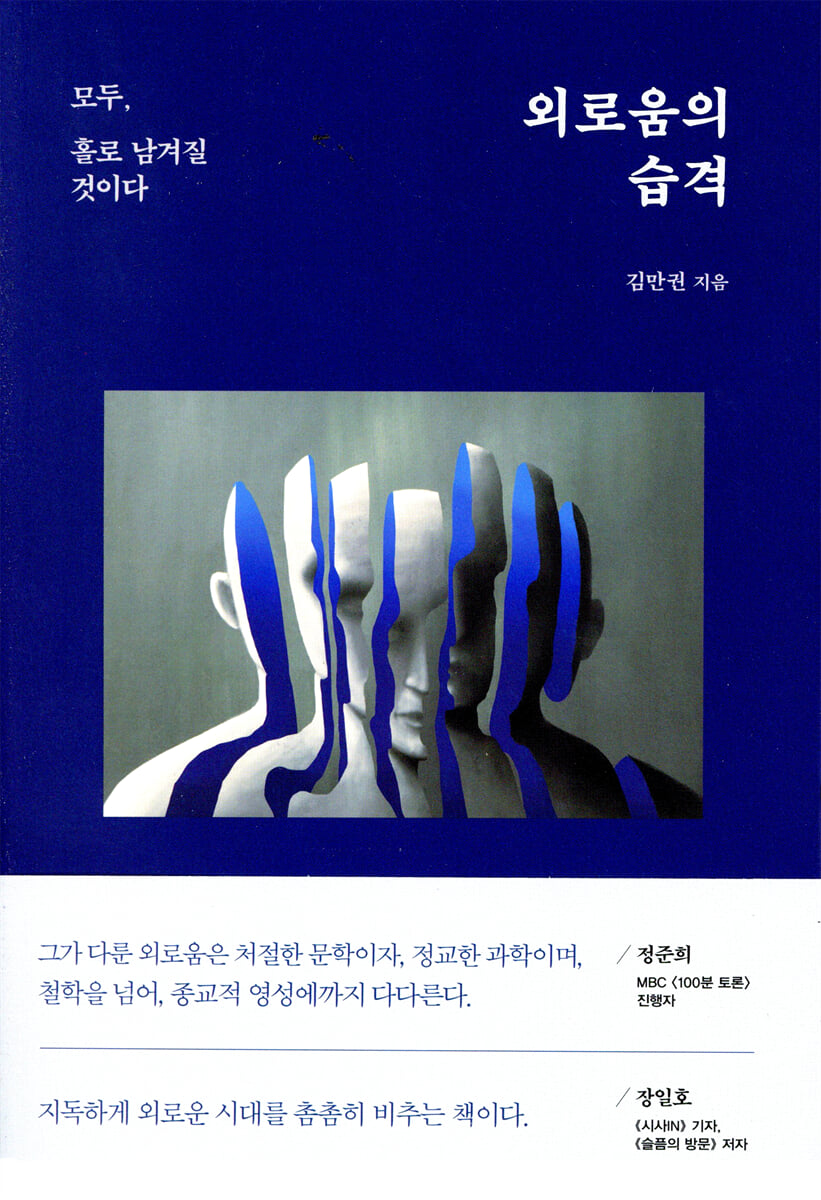
Attack of loneliness
 |
Description
Book Introduction
- A word from MD
-
In an age where poverty and loneliness are problemsIn an age where we are connected 24/7 via smartphones, paradoxically, modern people are becoming increasingly isolated.
Author Kim Man-kwon of "Attack of Loneliness" diagnoses that the problem is that the poorer you are, the lonelier you are.
Even the rich are no exception.
Why on earth did the world become like this?
We analyzed the poverty and loneliness brought about by digital and meritocracy.
December 22, 2023. Social and Political PD Son Min-gyu
“Everyone will be left alone!”
How are poverty, digital technology, and meritocracy creating a lonely era?
How does loneliness destroy not only individuals but also society?
Who, how, and how lonely is it in South Korea?
How will humanity fight loneliness?
In January 2018, the UK became the world's first country to appoint a Minister for Loneliness.
It's no surprise.
A report published in the UK titled "Fighting Loneliness" found that many people suffer from loneliness "often or always" and that an overwhelming number of older people said that the TV was their most precious friend.
The cost of people being isolated and communities being cut off is estimated to be around £3.5 billion for the UK economy.
This point suggests that loneliness is not just a problem limited to individual emotions.
Loneliness is not just a British problem.
Elderly people in Japan are putting themselves in prison to solve both loneliness and financial problems.
Korea is also one of the loneliest countries.
26% of the population complains of constant loneliness, and for those in their 20s, that figure soars to 40%.
There are more people living in the world today than ever before.
And most of us live in cities where we can discover the presence of others as soon as we open the door.
Even thanks to the amazing advancement of technology, we live in a 'hyper-connected society' where everyone is connected.
Yet, many people suffer from loneliness.
It is said that following the UK, Japan has also appointed a ‘Minister for Loneliness.’
Perhaps that's why political economist Norina Hertz dubbed the 21st century "the lonely century."
It is impossible to know the circumstances of each person who is lonely or becoming lonely.
However, it is possible to approach the reasons and processes by which people become lonely from a philosophical, socio-political perspective.
If people are feeling more lonely than ever, there must be some unique 21st-century condition that has made us this way.
The author believes that figuring out what that is is the job of philosophy.
The first chapter begins by examining loneliness in its historical and philosophical context.
In the English-speaking world, there was no word for loneliness until the 16th century, and the feeling was a new one that came with later social changes.
Ultimately, the author points out that the causes that make people in this era increasingly lonely are poverty, digital technology, data bias, and meritocracy.
In addition, it explains, one by one, how dangerous a world covered in loneliness is, using specific examples and statistics.
And at the end of the story, he suggests that we imagine together an alternative, even if a little clumsy, way to deal with loneliness.
As a father who brought a young life into this world at a late age, the author wrote this book with the earnest hope that the child would no longer have to live in a lonely world.
I hope many people will join me on this journey.
How are poverty, digital technology, and meritocracy creating a lonely era?
How does loneliness destroy not only individuals but also society?
Who, how, and how lonely is it in South Korea?
How will humanity fight loneliness?
In January 2018, the UK became the world's first country to appoint a Minister for Loneliness.
It's no surprise.
A report published in the UK titled "Fighting Loneliness" found that many people suffer from loneliness "often or always" and that an overwhelming number of older people said that the TV was their most precious friend.
The cost of people being isolated and communities being cut off is estimated to be around £3.5 billion for the UK economy.
This point suggests that loneliness is not just a problem limited to individual emotions.
Loneliness is not just a British problem.
Elderly people in Japan are putting themselves in prison to solve both loneliness and financial problems.
Korea is also one of the loneliest countries.
26% of the population complains of constant loneliness, and for those in their 20s, that figure soars to 40%.
There are more people living in the world today than ever before.
And most of us live in cities where we can discover the presence of others as soon as we open the door.
Even thanks to the amazing advancement of technology, we live in a 'hyper-connected society' where everyone is connected.
Yet, many people suffer from loneliness.
It is said that following the UK, Japan has also appointed a ‘Minister for Loneliness.’
Perhaps that's why political economist Norina Hertz dubbed the 21st century "the lonely century."
It is impossible to know the circumstances of each person who is lonely or becoming lonely.
However, it is possible to approach the reasons and processes by which people become lonely from a philosophical, socio-political perspective.
If people are feeling more lonely than ever, there must be some unique 21st-century condition that has made us this way.
The author believes that figuring out what that is is the job of philosophy.
The first chapter begins by examining loneliness in its historical and philosophical context.
In the English-speaking world, there was no word for loneliness until the 16th century, and the feeling was a new one that came with later social changes.
Ultimately, the author points out that the causes that make people in this era increasingly lonely are poverty, digital technology, data bias, and meritocracy.
In addition, it explains, one by one, how dangerous a world covered in loneliness is, using specific examples and statistics.
And at the end of the story, he suggests that we imagine together an alternative, even if a little clumsy, way to deal with loneliness.
As a father who brought a young life into this world at a late age, the author wrote this book with the earnest hope that the child would no longer have to live in a lonely world.
I hope many people will join me on this journey.
- You can preview some of the book's contents.
Preview
index
005 Prologue Another Name for '21st Century Us': 'Loneliness'
Chapter 1: "Becoming Lonely"
022 21st Century, Encountering Loneliness
028 What is Loneliness?: A 'Short' History of Loneliness
035 Why is loneliness dangerous?
044 How lonely are we?
053 20s, the loneliest generation of the loneliest century
Chapter 2: When Loneliness Meets Digital
065 When Loneliness Meets Digital
073 Why Does Digital Create a Distribution Gap? ①: The Astonishing Speed of Development
079 Why Does Digital Create Distribution Gaps? ②: Network Effects
084 Why Does Digital Create a Distribution Gap? ③: Replacing Mid-Skilled Jobs and Increasing Low-Skilled Jobs
Generative AI: Making the 088 Gap More Visible
092 Data started talking to me
108 A Community for Digital Humans: Lonely Sapiens
Chapter 3: When Data Meets 'Bias'
119 Are humans information processing systems?
124 What is data?
128 Why do massive amounts of data require humans?
139 Big Data Underestimates Human Labor
149 Big data also has biases.
161 Big data is more severe for the poor.
172 Big data is strict even for those who work there.
180 Big Data is also obsessed with school ties, regional ties, and gender.
186 Big Data Makes Even the Earth Lonely
195 Good human relationships create good data.
Chapter 4: When Loneliness Meets Meritocracy
204 What is 'meritocracy'?
209 What is 'ability'?
216 Why are we so obsessed with meritocracy?
221 Abilities are also inherited
229 Why is meritocracy harmful even to successful people?
238 What is different about 'Korean meritocracy'?
246 Meritocracy Creates an 'Employment Status Society'?
255 Meritocracy makes even the middle class lonely?
260 The Politics of Humiliation: The Right-Wing Populism That Creates
268 In the age of "digital meritocracy," loneliness is a burden, even below minimum wage.
Chapter 5: How to Respond to the 'Attack' of Loneliness
280 Social Values: Let's Break Free from the Ethics of Obsessive Self-Responsibility
286 Socio-Cultural Response ①: Let's Create a Community of People Who "Listen"
292 Socio-Cultural Dimension Response ②: Let's Make Listening the Core of Civic Education
297 Distribution-Level Responses: Distribution Alternatives That Don't Go Through the Labor Market
300 Basic income and basic assets that do not use labor as the basis for distribution
305 Making the Underlying Asset Work ①: 'Life Cycle Capital'
311 Making the underlying asset work②: Resources, dividends, receipt conditions, and returns of 'life cycle capital'
Making Basic Income Work ①: "Income for Life Crisis and Transition"
323 Making Basic Income Work②: Resources, Dividends, Payment Conditions, and Returns for "Life Crisis and Transition Response Income"
330 Rights-Level Response: Digital Citizenship
343 Epilogue To the dreamers called 'Dad'
Chapter 1: "Becoming Lonely"
022 21st Century, Encountering Loneliness
028 What is Loneliness?: A 'Short' History of Loneliness
035 Why is loneliness dangerous?
044 How lonely are we?
053 20s, the loneliest generation of the loneliest century
Chapter 2: When Loneliness Meets Digital
065 When Loneliness Meets Digital
073 Why Does Digital Create a Distribution Gap? ①: The Astonishing Speed of Development
079 Why Does Digital Create Distribution Gaps? ②: Network Effects
084 Why Does Digital Create a Distribution Gap? ③: Replacing Mid-Skilled Jobs and Increasing Low-Skilled Jobs
Generative AI: Making the 088 Gap More Visible
092 Data started talking to me
108 A Community for Digital Humans: Lonely Sapiens
Chapter 3: When Data Meets 'Bias'
119 Are humans information processing systems?
124 What is data?
128 Why do massive amounts of data require humans?
139 Big Data Underestimates Human Labor
149 Big data also has biases.
161 Big data is more severe for the poor.
172 Big data is strict even for those who work there.
180 Big Data is also obsessed with school ties, regional ties, and gender.
186 Big Data Makes Even the Earth Lonely
195 Good human relationships create good data.
Chapter 4: When Loneliness Meets Meritocracy
204 What is 'meritocracy'?
209 What is 'ability'?
216 Why are we so obsessed with meritocracy?
221 Abilities are also inherited
229 Why is meritocracy harmful even to successful people?
238 What is different about 'Korean meritocracy'?
246 Meritocracy Creates an 'Employment Status Society'?
255 Meritocracy makes even the middle class lonely?
260 The Politics of Humiliation: The Right-Wing Populism That Creates
268 In the age of "digital meritocracy," loneliness is a burden, even below minimum wage.
Chapter 5: How to Respond to the 'Attack' of Loneliness
280 Social Values: Let's Break Free from the Ethics of Obsessive Self-Responsibility
286 Socio-Cultural Response ①: Let's Create a Community of People Who "Listen"
292 Socio-Cultural Dimension Response ②: Let's Make Listening the Core of Civic Education
297 Distribution-Level Responses: Distribution Alternatives That Don't Go Through the Labor Market
300 Basic income and basic assets that do not use labor as the basis for distribution
305 Making the Underlying Asset Work ①: 'Life Cycle Capital'
311 Making the underlying asset work②: Resources, dividends, receipt conditions, and returns of 'life cycle capital'
Making Basic Income Work ①: "Income for Life Crisis and Transition"
323 Making Basic Income Work②: Resources, Dividends, Payment Conditions, and Returns for "Life Crisis and Transition Response Income"
330 Rights-Level Response: Digital Citizenship
343 Epilogue To the dreamers called 'Dad'
Detailed image

Into the book
We often say that humans are 'originally' lonely beings.
This expression implies that loneliness is an aspect of human nature.
But is that really the case? At least not in the English-speaking world.
The proof is that the word 'lonely' did not exist until the 16th century.
The person who first coined the expression 'lonely' was none other than the great British author William Shakespeare.
The expression 'lonely' is said to have first been used by Shakespeare in Coriolanus, written between 1605 and 1608.
So, the word 'lonely' as an adjective did not appear until the 17th century.
--- From "What is Loneliness?: A 'Short' History of Loneliness"
In 2016, the Center for the Study of American Elections and Democracy asked 3,000 Americans who they turned to for help with various things like childcare, financial support, relationship advice, and getting a ride.
In this regard, voters who voted for Trump were more likely to say that they would just solve the problem themselves, without mentioning neighbors, communities, or friends, than voters who voted for Hillary or Sanders.
In fact, Trump's supporters reported having fewer close friends or acquaintances or spending less time with them during the week.
A survey by the Public Religion Research Institute during the 2016 Republican primary found that Trump supporters were twice as likely as supporters of then-candidate Ted Cruz to say they rarely or never participated in community activities like sports teams, book clubs, or parent-teacher associations.
--- From "Why Loneliness is Dangerous"
In this context, AI friends like 'Iruda' not only do not have the emotional burden that is inevitable when forming relationships with humans, but the cost of forming relationships is also relatively much lower.
In this way, AI friends may be the most accessible to the poor and lonely.
Considering that the data for 'Iruda 1.0' came from another app called 'Science of Love', conversational AI may be their only love in the future.
Surely that's not really happening? In 2023, a 36-year-old woman in New York married a boyfriend created by an AI chatbot called "Replika."
This virtual boyfriend seems very human, with a name like 'Irene Kartal', a job as a medical professional, and a penchant for writing and indie music.
Industries targeting loneliness and human relationships are already emerging. For example, apps that help you find friends are very popular.
Apps like 'Rent a Friend' allow you to rent a friend for a set fee per hour.
If you don't want to go for a walk alone, you can find someone to walk with through an app called 'People Walker'.
Going forward, for digital capital, the countless lonely, isolated, and isolated people living in the "loneliest century" will be the ones who can generate the most profit.
--- From "Data Started Talking to Me"
Joan works an average of 10 hours a day.
Imagine looking at nothing but pictures of penises for 10 hours every day.
Couldn't it be psychologically traumatic? Joan only earns about $40 for 10 hours of work.
That's $4 an hour, a little over 5,000 won in our currency.
The problem with crowd labor isn't just low wages.
Research on this topic shows that the attitude of companies and employers who do not view crowd workers as people but as machine parts is also serious.
The reason we treat them this way is because once we recognize the importance of crowd labor, we must compensate them properly.
If that happens, the cost of developing artificial intelligence will increase, which will result in lower cost-effectiveness and lower profits for companies.
This is why crowd workers are not treated as human beings, but as machines that move automatically, organizing and tagging data.
--- From "Big Data Underestimates Human Labor"
This society says that anyone can be a part of it if only opportunities were fair, but the truth is that the group at the top would never share the precious opportunity to acquire wealth and benefits with the rest of us, rather than pass it on to their children.
In this situation, meritocracy is being used to divide workers into different classes, creating an impenetrable barrier even within the same company or workplace, and insulting fellow citizens by calling them unworkable.
What do you think about the fact that, in this bitter reality, the vast majority of people live without adequate social protection? Above all, what are the chances that our children, growing up in this era of fierce competition, polarized distribution, and meritocracy, will not suffer from loneliness?
--- From "The Loneliness of Earning Less Than Minimum Wage in the Era of 'Digital Meritocracy'"
In fact, there has been an ongoing debate since the 1990s about which is better as a future distribution alternative: basic income or basic assets.
As Philippe van Parijs, Guy Standing, and others argue, if we take seriously the factors of a consumer society and polarization, a basic income that can preserve sustainable spending power throughout life seems much more compelling than basic assets that can easily be squandered in youth.
But if we focus on the inequality of the younger generation living under the rule of digital technology and meritocracy, the story may be different.
Especially when you consider the difficulties faced by the younger generation who have to start their social life without inheriting any assets and without the protection of social institutions, basic assets may seem like a better system.
--- From "Basic Income and Basic Assets That Do Not Use Labor as the Basis for Distribution"
We live in an era where people who have been left behind by the digital technology gap are called 'digital refugees.'
People continue to be excluded from protecting their lives and property, participating in politics, and ensuring a decent life due to their inability to utilize digital technologies.
Digital citizenship is a right that prevents this from happening again, and even if it does happen, it ensures that I and my fellow citizens are not turned into refugees without any protection.
So what I want to say is this:
“Digital citizenship is truly the ‘right to have rights!’”
--- From "Rights-Level Response: Digital Citizenship"
As a father, I ask:
'Why can't we readily tell our children to consider others first?' The reason, as we all know, is that this world demands 'everyone for themselves.'
Most people live in an age overflowing with abundance, meekly accepting the contradictions of a time when each person must worry about their own survival.
As a father, I want to change this world even a little.
I don't want to leave this 'lonely' world to my child.
If my child is not to be lonely, the other children who live shoulder to shoulder with my child should not be lonely either.
Of course, nothing may change.
But the father with the child desperately needed to do something.
It was the least I could do as a father who brought a young life into this world at a late age.
This book is a journey taken with that kind of heart.
This expression implies that loneliness is an aspect of human nature.
But is that really the case? At least not in the English-speaking world.
The proof is that the word 'lonely' did not exist until the 16th century.
The person who first coined the expression 'lonely' was none other than the great British author William Shakespeare.
The expression 'lonely' is said to have first been used by Shakespeare in Coriolanus, written between 1605 and 1608.
So, the word 'lonely' as an adjective did not appear until the 17th century.
--- From "What is Loneliness?: A 'Short' History of Loneliness"
In 2016, the Center for the Study of American Elections and Democracy asked 3,000 Americans who they turned to for help with various things like childcare, financial support, relationship advice, and getting a ride.
In this regard, voters who voted for Trump were more likely to say that they would just solve the problem themselves, without mentioning neighbors, communities, or friends, than voters who voted for Hillary or Sanders.
In fact, Trump's supporters reported having fewer close friends or acquaintances or spending less time with them during the week.
A survey by the Public Religion Research Institute during the 2016 Republican primary found that Trump supporters were twice as likely as supporters of then-candidate Ted Cruz to say they rarely or never participated in community activities like sports teams, book clubs, or parent-teacher associations.
--- From "Why Loneliness is Dangerous"
In this context, AI friends like 'Iruda' not only do not have the emotional burden that is inevitable when forming relationships with humans, but the cost of forming relationships is also relatively much lower.
In this way, AI friends may be the most accessible to the poor and lonely.
Considering that the data for 'Iruda 1.0' came from another app called 'Science of Love', conversational AI may be their only love in the future.
Surely that's not really happening? In 2023, a 36-year-old woman in New York married a boyfriend created by an AI chatbot called "Replika."
This virtual boyfriend seems very human, with a name like 'Irene Kartal', a job as a medical professional, and a penchant for writing and indie music.
Industries targeting loneliness and human relationships are already emerging. For example, apps that help you find friends are very popular.
Apps like 'Rent a Friend' allow you to rent a friend for a set fee per hour.
If you don't want to go for a walk alone, you can find someone to walk with through an app called 'People Walker'.
Going forward, for digital capital, the countless lonely, isolated, and isolated people living in the "loneliest century" will be the ones who can generate the most profit.
--- From "Data Started Talking to Me"
Joan works an average of 10 hours a day.
Imagine looking at nothing but pictures of penises for 10 hours every day.
Couldn't it be psychologically traumatic? Joan only earns about $40 for 10 hours of work.
That's $4 an hour, a little over 5,000 won in our currency.
The problem with crowd labor isn't just low wages.
Research on this topic shows that the attitude of companies and employers who do not view crowd workers as people but as machine parts is also serious.
The reason we treat them this way is because once we recognize the importance of crowd labor, we must compensate them properly.
If that happens, the cost of developing artificial intelligence will increase, which will result in lower cost-effectiveness and lower profits for companies.
This is why crowd workers are not treated as human beings, but as machines that move automatically, organizing and tagging data.
--- From "Big Data Underestimates Human Labor"
This society says that anyone can be a part of it if only opportunities were fair, but the truth is that the group at the top would never share the precious opportunity to acquire wealth and benefits with the rest of us, rather than pass it on to their children.
In this situation, meritocracy is being used to divide workers into different classes, creating an impenetrable barrier even within the same company or workplace, and insulting fellow citizens by calling them unworkable.
What do you think about the fact that, in this bitter reality, the vast majority of people live without adequate social protection? Above all, what are the chances that our children, growing up in this era of fierce competition, polarized distribution, and meritocracy, will not suffer from loneliness?
--- From "The Loneliness of Earning Less Than Minimum Wage in the Era of 'Digital Meritocracy'"
In fact, there has been an ongoing debate since the 1990s about which is better as a future distribution alternative: basic income or basic assets.
As Philippe van Parijs, Guy Standing, and others argue, if we take seriously the factors of a consumer society and polarization, a basic income that can preserve sustainable spending power throughout life seems much more compelling than basic assets that can easily be squandered in youth.
But if we focus on the inequality of the younger generation living under the rule of digital technology and meritocracy, the story may be different.
Especially when you consider the difficulties faced by the younger generation who have to start their social life without inheriting any assets and without the protection of social institutions, basic assets may seem like a better system.
--- From "Basic Income and Basic Assets That Do Not Use Labor as the Basis for Distribution"
We live in an era where people who have been left behind by the digital technology gap are called 'digital refugees.'
People continue to be excluded from protecting their lives and property, participating in politics, and ensuring a decent life due to their inability to utilize digital technologies.
Digital citizenship is a right that prevents this from happening again, and even if it does happen, it ensures that I and my fellow citizens are not turned into refugees without any protection.
So what I want to say is this:
“Digital citizenship is truly the ‘right to have rights!’”
--- From "Rights-Level Response: Digital Citizenship"
As a father, I ask:
'Why can't we readily tell our children to consider others first?' The reason, as we all know, is that this world demands 'everyone for themselves.'
Most people live in an age overflowing with abundance, meekly accepting the contradictions of a time when each person must worry about their own survival.
As a father, I want to change this world even a little.
I don't want to leave this 'lonely' world to my child.
If my child is not to be lonely, the other children who live shoulder to shoulder with my child should not be lonely either.
Of course, nothing may change.
But the father with the child desperately needed to do something.
It was the least I could do as a father who brought a young life into this world at a late age.
This book is a journey taken with that kind of heart.
--- From "Epilogue: To the Dreamers Called 'Dad'"
Publisher's Review
An era of loneliness created by poverty, digital technology, and meritocracy!
How will humanity fight back?
There has never been a time so lonely
Some people dismiss loneliness as a luxury, something only people with time on their hands can enjoy.
“Live busy and intensely, how can you ever be lonely!” But numerous statistics show that this thinking is wrong.
The 21st century is a busier and more intense era than ever before, and the fact that loneliness is emerging as a social problem in this era is proof of this.
Loneliness is having a huge impact not only on individuals' daily lives but also on politics, economics, and social life.
No wonder the UK appointed a ‘Minister for Loneliness’ and Japan established a ‘Ministry of Loneliness’.
Our country is no exception.
Looking at just those in their 20s, 4 out of 10 people complained of experiencing loneliness 'on a regular basis'.
Especially for those in their 20s living alone, the intensity of isolation is only increasing amidst the decline in quality jobs and the disconnection from community brought about by the pandemic and digital technology.
In the 21st century, which is called the "lonely century," loneliness has invaded our lives without people even realizing it!
What Happens When Loneliness Meets Digital Technology
Despite humanity's growing loneliness, digital technologies, represented by AI, are advancing at a dazzling pace.
But people don't realize that this amazing technology is making our lives lonelier.
The pace of technological advancement is so rapid that it is difficult for ordinary people to keep up.
Those who cannot adapt to that speed will fall behind.
Of course, even before the advent of digital technology, society was not a very equal place.
However, digital technology is widening the distribution gap and exacerbating polarization and inequality.
Workers are not even paid the minimum wage in the labor market formed by various online platforms, while platform companies collect huge commissions in the middle.
The corporations driving this concierge economy amass enormous wealth through brokerage alone, yet they have no interest in providing their workers with even the bare minimum of social insurance.
Technological advancements are increasingly leaving those isolated by poverty and inequality feeling more and more lonely.
If AI is your only conversation partner
In this age of disconnected relationships and growing isolation, what impact will the advent of conversational AI have on human relationships? Younger generations, who have experienced less face-to-face interaction due to the prolonged pandemic and the advancement of digital technology, appear to be experiencing greater difficulty forming relationships with others.
In one survey, 47% of people in their 20s said, “I’m afraid of communicating with people face to face,” and 50% said, “I worry about what to say when I’m in a situation where I actually meet people.”
What's even more problematic is that younger generations, while using the various services provided by digital technology and confined to their private spheres, mistakenly believe they are actually communicating with human beings.
If AI becomes the only conversational companion for 20-somethings, who already frequently complain of loneliness, how will humans relate to one another in the future? Can humanity, which struggles even with other people, truly cultivate a proper relationship with machines, represented by AI?
The bias inherent in big data makes us feel even more isolated.
Despite this situation, AI is being utilized in many areas of society.
And many people believe that AI will be more objective and fair than humans.
But the reality is different. The big data used to train AI already contains a culture of prejudice, discrimination, and hatred that humans have long perpetuated.
The reality of using AI with such biases to conduct interviews and develop various services makes it difficult to expect fairness and objectivity.
And that's not all.
AI, incorporated into various administrative systems, is creating a "digital poorhouse" by imposing stricter standards on the poor and powerless who need welfare benefits, demanding more information and more stringent qualifications.
Additionally, 'digital panopticons' are emerging in the workplace, using all kinds of digital technologies to monitor workers' daily lives.
Advanced technology is being used to make our lives lonelier.
In a world ruled by meritocracy, people are becoming increasingly lonely as they struggle to survive on their own.
As inequality worsens, more and more people are arguing that it can be solved through meritocracy.
As competition for social capital intensifies, those obsessed with fairness are becoming enthusiastic about meritocracy, which is being touted as the only solution.
But meritocracy isn't as fair as people believe.
Much of what we call ability is determined by luck, whether innate or inherited.
In particular, the elite class at the top of the ladder invests resources that the middle class cannot even imagine to create and pass on 'abilities' to their children.
Ordinary people ignore this reality and build high walls, rejecting each other over the few quality jobs, social status, and wealth they have.
In this way, meritocracy morally condones the reality that those who already have a lot use their ability as an excuse to take more.
Conversely, those who fail to succeed are treated as incompetent and lazy, and are even subject to moral condemnation.
To avoid such criticism, the powerless do not reach out to society even when they need help.
The shadow created by the ideology of meritocracy continues to grow darker.
How to deal with the onslaught of loneliness?
It is not advisable to leave the response to this problem to individuals.
The only way for individuals to address these structural problems is through self-help-level advice: "Think about what AI can't do and diligently cultivate your own creativity."
Moreover, these solutions cannot be called true solutions, as they ultimately amount to nothing more than accepting the digital divide and embracing meritocracy as the dominant ideology.
In times of crisis, the task of philosophy, and especially of political philosophy, is to actively work to create social systems that can protect anxious individuals and thereby help people live well in the world.
Under these premises, the author, who has given numerous public lectures as a street philosopher, proposes a "life cycle capital" based on basic assets and a "life crisis/transition response fund" inspired by basic income as alternatives to reduce the distribution gap.
Furthermore, as a socio-cultural response, I propose creating a culture of listening and educating citizens on this, so that they can hear the voices of those in need when they seek help.
Finally, as a rights-based response, we propose establishing digital citizenship and narrowing the gap created by digital technology to protect those who have fallen behind in technological advancements.
Father's earnest heart
The author says that as a father of one child, he wants to change this world, even if only a little.
He says he cannot leave a 'lonely' world to his young son.
If my child is not to be lonely, the other children who live shoulder to shoulder with my child should not be lonely either.
He says that even though he can't change anything, he has to do something because he is a father.
This earnestness is the minimum duty that a father must bear as he brought a young life into this world at a late age.
This book is a journey taken with that kind of heart.
I hope many people will join us on this journey.
How will humanity fight back?
There has never been a time so lonely
Some people dismiss loneliness as a luxury, something only people with time on their hands can enjoy.
“Live busy and intensely, how can you ever be lonely!” But numerous statistics show that this thinking is wrong.
The 21st century is a busier and more intense era than ever before, and the fact that loneliness is emerging as a social problem in this era is proof of this.
Loneliness is having a huge impact not only on individuals' daily lives but also on politics, economics, and social life.
No wonder the UK appointed a ‘Minister for Loneliness’ and Japan established a ‘Ministry of Loneliness’.
Our country is no exception.
Looking at just those in their 20s, 4 out of 10 people complained of experiencing loneliness 'on a regular basis'.
Especially for those in their 20s living alone, the intensity of isolation is only increasing amidst the decline in quality jobs and the disconnection from community brought about by the pandemic and digital technology.
In the 21st century, which is called the "lonely century," loneliness has invaded our lives without people even realizing it!
What Happens When Loneliness Meets Digital Technology
Despite humanity's growing loneliness, digital technologies, represented by AI, are advancing at a dazzling pace.
But people don't realize that this amazing technology is making our lives lonelier.
The pace of technological advancement is so rapid that it is difficult for ordinary people to keep up.
Those who cannot adapt to that speed will fall behind.
Of course, even before the advent of digital technology, society was not a very equal place.
However, digital technology is widening the distribution gap and exacerbating polarization and inequality.
Workers are not even paid the minimum wage in the labor market formed by various online platforms, while platform companies collect huge commissions in the middle.
The corporations driving this concierge economy amass enormous wealth through brokerage alone, yet they have no interest in providing their workers with even the bare minimum of social insurance.
Technological advancements are increasingly leaving those isolated by poverty and inequality feeling more and more lonely.
If AI is your only conversation partner
In this age of disconnected relationships and growing isolation, what impact will the advent of conversational AI have on human relationships? Younger generations, who have experienced less face-to-face interaction due to the prolonged pandemic and the advancement of digital technology, appear to be experiencing greater difficulty forming relationships with others.
In one survey, 47% of people in their 20s said, “I’m afraid of communicating with people face to face,” and 50% said, “I worry about what to say when I’m in a situation where I actually meet people.”
What's even more problematic is that younger generations, while using the various services provided by digital technology and confined to their private spheres, mistakenly believe they are actually communicating with human beings.
If AI becomes the only conversational companion for 20-somethings, who already frequently complain of loneliness, how will humans relate to one another in the future? Can humanity, which struggles even with other people, truly cultivate a proper relationship with machines, represented by AI?
The bias inherent in big data makes us feel even more isolated.
Despite this situation, AI is being utilized in many areas of society.
And many people believe that AI will be more objective and fair than humans.
But the reality is different. The big data used to train AI already contains a culture of prejudice, discrimination, and hatred that humans have long perpetuated.
The reality of using AI with such biases to conduct interviews and develop various services makes it difficult to expect fairness and objectivity.
And that's not all.
AI, incorporated into various administrative systems, is creating a "digital poorhouse" by imposing stricter standards on the poor and powerless who need welfare benefits, demanding more information and more stringent qualifications.
Additionally, 'digital panopticons' are emerging in the workplace, using all kinds of digital technologies to monitor workers' daily lives.
Advanced technology is being used to make our lives lonelier.
In a world ruled by meritocracy, people are becoming increasingly lonely as they struggle to survive on their own.
As inequality worsens, more and more people are arguing that it can be solved through meritocracy.
As competition for social capital intensifies, those obsessed with fairness are becoming enthusiastic about meritocracy, which is being touted as the only solution.
But meritocracy isn't as fair as people believe.
Much of what we call ability is determined by luck, whether innate or inherited.
In particular, the elite class at the top of the ladder invests resources that the middle class cannot even imagine to create and pass on 'abilities' to their children.
Ordinary people ignore this reality and build high walls, rejecting each other over the few quality jobs, social status, and wealth they have.
In this way, meritocracy morally condones the reality that those who already have a lot use their ability as an excuse to take more.
Conversely, those who fail to succeed are treated as incompetent and lazy, and are even subject to moral condemnation.
To avoid such criticism, the powerless do not reach out to society even when they need help.
The shadow created by the ideology of meritocracy continues to grow darker.
How to deal with the onslaught of loneliness?
It is not advisable to leave the response to this problem to individuals.
The only way for individuals to address these structural problems is through self-help-level advice: "Think about what AI can't do and diligently cultivate your own creativity."
Moreover, these solutions cannot be called true solutions, as they ultimately amount to nothing more than accepting the digital divide and embracing meritocracy as the dominant ideology.
In times of crisis, the task of philosophy, and especially of political philosophy, is to actively work to create social systems that can protect anxious individuals and thereby help people live well in the world.
Under these premises, the author, who has given numerous public lectures as a street philosopher, proposes a "life cycle capital" based on basic assets and a "life crisis/transition response fund" inspired by basic income as alternatives to reduce the distribution gap.
Furthermore, as a socio-cultural response, I propose creating a culture of listening and educating citizens on this, so that they can hear the voices of those in need when they seek help.
Finally, as a rights-based response, we propose establishing digital citizenship and narrowing the gap created by digital technology to protect those who have fallen behind in technological advancements.
Father's earnest heart
The author says that as a father of one child, he wants to change this world, even if only a little.
He says he cannot leave a 'lonely' world to his young son.
If my child is not to be lonely, the other children who live shoulder to shoulder with my child should not be lonely either.
He says that even though he can't change anything, he has to do something because he is a father.
This earnestness is the minimum duty that a father must bear as he brought a young life into this world at a late age.
This book is a journey taken with that kind of heart.
I hope many people will join us on this journey.
GOODS SPECIFICS
- Date of issue: December 15, 2023
- Page count, weight, size: 352 pages | 478g | 145*210*20mm
- ISBN13: 9791191183276
- ISBN10: 1191183270
You may also like
카테고리
korean


korean

![GQ KOREA Mark (Monthly): December [2025]](http://librairie.coreenne.fr/cdn/shop/files/8ef265dbbfbf186523ed75ba7319009d.jpg?v=1765340328&width=3840)


