

The Post-AI World
 |
Description
Book Introduction
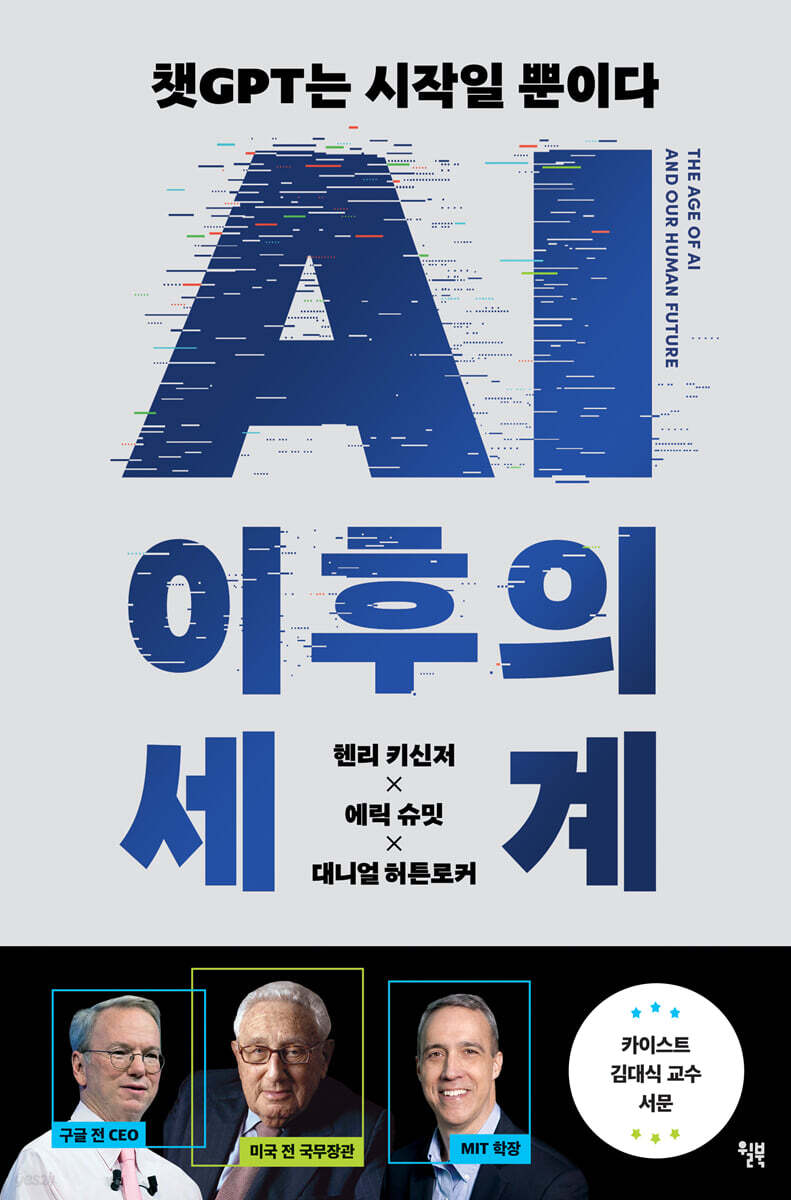
Beyond ChatGPT, the era of full-fledged artificial intelligence is coming. What is the future of humanity? Kissinger (former US Secretary of State) × Schmidt (former Google CEO) × Hutton Locker (MIT president) Sharp insights from three giants of politics, economics, and science A Wall Street Journal bestseller and a Forbes Best Technology Book of 2021 #1 Amazon Politics Book, Editors' Pick Best Nonfiction KAIST neuroscientist Professor Dae-sik Kim includes a preface to the Korean edition. ● If an AI in HR passed me over for a promotion, would I be able to accept that? ● If a security expert AI suggests striking an enemy country, should a general or president follow suit? ● How will the responsibility for this be met, and how will people be convinced of the consequences? ● Should we follow or limit AI that surpasses human logic and thinking ability? ● How much can we trust the decisions of artificial intelligence that we cannot understand or empathize with? ChatGPT is just the beginning. The time has come to truly explore and understand what kind of future awaits us. Three giants from politics, business, and academia—Henry Kissinger, Eric Schmidt, and Daniel Hutton-Locker—came together to discuss artificial intelligence (AI). "The World After AI" is a book that delves into the dilemmas we face amidst the revolutionary changes brought about by AI in various fields, including society, economy, politics, diplomacy, and technology. The contents discussed over four years are compiled into one volume. While we admire the remarkable results produced by generative AI and focus on its practical applications, there is a dearth of discussion about the philosophical and strategic impact this new technology will have on humanity. With the advent of a new generation of "AI natives" who will take for granted AI that thinks and makes decisions on our behalf, all citizens must confront these questions now and agree on the benefits and limitations of AI before uncontrollable problems arise. The authors argue that humans still hold the reins of the future. This book provides readers with a framework for exploring their own desirable future that aligns with our values. |
- You can preview some of the book's contents.
Preview
index
Preface to the Korean Edition: Generative AI: The Questions It Asks Sapiens
Preface: ChatGPT Heralds an Intellectual Revolution
Entering
Chapter 1.
Current address
Chapter 2.
Trajectories so far: A history of technology and thought
Chapter 3.
From Turing's time to the present and beyond
Chapter 4.
Global network platform
Chapter 5.
Security and World Order
Chapter 6.
human identity
Chapter 7.
future
Acknowledgements
Americas
Search
Preface: ChatGPT Heralds an Intellectual Revolution
Entering
Chapter 1.
Current address
Chapter 2.
Trajectories so far: A history of technology and thought
Chapter 3.
From Turing's time to the present and beyond
Chapter 4.
Global network platform
Chapter 5.
Security and World Order
Chapter 6.
human identity
Chapter 7.
future
Acknowledgements
Americas
Search
Detailed image
.jpg)
Into the book
Until now, artificial intelligence has existed only in back rooms, invisible to our eyes.
When ordering items from an online mall, an AI algorithm identifies the products, and when using a mobility service, an AI algorithm assigns a nearby taxi.
But generative AI is different.
What will humanity be able to do in the future if machines begin to mass-produce results instead of performing human-specific intellectual labor?
--- p.15 From the Korean edition preface: Questions Generative AI poses to Sapiens
We need to quickly develop a sophisticated dialectic that will allow people to readily question the interactivity of generative AI.
The purpose of asking such questions is not simply to justify or explain the AI's answers, but to investigate them.
We need to develop the ability to systematically examine AI under a shared skepticism framework to determine whether its answers are entirely reliable, and to what extent.
To do so, we must consciously alleviate our unconscious biases, train ourselves rigorously, and practice constantly.
--- p.29~30 From “Introduction: Chat GPT heralds an intellectual revolution”
In 2020, US AI startups raised approximately $38 billion in investment.
Investments in AI startups in Asia and Europe also reached $25 billion and $8 billion, respectively.
The governments of the United States, China, and the European Union have all formed a high-level committee to research AI and report on its findings.
It's now common to hear political leaders and corporate executives declare that they aim to "win" the AI race, or at least to use AI in ways that serve their own purposes.
--- p.37 From "Introduction"
While AI may seem like a mysterious and incomprehensible technology to most people, many people are already using AI without even realizing it, as universities, companies, and governments research how to develop and operate AI and increasingly incorporate it into consumer products.
But while the number of people developing AI has increased, the number of people exploring the social, legal, philosophical, spiritual, and ethical implications of AI for humanity remains dangerously small.
--- p.63~64 From “Chapter 1: Current Address”
When context is added to information, it becomes knowledge.
And when belief is added to knowledge, it becomes wisdom.
Historically, developing convictions required time for solitude and reflection.
But the Internet doesn't allow users any time to be alone, bombarding them with the opinions of thousands, tens of thousands, and even hundreds of millions of people.
When time to think alone decreases, courage diminishes.
Courage is essential to developing and maintaining convictions, especially when embarking on a new, and often lonely, path.
Only when humans have conviction and wisdom can they explore new horizons.
--- p.89~90 From “Chapter 2: The Trajectory So Far: The History of Technology and Thought”
A common training technique used to create generative AI involves pitting two neural networks with complementary learning objectives against each other.
These are called "generative adversarial networks (GANs)." GANs consist of a "generative network" that generates potential outputs and a "discriminative network" that prevents the generation of poor outputs.
To use an analogy, the generative network does the brainstorming, and the discriminative network selects meaningful and realistic ideas.
--- p.111 From “Chapter 3: From Turing’s Era to the Present and Beyond”
When a free society relies on AI-powered network platforms that generate, transmit, and filter content without borders, and when those platforms, even if unintentionally, promote hatred and division, that society faces an unprecedented threat and must police its information environment in unprecedented ways.
This is an urgent problem, but solutions that rely on AI raise serious questions in themselves.
We must always consider the right balance between human judgment and AI-driven automation.
--- p.155 From “Chapter 4 Global Network Platform”
Until now, no technology has had the potential to combine military-civilian versatility, scalability, and powerful destructive power.
Railroads transport goods to markets and soldiers to battlefields, but they have no potential for destruction.
Nuclear technology is largely dual-use and generates incredible destructive power, but it requires complex infrastructure that governments can control with relative certainty.
While shotguns are widely available and can be used by both military and civilians, their limited performance makes it difficult to expect them to deliver strategic destructive power. AI is disrupting this paradigm.
--- p.209 From “Chapter 5 Security and World Order”
Since the time of Aristotle, who called humans "political animals," the ability to form and cooperate in complex societies has been considered a key characteristic of humans, along with reason.
Thus, each society has basic principles for resolving disputes peacefully.
Order must be maintained by legitimate means based on those principles.
Attempting to impose order while ignoring legitimacy is nothing more than violence. Even in the age of AI, those making crucial decisions must be properly qualified, able to provide justification, and human, not anonymous.
--- p.241 From “Chapter 6: Human Identity”
We live in an era where human intelligence is collaborating with artificial intelligence to achieve national, continental, and global goals.
Understanding this shift and developing an ethical framework to guide it will require the combined efforts and dedication of scientists, strategists, politicians, philosophers, clergy, and CEOs.
Such efforts are required not only at the national level but also at the global level.
Now is the time to define how we collaborate with artificial intelligence to explore reality.
--- p.273 From “Chapter 7: The Future”
When ordering items from an online mall, an AI algorithm identifies the products, and when using a mobility service, an AI algorithm assigns a nearby taxi.
But generative AI is different.
What will humanity be able to do in the future if machines begin to mass-produce results instead of performing human-specific intellectual labor?
--- p.15 From the Korean edition preface: Questions Generative AI poses to Sapiens
We need to quickly develop a sophisticated dialectic that will allow people to readily question the interactivity of generative AI.
The purpose of asking such questions is not simply to justify or explain the AI's answers, but to investigate them.
We need to develop the ability to systematically examine AI under a shared skepticism framework to determine whether its answers are entirely reliable, and to what extent.
To do so, we must consciously alleviate our unconscious biases, train ourselves rigorously, and practice constantly.
--- p.29~30 From “Introduction: Chat GPT heralds an intellectual revolution”
In 2020, US AI startups raised approximately $38 billion in investment.
Investments in AI startups in Asia and Europe also reached $25 billion and $8 billion, respectively.
The governments of the United States, China, and the European Union have all formed a high-level committee to research AI and report on its findings.
It's now common to hear political leaders and corporate executives declare that they aim to "win" the AI race, or at least to use AI in ways that serve their own purposes.
--- p.37 From "Introduction"
While AI may seem like a mysterious and incomprehensible technology to most people, many people are already using AI without even realizing it, as universities, companies, and governments research how to develop and operate AI and increasingly incorporate it into consumer products.
But while the number of people developing AI has increased, the number of people exploring the social, legal, philosophical, spiritual, and ethical implications of AI for humanity remains dangerously small.
--- p.63~64 From “Chapter 1: Current Address”
When context is added to information, it becomes knowledge.
And when belief is added to knowledge, it becomes wisdom.
Historically, developing convictions required time for solitude and reflection.
But the Internet doesn't allow users any time to be alone, bombarding them with the opinions of thousands, tens of thousands, and even hundreds of millions of people.
When time to think alone decreases, courage diminishes.
Courage is essential to developing and maintaining convictions, especially when embarking on a new, and often lonely, path.
Only when humans have conviction and wisdom can they explore new horizons.
--- p.89~90 From “Chapter 2: The Trajectory So Far: The History of Technology and Thought”
A common training technique used to create generative AI involves pitting two neural networks with complementary learning objectives against each other.
These are called "generative adversarial networks (GANs)." GANs consist of a "generative network" that generates potential outputs and a "discriminative network" that prevents the generation of poor outputs.
To use an analogy, the generative network does the brainstorming, and the discriminative network selects meaningful and realistic ideas.
--- p.111 From “Chapter 3: From Turing’s Era to the Present and Beyond”
When a free society relies on AI-powered network platforms that generate, transmit, and filter content without borders, and when those platforms, even if unintentionally, promote hatred and division, that society faces an unprecedented threat and must police its information environment in unprecedented ways.
This is an urgent problem, but solutions that rely on AI raise serious questions in themselves.
We must always consider the right balance between human judgment and AI-driven automation.
--- p.155 From “Chapter 4 Global Network Platform”
Until now, no technology has had the potential to combine military-civilian versatility, scalability, and powerful destructive power.
Railroads transport goods to markets and soldiers to battlefields, but they have no potential for destruction.
Nuclear technology is largely dual-use and generates incredible destructive power, but it requires complex infrastructure that governments can control with relative certainty.
While shotguns are widely available and can be used by both military and civilians, their limited performance makes it difficult to expect them to deliver strategic destructive power. AI is disrupting this paradigm.
--- p.209 From “Chapter 5 Security and World Order”
Since the time of Aristotle, who called humans "political animals," the ability to form and cooperate in complex societies has been considered a key characteristic of humans, along with reason.
Thus, each society has basic principles for resolving disputes peacefully.
Order must be maintained by legitimate means based on those principles.
Attempting to impose order while ignoring legitimacy is nothing more than violence. Even in the age of AI, those making crucial decisions must be properly qualified, able to provide justification, and human, not anonymous.
--- p.241 From “Chapter 6: Human Identity”
We live in an era where human intelligence is collaborating with artificial intelligence to achieve national, continental, and global goals.
Understanding this shift and developing an ethical framework to guide it will require the combined efforts and dedication of scientists, strategists, politicians, philosophers, clergy, and CEOs.
Such efforts are required not only at the national level but also at the global level.
Now is the time to define how we collaborate with artificial intelligence to explore reality.
--- p.273 From “Chapter 7: The Future”
--- From p.271~272, “Appendix: Chat GPT heralds an intellectual revolution”
Publisher's Review
"There has never been such a lack of consensus on complex technical and strategic issues."
Three luminaries from politics, business, and academia discuss the future of humanity after the singularity.
With the emergence of generative AI, including ChatGPT, DALL·E, and Stability AI, artificial intelligence has become a hot topic of the times.
While many are focusing on its benefits and potential applications, there is little discussion about the fundamental impact this new technology will have on humanity and how to address it.
A petition calling for a “stop training AI systems more powerful than GPT-4 for at least six months” has garnered international attention, with prominent researchers and CEOs joining the petition.
Meanwhile, in Korea, ChatGPT became a hot topic on social media after it displayed a hallucination phenomenon in which it generated absurd answers to the absurd question, “Tell me about the incident where King Sejong threw a MacBook Pro as recorded in the Annals of the Joseon Dynasty.”
Recently, the US Congress introduced the 'RESTRICT Act' to ban TikTok, a platform that recommends interesting videos using AI algorithms.
All of this surrounding artificial intelligence points to one thing.
All citizens—especially leaders who drive society—must consider and decide on strategies for the post-AI era.
So, three authors representing each field, politics, economics, and science, gathered their opinions.
"The World After AI" is a book that contains discussions on the topic of AI over four years by Henry Kissinger, former U.S. Secretary of State and a leading figure in international political theory; Eric Schmidt, former chairman of Google and chairman of the National Security Commission on Artificial Intelligence (NSCAI); and Daniel Hutton-Locker, the first dean of MIT's Schwarzman School of Computing.
“Handle and control AI with care.
“A book that contributes to the most urgent debate of the 21st century” _[The Economist]
The key is ‘trust and responsibility.’
An in-depth strategy book for the AI era
Just like today's 'digital natives', in the future everyone will use artificial intelligence as naturally as a smartphone.
The authors predict the emergence of a generation of "AI natives" and sketch a vision of the future, encompassing fields such as society, economy, politics, technology, history, and philosophy.
I would like to answer these questions from an objective perspective, without being overly enthusiastic or pessimistic about new technologies.
● How far has artificial intelligence development progressed and where is it headed?
● What chapters unfold in the history of intellect after the modern and contemporary Enlightenment that worshipped reason?
● What innovations are happening on AI-based digital platforms like TikTok and Facebook?
● How will the form of war and the international order be reorganized, and what will be the role of the United States?
● How does human identity change in a society that coexists with superhuman intelligence?
By exploring answers to important questions, this book explores how far we should trust artificial intelligence and how we should take responsibility for it.
For example, AI can create clever fake news by fabricating facts to provide coherent answers.
The book sharply warns that AI's answers will become increasingly "overconfident in their results because they appear perfect."
If AI creates misinformation, AI will inevitably be used to filter it out.
Some people say we should actively hand over censorship power to artificial intelligence, which seems to be immune to bias.
But can we correct AI if it accidentally suppresses truthful information? Do we have the authority to read information labeled 'fake' by AI? Or, do we even want to read such information in the first place? The authors point out that reckless reliance is also not the answer.
"A brilliant rebuttal to the 'AI fatalism' that humans are powerless in the face of technological change." _[New York Times]
Reexamining the role and status of humanity amid new opportunities and crises.
The unpredictable and incomprehensible nature of AI further complicates the situation.
AlphaZero, developed by Google DeepMind, demonstrated an unusual tactic in chess, which was the result of recognizing patterns by examining a vast number of possible scenarios that our minds could not handle.
In other words, AI simply presents the results, but does not explain why (or how) it was achieved in a way that humans can empathize with and understand.
While AI assistance in board games may not be a major issue, what if it's directly linked to national security? In a disaster or war, if a leader were to recommend, based on their own calculations, that some citizens be sacrificed to save more lives, what basis would they have for following or rejecting that recommendation? Relying solely on human reasoning, rather than leveraging AI that surpasses our capabilities, could be seen as stubbornness and negligence.
Can it really be justified to reject the recommendation in such a situation?
This book explains that even in a post-singularity world, 'humanity' will not become meaningless.
“Artificial intelligence is not human.
“There is no consciousness and no ability to reflect.” Therefore, important matters such as policy decisions and law enforcement are only justified when they are decided and supervised by humans.
As political animals, humans have formed complex societies, established principles for peacefully resolving disputes, and maintained order based on them.
The authors' assertion that "the subject of judgment must be a human being who can provide reasons and is not anonymous" leads readers to reflect again on what it means to live as a human being.
"We are experiencing a turning point that will determine the fate of humanity." _Kim Dae-sik
Speaking of the responsibilities given to "Homo technicus," humans who coexist with technology.
This book is both a scientific treatise that explains machine learning and generative technologies in a way even non-experts can easily understand, and a philosophical treatise that provides insight into the ethical and ontological dilemmas humans experience.
The three authors—Kissinger, Schmidt, and Hutton-Locker—collected the opinions of various researchers and innovators to comprehensively analyze AI supporting various aspects of life, such as education, logistics, transportation, public safety, and the arts.
The manuscript was enriched with feedback from the founder of DeepMind, the chief strategy officer of Microsoft, the former director of the White House Office of Science Policy, and the CEO of OpenAI.
In particular, the Korean edition reflects the most up-to-date information by including the authors' columns that appeared in the February 2023 issue of [The Wall Street Journal], and the foreword by KAIST neuroscientist Professor Dae-sik Kim explains how the field of research called 'artificial intelligence' began and why generative AI is an innovation today.
The authors do not provide answers to all the many questions surrounding AI.
I acknowledge that trying to define an era by concluding it perfectly in one volume is an arrogant attempt, and rather raises even more questions.
The purpose of this book is to spark more active discussion and debate so that those who will coexist with machines that transcend human reason can define the purpose of humanity.
"The World After AI" is an excellent introduction to AI that everyone, from students seeking jobs to parents raising children to global leaders, should read.
Three luminaries from politics, business, and academia discuss the future of humanity after the singularity.
With the emergence of generative AI, including ChatGPT, DALL·E, and Stability AI, artificial intelligence has become a hot topic of the times.
While many are focusing on its benefits and potential applications, there is little discussion about the fundamental impact this new technology will have on humanity and how to address it.
A petition calling for a “stop training AI systems more powerful than GPT-4 for at least six months” has garnered international attention, with prominent researchers and CEOs joining the petition.
Meanwhile, in Korea, ChatGPT became a hot topic on social media after it displayed a hallucination phenomenon in which it generated absurd answers to the absurd question, “Tell me about the incident where King Sejong threw a MacBook Pro as recorded in the Annals of the Joseon Dynasty.”
Recently, the US Congress introduced the 'RESTRICT Act' to ban TikTok, a platform that recommends interesting videos using AI algorithms.
All of this surrounding artificial intelligence points to one thing.
All citizens—especially leaders who drive society—must consider and decide on strategies for the post-AI era.
So, three authors representing each field, politics, economics, and science, gathered their opinions.
"The World After AI" is a book that contains discussions on the topic of AI over four years by Henry Kissinger, former U.S. Secretary of State and a leading figure in international political theory; Eric Schmidt, former chairman of Google and chairman of the National Security Commission on Artificial Intelligence (NSCAI); and Daniel Hutton-Locker, the first dean of MIT's Schwarzman School of Computing.
“Handle and control AI with care.
“A book that contributes to the most urgent debate of the 21st century” _[The Economist]
The key is ‘trust and responsibility.’
An in-depth strategy book for the AI era
Just like today's 'digital natives', in the future everyone will use artificial intelligence as naturally as a smartphone.
The authors predict the emergence of a generation of "AI natives" and sketch a vision of the future, encompassing fields such as society, economy, politics, technology, history, and philosophy.
I would like to answer these questions from an objective perspective, without being overly enthusiastic or pessimistic about new technologies.
● How far has artificial intelligence development progressed and where is it headed?
● What chapters unfold in the history of intellect after the modern and contemporary Enlightenment that worshipped reason?
● What innovations are happening on AI-based digital platforms like TikTok and Facebook?
● How will the form of war and the international order be reorganized, and what will be the role of the United States?
● How does human identity change in a society that coexists with superhuman intelligence?
By exploring answers to important questions, this book explores how far we should trust artificial intelligence and how we should take responsibility for it.
For example, AI can create clever fake news by fabricating facts to provide coherent answers.
The book sharply warns that AI's answers will become increasingly "overconfident in their results because they appear perfect."
If AI creates misinformation, AI will inevitably be used to filter it out.
Some people say we should actively hand over censorship power to artificial intelligence, which seems to be immune to bias.
But can we correct AI if it accidentally suppresses truthful information? Do we have the authority to read information labeled 'fake' by AI? Or, do we even want to read such information in the first place? The authors point out that reckless reliance is also not the answer.
"A brilliant rebuttal to the 'AI fatalism' that humans are powerless in the face of technological change." _[New York Times]
Reexamining the role and status of humanity amid new opportunities and crises.
The unpredictable and incomprehensible nature of AI further complicates the situation.
AlphaZero, developed by Google DeepMind, demonstrated an unusual tactic in chess, which was the result of recognizing patterns by examining a vast number of possible scenarios that our minds could not handle.
In other words, AI simply presents the results, but does not explain why (or how) it was achieved in a way that humans can empathize with and understand.
While AI assistance in board games may not be a major issue, what if it's directly linked to national security? In a disaster or war, if a leader were to recommend, based on their own calculations, that some citizens be sacrificed to save more lives, what basis would they have for following or rejecting that recommendation? Relying solely on human reasoning, rather than leveraging AI that surpasses our capabilities, could be seen as stubbornness and negligence.
Can it really be justified to reject the recommendation in such a situation?
This book explains that even in a post-singularity world, 'humanity' will not become meaningless.
“Artificial intelligence is not human.
“There is no consciousness and no ability to reflect.” Therefore, important matters such as policy decisions and law enforcement are only justified when they are decided and supervised by humans.
As political animals, humans have formed complex societies, established principles for peacefully resolving disputes, and maintained order based on them.
The authors' assertion that "the subject of judgment must be a human being who can provide reasons and is not anonymous" leads readers to reflect again on what it means to live as a human being.
"We are experiencing a turning point that will determine the fate of humanity." _Kim Dae-sik
Speaking of the responsibilities given to "Homo technicus," humans who coexist with technology.
This book is both a scientific treatise that explains machine learning and generative technologies in a way even non-experts can easily understand, and a philosophical treatise that provides insight into the ethical and ontological dilemmas humans experience.
The three authors—Kissinger, Schmidt, and Hutton-Locker—collected the opinions of various researchers and innovators to comprehensively analyze AI supporting various aspects of life, such as education, logistics, transportation, public safety, and the arts.
The manuscript was enriched with feedback from the founder of DeepMind, the chief strategy officer of Microsoft, the former director of the White House Office of Science Policy, and the CEO of OpenAI.
In particular, the Korean edition reflects the most up-to-date information by including the authors' columns that appeared in the February 2023 issue of [The Wall Street Journal], and the foreword by KAIST neuroscientist Professor Dae-sik Kim explains how the field of research called 'artificial intelligence' began and why generative AI is an innovation today.
The authors do not provide answers to all the many questions surrounding AI.
I acknowledge that trying to define an era by concluding it perfectly in one volume is an arrogant attempt, and rather raises even more questions.
The purpose of this book is to spark more active discussion and debate so that those who will coexist with machines that transcend human reason can define the purpose of humanity.
"The World After AI" is an excellent introduction to AI that everyone, from students seeking jobs to parents raising children to global leaders, should read.
GOODS SPECIFICS
- Date of issue: May 22, 2023
- Page count, weight, size: 296 pages | 444g | 145*220*20mm
- ISBN13: 9791155816066
- ISBN10: 1155816064
You may also like
카테고리
korean


korean

![ELLE 엘르 스페셜 에디션 A형 : 12월 [2025]](http://librairie.coreenne.fr/cdn/shop/files/b8e27a3de6c9538896439686c6b0e8fb.jpg?v=1766436872&width=3840)


