

How Poor Children Grow Up
 |
Description
Book Introduction
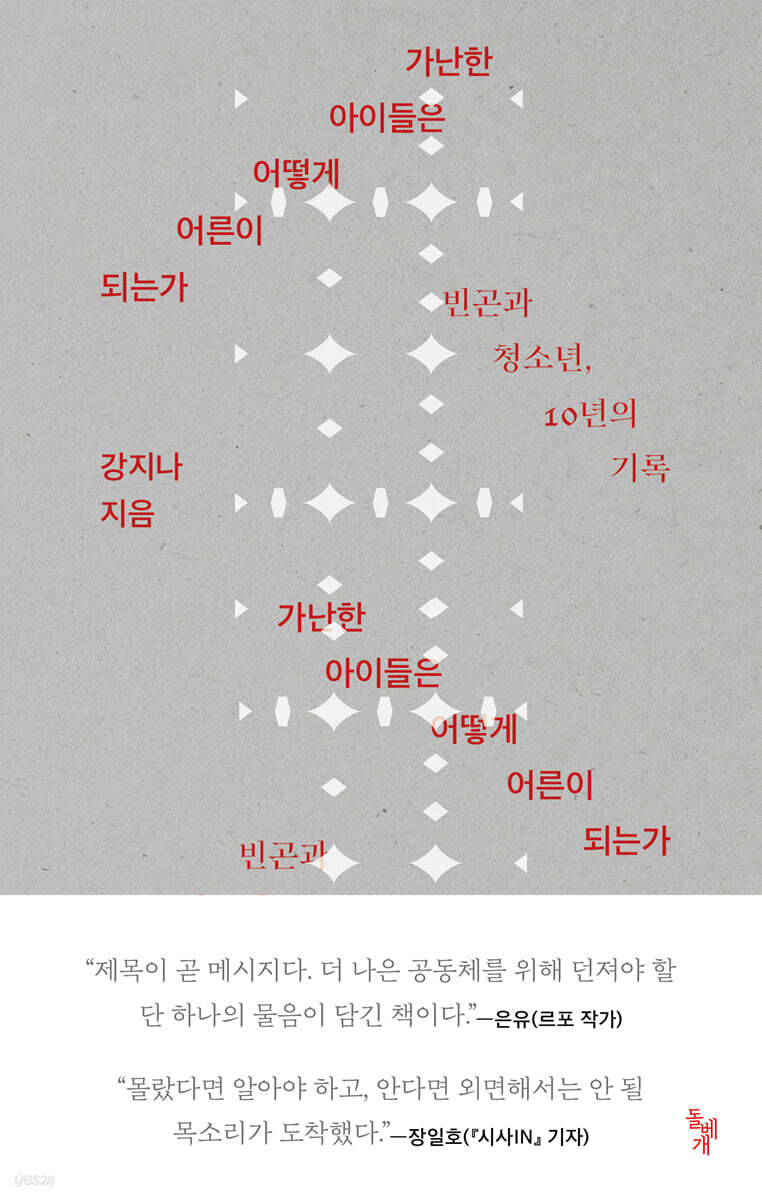
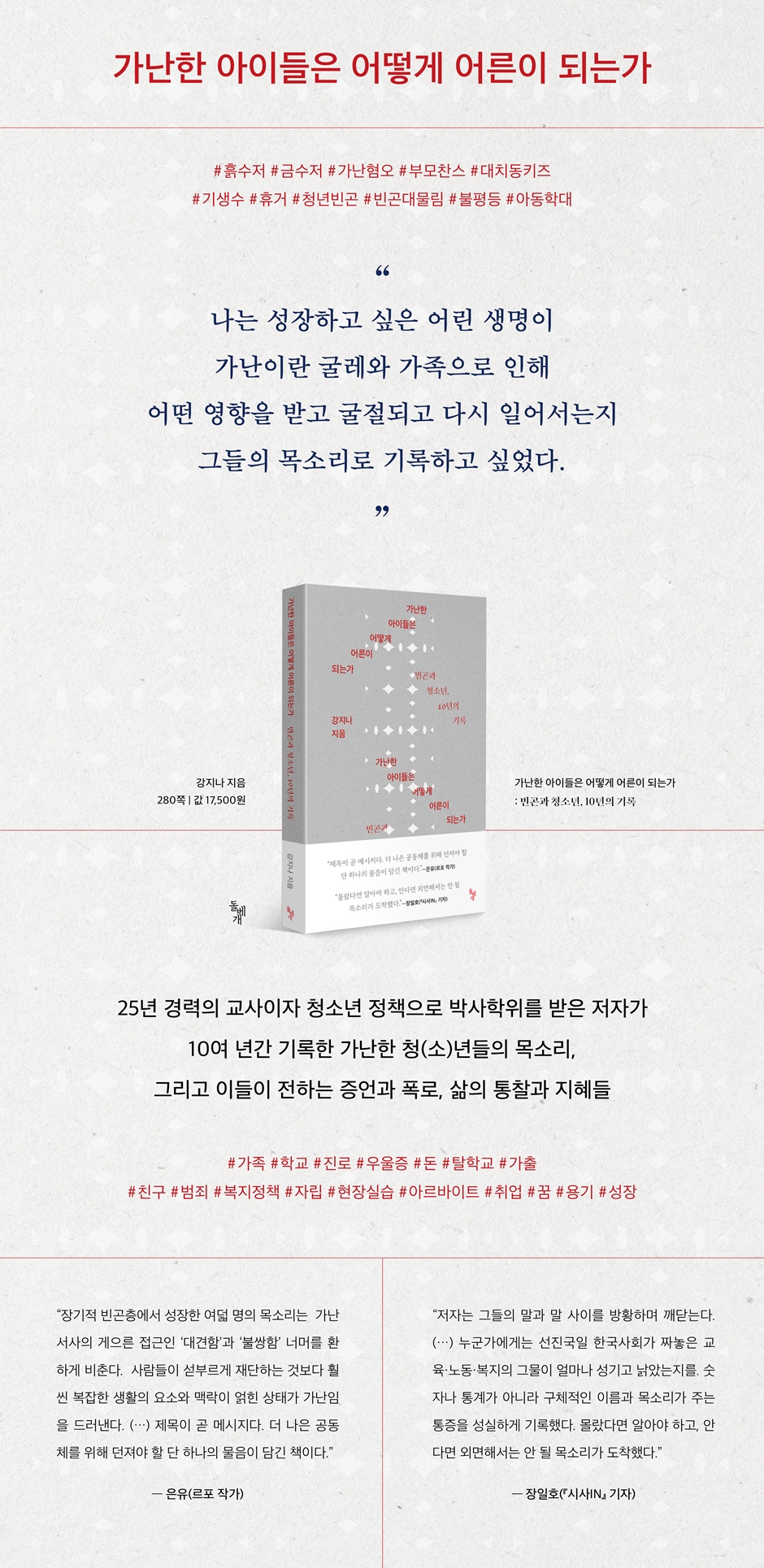
“When we first met, they were teenagers of sixteen or seventeen years old. “He is now a young man in his thirties.” A time of poverty and growth meticulously recorded over ten years. The author, a teacher with 25 years of experience and a doctorate in youth policy, spent over a decade interacting with eight children from impoverished families. Through this experience, he actively explores the challenges faced by impoverished youth as they grow into adulthood and the intersection of education, labor, and welfare in our society. This book is a thorough dissection of the multifaceted realities surrounding poverty, a sharp policy proposal, and a heartbreaking coming-of-age story about how people discover insight and wisdom about life within the shackles of poverty. Writer Eunyu and reporter Jang Il-ho added thoughtful recommendations. |
- You can preview some of the book's contents.
Preview
index
Entering
“When I think about the future, it’s really dark.”
Sohee, a life of enduring depression
[Sohee's Backstory] Why Are Poor Families Depressed?
“I want to be a good father.”
A righteous and honest young man, spiritual
[Spiritual Story] Where does this love for family come from?
“My strength is leveraging my experience.”
Super positive energy, Jihyun
[Jihyun's Backstory] How does one gain the strength to overcome poverty?
“How can I live happily later?”
Yeonwoo, the shadow of melancholic youth
[Yeonwoo's Backstory] How can you find the path that's right for you?
“If we get pushed here, it’s over.”
Swamp of poverty, Sujeong
[Behind the scenes] Why does the transmission of poverty persist even after employment?
“Riding a motorcycle relieves my stress.”
Literally a storm, Hyunseok
[Hyunseok's Backstory] Who are the youths who commit crimes?
“I feel anxious when I don’t have money.”
Future businessman, Woobin
[Woobin's Backstory] What kind of life do working youth dream of?
“I hate people staring at me.”
Hye-ju, who stands out but has a scary gaze
[Hyeju's Backstory] Why was she afraid of the gaze of the world outside school?
Going out
“When I think about the future, it’s really dark.”
Sohee, a life of enduring depression
[Sohee's Backstory] Why Are Poor Families Depressed?
“I want to be a good father.”
A righteous and honest young man, spiritual
[Spiritual Story] Where does this love for family come from?
“My strength is leveraging my experience.”
Super positive energy, Jihyun
[Jihyun's Backstory] How does one gain the strength to overcome poverty?
“How can I live happily later?”
Yeonwoo, the shadow of melancholic youth
[Yeonwoo's Backstory] How can you find the path that's right for you?
“If we get pushed here, it’s over.”
Swamp of poverty, Sujeong
[Behind the scenes] Why does the transmission of poverty persist even after employment?
“Riding a motorcycle relieves my stress.”
Literally a storm, Hyunseok
[Hyunseok's Backstory] Who are the youths who commit crimes?
“I feel anxious when I don’t have money.”
Future businessman, Woobin
[Woobin's Backstory] What kind of life do working youth dream of?
“I hate people staring at me.”
Hye-ju, who stands out but has a scary gaze
[Hyeju's Backstory] Why was she afraid of the gaze of the world outside school?
Going out
Detailed image
Into the book
I wanted to record, through their voices, how young lives, longing to grow, are affected, distorted, and rise again by the shackles of poverty and family.
It contained insight and wisdom about life that was different from the common perception or image of poverty in the world.
I wanted to academically capture the insights and wisdom that young people have gained from life.
--- p.7
These people, who were sixteen or seventeen years old when they first met, are now young men in their thirties.
The changes and twists and turns of their lives over time were conveyed in their entirety, and at times, I felt pitiful and sad, while at other times, I felt admiration and admiration for them.
They wanted their stories to help others, just as they had been helped when they were struggling, and they were curious to hear what other interviewees had to say.
Although it is not easy to share your story, you have supported and waited for my book for a long time with the intention of helping other young people in difficult circumstances.
--- p.8
I was very happy when I heard the news that Sohee passed the high school qualification exam, entered college, and was studying social welfare.
I thought that the bright and confident Sohee had overcome all that as if she were showing the world something.
But when I met Sohee again in college, I was puzzled to see that she was still depressed and had difficulty forming relationships like when she was a teenager.
Even when times are tough, people who still drink excessively and socialize haven't really moved far beyond their former circle of friends.
Even the social worker who had been watching him for a long time could not explain this part.
The question of why emotional problems like anxiety and depression persist from generation to generation kept lingering in my mind.
--- p.34
When I look at spirituality, I have this question:
Why does Yeongseong make so many decisions for his family, even though they weren't always helpful to him? Yeongseong's family faced hardships and even faced a near-breakup, but they eventually reunited and have now reestablished their former harmonious relationship.
This process that my parents showed me during my spiritual growth period seemed to have become a role model in my life.
--- p.55
Writing is like that too.
If I want to get a scholarship, I have to write about my circumstances.
As I write so much, my writing skills also improve.
I got an A in college because people said I was so good at writing.
That all helped (laughs).
--- p.81
Originally, when I was in the second year of middle school, I gave up on studying completely and then started studying again, planning to go into the humanities.
But my mom and dad were strongly against it.
To learn skills or something.
If you go into the humanities, you have to excel in your studies to get into a good university and get a stable job.
It's already easy to make a living in the technology field.
When I was in middle school, I had no dreams and nothing I wanted to do.
(…) My major is interior design.
I originally went in with a friend, but when I went there, it seemed fun and they seemed good at it… .
--- p.110~111
When I look at it from my own perspective, it seems like I've gained some foundation because I've gained the ability to work, but when I look at the whole family, I feel like I've become more lacking and things have become more difficult.
And it feels like there's nothing ahead, like I'll just stay here? Like I'll have to give up on my endless dreams? They say dreams collide with reality.
I understand what you mean.
At first, I only thought of it as a dream, but when I looked at reality, I realized that it is impossible to make dreams come true.
Then it's hard to see ahead.
--- p.146
My house is stuffy.
I was just bored of being at home.
I always fought with my sister and wanted to go out.
(…) We fight almost because of something I did.
They even fight over money.
My sister lent me money, but I didn't pay it back.
He never told me about his family life.
I don't eat much at home.
(…) I just didn’t go home often.
--- p.171
There's nothing else I'm more confident in than this.
This kind of thing really helps me build connections.
Even at this age, I already know most people in the liquor industry, distribution, and food industry.
Actually, I don't have the connections and confidence to do anything else besides this.
I don’t have confidence that I will do well even if I go to college… .
(…) If you look at the people in this industry, they are all people who came from poverty like me, but they have all become successful.
When I listen to people's stories, I realize that there are people who have it worse than me.
They said they would help everyone.
There are also people who want to do it together.
--- p.207
I thought about the changes I had seen in Hyeju over the past ten years.
In her teens, Hyeju wandered the streets and was the center of attention for people.
He was a confused child, and Hye-ju, in her early twenties, was a young man who left home empty-handed and didn't know what to do.
Her family considered her hopeless and a nuisance to the household.
I was also at a loss as to what to do with my life.
But after going through that period, I was impressed by how he gradually found his place and fulfilled his role.
Hyeju said, “What can I do now that I’m old?
I often said, “I should just try it.”
Children grow up through ups and downs and eventually stand on their own two feet.
Maybe we need to support them, give them opportunities, and wait until they are old enough.
It contained insight and wisdom about life that was different from the common perception or image of poverty in the world.
I wanted to academically capture the insights and wisdom that young people have gained from life.
--- p.7
These people, who were sixteen or seventeen years old when they first met, are now young men in their thirties.
The changes and twists and turns of their lives over time were conveyed in their entirety, and at times, I felt pitiful and sad, while at other times, I felt admiration and admiration for them.
They wanted their stories to help others, just as they had been helped when they were struggling, and they were curious to hear what other interviewees had to say.
Although it is not easy to share your story, you have supported and waited for my book for a long time with the intention of helping other young people in difficult circumstances.
--- p.8
I was very happy when I heard the news that Sohee passed the high school qualification exam, entered college, and was studying social welfare.
I thought that the bright and confident Sohee had overcome all that as if she were showing the world something.
But when I met Sohee again in college, I was puzzled to see that she was still depressed and had difficulty forming relationships like when she was a teenager.
Even when times are tough, people who still drink excessively and socialize haven't really moved far beyond their former circle of friends.
Even the social worker who had been watching him for a long time could not explain this part.
The question of why emotional problems like anxiety and depression persist from generation to generation kept lingering in my mind.
--- p.34
When I look at spirituality, I have this question:
Why does Yeongseong make so many decisions for his family, even though they weren't always helpful to him? Yeongseong's family faced hardships and even faced a near-breakup, but they eventually reunited and have now reestablished their former harmonious relationship.
This process that my parents showed me during my spiritual growth period seemed to have become a role model in my life.
--- p.55
Writing is like that too.
If I want to get a scholarship, I have to write about my circumstances.
As I write so much, my writing skills also improve.
I got an A in college because people said I was so good at writing.
That all helped (laughs).
--- p.81
Originally, when I was in the second year of middle school, I gave up on studying completely and then started studying again, planning to go into the humanities.
But my mom and dad were strongly against it.
To learn skills or something.
If you go into the humanities, you have to excel in your studies to get into a good university and get a stable job.
It's already easy to make a living in the technology field.
When I was in middle school, I had no dreams and nothing I wanted to do.
(…) My major is interior design.
I originally went in with a friend, but when I went there, it seemed fun and they seemed good at it… .
--- p.110~111
When I look at it from my own perspective, it seems like I've gained some foundation because I've gained the ability to work, but when I look at the whole family, I feel like I've become more lacking and things have become more difficult.
And it feels like there's nothing ahead, like I'll just stay here? Like I'll have to give up on my endless dreams? They say dreams collide with reality.
I understand what you mean.
At first, I only thought of it as a dream, but when I looked at reality, I realized that it is impossible to make dreams come true.
Then it's hard to see ahead.
--- p.146
My house is stuffy.
I was just bored of being at home.
I always fought with my sister and wanted to go out.
(…) We fight almost because of something I did.
They even fight over money.
My sister lent me money, but I didn't pay it back.
He never told me about his family life.
I don't eat much at home.
(…) I just didn’t go home often.
--- p.171
There's nothing else I'm more confident in than this.
This kind of thing really helps me build connections.
Even at this age, I already know most people in the liquor industry, distribution, and food industry.
Actually, I don't have the connections and confidence to do anything else besides this.
I don’t have confidence that I will do well even if I go to college… .
(…) If you look at the people in this industry, they are all people who came from poverty like me, but they have all become successful.
When I listen to people's stories, I realize that there are people who have it worse than me.
They said they would help everyone.
There are also people who want to do it together.
--- p.207
I thought about the changes I had seen in Hyeju over the past ten years.
In her teens, Hyeju wandered the streets and was the center of attention for people.
He was a confused child, and Hye-ju, in her early twenties, was a young man who left home empty-handed and didn't know what to do.
Her family considered her hopeless and a nuisance to the household.
I was also at a loss as to what to do with my life.
But after going through that period, I was impressed by how he gradually found his place and fulfilled his role.
Hyeju said, “What can I do now that I’m old?
I often said, “I should just try it.”
Children grow up through ups and downs and eventually stand on their own two feet.
Maybe we need to support them, give them opportunities, and wait until they are old enough.
--- p.247
Publisher's Review
◆ A portion of the author's royalties and the publisher's income from this book will be donated to social organizations to help youth in difficult circumstances.
◆
The Age of Dirt Spoons and Gold Spoons: Words from Poor Children
For the past decade, terms like “poverty aversion,” “dirt spoon,” “inherited poverty,” and “youth poverty” have dominated the discourse on poverty in our society.
‘Poverty’ was a situation to be hidden or an object of insult.
Or it has become a symbol of misfortune or a reality that cannot be escaped from at birth.
So, what impact did poverty have on children growing up in this era? In an era where expectations of class mobility through education have faded and the value of labor has declined, what experiences did young people, far removed from terms like "Daechi-dong kids," "golden spoon," and "parents' chance," experience, and what did they dream of? Now, more than ever, is the time for a thorough and in-depth discussion about poverty and inequality.
"How Poor Children Become Adults: Poverty and Youth, A Record of 10 Years" began with the author's doctoral dissertation ("Coping Mechanisms of Youth from Families with Inherited Poverty") on youth from families that experienced intergenerational poverty.
The author, who has been working as a middle and high school teacher for over 20 years, felt a sense of guilt and helplessness when he was a new teacher and was unable to provide any help to his students growing up in poverty, so he studied social welfare in graduate school.
Based on the author's doctoral dissertation completed in 2016, this book follows the lives of these young people as they become adults and captures their voices, thoroughly "bearing witness" and "exposing" the multifaceted realities surrounding poverty.
It vividly chronicles in-depth stories of family issues, career concerns, depression, dropping out of school, running away from home, crime, social advancement and independence as an adult, and the labor experiences of young people, ultimately leading to sharp diagnoses and proposals for education, labor, and welfare policies.
Words of growth that grew out of poverty
"How Poor Kids Become Adults" is both an analysis of poverty in Korean society today and a heartbreaking coming-of-age story about how young people, struggling within the shackles of poverty, discover insight and wisdom about life.
It is also the story of those who have been erased from the existing youth discourse, namely, graduates of specialized high schools or two- or three-year universities, out-of-school youth, and unstable workers, as well as the story of those who were born in the 1990s, spent their adolescence in the 2010s, and are now entering their young adulthood in the 2020s.
This book contains the stories of eight young men.
So-hee, who suffers from depression and addiction that has been passed down from her grandparents; Yeong-seong, a model student who believes that if she lives diligently, she will be rewarded, but on the other hand, she feels insecure; Ji-hyeon, who pushes forward with her choices for what she truly wants even in difficult circumstances; Yeon-woo, who found work she loves through time for reflection despite her family's indifference and neglect; Soo-jeong, who gave up on her dreams due to her mother's illness and debt and then became independent; Hyeon-seok, who constantly tries to change and fill himself despite the prejudice and misunderstanding about being a criminal; Woo-bin, who devotes himself to part-time work to become a "cheap boss"; and Hye-ju, who had low self-esteem as an out-of-school youth but has now found her place.
Although each of us has different personalities, different pursuits in life, and different situations, we are surprisingly similar in some ways.
Growing up in poverty means having many limitations in life, being prone to mental fragility, thinking too much about 'family', and carrying the burden of having to escape poverty.
So what does it mean for a youth from a disadvantaged family to escape poverty? It's not simply about getting into college or landing a stable job after graduation.
The book follows Amartya Sen's argument that "poverty is not simply low income, but the deprivation of basic capabilities," and that capabilities mean "the real freedom to lead a life that individuals value" (p. 146).
Therefore, escaping poverty is a process of regaining capacity, and children grow significantly as they broaden their awareness of poverty, family, other people, and society, and come to understand themselves as independent individuals with unique desires.
This is why these stories of poverty cannot help but be stories of growth.
We also know that these eight young people have gotten to where they are thanks to the help, big and small, from friends, family, school, local children's centers, social welfare centers, and their workplaces.
Therefore, the author writes that they “wanted their stories to help someone, just as they had been helped by someone when they were struggling” (p. 8).
Their desire to give back what they have received from the world, their hope that their stories will become a resource for the community, and their “authenticity and courage” are the most shining points in this book.
Words of Love from a Teacher Who Became a Policy Researcher
"How Poor Children Become Adults" is a record of the experiences of eight young people over the past ten years, and is also the fruition of the author's contemplation that has continued for over twenty years. It is also a responsible record of a teacher who never feels powerless before his students.
The author of this book, Ji-na Kang, is a teacher of English at a middle and high school in Gyeonggi Province, and a researcher who holds a doctorate in social welfare policy (youth) and has written several papers related to policy.
When he was a new teacher, faced with the helplessness of children from poor families who were being abused, instead of accepting the situation as an inevitable reality, he sought practical ways to help.
The teacher chose the path of a school social worker and later a policy researcher.
All the heartfelt moments from that time are contained in this book.
Here are vivid testimonies and insights drawn from the author's experiences in education and welfare settings, along with the voices of poor young people reflecting on their lives.
But this book minimizes the emotional approach.
The author writes, “The changes and twists and turns of their lives over time were conveyed in their entirety, and at times, I felt a sense of pity and sorrow, while at other times, I felt admiration and pride, intertwined with countless other emotions” (p. 8), but such feelings remain as invisible traces.
Each chapter in this book is structured around a first half that brings the voices of eight young people to the forefront, followed by a second half that discusses key themes or agendas drawn from their stories.
The first half conveys the feeling of being in a warm and close conversation with the author and interviewees, who have maintained a relationship for over ten years, and the individual personalities, speech patterns, and emotions of each of the eight people are vividly expressed.
The second half, on the other hand, distances itself from these individuals and analyzes more general issues.
Affection for the individual interviewees intersects with a desire to maintain composure and composure as a researcher. These slightly different stories of resolution illuminate the lives, mental landscapes, and social structures of poor youth in a three-dimensional way.
In this way, this book could be said to be a precious letter that a teacher, trying to fulfill his 'social responsibility', conveys to his beloved children the words he was unable to say, or that he finally receives after a long struggle to send it.
◆
The Age of Dirt Spoons and Gold Spoons: Words from Poor Children
For the past decade, terms like “poverty aversion,” “dirt spoon,” “inherited poverty,” and “youth poverty” have dominated the discourse on poverty in our society.
‘Poverty’ was a situation to be hidden or an object of insult.
Or it has become a symbol of misfortune or a reality that cannot be escaped from at birth.
So, what impact did poverty have on children growing up in this era? In an era where expectations of class mobility through education have faded and the value of labor has declined, what experiences did young people, far removed from terms like "Daechi-dong kids," "golden spoon," and "parents' chance," experience, and what did they dream of? Now, more than ever, is the time for a thorough and in-depth discussion about poverty and inequality.
"How Poor Children Become Adults: Poverty and Youth, A Record of 10 Years" began with the author's doctoral dissertation ("Coping Mechanisms of Youth from Families with Inherited Poverty") on youth from families that experienced intergenerational poverty.
The author, who has been working as a middle and high school teacher for over 20 years, felt a sense of guilt and helplessness when he was a new teacher and was unable to provide any help to his students growing up in poverty, so he studied social welfare in graduate school.
Based on the author's doctoral dissertation completed in 2016, this book follows the lives of these young people as they become adults and captures their voices, thoroughly "bearing witness" and "exposing" the multifaceted realities surrounding poverty.
It vividly chronicles in-depth stories of family issues, career concerns, depression, dropping out of school, running away from home, crime, social advancement and independence as an adult, and the labor experiences of young people, ultimately leading to sharp diagnoses and proposals for education, labor, and welfare policies.
Words of growth that grew out of poverty
"How Poor Kids Become Adults" is both an analysis of poverty in Korean society today and a heartbreaking coming-of-age story about how young people, struggling within the shackles of poverty, discover insight and wisdom about life.
It is also the story of those who have been erased from the existing youth discourse, namely, graduates of specialized high schools or two- or three-year universities, out-of-school youth, and unstable workers, as well as the story of those who were born in the 1990s, spent their adolescence in the 2010s, and are now entering their young adulthood in the 2020s.
This book contains the stories of eight young men.
So-hee, who suffers from depression and addiction that has been passed down from her grandparents; Yeong-seong, a model student who believes that if she lives diligently, she will be rewarded, but on the other hand, she feels insecure; Ji-hyeon, who pushes forward with her choices for what she truly wants even in difficult circumstances; Yeon-woo, who found work she loves through time for reflection despite her family's indifference and neglect; Soo-jeong, who gave up on her dreams due to her mother's illness and debt and then became independent; Hyeon-seok, who constantly tries to change and fill himself despite the prejudice and misunderstanding about being a criminal; Woo-bin, who devotes himself to part-time work to become a "cheap boss"; and Hye-ju, who had low self-esteem as an out-of-school youth but has now found her place.
Although each of us has different personalities, different pursuits in life, and different situations, we are surprisingly similar in some ways.
Growing up in poverty means having many limitations in life, being prone to mental fragility, thinking too much about 'family', and carrying the burden of having to escape poverty.
So what does it mean for a youth from a disadvantaged family to escape poverty? It's not simply about getting into college or landing a stable job after graduation.
The book follows Amartya Sen's argument that "poverty is not simply low income, but the deprivation of basic capabilities," and that capabilities mean "the real freedom to lead a life that individuals value" (p. 146).
Therefore, escaping poverty is a process of regaining capacity, and children grow significantly as they broaden their awareness of poverty, family, other people, and society, and come to understand themselves as independent individuals with unique desires.
This is why these stories of poverty cannot help but be stories of growth.
We also know that these eight young people have gotten to where they are thanks to the help, big and small, from friends, family, school, local children's centers, social welfare centers, and their workplaces.
Therefore, the author writes that they “wanted their stories to help someone, just as they had been helped by someone when they were struggling” (p. 8).
Their desire to give back what they have received from the world, their hope that their stories will become a resource for the community, and their “authenticity and courage” are the most shining points in this book.
Words of Love from a Teacher Who Became a Policy Researcher
"How Poor Children Become Adults" is a record of the experiences of eight young people over the past ten years, and is also the fruition of the author's contemplation that has continued for over twenty years. It is also a responsible record of a teacher who never feels powerless before his students.
The author of this book, Ji-na Kang, is a teacher of English at a middle and high school in Gyeonggi Province, and a researcher who holds a doctorate in social welfare policy (youth) and has written several papers related to policy.
When he was a new teacher, faced with the helplessness of children from poor families who were being abused, instead of accepting the situation as an inevitable reality, he sought practical ways to help.
The teacher chose the path of a school social worker and later a policy researcher.
All the heartfelt moments from that time are contained in this book.
Here are vivid testimonies and insights drawn from the author's experiences in education and welfare settings, along with the voices of poor young people reflecting on their lives.
But this book minimizes the emotional approach.
The author writes, “The changes and twists and turns of their lives over time were conveyed in their entirety, and at times, I felt a sense of pity and sorrow, while at other times, I felt admiration and pride, intertwined with countless other emotions” (p. 8), but such feelings remain as invisible traces.
Each chapter in this book is structured around a first half that brings the voices of eight young people to the forefront, followed by a second half that discusses key themes or agendas drawn from their stories.
The first half conveys the feeling of being in a warm and close conversation with the author and interviewees, who have maintained a relationship for over ten years, and the individual personalities, speech patterns, and emotions of each of the eight people are vividly expressed.
The second half, on the other hand, distances itself from these individuals and analyzes more general issues.
Affection for the individual interviewees intersects with a desire to maintain composure and composure as a researcher. These slightly different stories of resolution illuminate the lives, mental landscapes, and social structures of poor youth in a three-dimensional way.
In this way, this book could be said to be a precious letter that a teacher, trying to fulfill his 'social responsibility', conveys to his beloved children the words he was unable to say, or that he finally receives after a long struggle to send it.
GOODS SPECIFICS
- Date of issue: November 6, 2023
- Page count, weight, size: 280 pages | 382g | 127*200*17mm
- ISBN13: 9791192836355
- ISBN10: 1192836359
You may also like
카테고리
korean


korean

![GQ KOREA Mark (Monthly): December [2025]](http://librairie.coreenne.fr/cdn/shop/files/8ef265dbbfbf186523ed75ba7319009d.jpg?v=1765340328&width=3840)


