

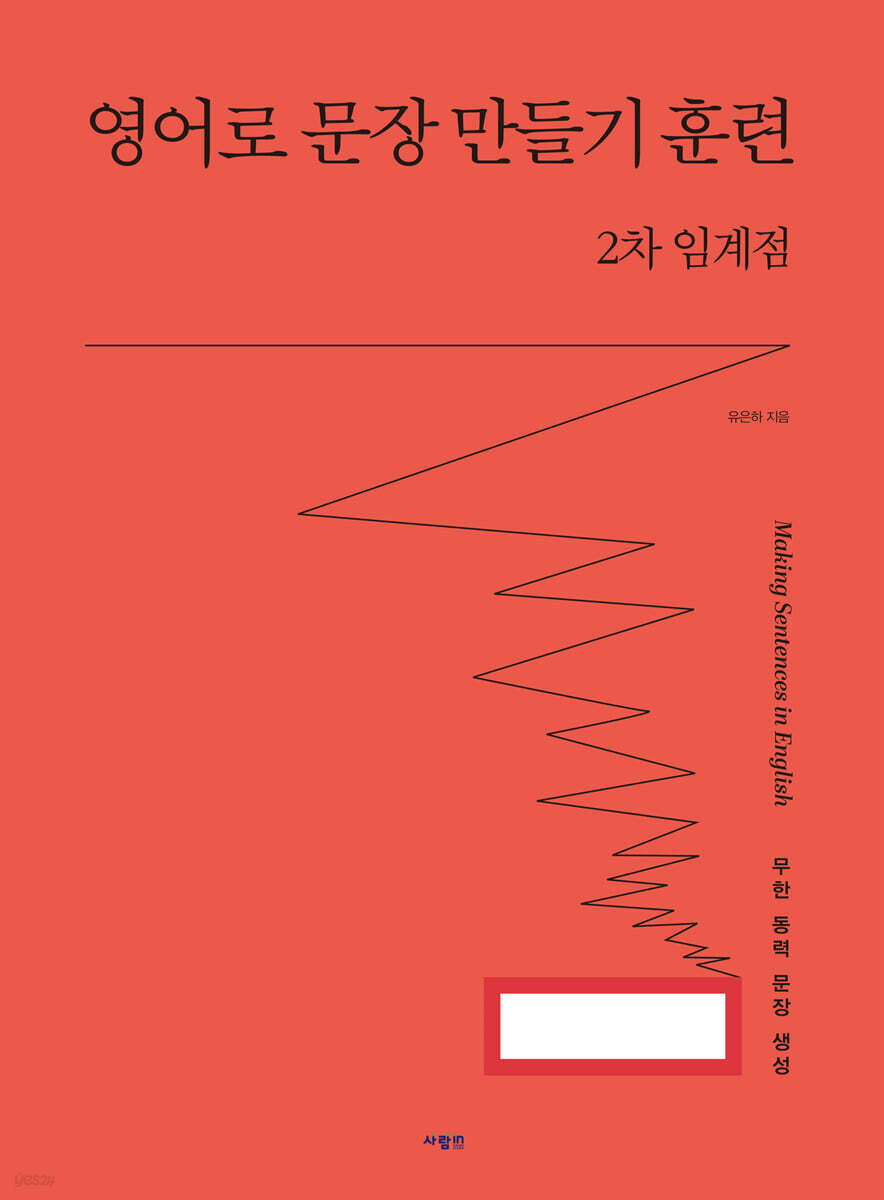
Second critical point of sentence-making training in English
 |
Description
Book Introduction
You can make sentences in English.
Grammar is of course included, as is English thinking.
Most Koreans make awkward English sentences that are grammatically correct but reflect Korean thinking.
If possible, let's create English sentences that sound like they were written by a native speaker.
It is important to learn English thinking from the beginning of training and to create English sentences that incorporate that thinking.
"English Sentence Creation Training 2nd Critical Point" trains native English speaker's sense of sentence structure, breaking free from Korean thinking.
It allows you to translate Korean sentences that come to mind into English as if they were written by a native speaker.
Grammar is of course included, as is English thinking.
Most Koreans make awkward English sentences that are grammatically correct but reflect Korean thinking.
If possible, let's create English sentences that sound like they were written by a native speaker.
It is important to learn English thinking from the beginning of training and to create English sentences that incorporate that thinking.
"English Sentence Creation Training 2nd Critical Point" trains native English speaker's sense of sentence structure, breaking free from Korean thinking.
It allows you to translate Korean sentences that come to mind into English as if they were written by a native speaker.
- You can preview some of the book's contents.
Preview
index
Making Sentences in English: Beginning is the Beginning
Features and structure of this book
WARM-UP: Two Principles That Make Any English Sentence Easier
PART 1: BASE on English Writing that Teaches Meaning
CHAPTER 1 TENSES IN ENGLISH
UNIT 1 Creating Simple Present and Present Progressive Sentences
UNIT 2 Creating Simple Past and Past Progressive Sentences
UNIT 3 Creating Present Perfect Sentences
UNIT 4 Creating Present Perfect and Present Perfect Continuous Sentences
UNIT 5 Creating Past Perfect Sentences
UNIT 6 Making Past Perfect Continuous Sentences
UNIT 7 Creating Present Progressive/Simple Present Sentences Expressing the Future
UNIT 8: Making sentences about 'will' and 'prediction' using 'will'
UNIT 9 Making sentences about the future that has already been decided and planned: be going to
UNIT 10: Making future sentences in the past with was/were going to
UNIT 11 Creating Future Continuous Sentences
UNIT 12: Creating Future Perfect Sentences
PART 2: Writing with a Native Speaker's Touch
CHAPTER 1 Making sentences more concise with object subjects
UNIT 1 Sentence Making with Object Subjects 1 (Object Subject + Predicate + Object)
UNIT 2 Sentence Making with Object Subjects 2 (Object Subject + Predicate + Prepositional Phrase)
UNIT 3 Sentence Making with Object Subjects 3 (Object Subject + Predicate + IO + DO)
UNIT 4 Sentence Making with Object Subjects 4 (5-type sentences with make/help/cause/drive)
UNIT 5 Sentence Making with Object Subjects 5 (Object Subject + Enable + Object + to V)
UNIT 6 Making Sentences with Object Subjects 6 (prevent/keep/prohibit/hinder + object + from Ving)
UNIT 7 Making Sentences with Object Subjects 7 (When the Object Subject Expresses a Condition)
CHAPTER 2 Passive Voice
UNIT 1 Creating sentences that refer to the action itself
UNIT 2 Creating Passive Sentences Using Tenses
UNIT 3 Creating passive sentences using get instead of be
UNIT 4 Creating Sentences in the Passive Voice 1
UNIT 5: Creating Passive Sentences 2
CHAPTER 3 VARIOUS TENSES OF AUXILIARY VERBS
UNIT 1 Creating to-infinitive sentences using tenses 1
UNIT 2 Creating to-infinitive structures with passive voice 2
UNIT 3 Creating Gerund Phrases with Tense
UNIT 4 Creating Participle Phrases in Various Tenses
UNIT 5 Creating Participle Phrases to Use When Adding Content
PART 3: Writing that develops English thinking
CHAPTER 1 Creating Questions and Negatives in English
UNIT 1: Making Questions with the Verb "Be" 1
UNIT 2: Making Questions with the Verb "Be" 2
UNIT 3: Creating Questions with Auxiliary Verbs
UNIT 4: Making Questions with Regular Verbs
UNIT 5: Creating Present Perfect Questions
UNIT 6 Interrogative Words: Making Questions - who, what 1
UNIT 7 Interrogative Words: Making Questions - who, what 2
UNIT 8 Interrogative Words: Making Questions - when, where, how, why
UNIT 9 Interrogative Words: Creating Questions - how + adjectives/adverbs
UNIT 10: Making Negative Sentences with the Verb "Be"
UNIT 11 Making Negative Sentences with Auxiliary Verbs
UNIT 12 Making Negative Sentences with Regular Verbs
UNIT 13 Creating Statements 1
UNIT 14 Creating Statements 2
CHAPTER 2 Basic Sentence Refining
UNIT 1 Making Subject-Verb Number Agreement Sentences 1 (Collective Noun-Singular Verb)
UNIT 2 Making Subject-Verb Number Agreement Sentences 2 (Plural Nouns-Plural Verbs)
UNIT 3 Making sentences with subject-verb agreement 3 (Nouns that appear to be plural but are treated as singular - singular verbs)
UNIT 4 Making Subject-Verb Number Agreement Sentences 4 (Quantifiers that can modify both uncountable and plural nouns)
CHAPTER 3: Knowing Articles Correctly and Using Them Confidently
UNIT 1 Making Sentences with Articles
UNIT 2 Making sentences using the correctly
UNIT 3 Making sentences using a/an correctly
UNIT 4 Creating sentences using article-free expressions correctly
ANSWERS
Features and structure of this book
WARM-UP: Two Principles That Make Any English Sentence Easier
PART 1: BASE on English Writing that Teaches Meaning
CHAPTER 1 TENSES IN ENGLISH
UNIT 1 Creating Simple Present and Present Progressive Sentences
UNIT 2 Creating Simple Past and Past Progressive Sentences
UNIT 3 Creating Present Perfect Sentences
UNIT 4 Creating Present Perfect and Present Perfect Continuous Sentences
UNIT 5 Creating Past Perfect Sentences
UNIT 6 Making Past Perfect Continuous Sentences
UNIT 7 Creating Present Progressive/Simple Present Sentences Expressing the Future
UNIT 8: Making sentences about 'will' and 'prediction' using 'will'
UNIT 9 Making sentences about the future that has already been decided and planned: be going to
UNIT 10: Making future sentences in the past with was/were going to
UNIT 11 Creating Future Continuous Sentences
UNIT 12: Creating Future Perfect Sentences
PART 2: Writing with a Native Speaker's Touch
CHAPTER 1 Making sentences more concise with object subjects
UNIT 1 Sentence Making with Object Subjects 1 (Object Subject + Predicate + Object)
UNIT 2 Sentence Making with Object Subjects 2 (Object Subject + Predicate + Prepositional Phrase)
UNIT 3 Sentence Making with Object Subjects 3 (Object Subject + Predicate + IO + DO)
UNIT 4 Sentence Making with Object Subjects 4 (5-type sentences with make/help/cause/drive)
UNIT 5 Sentence Making with Object Subjects 5 (Object Subject + Enable + Object + to V)
UNIT 6 Making Sentences with Object Subjects 6 (prevent/keep/prohibit/hinder + object + from Ving)
UNIT 7 Making Sentences with Object Subjects 7 (When the Object Subject Expresses a Condition)
CHAPTER 2 Passive Voice
UNIT 1 Creating sentences that refer to the action itself
UNIT 2 Creating Passive Sentences Using Tenses
UNIT 3 Creating passive sentences using get instead of be
UNIT 4 Creating Sentences in the Passive Voice 1
UNIT 5: Creating Passive Sentences 2
CHAPTER 3 VARIOUS TENSES OF AUXILIARY VERBS
UNIT 1 Creating to-infinitive sentences using tenses 1
UNIT 2 Creating to-infinitive structures with passive voice 2
UNIT 3 Creating Gerund Phrases with Tense
UNIT 4 Creating Participle Phrases in Various Tenses
UNIT 5 Creating Participle Phrases to Use When Adding Content
PART 3: Writing that develops English thinking
CHAPTER 1 Creating Questions and Negatives in English
UNIT 1: Making Questions with the Verb "Be" 1
UNIT 2: Making Questions with the Verb "Be" 2
UNIT 3: Creating Questions with Auxiliary Verbs
UNIT 4: Making Questions with Regular Verbs
UNIT 5: Creating Present Perfect Questions
UNIT 6 Interrogative Words: Making Questions - who, what 1
UNIT 7 Interrogative Words: Making Questions - who, what 2
UNIT 8 Interrogative Words: Making Questions - when, where, how, why
UNIT 9 Interrogative Words: Creating Questions - how + adjectives/adverbs
UNIT 10: Making Negative Sentences with the Verb "Be"
UNIT 11 Making Negative Sentences with Auxiliary Verbs
UNIT 12 Making Negative Sentences with Regular Verbs
UNIT 13 Creating Statements 1
UNIT 14 Creating Statements 2
CHAPTER 2 Basic Sentence Refining
UNIT 1 Making Subject-Verb Number Agreement Sentences 1 (Collective Noun-Singular Verb)
UNIT 2 Making Subject-Verb Number Agreement Sentences 2 (Plural Nouns-Plural Verbs)
UNIT 3 Making sentences with subject-verb agreement 3 (Nouns that appear to be plural but are treated as singular - singular verbs)
UNIT 4 Making Subject-Verb Number Agreement Sentences 4 (Quantifiers that can modify both uncountable and plural nouns)
CHAPTER 3: Knowing Articles Correctly and Using Them Confidently
UNIT 1 Making Sentences with Articles
UNIT 2 Making sentences using the correctly
UNIT 3 Making sentences using a/an correctly
UNIT 4 Creating sentences using article-free expressions correctly
ANSWERS
Detailed image

Publisher's Review
English sentences that feel like they were written by a Korean. We will identify the cause and provide an answer!
The grammar is correct and the meaning seems to make sense, but it doesn't feel like a sentence written by a native speaker. This is because we haven't acquired the unique sentence structure of English that native speakers share.
Will reading a lot of books solve this problem? "English Sentence Creation Training: 2nd Critical Point" addresses the causes of unsatisfactory English writing and provides solutions, enabling you to write sentences that sound like a native speaker.
I'm not sure about making sentences - Presenting unique sentence structures frequently used by native speakers.
The biggest difference between English and Korean sentences is the subjectification of adverbial clauses.
In other words, being able to use object subjects well is a key weapon in writing English sentences that sound like a native speaker.
In "Training to Create Sentences in English: Level 2," we focus on this part.
Additionally, by focusing on elements that distinguish subtle differences in meaning, you will gain confidence in sentence construction when you finish this book.
English thinking doesn't work - all Korean sentences are presented in English sentence structure.
It is difficult for Koreans to think in English.
So, I have no choice but to try to write sentences that conform to the English sentence structure as much as possible.
To this end, all Korean sentences in this book have been arranged in English sentence order.
Just as you learn to follow along if you keep listening, and you get used to it if you keep seeing it, if you keep seeing Korean sentences arranged in English sentence order, when the Korean sentence comes to mind, you will unconsciously arrange it in English sentence order.
The rush to transition from Korean to English one-on-one - providing hints at the right time and place to ensure continuous training
When you try to translate Korean into English one-to-one, it often doesn't work.
This is also a major obstacle that hinders writing practice.
But it is also true that with just a little hint, you can move forward.
Whenever learners encounter an expression that they might get stuck on, hints are provided at the right place to help them move on without giving up.
Repetition is boring, so I don't have enough practice - I cleverly catch the point where I want to write more.
No one likes to write long sentences over and over again from the beginning.
You need to think, ‘This much is worth writing about.’ or ‘Oh, I could write more, but I’m done.’ This is the only way to continue learning.
With continuous training, you can create sentences in a short period of time.
By pinpointing these points precisely, you can keep writing without feeling bored even if you repeat them, and you can keep writing as if you were possessed.
There is no progress because only easy things are used - a gradual structure that gradually becomes more difficult to try.
The critical point can be reached and surpassed by gradually increasing the level.
So, in this book, we structure it as follows: STEP 1: Create English sentences very easily - Create sentences using the given word - Create sentences using the given word, STEP 2: Create sentences by combining what you learned in STEP 1 while looking at hint expressions, and STEP 3: Complete a paragraph, so that learners can create sentences that will amaze them.
The grammar is correct and the meaning seems to make sense, but it doesn't feel like a sentence written by a native speaker. This is because we haven't acquired the unique sentence structure of English that native speakers share.
Will reading a lot of books solve this problem? "English Sentence Creation Training: 2nd Critical Point" addresses the causes of unsatisfactory English writing and provides solutions, enabling you to write sentences that sound like a native speaker.
I'm not sure about making sentences - Presenting unique sentence structures frequently used by native speakers.
The biggest difference between English and Korean sentences is the subjectification of adverbial clauses.
In other words, being able to use object subjects well is a key weapon in writing English sentences that sound like a native speaker.
In "Training to Create Sentences in English: Level 2," we focus on this part.
Additionally, by focusing on elements that distinguish subtle differences in meaning, you will gain confidence in sentence construction when you finish this book.
English thinking doesn't work - all Korean sentences are presented in English sentence structure.
It is difficult for Koreans to think in English.
So, I have no choice but to try to write sentences that conform to the English sentence structure as much as possible.
To this end, all Korean sentences in this book have been arranged in English sentence order.
Just as you learn to follow along if you keep listening, and you get used to it if you keep seeing it, if you keep seeing Korean sentences arranged in English sentence order, when the Korean sentence comes to mind, you will unconsciously arrange it in English sentence order.
The rush to transition from Korean to English one-on-one - providing hints at the right time and place to ensure continuous training
When you try to translate Korean into English one-to-one, it often doesn't work.
This is also a major obstacle that hinders writing practice.
But it is also true that with just a little hint, you can move forward.
Whenever learners encounter an expression that they might get stuck on, hints are provided at the right place to help them move on without giving up.
Repetition is boring, so I don't have enough practice - I cleverly catch the point where I want to write more.
No one likes to write long sentences over and over again from the beginning.
You need to think, ‘This much is worth writing about.’ or ‘Oh, I could write more, but I’m done.’ This is the only way to continue learning.
With continuous training, you can create sentences in a short period of time.
By pinpointing these points precisely, you can keep writing without feeling bored even if you repeat them, and you can keep writing as if you were possessed.
There is no progress because only easy things are used - a gradual structure that gradually becomes more difficult to try.
The critical point can be reached and surpassed by gradually increasing the level.
So, in this book, we structure it as follows: STEP 1: Create English sentences very easily - Create sentences using the given word - Create sentences using the given word, STEP 2: Create sentences by combining what you learned in STEP 1 while looking at hint expressions, and STEP 3: Complete a paragraph, so that learners can create sentences that will amaze them.
GOODS SPECIFICS
- Date of issue: February 7, 2025
- Page count, weight, size: 376 pages | 912g | 188*257*21mm
- ISBN13: 9791171011377
- ISBN10: 1171011377
You may also like
카테고리
korean


korean

![GQ KOREA Mark (Monthly): December [2025]](http://librairie.coreenne.fr/cdn/shop/files/8ef265dbbfbf186523ed75ba7319009d.jpg?v=1765340328&width=3840)


