

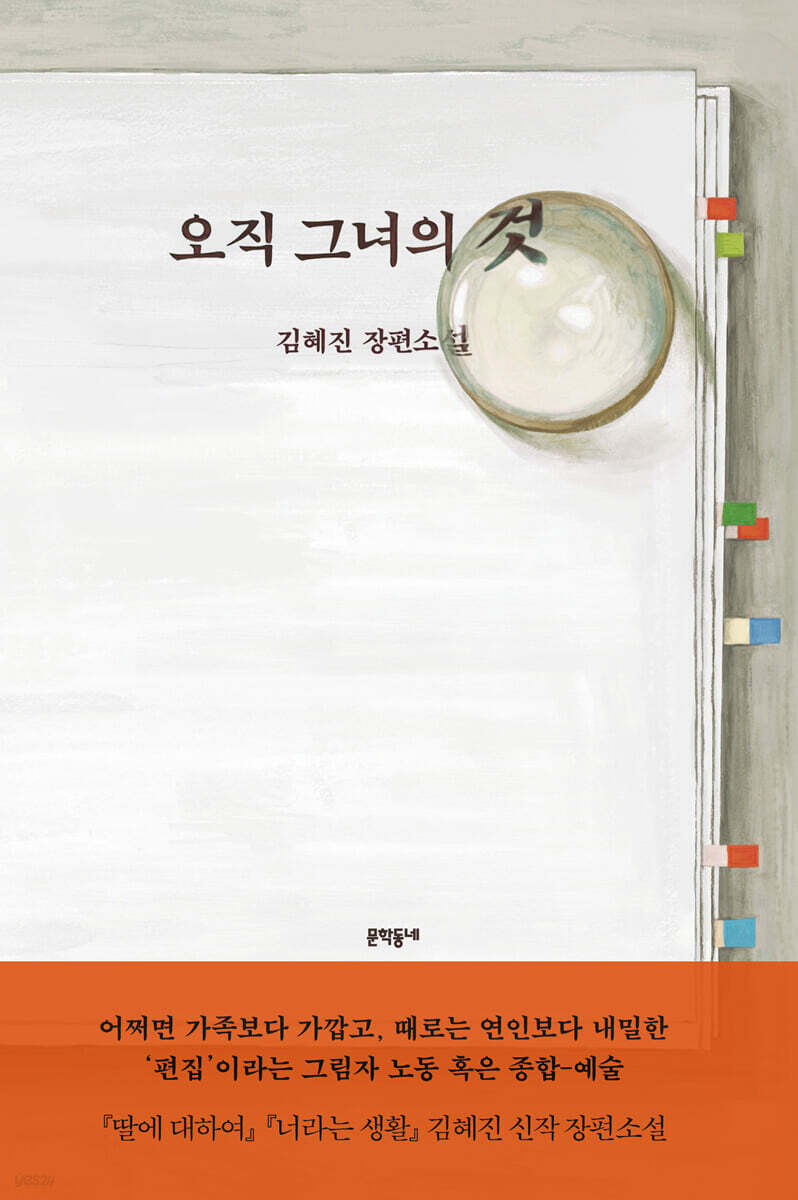
Only hers
 |
Description
Book Introduction
- A word from MD
-
Do you like books?A new work by author Kim Hye-jin that explores our lives with a delicate gaze.
This feature-length film deals with the life of a woman named Hong Seok-ju, who lives her entire life as a literary editor.
Although it may be a trivial and ordinary story to some, it depicts an overwhelming journey that cannot be replaced by anything else.
October 17, 2025. Novel/Poetry PD Kim Yu-ri
Maybe closer than family, and sometimes more intimate than a lover.
The Shadow Labor of 'Editing' or the World of Comprehensive Art
Kim Hye-jin's new novels, "About My Daughter" and "A Life Called You."
Novelist Kim Hye-jin's tenth novel and fifth full-length novel, "Only Hers," is published by Munhakdongne.
Not only has he won major literary awards such as the Young Writer's Award, the Kim Seung-ok Literary Award, the Daesan Literary Award, and the Shin Dong-yup Literary Award, but his work "About My Daughter" has been translated and published in many countries around the world, establishing him as a writer who truly represents Korean literature.
Over the years, Kim Hye-jin has consistently presented novels that slowly examine the placeless beings in our society, the people of today who have nowhere to turn, and the blind spots we would rather ignore, and turn the field of alienation into the center of the stage.
The field he portrays in this new full-length work is the shadow labor of 'editing' or the world of comprehensive art.
This novel, which deals with the life of a woman who began her publishing career as a proofreader in the early 1990s and has lived her entire life as a literary editor, depicts the introverted, fate-obedient protagonist slowly but meticulously weaving together her own life through the relationships and events she encounters while creating books, in a calm yet solid tone.
"Only Hers" is an extension of the "work" that the author has been obsessed with, but it is also a work that brings to life the rich meaning and texture of "work" that cannot be expressed solely through the word "labor."
As the recommendation says, “Do not be easily offended by the cruelty of work, do not dismiss or interpret the difficulties of work, and see the time in which work lives” (Kim Hwa-jin), the dynamics between work, love, and people are elegantly unfolded silently without exaggerating or minimizing them.
The Shadow Labor of 'Editing' or the World of Comprehensive Art
Kim Hye-jin's new novels, "About My Daughter" and "A Life Called You."
Novelist Kim Hye-jin's tenth novel and fifth full-length novel, "Only Hers," is published by Munhakdongne.
Not only has he won major literary awards such as the Young Writer's Award, the Kim Seung-ok Literary Award, the Daesan Literary Award, and the Shin Dong-yup Literary Award, but his work "About My Daughter" has been translated and published in many countries around the world, establishing him as a writer who truly represents Korean literature.
Over the years, Kim Hye-jin has consistently presented novels that slowly examine the placeless beings in our society, the people of today who have nowhere to turn, and the blind spots we would rather ignore, and turn the field of alienation into the center of the stage.
The field he portrays in this new full-length work is the shadow labor of 'editing' or the world of comprehensive art.
This novel, which deals with the life of a woman who began her publishing career as a proofreader in the early 1990s and has lived her entire life as a literary editor, depicts the introverted, fate-obedient protagonist slowly but meticulously weaving together her own life through the relationships and events she encounters while creating books, in a calm yet solid tone.
"Only Hers" is an extension of the "work" that the author has been obsessed with, but it is also a work that brings to life the rich meaning and texture of "work" that cannot be expressed solely through the word "labor."
As the recommendation says, “Do not be easily offended by the cruelty of work, do not dismiss or interpret the difficulties of work, and see the time in which work lives” (Kim Hwa-jin), the dynamics between work, love, and people are elegantly unfolded silently without exaggerating or minimizing them.
- You can preview some of the book's contents.
Preview
index
Only Hers _007
Author's Note _273
Author's Note _273
Into the book
The reason we read novels together here is not to say nice things to each other.
To find the gaps in the story and make up for what's lacking.
Learning something is not without its challenges.
--- p.20
For a long time, passion was something that captivated people in an instant.
It was not something that could be created by oneself, nor could it be controlled by reason.
And then a change came to this thinking.
More important than passion is the will to awaken and sustain it.
That it was headed somewhere else.
At that time, Seok-ju's passion was focused on creating books in a way that would gently tame people, rather than overwhelming them all at once.
--- p.87
Every moment they discovered each other.
As if the final destination of that sincere walk was actually the other person's heart.
No, they may not have known that what they discovered was themselves becoming more distinct through each other.
--- p.162
However, at such moments, I could vaguely guess that his interest was not directed towards the bright side but towards the dark side, and not towards the winning side but towards the losing side.
It was like a shadow of his inner self that Seok-ju could never know or reach, and it also seemed somewhat similar to the world of literature she dealt with.
--- p.192
Love was stable rather than dramatic.
It could change his life completely, just as he had long imagined, but not in a way that would overwhelm everything else.
Rather, it functioned in a way that permeated everything.
It was always something that existed in the process, not the result.
--- p.211
What if we had met when we were younger?
Still, there were times when I asked Wonho that.
well.
We must have met in a younger way, right?
how?
Freshly, childishly, poorly?
To find the gaps in the story and make up for what's lacking.
Learning something is not without its challenges.
--- p.20
For a long time, passion was something that captivated people in an instant.
It was not something that could be created by oneself, nor could it be controlled by reason.
And then a change came to this thinking.
More important than passion is the will to awaken and sustain it.
That it was headed somewhere else.
At that time, Seok-ju's passion was focused on creating books in a way that would gently tame people, rather than overwhelming them all at once.
--- p.87
Every moment they discovered each other.
As if the final destination of that sincere walk was actually the other person's heart.
No, they may not have known that what they discovered was themselves becoming more distinct through each other.
--- p.162
However, at such moments, I could vaguely guess that his interest was not directed towards the bright side but towards the dark side, and not towards the winning side but towards the losing side.
It was like a shadow of his inner self that Seok-ju could never know or reach, and it also seemed somewhat similar to the world of literature she dealt with.
--- p.192
Love was stable rather than dramatic.
It could change his life completely, just as he had long imagined, but not in a way that would overwhelm everything else.
Rather, it functioned in a way that permeated everything.
It was always something that existed in the process, not the result.
--- p.211
What if we had met when we were younger?
Still, there were times when I asked Wonho that.
well.
We must have met in a younger way, right?
how?
Freshly, childishly, poorly?
--- p.212
Publisher's Review
“It is a heart that one has pushed away, a heart that one has given up on, thinking that there is nothing one can do about it.
So, it was a strange attraction that I couldn't shake off no matter what I did."
Was what she did work or love?
The story begins with the college life of the main character, Seok-ju.
She, a history student at a university in a small town, “thinks that the subject I am studying resembles death” (p. 8).
That judgment soon turns into the realization that “a profound and rich conversation with a past time that has now disappeared is possible” (same page), but no vitality suddenly appears in the colorless and odorless college life and one’s own life.
However, as she joined the literary writing club at the end of the second semester of her freshman year, and as she took a novel writing class a year later, color began to gradually appear in her life.
Although she had no qualms about accepting the role she was given, on the day of her graduation ceremony, attended by her entire family, Seok-ju rebels against her parents, who have no doubt that she will become a teacher in the future, in a way that may be her first time doing so.
“No, other than being a teacher, I want to think about what I really want to do.” (Page 35) That courage was indebted to her passion and love for literature, but as spring passed and summer passed, she was unable to find a job, and at the age of twenty-four, she joined ‘Gyohanseoga’ as a proofreader.
Seok-ju felt like approaching the manuscript, which seemed to be looking down on the new proofreader and was reluctant to give him any attention.
In the writing that would be published as a book, I wanted to find a role that suited me, one that was neither too much nor too little. (Page 50)
It was a time when computers were becoming widespread but typewriters were still used, and most books were printed using letterpress.
Seok-ju begins his career by proofreading and editing the appendices of a book, excluding the main text, under the editorial manager, Oh Gi-seo, who is known for being strict with his work.
Although Ogiseo is a strict critic who “criticizes manuscripts that have been actively edited as excessive” and “shouts at manuscripts that have barely been edited as insincere” (p. 50), he was also the senior who first recognized Seokju’s talent.
Afterwards, Seok-ju is transferred to the Humanities and Liberal Arts Department as an editor upon his recommendation, and enters the seemingly similar but completely different world of 'editing'.
As she opens her eyes to the allure of editing work, which seems impossible to 'adapt' or 'become accustomed to', which is "without any standards or rules" and "at the same time accidental and inevitable" (pp. 95-96), another quiet yet hot passion arises within her.
And at the editors' club meeting that he went to with courage, he met 'Jo Won-ho', a magazine editor who does similar but completely different work.
It can be planned, but it doesn't go as planned, and it can be predicted, but it ends up in a way that deviates from expectations.
The two immediately recognized each other as similar beings, fascinated by such a coincidental and imperfect world. (p. 211)
At the same time, I completely failed at my first love.
About a life that ended up being exactly successful.
“When viewed from afar, the days seem monotonous, like the same day strung together.
But for her, every day was new” (p. 115) because of work and because of Wonho.
For her, work and love are similar, “something that is somewhat unexpected, but therefore pleasing” (p. 131), and “something that always exists in the process, not the result, but in the way it permeates everything else” (p. 211).
Seok-ju and Won-ho begin a love that is more like a daily walk than a trip, and their relationship develops into a deeper one.
As she works as a literary editor tailored to her needs and takes on writers, her work becomes more substantial.
Of course, work and love are similar to the burdens that weigh on life's shoulders.
It's scary how much I like something.
Even if you hate it, dislike it, and want to quit, you have to keep going.
My old friend used to say that.
That's what liking something is like.
The more you like someone, the more likely you are to get hurt. (Page 253)
The story, which at first glance seems to flow gently, hides in its second half the spectacle and overwhelming resonance that only a full-length novel can offer.
Where did this "journey, nothing remarkable, nothing to boast about" (p. 264) finally arrive? Furthermore, how similar and different are the journeys of the readers of this book to hers? "Her Only" can be read as a coming-of-age novel about a young woman struggling to find her place in society, a labor novel realistically portraying the world of "editing" and publishing, and a romance novel about a man and his lifelong love.
A great and broad love that can be called 'life love' that transcends literature, work, and even love for fate.
I sincerely hope that readers will also find something uniquely hers (me) in this novel that cannot be replaced or substituted.
A heart mixed with trembling and excitement, clumsiness and awkwardness, longing and fear.
Once you start, you can't stop or quit.
It is the very thing that gives height and depth to one's blank life, and gives light and shade to it. (p. 271)
Author's Note
Last year, I searched for and read books written by bookmakers.
I don't know why that reading, which started out of mild curiosity, brought about the desire to write something.
There must have been something that touched your heart.
Is it sincerity or enthusiasm?
There are things that become trivial when written down like this, things that are difficult to see because they are hidden by the work.
(…) Editing is not the only impossible task that ordinary people do every day.
Still, the daily life of reading and creating books had a great resonance.
Looking at it that way, I think this novel might be a review of the books I've read so far.
Fall 2025
Kim Hye-jin
So, it was a strange attraction that I couldn't shake off no matter what I did."
Was what she did work or love?
The story begins with the college life of the main character, Seok-ju.
She, a history student at a university in a small town, “thinks that the subject I am studying resembles death” (p. 8).
That judgment soon turns into the realization that “a profound and rich conversation with a past time that has now disappeared is possible” (same page), but no vitality suddenly appears in the colorless and odorless college life and one’s own life.
However, as she joined the literary writing club at the end of the second semester of her freshman year, and as she took a novel writing class a year later, color began to gradually appear in her life.
Although she had no qualms about accepting the role she was given, on the day of her graduation ceremony, attended by her entire family, Seok-ju rebels against her parents, who have no doubt that she will become a teacher in the future, in a way that may be her first time doing so.
“No, other than being a teacher, I want to think about what I really want to do.” (Page 35) That courage was indebted to her passion and love for literature, but as spring passed and summer passed, she was unable to find a job, and at the age of twenty-four, she joined ‘Gyohanseoga’ as a proofreader.
Seok-ju felt like approaching the manuscript, which seemed to be looking down on the new proofreader and was reluctant to give him any attention.
In the writing that would be published as a book, I wanted to find a role that suited me, one that was neither too much nor too little. (Page 50)
It was a time when computers were becoming widespread but typewriters were still used, and most books were printed using letterpress.
Seok-ju begins his career by proofreading and editing the appendices of a book, excluding the main text, under the editorial manager, Oh Gi-seo, who is known for being strict with his work.
Although Ogiseo is a strict critic who “criticizes manuscripts that have been actively edited as excessive” and “shouts at manuscripts that have barely been edited as insincere” (p. 50), he was also the senior who first recognized Seokju’s talent.
Afterwards, Seok-ju is transferred to the Humanities and Liberal Arts Department as an editor upon his recommendation, and enters the seemingly similar but completely different world of 'editing'.
As she opens her eyes to the allure of editing work, which seems impossible to 'adapt' or 'become accustomed to', which is "without any standards or rules" and "at the same time accidental and inevitable" (pp. 95-96), another quiet yet hot passion arises within her.
And at the editors' club meeting that he went to with courage, he met 'Jo Won-ho', a magazine editor who does similar but completely different work.
It can be planned, but it doesn't go as planned, and it can be predicted, but it ends up in a way that deviates from expectations.
The two immediately recognized each other as similar beings, fascinated by such a coincidental and imperfect world. (p. 211)
At the same time, I completely failed at my first love.
About a life that ended up being exactly successful.
“When viewed from afar, the days seem monotonous, like the same day strung together.
But for her, every day was new” (p. 115) because of work and because of Wonho.
For her, work and love are similar, “something that is somewhat unexpected, but therefore pleasing” (p. 131), and “something that always exists in the process, not the result, but in the way it permeates everything else” (p. 211).
Seok-ju and Won-ho begin a love that is more like a daily walk than a trip, and their relationship develops into a deeper one.
As she works as a literary editor tailored to her needs and takes on writers, her work becomes more substantial.
Of course, work and love are similar to the burdens that weigh on life's shoulders.
It's scary how much I like something.
Even if you hate it, dislike it, and want to quit, you have to keep going.
My old friend used to say that.
That's what liking something is like.
The more you like someone, the more likely you are to get hurt. (Page 253)
The story, which at first glance seems to flow gently, hides in its second half the spectacle and overwhelming resonance that only a full-length novel can offer.
Where did this "journey, nothing remarkable, nothing to boast about" (p. 264) finally arrive? Furthermore, how similar and different are the journeys of the readers of this book to hers? "Her Only" can be read as a coming-of-age novel about a young woman struggling to find her place in society, a labor novel realistically portraying the world of "editing" and publishing, and a romance novel about a man and his lifelong love.
A great and broad love that can be called 'life love' that transcends literature, work, and even love for fate.
I sincerely hope that readers will also find something uniquely hers (me) in this novel that cannot be replaced or substituted.
A heart mixed with trembling and excitement, clumsiness and awkwardness, longing and fear.
Once you start, you can't stop or quit.
It is the very thing that gives height and depth to one's blank life, and gives light and shade to it. (p. 271)
Author's Note
Last year, I searched for and read books written by bookmakers.
I don't know why that reading, which started out of mild curiosity, brought about the desire to write something.
There must have been something that touched your heart.
Is it sincerity or enthusiasm?
There are things that become trivial when written down like this, things that are difficult to see because they are hidden by the work.
(…) Editing is not the only impossible task that ordinary people do every day.
Still, the daily life of reading and creating books had a great resonance.
Looking at it that way, I think this novel might be a review of the books I've read so far.
Fall 2025
Kim Hye-jin
GOODS SPECIFICS
- Date of issue: September 30, 2025
- Page count, weight, size: 276 pages | 340g | 133*200*17mm
- ISBN13: 9791141602628
- ISBN10: 1141602628
You may also like
카테고리
korean


korean

![GQ KOREA Mark (Monthly): December [2025]](http://librairie.coreenne.fr/cdn/shop/files/8ef265dbbfbf186523ed75ba7319009d.jpg?v=1765340328&width=3840)


