

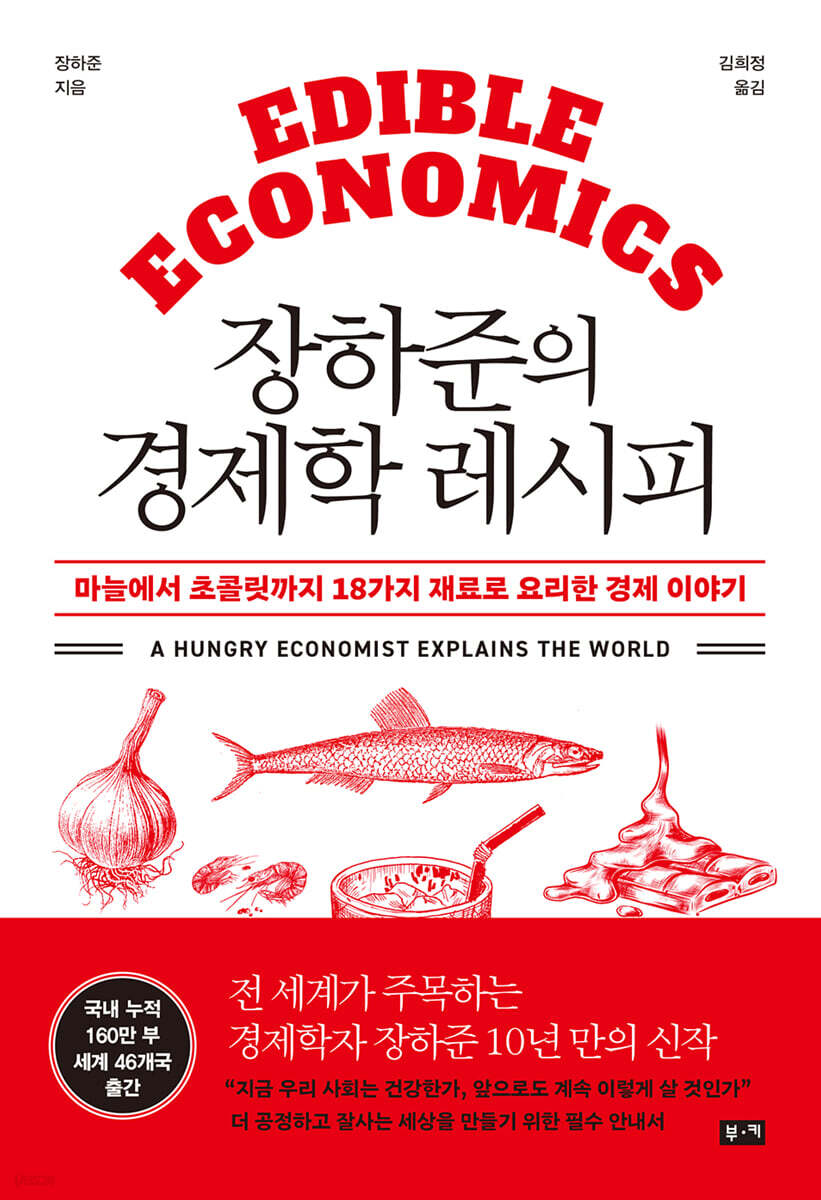
Ha-Joon Chang's Economics Recipe
 |
Description
Book Introduction
- A word from MD
-
A bizarre economic story, deliciously told from various perspectives.This is a new book published 10 years after the previous work, 『Ha-Joon Chang's Economics Lectures』.
The author discusses the economics of overcoming prejudice, increasing productivity, and living together well through the food he likes.
Let's meet the author's amazing insight into various foods and ingredients, and his real economic stories that he has thought about and researched.
March 28, 2023. Economics and Management PD Kim Sang-geun
How will we navigate the tough financial times and uncertain economy?
World-renowned scholar Ha-Joon Chang presents a path toward a fairer and more prosperous future for all!
“Will the economy develop on its own if left to the free market?” “Are people poor because they are lazy?” “Will a fair world be created if only equal opportunity is guaranteed?” “Is the welfare system a system that provides free benefits to the poor?” “Do corporations really belong to shareholders?” “Is government intervention really unnecessary for economic development?” “Is free trade really free trade?” “Does the ability of outstanding individual entrepreneurs determine the development of companies and industries?” “Will automation take away all our jobs?” “Is it true that manufacturing is over and the service industry is the trend?”
Professor Ha-Joon Chang, a world-renowned scholar and bestselling author of "Economics with Ha-Joon Chang," "23 Things They Don't Tell You," and "Bad Samaritans," returns to us with a story about economics cooked up using various dishes.
In this book, the author uses 18 familiar ingredients and foods, from garlic to chocolate, to explore economic issues closely related to us, such as poverty and wealth, growth and decline, freedom and protection, fairness and inequality, manufacturing and services, privatization and nationalization, deregulation and restrictions, financial liberalization and financial supervision, and welfare expansion and welfare reduction, with fascinating and nutritious knowledge and insight.
This book shatters our stereotypes, prejudices, and misconceptions about the economy, offering alternatives and a vision. It will provide strength and hope to overcome adversity and grow for all those who have lost their way in the face of difficult financial circumstances and an uncertain economy.
World-renowned scholar Ha-Joon Chang presents a path toward a fairer and more prosperous future for all!
“Will the economy develop on its own if left to the free market?” “Are people poor because they are lazy?” “Will a fair world be created if only equal opportunity is guaranteed?” “Is the welfare system a system that provides free benefits to the poor?” “Do corporations really belong to shareholders?” “Is government intervention really unnecessary for economic development?” “Is free trade really free trade?” “Does the ability of outstanding individual entrepreneurs determine the development of companies and industries?” “Will automation take away all our jobs?” “Is it true that manufacturing is over and the service industry is the trend?”
Professor Ha-Joon Chang, a world-renowned scholar and bestselling author of "Economics with Ha-Joon Chang," "23 Things They Don't Tell You," and "Bad Samaritans," returns to us with a story about economics cooked up using various dishes.
In this book, the author uses 18 familiar ingredients and foods, from garlic to chocolate, to explore economic issues closely related to us, such as poverty and wealth, growth and decline, freedom and protection, fairness and inequality, manufacturing and services, privatization and nationalization, deregulation and restrictions, financial liberalization and financial supervision, and welfare expansion and welfare reduction, with fascinating and nutritious knowledge and insight.
This book shatters our stereotypes, prejudices, and misconceptions about the economy, offering alternatives and a vision. It will provide strength and hope to overcome adversity and grow for all those who have lost their way in the face of difficult financial circumstances and an uncertain economy.
- You can preview some of the book's contents.
Preview
index
Foreword: Garlic
This foul-smelling ingredient gave birth to today's Korea, terrifies the British, and makes you want to read this book.
Part 1: Overcoming Prejudice
Chapter 1 Acorns
Through the stories of pigs in southern Spain that grow on acorns and Koreans who enjoy eating acorns, we understand that culture is not that important in determining economic performance.
Chapter 2 Okra
This vegetable, also known as "ladies' fingers," makes us realize how narrow-minded and easily misleading the arguments of free-market economists can be.
Chapter 3 Coconut
This brown fruit shows how wrong the belief is that people with 'brown' skin are poor because they don't work hard.
Part 2: Increasing Productivity
Chapter 4 Anchovies
It turns out that this small fish, which not only enriched the taste of food but also brought enormous wealth, was a public relations ambassador for industrialization.
Chapter 5 Shrimp
This tiny crustacean turns out to be an insect in disguise, and it highlights the need for developing countries to use protectionism to compete with superior foreign rivals.
Chapter 6 Noodles
The intertwined story of two noodle-obsessed countries reexamines our thinking about entrepreneurship and successful businesses.
Chapter 7 Carrots
Understand why and how to improve the patent system through the story of the "orange carrot," a concept once considered far-fetched.
Part 3: A Better World
Chapter 8 Beef
Beef, the most controversial of all meats, shows us that free trade doesn't always mean freedom for everyone.
Chapter 9 Banana
The world's most productive fruit demonstrates that multinational corporations can play a positive role in developing countries, but only if properly managed.
Chapter 10 Coca-Cola
This drink, which has a resemblance to an aging rock 'n' roll band, explains why so many developing countries are dissatisfied with the current mainstream economic ideology.
Part 4: Living Together
Chapter 11 Rye
Thanks to rye, a staple grain of Northern Europe, we can dispel some misconceptions about the welfare state.
Chapter 12 Chicken
This meat, loved by everyone but taken seriously by no one, teaches us the meaning of economic equality and fairness.
Chapter 13: Peppers
Through this berry, a con artist who often deceives us, we understand how care work is often neglected and undervalued, despite its fundamental role in our economy and society.
Part 5: Thinking about the future
Chapter 14 Lime
The Royal Navy and Brazil's national drink join forces to address the challenges of climate change.
Chapter 15 Spices
We hear the story of how modern corporations were born from pepper, cinnamon, nutmeg, and cloves, and how these corporations, while making capitalism a great success, now serve to strangle it.
Chapter 16 Strawberries
This fruit, which is not a berry but is called a berry, makes us think about the development of robots and the future of jobs.
Chapter 17 Chocolate
A glimpse into the secrets of Switzerland's economic prosperity through a milk chocolate bar, and learn that it has little to do with secret banks or luxury tourism.
Conclusion: How to Get a Better Economics
Acknowledgements
Americas
Search
This foul-smelling ingredient gave birth to today's Korea, terrifies the British, and makes you want to read this book.
Part 1: Overcoming Prejudice
Chapter 1 Acorns
Through the stories of pigs in southern Spain that grow on acorns and Koreans who enjoy eating acorns, we understand that culture is not that important in determining economic performance.
Chapter 2 Okra
This vegetable, also known as "ladies' fingers," makes us realize how narrow-minded and easily misleading the arguments of free-market economists can be.
Chapter 3 Coconut
This brown fruit shows how wrong the belief is that people with 'brown' skin are poor because they don't work hard.
Part 2: Increasing Productivity
Chapter 4 Anchovies
It turns out that this small fish, which not only enriched the taste of food but also brought enormous wealth, was a public relations ambassador for industrialization.
Chapter 5 Shrimp
This tiny crustacean turns out to be an insect in disguise, and it highlights the need for developing countries to use protectionism to compete with superior foreign rivals.
Chapter 6 Noodles
The intertwined story of two noodle-obsessed countries reexamines our thinking about entrepreneurship and successful businesses.
Chapter 7 Carrots
Understand why and how to improve the patent system through the story of the "orange carrot," a concept once considered far-fetched.
Part 3: A Better World
Chapter 8 Beef
Beef, the most controversial of all meats, shows us that free trade doesn't always mean freedom for everyone.
Chapter 9 Banana
The world's most productive fruit demonstrates that multinational corporations can play a positive role in developing countries, but only if properly managed.
Chapter 10 Coca-Cola
This drink, which has a resemblance to an aging rock 'n' roll band, explains why so many developing countries are dissatisfied with the current mainstream economic ideology.
Part 4: Living Together
Chapter 11 Rye
Thanks to rye, a staple grain of Northern Europe, we can dispel some misconceptions about the welfare state.
Chapter 12 Chicken
This meat, loved by everyone but taken seriously by no one, teaches us the meaning of economic equality and fairness.
Chapter 13: Peppers
Through this berry, a con artist who often deceives us, we understand how care work is often neglected and undervalued, despite its fundamental role in our economy and society.
Part 5: Thinking about the future
Chapter 14 Lime
The Royal Navy and Brazil's national drink join forces to address the challenges of climate change.
Chapter 15 Spices
We hear the story of how modern corporations were born from pepper, cinnamon, nutmeg, and cloves, and how these corporations, while making capitalism a great success, now serve to strangle it.
Chapter 16 Strawberries
This fruit, which is not a berry but is called a berry, makes us think about the development of robots and the future of jobs.
Chapter 17 Chocolate
A glimpse into the secrets of Switzerland's economic prosperity through a milk chocolate bar, and learn that it has little to do with secret banks or luxury tourism.
Conclusion: How to Get a Better Economics
Acknowledgements
Americas
Search
Detailed image

Into the book
Preface: Garlic
Since the 1980s, the field of economics has become like British food culture before the 1990s.
Because one academic tradition, namely neoclassical economics, has become the entire menu.
Like all other schools, neoclassical school also has its strengths.
And there are serious drawbacks.
The circumstances under which neoclassical economics came to dominate the entire field are too complex and complicated to be examined in this book.
Whatever the cause, neoclassical economics has now become the mainstream economics in most countries (with a few exceptions, Japan and Brazil, and to a lesser extent Italy and Turkey), and its influence has become so strong that many people now consider 'economics' and 'neoclassical economics' synonymous.
This kind of intellectual 'monocropping' has resulted in a narrowing of the intellectual gene pool in this field.
---p.30
We all know that economic theory influences government policies such as taxes, welfare spending, interest rates, and labor market regulations, which in turn affect our jobs, working conditions, wages, mortgages, and student loan repayments.
But economic theory doesn't stop there. It also influences the development of high-productivity industries, fosters innovation, and establishes policies that enable sustainable, environmentally friendly development, thereby determining the long-term, collective development potential of an economic system.
That's not all.
Economics not only affects economic variables, whether individual or collective, but also changes our identity, that is, our very definition of ourselves.
---p.32~33
I believe we all should understand at least some of the principles of economics.
Not only to defend our own interests, but more importantly, to ensure that we and our descendants can live in a better society.
When I make this argument, some people react by saying that economics is not for the average citizen, but for 'experts'.
The argument is that most people will not understand it because it is a discipline that is full of difficult-to-understand jargon, technical arguments, complex mathematical formulas and statistics.
But will we continue to live like this? Will we simply "watch in despairing silence" as incomprehensible economic theories appear out of nowhere, upending and disrupting our entire world?
---p.36
Chapter 1 Acorns
No matter how much I love acorn jelly, I can't claim that it's a top-class dish.
Acorn jelly is a food that you eat after leaving early in the morning for a hike, eating at a roadside stall, or meeting friends for a drink at a cheap local bar.
In fact, it is not easy to think of a top-quality dish made with acorns.
But when you feed acorns to Iberian pigs, it's a different story.
Jamon Ibérico is a ham made from the leg meat of the Ibérico pig, also known as the Pata Negra (black hoof) pig.
The highest quality Jamon Ibérico is called Jamon Ibérico de Bellota because it is made from Pata Negra pigs that are left to graze in oak forests for a period of time before slaughter, eating only acorns (Bellota is Spanish for acorn).
Thanks to acorns, a ham with a rich, deep flavor that is unparalleled is born.
---p.45
Well, by now, the stereotype that Islamic culture is inherently a hindrance to development should have disappeared.
Islamic culture, which emphasizes learning, has a tradition of scientific thinking, has a low social hierarchy, values commerce, and has a strong tradition of rule of law and tolerance, has many elements favorable for economic development.
Both Malaysia and Dubai are good examples of how Islamic culture can coexist with economic development.
We sometimes apply negative cultural stereotypes to 'alien' cultures out of ignorance and sometimes with malicious intent.
There are many cases where we single out only the negative aspects of a culture that make us anxious and blame the socioeconomic problems experienced by countries within that culture on the culture.
But such an attitude leads to the error of missing the real cause of the problem.
---p.51~52
Appropriate economic and social policies can achieve positive outcomes, such as promoting development and providing equal opportunities, in any cultural context.
Japan and Korea were countries that did not have a modern industrial workforce with an accurate concept of time and the discipline of an industrial society.
Both countries have created such a workforce through concrete measures.
Methods used included teaching the habit of keeping time and discipline through school education, conducting ideological campaigns emphasizing the need for hard work to "rebuild the nation" through economic development, and maintaining labor laws that permitted long working hours and difficult working conditions.
The reason why people in countries with Confucian cultural spheres actively invested in education was not because Confucius emphasized learning, but because after World War II, land reform and other policies made social mobility possible, and education became a means of social advancement.
---p.56
Chapter 2 Okra
Okra is an essential ingredient in gumbo, a Southern American dish that is somewhere between a soup and a stew (in the US, okra itself is often called gumbo or gombo).
A few years later, I was looking at a Southern cookbook and tried making succotash, my first (and so far only) dish that includes okra.
After tasting the finished succulent, I experienced, to borrow the expression of today's youth, a 'heart-fluttering' experience.
It would have been great if my cooking skills had made my heart flutter, but the real reason for the excitement was the soft and sticky texture, which was created by the okra.
The stickiness that made me hesitate the first time I tried okra worked its magic to make the taste of succotash smooth, comforting, and heart-meltingly delicious.
---p.63~64
Without enslaved Africans and their descendants, the capitalist nations of Europe would not have access to cheap gold, silver, cotton, sugar, indigo dye, rubber, and other resources to run their factories and banks and feed their workers.
In particular, without them, the United States would not have grown into the economic power it is today.
(…) Enslaved Africans did not stop at providing (unpaid) labor.
Slaves were a very important means of mobilizing capital.
I must confess that this is a fact that I was unaware of until recently.
Matthew Desmond, an American sociologist who researched the legacy of slavery for an article in The New York Times, wrote:
“Enslaved people were used as collateral for loans hundreds of years before mortgages were invented.
…before American independence, when land prices were low… most loans were made using human capital as collateral.” Desmond further points out that bond transactions were also made by bundling loans using individual slaves as collateral.
---p.66~67
But the freedom that free market advocates talk about is a very narrow concept of freedom.
First, the freedom they speak of is limited to freedom within the economic sphere, such as the freedom of businesses to make and sell what yields the highest profits, the freedom of workers to choose their occupations, and the freedom of consumers to buy what they want.
When other freedoms, such as political or social freedom, come into conflict with economic freedom, free market advocates do not hesitate to prioritize economic freedom.
(…) In addition, the freedom that Friedman and the Heritage Foundation cherish most is, within the narrow concept of economic freedom, the freedom of asset owners (landowners and capitalists) to use their assets in the way that generates the greatest profit.
The economic freedoms of others that might conflict with the freedom of the wealthy—the freedom of workers to act collectively (e.g., to strike), the freedom of unemployed workers to have the luxury of a strong welfare state to make better choices when looking for new jobs—are at best ignored, and in many cases condemned as counterproductive.
---p.74~75
Chapter 3 Coconut
My views on coconut were completely turned upside down when I first tasted a piña colada during my first ever tropical beach vacation in Cancun, Mexico, in the late 1990s.
I've always loved pineapple juice, but when it meets coconut milk and rum, the resulting drink is magical.
I probably spent half of that vacation sipping piña coladas and the other half chasing my then-baby daughter around the beach and pool.
---p.80~81
People in rich countries often assume that the reason people in poor countries are poor is because they don't work hard.
And because many, if not all, poor countries are located in the tropics, it is often assumed or assumed that the reason poor people lack a work ethic is because the tropics are blessed with abundant natural resources that make it easy to make a living.
In the tropical regions of this imaginary world, food (bananas, coconuts, mangoes, etc.) grows everywhere, and because it is not cold, there is no need to build sturdy houses or wear many layers of clothing.
So the logic is that people living in tropical regions don't have to work as hard to survive, and as a result, they become less diligent.
In these stories—which are so offensive that they are often discussed only in private—coconuts often feature.
Those who argue that "tropical people have a weak work ethic" say that the "natives" in the tropics are poor because they lie under palm trees waiting for coconuts to fall rather than actively growing crops or working to create goods.
This may sound like a plausible story.
But it was completely wrong.
---p.84~85
If people in poor countries work much harder than people in rich countries, their poverty cannot be due to a lack of diligence.
The problem is productivity.
The reason why they do not produce as much as people in rich countries, despite working much longer and for much longer periods of their lives, is because their productivity is not that high.
And this low productivity has little to do with the individual workers' abilities or conditions, such as their level of education or health.
The quality of the workforce can make a difference in productivity in specialized or highly skilled occupations.
However, in most occupations, there is little difference in individual productivity between workers in poor countries and workers in rich countries.
---p.88~89
Chapter 4 Anchovies
It may sound strange, but I think the award for most ardent fan of fermented anchovy sauce should go to an American.
Aren't they the ones who drink anchovy sauce? (Wow, they drink anchovy sauce!) But America's quintessential cocktail, the Bloody Mary (although named after Queen Mary, daughter of Henry VIII and half-sister of Elizabeth I), contains fermented anchovy sauce.
It's just hidden in Worcestershire sauce.
The British also have grilled cheese toastie.
I love to drizzle Worcestershire sauce on my veggies (see Chapter 15, Spices), so I guess you could say I'm a fan of the "disguised" fermented anchovy sauce.
Anchovies are not only a rich flavor, but were also once a valuable fish that brought abundant wealth.
This small fish was responsible for Peru's economic prosperity in the mid-19th century.
Peru didn't make money by exporting anchovies.
At that time, Peru enjoyed national prosperity by exporting seabird guano (dried bird droppings).
Guano was not only a popular fertilizer because it was rich in nitrates and phosphorus and did not have a particularly unpleasant smell, but it was also used in the manufacture of gunpowder because it contained potassium nitrate, a key ingredient in gunpowder.
Peruvian guano is the droppings of cormorants and boobies, birds that live in clusters on islands along the Pacific coast.
The birds' main food source is fish, especially anchovies, which migrate along the nutrient-rich Humboldt Current off the west coast of South America, from southern Chile to northern Peru.
---p.98~100
In other words, the position as a major producer of primary goods can be easily taken away.
This is because primary products are easy to produce.
However, the damage that the German chemical industry has done to countries that depend primarily on primary commodities, such as Peru, Chile, Guatemala, and India, is incomparable to the damage that Vietnam has done to coffee-producing countries like Brazil and Colombia.
An economic system that has the ability to develop technologies to manufacture artificial substances that can replace natural resources has the ability to completely destroy existing markets (such as the market for guano) and create new ones (in this case, the market for chemical fertilizers).
More generally, it means that with advanced technology, we can overcome the limitations of nature.
Lacking guano deposits, cologne 'beetles' or indigo plants, the Germans overcame this deficiency by creating chemical substitutes.
---p.105~106
Chapter 5 Shrimp
But it's curious that even people who find eating insects abhorrent can happily eat their relatives, such as prawns, shrimp, lobsters, and crayfish.
Avoiding insects is, at least to me, one of the most baffling of all the food avoidance behaviors.
Crustaceans and insects are both arthropods (non-experts like you and me call them bugs) with tentacles, an exoskeleton, a segmented body, and multiple legs.
But why do people eat crustaceans but not insects? Would renaming insects encourage more people to eat them? What if we called crickets "bush shrimp" and grasshoppers "wild crayfish"?
---p.113
It takes at least 20 years for a country's productive capacity to change significantly.
This means that such changes cannot occur in a free trade environment.
In a free trade system, inefficient start-up firms in new industries are quickly wiped out by superior and larger foreign competitors.
The argument that immature manufacturers in economically backward countries should be protected in the hope that they will improve is called the "infant industry argument."
This is a term that came from the perspective of viewing economic development and child growth and development as similar.
We protect children until they are old enough to compete with adults in the labor market.
Infant industry theory argues that governments of economically underdeveloped countries should protect and nurture their new industrial enterprises until they develop their production capabilities and can compete with superior foreign companies in the global market.
(…) Contrary to their current image as the birthplace of free trade, Britain and the United States were among the world's most protectionist countries in the early stages of their economic development.
---p.118~119
Chapter 6 Noodles
Orzo/risoni are small grains (literally meaning barley or rice) that are often eaten in hot, clear soups.
The moment the food was placed in front of me, I thought it was rice rolled in soup.
This is because in Korea, it is common to eat rice mixed with hot soup (whether clear or not).
So I couldn't believe that what I just ate was 'noodles' (pasta).
In Italy, wheat is almost the only carbohydrate source used to make pasta (see Chapter 1, Acorns).
However, there are over 200 different types of pasta made by varying the shape.
Of course, like in other countries, including Korea, there are also string-shaped or flattened pastas, but there are also all sorts of shapes including tubes, rings, spirals/screws, butterflies, human ears, shells, grains, balls, stuffed dumplings, plates, etc. (I haven't tried them yet, but I've heard they even have carriage wheels, olive leaves, tops, and even radiator shapes).
---p.129~130
But some readers might ask whether Hyundai Motor Company's success story is one of the few exceptions in the world of heroic entrepreneurship.
'No' is the answer to that.
First of all, there are many Korean companies that have achieved success through the same process as Hyundai.
Samsung, which started out as a sugar refiner and apparel manufacturer, has become the world's leading semiconductor and mobile phone manufacturer, while LG, which started out as a cosmetics and toothpaste manufacturer, has dominated the global display market.
Well-known Japanese multinational corporations (MNCs) also followed a similar path.
Toyota grew from a simple textile machinery company to become the world's largest automobile manufacturer, while Mitsubishi, which started out as a transportation company, grew into a multinational corporation with operations spanning shipbuilding, nuclear power plants, electronics, and automobiles.
All of these companies were able to achieve this transformation through outstanding individual talent, entrepreneurial effort, "cross-subsidies within the company," government support, and consumer sacrifice.
Nokia, a Finnish conglomerate that started out as a paper mill but grew to become a global leader in the mobile phone industry and is now a major player in network hardware and software production, also had a similar growth history to the companies mentioned above.
(…) Even the United States, which takes great pride in its “free enterprise” system and always praises heroic entrepreneurs, is a country that has developed through the importance of “collective entrepreneurship” in the modern economy.
---p.137~138
Chapter 7 Carrots
One of the (many) things I thought was strange when I first came to England was carrot cake.
Carrots are used as a seasoning when making kimchi, or boiled with onions and potatoes to make Japanese curry, or stir-fried with various vegetables to make japchae, or eaten as a salad ingredient, but I have never seen them used in sweet foods like cake.
Never.
Carrot cake is now one of my favorite desserts, but at first, hmm… it felt like a strange food.
---p.142
A patent is a system in which the government grants developers of new technologies exclusive rights to that technology for a certain period of time in exchange for requiring them to disclose that technology (the English word patent means 'to make something known by showing it').
If we consider only the effect of improving knowledge, the patent system is a double-edged sword.
A person who has created knowledge that is recognized as sufficiently new knowledge is given the right to use that knowledge for a certain period of time (nowadays, usually 20 years).
It used to be shorter than this.
This issue was created to encourage and stimulate the creation of new knowledge by ensuring that it is available exclusively (we will discuss this in more detail later).
During this period, developers of that new knowledge can charge as much as the market can afford without fear of competition.
However, at the same time, the patent system acts as an obstacle to the creation of new knowledge in that it makes it almost impossible for others to use the new knowledge to create new knowledge during the period of monopoly.
The problem is that the most important material for knowledge production is knowledge itself.
Therefore, if a large amount of related knowledge is protected by patents, the cost of developing new knowledge becomes expensive.
Golden rice is a good example.
I call this problem "interlocking patents," and the eminent economist Joseph Stiglitz calls it "patent thicket."
---p.148~149
Chapter 8 Beef
After enjoying great success with beef extract, Remco has launched another global hit product.
This is canned corned beef, which has been produced since 1873.
Corned beef, which is beef preserved by salting, has been eaten in Europe for at least several hundred years.
But Remco combined inexpensive ingredients with preservation techniques to make this food accessible to a much wider audience.
It was made cheaper by using ground beef from cheaper cuts of Uruguayan beef (probably to disguise the fact that it was cheaper) instead of the brisket used in the original 'official' recipe.
Remco's canning method allowed him to preserve his beef for much longer than the original salt-curing method, allowing him to export it farther afield.
Oxo cubes and canned corned beef became “indispensable staple foodstuffs for the working classes throughout Europe, where meat had previously been a luxury.
---p.163
Corned beef is not so named because it contains corn, the grain most people think of these days.
It is in relatively new American English that corn came to mean only corn.
In older British English, corn meant any kind of 'grain', not just maize.
The name 'corned beef' comes from the preservation method of the time, which used coarse salt that looked like grains of grain.
---p.165
But like all 'origin stories', the origin story of free trade is riddled with errors and myths.
Let us set aside for a moment the fact that many of the "government regulations of trade and industry" that Friedman so vehemently denounces as unproductive were the very things that had made Britain's manufacturing sector the world's leader before it adopted free trade policies (see Chapter 5, "Shrimp").
Let us also set aside for a moment the 'trivial fact' that Britain did not fully transition to a free trade system even after the repeal of the Corn Laws.
In 1848, tariffs were still imposed on 1,100 items (many of them at very high levels).
It was not until 1860, when tariffs were imposed on fewer than 50 goods, that Britain could truly be called a free-trade nation.
Even if we ignore these two "inconvenient truths," the creation myth of free trade is riddled with major flaws.
Britain was not the first country to implement free trade.
That honor actually belongs to the South American countries that adopted free trade policies between the 1810s and 1830s, at least several decades before Britain.
South American countries may have pioneered free trade policies, but their 'free' trade policies were not implemented 'of their own free will.'
After freeing themselves from Spanish and Portuguese colonial rule in the early 19th century, these countries were pressured by European powers, led by Britain, to sign what later came to be known as "unequal treaties."
These treaties, among other things, took away from weaker countries the "tariff autonomy" of imposing their own tariffs, forcing them to engage in free trade.
---p.168~169
Chapter 9 Banana
The Portuguese used bananas as food for enslaved Africans who were forced to work in sugar production on the North Atlantic islands of Madeira and the Canary Islands (which were partially under Portuguese control until 1479).
As they began to sell Africans as slaves to the Americas, they used bananas (especially plantains) and rice as staple foods on their slave ships.
On the plantations, slaves were encouraged to plant bananas on the small plots of land given to them to supplement their meager food rations.
When climatic conditions are right, banana trees grow year-round and produce a huge amount of fruit.
With little labor investment, it can produce 200,000 pounds of bananas per acre, which is 10 times that of yams and 100 times that of potatoes.
It was also an ideal crop for slave owners because it could be harvested with minimal time investment by slaves.
---p.183
Soon American banana companies came to dominate the economies of these countries.
In Honduras, for example, the United Fruit Company and the Standard Fruit Company controlled the railroads, power, postal service, and telegraph and telephone services.
In the 1930s, the United Fruit Company was Guatemala's largest landowner, largest employer, and largest exporter, and it owned virtually all of the country's railroads.
People in countries whose economies depend on bananas called American banana companies El Pulpo, or "the octopus."
It meant that he had a firm grip on almost every aspect of the country's economy.
Naturally, banana companies that had such an almost absolute control over the economy also exerted a great deal of influence on the politics of banana-producing countries in the Americas.
Banana companies had their own customs and police, so much of their business was outside the jurisdiction of the country in which they operated.
Politicians were frequently bribed to secure "pro-business" policies, and if a government tried to do something against the interests of these corporations (for example, raising extremely low taxes to a very low level, selling off unused land, or making very small improvements to workers' rights), they did not hesitate to stage a coup, even enlisting the support of American mercenaries called filibusters (from the Dutch word for pirate).
---p.185
These days, people in wealthy countries, including the United States, only know 'Banana Republic' as a clothing brand name.
But the term was originally coined to describe the grim reality of how large corporations in rich countries had almost complete control over poor developing countries.
(…) The banana republic phenomenon illustrates how powerful corporations from rich countries operating in many countries—called multinational corporations or transnational corporations—can negatively impact the countries in which they invest.
---p.188~189
Chapter 10 Coca-Cola
Coca-Cola, the product that best represents America, has come to symbolize the light and dark sides of American capitalism.
For some, like the young people who protested against the former Soviet system, Coca-Cola was a symbol of personal, economic, and political freedom.
But many, like the Indian left in the 1980s, saw it as a perfect example of a flawed American capitalism—a prime example of consumerism and, more broadly, the commercial manipulation of consumer tastes.
---p.199
Former Bolivian President Evo Morales (serving from 2006 to 2019), the second indigenous president in the history of a Latin American country, was also a coca farmer (the first indigenous president was Benito Juárez, who served as president of Mexico from 1858 to 1872).
Morales gained political prominence in the late 1990s and early 2000s during his resistance to the Bolivian government's attempt to forcibly eradicate coca cultivation, with strong support from the U.S. government during its "war on drugs."
Morales was elected president in 2005 on a wave of popular protests against the so-called "Washington Consensus" of austerity, trade liberalization, deregulation and privatization that had devastated Bolivia's economy over the previous two decades.
The Washington Consensus policies are so named because they are actively advocated by the three most powerful international economic organizations, the U.S. Treasury, the International Monetary Fund, and the World Bank, all headquartered in Washington, D.C.
---p.204~205
Even in rich countries, neoliberal policies have not been effective.
In rich countries, growth rates were slower, inequality increased, and financial crises were more frequent during the neoliberal period since the 1980s than during the "mixed economy" era, when governments took a more active—and, in neoliberal terms, excessive—role in controlling and regulating market forces.
However, the neoliberal policies implemented in developing countries have been close to disaster.
Because these policies were not particularly suited to their needs.
Above all, the neoliberal tradition completely denies the fact that developing countries must ensure that their producers "grow" and enter more productive sectors under the support and protection of governments that lead to protectionism, subsidies, and restrictions on foreign investment in order to develop their economies.
---p.212
Chapter 11 Rye
The German economy experienced unprecedented growth thanks to the alliance between rye and iron producers formed through the mediation of the 'Iron Chancellor' Bismarck.
New heavy industries such as steel, machinery, and chemicals grew by relying on the protective wall, and eventually caught up with Britain, which was then the world leader.
During this process, free trade in the agricultural sector was not permitted, so Germans had to buy food at higher prices (however, as Germany's successful industrialization increased the income of most Germans, the high food prices were not a big problem).
Bismarck's legacy extends beyond the development of German heavy industry.
He achieved something even more significant, something that had an impact far beyond Germany.
The establishment of a welfare state is precisely that.
Many people believe that the welfare state is a product of 'progressive' political forces.
Like the New Deal Democrats in the US, the Labour Party in the UK, or the Social Democratic Parties in Scandinavia.
However, the person who first invented the welfare state was Bismarck, a byword for arch-conservative.
---p.224~225
The welfare state is not only misunderstood for its origin story.
There are also many misunderstandings about the essence itself.
One of the most common misconceptions about the welfare state is that it provides 'free' benefits to the poor through income support, pensions, housing subsidies, health insurance, unemployment benefits, and so on.
And because these 'free' benefits come from taxes paid by the wealthier, people often think that the poor are free-riding on the efforts of the rich.
This may be why the expression 'welfare scroungers', used to criticize welfare recipients in Britain these days, is increasingly heard.
However, welfare benefits are not free.
Everyone pays the cost.
A large portion of the welfare benefits people receive are paid out of 'social security contributions'.
In other words, it means that the payment is linked to a specific burden, such as old age or unemployment, that most taxpayers bear.
In addition, most people pay income tax.
---p.228
Chapter 12 Chicken
It's no surprise that airlines favor chicken, given that it's a meat that everyone eats.
Because they have to satisfy a huge variety of food preferences and taboos in a limited space.
---p.235
In short, treating people with different needs the same—like giving a vegetarian chicken dish, giving someone with celiac disease wheat bread, or making men's and women's restrooms the same size—is fundamentally unfair. Contrary to what the Aeroflot flight attendants might have thought, treating people with different needs differently is not special treatment.
It is one of the most important conditions of fairness.
Including vegetarian options on in-flight menus, providing gluten-free bread, or building larger and more women's restrooms does not give special treatment to vegetarians, people with chronic digestive disorders, or women.
It simply ensures that they are given equal footing with others in meeting their basic needs.
---p.238~239
Competition cannot be truly fair just because everyone is given an equal opportunity to compete under the same rules.
If a person were to run a race with one eye blind or with only one leg, no one would call it a fair race even if everyone started from the same point.
Likewise, in real life, even if everyone theoretically has an equal opportunity to compete for a desirable job, the competition is not fair if some members lack the minimum skills necessary to participate in the competition.
Some people may have suffered from poor brain development due to malnutrition in childhood, while others may not have received a proper education because they grew up in poor areas with limited financial support for education.
In other words, if all members of society do not have the minimum necessary abilities to utilize the given opportunities, equality of opportunity also loses its meaning.
---p.244~245
Chapter 13: Peppers
The spiciness of chili peppers is actually a sensation, not a taste.
This spicy 'taste' is actually a chili 'berry' (yes, chili is also a 'berry' in disguise.
(See Chapter 16 Strawberry) is a magical phenomenon created by using incredibly sophisticated chemical trickery.
Although it produces a burning sensation, especially in the mucous membranes, capsaicin, the main ingredient in spicy food, does not actually directly damage tissue.
It's just tricking the brain into thinking that the body is suffering from that kind of damage.
Capsaicin produces this effect by binding to sensory receptors that "detect when the body is in contact with extreme temperatures, acids or corrosive substances, or when it has suffered abrasions or friction."
The spiciness of chili peppers is such an important issue that there is even a separate standard for measuring the spiciness.
This standard, called the 'Scoville Scale', was created in 1912 by American pharmacist Wilbur Scoville.
---p.250~251
We tend to take for granted what is so prevalent around us.
And when you take something for granted, you stop thinking about its importance.
Like the pepper markings on the pepper scale at Sichuan restaurants.
A prime example of a similar phenomenon occurring in economics is the unpaid care work that takes place in our homes and communities.
The most widely used economic measure, GDP (gross domestic product), includes only what is exchanged in markets.
Like all measures used in economics, GDP has several problems, but the biggest one is that it is based on an extremely 'capitalist' perspective.
The view is that because different people have different values, when determining what value something has in society, we have no choice but to use the price it is traded at in the market as a standard.
The practice of counting only market activity has the disadvantage of blinding us to a huge portion of economic activity.
In developing countries, a large portion of agricultural production often goes unaccounted for.
Many farmers do not sell the crops they grow but instead consume a certain amount. This portion of agricultural production is not exchanged in the market and is therefore not captured in GDP statistics.
Unpaid care work performed in homes and communities is also excluded from GDP in both rich and developing countries when production is measured on a market basis.
Giving birth to children, raising them, helping them learn, caring for the elderly and disabled, cooking, cleaning and doing laundry, and running a household (activities that American sociologist Allison Daminger calls “cognitive labor”).
---p.254~255
Chapter 14 Lime
It is estimated that more than two million sailors died from scurvy between the late 15th and mid-19th centuries.
Naturally, everyone was frantically searching for a cure for scurvy.
All sorts of remedies were tried, including vinegar and sulfuric acid.
And slowly citrus (citrus genus.
Although it became known that the juice of the Citrus fruit was an effective remedy, it was not until the 20th century that people realized that vitamin C was the main culprit.
Research into a cure for scurvy played a major role in the discovery of vitamin C, so much so that its scientific name was given to it as 'ascorbic acid', which literally means 'anti-scurvy acid'.
Although rival navies were aware that citrus juice was effective in preventing scurvy, the British Navy was the first to systematically use this remedy.
In 1795, the British Navy made lemon juice a mandatory part of sailors' rations and used a clever trick to ensure sailors didn't have to drink it: they distributed a drink called 'grog', which was a mixture of lemon juice and watered-down rum.
Soon limes began to be used instead of lemons.
This was because limes were cheaper and, unlike lemons, were grown in the Caribbean, a region colonized by Britain.
But another reason was the mistaken belief that limes would be more effective than lemons, a belief that stemmed from the misconception that it was the sourness, not the vitamin C, that cured scurvy (limes are more acidic than lemons, but contain only about half the vitamin C).
---p.273~274
If we leave it to the market, many of the technologies needed to combat and address climate change will never be developed.
This is not because private companies are "evil," but because they are under constant pressure to deliver short-term results, a pressure that is being exacerbated by financial deregulation (see Chapter 15, "Spice").
Even when green technologies are developed and deployed, it often takes decades, and even longer, for their benefits to become visible.
However, it is understandable that private sector companies are hesitant to develop such technologies, as they often have to demonstrate visible results every quarter, let alone for several years.
Because the private sector tends to be so short-sighted, the government has traditionally had to play a strong role in large-scale investments in developing new technologies and in adopting those technologies.
The most prominent examples in this area are the development of IT and biotechnology, both of which were initially almost entirely funded by the U.S. government (through the federal government's "defense" and "health" research programs, respectively).
(See Chapter 6 Noodles).
Because these were sectors with a very high risk of failure and a long—a very long—wait to make a profit.
The development and deployment of low-carbon energy technologies such as solar power and tidal power on a significant scale in the United States, many European countries, China, Brazil, and elsewhere would not have been possible without government intervention.
---p.281~282
Chapter 15 Spices
It is well known that the desire to obtain spices was an important motivation for opening up a sea route between Europe and Asia.
What is less well known is that this process gave rise to institutions that played a crucial role in the development of capitalism.
A joint stock company or a limited liability company is just that.
When it first began, the spice trade with the East Indies was an incredibly risky undertaking for Europeans.
Crossing two or three oceans (the Atlantic, the Indian, and the Pacific to reach Indonesia) by sailing ship was, to put it mildly, a feat comparable to sending a probe to Mars and successfully returning it to Earth today.
Of course, if you succeed, the price is enormous.
However, the risks involved were so high that investors were reluctant to risk their money in the spice import race.
Moreover, if the business fails, the investors lose everything.
Not only the money invested in the business, but also all of his property (house, furniture, even household goods) was confiscated.
Because I took it for granted that I would repay all the money I borrowed.
To use more technical terms, you had to take on infinite responsibility.
A businessman who failed in business could lose his personal freedom.
---p.292~293
But this system, once a powerful tool for economic growth, has recently become an obstacle to growth.
Deregulation of financial institutions over the past several decades has freed shareholders from the need to make long-term investments in the companies they legally own.
Because there are so many different opportunities to invest and generate profits.
In the UK, for example, shareholders' holding periods have decreased from five years in the 1960s to less than a year today.
Can someone who withdraws their investment before a year has passed truly be considered a joint owner (stakeholder) of the company? To meet the demands of restless shareholders, professional managers resort to dividends and share buybacks.
This practice allows shareholders to take an extremely high percentage of corporate profits through practices such as the practice of companies buying back their own stocks to raise their prices and allowing shareholders to sell their stocks at will.
In the US and UK, the percentage of corporate profits returned to shareholders was less than half in the 1980s, but over the past 10 to 20 years, that figure has soared to 90 to 95 percent.
Given that retained earnings are a major source of corporate investment, this change has severely weakened corporate investment capacity, particularly in projects that require a long wait for returns (see Chapter 14, Lime).
---p.296~297
Chapter 16 Strawberries
Robots that can harvest difficult-to-pick crops such as strawberries, raspberries, tomatoes, and lettuce are said to be commercially available soon.
Currently, several companies are developing harvesting robots that can find strawberries among leaves, determine their ripeness, and harvest them without bruising.
These robots aren't yet as capable as humans, but they're constantly improving, and it won't be long before they conquer the final hurdle of agricultural mechanization: automating strawberry harvesting.
Strawberry pickers aren't the only ones whose jobs are threatened by automation.
These days, you can't avoid seeing reports in newspapers, on the radio, or on TV that robots will replace human jobs and that most people will lose their jobs as a result.
Fears about a future without jobs are heightened by the development of artificial intelligence (AI) technology.
This is because there are fears that machines will replace not only human hands and muscles, but even the brain.
---p.308
Automation has been going on for the past 250 years, and it has never resulted in the massive loss of jobs that people fear and fear.
This is because while automation may cause existing jobs to disappear, it may also create new jobs.
Above all, new job creation occurs directly through the automation process itself.
For example, while robots may eliminate jobs picking strawberries, there will be demand for engineers who design those robots, workers who build them, and workers who produce the parts they need.
Moreover, while automation may reduce the labor required per unit of output produced, it may also lead to a need for more workers as product prices fall and demand increases.
According to James Bessen, the automation of the American textile industry in the 19th century eliminated 98 percent of the weaving labor needed to produce a yard of cloth, but the number of actual spinning workers quadrupled as demand exploded due to the low price of cotton.
---p.310~311
Chapter 17 Chocolate
Many people think that the only thing Switzerland knows how to make is chocolate.
Oh, and on top of that, there are ridiculously expensive wristwatches that only millionaires, bankers, and sports stars can afford.
There is a widespread perception that Switzerland is a country that makes a living by providing services and not by manufacturing goods.
Those who criticize Switzerland will say that it is a country that secretly manages the money embezzled by Third World dictators in its banks and survives by selling cheap items like cuckoo clocks and cow bells (both of which are probably made in China these days anyway) to naive Japanese and American tourists.
A more positive and more widespread view is that the country is a model of a post-industrial economy, one that thrives on service industries like finance and luxury tourism rather than manufacturing.
---p.325
It's a shame for advocates of a post-industrial society, but Switzerland is actually the most industrialized country in the world, boasting the world's highest per capita manufacturing output.
You don't see many products labeled "Made in Switzerland" in large part because Switzerland is a small country (it has a population of only about 9 million), but also because it produces what economists call "producer goods": machinery, precision equipment, industrial chemicals, and other items that ordinary consumers like us don't have access to.
It is interesting to note that Singapore, another country often cited as a success story of a so-called post-industrial society, is the second most industrialized country in the world.
---p.327
Contrary to the myth of deindustrialization, the ability to produce industrial products at competitive prices and quality remains the most important factor in determining a country's standard of living (see Chapter 4, Anchovies).
Many of the high-productivity service sectors that are thought to replace manufacturing, such as finance, transportation, and management services (management consulting, engineering, design, etc.), could not exist without the manufacturing sector.
This is because the main customers of this service are the manufacturing sector.
What makes these services seem 'new' is that, whereas previously they were primarily provided by manufacturing companies themselves (and thus counted as part of the manufacturing sector's output), they are now provided by companies that specialize in these services (and thus counted as part of the service sector's output).
It is for this very reason that countries like Switzerland and Singapore, which have strong manufacturing sectors, also have strong service sectors (though the reverse may not be true).
Moreover, manufacturing remains the primary source of technological innovation.
Even in the United States and the United Kingdom, where manufacturing accounts for only about 10 percent of economic output, 60 to 70 percent of research and development is conducted in the manufacturing sector.
In countries with stronger manufacturing sectors, such as Germany or Korea, this figure is 80 to 90 percent.
---p.329~330
Chapter 18 Conclusion
Above all, a skilled chef is one who is not bound by conventional wisdom about food, and possesses the imagination to combine diverse food cultures to create dishes that suit him or her.
Likewise, good economists (and I mean not just academic economists, but also policymakers, activists, and informed citizens) are those who can apply the principles of "imaginative" cooking to their understanding of economics.
They are considered sacred materials (e.g. economic freedom).
(See Chapter 2 Okra, Chapter 8 Beef) and boldly discard existing ingredients and use them in new places (think about how social democrats used the 'anti-socialist' welfare state).
(See Chapter 11 Rye), reviving forgotten materials (such as a system of rewarding inventions).
(See Chapter 7 Carrot) These are people who demonstrate their abilities.
They are the ones who know why and how trends become popular and what to learn from them without being swept away by them (future without jobs or post-industrial knowledge society economy).
(See 'Chapter 16 Strawberry' and 'Chapter 17 Chocolate' respectively).
Moreover, the best economists, like the best chefs, must be able to combine different theories to obtain a more balanced perspective.
Since the 1980s, the field of economics has become like British food culture before the 1990s.
Because one academic tradition, namely neoclassical economics, has become the entire menu.
Like all other schools, neoclassical school also has its strengths.
And there are serious drawbacks.
The circumstances under which neoclassical economics came to dominate the entire field are too complex and complicated to be examined in this book.
Whatever the cause, neoclassical economics has now become the mainstream economics in most countries (with a few exceptions, Japan and Brazil, and to a lesser extent Italy and Turkey), and its influence has become so strong that many people now consider 'economics' and 'neoclassical economics' synonymous.
This kind of intellectual 'monocropping' has resulted in a narrowing of the intellectual gene pool in this field.
---p.30
We all know that economic theory influences government policies such as taxes, welfare spending, interest rates, and labor market regulations, which in turn affect our jobs, working conditions, wages, mortgages, and student loan repayments.
But economic theory doesn't stop there. It also influences the development of high-productivity industries, fosters innovation, and establishes policies that enable sustainable, environmentally friendly development, thereby determining the long-term, collective development potential of an economic system.
That's not all.
Economics not only affects economic variables, whether individual or collective, but also changes our identity, that is, our very definition of ourselves.
---p.32~33
I believe we all should understand at least some of the principles of economics.
Not only to defend our own interests, but more importantly, to ensure that we and our descendants can live in a better society.
When I make this argument, some people react by saying that economics is not for the average citizen, but for 'experts'.
The argument is that most people will not understand it because it is a discipline that is full of difficult-to-understand jargon, technical arguments, complex mathematical formulas and statistics.
But will we continue to live like this? Will we simply "watch in despairing silence" as incomprehensible economic theories appear out of nowhere, upending and disrupting our entire world?
---p.36
Chapter 1 Acorns
No matter how much I love acorn jelly, I can't claim that it's a top-class dish.
Acorn jelly is a food that you eat after leaving early in the morning for a hike, eating at a roadside stall, or meeting friends for a drink at a cheap local bar.
In fact, it is not easy to think of a top-quality dish made with acorns.
But when you feed acorns to Iberian pigs, it's a different story.
Jamon Ibérico is a ham made from the leg meat of the Ibérico pig, also known as the Pata Negra (black hoof) pig.
The highest quality Jamon Ibérico is called Jamon Ibérico de Bellota because it is made from Pata Negra pigs that are left to graze in oak forests for a period of time before slaughter, eating only acorns (Bellota is Spanish for acorn).
Thanks to acorns, a ham with a rich, deep flavor that is unparalleled is born.
---p.45
Well, by now, the stereotype that Islamic culture is inherently a hindrance to development should have disappeared.
Islamic culture, which emphasizes learning, has a tradition of scientific thinking, has a low social hierarchy, values commerce, and has a strong tradition of rule of law and tolerance, has many elements favorable for economic development.
Both Malaysia and Dubai are good examples of how Islamic culture can coexist with economic development.
We sometimes apply negative cultural stereotypes to 'alien' cultures out of ignorance and sometimes with malicious intent.
There are many cases where we single out only the negative aspects of a culture that make us anxious and blame the socioeconomic problems experienced by countries within that culture on the culture.
But such an attitude leads to the error of missing the real cause of the problem.
---p.51~52
Appropriate economic and social policies can achieve positive outcomes, such as promoting development and providing equal opportunities, in any cultural context.
Japan and Korea were countries that did not have a modern industrial workforce with an accurate concept of time and the discipline of an industrial society.
Both countries have created such a workforce through concrete measures.
Methods used included teaching the habit of keeping time and discipline through school education, conducting ideological campaigns emphasizing the need for hard work to "rebuild the nation" through economic development, and maintaining labor laws that permitted long working hours and difficult working conditions.
The reason why people in countries with Confucian cultural spheres actively invested in education was not because Confucius emphasized learning, but because after World War II, land reform and other policies made social mobility possible, and education became a means of social advancement.
---p.56
Chapter 2 Okra
Okra is an essential ingredient in gumbo, a Southern American dish that is somewhere between a soup and a stew (in the US, okra itself is often called gumbo or gombo).
A few years later, I was looking at a Southern cookbook and tried making succotash, my first (and so far only) dish that includes okra.
After tasting the finished succulent, I experienced, to borrow the expression of today's youth, a 'heart-fluttering' experience.
It would have been great if my cooking skills had made my heart flutter, but the real reason for the excitement was the soft and sticky texture, which was created by the okra.
The stickiness that made me hesitate the first time I tried okra worked its magic to make the taste of succotash smooth, comforting, and heart-meltingly delicious.
---p.63~64
Without enslaved Africans and their descendants, the capitalist nations of Europe would not have access to cheap gold, silver, cotton, sugar, indigo dye, rubber, and other resources to run their factories and banks and feed their workers.
In particular, without them, the United States would not have grown into the economic power it is today.
(…) Enslaved Africans did not stop at providing (unpaid) labor.
Slaves were a very important means of mobilizing capital.
I must confess that this is a fact that I was unaware of until recently.
Matthew Desmond, an American sociologist who researched the legacy of slavery for an article in The New York Times, wrote:
“Enslaved people were used as collateral for loans hundreds of years before mortgages were invented.
…before American independence, when land prices were low… most loans were made using human capital as collateral.” Desmond further points out that bond transactions were also made by bundling loans using individual slaves as collateral.
---p.66~67
But the freedom that free market advocates talk about is a very narrow concept of freedom.
First, the freedom they speak of is limited to freedom within the economic sphere, such as the freedom of businesses to make and sell what yields the highest profits, the freedom of workers to choose their occupations, and the freedom of consumers to buy what they want.
When other freedoms, such as political or social freedom, come into conflict with economic freedom, free market advocates do not hesitate to prioritize economic freedom.
(…) In addition, the freedom that Friedman and the Heritage Foundation cherish most is, within the narrow concept of economic freedom, the freedom of asset owners (landowners and capitalists) to use their assets in the way that generates the greatest profit.
The economic freedoms of others that might conflict with the freedom of the wealthy—the freedom of workers to act collectively (e.g., to strike), the freedom of unemployed workers to have the luxury of a strong welfare state to make better choices when looking for new jobs—are at best ignored, and in many cases condemned as counterproductive.
---p.74~75
Chapter 3 Coconut
My views on coconut were completely turned upside down when I first tasted a piña colada during my first ever tropical beach vacation in Cancun, Mexico, in the late 1990s.
I've always loved pineapple juice, but when it meets coconut milk and rum, the resulting drink is magical.
I probably spent half of that vacation sipping piña coladas and the other half chasing my then-baby daughter around the beach and pool.
---p.80~81
People in rich countries often assume that the reason people in poor countries are poor is because they don't work hard.
And because many, if not all, poor countries are located in the tropics, it is often assumed or assumed that the reason poor people lack a work ethic is because the tropics are blessed with abundant natural resources that make it easy to make a living.
In the tropical regions of this imaginary world, food (bananas, coconuts, mangoes, etc.) grows everywhere, and because it is not cold, there is no need to build sturdy houses or wear many layers of clothing.
So the logic is that people living in tropical regions don't have to work as hard to survive, and as a result, they become less diligent.
In these stories—which are so offensive that they are often discussed only in private—coconuts often feature.
Those who argue that "tropical people have a weak work ethic" say that the "natives" in the tropics are poor because they lie under palm trees waiting for coconuts to fall rather than actively growing crops or working to create goods.
This may sound like a plausible story.
But it was completely wrong.
---p.84~85
If people in poor countries work much harder than people in rich countries, their poverty cannot be due to a lack of diligence.
The problem is productivity.
The reason why they do not produce as much as people in rich countries, despite working much longer and for much longer periods of their lives, is because their productivity is not that high.
And this low productivity has little to do with the individual workers' abilities or conditions, such as their level of education or health.
The quality of the workforce can make a difference in productivity in specialized or highly skilled occupations.
However, in most occupations, there is little difference in individual productivity between workers in poor countries and workers in rich countries.
---p.88~89
Chapter 4 Anchovies
It may sound strange, but I think the award for most ardent fan of fermented anchovy sauce should go to an American.
Aren't they the ones who drink anchovy sauce? (Wow, they drink anchovy sauce!) But America's quintessential cocktail, the Bloody Mary (although named after Queen Mary, daughter of Henry VIII and half-sister of Elizabeth I), contains fermented anchovy sauce.
It's just hidden in Worcestershire sauce.
The British also have grilled cheese toastie.
I love to drizzle Worcestershire sauce on my veggies (see Chapter 15, Spices), so I guess you could say I'm a fan of the "disguised" fermented anchovy sauce.
Anchovies are not only a rich flavor, but were also once a valuable fish that brought abundant wealth.
This small fish was responsible for Peru's economic prosperity in the mid-19th century.
Peru didn't make money by exporting anchovies.
At that time, Peru enjoyed national prosperity by exporting seabird guano (dried bird droppings).
Guano was not only a popular fertilizer because it was rich in nitrates and phosphorus and did not have a particularly unpleasant smell, but it was also used in the manufacture of gunpowder because it contained potassium nitrate, a key ingredient in gunpowder.
Peruvian guano is the droppings of cormorants and boobies, birds that live in clusters on islands along the Pacific coast.
The birds' main food source is fish, especially anchovies, which migrate along the nutrient-rich Humboldt Current off the west coast of South America, from southern Chile to northern Peru.
---p.98~100
In other words, the position as a major producer of primary goods can be easily taken away.
This is because primary products are easy to produce.
However, the damage that the German chemical industry has done to countries that depend primarily on primary commodities, such as Peru, Chile, Guatemala, and India, is incomparable to the damage that Vietnam has done to coffee-producing countries like Brazil and Colombia.
An economic system that has the ability to develop technologies to manufacture artificial substances that can replace natural resources has the ability to completely destroy existing markets (such as the market for guano) and create new ones (in this case, the market for chemical fertilizers).
More generally, it means that with advanced technology, we can overcome the limitations of nature.
Lacking guano deposits, cologne 'beetles' or indigo plants, the Germans overcame this deficiency by creating chemical substitutes.
---p.105~106
Chapter 5 Shrimp
But it's curious that even people who find eating insects abhorrent can happily eat their relatives, such as prawns, shrimp, lobsters, and crayfish.
Avoiding insects is, at least to me, one of the most baffling of all the food avoidance behaviors.
Crustaceans and insects are both arthropods (non-experts like you and me call them bugs) with tentacles, an exoskeleton, a segmented body, and multiple legs.
But why do people eat crustaceans but not insects? Would renaming insects encourage more people to eat them? What if we called crickets "bush shrimp" and grasshoppers "wild crayfish"?
---p.113
It takes at least 20 years for a country's productive capacity to change significantly.
This means that such changes cannot occur in a free trade environment.
In a free trade system, inefficient start-up firms in new industries are quickly wiped out by superior and larger foreign competitors.
The argument that immature manufacturers in economically backward countries should be protected in the hope that they will improve is called the "infant industry argument."
This is a term that came from the perspective of viewing economic development and child growth and development as similar.
We protect children until they are old enough to compete with adults in the labor market.
Infant industry theory argues that governments of economically underdeveloped countries should protect and nurture their new industrial enterprises until they develop their production capabilities and can compete with superior foreign companies in the global market.
(…) Contrary to their current image as the birthplace of free trade, Britain and the United States were among the world's most protectionist countries in the early stages of their economic development.
---p.118~119
Chapter 6 Noodles
Orzo/risoni are small grains (literally meaning barley or rice) that are often eaten in hot, clear soups.
The moment the food was placed in front of me, I thought it was rice rolled in soup.
This is because in Korea, it is common to eat rice mixed with hot soup (whether clear or not).
So I couldn't believe that what I just ate was 'noodles' (pasta).
In Italy, wheat is almost the only carbohydrate source used to make pasta (see Chapter 1, Acorns).
However, there are over 200 different types of pasta made by varying the shape.
Of course, like in other countries, including Korea, there are also string-shaped or flattened pastas, but there are also all sorts of shapes including tubes, rings, spirals/screws, butterflies, human ears, shells, grains, balls, stuffed dumplings, plates, etc. (I haven't tried them yet, but I've heard they even have carriage wheels, olive leaves, tops, and even radiator shapes).
---p.129~130
But some readers might ask whether Hyundai Motor Company's success story is one of the few exceptions in the world of heroic entrepreneurship.
'No' is the answer to that.
First of all, there are many Korean companies that have achieved success through the same process as Hyundai.
Samsung, which started out as a sugar refiner and apparel manufacturer, has become the world's leading semiconductor and mobile phone manufacturer, while LG, which started out as a cosmetics and toothpaste manufacturer, has dominated the global display market.
Well-known Japanese multinational corporations (MNCs) also followed a similar path.
Toyota grew from a simple textile machinery company to become the world's largest automobile manufacturer, while Mitsubishi, which started out as a transportation company, grew into a multinational corporation with operations spanning shipbuilding, nuclear power plants, electronics, and automobiles.
All of these companies were able to achieve this transformation through outstanding individual talent, entrepreneurial effort, "cross-subsidies within the company," government support, and consumer sacrifice.
Nokia, a Finnish conglomerate that started out as a paper mill but grew to become a global leader in the mobile phone industry and is now a major player in network hardware and software production, also had a similar growth history to the companies mentioned above.
(…) Even the United States, which takes great pride in its “free enterprise” system and always praises heroic entrepreneurs, is a country that has developed through the importance of “collective entrepreneurship” in the modern economy.
---p.137~138
Chapter 7 Carrots
One of the (many) things I thought was strange when I first came to England was carrot cake.
Carrots are used as a seasoning when making kimchi, or boiled with onions and potatoes to make Japanese curry, or stir-fried with various vegetables to make japchae, or eaten as a salad ingredient, but I have never seen them used in sweet foods like cake.
Never.
Carrot cake is now one of my favorite desserts, but at first, hmm… it felt like a strange food.
---p.142
A patent is a system in which the government grants developers of new technologies exclusive rights to that technology for a certain period of time in exchange for requiring them to disclose that technology (the English word patent means 'to make something known by showing it').
If we consider only the effect of improving knowledge, the patent system is a double-edged sword.
A person who has created knowledge that is recognized as sufficiently new knowledge is given the right to use that knowledge for a certain period of time (nowadays, usually 20 years).
It used to be shorter than this.
This issue was created to encourage and stimulate the creation of new knowledge by ensuring that it is available exclusively (we will discuss this in more detail later).
During this period, developers of that new knowledge can charge as much as the market can afford without fear of competition.
However, at the same time, the patent system acts as an obstacle to the creation of new knowledge in that it makes it almost impossible for others to use the new knowledge to create new knowledge during the period of monopoly.
The problem is that the most important material for knowledge production is knowledge itself.
Therefore, if a large amount of related knowledge is protected by patents, the cost of developing new knowledge becomes expensive.
Golden rice is a good example.
I call this problem "interlocking patents," and the eminent economist Joseph Stiglitz calls it "patent thicket."
---p.148~149
Chapter 8 Beef
After enjoying great success with beef extract, Remco has launched another global hit product.
This is canned corned beef, which has been produced since 1873.
Corned beef, which is beef preserved by salting, has been eaten in Europe for at least several hundred years.
But Remco combined inexpensive ingredients with preservation techniques to make this food accessible to a much wider audience.
It was made cheaper by using ground beef from cheaper cuts of Uruguayan beef (probably to disguise the fact that it was cheaper) instead of the brisket used in the original 'official' recipe.
Remco's canning method allowed him to preserve his beef for much longer than the original salt-curing method, allowing him to export it farther afield.
Oxo cubes and canned corned beef became “indispensable staple foodstuffs for the working classes throughout Europe, where meat had previously been a luxury.
---p.163
Corned beef is not so named because it contains corn, the grain most people think of these days.
It is in relatively new American English that corn came to mean only corn.
In older British English, corn meant any kind of 'grain', not just maize.
The name 'corned beef' comes from the preservation method of the time, which used coarse salt that looked like grains of grain.
---p.165
But like all 'origin stories', the origin story of free trade is riddled with errors and myths.
Let us set aside for a moment the fact that many of the "government regulations of trade and industry" that Friedman so vehemently denounces as unproductive were the very things that had made Britain's manufacturing sector the world's leader before it adopted free trade policies (see Chapter 5, "Shrimp").
Let us also set aside for a moment the 'trivial fact' that Britain did not fully transition to a free trade system even after the repeal of the Corn Laws.
In 1848, tariffs were still imposed on 1,100 items (many of them at very high levels).
It was not until 1860, when tariffs were imposed on fewer than 50 goods, that Britain could truly be called a free-trade nation.
Even if we ignore these two "inconvenient truths," the creation myth of free trade is riddled with major flaws.
Britain was not the first country to implement free trade.
That honor actually belongs to the South American countries that adopted free trade policies between the 1810s and 1830s, at least several decades before Britain.
South American countries may have pioneered free trade policies, but their 'free' trade policies were not implemented 'of their own free will.'
After freeing themselves from Spanish and Portuguese colonial rule in the early 19th century, these countries were pressured by European powers, led by Britain, to sign what later came to be known as "unequal treaties."
These treaties, among other things, took away from weaker countries the "tariff autonomy" of imposing their own tariffs, forcing them to engage in free trade.
---p.168~169
Chapter 9 Banana
The Portuguese used bananas as food for enslaved Africans who were forced to work in sugar production on the North Atlantic islands of Madeira and the Canary Islands (which were partially under Portuguese control until 1479).
As they began to sell Africans as slaves to the Americas, they used bananas (especially plantains) and rice as staple foods on their slave ships.
On the plantations, slaves were encouraged to plant bananas on the small plots of land given to them to supplement their meager food rations.
When climatic conditions are right, banana trees grow year-round and produce a huge amount of fruit.
With little labor investment, it can produce 200,000 pounds of bananas per acre, which is 10 times that of yams and 100 times that of potatoes.
It was also an ideal crop for slave owners because it could be harvested with minimal time investment by slaves.
---p.183
Soon American banana companies came to dominate the economies of these countries.
In Honduras, for example, the United Fruit Company and the Standard Fruit Company controlled the railroads, power, postal service, and telegraph and telephone services.
In the 1930s, the United Fruit Company was Guatemala's largest landowner, largest employer, and largest exporter, and it owned virtually all of the country's railroads.
People in countries whose economies depend on bananas called American banana companies El Pulpo, or "the octopus."
It meant that he had a firm grip on almost every aspect of the country's economy.
Naturally, banana companies that had such an almost absolute control over the economy also exerted a great deal of influence on the politics of banana-producing countries in the Americas.
Banana companies had their own customs and police, so much of their business was outside the jurisdiction of the country in which they operated.
Politicians were frequently bribed to secure "pro-business" policies, and if a government tried to do something against the interests of these corporations (for example, raising extremely low taxes to a very low level, selling off unused land, or making very small improvements to workers' rights), they did not hesitate to stage a coup, even enlisting the support of American mercenaries called filibusters (from the Dutch word for pirate).
---p.185
These days, people in wealthy countries, including the United States, only know 'Banana Republic' as a clothing brand name.
But the term was originally coined to describe the grim reality of how large corporations in rich countries had almost complete control over poor developing countries.
(…) The banana republic phenomenon illustrates how powerful corporations from rich countries operating in many countries—called multinational corporations or transnational corporations—can negatively impact the countries in which they invest.
---p.188~189
Chapter 10 Coca-Cola
Coca-Cola, the product that best represents America, has come to symbolize the light and dark sides of American capitalism.
For some, like the young people who protested against the former Soviet system, Coca-Cola was a symbol of personal, economic, and political freedom.
But many, like the Indian left in the 1980s, saw it as a perfect example of a flawed American capitalism—a prime example of consumerism and, more broadly, the commercial manipulation of consumer tastes.
---p.199
Former Bolivian President Evo Morales (serving from 2006 to 2019), the second indigenous president in the history of a Latin American country, was also a coca farmer (the first indigenous president was Benito Juárez, who served as president of Mexico from 1858 to 1872).
Morales gained political prominence in the late 1990s and early 2000s during his resistance to the Bolivian government's attempt to forcibly eradicate coca cultivation, with strong support from the U.S. government during its "war on drugs."
Morales was elected president in 2005 on a wave of popular protests against the so-called "Washington Consensus" of austerity, trade liberalization, deregulation and privatization that had devastated Bolivia's economy over the previous two decades.
The Washington Consensus policies are so named because they are actively advocated by the three most powerful international economic organizations, the U.S. Treasury, the International Monetary Fund, and the World Bank, all headquartered in Washington, D.C.
---p.204~205
Even in rich countries, neoliberal policies have not been effective.
In rich countries, growth rates were slower, inequality increased, and financial crises were more frequent during the neoliberal period since the 1980s than during the "mixed economy" era, when governments took a more active—and, in neoliberal terms, excessive—role in controlling and regulating market forces.
However, the neoliberal policies implemented in developing countries have been close to disaster.
Because these policies were not particularly suited to their needs.
Above all, the neoliberal tradition completely denies the fact that developing countries must ensure that their producers "grow" and enter more productive sectors under the support and protection of governments that lead to protectionism, subsidies, and restrictions on foreign investment in order to develop their economies.
---p.212
Chapter 11 Rye
The German economy experienced unprecedented growth thanks to the alliance between rye and iron producers formed through the mediation of the 'Iron Chancellor' Bismarck.
New heavy industries such as steel, machinery, and chemicals grew by relying on the protective wall, and eventually caught up with Britain, which was then the world leader.
During this process, free trade in the agricultural sector was not permitted, so Germans had to buy food at higher prices (however, as Germany's successful industrialization increased the income of most Germans, the high food prices were not a big problem).
Bismarck's legacy extends beyond the development of German heavy industry.
He achieved something even more significant, something that had an impact far beyond Germany.
The establishment of a welfare state is precisely that.
Many people believe that the welfare state is a product of 'progressive' political forces.
Like the New Deal Democrats in the US, the Labour Party in the UK, or the Social Democratic Parties in Scandinavia.
However, the person who first invented the welfare state was Bismarck, a byword for arch-conservative.
---p.224~225
The welfare state is not only misunderstood for its origin story.
There are also many misunderstandings about the essence itself.
One of the most common misconceptions about the welfare state is that it provides 'free' benefits to the poor through income support, pensions, housing subsidies, health insurance, unemployment benefits, and so on.
And because these 'free' benefits come from taxes paid by the wealthier, people often think that the poor are free-riding on the efforts of the rich.
This may be why the expression 'welfare scroungers', used to criticize welfare recipients in Britain these days, is increasingly heard.
However, welfare benefits are not free.
Everyone pays the cost.
A large portion of the welfare benefits people receive are paid out of 'social security contributions'.
In other words, it means that the payment is linked to a specific burden, such as old age or unemployment, that most taxpayers bear.
In addition, most people pay income tax.
---p.228
Chapter 12 Chicken
It's no surprise that airlines favor chicken, given that it's a meat that everyone eats.
Because they have to satisfy a huge variety of food preferences and taboos in a limited space.
---p.235
In short, treating people with different needs the same—like giving a vegetarian chicken dish, giving someone with celiac disease wheat bread, or making men's and women's restrooms the same size—is fundamentally unfair. Contrary to what the Aeroflot flight attendants might have thought, treating people with different needs differently is not special treatment.
It is one of the most important conditions of fairness.
Including vegetarian options on in-flight menus, providing gluten-free bread, or building larger and more women's restrooms does not give special treatment to vegetarians, people with chronic digestive disorders, or women.
It simply ensures that they are given equal footing with others in meeting their basic needs.
---p.238~239
Competition cannot be truly fair just because everyone is given an equal opportunity to compete under the same rules.
If a person were to run a race with one eye blind or with only one leg, no one would call it a fair race even if everyone started from the same point.
Likewise, in real life, even if everyone theoretically has an equal opportunity to compete for a desirable job, the competition is not fair if some members lack the minimum skills necessary to participate in the competition.
Some people may have suffered from poor brain development due to malnutrition in childhood, while others may not have received a proper education because they grew up in poor areas with limited financial support for education.
In other words, if all members of society do not have the minimum necessary abilities to utilize the given opportunities, equality of opportunity also loses its meaning.
---p.244~245
Chapter 13: Peppers
The spiciness of chili peppers is actually a sensation, not a taste.
This spicy 'taste' is actually a chili 'berry' (yes, chili is also a 'berry' in disguise.
(See Chapter 16 Strawberry) is a magical phenomenon created by using incredibly sophisticated chemical trickery.
Although it produces a burning sensation, especially in the mucous membranes, capsaicin, the main ingredient in spicy food, does not actually directly damage tissue.
It's just tricking the brain into thinking that the body is suffering from that kind of damage.
Capsaicin produces this effect by binding to sensory receptors that "detect when the body is in contact with extreme temperatures, acids or corrosive substances, or when it has suffered abrasions or friction."
The spiciness of chili peppers is such an important issue that there is even a separate standard for measuring the spiciness.
This standard, called the 'Scoville Scale', was created in 1912 by American pharmacist Wilbur Scoville.
---p.250~251
We tend to take for granted what is so prevalent around us.
And when you take something for granted, you stop thinking about its importance.
Like the pepper markings on the pepper scale at Sichuan restaurants.
A prime example of a similar phenomenon occurring in economics is the unpaid care work that takes place in our homes and communities.
The most widely used economic measure, GDP (gross domestic product), includes only what is exchanged in markets.
Like all measures used in economics, GDP has several problems, but the biggest one is that it is based on an extremely 'capitalist' perspective.
The view is that because different people have different values, when determining what value something has in society, we have no choice but to use the price it is traded at in the market as a standard.
The practice of counting only market activity has the disadvantage of blinding us to a huge portion of economic activity.
In developing countries, a large portion of agricultural production often goes unaccounted for.
Many farmers do not sell the crops they grow but instead consume a certain amount. This portion of agricultural production is not exchanged in the market and is therefore not captured in GDP statistics.
Unpaid care work performed in homes and communities is also excluded from GDP in both rich and developing countries when production is measured on a market basis.
Giving birth to children, raising them, helping them learn, caring for the elderly and disabled, cooking, cleaning and doing laundry, and running a household (activities that American sociologist Allison Daminger calls “cognitive labor”).
---p.254~255
Chapter 14 Lime
It is estimated that more than two million sailors died from scurvy between the late 15th and mid-19th centuries.
Naturally, everyone was frantically searching for a cure for scurvy.
All sorts of remedies were tried, including vinegar and sulfuric acid.
And slowly citrus (citrus genus.
Although it became known that the juice of the Citrus fruit was an effective remedy, it was not until the 20th century that people realized that vitamin C was the main culprit.
Research into a cure for scurvy played a major role in the discovery of vitamin C, so much so that its scientific name was given to it as 'ascorbic acid', which literally means 'anti-scurvy acid'.
Although rival navies were aware that citrus juice was effective in preventing scurvy, the British Navy was the first to systematically use this remedy.
In 1795, the British Navy made lemon juice a mandatory part of sailors' rations and used a clever trick to ensure sailors didn't have to drink it: they distributed a drink called 'grog', which was a mixture of lemon juice and watered-down rum.
Soon limes began to be used instead of lemons.
This was because limes were cheaper and, unlike lemons, were grown in the Caribbean, a region colonized by Britain.
But another reason was the mistaken belief that limes would be more effective than lemons, a belief that stemmed from the misconception that it was the sourness, not the vitamin C, that cured scurvy (limes are more acidic than lemons, but contain only about half the vitamin C).
---p.273~274
If we leave it to the market, many of the technologies needed to combat and address climate change will never be developed.
This is not because private companies are "evil," but because they are under constant pressure to deliver short-term results, a pressure that is being exacerbated by financial deregulation (see Chapter 15, "Spice").
Even when green technologies are developed and deployed, it often takes decades, and even longer, for their benefits to become visible.
However, it is understandable that private sector companies are hesitant to develop such technologies, as they often have to demonstrate visible results every quarter, let alone for several years.
Because the private sector tends to be so short-sighted, the government has traditionally had to play a strong role in large-scale investments in developing new technologies and in adopting those technologies.
The most prominent examples in this area are the development of IT and biotechnology, both of which were initially almost entirely funded by the U.S. government (through the federal government's "defense" and "health" research programs, respectively).
(See Chapter 6 Noodles).
Because these were sectors with a very high risk of failure and a long—a very long—wait to make a profit.
The development and deployment of low-carbon energy technologies such as solar power and tidal power on a significant scale in the United States, many European countries, China, Brazil, and elsewhere would not have been possible without government intervention.
---p.281~282
Chapter 15 Spices
It is well known that the desire to obtain spices was an important motivation for opening up a sea route between Europe and Asia.
What is less well known is that this process gave rise to institutions that played a crucial role in the development of capitalism.
A joint stock company or a limited liability company is just that.
When it first began, the spice trade with the East Indies was an incredibly risky undertaking for Europeans.
Crossing two or three oceans (the Atlantic, the Indian, and the Pacific to reach Indonesia) by sailing ship was, to put it mildly, a feat comparable to sending a probe to Mars and successfully returning it to Earth today.
Of course, if you succeed, the price is enormous.
However, the risks involved were so high that investors were reluctant to risk their money in the spice import race.
Moreover, if the business fails, the investors lose everything.
Not only the money invested in the business, but also all of his property (house, furniture, even household goods) was confiscated.
Because I took it for granted that I would repay all the money I borrowed.
To use more technical terms, you had to take on infinite responsibility.
A businessman who failed in business could lose his personal freedom.
---p.292~293
But this system, once a powerful tool for economic growth, has recently become an obstacle to growth.
Deregulation of financial institutions over the past several decades has freed shareholders from the need to make long-term investments in the companies they legally own.
Because there are so many different opportunities to invest and generate profits.
In the UK, for example, shareholders' holding periods have decreased from five years in the 1960s to less than a year today.
Can someone who withdraws their investment before a year has passed truly be considered a joint owner (stakeholder) of the company? To meet the demands of restless shareholders, professional managers resort to dividends and share buybacks.
This practice allows shareholders to take an extremely high percentage of corporate profits through practices such as the practice of companies buying back their own stocks to raise their prices and allowing shareholders to sell their stocks at will.
In the US and UK, the percentage of corporate profits returned to shareholders was less than half in the 1980s, but over the past 10 to 20 years, that figure has soared to 90 to 95 percent.
Given that retained earnings are a major source of corporate investment, this change has severely weakened corporate investment capacity, particularly in projects that require a long wait for returns (see Chapter 14, Lime).
---p.296~297
Chapter 16 Strawberries
Robots that can harvest difficult-to-pick crops such as strawberries, raspberries, tomatoes, and lettuce are said to be commercially available soon.
Currently, several companies are developing harvesting robots that can find strawberries among leaves, determine their ripeness, and harvest them without bruising.
These robots aren't yet as capable as humans, but they're constantly improving, and it won't be long before they conquer the final hurdle of agricultural mechanization: automating strawberry harvesting.
Strawberry pickers aren't the only ones whose jobs are threatened by automation.
These days, you can't avoid seeing reports in newspapers, on the radio, or on TV that robots will replace human jobs and that most people will lose their jobs as a result.
Fears about a future without jobs are heightened by the development of artificial intelligence (AI) technology.
This is because there are fears that machines will replace not only human hands and muscles, but even the brain.
---p.308
Automation has been going on for the past 250 years, and it has never resulted in the massive loss of jobs that people fear and fear.
This is because while automation may cause existing jobs to disappear, it may also create new jobs.
Above all, new job creation occurs directly through the automation process itself.
For example, while robots may eliminate jobs picking strawberries, there will be demand for engineers who design those robots, workers who build them, and workers who produce the parts they need.
Moreover, while automation may reduce the labor required per unit of output produced, it may also lead to a need for more workers as product prices fall and demand increases.
According to James Bessen, the automation of the American textile industry in the 19th century eliminated 98 percent of the weaving labor needed to produce a yard of cloth, but the number of actual spinning workers quadrupled as demand exploded due to the low price of cotton.
---p.310~311
Chapter 17 Chocolate
Many people think that the only thing Switzerland knows how to make is chocolate.
Oh, and on top of that, there are ridiculously expensive wristwatches that only millionaires, bankers, and sports stars can afford.
There is a widespread perception that Switzerland is a country that makes a living by providing services and not by manufacturing goods.
Those who criticize Switzerland will say that it is a country that secretly manages the money embezzled by Third World dictators in its banks and survives by selling cheap items like cuckoo clocks and cow bells (both of which are probably made in China these days anyway) to naive Japanese and American tourists.
A more positive and more widespread view is that the country is a model of a post-industrial economy, one that thrives on service industries like finance and luxury tourism rather than manufacturing.
---p.325
It's a shame for advocates of a post-industrial society, but Switzerland is actually the most industrialized country in the world, boasting the world's highest per capita manufacturing output.
You don't see many products labeled "Made in Switzerland" in large part because Switzerland is a small country (it has a population of only about 9 million), but also because it produces what economists call "producer goods": machinery, precision equipment, industrial chemicals, and other items that ordinary consumers like us don't have access to.
It is interesting to note that Singapore, another country often cited as a success story of a so-called post-industrial society, is the second most industrialized country in the world.
---p.327
Contrary to the myth of deindustrialization, the ability to produce industrial products at competitive prices and quality remains the most important factor in determining a country's standard of living (see Chapter 4, Anchovies).
Many of the high-productivity service sectors that are thought to replace manufacturing, such as finance, transportation, and management services (management consulting, engineering, design, etc.), could not exist without the manufacturing sector.
This is because the main customers of this service are the manufacturing sector.
What makes these services seem 'new' is that, whereas previously they were primarily provided by manufacturing companies themselves (and thus counted as part of the manufacturing sector's output), they are now provided by companies that specialize in these services (and thus counted as part of the service sector's output).
It is for this very reason that countries like Switzerland and Singapore, which have strong manufacturing sectors, also have strong service sectors (though the reverse may not be true).
Moreover, manufacturing remains the primary source of technological innovation.
Even in the United States and the United Kingdom, where manufacturing accounts for only about 10 percent of economic output, 60 to 70 percent of research and development is conducted in the manufacturing sector.
In countries with stronger manufacturing sectors, such as Germany or Korea, this figure is 80 to 90 percent.
---p.329~330
Chapter 18 Conclusion
Above all, a skilled chef is one who is not bound by conventional wisdom about food, and possesses the imagination to combine diverse food cultures to create dishes that suit him or her.
Likewise, good economists (and I mean not just academic economists, but also policymakers, activists, and informed citizens) are those who can apply the principles of "imaginative" cooking to their understanding of economics.
They are considered sacred materials (e.g. economic freedom).
(See Chapter 2 Okra, Chapter 8 Beef) and boldly discard existing ingredients and use them in new places (think about how social democrats used the 'anti-socialist' welfare state).
(See Chapter 11 Rye), reviving forgotten materials (such as a system of rewarding inventions).
(See Chapter 7 Carrot) These are people who demonstrate their abilities.
They are the ones who know why and how trends become popular and what to learn from them without being swept away by them (future without jobs or post-industrial knowledge society economy).
(See 'Chapter 16 Strawberry' and 'Chapter 17 Chocolate' respectively).
Moreover, the best economists, like the best chefs, must be able to combine different theories to obtain a more balanced perspective.
---p.339
Publisher's Review
* Youngest recipient of the Vasily Leontief Prize
* [Prospect] Top 10 Thinkers of the Year
* No. 1 domestic best-selling author
* Recommended by [New Statesman], [Guardian], and [Sunday Times]
* A new book 10 years after [Ha-Joon Chang's Economics Lecture]
Bismarck, the epitome of extreme conservatism, first created a welfare state?
The author introduces rye, which is well known as a staple food in Northern and Eastern European countries, with a beautiful sentence that says, “Eating Finnish rye crispbread, especially crispbread with ground pine bark (…), makes you feel like you are standing in the middle of a slightly chilly Nordic forest.”
A more important but lesser-known historical event related to rye is the so-called “marriage of iron and rye.”
Bismarck, the “Iron Chancellor” of unified Germany, successfully achieved unprecedented economic growth in Germany by mediating an alliance between rye producers (landowners) and iron producers (new capitalists) and actively protecting and fostering heavy industry.
There is another, much more important fact that we do not know: Bismarck was the founder of the welfare state.
We often have a stereotype that welfare systems are the product of progressive forces.
However, Bismarck, who is synonymous with extreme conservatism, actually established the first welfare state in human history by successively introducing public health insurance, industrial accident insurance, and unemployment insurance.
Another common misconception is that the welfare state provides benefits to the poor “for free.”
But welfare benefits aren't free at all.
This is because, in addition to the "social security contributions" that everyone pays for, such as old age and unemployment, income tax and indirect taxes paid by most people are used to fund the welfare system.
Of course, Bismarck introduced welfare policies not because he was a socialist, but to prevent workers from falling into socialism.
But he also knew very well.
How important it is for political stability to ensure that ordinary citizens can live in peace.
A feast of economic stories that create a better world for everyone!
Professor Ha-Joon Chang, a world-renowned scholar and bestselling author, is back.
This time, it's a fantastic collaboration of food and economic stories.
Here, not only food, but also history, politics, society, science, and other rich materials are mixed together.
In this book, the author uses 18 ingredients, from garlic to chocolate, to shatter various stereotypes, prejudices, and misunderstandings related to the economy, and presents methods and a vision for creating a world where everyone can live better together.
For example, the story of the coconut, which symbolizes both natural abundance and laziness, reveals the real causes of poverty and solutions for poor countries.
The same disgusting insects, but their culinary preferences, such as a preference for shrimp, explain how countries like the UK, the US, Germany, Japan, and Korea, once economic shrimps, were able to grow into whales of the world economy.
The story of okra, which melds all the ingredients well, teaches us how to make capitalism more humane by showing us who and what the “freedom” of free markets and free trade is for.
The story of chicken, a universally loved meat, reminds us that in order to create a fair society, we must ensure not only equal opportunity but also equality of outcome.
The story of California's massive strawberry farms and harvesting presents a hopeful vision, dispelling concerns about immigrant workers and job insecurity caused by robots and artificial intelligence.
The story of the development of milk chocolate shatters the stereotype that Switzerland prospered through secret banking and tourism, revealing that it is a manufacturing powerhouse. It also criticizes the fiction of the post-industrial society discourse that we have entered a service-dominated economy, and emphasizes the importance of industrialization and manufacturing for future economic growth.
From the common acorn to the finest ham, Americans enjoy cocktails with anchovy sauce, carrots weren't originally orange, canned corned beef doesn't contain corn, bananas were originally a staple on slave ships and slave plantations, the fashion brand Banana Republic has a dark history of massacre, and the fact that the first chocolate bar was dark chocolate, not milk chocolate, it's a delicious source of interesting food, history, and economic knowledge.
Now, we desperately need a true economic story—an economics of hope—that shows us the way to a fairer, freer, and better life.
In this book, the author transforms economics from a "discipline riddled with jargon, technical arguments, complex mathematical formulas, and statistics" into a "soft, comforting, and heart-melting" and delicious economic knowledge.
Moreover, we will transform the economy from one where experts and those in power manipulate it at will, into one where all citizens participate, operate, and enjoy the results as excellent chefs.
So, it's full of knowledge and insight that's not only delicious but also nutritious.
This book will serve as an essential economic guide, offering alternatives and vision to anyone struggling with difficult financial circumstances and an uncertain economy.
* [Prospect] Top 10 Thinkers of the Year
* No. 1 domestic best-selling author
* Recommended by [New Statesman], [Guardian], and [Sunday Times]
* A new book 10 years after [Ha-Joon Chang's Economics Lecture]
Bismarck, the epitome of extreme conservatism, first created a welfare state?
The author introduces rye, which is well known as a staple food in Northern and Eastern European countries, with a beautiful sentence that says, “Eating Finnish rye crispbread, especially crispbread with ground pine bark (…), makes you feel like you are standing in the middle of a slightly chilly Nordic forest.”
A more important but lesser-known historical event related to rye is the so-called “marriage of iron and rye.”
Bismarck, the “Iron Chancellor” of unified Germany, successfully achieved unprecedented economic growth in Germany by mediating an alliance between rye producers (landowners) and iron producers (new capitalists) and actively protecting and fostering heavy industry.
There is another, much more important fact that we do not know: Bismarck was the founder of the welfare state.
We often have a stereotype that welfare systems are the product of progressive forces.
However, Bismarck, who is synonymous with extreme conservatism, actually established the first welfare state in human history by successively introducing public health insurance, industrial accident insurance, and unemployment insurance.
Another common misconception is that the welfare state provides benefits to the poor “for free.”
But welfare benefits aren't free at all.
This is because, in addition to the "social security contributions" that everyone pays for, such as old age and unemployment, income tax and indirect taxes paid by most people are used to fund the welfare system.
Of course, Bismarck introduced welfare policies not because he was a socialist, but to prevent workers from falling into socialism.
But he also knew very well.
How important it is for political stability to ensure that ordinary citizens can live in peace.
A feast of economic stories that create a better world for everyone!
Professor Ha-Joon Chang, a world-renowned scholar and bestselling author, is back.
This time, it's a fantastic collaboration of food and economic stories.
Here, not only food, but also history, politics, society, science, and other rich materials are mixed together.
In this book, the author uses 18 ingredients, from garlic to chocolate, to shatter various stereotypes, prejudices, and misunderstandings related to the economy, and presents methods and a vision for creating a world where everyone can live better together.
For example, the story of the coconut, which symbolizes both natural abundance and laziness, reveals the real causes of poverty and solutions for poor countries.
The same disgusting insects, but their culinary preferences, such as a preference for shrimp, explain how countries like the UK, the US, Germany, Japan, and Korea, once economic shrimps, were able to grow into whales of the world economy.
The story of okra, which melds all the ingredients well, teaches us how to make capitalism more humane by showing us who and what the “freedom” of free markets and free trade is for.
The story of chicken, a universally loved meat, reminds us that in order to create a fair society, we must ensure not only equal opportunity but also equality of outcome.
The story of California's massive strawberry farms and harvesting presents a hopeful vision, dispelling concerns about immigrant workers and job insecurity caused by robots and artificial intelligence.
The story of the development of milk chocolate shatters the stereotype that Switzerland prospered through secret banking and tourism, revealing that it is a manufacturing powerhouse. It also criticizes the fiction of the post-industrial society discourse that we have entered a service-dominated economy, and emphasizes the importance of industrialization and manufacturing for future economic growth.
From the common acorn to the finest ham, Americans enjoy cocktails with anchovy sauce, carrots weren't originally orange, canned corned beef doesn't contain corn, bananas were originally a staple on slave ships and slave plantations, the fashion brand Banana Republic has a dark history of massacre, and the fact that the first chocolate bar was dark chocolate, not milk chocolate, it's a delicious source of interesting food, history, and economic knowledge.
Now, we desperately need a true economic story—an economics of hope—that shows us the way to a fairer, freer, and better life.
In this book, the author transforms economics from a "discipline riddled with jargon, technical arguments, complex mathematical formulas, and statistics" into a "soft, comforting, and heart-melting" and delicious economic knowledge.
Moreover, we will transform the economy from one where experts and those in power manipulate it at will, into one where all citizens participate, operate, and enjoy the results as excellent chefs.
So, it's full of knowledge and insight that's not only delicious but also nutritious.
This book will serve as an essential economic guide, offering alternatives and vision to anyone struggling with difficult financial circumstances and an uncertain economy.
GOODS SPECIFICS
- Date of issue: March 30, 2023
- Page count, weight, size: 376 pages | 496g | 145*212*18mm
- ISBN13: 9788960519794
- ISBN10: 8960519790
You may also like
카테고리
korean


korean

![ELLE 엘르 스페셜 에디션 A형 : 12월 [2025]](http://librairie.coreenne.fr/cdn/shop/files/b8e27a3de6c9538896439686c6b0e8fb.jpg?v=1766436872&width=3840)


