

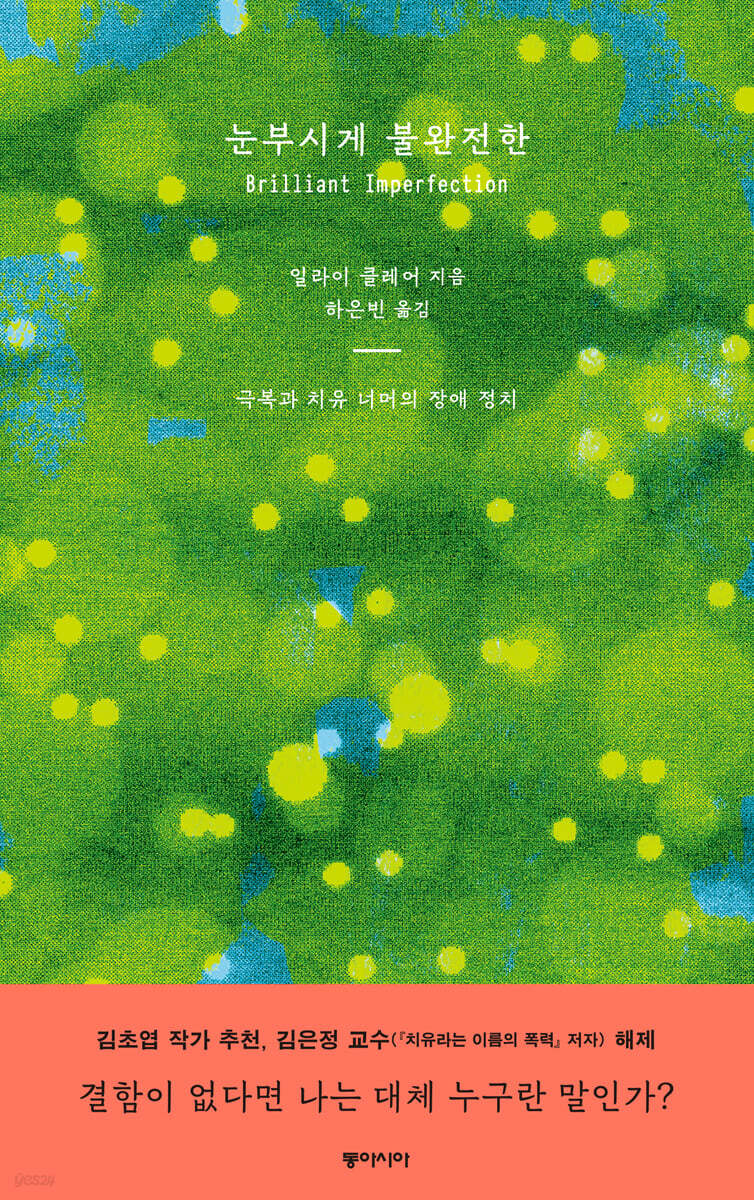
dazzlingly imperfect
 |
Description
Book Introduction
- A word from MD
- A new book by Eli Clare, who has challenged modern society with his multiple identities as disabled, working class, and queer.
The theme of this book is disability and healing.
Resist the structure that has treated disability as something to be healed and improved.
A captivating humanities essay, blending the author's experiences with insights that reflect beyond structure.
- Son Min-gyu, Social and Political PD
"A Guidebook for Disability, Queer, and Gender Studies"
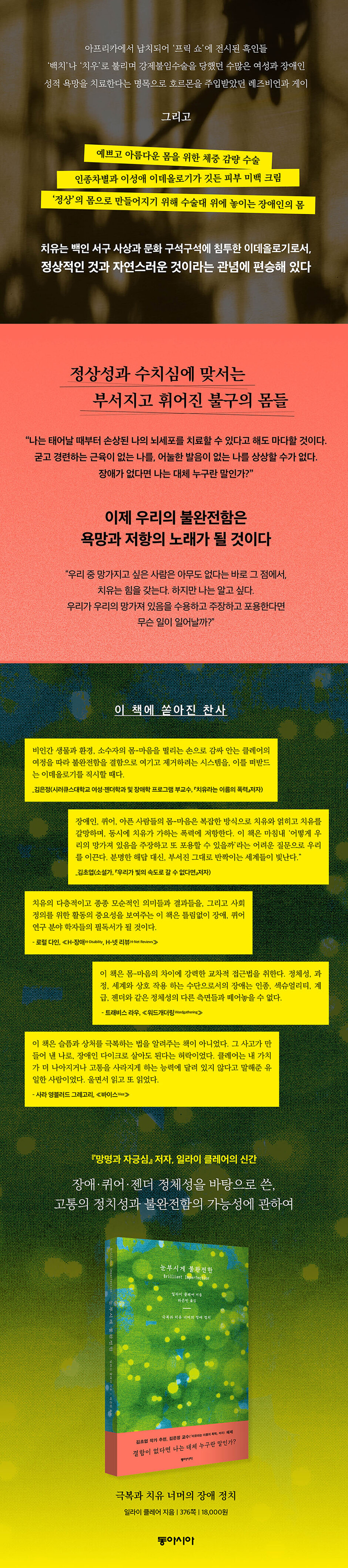
From forced sterilizations to skin-whitening creams, how does healing become violence?
What we need is not 'healing',
It is a 'dazzling imperfection' that allows me to assert myself as I am.
Broken, twisted, crippled bodies that confront normalcy and shame.
“What would happen if we accepted, claimed, and embraced that we were broken?”
Just as people go to the hospital to get better when they are sick, or try to get back to their previous state after experiencing an accident, big or small, people naturally expect people with disabilities to be free from their disabilities and return to a "normal" state.
But Eli Clare, author of Dazzlingly Imperfect, a congenital cerebral palsy sufferer, poet, disability and trans activist, writes:
“I would refuse even if I could heal my brain cells, which were damaged from birth.
I can't imagine myself without stiff, crampy muscles, without my slurred speech.
(…) Who would we be without disabilities?”
Eli Clare, who presented the idea of intersectional politics based on the multiple identities of disabled, working-class, queer, and transgender people in his previous work, Exile and Pride, has published his new book, Dazzlingly Imperfect.
In this book, Eli Clare's multiple identities challenge the diagnoses of "cerebral palsy," "schizophrenia," and "gender identity disorder" and the normalcy rooted in "cure."
As a person with a disability, I dissect the systems, cultures, and value systems that view my body as nothing more than an object to be fixed. As a transgender person, I have written in various formats, presenting brilliant insights that I have cultivated through my longing for and entanglement with healing to achieve the body and mind I desire.
Embracing disability, asserting the body and mind as they are, resisting ableism, and talking about the desires of one's own body and mind, "Dazzlingly Imperfect" explores a politics in which the diverse differences in body and mind that cannot be captured by the dichotomy of "normal" and "abnormal" can each survive in their own way.
Eunjung Kim, an associate professor in the Department of Women's and Gender Studies and Disability Studies Program at Syracuse University, provides a detailed explanation of how the book's message can function within discourses on disability, queerness, and caregiving in Korean society.
In short, this book will instill “a completely different imagination of dependence and life” in Korean society, where physician-assisted dying is emerging as an alternative to dignified life and death.
From forced sterilizations to skin-whitening creams, how does healing become violence?
What we need is not 'healing',
It is a 'dazzling imperfection' that allows me to assert myself as I am.
Broken, twisted, crippled bodies that confront normalcy and shame.
“What would happen if we accepted, claimed, and embraced that we were broken?”
Just as people go to the hospital to get better when they are sick, or try to get back to their previous state after experiencing an accident, big or small, people naturally expect people with disabilities to be free from their disabilities and return to a "normal" state.
But Eli Clare, author of Dazzlingly Imperfect, a congenital cerebral palsy sufferer, poet, disability and trans activist, writes:
“I would refuse even if I could heal my brain cells, which were damaged from birth.
I can't imagine myself without stiff, crampy muscles, without my slurred speech.
(…) Who would we be without disabilities?”
Eli Clare, who presented the idea of intersectional politics based on the multiple identities of disabled, working-class, queer, and transgender people in his previous work, Exile and Pride, has published his new book, Dazzlingly Imperfect.
In this book, Eli Clare's multiple identities challenge the diagnoses of "cerebral palsy," "schizophrenia," and "gender identity disorder" and the normalcy rooted in "cure."
As a person with a disability, I dissect the systems, cultures, and value systems that view my body as nothing more than an object to be fixed. As a transgender person, I have written in various formats, presenting brilliant insights that I have cultivated through my longing for and entanglement with healing to achieve the body and mind I desire.
Embracing disability, asserting the body and mind as they are, resisting ableism, and talking about the desires of one's own body and mind, "Dazzlingly Imperfect" explores a politics in which the diverse differences in body and mind that cannot be captured by the dichotomy of "normal" and "abnormal" can each survive in their own way.
Eunjung Kim, an associate professor in the Department of Women's and Gender Studies and Disability Studies Program at Syracuse University, provides a detailed explanation of how the book's message can function within discourses on disability, queerness, and caregiving in Korean society.
In short, this book will instill “a completely different imagination of dependence and life” in Korean society, where physician-assisted dying is emerging as an alternative to dignified life and death.
- You can preview some of the book's contents.
Preview
index
introduction
time
Before reading
◇Strobe pine
Chapter 1 | The Ideology of Healing
◇Convulsions and tremors
Chapter 2 | The Violence of Healing
◇Maple tree
Chapter 3 | Healing and Complicity
◇Stone
Chapter 4 | The Nuances of Healing
◇Sora shell
Chapter 5 | The Structure of Healing
◇Sora-ge
Chapter 6 | How Healing Works
◇Rolling
Chapter 7 | In the Heart of Healing
◇Cairo tree
Chapter 8 | Embracing Healing
◇Drag queen
Chapter 9 | The Impact of Healing
◇Survival Notes
Chapter 10 | The Promise of Healing
◇Riding a bicycle
Acknowledgements
clear
Translator's Note
main
References
Search
time
Before reading
◇Strobe pine
Chapter 1 | The Ideology of Healing
◇Convulsions and tremors
Chapter 2 | The Violence of Healing
◇Maple tree
Chapter 3 | Healing and Complicity
◇Stone
Chapter 4 | The Nuances of Healing
◇Sora shell
Chapter 5 | The Structure of Healing
◇Sora-ge
Chapter 6 | How Healing Works
◇Rolling
Chapter 7 | In the Heart of Healing
◇Cairo tree
Chapter 8 | Embracing Healing
◇Drag queen
Chapter 9 | The Impact of Healing
◇Survival Notes
Chapter 10 | The Promise of Healing
◇Riding a bicycle
Acknowledgements
clear
Translator's Note
main
References
Search
Detailed image
Into the book
I don't know how to convey the simple truth that I am not a broken being.
I would refuse even if I could heal my brain cells, which were damaged from birth.
I can't imagine myself without stiff, crampy muscles, without my slurred speech.
--- p.25, from “Chapter 1: The Ideology of Healing”
I think about the comedy and poetry, performance art, intense activism, dirty movies, important thoughts, good conversations, and fun we've brought to the world.
We think about who we are and how our particular body-mind has made us who we are.
Who would we be without disabilities?
--- p.57, from “Chapter 2: Violence Called Healing”
I would like to interpret diagnosis as a source of knowledge that is sometimes reliable and sometimes questionable.
As tools and weapons forged by a particular belief system, sometimes useful, sometimes dangerous.
A fierce storm that spreads its power in all directions.
--- p.79, from “Chapter 3: Healing and Conspiracy”
I can't understand what is natural, what is normal.
It's a really foggy issue for me.
Who says your bumpy, purple skin is unnatural, or my trembling hands are abnormal? How are such life-altering decisions made?
--- p.101, from “Chapter 4: Nuances of Healing”
If possible, recovery would be a powerful force that not only provides a countermeasure to loss, but also contributes to the well-being of the planet.
However, the damage is irreversible.
Some ecosystems are irreplaceable.
It is unclear how many centuries it will take to heal, and it may simply be a matter of putting a band-aid on a gaping wound.
We may not be able to fix what is already broken.
--- p.108, from “Chapter 4: Nuances of Healing”
No technology is a perfect example of a healing ideology.
Rather, the ideology is attached to various tools.
From things as old as the planet itself to those at the cutting edge of science.
--- p.147, from “Chapter 5: Structure of Healing”
Non-disabled people who ask me if I'd take a hypothetical drug that would cure my cerebral palsy really draw me into a fantasy of many levels.
No such technology exists for cerebral palsy, and unlike breast cancer, diabetes, or autism, there are promising treatment candidates, none are being developed.
These questions are nothing more than thought experiments that focus on devaluing the value of disability.
--- p.155-156, from “Chapter 6 How Healing Works”
We live in peace.
Accept.
Congratulations.
Put it down.
Find your self-esteem.
Embrace ambiguity.
We face the fact that we will inevitably die someday.
Rejects compassion and overcoming.
Build community and get used to isolation.
They begin to seek interdependence.
I neither hope for nor expect very high productivity.
Claims what we know about our body-mind.
Learn to balance loss and pride.
Struggle with frustration and pain.
I don't want to define what it means to claim a disability.
Sometimes it overlaps with actively choosing disability, and sometimes it overlaps with avoiding disability.
This work is often fraught with contradictions.
--- p.229, from “Chapter 8: Healing”
Mental retardation, although it has faded in the meantime, still follows me around in the form of hate speech.
Cerebral palsy found me while my parents were exploring healing.
(…) I barely escaped from schizophrenia.
It wasn't that hearing voices and seeing hallucinations was inherently bad or wrong, but rather that the medical treatment and social situations that accompanied the diagnosis were sometimes horrific, so when I escaped, I felt grateful.
Meanwhile, in the case of gender identity disorder, I actively sought it out.
--- p.246, from “Chapter 8: Healing”
But I wish we could go further.
I'd like to imagine deconstructing the DSM itself, discarding the concepts of disorder and defect, and exploring other ways of approaching medical technology beyond white, Western diagnosis.
Yes, I am proposing a rebellion.
--- p.252, Chapter 8, “Walking Through Healing,” p.252
Healing ignores resilience and survival, the spiderweb between the cracks, crevices, and seams.
The promise of healing is powerful precisely because none of us want to be broken.
But I want to know.
What would happen if we accepted, claimed, and embraced our brokenness?
--- p.280-281, from “Chapter 9: The Influence of Healing”
Because even as I run my hand over my chest, admire the fit of my shirt, and feel endlessly comfortable in my own skin, the self-doubts of the past still resonate.
How can I reconcile my lifelong struggle to love myself as I am, despite my disability, with the medical technologies used to reshape my gendered and sexualized body and mind? I'm looking for a slightly more sordid story.
--- p.301, from “Chapter 10: The Promise of Healing”
The gradual transition from being a butch dyke to a genderqueer white man has never been a matter of healing a disorder or fixing a brokenness.
It was more of a matter of desire or comfort.
The transition was a door, a window, and a deep blue sky.
--- p.306, from “Chapter 10: The Promise of Healing”
I walked into the door that held the promise of healing.
I heard the sound of desire and found peace of mind and body.
I live more comfortably within the gender binary.
I still feel like I'm nine years old, flying a kite in the grass, knowing I was neither a boy nor a girl.
I didn't heal anything.
Because there was nothing to heal.
All these forces are pushing through me.
I would refuse even if I could heal my brain cells, which were damaged from birth.
I can't imagine myself without stiff, crampy muscles, without my slurred speech.
--- p.25, from “Chapter 1: The Ideology of Healing”
I think about the comedy and poetry, performance art, intense activism, dirty movies, important thoughts, good conversations, and fun we've brought to the world.
We think about who we are and how our particular body-mind has made us who we are.
Who would we be without disabilities?
--- p.57, from “Chapter 2: Violence Called Healing”
I would like to interpret diagnosis as a source of knowledge that is sometimes reliable and sometimes questionable.
As tools and weapons forged by a particular belief system, sometimes useful, sometimes dangerous.
A fierce storm that spreads its power in all directions.
--- p.79, from “Chapter 3: Healing and Conspiracy”
I can't understand what is natural, what is normal.
It's a really foggy issue for me.
Who says your bumpy, purple skin is unnatural, or my trembling hands are abnormal? How are such life-altering decisions made?
--- p.101, from “Chapter 4: Nuances of Healing”
If possible, recovery would be a powerful force that not only provides a countermeasure to loss, but also contributes to the well-being of the planet.
However, the damage is irreversible.
Some ecosystems are irreplaceable.
It is unclear how many centuries it will take to heal, and it may simply be a matter of putting a band-aid on a gaping wound.
We may not be able to fix what is already broken.
--- p.108, from “Chapter 4: Nuances of Healing”
No technology is a perfect example of a healing ideology.
Rather, the ideology is attached to various tools.
From things as old as the planet itself to those at the cutting edge of science.
--- p.147, from “Chapter 5: Structure of Healing”
Non-disabled people who ask me if I'd take a hypothetical drug that would cure my cerebral palsy really draw me into a fantasy of many levels.
No such technology exists for cerebral palsy, and unlike breast cancer, diabetes, or autism, there are promising treatment candidates, none are being developed.
These questions are nothing more than thought experiments that focus on devaluing the value of disability.
--- p.155-156, from “Chapter 6 How Healing Works”
We live in peace.
Accept.
Congratulations.
Put it down.
Find your self-esteem.
Embrace ambiguity.
We face the fact that we will inevitably die someday.
Rejects compassion and overcoming.
Build community and get used to isolation.
They begin to seek interdependence.
I neither hope for nor expect very high productivity.
Claims what we know about our body-mind.
Learn to balance loss and pride.
Struggle with frustration and pain.
I don't want to define what it means to claim a disability.
Sometimes it overlaps with actively choosing disability, and sometimes it overlaps with avoiding disability.
This work is often fraught with contradictions.
--- p.229, from “Chapter 8: Healing”
Mental retardation, although it has faded in the meantime, still follows me around in the form of hate speech.
Cerebral palsy found me while my parents were exploring healing.
(…) I barely escaped from schizophrenia.
It wasn't that hearing voices and seeing hallucinations was inherently bad or wrong, but rather that the medical treatment and social situations that accompanied the diagnosis were sometimes horrific, so when I escaped, I felt grateful.
Meanwhile, in the case of gender identity disorder, I actively sought it out.
--- p.246, from “Chapter 8: Healing”
But I wish we could go further.
I'd like to imagine deconstructing the DSM itself, discarding the concepts of disorder and defect, and exploring other ways of approaching medical technology beyond white, Western diagnosis.
Yes, I am proposing a rebellion.
--- p.252, Chapter 8, “Walking Through Healing,” p.252
Healing ignores resilience and survival, the spiderweb between the cracks, crevices, and seams.
The promise of healing is powerful precisely because none of us want to be broken.
But I want to know.
What would happen if we accepted, claimed, and embraced our brokenness?
--- p.280-281, from “Chapter 9: The Influence of Healing”
Because even as I run my hand over my chest, admire the fit of my shirt, and feel endlessly comfortable in my own skin, the self-doubts of the past still resonate.
How can I reconcile my lifelong struggle to love myself as I am, despite my disability, with the medical technologies used to reshape my gendered and sexualized body and mind? I'm looking for a slightly more sordid story.
--- p.301, from “Chapter 10: The Promise of Healing”
The gradual transition from being a butch dyke to a genderqueer white man has never been a matter of healing a disorder or fixing a brokenness.
It was more of a matter of desire or comfort.
The transition was a door, a window, and a deep blue sky.
--- p.306, from “Chapter 10: The Promise of Healing”
I walked into the door that held the promise of healing.
I heard the sound of desire and found peace of mind and body.
I live more comfortably within the gender binary.
I still feel like I'm nine years old, flying a kite in the grass, knowing I was neither a boy nor a girl.
I didn't heal anything.
Because there was nothing to heal.
All these forces are pushing through me.
--- p.311, from “Chapter 10: The Promise of Healing”
Publisher's Review
What conditions has society defined as “problems” and “cured”?
"Healing is an ideology that has permeated white Western thought and culture."
Healing, in the sense of curing an illness and making it better, always presupposes a 'defective' and 'problematic' state, which, according to the author, is a political definition.
This is because the powerful groups with medical, scientific, and national authority have declared people with disabilities, people of color, and queers as defective beings and have wielded violence and oppression in the name of healing.
In this history, the characteristics of the dominant group—white, wealthy, able-bodied, and cisgender—became the standard for what was “natural” and “normal,” and the countless bodies and minds that did not fall into this category were relegated to beings of no value and in need of elimination.
『Dazzlingly Imperfect』 argues that this concept of 'healing' has permeated every corner of modern culture and value systems, functioning as a kind of ideology that preaches 'normality.'
According to Claire, the ideology of healing permeates even very everyday tools, as well as medical technologies like selective abortion, which are still practiced.
For example, commonly sold skin-whitening creams reinforce racist messages that dark-skinned bodies are unattractive and immoral, perpetuating white supremacy.
『Dazzlingly Imperfect』, which structurally explores the structure, operation, purpose, cases, and promises of 'healing' as a powerful mechanism that operates normalcy, does not simply say that we should reject healing.
This is a radical proposal to establish a new framework for understanding pain and healing, health and recovery, by understanding the political and economic power relations surrounding healing.
Bodies and minds that adapt, negotiate, depend, and desire
Beyond Overcoming and Healing, About the Colorful Possibilities of Imperfect Beings
Consider some common tropes used in disability and illness campaign advertising.
Christopher Reeve, the lead actor in "Superman," who became paralyzed in a horse riding accident and constantly yearned to stand on his own two feet while seeking cutting-edge treatments.
Whoopi Goldberg on a billboard proclaiming that anyone can overcome dyslexia if they try.
Numerous disabilities and diseases are consumed as symbols of bad luck and injustice.
Dazzlingly Imperfect argues that the dominant view of disability as a “flaw” and a problem to be “overcome” reduces disability to an individual problem and erases the social context and issues surrounding disability and illness.
Rather than risking enormous costs and side effects to repair paralyzed legs, what if society allowed people to travel anywhere in wheelchairs? How would the lives of the deaf and blind change if access to various languages, including sign language and Braille, were guaranteed? If the stigma surrounding mental illness were lessened, wouldn't the experiences of seeing hallucinations and hearing voices be less terrifying? "Dazzlingly Imperfect" proposes a shift from the current focus on medical healing to examine the disabling of specific bodies and minds.
This book does not insist on a single, unified position opposing healing as a strategy for asserting disability identity and self-esteem.
In the latter part of the book, Eli Clare confesses his journey as a female-to-male (FTM) transgender person to choosing breast reconstruction surgery and testosterone treatment, and he reflects intensely on the self-contradiction, healing, and politics of desire he experienced along the way.
The author, who is objectively aware of his own privilege as a white person and his own positionality as a person with congenital cerebral palsy, illuminates the various ways in which people of diverse races, classes, genders, illnesses, and sexualities relate to healing.
It demonstrates that minority pride and identity can be compatible with healing, and thoughtfully discusses how asserting self-esteem can be challenging for those with intersectional identities.
Exploring the possibilities of solidarity based on diverse identities and differences, "Dazzlingly Imperfect" will serve as a valuable guide to the evolving discourses on disability, queerness, gender, and feminism.
Literary imagination that revives erased and forgotten beings
Clare's solidarity extends to the environment and non-human creatures.
Beginning with the suffering of individuals, this book expands to include the lives of minorities throughout history and even non-human creatures, and its format is also noteworthy.
Chapter 7, "In the Heart of Healing," tells the story of Carrie Buck and her mother, Emma Buck, who were branded "mentally retarded" and forced to undergo sterilization under eugenics laws.
Eli Clare imagines Carrie Buck's voice based on various literature and sources, and makes her the narrator of the text.
Claire's narrative, which revives the voices of those left in the blank spaces of history, questions them, and speaks to them, breathes special vitality and literary imagination into this book.
In 『Dazzlingly Imperfect』, the oppression of minorities by the powerful group expands into the oppression of nature by humans.
The author interprets the 'monoculture' method of growing only one crop as a healing ideology that erases the differences between different bodies and minds and produces only 'normal' beings.
Claire's story is quite chilling, as it reminds us of how much this loss of diversity has destroyed ecosystems.
Rather than thinking of recovery as removing the 'problem' and returning it to its previous state, Claire's unique insight shines through in reimagining 'recovery' from the perspective of reviving the interdependence between diverse organisms.
The prose interspersed between each chapter (Strobe Pine, Cramps and Tremors, Stones, Conch Shells, Rolling, Barrington, Drag Queen, Survival Notes, Bicycle Riding) connects the chapters while paying attention to “moments and feelings that are not subsumed by the arguments and arguments presented in each chapter.”
These writings are Claire's invitation to readers to open their senses and experience the interdependence of nature and humanity.
The work of marking American place names as the territories of Native Americans also reveals Clareman's sensibility, which broadly recognizes the violence and history engraved on nature and land.
"Healing is an ideology that has permeated white Western thought and culture."
Healing, in the sense of curing an illness and making it better, always presupposes a 'defective' and 'problematic' state, which, according to the author, is a political definition.
This is because the powerful groups with medical, scientific, and national authority have declared people with disabilities, people of color, and queers as defective beings and have wielded violence and oppression in the name of healing.
In this history, the characteristics of the dominant group—white, wealthy, able-bodied, and cisgender—became the standard for what was “natural” and “normal,” and the countless bodies and minds that did not fall into this category were relegated to beings of no value and in need of elimination.
『Dazzlingly Imperfect』 argues that this concept of 'healing' has permeated every corner of modern culture and value systems, functioning as a kind of ideology that preaches 'normality.'
According to Claire, the ideology of healing permeates even very everyday tools, as well as medical technologies like selective abortion, which are still practiced.
For example, commonly sold skin-whitening creams reinforce racist messages that dark-skinned bodies are unattractive and immoral, perpetuating white supremacy.
『Dazzlingly Imperfect』, which structurally explores the structure, operation, purpose, cases, and promises of 'healing' as a powerful mechanism that operates normalcy, does not simply say that we should reject healing.
This is a radical proposal to establish a new framework for understanding pain and healing, health and recovery, by understanding the political and economic power relations surrounding healing.
Bodies and minds that adapt, negotiate, depend, and desire
Beyond Overcoming and Healing, About the Colorful Possibilities of Imperfect Beings
Consider some common tropes used in disability and illness campaign advertising.
Christopher Reeve, the lead actor in "Superman," who became paralyzed in a horse riding accident and constantly yearned to stand on his own two feet while seeking cutting-edge treatments.
Whoopi Goldberg on a billboard proclaiming that anyone can overcome dyslexia if they try.
Numerous disabilities and diseases are consumed as symbols of bad luck and injustice.
Dazzlingly Imperfect argues that the dominant view of disability as a “flaw” and a problem to be “overcome” reduces disability to an individual problem and erases the social context and issues surrounding disability and illness.
Rather than risking enormous costs and side effects to repair paralyzed legs, what if society allowed people to travel anywhere in wheelchairs? How would the lives of the deaf and blind change if access to various languages, including sign language and Braille, were guaranteed? If the stigma surrounding mental illness were lessened, wouldn't the experiences of seeing hallucinations and hearing voices be less terrifying? "Dazzlingly Imperfect" proposes a shift from the current focus on medical healing to examine the disabling of specific bodies and minds.
This book does not insist on a single, unified position opposing healing as a strategy for asserting disability identity and self-esteem.
In the latter part of the book, Eli Clare confesses his journey as a female-to-male (FTM) transgender person to choosing breast reconstruction surgery and testosterone treatment, and he reflects intensely on the self-contradiction, healing, and politics of desire he experienced along the way.
The author, who is objectively aware of his own privilege as a white person and his own positionality as a person with congenital cerebral palsy, illuminates the various ways in which people of diverse races, classes, genders, illnesses, and sexualities relate to healing.
It demonstrates that minority pride and identity can be compatible with healing, and thoughtfully discusses how asserting self-esteem can be challenging for those with intersectional identities.
Exploring the possibilities of solidarity based on diverse identities and differences, "Dazzlingly Imperfect" will serve as a valuable guide to the evolving discourses on disability, queerness, gender, and feminism.
Literary imagination that revives erased and forgotten beings
Clare's solidarity extends to the environment and non-human creatures.
Beginning with the suffering of individuals, this book expands to include the lives of minorities throughout history and even non-human creatures, and its format is also noteworthy.
Chapter 7, "In the Heart of Healing," tells the story of Carrie Buck and her mother, Emma Buck, who were branded "mentally retarded" and forced to undergo sterilization under eugenics laws.
Eli Clare imagines Carrie Buck's voice based on various literature and sources, and makes her the narrator of the text.
Claire's narrative, which revives the voices of those left in the blank spaces of history, questions them, and speaks to them, breathes special vitality and literary imagination into this book.
In 『Dazzlingly Imperfect』, the oppression of minorities by the powerful group expands into the oppression of nature by humans.
The author interprets the 'monoculture' method of growing only one crop as a healing ideology that erases the differences between different bodies and minds and produces only 'normal' beings.
Claire's story is quite chilling, as it reminds us of how much this loss of diversity has destroyed ecosystems.
Rather than thinking of recovery as removing the 'problem' and returning it to its previous state, Claire's unique insight shines through in reimagining 'recovery' from the perspective of reviving the interdependence between diverse organisms.
The prose interspersed between each chapter (Strobe Pine, Cramps and Tremors, Stones, Conch Shells, Rolling, Barrington, Drag Queen, Survival Notes, Bicycle Riding) connects the chapters while paying attention to “moments and feelings that are not subsumed by the arguments and arguments presented in each chapter.”
These writings are Claire's invitation to readers to open their senses and experience the interdependence of nature and humanity.
The work of marking American place names as the territories of Native Americans also reveals Clareman's sensibility, which broadly recognizes the violence and history engraved on nature and land.
GOODS SPECIFICS
- Date of issue: September 5, 2023
- Page count, weight, size: 376 pages | 460g | 132*210*20mm
- ISBN13: 9788962625752
- ISBN10: 896262575X
You may also like
카테고리
korean


korean

![GQ KOREA Mark (Monthly): December [2025]](http://librairie.coreenne.fr/cdn/shop/files/8ef265dbbfbf186523ed75ba7319009d.jpg?v=1765340328&width=3840)


