![[YesRecover] Introduction to CEO Studies](http://librairie.coreenne.fr/cdn/shop/files/b3a8091f9fd3cd1eea46b9d6073c4fc4.jpg?v=1765355368&width=3840)

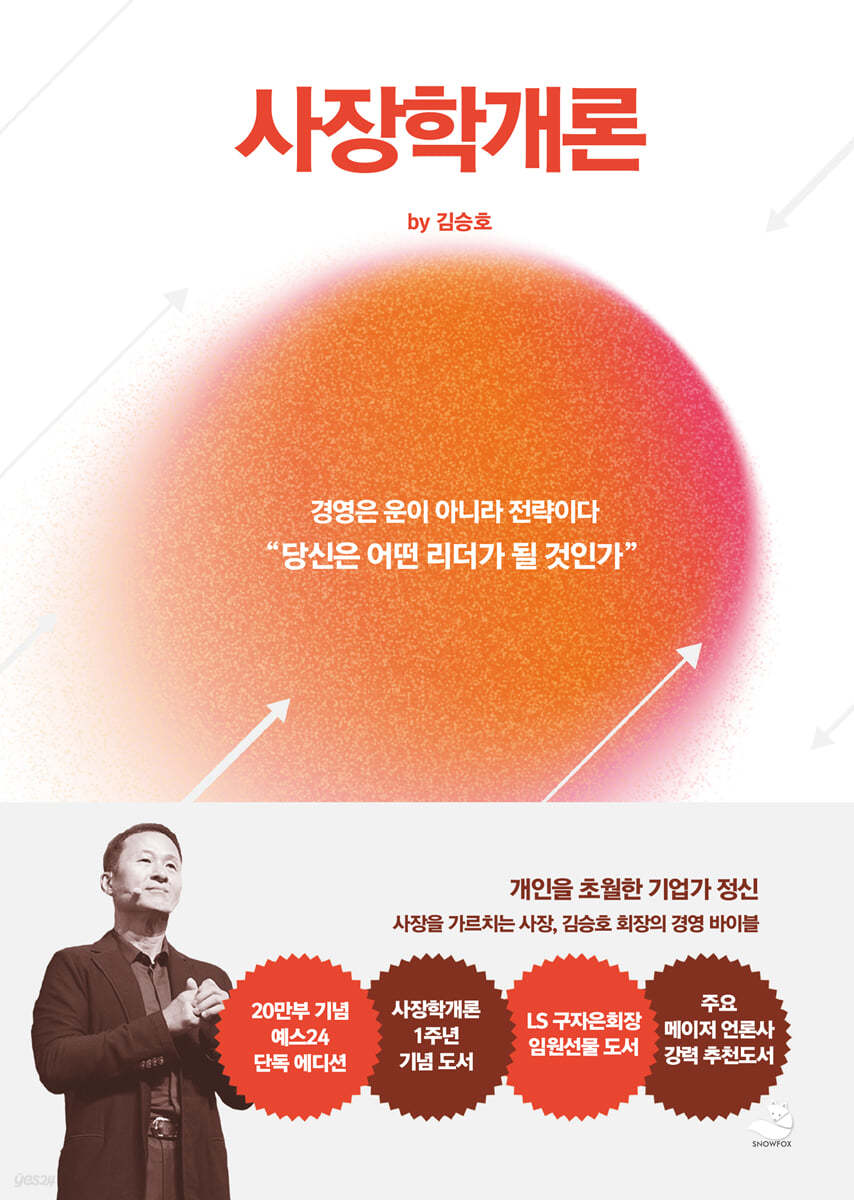
[YesRecover] Introduction to CEO Studies
 |
Description
Book Introduction
This book is a new publication by Chairman Seung-ho Kim, author of “The Nature of Money,” who is known as “the CEO who teaches CEOs” while traveling between Korea, the United States, and around the world. He has spent over ten years organizing all of his management philosophies, having lived his entire life as a CEO, and has completed all of them in this book, "Introduction to CEO Studies," covering 120 topics. Over the past seven years, I have met with 3,000 CEO students and conducted [CEO Studies] classes. While discussing the various problems they face in real life, I have found common difficulties CEOs ask about. I have organized these problems into a table of contents to provide further guidance. The author, a businessman living in the United States who passed the Korea KCA CEO School and met with CEOs who were waiting for him, visits Korea twice a year. However, due to the continued limitations of limited opportunities and limited number of participants, we decided to publish the entire contents of [CEO Studies Class] as a book titled 『Introduction to CEO Studies』. The book is divided into six chapters that allow the target audience to focus more on each case. Chapter 1 covers topics that are most realistic and urgent to learn. The criteria for whether you are currently in business or running a business, and whether you will use people to increase sales or use people to increase sales. The book contains the author's management philosophy on a wide range of questions, such as the rebellion of the founding fathers who founded the company together and the signs of the business failing, such as 'What should we do now?' Chapter 2 covers topics necessary to develop the inner strength to go longer, further, and sustainably. We focused on why great competitors are a blessing, how a CEO's attitude must change with scale, and advice on how to become a CEO with a deep heart who can be reborn by following the fundamentals of organization, order, cleaning, and cleanliness while being firm in the face of criticism. Chapter 3 contains solutions to the overall management of employees, a problem that almost all CEOs and mid-level executives find difficult. It's full of advice on managing employees, the most difficult and persistent challenge in business. It covers everything from who to promote, how to find good employees, how to identify the employees you should be most wary of and those you should fire immediately, and even how to teach work reporting methods that enable reporting and communication in the company's language. You'll find solutions to problems you need right away, right in the field. Chapters 4 and 5 are for CEOs who are in the process of transitioning from CEO to entrepreneur, and the final chapter, Chapter 6, focuses on content for anyone who is preparing to become a CEO or has a dream of becoming one. The book "Introduction to CEO Studies" was written so that all 9 million CEOs, or 25% of the country's total, can read it individually, according to the size and situation of their company. It is also a book for all CEOs who want to hear firsthand advice from experienced senior managers who have spent their entire lives as CEOs. |
- You can preview some of the book's contents.
Preview
index
Book Introduction
prolog
Before reading this book
Chapter 1: Asking the Most Realistic and Urgent Questions
'What should I do now?'
001 Am I in business? Am I in business?
002 Four Paths to Income
003 What is your business's PER?
004 Follow orders and instructions accurately.
005 Bad Instructions and Good Instructions
006 Should I hire people when sales increase? Should I hire people to increase sales?
007 How to beat your competition 100%
008 When making decisions is not easy
009 How to handle important decisions
010 What to do the next day if you fail again
011 Five Pitfalls of Growing a Business
012 Rebellion of the National Subjects and the Tosagu Peng
013 12 Signs Your Business Is Failing
014 Four Skills to Become Truly Rich
015 Some Signs You're Becoming a Good Boss
016 When to Ignore Advice
017 How to Get Your Wife's Absolute Support
6 Things to Keep in Mind When Asking Questions or Requests via Text Message
019 How to Create a Company Story
020 Things to keep in mind when setting the price of your product or service
021 Every business eventually encounters real estate and finance.
022 Titles Managers Should Be Aware of
Chapter 2: "Thoughts" on the mindset needed to become a stronger CEO
“It takes inner strength to go long, far, and sustainably.”
023 Attitude toward praise and criticism
024 The Power of Organizing, Tidying, Cleaning, and Cleanliness
025 A great competitor is a blessing
026 My Independence Day
027 If you need to help someone
028 Find someone with common sense.
029 Get out of the frame
030 Similarities Between Campfires and Business
031 The sword that protected me is now aimed at my neck.
032 You can also buy items at my store with money.
033 15 Ways to Create Good Luck
034 Why do thoughts become reality?
035 Three Cases in Which People Hate Me for No Reason
036 On Coexistence, Cooperation, and Organic Business
037 Things the CEO must do every two years
038 What happens when you become the president?
039 How far can the president's extravagance go?
040 As the company grows, the CEO's attitudes must and must not change.
041 What will I do with my friends if I become the CEO?
042 How much money you earn by age
043 Two Qualities of a Great Teacher
044 How to find the facts
045 When donating in the name of a company or as an individual
Chapter 3 Staff - Who Are They?
“What can I do to overcome the most difficult and persistent difficulties in business?”
046 Who will be promoted?
047 How to Find Good Employees
048 Four Types of Employees Who May Seem Like Good Employees, But You Should Be Most Wary of
049 People whose evaluations by the CEO and lower-level employees are different
050 Raising a Second Person
051 Three Rules for Receiving Employee Reports
052 All instructions end with a final report.
053 Employees who will have to be fired anyway and the attitude toward firing them
054 How to Fire an Employee
055 If you want your employees to work on their own
056 Two Cases of Letting Go of Good Employees
057 Employees are not subordinates
058 Is it possible to have a company where all employees are excellent employees?
059 To be respected by employees
060 Ten Things You Should Never Do to Your Employees
061 Patterns of Bosses That Make Employees Tired
062 Small Kindnesses and Inconvenient Kindnesses
063 Dividends are better than equity.
064 Will paying high salaries attract good employees?
065 The Paradox of Praise for Employees
066 Changes in the CEO's behavior depending on the number of employees, from one to one hundred.
067 The Value of Remembering Your Opponent's Name
068 Why You Shouldn't Make Friends with Employees
Chapter 4: Beyond Business to Enterprise
“Where should we go next?”
069 Which of these is not the president's fault?
070 Revolution or Rebellion?
071 If the boss is afraid of fear, it's over.
072 The Secret of Rent
Two Keys to Franchise Success
074 Two major developmental stages of industry - enlargement and sophistication
075 Two Things CEOs Looking to Enter Overseas Markets Must Learn
076 The process of creating a company brand
077 Types of Business Profits
078 What is your exit strategy?
079 Black ink bankruptcy
080 Why has our company stopped growing?
081 Things to keep in mind when listing a company
082 Another business hidden within the business
083 How do businessmen get scammed?
084 You must enter the US market to become an international brand.
085 How long does it take for a family to escape poverty?
086 What is your color?
087 The Greatness of White
088 The Power of Modern Products
089 Customers have the best interior
090 Profit margin and profit
Chapter 5: Establish Your Own Philosophy
“I think it’s time for a balance between body and mind, in all aspects.”
091 The President's Puberty
092 Seven Reasons Why Good Bosses Fail
093 The conduct of the most successful person in the family
094 The center is not in the middle
095 Become friends with failure
096 8 Things Successful Entrepreneurs Have in Common
097 The entire process of persuading those around you
098 The Value of the Side Door Policy
099 13 Differences Between Successful and Highly Successful People
How to throw away 100 balls and get thread
Chapter 6: You Who Decided to Become the President
“I really want to succeed as a CEO.”
101 To those who say they can't start a business because they don't have money
102 What is the best age to start a business?
103 How do you find new business?
104 One way to distinguish between successful and failed businesses
105 Misconceptions among Young People Dreaming of Social Enterprises
106 Why should I become a CEO?
107 This kind of person is ultimately the answer to the boss.
108 Two Conditions for a Successful Partnership
109 How to Name a Company
110 Why Jiwoo and Seungwoo Believe in Santa
111 Break off the branches, not the leaves.
112 Can I run a business without drinking or smoking?
113 How to Communicate with Business People or Celebrities
114 The lives of successful people are packaged after their success, ruining the lives of ordinary people.
115 Why do managers always read?
116 Mistakes in calculating margins that ruin a company
117 Thinking that sees through the fraud in graphs or statistics
118 The principle of income generation
Why 119 Professionals Can't Grow Their Businesses
120 The Uniqueness of Korean Food and the Changing Western Customers
Epilogue
prolog
Before reading this book
Chapter 1: Asking the Most Realistic and Urgent Questions
'What should I do now?'
001 Am I in business? Am I in business?
002 Four Paths to Income
003 What is your business's PER?
004 Follow orders and instructions accurately.
005 Bad Instructions and Good Instructions
006 Should I hire people when sales increase? Should I hire people to increase sales?
007 How to beat your competition 100%
008 When making decisions is not easy
009 How to handle important decisions
010 What to do the next day if you fail again
011 Five Pitfalls of Growing a Business
012 Rebellion of the National Subjects and the Tosagu Peng
013 12 Signs Your Business Is Failing
014 Four Skills to Become Truly Rich
015 Some Signs You're Becoming a Good Boss
016 When to Ignore Advice
017 How to Get Your Wife's Absolute Support
6 Things to Keep in Mind When Asking Questions or Requests via Text Message
019 How to Create a Company Story
020 Things to keep in mind when setting the price of your product or service
021 Every business eventually encounters real estate and finance.
022 Titles Managers Should Be Aware of
Chapter 2: "Thoughts" on the mindset needed to become a stronger CEO
“It takes inner strength to go long, far, and sustainably.”
023 Attitude toward praise and criticism
024 The Power of Organizing, Tidying, Cleaning, and Cleanliness
025 A great competitor is a blessing
026 My Independence Day
027 If you need to help someone
028 Find someone with common sense.
029 Get out of the frame
030 Similarities Between Campfires and Business
031 The sword that protected me is now aimed at my neck.
032 You can also buy items at my store with money.
033 15 Ways to Create Good Luck
034 Why do thoughts become reality?
035 Three Cases in Which People Hate Me for No Reason
036 On Coexistence, Cooperation, and Organic Business
037 Things the CEO must do every two years
038 What happens when you become the president?
039 How far can the president's extravagance go?
040 As the company grows, the CEO's attitudes must and must not change.
041 What will I do with my friends if I become the CEO?
042 How much money you earn by age
043 Two Qualities of a Great Teacher
044 How to find the facts
045 When donating in the name of a company or as an individual
Chapter 3 Staff - Who Are They?
“What can I do to overcome the most difficult and persistent difficulties in business?”
046 Who will be promoted?
047 How to Find Good Employees
048 Four Types of Employees Who May Seem Like Good Employees, But You Should Be Most Wary of
049 People whose evaluations by the CEO and lower-level employees are different
050 Raising a Second Person
051 Three Rules for Receiving Employee Reports
052 All instructions end with a final report.
053 Employees who will have to be fired anyway and the attitude toward firing them
054 How to Fire an Employee
055 If you want your employees to work on their own
056 Two Cases of Letting Go of Good Employees
057 Employees are not subordinates
058 Is it possible to have a company where all employees are excellent employees?
059 To be respected by employees
060 Ten Things You Should Never Do to Your Employees
061 Patterns of Bosses That Make Employees Tired
062 Small Kindnesses and Inconvenient Kindnesses
063 Dividends are better than equity.
064 Will paying high salaries attract good employees?
065 The Paradox of Praise for Employees
066 Changes in the CEO's behavior depending on the number of employees, from one to one hundred.
067 The Value of Remembering Your Opponent's Name
068 Why You Shouldn't Make Friends with Employees
Chapter 4: Beyond Business to Enterprise
“Where should we go next?”
069 Which of these is not the president's fault?
070 Revolution or Rebellion?
071 If the boss is afraid of fear, it's over.
072 The Secret of Rent
Two Keys to Franchise Success
074 Two major developmental stages of industry - enlargement and sophistication
075 Two Things CEOs Looking to Enter Overseas Markets Must Learn
076 The process of creating a company brand
077 Types of Business Profits
078 What is your exit strategy?
079 Black ink bankruptcy
080 Why has our company stopped growing?
081 Things to keep in mind when listing a company
082 Another business hidden within the business
083 How do businessmen get scammed?
084 You must enter the US market to become an international brand.
085 How long does it take for a family to escape poverty?
086 What is your color?
087 The Greatness of White
088 The Power of Modern Products
089 Customers have the best interior
090 Profit margin and profit
Chapter 5: Establish Your Own Philosophy
“I think it’s time for a balance between body and mind, in all aspects.”
091 The President's Puberty
092 Seven Reasons Why Good Bosses Fail
093 The conduct of the most successful person in the family
094 The center is not in the middle
095 Become friends with failure
096 8 Things Successful Entrepreneurs Have in Common
097 The entire process of persuading those around you
098 The Value of the Side Door Policy
099 13 Differences Between Successful and Highly Successful People
How to throw away 100 balls and get thread
Chapter 6: You Who Decided to Become the President
“I really want to succeed as a CEO.”
101 To those who say they can't start a business because they don't have money
102 What is the best age to start a business?
103 How do you find new business?
104 One way to distinguish between successful and failed businesses
105 Misconceptions among Young People Dreaming of Social Enterprises
106 Why should I become a CEO?
107 This kind of person is ultimately the answer to the boss.
108 Two Conditions for a Successful Partnership
109 How to Name a Company
110 Why Jiwoo and Seungwoo Believe in Santa
111 Break off the branches, not the leaves.
112 Can I run a business without drinking or smoking?
113 How to Communicate with Business People or Celebrities
114 The lives of successful people are packaged after their success, ruining the lives of ordinary people.
115 Why do managers always read?
116 Mistakes in calculating margins that ruin a company
117 Thinking that sees through the fraud in graphs or statistics
118 The principle of income generation
Why 119 Professionals Can't Grow Their Businesses
120 The Uniqueness of Korean Food and the Changing Western Customers
Epilogue
Detailed image

Into the book
I hope this book can be used as a textbook on entrepreneurship for those who are thinking about starting a business or are currently running a business.
Although this book was written with the intention of being a textbook, it contains many analogies and explanations to make it easy to understand.
Whether you're a one-person business or a leader with hundreds of employees, I hope you can find comfort in knowing that other business owners have grappled with and solved similar challenges.
I recommend reading content you have not experienced or find somewhat difficult to understand with the mindset of experiencing it in advance.
---p.09
Instructions should never be abstract.
Because as important as understanding well is directing so as not to misunderstand.
Especially when it comes to complex work instructions, you need to be clear.
This is something that superiors, not subordinates, should learn from.
Even if the task is complex, if the person giving the instructions cannot perform the task clearly, it means that the person giving the instructions does not understand the content well.
In the end, it's like giving unclear instructions and expecting the other person to figure out the intention and do the work.
---p.35
As a boss, I naturally want my employees to be people with general knowledge.
To create a normal company, you need to work with people who can think of common sense in a sensible way.
So, in my opinion, the people I exclude from my staff are those who have a serious attitude towards the things listed above.
If you already have someone on your staff who is serious about that, you should consider promoting them.
If you are one of those people, hide from today.
It's embarrassing as a manager.
---p.123
Business must always strike a balance between specialization and universality.
I need to think and examine whether I am in a business that I have no way out of.
If there is absolutely no way out, you should pool the assets you have accumulated from that business and invest them in a business with an exit.
If you're currently in a business with no exit, you should always have enough spare cash on hand to survive at least a few months of no income, so you can bounce back when the storm passes.
If my meticulousness has brought the company this far, my meticulousness could also ruin it.
If my warm heart has brought the company this far, my warm heart could ruin the company.
My diligence, my philosophy, my discerning eye, my sincerity, my delicacy, my charisma sometimes save me and sometimes kill me.
Therefore, we should not understand all values as absolute values, but always accept and understand change.
---p.132~133
When Korean managers elect or delegate a CEO to replace them, they only give them responsibility, not authority.
And they are hanging on to the back, trembling in fear that the company will go bankrupt.
Even if you pass your position on to your children, it's the same.
This is how you can never grow a great second-in-command.
If you are a leader who wants to succeed, you should not hesitate to create a second-in-command leadership position and give him as much space as possible to demonstrate his abilities.
---p.199
It's my fault for running a business that doesn't work in a recession.
Any discord among employees is my fault for poor management or hiring.
It was my fault for entering the business world where there were so many competitors.
It's my fault for being in a business that is vulnerable to exchange rates.
When interest rates rise, some people make money while I lose money.
It's my fault.
Embezzlement or theft is my lack of management.
Who should I blame? The lawsuit was my fault for giving it a pretext. As for the hiring crisis, there's one CEO who doesn't seem to be concerned about it.
Since we are in a business that is vulnerable to wage increases, we cannot raise salaries even if there is a shortage of workers.
It's all my fault.
It's also my fault that the business partner went somewhere else.
It's also my fault that my employees keep having accidents while driving.
It's also my fault that the rent keeps going up.
It's also my fault for meeting abusive customers.
---p.255~256
I've met thousands of businessmen and women, but I've yet to meet anyone who has made a fortune and started a successful business.
People who try to do business with money always come up with plans that can only be solved with money.
But if you don't have money, you have no choice but to start a business with an idea, and you have to block it with your body and time.
People who do business with money will always need more money, but people who do business with ideas will no longer need money once their idea catches on, and instead, money will start coming in.
If someone wants to start a business, there are two options: one where they have money but no ideas, and the other where they have ideas but no money. The latter is much more advantageous.
---p.369
New business emerges from almost every change.
Change is like a rock that was not moving at all, and when something like a heavy rain or an earthquake occurs, a crack opens and it starts to move.
Advances in scientific civilization, changes in government, cultural shifts, changes in public perception, and even minor events like recessions and, more directly, wars, create countless new businesses.
Business doesn't start with capital.
New businesses come from the mind and are born with passion.
Those who say that they need capital to do business do not know where all the businesses in this world started.
Please don't forget that you already have a business worth billions or even hundreds of billions of dollars inside you.
Although this book was written with the intention of being a textbook, it contains many analogies and explanations to make it easy to understand.
Whether you're a one-person business or a leader with hundreds of employees, I hope you can find comfort in knowing that other business owners have grappled with and solved similar challenges.
I recommend reading content you have not experienced or find somewhat difficult to understand with the mindset of experiencing it in advance.
---p.09
Instructions should never be abstract.
Because as important as understanding well is directing so as not to misunderstand.
Especially when it comes to complex work instructions, you need to be clear.
This is something that superiors, not subordinates, should learn from.
Even if the task is complex, if the person giving the instructions cannot perform the task clearly, it means that the person giving the instructions does not understand the content well.
In the end, it's like giving unclear instructions and expecting the other person to figure out the intention and do the work.
---p.35
As a boss, I naturally want my employees to be people with general knowledge.
To create a normal company, you need to work with people who can think of common sense in a sensible way.
So, in my opinion, the people I exclude from my staff are those who have a serious attitude towards the things listed above.
If you already have someone on your staff who is serious about that, you should consider promoting them.
If you are one of those people, hide from today.
It's embarrassing as a manager.
---p.123
Business must always strike a balance between specialization and universality.
I need to think and examine whether I am in a business that I have no way out of.
If there is absolutely no way out, you should pool the assets you have accumulated from that business and invest them in a business with an exit.
If you're currently in a business with no exit, you should always have enough spare cash on hand to survive at least a few months of no income, so you can bounce back when the storm passes.
If my meticulousness has brought the company this far, my meticulousness could also ruin it.
If my warm heart has brought the company this far, my warm heart could ruin the company.
My diligence, my philosophy, my discerning eye, my sincerity, my delicacy, my charisma sometimes save me and sometimes kill me.
Therefore, we should not understand all values as absolute values, but always accept and understand change.
---p.132~133
When Korean managers elect or delegate a CEO to replace them, they only give them responsibility, not authority.
And they are hanging on to the back, trembling in fear that the company will go bankrupt.
Even if you pass your position on to your children, it's the same.
This is how you can never grow a great second-in-command.
If you are a leader who wants to succeed, you should not hesitate to create a second-in-command leadership position and give him as much space as possible to demonstrate his abilities.
---p.199
It's my fault for running a business that doesn't work in a recession.
Any discord among employees is my fault for poor management or hiring.
It was my fault for entering the business world where there were so many competitors.
It's my fault for being in a business that is vulnerable to exchange rates.
When interest rates rise, some people make money while I lose money.
It's my fault.
Embezzlement or theft is my lack of management.
Who should I blame? The lawsuit was my fault for giving it a pretext. As for the hiring crisis, there's one CEO who doesn't seem to be concerned about it.
Since we are in a business that is vulnerable to wage increases, we cannot raise salaries even if there is a shortage of workers.
It's all my fault.
It's also my fault that the business partner went somewhere else.
It's also my fault that my employees keep having accidents while driving.
It's also my fault that the rent keeps going up.
It's also my fault for meeting abusive customers.
---p.255~256
I've met thousands of businessmen and women, but I've yet to meet anyone who has made a fortune and started a successful business.
People who try to do business with money always come up with plans that can only be solved with money.
But if you don't have money, you have no choice but to start a business with an idea, and you have to block it with your body and time.
People who do business with money will always need more money, but people who do business with ideas will no longer need money once their idea catches on, and instead, money will start coming in.
If someone wants to start a business, there are two options: one where they have money but no ideas, and the other where they have ideas but no money. The latter is much more advantageous.
---p.369
New business emerges from almost every change.
Change is like a rock that was not moving at all, and when something like a heavy rain or an earthquake occurs, a crack opens and it starts to move.
Advances in scientific civilization, changes in government, cultural shifts, changes in public perception, and even minor events like recessions and, more directly, wars, create countless new businesses.
Business doesn't start with capital.
New businesses come from the mind and are born with passion.
Those who say that they need capital to do business do not know where all the businesses in this world started.
Please don't forget that you already have a business worth billions or even hundreds of billions of dollars inside you.
---p.378
Publisher's Review
Being a CEO is the only job that can give me my entire life.
The moment you become a manager, you become your own employer and can take all the benefits.
But if you fail, you could lose everything and even be separated from your family.
Still, the reason I become a CEO is because I can take charge of my own life.
Because I can never accept living my whole life in someone else's business to get the safety net of a salary, barely getting a house, and going to a spring after I'm in my sixties.
Being a CEO is not something that is exclusive to people with special talents or circumstances.
Anyone can be a CEO.
Anyone can be a CEO: a timid person, an introvert, someone who doesn't like to step forward, a woman with a quiet personality, someone with a low education, an immigrant.
Anyone who has the challenge, faith, and hope to neutralize all these shortcomings at once can become a CEO.
Starting a business is more than just a way to make money; it has a meaning to life.
Giving up my salary and starting my own business is an expression of my will to let go of the leash and run as I please.
There is nothing to be afraid of.
It is a beautiful, happy and enjoyable thing.
Working 20 hours a day, 140 hours a week, 365 days a year is a fun and happy job for a CEO.
Because you do what you want to do.
Taking control of your own life is a beautiful challenge.
With only one life given to you, how could you not challenge yourself to live it? Success in this challenge grants you the freedom to do what you want and the freedom to not do what you don't.
You can achieve economic freedom and live a life free from work.
A little more success than this gives you the freedom to go anywhere, anytime, with anyone.
You can gain freedom from time and space.
More successful than that, you can have authority that is unsubordinate to any authority, and sometimes even gain honor.
The freedom I gain from my assets gives me the gift of life, allows me to protect those I love to the end, and helps me maintain my own independent personality.
There are many ways to become master of your own life.
But not everyone can become a celebrity, a sportsperson, or an artist.
But anyone can be a CEO, so to live this kind of life, you have no choice but to become one.
The moment you become a manager, you become your own employer and can take all the benefits.
But if you fail, you could lose everything and even be separated from your family.
Still, the reason I become a CEO is because I can take charge of my own life.
Because I can never accept living my whole life in someone else's business to get the safety net of a salary, barely getting a house, and going to a spring after I'm in my sixties.
Being a CEO is not something that is exclusive to people with special talents or circumstances.
Anyone can be a CEO.
Anyone can be a CEO: a timid person, an introvert, someone who doesn't like to step forward, a woman with a quiet personality, someone with a low education, an immigrant.
Anyone who has the challenge, faith, and hope to neutralize all these shortcomings at once can become a CEO.
Starting a business is more than just a way to make money; it has a meaning to life.
Giving up my salary and starting my own business is an expression of my will to let go of the leash and run as I please.
There is nothing to be afraid of.
It is a beautiful, happy and enjoyable thing.
Working 20 hours a day, 140 hours a week, 365 days a year is a fun and happy job for a CEO.
Because you do what you want to do.
Taking control of your own life is a beautiful challenge.
With only one life given to you, how could you not challenge yourself to live it? Success in this challenge grants you the freedom to do what you want and the freedom to not do what you don't.
You can achieve economic freedom and live a life free from work.
A little more success than this gives you the freedom to go anywhere, anytime, with anyone.
You can gain freedom from time and space.
More successful than that, you can have authority that is unsubordinate to any authority, and sometimes even gain honor.
The freedom I gain from my assets gives me the gift of life, allows me to protect those I love to the end, and helps me maintain my own independent personality.
There are many ways to become master of your own life.
But not everyone can become a celebrity, a sportsperson, or an artist.
But anyone can be a CEO, so to live this kind of life, you have no choice but to become one.
GOODS SPECIFICS
- Date of issue: April 19, 2023
- Page count, weight, size: 438 pages | 602g | 148*210*26mm
- ISBN13: 9791188331888
- ISBN10: 1188331884
You may also like
카테고리
korean


korean

![ELLE 엘르 스페셜 에디션 A형 : 12월 [2025]](http://librairie.coreenne.fr/cdn/shop/files/b8e27a3de6c9538896439686c6b0e8fb.jpg?v=1766436872&width=3840)


