

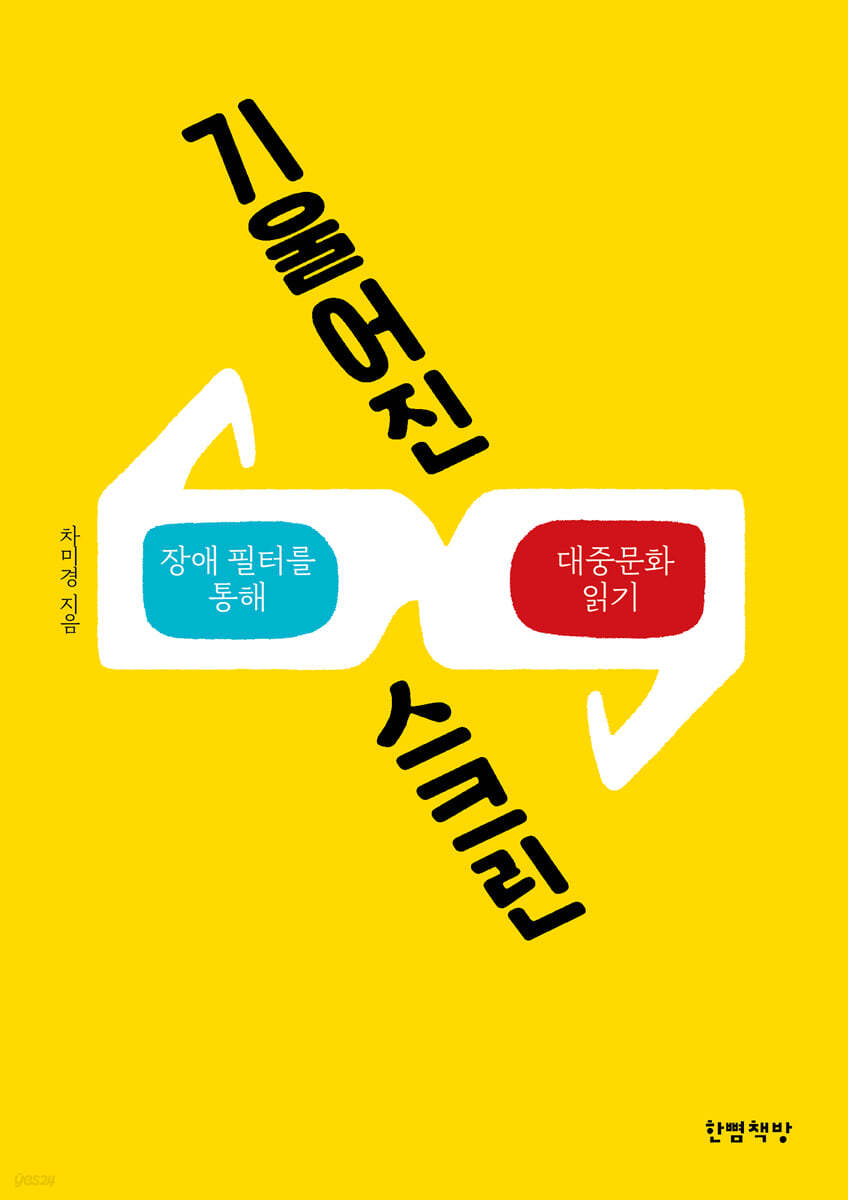
tilted screen
 |
Description
Book Introduction
- A word from MD
- [We must keep meeting and talking] How are people with disabilities represented in popular culture?
The author, a person with a disability and a critic of popular culture, argues that it is the responsibility of popular culture to avoid hating or excluding certain groups, and that it is the role of popular culture to naturally make visible the presence of people with disabilities in our society.
- Hyunjae Ahn, Social and Political PD
My identity as a "disabled" person allows me to see things differently in various forms of popular culture.
Why are people so desperate to find dreams and hope in the lives of people with disabilities?
Why do disabled people have to sing about hope, dream, and write all day long?
“Oh, how happy I am while they live like that.” Let’s stop this pursuit of emotion by objectifying people with disabilities and dividing them into “us” and “them,” giving them cheap self-consolation and false hope.
We need to talk more about how popular culture portrays disability.
The author, who has worked as a broadcast writer and columnist, says that the identity of 'disability' allows us to see things that are different from others in various popular cultures.
In dramas, movies, novels, plays, and advertisements, the reality is that people with disabilities are positioned at the lower end of a tilted playing field.
Through works, we discuss popular culture through the eyes of people with disabilities, what the problems are, and how we can change them.
Why are people so desperate to find dreams and hope in the lives of people with disabilities?
Why do disabled people have to sing about hope, dream, and write all day long?
“Oh, how happy I am while they live like that.” Let’s stop this pursuit of emotion by objectifying people with disabilities and dividing them into “us” and “them,” giving them cheap self-consolation and false hope.
We need to talk more about how popular culture portrays disability.
The author, who has worked as a broadcast writer and columnist, says that the identity of 'disability' allows us to see things that are different from others in various popular cultures.
In dramas, movies, novels, plays, and advertisements, the reality is that people with disabilities are positioned at the lower end of a tilted playing field.
Through works, we discuss popular culture through the eyes of people with disabilities, what the problems are, and how we can change them.
- You can preview some of the book's contents.
Preview
index
preface
Chapter 1.
Media: A Mirror Reflecting Disability
Why are you sick? You need to know!
Do you still need angels?
Conditions of Friendship
To the child who carries the bag
Why did Snow White marry the prince?
Poor or uncomfortable
Viewing public service announcements crookedly
unusual or special
Not a miracle, but an opportunity
The reality of disability programs that hinder disability
The golden age of soap operas
When you break the witch's mirror
Chapter 2.
Breaking the mirror
Show me your voice
Mom's Growing Pains
Meet the family at the end of the world
About humiliation
The novel "Almond" questions the meaning of normalcy.
A society where the Green Book still exists
Disabled person, just a friend, just a neighbor, just a person
The story of being upset while making a reservation
Extreme Lover, Standing on Stage as Myself
People who fight while lying down
A man's fierce proof of existence
I just do it because I like it, and if it makes you laugh, I'm glad.
To be right then and wrong now
Still you, anyway you
The Man Who Became a Star, Stephen Hawking
Are you really alive and breathing?
Back to her
Chapter 3.
For beautiful communication
Hidden Figures Within Us
As kind as the master
A World Beyond Language
Dance like no one's watching!
The life of a disabled person in the drama [Life]
Why are the Paralympics separate?
People with disabilities should be able to meet each other anywhere.
Let him have the reins of life!
How I can reach you
A question where everyone wins
Are you a good person, are you the right person?
The disabled and the elderly, between compassion and contempt
Everyone is Navillera
Still going, still living
A Beautiful Astronaut's Exploration of Earth
Coda, connecting the farmers and the young
Shouting to a world that doesn't listen
For a beautiful extinction
Your name is
Chapter 1.
Media: A Mirror Reflecting Disability
Why are you sick? You need to know!
Do you still need angels?
Conditions of Friendship
To the child who carries the bag
Why did Snow White marry the prince?
Poor or uncomfortable
Viewing public service announcements crookedly
unusual or special
Not a miracle, but an opportunity
The reality of disability programs that hinder disability
The golden age of soap operas
When you break the witch's mirror
Chapter 2.
Breaking the mirror
Show me your voice
Mom's Growing Pains
Meet the family at the end of the world
About humiliation
The novel "Almond" questions the meaning of normalcy.
A society where the Green Book still exists
Disabled person, just a friend, just a neighbor, just a person
The story of being upset while making a reservation
Extreme Lover, Standing on Stage as Myself
People who fight while lying down
A man's fierce proof of existence
I just do it because I like it, and if it makes you laugh, I'm glad.
To be right then and wrong now
Still you, anyway you
The Man Who Became a Star, Stephen Hawking
Are you really alive and breathing?
Back to her
Chapter 3.
For beautiful communication
Hidden Figures Within Us
As kind as the master
A World Beyond Language
Dance like no one's watching!
The life of a disabled person in the drama [Life]
Why are the Paralympics separate?
People with disabilities should be able to meet each other anywhere.
Let him have the reins of life!
How I can reach you
A question where everyone wins
Are you a good person, are you the right person?
The disabled and the elderly, between compassion and contempt
Everyone is Navillera
Still going, still living
A Beautiful Astronaut's Exploration of Earth
Coda, connecting the farmers and the young
Shouting to a world that doesn't listen
For a beautiful extinction
Your name is
Detailed image
Into the book
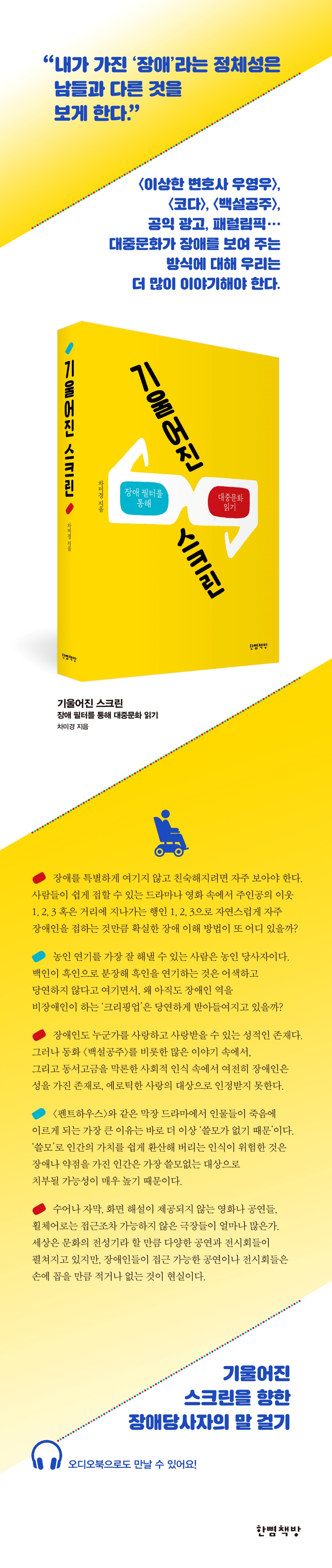
Just as my low perspective allows me to see different landscapes, my identity as a 'disabled' person allows me to see different things in various popular cultures.
Even when watching the same movie or drama, some people see an oppressed woman, others a neglected father, and still others a difficult work environment. Just as my slanted gaze reveals 'hidden disabilities' within the media,
--- p.4
Disabled people are also sexual beings who can love and be loved.
However, in many stories, including the fairy tale [Snow White], and in social perceptions across the East and the West, people with disabilities are still not recognized as sexual beings or objects of erotic love.
--- p.43
In a soap opera like [The Penthouse], the biggest reason characters die is because they are no longer 'useful'.
The perception that easily converts human value into 'usefulness' is dangerous because people with disabilities or weaknesses are very likely to be considered the most useless.
--- p.70
How many movies and performances are there without sign language, subtitles, or audio descriptions, or theaters that aren't even wheelchair accessible?
The world is in a golden age of culture, with a wide variety of performances and exhibitions taking place. However, the reality is that performances and exhibitions that are accessible to people with disabilities are few and far between.
--- p.124
To become familiar with a disability and not see it as special, you have to see it often.
What other way to understand disability is more certain than naturally encountering people with disabilities as neighbors 1, 2, 3 of the main characters in dramas or movies that people can easily access, or as passersby 1, 2, 3?
--- p.217
The person who can best portray a farmer is the farmer himself.
If it is considered awkward and unusual for a white person to dress up as a black person and play a black person, why is it still accepted as normal for a non-disabled person to play a disabled person, called "creeping up"?
Even when watching the same movie or drama, some people see an oppressed woman, others a neglected father, and still others a difficult work environment. Just as my slanted gaze reveals 'hidden disabilities' within the media,
--- p.4
Disabled people are also sexual beings who can love and be loved.
However, in many stories, including the fairy tale [Snow White], and in social perceptions across the East and the West, people with disabilities are still not recognized as sexual beings or objects of erotic love.
--- p.43
In a soap opera like [The Penthouse], the biggest reason characters die is because they are no longer 'useful'.
The perception that easily converts human value into 'usefulness' is dangerous because people with disabilities or weaknesses are very likely to be considered the most useless.
--- p.70
How many movies and performances are there without sign language, subtitles, or audio descriptions, or theaters that aren't even wheelchair accessible?
The world is in a golden age of culture, with a wide variety of performances and exhibitions taking place. However, the reality is that performances and exhibitions that are accessible to people with disabilities are few and far between.
--- p.124
To become familiar with a disability and not see it as special, you have to see it often.
What other way to understand disability is more certain than naturally encountering people with disabilities as neighbors 1, 2, 3 of the main characters in dramas or movies that people can easily access, or as passersby 1, 2, 3?
--- p.217
The person who can best portray a farmer is the farmer himself.
If it is considered awkward and unusual for a white person to dress up as a black person and play a black person, why is it still accepted as normal for a non-disabled person to play a disabled person, called "creeping up"?
--- p.268
Publisher's Review
In the so-called golden age of K-culture, Korean cultural products are delivered to the world through YouTube and Netflix.
The Academy Award and Emmy Award wins for [Parasite] and [Squid Game] demonstrate the growing influence of Korean culture, but also signify a growing sense of responsibility.
What responsibility should popular culture shoulder? The most fundamental of these is that it should be created in a way that doesn't hate or exclude any specific audience.
But the screen is still tilted, and there are those sitting underneath it.
People with disabilities are a representative group.
Although the number of people with disabilities registered in our country exceeds 5 percent of the total population, they are erased from the screen in various ways.
In a way that they do not appear, or if they do appear, they are treated as if they are invisible, in a way that non-disabled people take the place of disabled people, and in a way that they are objectified from the perspective of non-disabled people.
The author of this book is a passionate pop culture enthusiast who has worked as a broadcast writer, reporter, and columnist.
The author, who is also a wheelchair user, takes a lot of photographs, and because he views the landscape from a lower position than a 'standing' able-bodied person, the angles he takes are quite different from 'normal' photographs.
The same applies when looking at popular culture.
As a disabled person, the perspective of popular culture criticism from a disabled person's perspective is different from that of a non-disabled person.
Only by continually exposing and speaking out about this difference can the tilted screen gradually find its level.
● Don't erase people with disabilities
When disabled characters appear in popular culture, they are often portrayed as weak or instrumental characters.
For example, let's talk about Snow White's wedding. As you know, Snow White marries the prince who suddenly appears without even having a chance to meet him. In doing so, the seven "dwarves" who had cared for her with such devotion for so long are obscured.
It can be seen as a reflection of the perspective of non-disabled people who do not recognize disabled people as beings with sexuality.
[The Boy Who Carries the Bag] is a representative fairy tale that deals with the story of a disabled child, and features Young-taek, who has a disability, and Seok-woo, who carries Young-taek's bag.
However, while the emotions of Seok-woo, a non-disabled person, are described in detail, the expressions and emotions of Yeong-taek, a person with a disability, are constantly erased.
These are examples of disabled characters being used like tools next to non-disabled people and being erased like invisible people.
● No need to replace
In the 2022 drama [Our Blues], actress Jung Eun-hye, who has a developmental disability, appeared as an actress and garnered much attention.
Isn't it natural for a disabled person to take on the role of a disabled person? The fact that it's becoming a hot topic also shows that "creeping up," where non-disabled people take on the role of disabled people, is still a cultural practice.
[Coda] This movie became a hot topic because a farmer actor played the role of a farmer.
Farmer actor Trey Kocher even won an Academy Award for his role in this film.
[Cyrano], starring Peter Dinklage, a person with dwarfism, as the romantic lead, and [Peter Burnett Falcon], starring Jack Gottsagen, who has Down syndrome, show that the roles of disabled people do not necessarily have to be filled by non-disabled people.
Because the people who can best portray disabled people are people with disabilities themselves.
● We have to keep meeting
"How do you wash your hair? How do you bathe? How do you use the bathroom?" These are questions the author has been asked countless times.
The reason non-disabled people have a one-dimensional and rude curiosity toward disabled people is because they have limited opportunities to interact with each other in everyday life.
In the drama [Life], Yesunwoo rides a sleek wheelchair, washes dishes at a sink that is the right height for the wheelchair, and takes a taxi for the disabled to and from work.
If the ordinary daily lives of disabled people, such as eating, cleaning, changing clothes, and moving, are naturally portrayed in dramas, and if we frequently encounter disabled people living independently and successfully, the perception that disability is only pitiful and inconvenient will fade.
In the musical film [Mamma Mia 2], there is a scene where people are singing and dancing in a restaurant, and a person in a wheelchair appears and dances happily together.
Even though it's just a minor role, the important thing is to naturally visualize the existence of disabled people in our society.
● You have to keep talking
[The Strange Lawyer Woo Young-woo] is a drama that has left behind a lot of topics to talk about as well as high viewer ratings.
I wonder if there has ever been so much talk about people with developmental disabilities.
Author Moon Ji-won also featured Ji-woo, who has a developmental disability, in her previous work [Witness], so we see Ji-woo and Woo Young-woo as an extension of each other.
The author cited the portrayal of Jiwoo as a super-disabled person and the fact that a non-disabled person leads the story by offering salvation as a regrettable point in [Witness], but [Woo Young-woo] shows a step forward in this regard.
When we constantly talk about pop culture and share our thoughts, the next piece will be better.
The Academy Award and Emmy Award wins for [Parasite] and [Squid Game] demonstrate the growing influence of Korean culture, but also signify a growing sense of responsibility.
What responsibility should popular culture shoulder? The most fundamental of these is that it should be created in a way that doesn't hate or exclude any specific audience.
But the screen is still tilted, and there are those sitting underneath it.
People with disabilities are a representative group.
Although the number of people with disabilities registered in our country exceeds 5 percent of the total population, they are erased from the screen in various ways.
In a way that they do not appear, or if they do appear, they are treated as if they are invisible, in a way that non-disabled people take the place of disabled people, and in a way that they are objectified from the perspective of non-disabled people.
The author of this book is a passionate pop culture enthusiast who has worked as a broadcast writer, reporter, and columnist.
The author, who is also a wheelchair user, takes a lot of photographs, and because he views the landscape from a lower position than a 'standing' able-bodied person, the angles he takes are quite different from 'normal' photographs.
The same applies when looking at popular culture.
As a disabled person, the perspective of popular culture criticism from a disabled person's perspective is different from that of a non-disabled person.
Only by continually exposing and speaking out about this difference can the tilted screen gradually find its level.
● Don't erase people with disabilities
When disabled characters appear in popular culture, they are often portrayed as weak or instrumental characters.
For example, let's talk about Snow White's wedding. As you know, Snow White marries the prince who suddenly appears without even having a chance to meet him. In doing so, the seven "dwarves" who had cared for her with such devotion for so long are obscured.
It can be seen as a reflection of the perspective of non-disabled people who do not recognize disabled people as beings with sexuality.
[The Boy Who Carries the Bag] is a representative fairy tale that deals with the story of a disabled child, and features Young-taek, who has a disability, and Seok-woo, who carries Young-taek's bag.
However, while the emotions of Seok-woo, a non-disabled person, are described in detail, the expressions and emotions of Yeong-taek, a person with a disability, are constantly erased.
These are examples of disabled characters being used like tools next to non-disabled people and being erased like invisible people.
● No need to replace
In the 2022 drama [Our Blues], actress Jung Eun-hye, who has a developmental disability, appeared as an actress and garnered much attention.
Isn't it natural for a disabled person to take on the role of a disabled person? The fact that it's becoming a hot topic also shows that "creeping up," where non-disabled people take on the role of disabled people, is still a cultural practice.
[Coda] This movie became a hot topic because a farmer actor played the role of a farmer.
Farmer actor Trey Kocher even won an Academy Award for his role in this film.
[Cyrano], starring Peter Dinklage, a person with dwarfism, as the romantic lead, and [Peter Burnett Falcon], starring Jack Gottsagen, who has Down syndrome, show that the roles of disabled people do not necessarily have to be filled by non-disabled people.
Because the people who can best portray disabled people are people with disabilities themselves.
● We have to keep meeting
"How do you wash your hair? How do you bathe? How do you use the bathroom?" These are questions the author has been asked countless times.
The reason non-disabled people have a one-dimensional and rude curiosity toward disabled people is because they have limited opportunities to interact with each other in everyday life.
In the drama [Life], Yesunwoo rides a sleek wheelchair, washes dishes at a sink that is the right height for the wheelchair, and takes a taxi for the disabled to and from work.
If the ordinary daily lives of disabled people, such as eating, cleaning, changing clothes, and moving, are naturally portrayed in dramas, and if we frequently encounter disabled people living independently and successfully, the perception that disability is only pitiful and inconvenient will fade.
In the musical film [Mamma Mia 2], there is a scene where people are singing and dancing in a restaurant, and a person in a wheelchair appears and dances happily together.
Even though it's just a minor role, the important thing is to naturally visualize the existence of disabled people in our society.
● You have to keep talking
[The Strange Lawyer Woo Young-woo] is a drama that has left behind a lot of topics to talk about as well as high viewer ratings.
I wonder if there has ever been so much talk about people with developmental disabilities.
Author Moon Ji-won also featured Ji-woo, who has a developmental disability, in her previous work [Witness], so we see Ji-woo and Woo Young-woo as an extension of each other.
The author cited the portrayal of Jiwoo as a super-disabled person and the fact that a non-disabled person leads the story by offering salvation as a regrettable point in [Witness], but [Woo Young-woo] shows a step forward in this regard.
When we constantly talk about pop culture and share our thoughts, the next piece will be better.
GOODS SPECIFICS
- Publication date: September 30, 2022
- Page count, weight, size: 288 pages | 378g | 145*205*15mm
- ISBN13: 9791190635127
- ISBN10: 1190635127
You may also like
카테고리
korean


korean

![GQ KOREA Mark (Monthly): December [2025]](http://librairie.coreenne.fr/cdn/shop/files/8ef265dbbfbf186523ed75ba7319009d.jpg?v=1765340328&width=3840)


