

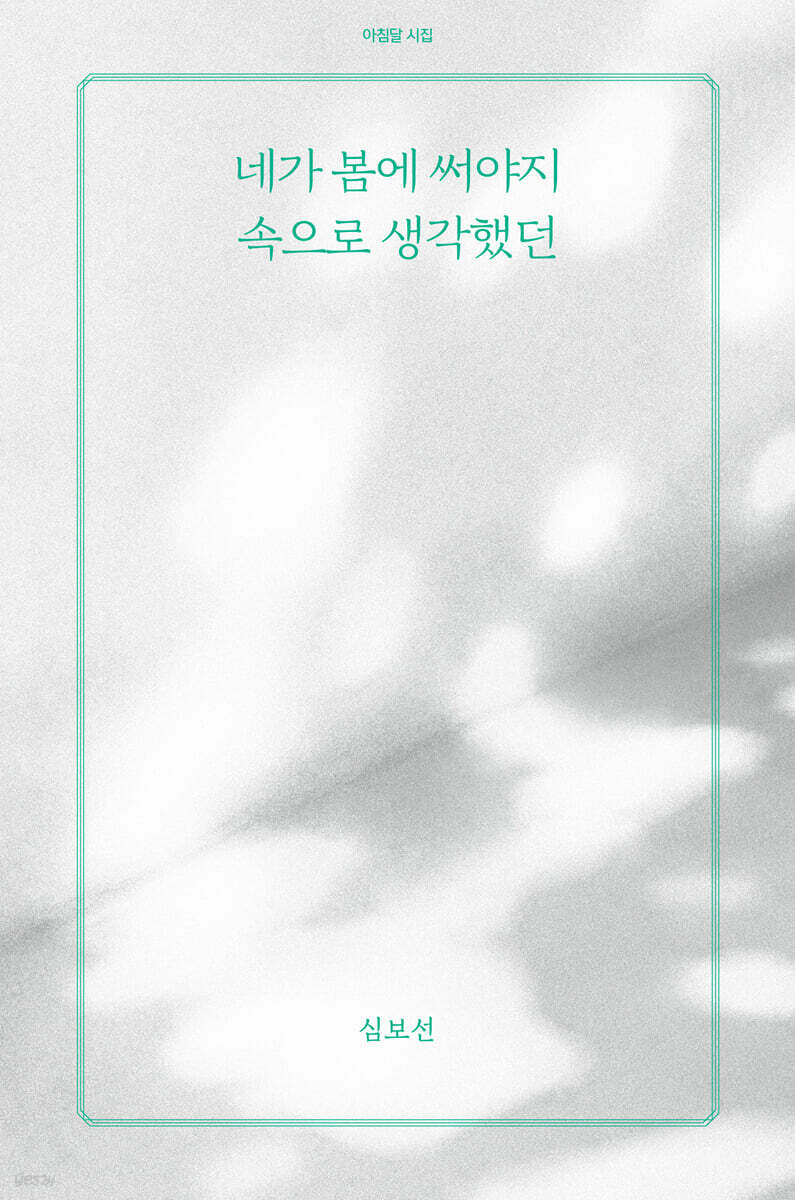
I thought to myself that you should write in the spring
 |
Description
Book Introduction
- A word from MD
-
What only poetry can do, confessionPoet Sim Bo-seon's fourth poetry collection has returned to us after eight years.
These psalms are more autobiographical than before, flowing along a quiet grain of silence.
As the darkness deepens, the poetic speaker once again raises his soul.
A brilliant confession by poet Sim Bo-seon, who draws a line of light over a dark world.
July 4, 2025. Novel/Poetry PD Kim Yu-ri
Poet Sim Bo-seon, who has willingly embraced sadness and pain and sung of hopes yet to be discovered, has published her fourth poetry collection, "I Thought in My Heart That You Should Write in Spring," as the 50th poetry collection in the Morning Moon series.
We introduce a new poetry collection by poet Sim Bo-seon, who is publishing a new work after eight years in a meaningful order of the poetry collection "Achimdal," which has been drawing a new topography of Korean literature.
Through his three poetry collections, the poet has stared straight at the pain and darkness that surrounds life, but has not postponed the sadness and pain.
The poet raises new and unfamiliar hopes within it, and it is also a name deeply imprinted on poetry readers.
In this collection of poetry, published after a long hiatus, stands the poet who bears witness to the struggles of enduring the world's dark maelstrom, to language that mixes love and separation, and to art that survives despite being scorched.
The hope of the symbolic line begins with an entity that approaches with an unfamiliar feeling, like “I tried / to myself / speaking politely.”
Don't comfort with light words or obscure the truth with empty promises.
The language of testimony makes the truth manifest.
Poet Lee Je-ni, who wrote the preface, said of the poet's poetry, "It has always depicted private sorrow and public weeping with its own amplitude between the inner self of humans and social time," and once again emphasized the position of the 'scorched art' that the poet spoke of.
In the sense that “‘Soot Art’ is art as a dream that seeks to find the light of happiness even in the misery of life,” this poetry collection unfolds as a story of survival by tracing the traces of soot.
In the midst of the turmoil of civil war, in the face of irreconcilable separation, the poet speaks for the survivors and becomes the conjunction 'and' between the cracks of the world and existence.
It is now time to read the light that the poet revealed as he broke through the darkness of the world and was deposited in the language of the times.
We introduce a new poetry collection by poet Sim Bo-seon, who is publishing a new work after eight years in a meaningful order of the poetry collection "Achimdal," which has been drawing a new topography of Korean literature.
Through his three poetry collections, the poet has stared straight at the pain and darkness that surrounds life, but has not postponed the sadness and pain.
The poet raises new and unfamiliar hopes within it, and it is also a name deeply imprinted on poetry readers.
In this collection of poetry, published after a long hiatus, stands the poet who bears witness to the struggles of enduring the world's dark maelstrom, to language that mixes love and separation, and to art that survives despite being scorched.
The hope of the symbolic line begins with an entity that approaches with an unfamiliar feeling, like “I tried / to myself / speaking politely.”
Don't comfort with light words or obscure the truth with empty promises.
The language of testimony makes the truth manifest.
Poet Lee Je-ni, who wrote the preface, said of the poet's poetry, "It has always depicted private sorrow and public weeping with its own amplitude between the inner self of humans and social time," and once again emphasized the position of the 'scorched art' that the poet spoke of.
In the sense that “‘Soot Art’ is art as a dream that seeks to find the light of happiness even in the misery of life,” this poetry collection unfolds as a story of survival by tracing the traces of soot.
In the midst of the turmoil of civil war, in the face of irreconcilable separation, the poet speaks for the survivors and becomes the conjunction 'and' between the cracks of the world and existence.
It is now time to read the light that the poet revealed as he broke through the darkness of the world and was deposited in the language of the times.
- You can preview some of the book's contents.
Preview
index
Part 1 What kind of life comes from what kind of life
Couldn't write
Life is my work
delirium
I thought to myself that you should write in the spring
Yurin
appear
Misconception 28
Fake love
North, dream
Night walk
Living by the book
Telescope
I am my father
Affectionate and warm
stargazer
Part 2 or no or goodbye
Each dog
Garden of Words
Graveyard of Horses
minus one
Ice Age
My God is not your God
Let's kiss
and
If I could pray again
What should I do?
skeleton
Wind chime thoughts
white noise
Part 3: Not knowing each other's well-being
Jealousy is my strength
A sick body moves to a non-sick side
reunion
twenty
Late Years' Style 2
Despair never reflects on itself until the very end.
rich kid
Remembering my ice witch
The day after World Poetry Day
Legend of the Yuseo font
literary community
Quo Vadis Domine
prose
Now that I've gone for a walk, let's write some poetry.
epilogue
Dedicated to sentences written in a state of charred emotion / Ijeni (poet)
Couldn't write
Life is my work
delirium
I thought to myself that you should write in the spring
Yurin
appear
Misconception 28
Fake love
North, dream
Night walk
Living by the book
Telescope
I am my father
Affectionate and warm
stargazer
Part 2 or no or goodbye
Each dog
Garden of Words
Graveyard of Horses
minus one
Ice Age
My God is not your God
Let's kiss
and
If I could pray again
What should I do?
skeleton
Wind chime thoughts
white noise
Part 3: Not knowing each other's well-being
Jealousy is my strength
A sick body moves to a non-sick side
reunion
twenty
Late Years' Style 2
Despair never reflects on itself until the very end.
rich kid
Remembering my ice witch
The day after World Poetry Day
Legend of the Yuseo font
literary community
Quo Vadis Domine
prose
Now that I've gone for a walk, let's write some poetry.
epilogue
Dedicated to sentences written in a state of charred emotion / Ijeni (poet)
Into the book
“I only remember the sins I committed.
I am a good person only when I am with someone I don't know.
Life speaks within me
Living, that's our job
We must flow together to a distant place
I live in silence
My job is to live
“It sends me off to a faraway place I don’t know.”
--- From "Life is My Work"
“We were survivors
We sit down and cry
In this place where my chest was beating
The gentle people survived
So that I can remember it later
Now put away the pillow
Quietly, very quietly
Don't even make a sound like silk wiping
The devil in my dream last night
“So that you will never lie down by my side again”
--- From "Delirium"
“You cover your sorrow with silence,
So that it ripens like alcohol
I gave it enough time
You wrote
Those who have souls
I'm so sad
I don't believe in the existence of the soul.
I thought to myself that you should write in the spring
The story could have started like that.”
--- From "I thought to myself that you should write in the spring"
“So it’s not that strange
Life is a series of misunderstandings.
People misunderstand me
I misunderstood my heart
My heart beats out of sync with life.
Due to misunderstandings, things and people
Beauty cannot be preserved for even a day
“It is a very strange and sad thing.”
--- From "Misunderstanding"
“I walk and walk
Some walks bring back forgotten fears in just three or four steps.
Dear readers
This poem is not about returning home.
This poem is a substitute for the missing fingers.
Engraved on black ground with black water
It's an invisible promise
As for me, I am a poet
Those who only look into the distance
Survivors from the Great Flood
“Because I am a public figure whose greatest responsibility is to curse.”
--- From "Tangyuan"
“This is a garden of beautiful horses.
My senses are frozen in black
My expression remains white
But in the end, the overflowing feeling of love
Or the opposite
Or goodbye
Meaningless shadows sway lively
Accidental sadness inevitably becomes sadder
I take a breath
I stopped once
“Exhale again”
--- From "The Garden of Words"
“I'm just sitting
I also have something called a skeleton
Although it may not be classy
Even if you just give a little force to the bone,
What is called a skeleton appears
Sometimes I type on the typewriter at night.
The sentences run in a straight line
From the origin to the miracle
With a very strong and solid skeleton
A heart that steps on flower petals all day long
A heart that pours water from a vase all day long
“I live with such a weak and pitiful heart.”
--- From "Skeleton"
“I tried hard
When I was sick
To the person who said this to me
My sister told me
I told my sister
My sister to the magpie
Big bird to little bird
A sick body moves to a non-sick side
To the lives that lie crouching
Here and now
And to eternity
A delicate blessing
“A blessing so delicate”
--- From "A sick body that is not sick"
“The living room of our house has good light. My mother dries sesame seeds and perilla seeds, watches TV, and knits with Swedish thread. The dog must not step on them. Keep the dog out. That’s what I’m saying. Listen to what I have to say, you troublemaker. How much does yarn cost? I wonder. Why do I write poetry? Why do I scatter grains of misfortune in such a sweet life? If this life is a curse, when will the curse take away its shadow? The puppy came in again, you naughty puppy. Come here, puppy. I’ll hold you. Let’s go for a walk together.”
I am a good person only when I am with someone I don't know.
Life speaks within me
Living, that's our job
We must flow together to a distant place
I live in silence
My job is to live
“It sends me off to a faraway place I don’t know.”
--- From "Life is My Work"
“We were survivors
We sit down and cry
In this place where my chest was beating
The gentle people survived
So that I can remember it later
Now put away the pillow
Quietly, very quietly
Don't even make a sound like silk wiping
The devil in my dream last night
“So that you will never lie down by my side again”
--- From "Delirium"
“You cover your sorrow with silence,
So that it ripens like alcohol
I gave it enough time
You wrote
Those who have souls
I'm so sad
I don't believe in the existence of the soul.
I thought to myself that you should write in the spring
The story could have started like that.”
--- From "I thought to myself that you should write in the spring"
“So it’s not that strange
Life is a series of misunderstandings.
People misunderstand me
I misunderstood my heart
My heart beats out of sync with life.
Due to misunderstandings, things and people
Beauty cannot be preserved for even a day
“It is a very strange and sad thing.”
--- From "Misunderstanding"
“I walk and walk
Some walks bring back forgotten fears in just three or four steps.
Dear readers
This poem is not about returning home.
This poem is a substitute for the missing fingers.
Engraved on black ground with black water
It's an invisible promise
As for me, I am a poet
Those who only look into the distance
Survivors from the Great Flood
“Because I am a public figure whose greatest responsibility is to curse.”
--- From "Tangyuan"
“This is a garden of beautiful horses.
My senses are frozen in black
My expression remains white
But in the end, the overflowing feeling of love
Or the opposite
Or goodbye
Meaningless shadows sway lively
Accidental sadness inevitably becomes sadder
I take a breath
I stopped once
“Exhale again”
--- From "The Garden of Words"
“I'm just sitting
I also have something called a skeleton
Although it may not be classy
Even if you just give a little force to the bone,
What is called a skeleton appears
Sometimes I type on the typewriter at night.
The sentences run in a straight line
From the origin to the miracle
With a very strong and solid skeleton
A heart that steps on flower petals all day long
A heart that pours water from a vase all day long
“I live with such a weak and pitiful heart.”
--- From "Skeleton"
“I tried hard
When I was sick
To the person who said this to me
My sister told me
I told my sister
My sister to the magpie
Big bird to little bird
A sick body moves to a non-sick side
To the lives that lie crouching
Here and now
And to eternity
A delicate blessing
“A blessing so delicate”
--- From "A sick body that is not sick"
“The living room of our house has good light. My mother dries sesame seeds and perilla seeds, watches TV, and knits with Swedish thread. The dog must not step on them. Keep the dog out. That’s what I’m saying. Listen to what I have to say, you troublemaker. How much does yarn cost? I wonder. Why do I write poetry? Why do I scatter grains of misfortune in such a sweet life? If this life is a curse, when will the curse take away its shadow? The puppy came in again, you naughty puppy. Come here, puppy. I’ll hold you. Let’s go for a walk together.”
--- From "The Rich Kid"
Publisher's Review
“The gentle people survived
“So that I can remember it later”
A song of despair and hope for the days we've lived through
Sim Bo-seon's new work, presented after eight years
The fourth poetry collection by poet Sim Bo-seon, who began her literary career by winning the Chosun Ilbo New Year’s literary contest in 1994.
It is also unusual that all of his works, published at his own pace, including the poetry collections 『Fifteen Seconds Without Sorrow』, 『The Person Who Is Not Before My Eyes』, and 『I Don't Know Today』, have become very important indicators of the Korean poetry world.
This fourth poetry collection, published after eight years, reflects his deepening perspective as a sociologist, meticulously examining the intertwining of art and society and depicting the flow of the times.
The poet, who left a deep impression on readers with his new lyricism, reflects on human existence through this collection of poems, looking into a world filled with pain and darkness.
Just like the practice of 'scorched art' that he has been talking about, his poetry fully captures his efforts to move forward without abandoning his miserable life and find a ray of light.
As the poet's prose in the collection reveals, it never ceases to speak on behalf of the sorrow of our times, when we were suddenly made survivors, having overcome the discord and gloom of the time amidst the turmoil of civil war.
These poems are filled with the poet's desperate voice, shining a light of unfamiliar hope amidst recurring despair and opening a path to survival.
A consolation to myself by speaking politely to myself, me missing my father and trying to become his own father, from a childhood scene as abundant as a bouquet of light to a reality where I desperately sense its absence.
The poet's light and darkness live together in one continuous being.
The poet's resolute attitude of never turning away from reality while assigning darkness its own work and light its own work is further highlighted in this collection of poems.
This poetry collection, which consists of three parts, is mainly composed of poems that are autobiographical and somewhat like intimate confessions.
As mentioned especially in prose and directly revealed in poetry, the unused time sent on errands for other unused work allowed the poet to see deeper solitude, to learn a new grammar of life needed in the times, and to testify to the time lived relying on the silent time that was neither spoken nor written.
“We were survivors/ In this place where we sat and wept/ And beat our breasts, the poet began to write again to remember that fact.
“My job is to live
“It sends me off to a faraway place I don’t know.”
Drawing a line of light in a charred world
A poem of promise and will delivered in the ashes
In Part 1, the relationship between the narrator, who is searching for a new subjectivity in life, and the other who intervenes in the process stands out.
The speaker, who says, “I am a good person only when I am a stranger to others” (“Life is My Work”), seeks to find something in life that he can look at when he is away from the “me” that was bound to him.
While practicing the act of “sending myself away to a faraway place I don’t know,” in the poem “Delirium,” he takes care of the “me” of the place he left behind and entrusts those memories to the poetic form.
Also, in the title work, the subject of ‘you’ is reduced to ‘I’s’ writing, which leads to a “story with no end” by starting a story from something that “you thought you should write in the spring.”
When you recognize me as a stranger, feeling the “marks on my body that I don’t even know about” (“Yurin”), ‘you’.
A typist like 'you' comes across much more clearly and becomes 'we'.
The relationship between 'me' and 'the other' is subtly misaligned and portrayed as an illusion filled with each other's absence: beings carrying each other on their backs, you leaning against my bare upper body, me coming back from a walk while you were asleep, my bookish father who abandoned me.
The poet calls out to the outside of me that constitutes 'me' and renews and understands the way life has worked.
In Part 2, poems that call out 'we' as a countless collection of me and others and reflect its attributes in a contemporary context stand out.
As can be seen in the line where it declares, “Your angel is my devil/ My angel is your devil” (“My God is not your god”), it redraws ‘us’ as a destined entity that cannot help but stand at the end of each other’s path and be together.
Just like the contrast between the blackness of the senses and the whiteness of the expression, we begin to understand life as beings who are starkly different, yet who ultimately “sleep with their heads together” (“And”) and who “do everything together without doing anything.”
Like the conjunction 'and', the poet reconnects broken or lost relationships and creates a new turning point in life.
This is also an extension of the strange hope that Sim Bo-seon had finally achieved in her previous poetry collections.
The situations that poets portray in their poems are not usually things that happen simultaneously.
There is a lot more repetition of what has already happened or what happened afterward.
“No one was born in this house/No one died/But there are too many gifts and keepsakes” (“What Should I Do”) It is nothing more than an act of looking back on the past, an act of anticipating the future, and it begins as a way of thinking as a way to fill in the narrative of the empty space simulated by the helpless state of “no one” being born or dead.
There, personal anecdotes and social contexts are cleverly interwoven, resonating with the repetition of the question, “What should we do now?”
Even in a listless and seemingly insignificant life of “just sitting” (“Skeleton”), discovering within myself the “skeleton of anger” that is subtly revealed is a “reveal” that is possible because in Part 1, the speaker sent me far away and reconstructed me as the other and cared for me as an empty “me.”
In Part 3, there are many poems that reveal the specific phenomenon of this manifestation through anecdotes with specific people.
Poems like "Reunion," a reply to a friend who returns after a friendship has ended, a 13th-century foreign witch, or a reply to a sick older sister, remind us of the place of someone who has stayed with us and left.
The poet reconstructs the temporality of “feeling that one’s own existence is clearly reaching somewhere” (“Form of the Later Years 2”) with the will to recover and with a heart that also coexists with nothingness.
So, we pass through the bright days of childhood and enter a reality filled with despair.
Yet, the place I eventually return to is the place of a being struggling and burdened by writing poetry, like the day after “World Poetry Day.”
The poet said, “Many of the poems in this collection were written in the midst of the whirlwind of civil war” (prose “Now that I’ve gone for a walk, let’s write some poetry”), and he compiled this collection of poems with a keen sense of the world that had fractured within him, feeling that “if I don’t live, if I don’t perform the things that make up life as if they were tasks, my soul will be swept away, crushed, and destroyed by external forces.”
If all of this was a moment of 'survival,' then for us, the survivors who have lived together, the poet conveys the tossing and turning of a subjective life with hope by realizing in poetry the things that are not there, the things that appear but do not exist.
All we can do in the charred art, as poet Ijeni writes in his preface, is “even if the flames of reality turn us into charred ashes, art is a persistent effort to find a small spark, a light of hope, in that ashes.”
These poems, written by poet Sim Bo-seon while tossing and turning in the darkness, are also things we have been thinking we should write in the spring, and they came to us before the chaos of the world covered them up.
"The poem you thought you should write in the spring" is a collection of poems that should be read here and now, and in all springs to come.
He doesn't teach us how to endure sadness and despair.
Instead, by being honest about those feelings, we are encouraged to imagine another way to live with them.
By revealing, rather than hiding, the scars of the times, we bear witness in our own way to the suffering our community has endured.
To present the possibility of humanity and solidarity in the name of community.
This collection of poems is a poet's personal reflection, the language of the times, and a survival record of the words we longed to hold onto.
The place where words have barely arrived, the place where language stands as a soot-covered art.
It is a remnant of the determination to speak out someday, even in the midst of unspeakable despair, and the courage to put that determination into practice.
So, with the speed and steadfastness of our steps, we advance one step further in today's precarious reality.
Towards the spring that will return again.
Towards a ray of light that will arrive someday.
- Preface_Lee Je-ni (poet)
Poet's words
I felt like I would never be able to use it again.
I was glad to be able to write again.
The rest of my life
A night that cannot be written
A night that I have no choice but to write
May we be endlessly affectionate to one another.
June 2025
Sim Bo-seon
“So that I can remember it later”
A song of despair and hope for the days we've lived through
Sim Bo-seon's new work, presented after eight years
The fourth poetry collection by poet Sim Bo-seon, who began her literary career by winning the Chosun Ilbo New Year’s literary contest in 1994.
It is also unusual that all of his works, published at his own pace, including the poetry collections 『Fifteen Seconds Without Sorrow』, 『The Person Who Is Not Before My Eyes』, and 『I Don't Know Today』, have become very important indicators of the Korean poetry world.
This fourth poetry collection, published after eight years, reflects his deepening perspective as a sociologist, meticulously examining the intertwining of art and society and depicting the flow of the times.
The poet, who left a deep impression on readers with his new lyricism, reflects on human existence through this collection of poems, looking into a world filled with pain and darkness.
Just like the practice of 'scorched art' that he has been talking about, his poetry fully captures his efforts to move forward without abandoning his miserable life and find a ray of light.
As the poet's prose in the collection reveals, it never ceases to speak on behalf of the sorrow of our times, when we were suddenly made survivors, having overcome the discord and gloom of the time amidst the turmoil of civil war.
These poems are filled with the poet's desperate voice, shining a light of unfamiliar hope amidst recurring despair and opening a path to survival.
A consolation to myself by speaking politely to myself, me missing my father and trying to become his own father, from a childhood scene as abundant as a bouquet of light to a reality where I desperately sense its absence.
The poet's light and darkness live together in one continuous being.
The poet's resolute attitude of never turning away from reality while assigning darkness its own work and light its own work is further highlighted in this collection of poems.
This poetry collection, which consists of three parts, is mainly composed of poems that are autobiographical and somewhat like intimate confessions.
As mentioned especially in prose and directly revealed in poetry, the unused time sent on errands for other unused work allowed the poet to see deeper solitude, to learn a new grammar of life needed in the times, and to testify to the time lived relying on the silent time that was neither spoken nor written.
“We were survivors/ In this place where we sat and wept/ And beat our breasts, the poet began to write again to remember that fact.
“My job is to live
“It sends me off to a faraway place I don’t know.”
Drawing a line of light in a charred world
A poem of promise and will delivered in the ashes
In Part 1, the relationship between the narrator, who is searching for a new subjectivity in life, and the other who intervenes in the process stands out.
The speaker, who says, “I am a good person only when I am a stranger to others” (“Life is My Work”), seeks to find something in life that he can look at when he is away from the “me” that was bound to him.
While practicing the act of “sending myself away to a faraway place I don’t know,” in the poem “Delirium,” he takes care of the “me” of the place he left behind and entrusts those memories to the poetic form.
Also, in the title work, the subject of ‘you’ is reduced to ‘I’s’ writing, which leads to a “story with no end” by starting a story from something that “you thought you should write in the spring.”
When you recognize me as a stranger, feeling the “marks on my body that I don’t even know about” (“Yurin”), ‘you’.
A typist like 'you' comes across much more clearly and becomes 'we'.
The relationship between 'me' and 'the other' is subtly misaligned and portrayed as an illusion filled with each other's absence: beings carrying each other on their backs, you leaning against my bare upper body, me coming back from a walk while you were asleep, my bookish father who abandoned me.
The poet calls out to the outside of me that constitutes 'me' and renews and understands the way life has worked.
In Part 2, poems that call out 'we' as a countless collection of me and others and reflect its attributes in a contemporary context stand out.
As can be seen in the line where it declares, “Your angel is my devil/ My angel is your devil” (“My God is not your god”), it redraws ‘us’ as a destined entity that cannot help but stand at the end of each other’s path and be together.
Just like the contrast between the blackness of the senses and the whiteness of the expression, we begin to understand life as beings who are starkly different, yet who ultimately “sleep with their heads together” (“And”) and who “do everything together without doing anything.”
Like the conjunction 'and', the poet reconnects broken or lost relationships and creates a new turning point in life.
This is also an extension of the strange hope that Sim Bo-seon had finally achieved in her previous poetry collections.
The situations that poets portray in their poems are not usually things that happen simultaneously.
There is a lot more repetition of what has already happened or what happened afterward.
“No one was born in this house/No one died/But there are too many gifts and keepsakes” (“What Should I Do”) It is nothing more than an act of looking back on the past, an act of anticipating the future, and it begins as a way of thinking as a way to fill in the narrative of the empty space simulated by the helpless state of “no one” being born or dead.
There, personal anecdotes and social contexts are cleverly interwoven, resonating with the repetition of the question, “What should we do now?”
Even in a listless and seemingly insignificant life of “just sitting” (“Skeleton”), discovering within myself the “skeleton of anger” that is subtly revealed is a “reveal” that is possible because in Part 1, the speaker sent me far away and reconstructed me as the other and cared for me as an empty “me.”
In Part 3, there are many poems that reveal the specific phenomenon of this manifestation through anecdotes with specific people.
Poems like "Reunion," a reply to a friend who returns after a friendship has ended, a 13th-century foreign witch, or a reply to a sick older sister, remind us of the place of someone who has stayed with us and left.
The poet reconstructs the temporality of “feeling that one’s own existence is clearly reaching somewhere” (“Form of the Later Years 2”) with the will to recover and with a heart that also coexists with nothingness.
So, we pass through the bright days of childhood and enter a reality filled with despair.
Yet, the place I eventually return to is the place of a being struggling and burdened by writing poetry, like the day after “World Poetry Day.”
The poet said, “Many of the poems in this collection were written in the midst of the whirlwind of civil war” (prose “Now that I’ve gone for a walk, let’s write some poetry”), and he compiled this collection of poems with a keen sense of the world that had fractured within him, feeling that “if I don’t live, if I don’t perform the things that make up life as if they were tasks, my soul will be swept away, crushed, and destroyed by external forces.”
If all of this was a moment of 'survival,' then for us, the survivors who have lived together, the poet conveys the tossing and turning of a subjective life with hope by realizing in poetry the things that are not there, the things that appear but do not exist.
All we can do in the charred art, as poet Ijeni writes in his preface, is “even if the flames of reality turn us into charred ashes, art is a persistent effort to find a small spark, a light of hope, in that ashes.”
These poems, written by poet Sim Bo-seon while tossing and turning in the darkness, are also things we have been thinking we should write in the spring, and they came to us before the chaos of the world covered them up.
"The poem you thought you should write in the spring" is a collection of poems that should be read here and now, and in all springs to come.
He doesn't teach us how to endure sadness and despair.
Instead, by being honest about those feelings, we are encouraged to imagine another way to live with them.
By revealing, rather than hiding, the scars of the times, we bear witness in our own way to the suffering our community has endured.
To present the possibility of humanity and solidarity in the name of community.
This collection of poems is a poet's personal reflection, the language of the times, and a survival record of the words we longed to hold onto.
The place where words have barely arrived, the place where language stands as a soot-covered art.
It is a remnant of the determination to speak out someday, even in the midst of unspeakable despair, and the courage to put that determination into practice.
So, with the speed and steadfastness of our steps, we advance one step further in today's precarious reality.
Towards the spring that will return again.
Towards a ray of light that will arrive someday.
- Preface_Lee Je-ni (poet)
Poet's words
I felt like I would never be able to use it again.
I was glad to be able to write again.
The rest of my life
A night that cannot be written
A night that I have no choice but to write
May we be endlessly affectionate to one another.
June 2025
Sim Bo-seon
GOODS SPECIFICS
- Date of issue: June 12, 2025
- Page count, weight, size: 144 pages | 125*190*20mm
- ISBN13: 9791194324997
- ISBN10: 1194324991
You may also like
카테고리
korean


korean

![GQ KOREA Mark (Monthly): December [2025]](http://librairie.coreenne.fr/cdn/shop/files/8ef265dbbfbf186523ed75ba7319009d.jpg?v=1765340328&width=3840)


