

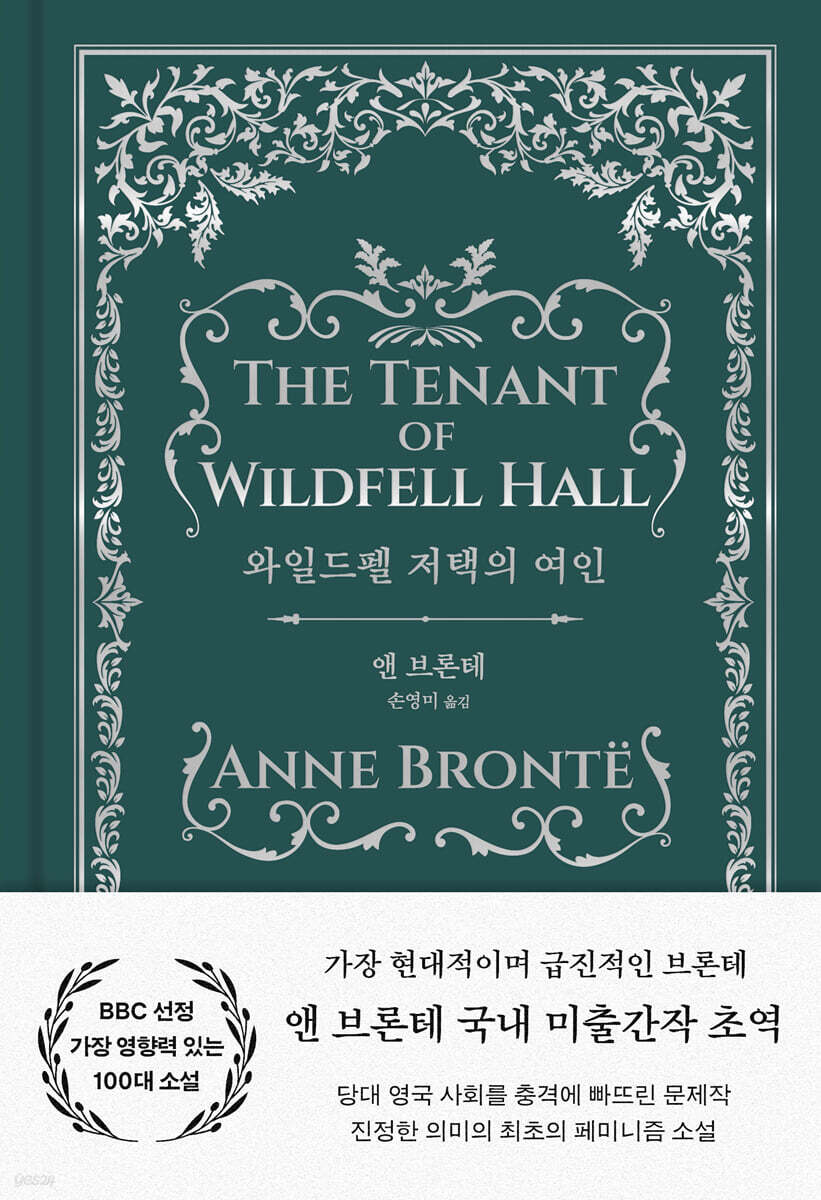
The Lady of Wildfell Manor
 |
Description
Book Introduction
- A word from MD
- Brontë's most modern and radical novelAnne Brontë's masterpiece and final novel, which sold more copies than Jane Eyre when it was first published in the 19th century, is finally being translated into Korean for the first time.
It boldly portrays the choices and realities of women that were not permitted by British law and custom at the time, and resonates deeply with us in the 21st century. Selected by the BBC as one of the 100 most influential novels of all time.
July 8, 2025. Novel/Poetry PD Kim Yu-ri
What we didn't know,
The most modern and radical Bronte
First translation of Anne Brontë's unpublished works in Korea
“Reading Anne Brontë in a modern context is liberating.
Now Anne's time has come."
★BBC's 100 Most Influential Novels★
Anne Brontë's novel, The Lady of Wildfell Manor, which has been re-evaluated in modern times as "Bronte's most revolutionary and daring move," has been published in Korea for the first time.
At the time of its publication, it sold more copies than Jane Eyre and was praised for its "powerful plot" and "great writing." However, despite this enthusiastic response, it was only relatively recently that its modernity and artistic value were recognized and it was established as a classic.
Hailed as 'the first truly feminist novel' and the only one of the Brontë sisters' novels to be included in the BBC's list of the 100 most influential novels of all time, it has been completely rediscovered today.
We are introducing Anne Brontë, the 'unknown Brontë', to Korea, and presenting her ill-fated last novel, The Lady of Wildfell Manor, which was robbed of the fame it deserved, in its first translation, accompanied by seven illustrations by Edmund Dulac.
The reason Anne Brontë has received relatively little attention compared to her two older sisters, Charlotte and Emily Brontë, was not because of the quality or literary value of the novels she wrote.
Irish writer George Moore praised Anne Brontë's first novel, Agnes Grey, as "the most perfect piece of prose ever written in the English language." However, the author who received such praise was not widely remembered for a long time because her second and final novel, The Lady of Wildfell Manor, was a shocking work that broke with the laws and customs of England at the time.
This work, which starkly confronts issues of marriage, love, violence, addiction, and religion, and depicts a female artist boldly carving out her own path in life, was so radical that it was difficult for 19th-century British people to accept.
Charlotte Brontë, the eldest of the three sisters, who had the authority over the works of her two younger sisters as she survived the longest, even prevented the republication of this novel after Anne's death out of concern for her sister's reputation.
Because of this, The Lady of Wildfell remained out of circulation for many years and, despite its immediate success, has long been undervalued.
However, after the shadow of Charlotte's harsh assessment that it was "a complete mistake" and "not worth preserving" and the contemporary criticism that it was "rough and vulgar in language and content" faded in the 20th century, the work was widely accepted as a bold and groundbreaking masterpiece that well demonstrated Anne's growth as an artist.
The most modern and radical Bronte
First translation of Anne Brontë's unpublished works in Korea
“Reading Anne Brontë in a modern context is liberating.
Now Anne's time has come."
★BBC's 100 Most Influential Novels★
Anne Brontë's novel, The Lady of Wildfell Manor, which has been re-evaluated in modern times as "Bronte's most revolutionary and daring move," has been published in Korea for the first time.
At the time of its publication, it sold more copies than Jane Eyre and was praised for its "powerful plot" and "great writing." However, despite this enthusiastic response, it was only relatively recently that its modernity and artistic value were recognized and it was established as a classic.
Hailed as 'the first truly feminist novel' and the only one of the Brontë sisters' novels to be included in the BBC's list of the 100 most influential novels of all time, it has been completely rediscovered today.
We are introducing Anne Brontë, the 'unknown Brontë', to Korea, and presenting her ill-fated last novel, The Lady of Wildfell Manor, which was robbed of the fame it deserved, in its first translation, accompanied by seven illustrations by Edmund Dulac.
The reason Anne Brontë has received relatively little attention compared to her two older sisters, Charlotte and Emily Brontë, was not because of the quality or literary value of the novels she wrote.
Irish writer George Moore praised Anne Brontë's first novel, Agnes Grey, as "the most perfect piece of prose ever written in the English language." However, the author who received such praise was not widely remembered for a long time because her second and final novel, The Lady of Wildfell Manor, was a shocking work that broke with the laws and customs of England at the time.
This work, which starkly confronts issues of marriage, love, violence, addiction, and religion, and depicts a female artist boldly carving out her own path in life, was so radical that it was difficult for 19th-century British people to accept.
Charlotte Brontë, the eldest of the three sisters, who had the authority over the works of her two younger sisters as she survived the longest, even prevented the republication of this novel after Anne's death out of concern for her sister's reputation.
Because of this, The Lady of Wildfell remained out of circulation for many years and, despite its immediate success, has long been undervalued.
However, after the shadow of Charlotte's harsh assessment that it was "a complete mistake" and "not worth preserving" and the contemporary criticism that it was "rough and vulgar in language and content" faded in the 20th century, the work was widely accepted as a bold and groundbreaking masterpiece that well demonstrated Anne's growth as an artist.
- You can preview some of the book's contents.
Preview
index
Author's Preface to the Second Edition - 5
Preface - 13
Chapter 1: Discovered - 16
Chapter 2 Dialogue - 30
Chapter 3 Controversy - 38
Chapter 4 Party - 49
Chapter 5: The Art Room - 61
Chapter 6: Deepening Friendship - 67
Chapter 7 Picnic - 78
Chapter 8 Gift - 93
Chapter 9: The Snake in the Grass - 100
Chapter 10: Promise of Friendship, Love Rivals - 116
Chapter 11: The Bride's Return - 123
Chapter 12: Conversation and Discovery - 131
Chapter 13: Returning to Routine - 145
Chapter 14 Attack - 151
Chapter 15: Encounters and Their Consequences - 160
Chapter 16: A Warning from Experience - 171
Chapter 17: More Warnings - 188
18 Small Portraits - 200
Chapter 19 Incident - 217
Chapter 20: Persistent Courtship - 227
Chapter 21: Diverse Opinions - 239
Chapter 22: The Sign of Friendship - 246
Chapter 23: Newlyweds - 268
Chapter 24: The First Marital Quarrel - 276
Chapter 25: The First Absence - 288
Chapter 26: The Party Guests - 304
Chapter 27: The Big Mistake - 309
Chapter 28: Motherhood - 319
Chapter 29: Mr. Hargrave - 324
Chapter 30: Domestic Discord - 333
Chapter 31: Social Conventions - 350
Chapter 32 Comparison, Trust - 368
Chapter 33: Two Evenings - 387
Hide Chapter 34 - 406
Chapter 35: Provocation - 413
Chapter 36: A Lonely Couple Together - 422
Chapter 37: Temptation - 429
Chapter 38: The Husband Who Was Hurt - 444
Chapter 39: Escape Plan - 459
Chapter 40: Frustrated Plans - 479
Chapter 41: "Hope Revived" - 486
Chapter 42: Conversion - 496
Chapter 43: Crossing the Line - 504
Chapter 44: Escape - 513
Chapter 45: Reconciliation - 523
Chapter 46: Advice from a Friend - 544
Chapter 47: Shocking News - 554
News after Chapter 48 - 572
Chapter 49: "It's Raining..." - 580
Chapter 50: Doubt and Disappointment - 595
Chapter 51: The Unexpected Event - 608
Chapter 52: The Ever-Changing World - 621
Chapter 53 Ending - 631
Commentary | "The Lady of Wildfell Manor," the First Full-Fledged Feminist Novel - 649
Preface - 13
Chapter 1: Discovered - 16
Chapter 2 Dialogue - 30
Chapter 3 Controversy - 38
Chapter 4 Party - 49
Chapter 5: The Art Room - 61
Chapter 6: Deepening Friendship - 67
Chapter 7 Picnic - 78
Chapter 8 Gift - 93
Chapter 9: The Snake in the Grass - 100
Chapter 10: Promise of Friendship, Love Rivals - 116
Chapter 11: The Bride's Return - 123
Chapter 12: Conversation and Discovery - 131
Chapter 13: Returning to Routine - 145
Chapter 14 Attack - 151
Chapter 15: Encounters and Their Consequences - 160
Chapter 16: A Warning from Experience - 171
Chapter 17: More Warnings - 188
18 Small Portraits - 200
Chapter 19 Incident - 217
Chapter 20: Persistent Courtship - 227
Chapter 21: Diverse Opinions - 239
Chapter 22: The Sign of Friendship - 246
Chapter 23: Newlyweds - 268
Chapter 24: The First Marital Quarrel - 276
Chapter 25: The First Absence - 288
Chapter 26: The Party Guests - 304
Chapter 27: The Big Mistake - 309
Chapter 28: Motherhood - 319
Chapter 29: Mr. Hargrave - 324
Chapter 30: Domestic Discord - 333
Chapter 31: Social Conventions - 350
Chapter 32 Comparison, Trust - 368
Chapter 33: Two Evenings - 387
Hide Chapter 34 - 406
Chapter 35: Provocation - 413
Chapter 36: A Lonely Couple Together - 422
Chapter 37: Temptation - 429
Chapter 38: The Husband Who Was Hurt - 444
Chapter 39: Escape Plan - 459
Chapter 40: Frustrated Plans - 479
Chapter 41: "Hope Revived" - 486
Chapter 42: Conversion - 496
Chapter 43: Crossing the Line - 504
Chapter 44: Escape - 513
Chapter 45: Reconciliation - 523
Chapter 46: Advice from a Friend - 544
Chapter 47: Shocking News - 554
News after Chapter 48 - 572
Chapter 49: "It's Raining..." - 580
Chapter 50: Doubt and Disappointment - 595
Chapter 51: The Unexpected Event - 608
Chapter 52: The Ever-Changing World - 621
Chapter 53 Ending - 631
Commentary | "The Lady of Wildfell Manor," the First Full-Fledged Feminist Novel - 649
Detailed image
.jpg)
Into the book
Because in my view, a good book is just a good book, regardless of the author's gender.
All novels are or should be written to be read by both men and women.
So it's hard for me to imagine that a male writer would deliberately write a book that's so shameful to women, or that a female writer would be criticized for writing a book that's appropriate and well-suited to men.
--- p.8 From the author's preface to the second edition
“At times like this, I wish I weren’t a painter,” said the wife.
"Why? Isn't it truly a blessing to have this special ability to emulate nature's dazzling beauty?"
"no.
Other people can enjoy such moments with all their heart, but I always find myself wondering how to express such a scene in a painting.
But no matter how hard you try, it's impossible, so it's just painful and futile.
(…) Anyway, I think I shouldn’t complain.
“There aren’t many people like me who can make a living doing something they really love.”
--- p.112
“If you marry the most handsome, educated, and outwardly attractive man,
How miserable it would be if they found out that he was actually a pathetic traitor or an incompetent fool.”
"But Auntie, what about the unfilial children and fools? If everyone did as you said, the world would end in no time."
“Don’t worry, my dear! There’s no reason why a man who is unfilial or stupid won’t get married.
“There are plenty of unfilial and foolish women out there, so I’ll be their match.”
--- p.174
But in this imperfect world, there is always a 'but'.
--- p.267
“Esther has a more romantic view of love and marriage than we might like.”
“But a romantic view is not enough.
“We need a true perspective.”
“That’s true.
But I think that what people consider romantic is often closer to the truth than people often think.
“Just because young people’s optimistic outlook is often clouded by sordid notions about the afterlife doesn’t mean their perspective is wrong.”
--- p.370
“This rose is not as fragrant as the summer flowers, but it has endured many hardships that summer flowers cannot endure.
“It grew up eating cold winter rain, warming itself in the weak winter sunlight, and even when strong winds blew, its colors did not fade or its branches did not break, and even when the sharp frosts struck, it did not fall ill.”
All novels are or should be written to be read by both men and women.
So it's hard for me to imagine that a male writer would deliberately write a book that's so shameful to women, or that a female writer would be criticized for writing a book that's appropriate and well-suited to men.
--- p.8 From the author's preface to the second edition
“At times like this, I wish I weren’t a painter,” said the wife.
"Why? Isn't it truly a blessing to have this special ability to emulate nature's dazzling beauty?"
"no.
Other people can enjoy such moments with all their heart, but I always find myself wondering how to express such a scene in a painting.
But no matter how hard you try, it's impossible, so it's just painful and futile.
(…) Anyway, I think I shouldn’t complain.
“There aren’t many people like me who can make a living doing something they really love.”
--- p.112
“If you marry the most handsome, educated, and outwardly attractive man,
How miserable it would be if they found out that he was actually a pathetic traitor or an incompetent fool.”
"But Auntie, what about the unfilial children and fools? If everyone did as you said, the world would end in no time."
“Don’t worry, my dear! There’s no reason why a man who is unfilial or stupid won’t get married.
“There are plenty of unfilial and foolish women out there, so I’ll be their match.”
--- p.174
But in this imperfect world, there is always a 'but'.
--- p.267
“Esther has a more romantic view of love and marriage than we might like.”
“But a romantic view is not enough.
“We need a true perspective.”
“That’s true.
But I think that what people consider romantic is often closer to the truth than people often think.
“Just because young people’s optimistic outlook is often clouded by sordid notions about the afterlife doesn’t mean their perspective is wrong.”
--- p.370
“This rose is not as fragrant as the summer flowers, but it has endured many hardships that summer flowers cannot endure.
“It grew up eating cold winter rain, warming itself in the weak winter sunlight, and even when strong winds blew, its colors did not fade or its branches did not break, and even when the sharp frosts struck, it did not fall ill.”
--- p.640
Publisher's Review
Listening to the intimate voices of letters and diaries
Private confessions between a man and a woman
“It’s a rainy, gloomy day, and my family is out, so I’m alone in my study, looking through old letters and records, reminiscing about old times. Now is the perfect time to tell you stories from the past.
(…) It’s a long story, so I’ll start from the first chapter.” _Pages 14-15
The novel begins in 1827 with a letter from Gilbert Markham.
He tells his friend the story of the most important event in his life, a story from twenty years ago when a mysterious young widow named Mrs. Graham moved into the desolate Wildfell Manor, which had been empty for a very long time, with her young son, Arthur.
The woman rarely shows up at church, rarely responds to invitations from neighbors, and lives the life of a recluse, painting alone in the gloomy and lonely studio of her mansion.
Gilbert, who had a bad feeling about her cold attitude when they first met, began to feel different feelings as he got to know her better.
However, the wife, who has too many secret corners, keeps her distance from Gilbert who tries to get close to her, and repeatedly rejects his advances. When the misunderstandings pile up and reach a point of no return, she gives Gilbert her diary...
A departure from the normalcy of 19th century Britain
Modern classic romance
Love and marriage are indispensable themes in Victorian English literature, especially in the works of female writers.
This is because in the lives of women of the time, marriage was not only an element that made up life, but also a very important and fatal issue directly related to survival.
Given that the types of work women could do were extremely limited and society held a cold eye on unmarried women, a “successful” marriage was essential for women to lead stable lives, and it was natural for them to consider “money, status, position, or material things” when choosing a marriage partner.
Therefore, a work that puts a woman's voice front and center, encouraging a "romantic outlook" on marriage and strongly advising against "loveless marriage," must have been unfamiliar to readers of the time.
In addition, “When you are doing housework, keep two things in mind.
As Gilbert's mother said, "What is the proper way to do it, and what is the most satisfying way for the men in the house?" In an era when the ideal form of marriage was also firmly established, "If I get married, I think I will be happier if I make my wife live that way rather than living happily and comfortably thanks to my wife.
The appearance of the male protagonist who answers, “I want to give rather than receive,” is also the reason why the love story in this work is considered “abnormal” to 19th century British readers, but is more familiar to us today.
This novel's romance, which loosens the clear hierarchies of status and gender in love and marriage and depicts the relationships between individuals with genuine feelings, can be called 'the most modern classic.'
It contains not only women's love but also their lives.
The first truly feminist novel
Although the central narrative focuses on love, The Lady of Wildfell is not limited to romance; it also has aspects of a coming-of-age novel and a social novel.
Instead of running straight toward the goal of marriage, the story shows the growth of the characters through various points of view, and among them, the growth of the main character Helen is particularly notable.
As Helen experiences various incidents, marriage becomes a realistic issue that must be approached very carefully and with clear standards of her own, and painting becomes a means of livelihood rather than a noble hobby permitted to women.
The way a female character establishes her own thoughts on not only love and marriage, but also work, education, parenting, morality, addiction, and religion, and maintains her identity as an independent individual rather than the property of a man even after marriage was “virtually revolutionary, and critics at the time felt it was an extremely dangerous work.”
Furthermore, by focusing more on the conversations and agreements that led to the conclusion of marriage rather than simply the fact that the person married the person of their choice, it differs from the majority of contemporary romance novels that usually ended when the goal of marriage was reached, and refuses to be classified in that category.
The love story that forms the backbone of the work contains the process of Helen, a young girl who falls in love, facing the unfair customs and the resulting real-life hardships, and her transformation into a mature and wise woman.
In other words, Helen is a heroine who, decades ahead of her time in legal and institutional matters, protected her body, children, property, and freedom, pursued happiness, and built the life she wanted through her own efforts.
(…) In this way, Anne established a new genre called feminist novel by unfolding modern techniques and pioneering vision based on realism in this novel.
_From the commentary
Judging from the fact that the author of the second edition stated in the preface, “I wrote this novel because I wanted to reveal the truth,” The Lady of Wildfell Manor was Anne’s conscious critique, indictment, and proposal for the society she lived in, and it was a bold attempt to present women’s stories to the world at a time when the concept of “feminism” did not even exist.
It is a liberation and a privilege to be able to read this work in an age where we are not bound by whether the author is male or female or how violent or sexual the novel's language and descriptions are.
Private confessions between a man and a woman
“It’s a rainy, gloomy day, and my family is out, so I’m alone in my study, looking through old letters and records, reminiscing about old times. Now is the perfect time to tell you stories from the past.
(…) It’s a long story, so I’ll start from the first chapter.” _Pages 14-15
The novel begins in 1827 with a letter from Gilbert Markham.
He tells his friend the story of the most important event in his life, a story from twenty years ago when a mysterious young widow named Mrs. Graham moved into the desolate Wildfell Manor, which had been empty for a very long time, with her young son, Arthur.
The woman rarely shows up at church, rarely responds to invitations from neighbors, and lives the life of a recluse, painting alone in the gloomy and lonely studio of her mansion.
Gilbert, who had a bad feeling about her cold attitude when they first met, began to feel different feelings as he got to know her better.
However, the wife, who has too many secret corners, keeps her distance from Gilbert who tries to get close to her, and repeatedly rejects his advances. When the misunderstandings pile up and reach a point of no return, she gives Gilbert her diary...
A departure from the normalcy of 19th century Britain
Modern classic romance
Love and marriage are indispensable themes in Victorian English literature, especially in the works of female writers.
This is because in the lives of women of the time, marriage was not only an element that made up life, but also a very important and fatal issue directly related to survival.
Given that the types of work women could do were extremely limited and society held a cold eye on unmarried women, a “successful” marriage was essential for women to lead stable lives, and it was natural for them to consider “money, status, position, or material things” when choosing a marriage partner.
Therefore, a work that puts a woman's voice front and center, encouraging a "romantic outlook" on marriage and strongly advising against "loveless marriage," must have been unfamiliar to readers of the time.
In addition, “When you are doing housework, keep two things in mind.
As Gilbert's mother said, "What is the proper way to do it, and what is the most satisfying way for the men in the house?" In an era when the ideal form of marriage was also firmly established, "If I get married, I think I will be happier if I make my wife live that way rather than living happily and comfortably thanks to my wife.
The appearance of the male protagonist who answers, “I want to give rather than receive,” is also the reason why the love story in this work is considered “abnormal” to 19th century British readers, but is more familiar to us today.
This novel's romance, which loosens the clear hierarchies of status and gender in love and marriage and depicts the relationships between individuals with genuine feelings, can be called 'the most modern classic.'
It contains not only women's love but also their lives.
The first truly feminist novel
Although the central narrative focuses on love, The Lady of Wildfell is not limited to romance; it also has aspects of a coming-of-age novel and a social novel.
Instead of running straight toward the goal of marriage, the story shows the growth of the characters through various points of view, and among them, the growth of the main character Helen is particularly notable.
As Helen experiences various incidents, marriage becomes a realistic issue that must be approached very carefully and with clear standards of her own, and painting becomes a means of livelihood rather than a noble hobby permitted to women.
The way a female character establishes her own thoughts on not only love and marriage, but also work, education, parenting, morality, addiction, and religion, and maintains her identity as an independent individual rather than the property of a man even after marriage was “virtually revolutionary, and critics at the time felt it was an extremely dangerous work.”
Furthermore, by focusing more on the conversations and agreements that led to the conclusion of marriage rather than simply the fact that the person married the person of their choice, it differs from the majority of contemporary romance novels that usually ended when the goal of marriage was reached, and refuses to be classified in that category.
The love story that forms the backbone of the work contains the process of Helen, a young girl who falls in love, facing the unfair customs and the resulting real-life hardships, and her transformation into a mature and wise woman.
In other words, Helen is a heroine who, decades ahead of her time in legal and institutional matters, protected her body, children, property, and freedom, pursued happiness, and built the life she wanted through her own efforts.
(…) In this way, Anne established a new genre called feminist novel by unfolding modern techniques and pioneering vision based on realism in this novel.
_From the commentary
Judging from the fact that the author of the second edition stated in the preface, “I wrote this novel because I wanted to reveal the truth,” The Lady of Wildfell Manor was Anne’s conscious critique, indictment, and proposal for the society she lived in, and it was a bold attempt to present women’s stories to the world at a time when the concept of “feminism” did not even exist.
It is a liberation and a privilege to be able to read this work in an age where we are not bound by whether the author is male or female or how violent or sexual the novel's language and descriptions are.
GOODS SPECIFICS
- Date of issue: June 20, 2025
- Format: Hardcover book binding method guide
- Page count, weight, size: 650 pages | 135*200*35mm
- ISBN13: 9791167375636
- ISBN10: 1167375637
You may also like
카테고리
korean


korean

![GQ KOREA Mark (Monthly): December [2025]](http://librairie.coreenne.fr/cdn/shop/files/8ef265dbbfbf186523ed75ba7319009d.jpg?v=1765340328&width=3840)


