

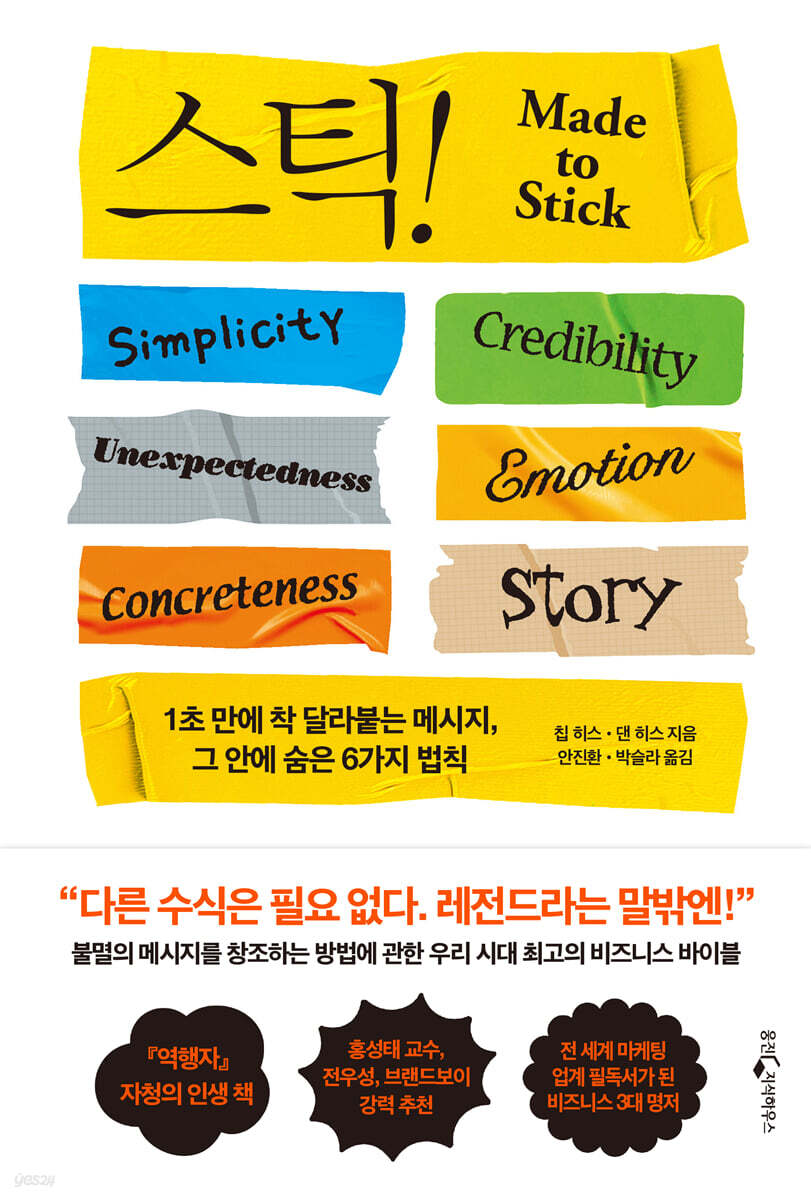
stick!
 |
Description
Book Introduction
- Three must-read business books for the global marketing industry
- Highly recommended by Professor Hong Seong-tae, Jeon Woo-seong, and Brand Boy
- [New York Times] [Wall Street Journal] [Business Week] Bestseller
“No other formula is needed.
“There is no other word than legend!”
The ultimate business bible of our time on how to create an immortal message.
From legendary copy that changed the fate of a company, to urban legends and proverbs, to political slogans that stole the public's heart...
A super-powerful message recipe extracted from messages that have survived for centuries!
Discover the masterpiece of business that has become a bible for CEOs and businessmen around the world.
In an age overflowing with messages from various corporate advertisements and brands, as well as YouTube, Instagram, and TV, which ones fade into obscurity, while which ones survive and leave a lasting impression on people's minds? Stanford University organizational behavior professor Chip Heath and management consultant Dan Heath conducted extensive research and meticulous analysis of messages that have endured for centuries—from timeless stories, unforgettable rumors, irresistible advertising copy, and election catchphrases that changed public behavior. These studies have distilled the six principles (SUCCESs) of sticker message creation into a compelling narrative.
"Stick!" is a masterpiece that presents the master key to successful storytelling based on outstanding insight into human psychology, containing the technique of creating immortal messages that will never leave your mind once they are stuck.
Since its domestic publication, it has been a must-read for the marketing industry, highly praised by CEOs and businessmen, and has been consistently loved for over 15 years.
With its new editing and design, "Stick!" will provide timeless intellectual inspiration to all areas of business, including marketing and communications, as well as to anyone seeking to persuade and inspire others in this day and age.
- Highly recommended by Professor Hong Seong-tae, Jeon Woo-seong, and Brand Boy
- [New York Times] [Wall Street Journal] [Business Week] Bestseller
“No other formula is needed.
“There is no other word than legend!”
The ultimate business bible of our time on how to create an immortal message.
From legendary copy that changed the fate of a company, to urban legends and proverbs, to political slogans that stole the public's heart...
A super-powerful message recipe extracted from messages that have survived for centuries!
Discover the masterpiece of business that has become a bible for CEOs and businessmen around the world.
In an age overflowing with messages from various corporate advertisements and brands, as well as YouTube, Instagram, and TV, which ones fade into obscurity, while which ones survive and leave a lasting impression on people's minds? Stanford University organizational behavior professor Chip Heath and management consultant Dan Heath conducted extensive research and meticulous analysis of messages that have endured for centuries—from timeless stories, unforgettable rumors, irresistible advertising copy, and election catchphrases that changed public behavior. These studies have distilled the six principles (SUCCESs) of sticker message creation into a compelling narrative.
"Stick!" is a masterpiece that presents the master key to successful storytelling based on outstanding insight into human psychology, containing the technique of creating immortal messages that will never leave your mind once they are stuck.
Since its domestic publication, it has been a must-read for the marketing industry, highly praised by CEOs and businessmen, and has been consistently loved for over 15 years.
With its new editing and design, "Stick!" will provide timeless intellectual inspiration to all areas of business, including marketing and communications, as well as to anyone seeking to persuade and inspire others in this day and age.
- You can preview some of the book's contents.
Preview
index
Preface to the Korean edition
Prologue: The Secret of Nostradamus's Prophecies Surviving to This Day
Kidney-stealing organ trafficking horror story
The Secret of a Message That Spreads Like a Virus
Why You Need to Make Your Message Sticky
The rumor that ruined Halloween
Six Key Elements to Make Your Message Stick
The Curse of Knowledge: A Villain That Reduces Stickiness
Can a brilliant message be created with just a novel idea?
Principle 1: Simplicity: Strength is simplicity.
The Army's Message That Motivates Millions of Soldiers
Southwest Airlines' Success: The Power of a Simple Message
Why do journalists have trouble writing their first sentences?
“I said it’s the economy, you idiot!”
The power of key messages that remind us of our priorities
Message Clinic Sun exposure is dangerous
The Secret of a Local Newspaper with a 112% Subscription Rate
Simplicity = Core + Conciseness
The world's oldest surviving message, the proverb
When designing a remote control, it should be 'stick!'
Awaken the knowledge that already exists
What is a pomelo?
Once you know something, you can't go back to the state you were in before you knew it.
One line of copy that determines the success of a Hollywood movie
Even a handful of onions in a sandwich is a work of art.
Principle 2: Unexpectedness: Break the listener's guessing mechanism.
Six Ways to Escape from an Airplane
Shocking new car commercial
Surprise them.
Find the answer yourself
How to go beyond people's guesses
Why a Department Store New Employee Was Shocked
Pick the lead for the next article.
Message Clinic: Is U.S. Foreign Aid Excessive?
Solve the mystery
How do kids memorize all the Pokémon names?
Why the 9 O'Clock News Trailer Is So Provocative: The Gap Theory
Presentation reporting on the status of fundraising for the Message Clinic
Attack the desire to fill the gaps in knowledge.
How to get people's attention?
Sony's sticker message portable radio
Kennedy's Achievements Through Messages
Principle 3: Concreteness: How to Break the Curse of Knowledge
The Secret of Aesop's Fables, Surviving 2,500 Years
The message must be specific.
Why We Give Up When We Read Papers
The secret to accounting lectures that stick in your head
Hey Jude, Watermelon, and Mona Lisa
The enemy that hinders communication, the curse of knowledge
A presentation that satisfied HP
A mat that frees imagination, concreteness
Message Clinic Let's save children who are dying from dehydration!
Why do mothers turn their backs on new products?
Principle 4: Credibility Make them believe what I say.
Make Helicobacter pylori believe
Even if you are not a Nobel Prize winner
Sometimes anti-authority is much more powerful
Boyfriend's death
Star Wars toothbrush overturns ruling
How to effectively deliver the destructive power of 5,000 nuclear weapons
How to Use Statistics Effectively
Message Clinic Shark attacks on humans are rare?
Amplify the credibility of your message
Non-toxic fiber? Edible fiber!
Where's the meat in this burger?
“Are you better off than you were four years ago?”
Message Clinic: Why Humans Believe the Liar Called Intuition
AIDS Education for NBA Players
Principle 5: Emotion Emotional messages motivate action.
Persuading a Charity That Moves Your Heart
“Think about it.” “You do it!”
Why Superlatives Don't Work
Why are people so passionate about sports?
The Advertising Laws of Legendary Marketer John Caples
Two Ways to Grow Your Cable TV Viewership
Maslow's pyramid theory of human motivation
Even soldiers have to eat to fight
Why do the poor support the conservative camp?
Message Clinic Why on earth do we have to study math?
That's not persuasion, that's preaching.
Appeal to profit, identity, and utopia
Principle 6: Tell the story so that it becomes vivid in the mind.
Principle 6: Tell the story so that it becomes vivid in the mind.
Stories inspire action
A story I heard at the Xerox cafeteria
When your audience won't listen to you
Stories are simulations for the brain.
Dealing with Student Message Clinic Issues
A Great Story Rolls Into a Subway Sandwich
You don't always have to 'create' a message.
There are three plots in a compelling story.
Challenge Plot: David and Goliath
Connecting Plot: Why is the Good Samaritan good?
Creativity Plot: Apples and the Law of Universal Gravitation
Focus on the small voice in your head.
Capture the stories life creates.
Practical Edition: The 'Stick!' Techniques You Need
Five Rules for Presentations That Stick with Your Audience
Strategic communication methods that permeate from CEO to new employees
How can we get rid of bad rumors?
Sticker teaching method that sticks to students
Epilogue: Great messages aren't created by geniuses.
The answer lies with the audience.
Keep your message sense deep in your bones
Stanford students' ability to create sticker messages
Other villains
Creating Sticker Messages: The Structure of Communication
Symptoms and Treatment
You are John F.
It's not Kennedy
main
Prologue: The Secret of Nostradamus's Prophecies Surviving to This Day
Kidney-stealing organ trafficking horror story
The Secret of a Message That Spreads Like a Virus
Why You Need to Make Your Message Sticky
The rumor that ruined Halloween
Six Key Elements to Make Your Message Stick
The Curse of Knowledge: A Villain That Reduces Stickiness
Can a brilliant message be created with just a novel idea?
Principle 1: Simplicity: Strength is simplicity.
The Army's Message That Motivates Millions of Soldiers
Southwest Airlines' Success: The Power of a Simple Message
Why do journalists have trouble writing their first sentences?
“I said it’s the economy, you idiot!”
The power of key messages that remind us of our priorities
Message Clinic Sun exposure is dangerous
The Secret of a Local Newspaper with a 112% Subscription Rate
Simplicity = Core + Conciseness
The world's oldest surviving message, the proverb
When designing a remote control, it should be 'stick!'
Awaken the knowledge that already exists
What is a pomelo?
Once you know something, you can't go back to the state you were in before you knew it.
One line of copy that determines the success of a Hollywood movie
Even a handful of onions in a sandwich is a work of art.
Principle 2: Unexpectedness: Break the listener's guessing mechanism.
Six Ways to Escape from an Airplane
Shocking new car commercial
Surprise them.
Find the answer yourself
How to go beyond people's guesses
Why a Department Store New Employee Was Shocked
Pick the lead for the next article.
Message Clinic: Is U.S. Foreign Aid Excessive?
Solve the mystery
How do kids memorize all the Pokémon names?
Why the 9 O'Clock News Trailer Is So Provocative: The Gap Theory
Presentation reporting on the status of fundraising for the Message Clinic
Attack the desire to fill the gaps in knowledge.
How to get people's attention?
Sony's sticker message portable radio
Kennedy's Achievements Through Messages
Principle 3: Concreteness: How to Break the Curse of Knowledge
The Secret of Aesop's Fables, Surviving 2,500 Years
The message must be specific.
Why We Give Up When We Read Papers
The secret to accounting lectures that stick in your head
Hey Jude, Watermelon, and Mona Lisa
The enemy that hinders communication, the curse of knowledge
A presentation that satisfied HP
A mat that frees imagination, concreteness
Message Clinic Let's save children who are dying from dehydration!
Why do mothers turn their backs on new products?
Principle 4: Credibility Make them believe what I say.
Make Helicobacter pylori believe
Even if you are not a Nobel Prize winner
Sometimes anti-authority is much more powerful
Boyfriend's death
Star Wars toothbrush overturns ruling
How to effectively deliver the destructive power of 5,000 nuclear weapons
How to Use Statistics Effectively
Message Clinic Shark attacks on humans are rare?
Amplify the credibility of your message
Non-toxic fiber? Edible fiber!
Where's the meat in this burger?
“Are you better off than you were four years ago?”
Message Clinic: Why Humans Believe the Liar Called Intuition
AIDS Education for NBA Players
Principle 5: Emotion Emotional messages motivate action.
Persuading a Charity That Moves Your Heart
“Think about it.” “You do it!”
Why Superlatives Don't Work
Why are people so passionate about sports?
The Advertising Laws of Legendary Marketer John Caples
Two Ways to Grow Your Cable TV Viewership
Maslow's pyramid theory of human motivation
Even soldiers have to eat to fight
Why do the poor support the conservative camp?
Message Clinic Why on earth do we have to study math?
That's not persuasion, that's preaching.
Appeal to profit, identity, and utopia
Principle 6: Tell the story so that it becomes vivid in the mind.
Principle 6: Tell the story so that it becomes vivid in the mind.
Stories inspire action
A story I heard at the Xerox cafeteria
When your audience won't listen to you
Stories are simulations for the brain.
Dealing with Student Message Clinic Issues
A Great Story Rolls Into a Subway Sandwich
You don't always have to 'create' a message.
There are three plots in a compelling story.
Challenge Plot: David and Goliath
Connecting Plot: Why is the Good Samaritan good?
Creativity Plot: Apples and the Law of Universal Gravitation
Focus on the small voice in your head.
Capture the stories life creates.
Practical Edition: The 'Stick!' Techniques You Need
Five Rules for Presentations That Stick with Your Audience
Strategic communication methods that permeate from CEO to new employees
How can we get rid of bad rumors?
Sticker teaching method that sticks to students
Epilogue: Great messages aren't created by geniuses.
The answer lies with the audience.
Keep your message sense deep in your bones
Stanford students' ability to create sticker messages
Other villains
Creating Sticker Messages: The Structure of Communication
Symptoms and Treatment
You are John F.
It's not Kennedy
main
Detailed image
.jpg)
Into the book
Chip started teaching a course at Stanford University a long time ago called "How to Make Sticker Messages."
The premise of this lecture was that if we understand what makes a sticky message sticky, we can make our messages stickier.
(Omitted) We wanted to completely disassemble and dissect the sticker message to find out the origin of its stickiness.
Why are urban legends so vividly etched in our memories? Why do some teachers' chemistry lessons stick with us longer than others? Why are similar proverbs found in nearly every culture? Why do some political messages spread widely while others don't? In short, we wanted to know what "sticks"—what becomes a sticker message.
---From the "Prologue"
There is no doubt that there are a few exceptional individuals who are more original and creative than the average person.
Maybe they are born with that ability.
So no matter what you do, you'll never become the Michael Jordan of sticker messaging.
But keep in mind:
The basic premise of this book is that anyone can learn how to create sticker messages.
---From the "Prologue"
The brilliantly simple message is concise and useful, and in many ways acts like a proverb.
Cervantes' definition of proverbs coincides with our definition of simplicity.
'Short sentences (conciseness) derived from long experience (core)'. A summary that compresses the content can cause confusion.
Because so many summaries are empty or misguided.
They are simply concise and lack substance.
But the simplicity we seek is not that kind of summary.
What we want is a proverb.
A message that combines simplicity and focus.
---From "Principle 1: Simplicity"
Gaps in knowledge create interest.
However, to demonstrate that a knowledge gap exists, it is essential to first highlight the knowledge that already exists.
“You know this and that.
Okay, and here's something you don't know." We've set the scene, and people are left wondering what's going to happen next.
Mystery writers and crossword puzzle writers don't just give us clues for nothing.
The moment we feel like we've almost completed the puzzle, curiosity takes over and pushes us to the finish line.
---From "Principle 2: Surprise"
Language is often abstract.
But life cannot be abstract.
The teacher teaches students about war, animals, and literature.
Doctors treat problems in our stomach, back, and heart.
Companies create software, build airplanes, and publish newspapers.
Car companies are making faster, cheaper, and prettier cars than last year.
Even the most abstract business strategies must ultimately be expressed through human action.
It is much easier to understand a fox complaining about sour grapes than to understand abstract strategies, and it is much easier to understand a fox complaining about sour grapes than to understand complex and abstract wordplay about the human mind.
---From "Principle 3: Specificity"
To the east of Silicon Valley lie a network of tawny hills and passes that mark the entrance to a vast wilderness rivaling Yosemite National Park.
These tan hills are a vital watershed for San Francisco Bay, but they are rapidly being eroded as Silicon Valley spreads further and further out.
Although it was an important area from an ecological perspective, it was not a particularly impressive sight no matter how you looked at it.
Even Silicon Valley people, who are deeply concerned about protecting the natural environment, paid no attention to the desolate brown hills.
But Sweeney said:
“We are not only protecting beautiful landscapes.
We protect it because it has ecological significance.” TNC named the oak savanna Mount Hamilton Wilderness (after the area’s highest peak, where the lookout stands).
Once named and recognized as a landscape, the Hamilton Wilderness became firmly established in the minds of local communities and policymakers.
---From "Principle 3: Specificity"
I threw my brown folder into the air.
It landed in the middle of the table with a loud thud.
“Guys, this is the next step in the computer revolution.” For a moment, I was terrified that I would be kicked out of the room for this over-the-top theatrics.
But they just stood there, frozen in place, staring intently at my plain brown folder on the table, as if it might come to life at any moment.
Finally, Brooke Myers, who had been a partner at the firm for many years, though her face looked young, slowly reached out and stroked the folder carefully as if it were a sacred talisman.
Then he asked.
“How much information can something like this contain?”
---From "Principle 3: Specificity"
If you can get help from Stephen Hawking, Michael Jordan, or any other celebrity or renowned expert, you can safely skip this chapter.
But for the vast majority of us ordinary people who lack that ability, who can we rely on? Can we draw upon a credible authority from outside sources without the help of celebrities or experts? Yes, that's right.
Surprisingly, the answer is yes.
You just have to draw credibility from anti-authoritarian people.
---From "Principle 4: Reliability"
The intern returned to Chicago in high spirits.
Jared actually existed.
And it was true that he succeeded in losing weight by eating only Subway sandwiches.
The advertising company thought.
‘We have a huge story rolling into our hands!’ (Omitted) The second value of this story lies right here.
That which encourages and inspires us.
Emotion, like simulation, causes action.
---From "Principle 6 Story"
The biggest and most common mistake in presentations is that the message is too abstract.
The presenter presents the concept and conclusion without providing any evidence.
They give a high-level explanation of the big picture, but don't give details that would make it easier to understand.
Even if you list a few examples or stories, they are treated as if they are unnecessary decorations.
Most people tend to mix explanations and examples in a 3 to 1 ratio.
It's doing the complete opposite.
For a presentation to be persuasive, examples and stories shouldn't be mere garnish sprinkled on top of the food.
It should be the main dish.
---From "The 'Stick!' Techniques You Need in Practical Life"
“How do I get rid of a sticker idea?” People wanted to get rid of bad news about their company or misconceptions about a particular product.
It took me a while to answer this last question.
Finally we had no choice but to admit it.
“That is impossible.” (Omitted) Above all, it must be realistic.
It took 17 years for the public to trust cars.
Despite Ray Kroc's brilliant strategy, rumors of worm meat in McDonald's burgers still circulate in some areas.
Sticker ideas survive in any situation.
And as we have already seen in this book.
That could be a great thing.
It would be a huge headache if you had to fight against bad sticker ideas.
Our advice is simple:
When fighting against sticker ideas, use sticker ideas.
The premise of this lecture was that if we understand what makes a sticky message sticky, we can make our messages stickier.
(Omitted) We wanted to completely disassemble and dissect the sticker message to find out the origin of its stickiness.
Why are urban legends so vividly etched in our memories? Why do some teachers' chemistry lessons stick with us longer than others? Why are similar proverbs found in nearly every culture? Why do some political messages spread widely while others don't? In short, we wanted to know what "sticks"—what becomes a sticker message.
---From the "Prologue"
There is no doubt that there are a few exceptional individuals who are more original and creative than the average person.
Maybe they are born with that ability.
So no matter what you do, you'll never become the Michael Jordan of sticker messaging.
But keep in mind:
The basic premise of this book is that anyone can learn how to create sticker messages.
---From the "Prologue"
The brilliantly simple message is concise and useful, and in many ways acts like a proverb.
Cervantes' definition of proverbs coincides with our definition of simplicity.
'Short sentences (conciseness) derived from long experience (core)'. A summary that compresses the content can cause confusion.
Because so many summaries are empty or misguided.
They are simply concise and lack substance.
But the simplicity we seek is not that kind of summary.
What we want is a proverb.
A message that combines simplicity and focus.
---From "Principle 1: Simplicity"
Gaps in knowledge create interest.
However, to demonstrate that a knowledge gap exists, it is essential to first highlight the knowledge that already exists.
“You know this and that.
Okay, and here's something you don't know." We've set the scene, and people are left wondering what's going to happen next.
Mystery writers and crossword puzzle writers don't just give us clues for nothing.
The moment we feel like we've almost completed the puzzle, curiosity takes over and pushes us to the finish line.
---From "Principle 2: Surprise"
Language is often abstract.
But life cannot be abstract.
The teacher teaches students about war, animals, and literature.
Doctors treat problems in our stomach, back, and heart.
Companies create software, build airplanes, and publish newspapers.
Car companies are making faster, cheaper, and prettier cars than last year.
Even the most abstract business strategies must ultimately be expressed through human action.
It is much easier to understand a fox complaining about sour grapes than to understand abstract strategies, and it is much easier to understand a fox complaining about sour grapes than to understand complex and abstract wordplay about the human mind.
---From "Principle 3: Specificity"
To the east of Silicon Valley lie a network of tawny hills and passes that mark the entrance to a vast wilderness rivaling Yosemite National Park.
These tan hills are a vital watershed for San Francisco Bay, but they are rapidly being eroded as Silicon Valley spreads further and further out.
Although it was an important area from an ecological perspective, it was not a particularly impressive sight no matter how you looked at it.
Even Silicon Valley people, who are deeply concerned about protecting the natural environment, paid no attention to the desolate brown hills.
But Sweeney said:
“We are not only protecting beautiful landscapes.
We protect it because it has ecological significance.” TNC named the oak savanna Mount Hamilton Wilderness (after the area’s highest peak, where the lookout stands).
Once named and recognized as a landscape, the Hamilton Wilderness became firmly established in the minds of local communities and policymakers.
---From "Principle 3: Specificity"
I threw my brown folder into the air.
It landed in the middle of the table with a loud thud.
“Guys, this is the next step in the computer revolution.” For a moment, I was terrified that I would be kicked out of the room for this over-the-top theatrics.
But they just stood there, frozen in place, staring intently at my plain brown folder on the table, as if it might come to life at any moment.
Finally, Brooke Myers, who had been a partner at the firm for many years, though her face looked young, slowly reached out and stroked the folder carefully as if it were a sacred talisman.
Then he asked.
“How much information can something like this contain?”
---From "Principle 3: Specificity"
If you can get help from Stephen Hawking, Michael Jordan, or any other celebrity or renowned expert, you can safely skip this chapter.
But for the vast majority of us ordinary people who lack that ability, who can we rely on? Can we draw upon a credible authority from outside sources without the help of celebrities or experts? Yes, that's right.
Surprisingly, the answer is yes.
You just have to draw credibility from anti-authoritarian people.
---From "Principle 4: Reliability"
The intern returned to Chicago in high spirits.
Jared actually existed.
And it was true that he succeeded in losing weight by eating only Subway sandwiches.
The advertising company thought.
‘We have a huge story rolling into our hands!’ (Omitted) The second value of this story lies right here.
That which encourages and inspires us.
Emotion, like simulation, causes action.
---From "Principle 6 Story"
The biggest and most common mistake in presentations is that the message is too abstract.
The presenter presents the concept and conclusion without providing any evidence.
They give a high-level explanation of the big picture, but don't give details that would make it easier to understand.
Even if you list a few examples or stories, they are treated as if they are unnecessary decorations.
Most people tend to mix explanations and examples in a 3 to 1 ratio.
It's doing the complete opposite.
For a presentation to be persuasive, examples and stories shouldn't be mere garnish sprinkled on top of the food.
It should be the main dish.
---From "The 'Stick!' Techniques You Need in Practical Life"
“How do I get rid of a sticker idea?” People wanted to get rid of bad news about their company or misconceptions about a particular product.
It took me a while to answer this last question.
Finally we had no choice but to admit it.
“That is impossible.” (Omitted) Above all, it must be realistic.
It took 17 years for the public to trust cars.
Despite Ray Kroc's brilliant strategy, rumors of worm meat in McDonald's burgers still circulate in some areas.
Sticker ideas survive in any situation.
And as we have already seen in this book.
That could be a great thing.
It would be a huge headache if you had to fight against bad sticker ideas.
Our advice is simple:
When fighting against sticker ideas, use sticker ideas.
---From "The 'Stick!' Techniques You Need in Practical Life"
Publisher's Review
A must-read for the global marketing industry, a new look at one of the top three business classics, "Stick!"
"The ultimate business bible for creating immortal messages."
A great message communicates a strategy in a single sentence and provides clear, actionable goals.
From crafting headlines to formulating corporate and national strategies, messages not only persuade others but also create explosive momentum.
So how do you create a powerful message that moves the world? Stanford professor of organizational behavior Chip Heath and management consultant Dan Heath conducted extensive research and meticulous analysis of messages that have endured for centuries—from timeless stories, to etched-in-your-mind fake news and rumors, to irresistible ad copy, to campaign slogans that changed public behavior. After this, they distilled the six principles (SUCCESs) of sticky message creation into a single, compelling message.
Based on a remarkable insight into human psychology, "Stick!" presents a technique for creating immortal messages that, once stuck in the mind, will never leave.
This book, which became a bestseller in the New York Times, the Wall Street Journal, and Business Week immediately after its publication in 2006 and was translated into 28 languages, has been praised by CEOs and businessmen around the world for “changing the paradigm of marketing language,” and has been a must-read in the marketing industry for over 15 years.
Coming to readers in 2022 with a new edit and design, "Stick!" will provide timeless intellectual inspiration to all areas of business, including marketing and communications, as well as to anyone seeking to persuade and inspire others.
A single "stick" is worth a thousand words! The secrets of sticker messages, proven over centuries.
“Paste it like a sticker on everyone’s mind in one second!”
This is truly the age of message wars.
From advertising copy that says it all in a single line, to brands that imprint their products and companies' values and identities with messages, to YouTube and Instagram that tell their stories through videos and images, we encounter at least 3,000 advertisements in our daily lives.
Which of these messages will capture people's attention, generate hundreds of thousands of views, and lead to sales that can transform a company's fortunes? We must remember.
A good message is one that stays in people's memories.
It is the fate of a message to either survive or disappear.
Stanford University professor Chip Heath and corporate consultant Dan Heath studied proverbs, myths, stories, advertising copies, and election slogans that have remained powerful and stuck in people's minds over time. After conducting 40 experiments with 1,700 people, they discovered that there are common rules hidden in the words that are imprinted on people's minds over time and never forgotten.
In "Stick!", authors Chip Heath and Dan Heath, who analyzed tens of thousands of cases for over a decade, distill the six laws hidden in powerful messages into "SUCCESs" and present a method for creating the world's most powerful sentence.
By simply applying these principles, anyone can create compelling storytelling, even if they aren't a genius copywriter or a creative director.
The reason why Aesop's Fables have survived since ancient Greece, the message that President Clinton sent to divert America's attention from the sexual harassment scandal to the economy, and the message that enabled John F. Kennedy to be born as a strong America.
An analysis of how Kennedy's one-sentence message, the message that turned Southwest Airlines from a loss to a profit, motivated employees to act revealed that the most powerful message that caught the world's attention contained the SUCCES element.
You only get one chance to squeeze what you put into your message.
“SUCCESs, pay attention to the 6 principles for sticker messages!”
In 1962, John F.
President Kennedy's declaration to "land a man on the moon and return him safely to Earth within the next ten years" became the trigger that allowed the United States to overtake the Soviet Union and establish global hegemony.
This message, which has profoundly influenced the actions of millions of people for ten years, embodies all six archetypes:
These six characteristics—Simple, Unexpected, Concrete, Credibility, Emotion, Story, and SUCCES—are key tools for creating a message that sticks in the mind.
To motivate millions of soldiers going into battle in diverse situations, the simplest message toward victory is needed (simplicity).
Nordstrom emerged as a customer service powerhouse in the department store industry with the unexpected message that they would also package items purchased from other department stores (surprise).
Aesop's Fables from the Greek era have survived for 2,500 years by specifically explaining the universal characteristics of human nature through examples (specificity).
Even if you're not a Nobel laureate or have Oprah Winfrey's enthusiastic endorsement, there are techniques you can use to give your opinions a high degree of credibility (credibility).
Appealing to emotions can capture people's hearts (emotions) more easily than any statistics.
Subway Sandwich was able to boost sales of its new product with a story-based advertisement (Story)
From psychological research on primal desires to analysis of corporate success stories, the book "Stick!" accurately identifies the listener's needs through extensive case studies and presents practical strategies.
For those of you who stay up all night crafting a powerful sentence that captures people's hearts, we're generously sharing our know-how on what makes a good message and how to create it.
From strategic communication to effective teaching and presentations, from CEOs to new employees!
"Wherever you want to persuade others, you need 'Stick!'"
McDonald's has been plagued by rumors for over a decade that it uses earthworms in its burgers.
With the groundbreaking message, “We simply cannot afford to use worm meat in our burger patties,” McDonald’s was able to shake off the decades-long, tiresome “worm burger” message from the public.
At a time when many businesses are struggling with negative rumors and misinformation, this book offers a powerful message and examples of how to fight back.
This book explores and analyzes examples of how companies overcame previous ideas with stronger messages, including malicious email rumors and the blatant backlash that came with the car when it was first released.
When Cranium, a company known for its board games, communicates with its U.S. headquarters staff and its manufacturing operations in China, it does so with one powerful message.
Cranium's differentiation strategy, the message of "CHIFF" (an acronym for Smart, High-Quality, Innovative, Friendly, and Fun), has resonated clearly across all areas of the organization, even to international employees who speak different languages.
This message has become a factor that allows the company to prioritize its core values in all decision-making and production processes.
The same goes for presentations.
The author emphasizes that any relevant data or numerical statistical data should be discarded.
He says that if you don't present the most important 'story' and 'case' in your presentation, your presentation will be an empty speech that no one will listen to.
The author says that teachers are especially in dire need of sticker ideas.
The technique of making difficult learning topics that would otherwise be difficult to grasp stick in children's minds is included in the supplementary manuscript.
After finding the core of the lesson at the very beginning, emphasize teaching by linking and connecting the knowledge that students already know.
This book reveals teaching methods that will remain vivid in children's minds through examples of how American teachers are successfully teaching classes using six principles, such as teaching functions with crickets and teaching accounting principles with Christmas trees.
"The ultimate business bible for creating immortal messages."
A great message communicates a strategy in a single sentence and provides clear, actionable goals.
From crafting headlines to formulating corporate and national strategies, messages not only persuade others but also create explosive momentum.
So how do you create a powerful message that moves the world? Stanford professor of organizational behavior Chip Heath and management consultant Dan Heath conducted extensive research and meticulous analysis of messages that have endured for centuries—from timeless stories, to etched-in-your-mind fake news and rumors, to irresistible ad copy, to campaign slogans that changed public behavior. After this, they distilled the six principles (SUCCESs) of sticky message creation into a single, compelling message.
Based on a remarkable insight into human psychology, "Stick!" presents a technique for creating immortal messages that, once stuck in the mind, will never leave.
This book, which became a bestseller in the New York Times, the Wall Street Journal, and Business Week immediately after its publication in 2006 and was translated into 28 languages, has been praised by CEOs and businessmen around the world for “changing the paradigm of marketing language,” and has been a must-read in the marketing industry for over 15 years.
Coming to readers in 2022 with a new edit and design, "Stick!" will provide timeless intellectual inspiration to all areas of business, including marketing and communications, as well as to anyone seeking to persuade and inspire others.
A single "stick" is worth a thousand words! The secrets of sticker messages, proven over centuries.
“Paste it like a sticker on everyone’s mind in one second!”
This is truly the age of message wars.
From advertising copy that says it all in a single line, to brands that imprint their products and companies' values and identities with messages, to YouTube and Instagram that tell their stories through videos and images, we encounter at least 3,000 advertisements in our daily lives.
Which of these messages will capture people's attention, generate hundreds of thousands of views, and lead to sales that can transform a company's fortunes? We must remember.
A good message is one that stays in people's memories.
It is the fate of a message to either survive or disappear.
Stanford University professor Chip Heath and corporate consultant Dan Heath studied proverbs, myths, stories, advertising copies, and election slogans that have remained powerful and stuck in people's minds over time. After conducting 40 experiments with 1,700 people, they discovered that there are common rules hidden in the words that are imprinted on people's minds over time and never forgotten.
In "Stick!", authors Chip Heath and Dan Heath, who analyzed tens of thousands of cases for over a decade, distill the six laws hidden in powerful messages into "SUCCESs" and present a method for creating the world's most powerful sentence.
By simply applying these principles, anyone can create compelling storytelling, even if they aren't a genius copywriter or a creative director.
The reason why Aesop's Fables have survived since ancient Greece, the message that President Clinton sent to divert America's attention from the sexual harassment scandal to the economy, and the message that enabled John F. Kennedy to be born as a strong America.
An analysis of how Kennedy's one-sentence message, the message that turned Southwest Airlines from a loss to a profit, motivated employees to act revealed that the most powerful message that caught the world's attention contained the SUCCES element.
You only get one chance to squeeze what you put into your message.
“SUCCESs, pay attention to the 6 principles for sticker messages!”
In 1962, John F.
President Kennedy's declaration to "land a man on the moon and return him safely to Earth within the next ten years" became the trigger that allowed the United States to overtake the Soviet Union and establish global hegemony.
This message, which has profoundly influenced the actions of millions of people for ten years, embodies all six archetypes:
These six characteristics—Simple, Unexpected, Concrete, Credibility, Emotion, Story, and SUCCES—are key tools for creating a message that sticks in the mind.
To motivate millions of soldiers going into battle in diverse situations, the simplest message toward victory is needed (simplicity).
Nordstrom emerged as a customer service powerhouse in the department store industry with the unexpected message that they would also package items purchased from other department stores (surprise).
Aesop's Fables from the Greek era have survived for 2,500 years by specifically explaining the universal characteristics of human nature through examples (specificity).
Even if you're not a Nobel laureate or have Oprah Winfrey's enthusiastic endorsement, there are techniques you can use to give your opinions a high degree of credibility (credibility).
Appealing to emotions can capture people's hearts (emotions) more easily than any statistics.
Subway Sandwich was able to boost sales of its new product with a story-based advertisement (Story)
From psychological research on primal desires to analysis of corporate success stories, the book "Stick!" accurately identifies the listener's needs through extensive case studies and presents practical strategies.
For those of you who stay up all night crafting a powerful sentence that captures people's hearts, we're generously sharing our know-how on what makes a good message and how to create it.
From strategic communication to effective teaching and presentations, from CEOs to new employees!
"Wherever you want to persuade others, you need 'Stick!'"
McDonald's has been plagued by rumors for over a decade that it uses earthworms in its burgers.
With the groundbreaking message, “We simply cannot afford to use worm meat in our burger patties,” McDonald’s was able to shake off the decades-long, tiresome “worm burger” message from the public.
At a time when many businesses are struggling with negative rumors and misinformation, this book offers a powerful message and examples of how to fight back.
This book explores and analyzes examples of how companies overcame previous ideas with stronger messages, including malicious email rumors and the blatant backlash that came with the car when it was first released.
When Cranium, a company known for its board games, communicates with its U.S. headquarters staff and its manufacturing operations in China, it does so with one powerful message.
Cranium's differentiation strategy, the message of "CHIFF" (an acronym for Smart, High-Quality, Innovative, Friendly, and Fun), has resonated clearly across all areas of the organization, even to international employees who speak different languages.
This message has become a factor that allows the company to prioritize its core values in all decision-making and production processes.
The same goes for presentations.
The author emphasizes that any relevant data or numerical statistical data should be discarded.
He says that if you don't present the most important 'story' and 'case' in your presentation, your presentation will be an empty speech that no one will listen to.
The author says that teachers are especially in dire need of sticker ideas.
The technique of making difficult learning topics that would otherwise be difficult to grasp stick in children's minds is included in the supplementary manuscript.
After finding the core of the lesson at the very beginning, emphasize teaching by linking and connecting the knowledge that students already know.
This book reveals teaching methods that will remain vivid in children's minds through examples of how American teachers are successfully teaching classes using six principles, such as teaching functions with crickets and teaching accounting principles with Christmas trees.
GOODS SPECIFICS
- Publication date: October 21, 2022
- Page count, weight, size: 476 pages | 636g | 145*215*24mm
- ISBN13: 9788901266091
- ISBN10: 8901266091
You may also like
카테고리
korean


korean

![ELLE 엘르 스페셜 에디션 A형 : 12월 [2025]](http://librairie.coreenne.fr/cdn/shop/files/b8e27a3de6c9538896439686c6b0e8fb.jpg?v=1766436872&width=3840)


