

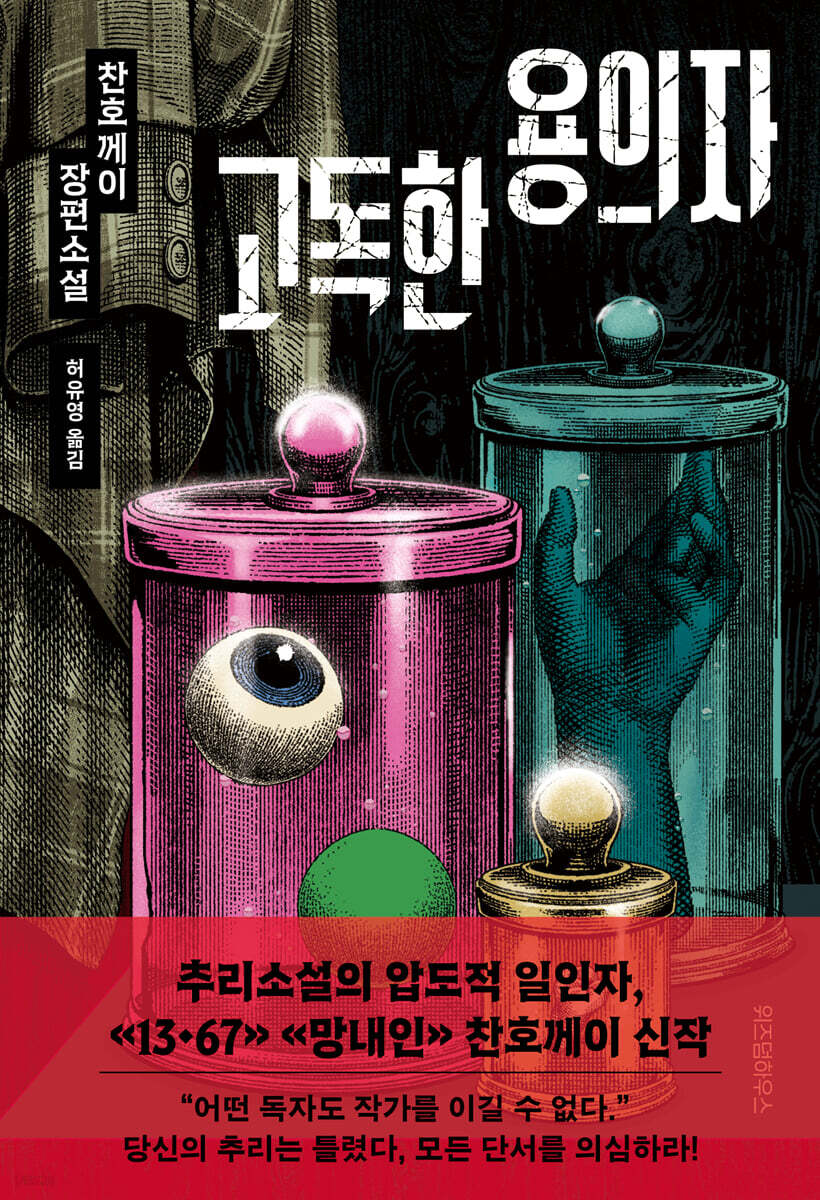
Lone Suspect
 |
Description
Book Introduction
- A word from MD
-
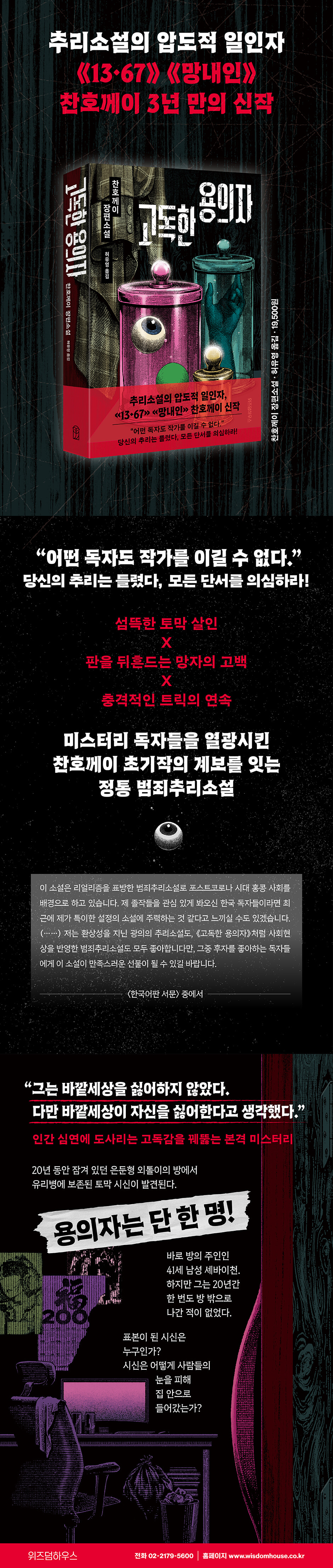
Chanho Kei's new mystery novel, his first in three years『13·67』 『The Youngest』 Chan Ho-kei has returned to the post-corona era with a classic crime mystery novel.
The death of a man who had been cut off from the world for 20 years, and the bodies hidden in the closet.
The closer we get to the truth, the deeper and darker the investigation becomes.
A full-fledged mystery that delicately captures the loneliness of human beings.
April 18, 2025. Novel/Poetry PD Kim Yu-ri
Chan Ho-kei, the undisputed leader in mystery novels with works like "13·67" and "The Last Princess," has released a new work after three years.
A classic crime mystery novel that follows in the footsteps of Chan Ho-kei's early works, which captivated mystery readers.
The new full-length novel, “The Lonely Suspect,” by Chan Ho-kei, author of the social mystery novels “13·67” and “The Last Child,” which are called the “starting point of mystery novels in the Chinese-speaking world” and are loved around the world, has been published by Wisdom House.
This is a new work being released in Korea for the first time in about three years since “The Magic Flute.”
If the recently introduced works were closer to horror or fantasy, "The Lonely Suspect" is a genuine crime mystery novel that has been released for the first time in a long time since "I Don't Remember, Detective."
In the preface to the Korean edition, author Chan Ho-kei stated, “This is a crime mystery novel that advocates realism and is set in Hong Kong society in the post-COVID era,” and added, “I hope this novel will be a satisfying gift to readers who enjoy crime mystery novels that reflect social phenomena.”
Hong Kong, a pressure cooker city where “everyone has some degree of mental illness.”
In the old apartment complex of Danqing Mansion, a 41-year-old man named Xie Baichen is found dead in his room, having committed suicide by burning charcoal.
There was nothing unusual about this case, which had no suspicion of murder.
Until twenty-five glass bottles appeared in Shebaichun's closet, which he had opened without thinking.
The closet was filled with specimen bottles containing pieces of corpses soaked in preservatives.
Human limbs and organs, and the face of a “man covering his face in agony.”
A classic crime mystery novel that follows in the footsteps of Chan Ho-kei's early works, which captivated mystery readers.
The new full-length novel, “The Lonely Suspect,” by Chan Ho-kei, author of the social mystery novels “13·67” and “The Last Child,” which are called the “starting point of mystery novels in the Chinese-speaking world” and are loved around the world, has been published by Wisdom House.
This is a new work being released in Korea for the first time in about three years since “The Magic Flute.”
If the recently introduced works were closer to horror or fantasy, "The Lonely Suspect" is a genuine crime mystery novel that has been released for the first time in a long time since "I Don't Remember, Detective."
In the preface to the Korean edition, author Chan Ho-kei stated, “This is a crime mystery novel that advocates realism and is set in Hong Kong society in the post-COVID era,” and added, “I hope this novel will be a satisfying gift to readers who enjoy crime mystery novels that reflect social phenomena.”
Hong Kong, a pressure cooker city where “everyone has some degree of mental illness.”
In the old apartment complex of Danqing Mansion, a 41-year-old man named Xie Baichen is found dead in his room, having committed suicide by burning charcoal.
There was nothing unusual about this case, which had no suspicion of murder.
Until twenty-five glass bottles appeared in Shebaichun's closet, which he had opened without thinking.
The closet was filled with specimen bottles containing pieces of corpses soaked in preservatives.
Human limbs and organs, and the face of a “man covering his face in agony.”
- You can preview some of the book's contents.
Preview
index
Preface to the Korean edition
prolog
Chapter 1
Confessions of a Dead Man - 1
Chapter 2
Excerpt from the novel "(title undecided)" - 1
Chapter 3
Confessions of a Dead Man - 2
Chapter 4
Excerpt from the novel "(title undecided)" - 2
Chapter 5
Confessions of a Dead Man - 3
Chapter 6
Excerpt from the novel "(title undecided)" - 3
Chapter 7
Confessions of a Dead Man - 4
Chapter 8
Excerpt from the novel "(title not yet determined)" - 4
Chapter 9
Confessions of a Dead Man - 5
Epilogue
prolog
Chapter 1
Confessions of a Dead Man - 1
Chapter 2
Excerpt from the novel "(title undecided)" - 1
Chapter 3
Confessions of a Dead Man - 2
Chapter 4
Excerpt from the novel "(title undecided)" - 2
Chapter 5
Confessions of a Dead Man - 3
Chapter 6
Excerpt from the novel "(title undecided)" - 3
Chapter 7
Confessions of a Dead Man - 4
Chapter 8
Excerpt from the novel "(title not yet determined)" - 4
Chapter 9
Confessions of a Dead Man - 5
Epilogue
Detailed image
Into the book
“Is this it? What did he say...?
“A reclusive loner? A NEET?”
(……)
A room about 4 pyeong in size.
The bedroom, which was quite large for the average Hong Kong living space, was filled with clutter.
There wasn't much room to move around, with cardboard boxes and trash bags stuffed between the desk, wardrobe, bed, and bookshelf.
The walls were covered with posters of animations and online games, and game character figures and decorations were placed in a mess on the cluttered computer desk.
Although it is said that there are many adult men in their 30s and 40s who are crazy about these toys these days, Kidari guessed that the owner of the room was unemployed based on his overall appearance.
The cardboard boxes containing ramen and snacks, the mini-fridge next to the computer desk, and the pile of trash filled with empty plastic bottles, beer cans, and snack wrappers were enough evidence to show that the deceased had been locked in his room all day playing games, forgetting to eat or sleep.
--- pp.17-18
Kidari thought about the cruelty of a society that remains indifferent even when a single person like this disappears.
There was no guarantee that the man's death would be even briefly reported in tomorrow's newspaper.
It may be a 200-character article that attracts no one's attention and is only published in a few online newspapers.
It was a suicide case with no suspicion of murder.
In this bustling city, people commit suicide every day for various reasons, and even when they disappear, society continues to function without any problems.
--- p.19
Inside the closet were about twenty cylindrical glass bottles of various sizes, filled with liquid like animal specimens in a biological laboratory.
However, what was in the glass bottle in front of Kidari and Asun was not a rat or a frog, but severed limbs and organs.
Human limbs and organs.
--- p.20
There was no doubt that Shebaichun was the culprit.
All that remained was to identify the victims and determine how they were killed.
He wasn't even interested in Shebaichun's motive for murder.
Anyone living in the pressure cooker city that is Hong Kong has some degree of mental illness.
Then, unable to withstand the pressure, he explodes and the screws fall out of his head, committing a brutal crime. It's all left to chance, like rolling dice.
--- p.52
I originally thought that dismembering a human body was a cruel and taboo act that humans should not commit, but after reading that book, I was fascinated by the idea of stitching together several pieces to create a perfect person.
To achieve this goal, the artist views the corpse as an inorganic object, casting off the shackles of worldly views and ethics to complete an exquisite work of art.
Later, I imagined how great it would be if I could create art pieces like this.
I felt it was worth it, even if it meant giving up my life.
--- p.76 From "Confessions of the Dead - 1"
For Abai, this small screen is a window to the world.
He didn't hate the outside world.
I just thought the outside world hated me.
He hid himself in his only protective armor and observed the world through a small window.
(……)
It is true that individuals come together to form a society, but not all individuals must cooperate to form a society.
He hid himself, severed his connection to society, erased the value of his existence, and embraced loneliness.
--- pp.114-115 Excerpt from the novel 『(title not yet decided)』 - 1
If the family has not reported the child missing, the child is likely an orphan or the family has been broken up.
In other words, there is a high probability that she is a woman who lives alone or has no friends or colleagues.
When a pretty woman tries to survive on her own in this city, a rental lover becomes one of the many options.
A person without family, friends, or a regular job can disappear without attracting anyone's attention.
These women are the most popular targets for killers, as landlords are likely to assume that the women ran away because they couldn't afford the overdue rent.
--- p.152
Everyone says, as if it were a habit, that the right way is to suppress the strong and help the weak, but humans are a species that naturally desires to be strong, and they derive pleasure from exploiting the weak.
This may be the most ultimate and primal meaning of life.
--- p.166
Even though the wounds have not yet healed, they pretend to be healed in order to survive in society.
Even though it's painful, like having your heart cut open with a knife, you have to pretend to be strong in front of others.
Abai wants to punch in the face those who advise him that "suicide won't solve any problems."
Are people meant to solve problems? Or are they meant to be some kind of computer program?
“A reclusive loner? A NEET?”
(……)
A room about 4 pyeong in size.
The bedroom, which was quite large for the average Hong Kong living space, was filled with clutter.
There wasn't much room to move around, with cardboard boxes and trash bags stuffed between the desk, wardrobe, bed, and bookshelf.
The walls were covered with posters of animations and online games, and game character figures and decorations were placed in a mess on the cluttered computer desk.
Although it is said that there are many adult men in their 30s and 40s who are crazy about these toys these days, Kidari guessed that the owner of the room was unemployed based on his overall appearance.
The cardboard boxes containing ramen and snacks, the mini-fridge next to the computer desk, and the pile of trash filled with empty plastic bottles, beer cans, and snack wrappers were enough evidence to show that the deceased had been locked in his room all day playing games, forgetting to eat or sleep.
--- pp.17-18
Kidari thought about the cruelty of a society that remains indifferent even when a single person like this disappears.
There was no guarantee that the man's death would be even briefly reported in tomorrow's newspaper.
It may be a 200-character article that attracts no one's attention and is only published in a few online newspapers.
It was a suicide case with no suspicion of murder.
In this bustling city, people commit suicide every day for various reasons, and even when they disappear, society continues to function without any problems.
--- p.19
Inside the closet were about twenty cylindrical glass bottles of various sizes, filled with liquid like animal specimens in a biological laboratory.
However, what was in the glass bottle in front of Kidari and Asun was not a rat or a frog, but severed limbs and organs.
Human limbs and organs.
--- p.20
There was no doubt that Shebaichun was the culprit.
All that remained was to identify the victims and determine how they were killed.
He wasn't even interested in Shebaichun's motive for murder.
Anyone living in the pressure cooker city that is Hong Kong has some degree of mental illness.
Then, unable to withstand the pressure, he explodes and the screws fall out of his head, committing a brutal crime. It's all left to chance, like rolling dice.
--- p.52
I originally thought that dismembering a human body was a cruel and taboo act that humans should not commit, but after reading that book, I was fascinated by the idea of stitching together several pieces to create a perfect person.
To achieve this goal, the artist views the corpse as an inorganic object, casting off the shackles of worldly views and ethics to complete an exquisite work of art.
Later, I imagined how great it would be if I could create art pieces like this.
I felt it was worth it, even if it meant giving up my life.
--- p.76 From "Confessions of the Dead - 1"
For Abai, this small screen is a window to the world.
He didn't hate the outside world.
I just thought the outside world hated me.
He hid himself in his only protective armor and observed the world through a small window.
(……)
It is true that individuals come together to form a society, but not all individuals must cooperate to form a society.
He hid himself, severed his connection to society, erased the value of his existence, and embraced loneliness.
--- pp.114-115 Excerpt from the novel 『(title not yet decided)』 - 1
If the family has not reported the child missing, the child is likely an orphan or the family has been broken up.
In other words, there is a high probability that she is a woman who lives alone or has no friends or colleagues.
When a pretty woman tries to survive on her own in this city, a rental lover becomes one of the many options.
A person without family, friends, or a regular job can disappear without attracting anyone's attention.
These women are the most popular targets for killers, as landlords are likely to assume that the women ran away because they couldn't afford the overdue rent.
--- p.152
Everyone says, as if it were a habit, that the right way is to suppress the strong and help the weak, but humans are a species that naturally desires to be strong, and they derive pleasure from exploiting the weak.
This may be the most ultimate and primal meaning of life.
--- p.166
Even though the wounds have not yet healed, they pretend to be healed in order to survive in society.
Even though it's painful, like having your heart cut open with a knife, you have to pretend to be strong in front of others.
Abai wants to punch in the face those who advise him that "suicide won't solve any problems."
Are people meant to solve problems? Or are they meant to be some kind of computer program?
--- pp.216-217 Excerpt from the novel 『(title not yet decided)』 - 2
Publisher's Review
Chan Ho-kei, the overwhelming leader in mystery novels, has released a new work after three years, including "13·67" and "The Youngest."
A classic crime mystery novel that follows in the footsteps of Chan Ho-kei's early works, which captivated mystery readers.
The new full-length novel, "The Lonely Suspect," by Chan Ho-kei, the author of the social mystery novels "13·67" and "The Young Lady," which are called the "starting point of mystery novels in the Chinese-speaking world" and are loved around the world, has been published by Wisdom House.
This is a new work being released in Korea for the first time in about three years since ‘The Magic Flute’.
If the recently introduced works were closer to horror or fantasy, 『The Lonely Suspect』 is a genuine crime mystery novel that has been released for the first time in a long time since 『I Don't Remember, Detective』.
In the preface to the Korean edition, author Chan Ho-kei stated, “This is a crime mystery novel that advocates realism and is set in Hong Kong society in the post-COVID era,” and added, “I hope this novel will be a satisfying gift to readers who enjoy crime mystery novels that reflect social phenomena.”
Hong Kong, a city where “everyone has some degree of mental illness” (p. 52).
In the old apartment complex of Danqing Mansion, a 41-year-old man named Xie Baichen is found dead in his room, having committed suicide by burning charcoal.
There was nothing unusual about this case, which had no suspicion of murder.
Until twenty-five glass bottles appeared in Shebaichun's closet, which he had opened without thinking.
The closet was filled with specimen bottles containing pieces of corpses soaked in preservatives.
Human limbs and organs, and the face of a “man covered in agony” (pp. 25-26).
Detective Superintendent Shi Yu-i of the violent crimes unit immediately arrives at the scene.
The small room with a bathroom, about 4 pyeong in size, was filled with all kinds of junk and trash, leaving no room to step.
Looking at the corpse with “long hair that reached his shoulders and a bushy beard” (p. 19), Xu Yui realizes that Xie Baichen is a reclusive loner who “forgets to eat or sleep, locks himself in his room all day long and plays games” (p. 18).
The only strong suspect is the owner of the room, Xie Baichen.
A middle-aged, unemployed, socially maladjusted person who eats meals prepared by his mother and plays games all day long… … .
Just when we were about to conclude that he had committed suicide after killing someone to relieve his boredom, we heard unexpected testimony from Xie Meifeng, Xie Baichen's mother.
“Bai Chen hasn’t been out for 20 years!” (Page 33)
If the body hadn't left the room for 20 years, who could it possibly be? How did Xie Baichen capture the victim, and how did the body manage to sneak into the house where she lived with her mother, evading public view? The more we investigate Xie Baichen's surroundings, the more entangled the investigation becomes.
The elaborately scattered pieces of the incident point in increasingly unexpected directions… … .
“He didn’t hate the outside world.
“I just thought the outside world hated me.”
A full-fledged mystery that penetrates the loneliness of the human abyss.
The 'reclusive loner', who has suffered irreparable wounds from people and society and hides in a safe room, "thinks the outside world hates him" and escapes to the Internet, "his only armor that can protect him" (p. 114).
In the novel, two stories coexist with the events contained on a computer hard drive.
In Xie Baichen's will, "Confession of a Dead Man," we can see glimpses of Xie Baichen's sad past of being constantly bullied by a violent upperclassman and his violent nature, which he was "fascinated by the idea of stitching together various pieces to create a perfect person" (p. 76).
Meanwhile, in the excerpt from the novel 『(title undecided)』, the reclusive loner protagonist Abai shares a true friendship with the mysterious girl 'L' whom he meets in an online game.
The two hidden stories further confuse readers who have followed the flow of events and solved their own deductions.
If "The Youngest" illuminates the malice of those who harm others, "The Lonely Suspect" delicately addresses the loneliness that resides in the darkest depths of humanity.
Suicides are so common they don't even make the news; women are pushed to the margins of society from a young age, working as "rental mistresses" without the protection of their families; and police officers who only care about promotions and personal safety and ignore the people's livelihoods are all on the streets of Hong Kong, where disconnection and indifference have become the norm since the COVID-19 pandemic.
In a cold city where people don't care about other people's expressions, David Bowie's song "The Loneliest Guy" flows.
A classic crime mystery novel that follows in the footsteps of Chan Ho-kei's early works, which captivated mystery readers.
The new full-length novel, "The Lonely Suspect," by Chan Ho-kei, the author of the social mystery novels "13·67" and "The Young Lady," which are called the "starting point of mystery novels in the Chinese-speaking world" and are loved around the world, has been published by Wisdom House.
This is a new work being released in Korea for the first time in about three years since ‘The Magic Flute’.
If the recently introduced works were closer to horror or fantasy, 『The Lonely Suspect』 is a genuine crime mystery novel that has been released for the first time in a long time since 『I Don't Remember, Detective』.
In the preface to the Korean edition, author Chan Ho-kei stated, “This is a crime mystery novel that advocates realism and is set in Hong Kong society in the post-COVID era,” and added, “I hope this novel will be a satisfying gift to readers who enjoy crime mystery novels that reflect social phenomena.”
Hong Kong, a city where “everyone has some degree of mental illness” (p. 52).
In the old apartment complex of Danqing Mansion, a 41-year-old man named Xie Baichen is found dead in his room, having committed suicide by burning charcoal.
There was nothing unusual about this case, which had no suspicion of murder.
Until twenty-five glass bottles appeared in Shebaichun's closet, which he had opened without thinking.
The closet was filled with specimen bottles containing pieces of corpses soaked in preservatives.
Human limbs and organs, and the face of a “man covered in agony” (pp. 25-26).
Detective Superintendent Shi Yu-i of the violent crimes unit immediately arrives at the scene.
The small room with a bathroom, about 4 pyeong in size, was filled with all kinds of junk and trash, leaving no room to step.
Looking at the corpse with “long hair that reached his shoulders and a bushy beard” (p. 19), Xu Yui realizes that Xie Baichen is a reclusive loner who “forgets to eat or sleep, locks himself in his room all day long and plays games” (p. 18).
The only strong suspect is the owner of the room, Xie Baichen.
A middle-aged, unemployed, socially maladjusted person who eats meals prepared by his mother and plays games all day long… … .
Just when we were about to conclude that he had committed suicide after killing someone to relieve his boredom, we heard unexpected testimony from Xie Meifeng, Xie Baichen's mother.
“Bai Chen hasn’t been out for 20 years!” (Page 33)
If the body hadn't left the room for 20 years, who could it possibly be? How did Xie Baichen capture the victim, and how did the body manage to sneak into the house where she lived with her mother, evading public view? The more we investigate Xie Baichen's surroundings, the more entangled the investigation becomes.
The elaborately scattered pieces of the incident point in increasingly unexpected directions… … .
“He didn’t hate the outside world.
“I just thought the outside world hated me.”
A full-fledged mystery that penetrates the loneliness of the human abyss.
The 'reclusive loner', who has suffered irreparable wounds from people and society and hides in a safe room, "thinks the outside world hates him" and escapes to the Internet, "his only armor that can protect him" (p. 114).
In the novel, two stories coexist with the events contained on a computer hard drive.
In Xie Baichen's will, "Confession of a Dead Man," we can see glimpses of Xie Baichen's sad past of being constantly bullied by a violent upperclassman and his violent nature, which he was "fascinated by the idea of stitching together various pieces to create a perfect person" (p. 76).
Meanwhile, in the excerpt from the novel 『(title undecided)』, the reclusive loner protagonist Abai shares a true friendship with the mysterious girl 'L' whom he meets in an online game.
The two hidden stories further confuse readers who have followed the flow of events and solved their own deductions.
If "The Youngest" illuminates the malice of those who harm others, "The Lonely Suspect" delicately addresses the loneliness that resides in the darkest depths of humanity.
Suicides are so common they don't even make the news; women are pushed to the margins of society from a young age, working as "rental mistresses" without the protection of their families; and police officers who only care about promotions and personal safety and ignore the people's livelihoods are all on the streets of Hong Kong, where disconnection and indifference have become the norm since the COVID-19 pandemic.
In a cold city where people don't care about other people's expressions, David Bowie's song "The Loneliest Guy" flows.
GOODS SPECIFICS
- Date of issue: April 15, 2025
- Page count, weight, size: 528 pages | 544g | 130*190*25mm
- ISBN13: 9791171713608
- ISBN10: 1171713606
You may also like
카테고리
korean


korean

![GQ KOREA Mark (Monthly): December [2025]](http://librairie.coreenne.fr/cdn/shop/files/8ef265dbbfbf186523ed75ba7319009d.jpg?v=1765340328&width=3840)


