

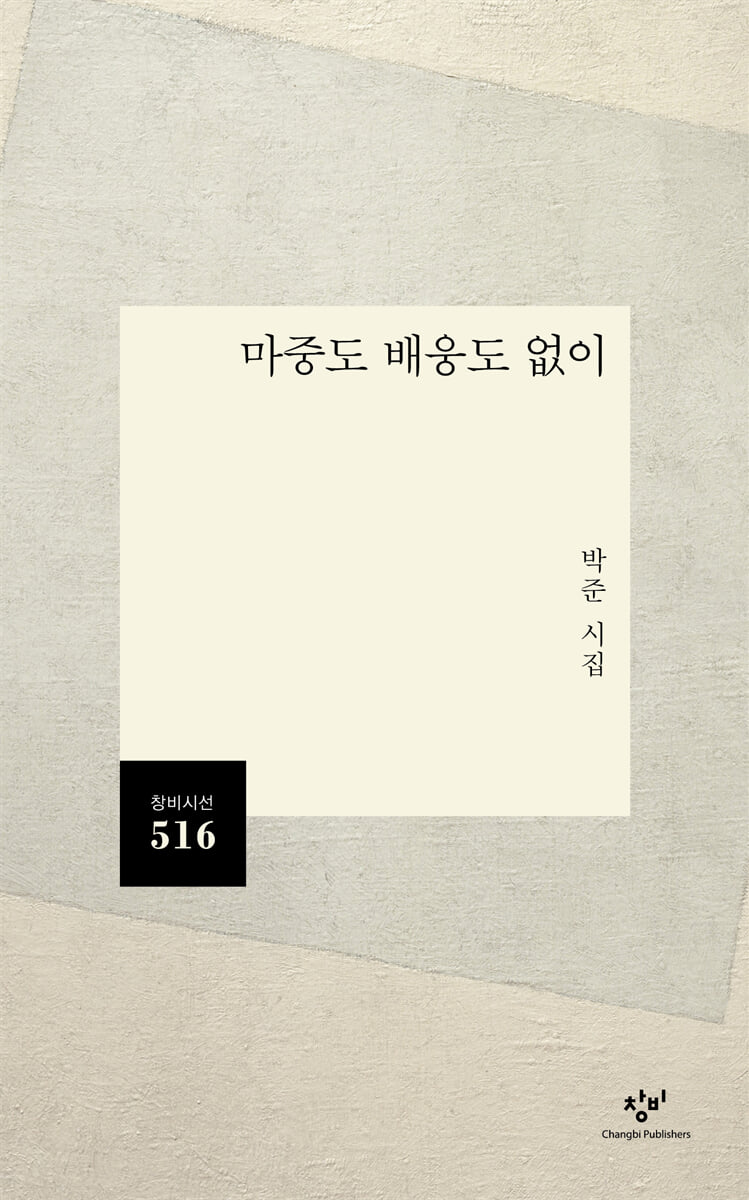
Without any greeting or farewell
 |
Description
Book Introduction
- A word from MD
-
Such a calm and upright comfortPoet Park Jun's new work, presented after seven years.
He returned with a collection of poems that more than lived up to the expectations of readers who admire his poetry.
I wrote about my deepened reflection and my attitude of quietly accepting someone's empty space as a part of my life in a 'less-speaking way'.
When you reach the end, you will want to ask after the well-being of your loved ones.
April 4, 2025. Novel/Poetry PD Kim Yu-ri
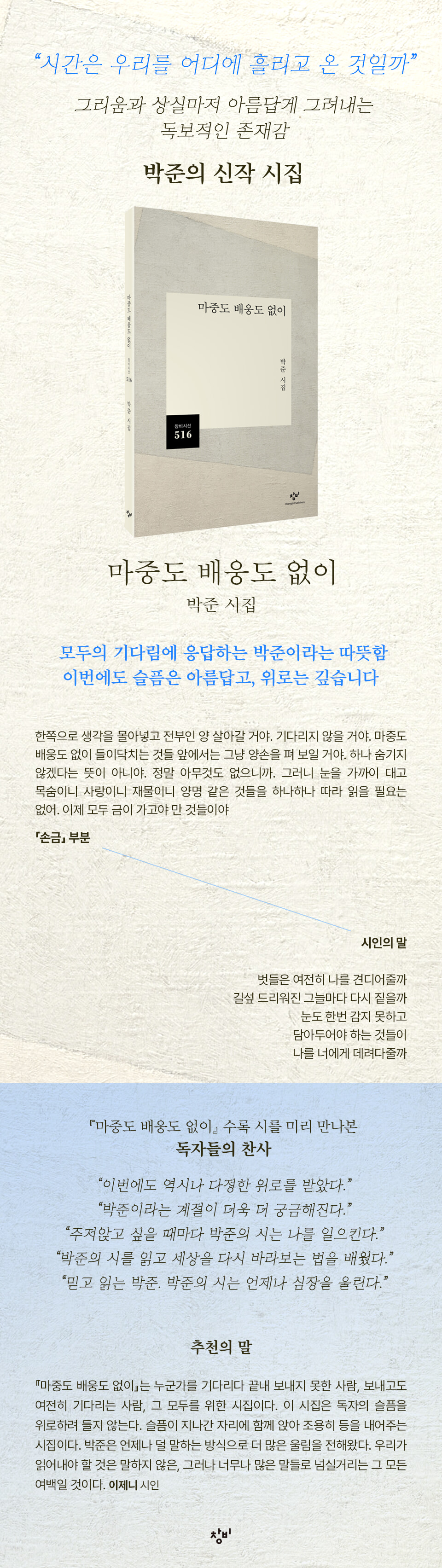
“Where has time taken us?”
The warmth of Park Jun, who responds to everyone's expectations
This time, the sorrow is beautiful and the comfort is deep.
Park Jun, who has broadened the scope of Korean poetry readers and demonstrated his unique presence with 『I Made Up Your Name and Ate It for Several Days』(Munhakdongne Publishing, 2012) and 『We Could See the Rainy Season Together』(Munhak and Jisungsa, 2018), has published his third poetry collection, 『Without Greeting or Seeing Off』.
The poet has proven his literary merit by winning numerous awards, including the Shin Dong-yup Literary Award, the Park Jae-sam Literary Award, the Pyeonun Literary Award, and the Today's Young Artist Award, for his unique lyricism in capturing the simple moments of everyday life with transparent language.
This collection of poems, presented after seven years, fully inherits the virtue of depicting even longing and loss with poignant beauty, while also displaying a level of perfection surpassing previous works through deeper reflection and more delicate poetic language.
In particular, the hand that caresses the empty space of things that have been missed in life and things that have been forgotten resonates with both the times and the individual, providing a special empathy.
As the saying goes, “A collection of poems that sits with you in the place where sorrow has passed and quietly turns its back” (recommendation, Lee Je-ni), the breath of comfort that Park Jun breathes into the lives that exist quietly is warmer than ever.
The warmth of Park Jun, who responds to everyone's expectations
This time, the sorrow is beautiful and the comfort is deep.
Park Jun, who has broadened the scope of Korean poetry readers and demonstrated his unique presence with 『I Made Up Your Name and Ate It for Several Days』(Munhakdongne Publishing, 2012) and 『We Could See the Rainy Season Together』(Munhak and Jisungsa, 2018), has published his third poetry collection, 『Without Greeting or Seeing Off』.
The poet has proven his literary merit by winning numerous awards, including the Shin Dong-yup Literary Award, the Park Jae-sam Literary Award, the Pyeonun Literary Award, and the Today's Young Artist Award, for his unique lyricism in capturing the simple moments of everyday life with transparent language.
This collection of poems, presented after seven years, fully inherits the virtue of depicting even longing and loss with poignant beauty, while also displaying a level of perfection surpassing previous works through deeper reflection and more delicate poetic language.
In particular, the hand that caresses the empty space of things that have been missed in life and things that have been forgotten resonates with both the times and the individual, providing a special empathy.
As the saying goes, “A collection of poems that sits with you in the place where sorrow has passed and quietly turns its back” (recommendation, Lee Je-ni), the breath of comfort that Park Jun breathes into the lives that exist quietly is warmer than ever.
- You can preview some of the book's contents.
Preview
index
Part 1 - Singing, Drawing, and Pointing
perception
missing child
move
water chestnut
Morning medicine
He said that in May, leaves would sprout. He couldn't tell if they would be white or green, but he said that in August, flowers would bloom.
Side by side forward
Palm
First ascension and first birth
Island language
Lighthouse at the End of the World 5
Soil
To where we are not
hold
Part 2 - It must be thinned out
seclusion
Even if
opening
My heart is like a sweet potato
Empty lot again
wall
Sobaek
White light below
Windy Hill
Love in a dream
They say the sky is high and high,
A scenery to cherish
dining table
Part 3 - Like a Water Lily Passing Through Winter
Daytime moon
Coalition
neighborhood
397-1 Papyeong-myeon, Paju-si, Gyeonggi-do
Neunggok Villa 3
side
feast
Peach Blossom
training
new habit
floor
Part 4 - Sunday Sunday Night
eye
greeting
Sunday Sunday night
Daytime speech
Horse of the Night
If
award
blacklist
On the way home
Donggang
Ganadara
pole
postmark
May
August
prose
The birthday and anniversary are too close
Commentary | Song Jong-won
Poet's words
perception
missing child
move
water chestnut
Morning medicine
He said that in May, leaves would sprout. He couldn't tell if they would be white or green, but he said that in August, flowers would bloom.
Side by side forward
Palm
First ascension and first birth
Island language
Lighthouse at the End of the World 5
Soil
To where we are not
hold
Part 2 - It must be thinned out
seclusion
Even if
opening
My heart is like a sweet potato
Empty lot again
wall
Sobaek
White light below
Windy Hill
Love in a dream
They say the sky is high and high,
A scenery to cherish
dining table
Part 3 - Like a Water Lily Passing Through Winter
Daytime moon
Coalition
neighborhood
397-1 Papyeong-myeon, Paju-si, Gyeonggi-do
Neunggok Villa 3
side
feast
Peach Blossom
training
new habit
floor
Part 4 - Sunday Sunday Night
eye
greeting
Sunday Sunday night
Daytime speech
Horse of the Night
If
award
blacklist
On the way home
Donggang
Ganadara
pole
postmark
May
August
prose
The birthday and anniversary are too close
Commentary | Song Jong-won
Poet's words
Detailed image
Into the book
My sorrow is under the tree
My sorry is on the lakeside
My fault lies in the slope.
I'm sorry under the tree
I repent at the lakeside
I am sad on the slope
What comes early is
It's always late
--- From "Perception"
When you're swept away by people and lose the hand you were holding, and even lose your bag somewhere, and you lose each other like that, you can't go anywhere else. You have to wait in the place where you first thought you were lost. You don't have to look for me. I'll find you.
--- From "Mia"
without a sound
Just by the shape of the mouth
If you sing along
In between
I'll forget the lyrics though
So only with the sound of the afterlife
I need to fill in the gaps though
Now who
Would you call this a mistake?
--- From "The First Rise and the First Rebirth"
My mother loves flowers, but she rarely goes out to see them. Last spring, she dismissed my suggestion to pass through Gurye and go to Hadong, and not long ago, she dismissed my suggestion to explore the fields of cosmos as a pointless endeavor. My mother's logic behind the futility of flower viewing is this: There are wild cherry trees and poplars on the mountain in front, an apricot tree in front of the house, and daffodils, peonies, roses, and zinnias blooming along the edges of the garden. In the fall, chrysanthemums bloom naturally along the roadside, so why bother going out to see flowers? My mother, who has lived her life treating a 10,000-won note as several times its value, seems to have learned how to save even her gaze. She says she treasures all the precious things in the world.
--- From "Scenery to be Treasured"
Was living warm?
Was the warmth alive?
Nothing was asked and nothing will be asked
With the thought that I don't have to make a promise
Like the first snow that breaks the dawn
If you come again
You come like that
--- From "The Feast"
A person boarding the bus asks, "Does it stop at the Ilshin Hospital funeral home?" and sits down. He then goes to the driver's seat and asks when the last train to Seoul is. He returns to his seat, looks out the window for a while, then goes back to the driver's seat and asks, "When is the first train tomorrow?"
--- From "On Sunday, Sunday Night"
Come sit in the sun
Paint the base
From bright colors
You who draw overlapping
If it's dark
I'll be the first to see
Just one breath
And since I came this far
Now we
It's getting blunter
We have to endure each other
My sorry is on the lakeside
My fault lies in the slope.
I'm sorry under the tree
I repent at the lakeside
I am sad on the slope
What comes early is
It's always late
--- From "Perception"
When you're swept away by people and lose the hand you were holding, and even lose your bag somewhere, and you lose each other like that, you can't go anywhere else. You have to wait in the place where you first thought you were lost. You don't have to look for me. I'll find you.
--- From "Mia"
without a sound
Just by the shape of the mouth
If you sing along
In between
I'll forget the lyrics though
So only with the sound of the afterlife
I need to fill in the gaps though
Now who
Would you call this a mistake?
--- From "The First Rise and the First Rebirth"
My mother loves flowers, but she rarely goes out to see them. Last spring, she dismissed my suggestion to pass through Gurye and go to Hadong, and not long ago, she dismissed my suggestion to explore the fields of cosmos as a pointless endeavor. My mother's logic behind the futility of flower viewing is this: There are wild cherry trees and poplars on the mountain in front, an apricot tree in front of the house, and daffodils, peonies, roses, and zinnias blooming along the edges of the garden. In the fall, chrysanthemums bloom naturally along the roadside, so why bother going out to see flowers? My mother, who has lived her life treating a 10,000-won note as several times its value, seems to have learned how to save even her gaze. She says she treasures all the precious things in the world.
--- From "Scenery to be Treasured"
Was living warm?
Was the warmth alive?
Nothing was asked and nothing will be asked
With the thought that I don't have to make a promise
Like the first snow that breaks the dawn
If you come again
You come like that
--- From "The Feast"
A person boarding the bus asks, "Does it stop at the Ilshin Hospital funeral home?" and sits down. He then goes to the driver's seat and asks when the last train to Seoul is. He returns to his seat, looks out the window for a while, then goes back to the driver's seat and asks, "When is the first train tomorrow?"
--- From "On Sunday, Sunday Night"
Come sit in the sun
Paint the base
From bright colors
You who draw overlapping
If it's dark
I'll be the first to see
Just one breath
And since I came this far
Now we
It's getting blunter
We have to endure each other
--- From "Peach Blossom"
Publisher's Review
A quiet but powerful sound,
A vibrant vitality created with affectionate warmth
The affectionate address to 'you' still shines.
Readers have felt a special affinity for the "you" in Park Jun's poetry, because the call transcends simple romantic feelings and reaches deep into the depths of one's being.
As seen in the phrase “It was I who decided on one answer/It was you who knew countless answers” (from “Return”), the poet’s “you” is “the high name of existence” (commentary, Song Jong-won).
By elevating those who are always by our side, “it not only leads the poet to learning, but also allows him to experience the sky within himself.” (Commentary) Perhaps because of this attitude, this collection of poems often places speakers on the periphery of life and in remote places.
It is richly filled with the language and lives of the simple yet sublime people found there.
The words and actions of these people, ordinary yet dignified, are reborn as genuine lyricism through the filter of Park Jun.
The realization that “life was not beyond, and only what could not be sung remains in my body” (from “Empty Space”) also shines thanks to this.
Park Jun's poetry is somewhat taciturn.
Rather than using a lot of words to express emotions at length, he approaches the reader by swallowing the words and allowing the emotions to seep into the space.
As in “Singing along silently/with only the shape of the mouth/without a sound” (“New Rise and New Birth”), it conveys the maximum resonance with the minimum of language.
This is a passage that shows that the poet has reached a certain level.
Just as the simple act of “I’m boiling a pot of rice cake soup” ends with “I can’t go to you yet” (“My Heart is Like Rice Cake”), the unsaid things speak louder than the spoken ones, allowing the reader to feel both the weight of loss and the sorrowful warmth within.
Song Jong-won described this as the poet's power to "make people happy through their monologue," and saw Park Jun as enduring "complete absence" while simultaneously sharing with readers the depth of emotion that blossoms from that void.
This brevity is not mere restraint, but evidence of the poet's mature attitude, which, even when confronted with the shortcomings of life, still maintains a warm gaze.
So, the readers look back at their own empty space when the speaker of the poem looks at his empty hands, saying, “There really is nothing there” (“Palm Fingers”), and then mutters, “I still have the words you left behind” (“Another Empty Lot”).
This collection of poems is all the more special because of its vitality that embraces and transcends loss.
Even in the face of “things that rush in without greeting or seeing off” (“Palm Palm”), it does not lose its deep-rooted vitality “like a lotus that survives winter” (“Water Lilies”).
This is different from shallow hopes or vain expectations of recovery.
Even in the empty space of loss, it is a power that exists quietly, like “a flowerpot that welcomes light, shade, wind, and rain” (“It was said that leaves would grow in May (…).”
It is this very power that teaches us to look deeply into the experience of loss and to fully embrace it as a part of life.
“『Without Greeting or Farewell』 is filled with words that quietly approach and linger.” (Recommendation) Even the sense of space here and there in the poetry collection provides readers with a richer sensibility.
Its quiet yet powerful resonance makes us reflect on the true meaning of life.
“I feel like I want to say hello to someone on an unfamiliar street” (“The birthday and the anniversary are so close”).
This is probably why many people read Park Jun's poetry with care.
The poet has carved his name into the hearts of even those who do not usually enjoy poetry.
All who have been waiting for his poetry will once again find their hearts immersed in the deep breath and silent love contained in this volume.
Poet's words
How far is the next road?
Will my friends still tolerate me?
Will the shadows cast on the roadside become darker again?
I can't even close my eyes
Things to keep in mind
Will you take me to you?
Spring 2025
Park Jun
A vibrant vitality created with affectionate warmth
The affectionate address to 'you' still shines.
Readers have felt a special affinity for the "you" in Park Jun's poetry, because the call transcends simple romantic feelings and reaches deep into the depths of one's being.
As seen in the phrase “It was I who decided on one answer/It was you who knew countless answers” (from “Return”), the poet’s “you” is “the high name of existence” (commentary, Song Jong-won).
By elevating those who are always by our side, “it not only leads the poet to learning, but also allows him to experience the sky within himself.” (Commentary) Perhaps because of this attitude, this collection of poems often places speakers on the periphery of life and in remote places.
It is richly filled with the language and lives of the simple yet sublime people found there.
The words and actions of these people, ordinary yet dignified, are reborn as genuine lyricism through the filter of Park Jun.
The realization that “life was not beyond, and only what could not be sung remains in my body” (from “Empty Space”) also shines thanks to this.
Park Jun's poetry is somewhat taciturn.
Rather than using a lot of words to express emotions at length, he approaches the reader by swallowing the words and allowing the emotions to seep into the space.
As in “Singing along silently/with only the shape of the mouth/without a sound” (“New Rise and New Birth”), it conveys the maximum resonance with the minimum of language.
This is a passage that shows that the poet has reached a certain level.
Just as the simple act of “I’m boiling a pot of rice cake soup” ends with “I can’t go to you yet” (“My Heart is Like Rice Cake”), the unsaid things speak louder than the spoken ones, allowing the reader to feel both the weight of loss and the sorrowful warmth within.
Song Jong-won described this as the poet's power to "make people happy through their monologue," and saw Park Jun as enduring "complete absence" while simultaneously sharing with readers the depth of emotion that blossoms from that void.
This brevity is not mere restraint, but evidence of the poet's mature attitude, which, even when confronted with the shortcomings of life, still maintains a warm gaze.
So, the readers look back at their own empty space when the speaker of the poem looks at his empty hands, saying, “There really is nothing there” (“Palm Fingers”), and then mutters, “I still have the words you left behind” (“Another Empty Lot”).
This collection of poems is all the more special because of its vitality that embraces and transcends loss.
Even in the face of “things that rush in without greeting or seeing off” (“Palm Palm”), it does not lose its deep-rooted vitality “like a lotus that survives winter” (“Water Lilies”).
This is different from shallow hopes or vain expectations of recovery.
Even in the empty space of loss, it is a power that exists quietly, like “a flowerpot that welcomes light, shade, wind, and rain” (“It was said that leaves would grow in May (…).”
It is this very power that teaches us to look deeply into the experience of loss and to fully embrace it as a part of life.
“『Without Greeting or Farewell』 is filled with words that quietly approach and linger.” (Recommendation) Even the sense of space here and there in the poetry collection provides readers with a richer sensibility.
Its quiet yet powerful resonance makes us reflect on the true meaning of life.
“I feel like I want to say hello to someone on an unfamiliar street” (“The birthday and the anniversary are so close”).
This is probably why many people read Park Jun's poetry with care.
The poet has carved his name into the hearts of even those who do not usually enjoy poetry.
All who have been waiting for his poetry will once again find their hearts immersed in the deep breath and silent love contained in this volume.
Poet's words
How far is the next road?
Will my friends still tolerate me?
Will the shadows cast on the roadside become darker again?
I can't even close my eyes
Things to keep in mind
Will you take me to you?
Spring 2025
Park Jun
GOODS SPECIFICS
- Date of issue: April 11, 2025
- Pages, weight, size: 112 pages | 196g | 125*200*12mm
- ISBN13: 9788936425166
You may also like
카테고리
korean


korean

![GQ KOREA Mark (Monthly): December [2025]](http://librairie.coreenne.fr/cdn/shop/files/8ef265dbbfbf186523ed75ba7319009d.jpg?v=1765340328&width=3840)


