

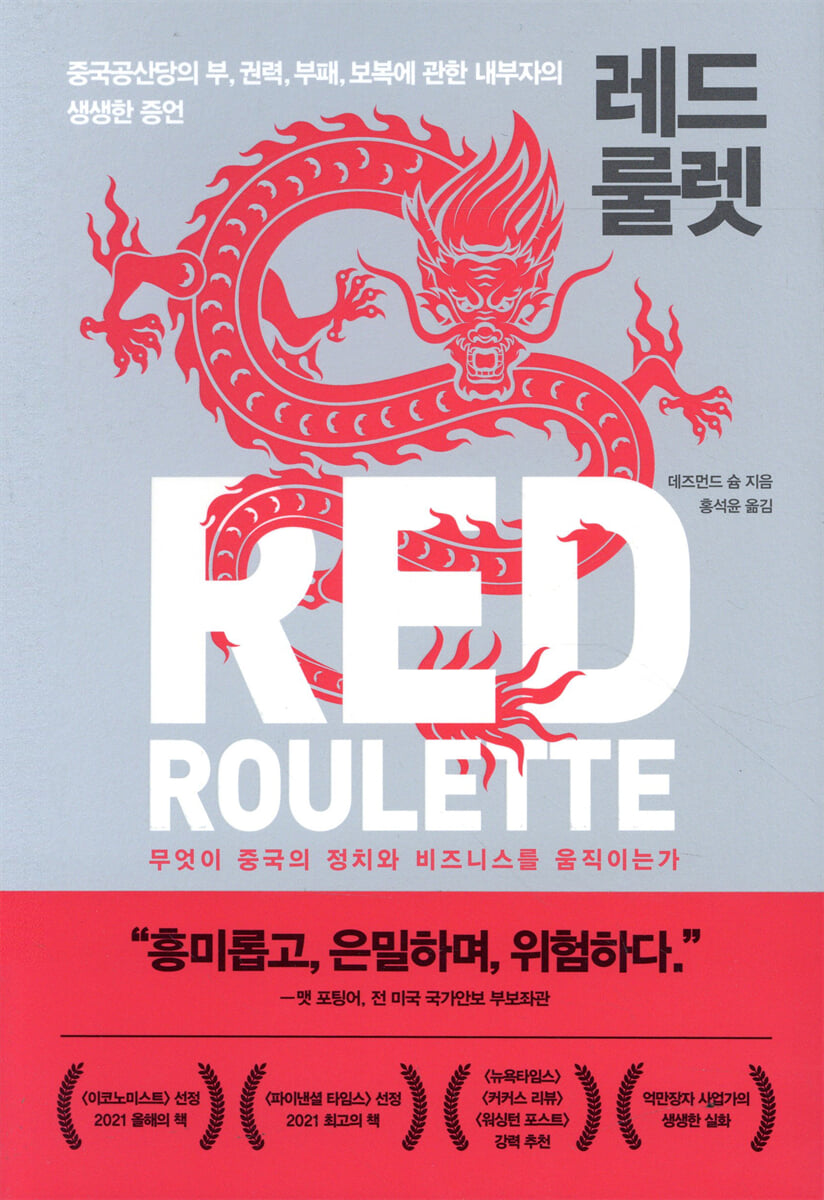
Red Roulette
 |
Description
Book Introduction
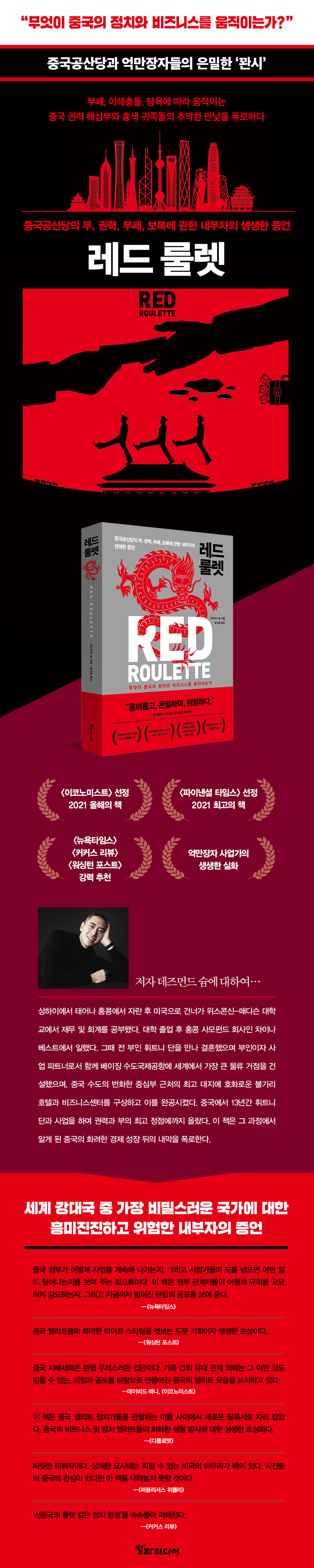
* [Economist] Book of the Year 2021
* [Financial Times] Best Books of 2021
* Highly recommended by [The New York Times], [Kirkus Reviews], and [The Washington Post]
* A vivid true story of a billionaire businessman
“What drives China’s politics and business?”
Driven by corruption, conflict of interest, and greed
Exposing the ugly truth about the Chinese power elite and the red aristocracy!
Powerful and shocking.
It's a book you can't put down from the moment you open the first page until you've read the last line.
What is surprising is that everything in this book is a vivid testimony from an insider and historical fact.
The author is a person who has amassed incredible wealth during China's economic renaissance, which saw it rise from one of the world's poorest countries to one of the G2.
The book begins with the sudden disappearance of his ex-wife, Whitney Dan, who had worked with the author on his rise to the pinnacle of wealth and connections with key figures in the Chinese Communist Party.
Why and where did she disappear?
This book exposes the ugly truth behind the disappearances that frequently occur in China, where the Communist Party monopolizes power, namely the Party and the red aristocracy (descendants of the families of the leaders of the communist elite group that seized power in China in 1949).
The author and his ex-wife were now faced with a harsh reality in their glamorous world of luxury and hedonism, where they chartered private jets touring Europe and indulged in ruthless luxury shopping sprees.
The author looks back on the dreamlike past and soberly assesses the past, present, and future of the Chinese Communist Party.
An inside look into the world's most secretive and absolute power.
This is perhaps the first book to expose the extremes of the Chinese Communist Party's power struggles and corruption, something that Chinese President Xi Jinping would most like to suppress by any means necessary. CNN commented, "China wants you to avoid reading this book."
In fact, just as the author was about to publish his book, Red Roulette, he received a sudden phone call from his wife, Whitney Dan, whose whereabouts had been unknown for four years.
He was briefly released and warned, "If you don't give up publishing this book, your life could be in danger."
However, the author took as his motto the words of the Northern Song Dynasty politician Fan Zhongyan, “I would rather die shouting than live with my mouth shut,” and wrote the book with courage, and finally the whole world learned about the corrupt nature of the Chinese Communist Party.
This is a must-read for anyone curious about the mechanisms that drive the Chinese Communist Party and its vast funds, and the direction China will take in the future.
* [Financial Times] Best Books of 2021
* Highly recommended by [The New York Times], [Kirkus Reviews], and [The Washington Post]
* A vivid true story of a billionaire businessman
“What drives China’s politics and business?”
Driven by corruption, conflict of interest, and greed
Exposing the ugly truth about the Chinese power elite and the red aristocracy!
Powerful and shocking.
It's a book you can't put down from the moment you open the first page until you've read the last line.
What is surprising is that everything in this book is a vivid testimony from an insider and historical fact.
The author is a person who has amassed incredible wealth during China's economic renaissance, which saw it rise from one of the world's poorest countries to one of the G2.
The book begins with the sudden disappearance of his ex-wife, Whitney Dan, who had worked with the author on his rise to the pinnacle of wealth and connections with key figures in the Chinese Communist Party.
Why and where did she disappear?
This book exposes the ugly truth behind the disappearances that frequently occur in China, where the Communist Party monopolizes power, namely the Party and the red aristocracy (descendants of the families of the leaders of the communist elite group that seized power in China in 1949).
The author and his ex-wife were now faced with a harsh reality in their glamorous world of luxury and hedonism, where they chartered private jets touring Europe and indulged in ruthless luxury shopping sprees.
The author looks back on the dreamlike past and soberly assesses the past, present, and future of the Chinese Communist Party.
An inside look into the world's most secretive and absolute power.
This is perhaps the first book to expose the extremes of the Chinese Communist Party's power struggles and corruption, something that Chinese President Xi Jinping would most like to suppress by any means necessary. CNN commented, "China wants you to avoid reading this book."
In fact, just as the author was about to publish his book, Red Roulette, he received a sudden phone call from his wife, Whitney Dan, whose whereabouts had been unknown for four years.
He was briefly released and warned, "If you don't give up publishing this book, your life could be in danger."
However, the author took as his motto the words of the Northern Song Dynasty politician Fan Zhongyan, “I would rather die shouting than live with my mouth shut,” and wrote the book with courage, and finally the whole world learned about the corrupt nature of the Chinese Communist Party.
This is a must-read for anyone curious about the mechanisms that drive the Chinese Communist Party and its vast funds, and the direction China will take in the future.
- You can preview some of the book's contents.
Preview
index
She disappeared while on the road to success.
Chapter 1 My Love, My Country
Chapter 2: Childhood in Hong Kong
Chapter 3: After studying in the US, back to Hong Kong
Chapter 4: China Wakes Up
Chapter 5: Meeting Whitney
Chapter 6: The Amazing Connection: Wen Jiabao's Wife
Chapter 7 Like a fish cleaning a crocodile's teeth
Chapter 8: The Beginning of 'Gwansi'
Chapter 9: Capital International Airport Project
Chapter 10: Ping An Stock Hits Big
Chapter 11: Joining the Super Rich
Chapter 12: The New Guanxi, Sun Zhengcai and Wang Qishan
Chapter 13: Meeting Xi Jinping
Chapter 14: A European Tour and a Shopping Frenzy
Chapter 15: The Chaos Caused by the "Palace in the Sky" Project
Chapter 16: The Power Struggle Between Xi Jinping and Bo Xilai
Chapter 17: The Chinese Communist Party Reveals Its True Colors
Chapter 18: Divorce, Leaving China Again
Author's Note: China Goes Backwards
Acknowledgements
Chapter 1 My Love, My Country
Chapter 2: Childhood in Hong Kong
Chapter 3: After studying in the US, back to Hong Kong
Chapter 4: China Wakes Up
Chapter 5: Meeting Whitney
Chapter 6: The Amazing Connection: Wen Jiabao's Wife
Chapter 7 Like a fish cleaning a crocodile's teeth
Chapter 8: The Beginning of 'Gwansi'
Chapter 9: Capital International Airport Project
Chapter 10: Ping An Stock Hits Big
Chapter 11: Joining the Super Rich
Chapter 12: The New Guanxi, Sun Zhengcai and Wang Qishan
Chapter 13: Meeting Xi Jinping
Chapter 14: A European Tour and a Shopping Frenzy
Chapter 15: The Chaos Caused by the "Palace in the Sky" Project
Chapter 16: The Power Struggle Between Xi Jinping and Bo Xilai
Chapter 17: The Chinese Communist Party Reveals Its True Colors
Chapter 18: Divorce, Leaving China Again
Author's Note: China Goes Backwards
Acknowledgements
Detailed image
Into the book
Finally, we found ourselves in a position of power in almost every sector of China, and we were able to exchange views with the new, rising powers of the bureaucracy.
We have been working to bring about social and political change to make China a better place.
I thought that if I did it well, I could do it very well.
Even a rough calculation shows that our total net worth amounts to tens of billions of dollars (trillions of won).
But now the Whitney band is gone.
When I contacted Whitney's home manager from my home in England, she said she had not returned from work that day in September 2017 and had not appeared since.
It was as if it had evaporated.
--- p.11
Whitney made a reservation for the meeting at Yuting, a trendy Cantonese restaurant in the basement of the Grand Hyatt Beijing.
The hotel was so extravagant that it seemed ostentatious, a symbolic representation of the ideals of 2000s China.
Custom-made luxury chairs, glossy ebony tables, Italian marble floors, and gold ornaments all blended together beautifully.
Among the guests were two Chinese men who had been present when Whitney first met her.
One of them was a so-called nouveau riche, dressed flashily, but somehow it didn't suit him.
He didn't even bother to take off the tag on his jacket sleeve to show off the brand of his clothes.
Another person, who appeared to be a Chinese official, avoided the camera, as if to avoid unwanted attention and jealousy.
Whitney and I arrived early to decide on the menu and preview the room she had reserved.
Whitney said that the person she was meeting today was an important adult whom she respected very much, and that she would reveal his identity after they finished eating.
I had no idea who she invited.
I could only guess that this meeting would have an impact on our future.
--- p.110~111
Wei had no objection to selling part of COSCO's stake to Whitney and, by extension, to Prime Minister Wen's family.
Although Wei did not make any special demands, he may have thought that, as an executive leading a state-run enterprise, currying favor with the Prime Minister's family might serve his own purposes later.
With Prime Minister Yuan's influence, we began internal preparations to purchase a portion of COSCO's shares.
Wei wanted to sell 3 percent of Ping An's shares.
We thought we would buy 1 percent and Aunt Jang would be interested in the remaining 2 percent.
Since this was our first joint project with Aunt Jang and it was going to be a one-time investment, we didn't apply the 70/30 rule.
Moreover, we did not even have enough capital to acquire a 1 percent stake.
It wasn't a sweet deal.
They offered to sell the stock at 10 percent above the net asset value calculated by the accounting firm.
At the time, similarly priced stocks were being negotiated, but none of them came to fruition.
Goldman Sachs, the American investment bank that bought a 10 percent stake in Ping An for $35 million in 1993, also tried to sell its stake around the same time but failed to find a buyer.
So Goldman sold Ping An's shares for a pittance to a then-unknown company called Alibaba (which would later grow into the world's largest e-commerce company). Had Goldman held onto these shares, he could have made hundreds of billions of dollars.
--- p.148~149
In a system where the laws that define what is legal and what is prohibited are often gray (meaning the Communist Party applies them as it sees fit), fostering a sense of belonging was crucial.
Because every time we tried to do something new, we had to wrestle with these gray laws.
In the West, laws are generally clear and courts are independent, so it's easy to see where the line between legal and illegal is.
But in China, the laws themselves are deliberately vague, constantly changing, and sometimes applied retroactively at will.
Moreover, the courts were merely instruments of party control.
This is why we need to build a sense of belonging.
So, if you want to convince the officials that your business is legal and not in violation of the law, you must first convince them to trust you.
Only then can you make it happen and become successful.
--- p.197
The Communist Party Secretary of Tsinghua University was a man named Chen Xi, a Tsinghua University graduate who studied at Stanford University in the United States for two years in the early 1990s.
All universities in China are run by the Chinese Communist Party and have a party secretary. The party secretary of a university, as well as of a primary, middle, and high school, has much more power than the president, dean, or principal.
Just as the General Secretary of the Communist Party ranks above the Prime Minister in the political system, so too does the Party Secretary rank highest in every school, state-owned enterprise, and research institute in China.
Cheon-shi worked as a professor at Tsinghua University for 20 years.
Appointed Secretary of Tsinghua University in 2002, he enjoyed strong support within the Communist Party.
He was close with Xi Jinping, who was the party's rising star at the time.
In fact, in the late 1970s, when Chen Xi and Xi Jinping attended Tsinghua University, they were dorm roommates.
When Xi Jinping was appointed governor of Fujian Province in 1999, he offered Chen Xi the position of vice governor, but Chen Xi declined.
While always loyal to Xi Jinping, Chen Shi walked his own path.
He was already established as a big shot in Beijing, so why would he turn down a good position and go to a distant province to become a vice-governor?
--- p.240
While Zhao Lin's smuggling activities continued, his wife (David's mother-in-law), Lin Yufang, worked as the president of the largest state-owned import-export company in Fujian Province.
I heard that when this incident broke out in 1999, Lin Yufang, who was once a leading figure in various party events, suffered from a nervous breakdown and aphasia out of fear that she and her husband would be caught up in the investigation, and was hospitalized in Beijing for several years.
However, neither man was indicted.
This once again clearly shows that in China, it is not who did what, but how powerful the connections are that matter.
--- p.267
The first problem with traveling around Europe was how to get around.
By this time, Whitney was enjoying traveling by private jet, and we had already ordered a $43 million Gulfstream G500 airplane from the American aircraft manufacturer Gulfstream Aerospace.
So we suggested that we take a private jet.
David agreed, saying that for convenience there should be three jets.
Finally, in June 2011, the four of us headed to Paris.
The plan was to split the trip into three jets, but at the last minute the men chartered two more jets, saying they wanted to play card games during the trip.
Two jets followed us, empty.
Here too, the good looks played an important role.
“If you charter one more jet, we have to charter one more.
“Because something might come up at the company and someone might have to come back first.”
--- p.274~275
Anyone with even a passing understanding of China would clearly see that the successive purges of Ling Jihua and Sun Zhengcai were not due to corruption.
It was nothing more than a political maneuver.
But Xi Jinping's anti-corruption campaign has avoided many of the red aristocrats he wants to deal with, especially those linked to Jiang Zemin, who leads the Shanghai faction.
In January 2014, the party ordered the closure of Beijing's high-end nightclubs.
But David's Maotai Club did not close.
David's father-in-law, Jia Qinglin, was one of Jiang Zemin's closest associates.
Because Jiang Zemin's support played a decisive role in Xi Jinping's rise.
We have been working to bring about social and political change to make China a better place.
I thought that if I did it well, I could do it very well.
Even a rough calculation shows that our total net worth amounts to tens of billions of dollars (trillions of won).
But now the Whitney band is gone.
When I contacted Whitney's home manager from my home in England, she said she had not returned from work that day in September 2017 and had not appeared since.
It was as if it had evaporated.
--- p.11
Whitney made a reservation for the meeting at Yuting, a trendy Cantonese restaurant in the basement of the Grand Hyatt Beijing.
The hotel was so extravagant that it seemed ostentatious, a symbolic representation of the ideals of 2000s China.
Custom-made luxury chairs, glossy ebony tables, Italian marble floors, and gold ornaments all blended together beautifully.
Among the guests were two Chinese men who had been present when Whitney first met her.
One of them was a so-called nouveau riche, dressed flashily, but somehow it didn't suit him.
He didn't even bother to take off the tag on his jacket sleeve to show off the brand of his clothes.
Another person, who appeared to be a Chinese official, avoided the camera, as if to avoid unwanted attention and jealousy.
Whitney and I arrived early to decide on the menu and preview the room she had reserved.
Whitney said that the person she was meeting today was an important adult whom she respected very much, and that she would reveal his identity after they finished eating.
I had no idea who she invited.
I could only guess that this meeting would have an impact on our future.
--- p.110~111
Wei had no objection to selling part of COSCO's stake to Whitney and, by extension, to Prime Minister Wen's family.
Although Wei did not make any special demands, he may have thought that, as an executive leading a state-run enterprise, currying favor with the Prime Minister's family might serve his own purposes later.
With Prime Minister Yuan's influence, we began internal preparations to purchase a portion of COSCO's shares.
Wei wanted to sell 3 percent of Ping An's shares.
We thought we would buy 1 percent and Aunt Jang would be interested in the remaining 2 percent.
Since this was our first joint project with Aunt Jang and it was going to be a one-time investment, we didn't apply the 70/30 rule.
Moreover, we did not even have enough capital to acquire a 1 percent stake.
It wasn't a sweet deal.
They offered to sell the stock at 10 percent above the net asset value calculated by the accounting firm.
At the time, similarly priced stocks were being negotiated, but none of them came to fruition.
Goldman Sachs, the American investment bank that bought a 10 percent stake in Ping An for $35 million in 1993, also tried to sell its stake around the same time but failed to find a buyer.
So Goldman sold Ping An's shares for a pittance to a then-unknown company called Alibaba (which would later grow into the world's largest e-commerce company). Had Goldman held onto these shares, he could have made hundreds of billions of dollars.
--- p.148~149
In a system where the laws that define what is legal and what is prohibited are often gray (meaning the Communist Party applies them as it sees fit), fostering a sense of belonging was crucial.
Because every time we tried to do something new, we had to wrestle with these gray laws.
In the West, laws are generally clear and courts are independent, so it's easy to see where the line between legal and illegal is.
But in China, the laws themselves are deliberately vague, constantly changing, and sometimes applied retroactively at will.
Moreover, the courts were merely instruments of party control.
This is why we need to build a sense of belonging.
So, if you want to convince the officials that your business is legal and not in violation of the law, you must first convince them to trust you.
Only then can you make it happen and become successful.
--- p.197
The Communist Party Secretary of Tsinghua University was a man named Chen Xi, a Tsinghua University graduate who studied at Stanford University in the United States for two years in the early 1990s.
All universities in China are run by the Chinese Communist Party and have a party secretary. The party secretary of a university, as well as of a primary, middle, and high school, has much more power than the president, dean, or principal.
Just as the General Secretary of the Communist Party ranks above the Prime Minister in the political system, so too does the Party Secretary rank highest in every school, state-owned enterprise, and research institute in China.
Cheon-shi worked as a professor at Tsinghua University for 20 years.
Appointed Secretary of Tsinghua University in 2002, he enjoyed strong support within the Communist Party.
He was close with Xi Jinping, who was the party's rising star at the time.
In fact, in the late 1970s, when Chen Xi and Xi Jinping attended Tsinghua University, they were dorm roommates.
When Xi Jinping was appointed governor of Fujian Province in 1999, he offered Chen Xi the position of vice governor, but Chen Xi declined.
While always loyal to Xi Jinping, Chen Shi walked his own path.
He was already established as a big shot in Beijing, so why would he turn down a good position and go to a distant province to become a vice-governor?
--- p.240
While Zhao Lin's smuggling activities continued, his wife (David's mother-in-law), Lin Yufang, worked as the president of the largest state-owned import-export company in Fujian Province.
I heard that when this incident broke out in 1999, Lin Yufang, who was once a leading figure in various party events, suffered from a nervous breakdown and aphasia out of fear that she and her husband would be caught up in the investigation, and was hospitalized in Beijing for several years.
However, neither man was indicted.
This once again clearly shows that in China, it is not who did what, but how powerful the connections are that matter.
--- p.267
The first problem with traveling around Europe was how to get around.
By this time, Whitney was enjoying traveling by private jet, and we had already ordered a $43 million Gulfstream G500 airplane from the American aircraft manufacturer Gulfstream Aerospace.
So we suggested that we take a private jet.
David agreed, saying that for convenience there should be three jets.
Finally, in June 2011, the four of us headed to Paris.
The plan was to split the trip into three jets, but at the last minute the men chartered two more jets, saying they wanted to play card games during the trip.
Two jets followed us, empty.
Here too, the good looks played an important role.
“If you charter one more jet, we have to charter one more.
“Because something might come up at the company and someone might have to come back first.”
--- p.274~275
Anyone with even a passing understanding of China would clearly see that the successive purges of Ling Jihua and Sun Zhengcai were not due to corruption.
It was nothing more than a political maneuver.
But Xi Jinping's anti-corruption campaign has avoided many of the red aristocrats he wants to deal with, especially those linked to Jiang Zemin, who leads the Shanghai faction.
In January 2014, the party ordered the closure of Beijing's high-end nightclubs.
But David's Maotai Club did not close.
David's father-in-law, Jia Qinglin, was one of Jiang Zemin's closest associates.
Because Jiang Zemin's support played a decisive role in Xi Jinping's rise.
-- p.335~336
Publisher's Review
The power struggle at the highest level of the Chinese Communist Party
A sharp exploration of the web of collusion between politics and business!
About the most secretive country among the world's great powers
An exciting and dangerous insider's testimony!
The author of this book, Desmond Shum, rose to the heights of power and wealth in China with his now-divorced wife, Whitney Dan, only to lose it all in an instant.
Whitney disappeared four years ago, but this book led to her dramatic reappearance.
The author was born in Shanghai, China, spent his childhood there, and moved to Hong Kong with his parents.
And as he experienced poverty in the unfamiliar environment of capitalism, which he had never encountered before, he resolved that his future would be different.
He earned his degree in the United States through persistent effort and diligence, returned to his home country, worked at an investment firm, and then started his own business.
And then, as if by fate, he meets his smart wife, Whitney Dan, who is as ambitious as he is.
The couple share a dream of accomplishing something historic for China.
Whitney demonstrates a remarkable ability to establish 'guanxi' with the core powers of the Chinese Communist Party, leading the author into the world of the red aristocracy.
They developed a massive aviation logistics facility at Beijing Capital International Airport and conceived and completed Beijing's premier Bulgari Hotel and business center building.
They also live lavishly, traveling on private jets, donating millions of dollars in scholarships, and purchasing expensive homes, cars, and art.
Before she disappeared, their combined net worth was worth tens of billions of dollars (trillions of won).
However, the couple clashed over issues such as who would take the lead in the business and how to direct it, and eventually ended up divorcing.
Then, in 2017, while Desmond was in England with his son, he heard that Whitney had suddenly disappeared along with three of her colleagues.
Their fates take completely different paths.
This book features key Chinese leaders, including Wen Jiabao, Bo Xilai, Zhou Yongkang, Ling Jihua, Sun Zhengcai, and Xi Jinping.
The author and Whitney's 'Gwansi' stories of the many key power figures unfold in an exciting way.
This book, which reads like a novel but is based on a vivid true story, sharply shows how the Communist Party leadership is a huge interest group, how they divide up vested interests, how business relationships are formed in China, and how those in power accumulate wealth, through what the author saw, heard, and experienced while doing business with his wife.
I knew that to open the door to success in China, I needed two keys.
The first key was political savvy.
In China, entrepreneurs could only succeed if they catered to the interests of the Communist Party.
Whether you're a corner store owner or a tech genius in China's Silicon Valley, any business needs a sponsor within this system.
The second key was the ability to execute when the opportunity came.
You need to have both of these keys to succeed in China.
That's the crux of the story that Whitney started and that I joined in with.
-From the text
The Chinese Communist Party and its billionaires' secret "guanxi"
In China, politics was a shortcut to wealth.
The author and Whitney Dan cited 'guanxi' as the most difficult aspect when conducting various real estate development projects in China.
Like all Chinese businesspeople, he had to pay extremely close attention to the central government's macroeconomic policies and political whims, and whenever he sought approval from each ministry, he had to demonstrate how his work aligned with the political and economic priorities of the Chinese Communist Party.
At this time, all approvals are possible only if you have a connection.
They confess:
We played a similar game with many other bureaucrats.
All approvals were possible only with connections.
Every connection meant investing in personal relationships, which meant a lot of effort and more Maotai.
The most difficult part of running our business was building personal connections and establishing a rapport.
-From the text
Growing up in Hong Kong and studying in the United States, the author initially found it incomprehensible, but gradually learned that by establishing certain connections within the Chinese power structure, known as guanxi, one could circumvent all laws and regulations.
A contract is not something that is concluded in a short period of time like a contract.
It's a human-to-human relationship, it takes a long time to build, and it takes genuine interest in the person.
There were so many places that needed that kind of advice.
Whitney tells in detail from the beginning how she met Zhang Peili, the wife of then-Vice Premier Wen Jiabao.
Although she calls her 'Aunt Jang' and seems to have a relationship like that of a daughter, it can never be an equal relationship.
The author and Whitney always tried to anticipate and fulfill Aunt Jang's desires that even she herself was unaware of.
Eventually, they gained power in almost every area of China, and found themselves in the company of the rising new bureaucrats, their wealth growing to an unfathomable degree.
Shouting the Chinese dream and becoming the new emperor
Xi Jinping and China's future on the path to permanent rule
And until he rose to the pinnacle of power
The story behind the life-or-death struggle for power!
China has entered a new phase of change that is completely different from the past.
Xi Jinping has become a leader of a different status from former Presidents Jiang Zemin and Hu Jintao.
He was ranked among the best, along with Mao Zedong, who founded the Chinese Communist Party, and Deng Xiaoping, who led the reform and opening up.
Deng Xiaoping stipulated in the constitution a system of two five-year terms for the president to prevent the evils of the Mao Zedong era's cult of one man and long-term rule, but Xi Jinping has already implemented a constitutional amendment to remove the term limit and will begin his third term in November 2022.
It would not be an exaggeration to say that China has emerged as a new emperor, a power on par with the United States, based on its rapidly growing economic power.
And changes are beginning to be felt in the Chinese Communist Party's attitude toward entrepreneurs.
The author of this book vividly describes how Xi Jinping eliminated his archrival Bo Xilai and rose to the pinnacle of power.
This book provides a glimpse into the fierce internal power struggle and detailed circumstances unknown to outsiders.
The scene where Whitney, who was an intimate 'guanxi' of Wen Jiabao's wife, describes a meal with Xi Jinping, who entered Beijing as a rookie politician, is impressive.
And the story of how countless figures, including Bo Xilai and Zhou Yongkang, were purged during Xi Jinping's rise to power is so fascinating that it feels almost tense.
And you can feel the distinct limitations of Chinese society.
If Ling Jihua and Sun Zhengcai had not been purged, they would be members of the Politburo Standing Committee today.
And the Chinese Communist Party would have maintained the structure of the collective leadership system organized by Deng Xiaoping in the 1980s.
Of course, it wasn't a perfect system, but it prevented a return to the past when Chairman Mao Zedong wielded absolute power.
But now, with all his rivals and potential successors marginalized or jailed, Xi Jinping is moving to centralize even more power.
In March 2018, Xi Jinping forced through amendments to China's constitution, abolishing term limits for the president and paving the way for him to become emperor for life.
-From the text
This is a must-read for anyone curious about how the Chinese government has operated since 1945 and where it will continue to operate, and the lavish lifestyles and corruption of China's business and political elite.
I hope many readers will join author Desmond Shum in his brilliant, urgent, and heartbreaking story.
You will be able to get a good look at the previously unknown face of China.
A sharp exploration of the web of collusion between politics and business!
About the most secretive country among the world's great powers
An exciting and dangerous insider's testimony!
The author of this book, Desmond Shum, rose to the heights of power and wealth in China with his now-divorced wife, Whitney Dan, only to lose it all in an instant.
Whitney disappeared four years ago, but this book led to her dramatic reappearance.
The author was born in Shanghai, China, spent his childhood there, and moved to Hong Kong with his parents.
And as he experienced poverty in the unfamiliar environment of capitalism, which he had never encountered before, he resolved that his future would be different.
He earned his degree in the United States through persistent effort and diligence, returned to his home country, worked at an investment firm, and then started his own business.
And then, as if by fate, he meets his smart wife, Whitney Dan, who is as ambitious as he is.
The couple share a dream of accomplishing something historic for China.
Whitney demonstrates a remarkable ability to establish 'guanxi' with the core powers of the Chinese Communist Party, leading the author into the world of the red aristocracy.
They developed a massive aviation logistics facility at Beijing Capital International Airport and conceived and completed Beijing's premier Bulgari Hotel and business center building.
They also live lavishly, traveling on private jets, donating millions of dollars in scholarships, and purchasing expensive homes, cars, and art.
Before she disappeared, their combined net worth was worth tens of billions of dollars (trillions of won).
However, the couple clashed over issues such as who would take the lead in the business and how to direct it, and eventually ended up divorcing.
Then, in 2017, while Desmond was in England with his son, he heard that Whitney had suddenly disappeared along with three of her colleagues.
Their fates take completely different paths.
This book features key Chinese leaders, including Wen Jiabao, Bo Xilai, Zhou Yongkang, Ling Jihua, Sun Zhengcai, and Xi Jinping.
The author and Whitney's 'Gwansi' stories of the many key power figures unfold in an exciting way.
This book, which reads like a novel but is based on a vivid true story, sharply shows how the Communist Party leadership is a huge interest group, how they divide up vested interests, how business relationships are formed in China, and how those in power accumulate wealth, through what the author saw, heard, and experienced while doing business with his wife.
I knew that to open the door to success in China, I needed two keys.
The first key was political savvy.
In China, entrepreneurs could only succeed if they catered to the interests of the Communist Party.
Whether you're a corner store owner or a tech genius in China's Silicon Valley, any business needs a sponsor within this system.
The second key was the ability to execute when the opportunity came.
You need to have both of these keys to succeed in China.
That's the crux of the story that Whitney started and that I joined in with.
-From the text
The Chinese Communist Party and its billionaires' secret "guanxi"
In China, politics was a shortcut to wealth.
The author and Whitney Dan cited 'guanxi' as the most difficult aspect when conducting various real estate development projects in China.
Like all Chinese businesspeople, he had to pay extremely close attention to the central government's macroeconomic policies and political whims, and whenever he sought approval from each ministry, he had to demonstrate how his work aligned with the political and economic priorities of the Chinese Communist Party.
At this time, all approvals are possible only if you have a connection.
They confess:
We played a similar game with many other bureaucrats.
All approvals were possible only with connections.
Every connection meant investing in personal relationships, which meant a lot of effort and more Maotai.
The most difficult part of running our business was building personal connections and establishing a rapport.
-From the text
Growing up in Hong Kong and studying in the United States, the author initially found it incomprehensible, but gradually learned that by establishing certain connections within the Chinese power structure, known as guanxi, one could circumvent all laws and regulations.
A contract is not something that is concluded in a short period of time like a contract.
It's a human-to-human relationship, it takes a long time to build, and it takes genuine interest in the person.
There were so many places that needed that kind of advice.
Whitney tells in detail from the beginning how she met Zhang Peili, the wife of then-Vice Premier Wen Jiabao.
Although she calls her 'Aunt Jang' and seems to have a relationship like that of a daughter, it can never be an equal relationship.
The author and Whitney always tried to anticipate and fulfill Aunt Jang's desires that even she herself was unaware of.
Eventually, they gained power in almost every area of China, and found themselves in the company of the rising new bureaucrats, their wealth growing to an unfathomable degree.
Shouting the Chinese dream and becoming the new emperor
Xi Jinping and China's future on the path to permanent rule
And until he rose to the pinnacle of power
The story behind the life-or-death struggle for power!
China has entered a new phase of change that is completely different from the past.
Xi Jinping has become a leader of a different status from former Presidents Jiang Zemin and Hu Jintao.
He was ranked among the best, along with Mao Zedong, who founded the Chinese Communist Party, and Deng Xiaoping, who led the reform and opening up.
Deng Xiaoping stipulated in the constitution a system of two five-year terms for the president to prevent the evils of the Mao Zedong era's cult of one man and long-term rule, but Xi Jinping has already implemented a constitutional amendment to remove the term limit and will begin his third term in November 2022.
It would not be an exaggeration to say that China has emerged as a new emperor, a power on par with the United States, based on its rapidly growing economic power.
And changes are beginning to be felt in the Chinese Communist Party's attitude toward entrepreneurs.
The author of this book vividly describes how Xi Jinping eliminated his archrival Bo Xilai and rose to the pinnacle of power.
This book provides a glimpse into the fierce internal power struggle and detailed circumstances unknown to outsiders.
The scene where Whitney, who was an intimate 'guanxi' of Wen Jiabao's wife, describes a meal with Xi Jinping, who entered Beijing as a rookie politician, is impressive.
And the story of how countless figures, including Bo Xilai and Zhou Yongkang, were purged during Xi Jinping's rise to power is so fascinating that it feels almost tense.
And you can feel the distinct limitations of Chinese society.
If Ling Jihua and Sun Zhengcai had not been purged, they would be members of the Politburo Standing Committee today.
And the Chinese Communist Party would have maintained the structure of the collective leadership system organized by Deng Xiaoping in the 1980s.
Of course, it wasn't a perfect system, but it prevented a return to the past when Chairman Mao Zedong wielded absolute power.
But now, with all his rivals and potential successors marginalized or jailed, Xi Jinping is moving to centralize even more power.
In March 2018, Xi Jinping forced through amendments to China's constitution, abolishing term limits for the president and paving the way for him to become emperor for life.
-From the text
This is a must-read for anyone curious about how the Chinese government has operated since 1945 and where it will continue to operate, and the lavish lifestyles and corruption of China's business and political elite.
I hope many readers will join author Desmond Shum in his brilliant, urgent, and heartbreaking story.
You will be able to get a good look at the previously unknown face of China.
GOODS SPECIFICS
- Publication date: March 28, 2022
- Page count, weight, size: 364 pages | 442g | 145*210*30mm
- ISBN13: 9791191122312
- ISBN10: 119112231X
You may also like
카테고리
korean


korean

![GQ KOREA Mark (Monthly): December [2025]](http://librairie.coreenne.fr/cdn/shop/files/8ef265dbbfbf186523ed75ba7319009d.jpg?v=1765340328&width=3840)


