

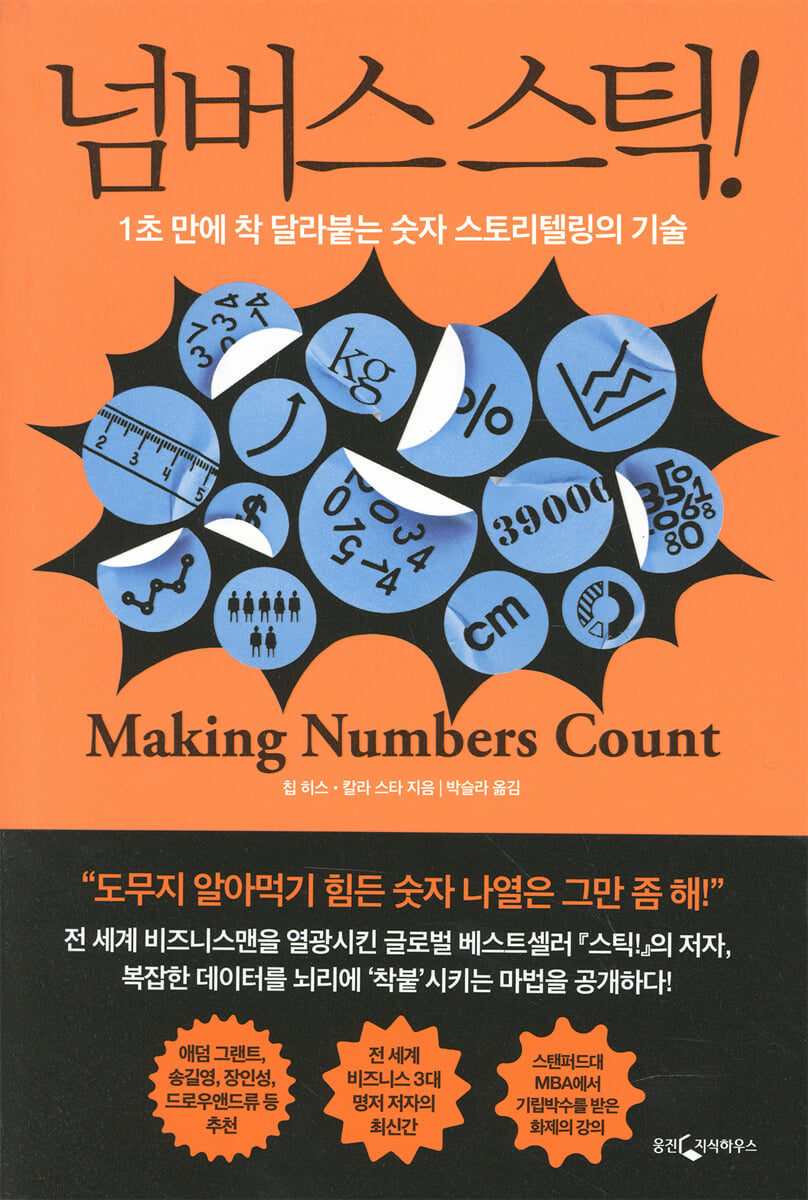
Number Stick!
 |
Description
Book Introduction
- A word from MD
-
Numbers stick to the brain!"Stick!", one of the top three must-read business books that introduces unforgettable message design methods, is now back with numbers.
In today's world where data-driven decision-making and strategy are essential, let's explore the art of storytelling, transforming complex numerical data into powerful, memorable and unforgettable messages.
September 23, 2022. Economics and Management PD Kim Sang-geun
Recommended by Adam Grant, Song Gil-young, Jang In-seong, and Draw Andrew.
The latest book from the author of one of the three most famous business books, "Stick!", and a popular lecture at Stanford University.
“Stop listing numbers that are so hard to understand!”
Chip Heath, the greatest organizational behavior professor of this century,
Revealing the magic of 'sticking' complex data to your brain!
“A book for people who are good at their jobs! This is an important skill to have.
“It’s surprising that there hasn’t been a book explaining this before.” _Jang In-seong (CBO, Woowa Brothers)
Stanford University organizational behavior professor Chip Heath, co-author of the global bestseller "Stick!", which created the "sticky message" that sticks in one second and captivated businessmen around the world, has returned to Korean readers with his new book, "Numbers Stick!" (Making Numbers Count).
This time it's numbers.
It contains the ultimate evolution of message design that transforms headache-inducing data into powerful, irresistible messages that stick to the brain in just one second.
In an age where no decision can be made without numbers, not just in reports, presentations, and marketing campaigns, only those who master "numerical storytelling" can win hearts and minds.
From Steve Jobs' magical presentation that made MacBooks look thinner, to Microsoft's secret to doubling users' numerical memory, and historical examples like Florence Nightingale saving lives on the battlefield with dry statistics, to examples of each country's campaigns for social distancing during COVID-19... the secrets of the super-powerful messages that move the world are all contained in this one book.
This book will be a powerful weapon for all businesspeople in this day and age who must persuade others with data.
The latest book from the author of one of the three most famous business books, "Stick!", and a popular lecture at Stanford University.
“Stop listing numbers that are so hard to understand!”
Chip Heath, the greatest organizational behavior professor of this century,
Revealing the magic of 'sticking' complex data to your brain!
“A book for people who are good at their jobs! This is an important skill to have.
“It’s surprising that there hasn’t been a book explaining this before.” _Jang In-seong (CBO, Woowa Brothers)
Stanford University organizational behavior professor Chip Heath, co-author of the global bestseller "Stick!", which created the "sticky message" that sticks in one second and captivated businessmen around the world, has returned to Korean readers with his new book, "Numbers Stick!" (Making Numbers Count).
This time it's numbers.
It contains the ultimate evolution of message design that transforms headache-inducing data into powerful, irresistible messages that stick to the brain in just one second.
In an age where no decision can be made without numbers, not just in reports, presentations, and marketing campaigns, only those who master "numerical storytelling" can win hearts and minds.
From Steve Jobs' magical presentation that made MacBooks look thinner, to Microsoft's secret to doubling users' numerical memory, and historical examples like Florence Nightingale saving lives on the battlefield with dry statistics, to examples of each country's campaigns for social distancing during COVID-19... the secrets of the super-powerful messages that move the world are all contained in this one book.
This book will be a powerful weapon for all businesspeople in this day and age who must persuade others with data.
- You can preview some of the book's contents.
Preview
index
Recommendation
Enter complex numbers, if you can't avoid them, write them properly.
Chapter 1 | Translate All the Numbers
How to approach the foreign language of numbers
All numbers can be translated
Avoid numbers
There is power in 1 - Beyond the trap of gigantism
Find user-friendly numbers
Chapter 2 | Finding Numbers Close to Everyday Life
Make numbers familiar, concrete, and human
Compare with something simple and familiar
From abstract numbers to concrete objects
Convert numbers into various units—time, space, distance, money, and even Pringles.
Human scale, people are the standard
Chapter 3 | Add Emotion to Numbers
How to Change Your Thinking and Behavior with Numbers
Nightingale, who saved lives with numbers
Comparison, absolute best, beyond categories
There's a different emotional combination that hits the nail on the head.
“This is not a number.
“It’s your story.”
Demonstrate the numbers
The weight of statistics comes from the process.
Encore Technique, Deliver the Final Blow
Expectations are meant to be shattered
Chapter 4 | Make Numbers Miniature
There are numbers that are easy to handle
Draw a map so you don't get lost.
The time map is the best map
Create easy-to-handle miniatures
As you can see, no one is weak when it comes to numbers.
Appendix 3 Translation Principles for Number Sticker Messages
main
Enter complex numbers, if you can't avoid them, write them properly.
Chapter 1 | Translate All the Numbers
How to approach the foreign language of numbers
All numbers can be translated
Avoid numbers
There is power in 1 - Beyond the trap of gigantism
Find user-friendly numbers
Chapter 2 | Finding Numbers Close to Everyday Life
Make numbers familiar, concrete, and human
Compare with something simple and familiar
From abstract numbers to concrete objects
Convert numbers into various units—time, space, distance, money, and even Pringles.
Human scale, people are the standard
Chapter 3 | Add Emotion to Numbers
How to Change Your Thinking and Behavior with Numbers
Nightingale, who saved lives with numbers
Comparison, absolute best, beyond categories
There's a different emotional combination that hits the nail on the head.
“This is not a number.
“It’s your story.”
Demonstrate the numbers
The weight of statistics comes from the process.
Encore Technique, Deliver the Final Blow
Expectations are meant to be shattered
Chapter 4 | Make Numbers Miniature
There are numbers that are easy to handle
Draw a map so you don't get lost.
The time map is the best map
Create easy-to-handle miniatures
As you can see, no one is weak when it comes to numbers.
Appendix 3 Translation Principles for Number Sticker Messages
main
Detailed image
Into the book
There is an experiment that can help you easily understand the difference between '1 million' and '1 billion'.
Imagine you and your friends are participating in a lottery game with a huge jackpot.
However, there is one condition: if you win the raffle, you must spend $50,000 (approximately 65.7 million won - translator's note) every day until you run out of the prize money.
Then you win a million dollars, and your friend wins a billion dollars.
How long will it take you and your friend to spend all your winnings?
---From "Entering"
This book is based on simple observations.
We cannot properly perceive information unless we translate numbers into intuitively recognizable human experiences.
We work very hard, sometimes desperately, to come up with the right numbers to help us make the right decisions, but if the numbers don't stick firmly in the minds of decision makers, all our efforts are in vain.
(Omitted) Shouldn't there be a book that teaches you how to translate numbers? But surprisingly, there wasn't one.
There are books on how to create attractive, compelling graphs, and books that explain how to easily understand complex infographics, but there was no guide or writing guide for the basic data processing needed to understand numbers—to help people understand numbers in intuitive and precise terms.
---From "Entering"
For the past 15 years, Chip has been teaching us how to make ideas stick like stickers.
He taught primarily MBA students, but also occasionally physicists, artists, naval officers, and scientists.
He advised avoiding numbers in lectures if possible.
Then one day, a student raised an objection.
“I am an investment banker.
All my ideas have to do with numbers.
“If you take the numbers out, you can’t talk,” he said. So that year, Chip added a lesson on how to make numbers stick.
(Omitted) In writing this book, we took full advantage of the benefits of casting a wide net rather than limiting ourselves to just one thing.
I explored various social science fields such as psychology, anthropology, and sociology, and read books and articles on the development of mathematical ability (and human flaws).
We explore anthropologists' research on number systems in various cultures around the world, and delve into the history, science, and media of counting methods.
---From "Entering"
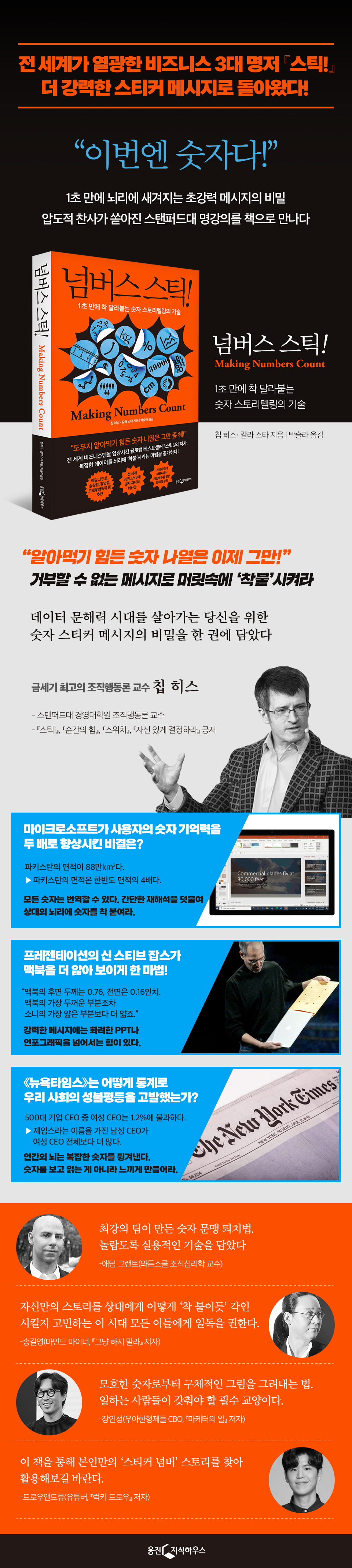
Microsoft's search engine, Bing, delivers millions of facts every day based on users' search requests.
The visual engine development team wanted to see if adding simple, context-sensitive descriptions would help people understand and remember numeric search results.
What they did was very simple.
Rather than simply stating that Pakistan's area is 880,000 square kilometers, they added a simple 'reinterpretation' such as 'twice the size of California'.
They then tested how well people remembered the facts over periods ranging from minutes to weeks.
(Omitted) Among them, some reinterpretation explanations were particularly effective, and the information was remembered better when compared to countries or states that were familiar to the reader.
In fact, adding each of these explanations cut the error rate of misremembering information in half.
---From Chapter 1
There are approximately 400 million civilian-owned firearms in the United States.
▶▶ There are approximately 330 million people living in the United States, and they own 400 million firearms.
In other words, if every man, woman, and child living in the United States had a gun, there would still be about 70 million guns left.
It's no surprise that a large country with a large population of gun enthusiasts would have a large number of guns.
That is exactly what the “400 million” in the first example refers to.
'There are a lot of guns in America.'
But if we replace this protagonist with a man with a gun, we can see just how absurd the number of guns Americans own is.
---From Chapter 2
The container ship Ever Given has a hull length of nearly 400 meters.
▶▶ Imagine the Empire State Building falling sideways and blocking a canal.
In fact, the container ship Ever Given is taller than the Empire State Building, if only for the small, needle-shaped antenna on top.
Concreteness is a key to making numbers feel real.
85 grams is abstract.
A deck of cards is specific.
It's hard to imagine a ship that's 400 meters long (399.97 meters to be exact).
The Empire State Building collapsing and blocking the canal is a striking image that will remain in your memory for a long time.
The second image shows that just describing something concretely can make it stick in your mind.
---From Chapter 2
Fluorescent bulbs use only a quarter of the power of regular bulbs, and while regular bulbs need to be replaced 'yearly', fluorescent bulbs only need to be replaced every seven years.
▶▶ If you replace the lights in your house with fluorescent bulbs when your child starts walking, by the time you change the next bulb, your child will be in second grade and learning about oxygen.
And by the time you change your light bulb next time, you'll have your driver's license.
This presentation was a truly precious experience for Chip, who has been teaching students for over 20 years.
The students applauded their classmates.
I think everyone probably knows deep down how long seven years is.
But the flow of time is a concept that is difficult to understand precisely.
As we live, time passes quietly, and we only realize this when we recall a particularly impressive event in our lives.
But once you become aware of the passage of time, you not only understand it, but it becomes deeply real.
“Wow, that’s a really long-lasting light bulb!”
---From Chapter 2
Jobs broke the pattern by first imprinting in the audience's minds what a competitor's "thin computer" would look like, and then showing them the dimensions of the MacBook Air.
“This is a MacBook Air,” he said, and an image appeared on the screen.
Now the TZ series looks thicker and duller than the MacBook Air.
There was thunderous applause and cheers.
“The back of the MacBook is 0.76 inches thick, and it gets thinner as you go forward, reaching a front thickness of only 0.16 inches...” Then the decisive sentence burst out, putting an end to it.
“I want to emphasize this point to you all.
“The thickest part of the MacBook Air is thinner than the thinnest part of the TZ”.
Look how beautifully the encore technique described in the previous chapter has been applied.
---From Chapter 3
The reason we are numerical people is because we are fascinated by the meaning contained in numbers.
Numbers are inherent in everything we want to do, imagine, and plan, and all of these numbers can be translated into intuitive, tangible ways. The world would be a better place if we used numbers more often and more wisely.
This is not to say that we should squeeze out more statistics as is the existing practice.
In fact, the fewer numbers you use, the more impactful they can be.
Numbers are not mere background information or decoration; they are core information that must be conveyed along with a profound story.
We truly believe in numbers.
I truly believe that we can help people understand the important numbers.
Imagine you and your friends are participating in a lottery game with a huge jackpot.
However, there is one condition: if you win the raffle, you must spend $50,000 (approximately 65.7 million won - translator's note) every day until you run out of the prize money.
Then you win a million dollars, and your friend wins a billion dollars.
How long will it take you and your friend to spend all your winnings?
---From "Entering"
This book is based on simple observations.
We cannot properly perceive information unless we translate numbers into intuitively recognizable human experiences.
We work very hard, sometimes desperately, to come up with the right numbers to help us make the right decisions, but if the numbers don't stick firmly in the minds of decision makers, all our efforts are in vain.
(Omitted) Shouldn't there be a book that teaches you how to translate numbers? But surprisingly, there wasn't one.
There are books on how to create attractive, compelling graphs, and books that explain how to easily understand complex infographics, but there was no guide or writing guide for the basic data processing needed to understand numbers—to help people understand numbers in intuitive and precise terms.
---From "Entering"
For the past 15 years, Chip has been teaching us how to make ideas stick like stickers.
He taught primarily MBA students, but also occasionally physicists, artists, naval officers, and scientists.
He advised avoiding numbers in lectures if possible.
Then one day, a student raised an objection.
“I am an investment banker.
All my ideas have to do with numbers.
“If you take the numbers out, you can’t talk,” he said. So that year, Chip added a lesson on how to make numbers stick.
(Omitted) In writing this book, we took full advantage of the benefits of casting a wide net rather than limiting ourselves to just one thing.
I explored various social science fields such as psychology, anthropology, and sociology, and read books and articles on the development of mathematical ability (and human flaws).
We explore anthropologists' research on number systems in various cultures around the world, and delve into the history, science, and media of counting methods.
---From "Entering"
Microsoft's search engine, Bing, delivers millions of facts every day based on users' search requests.
The visual engine development team wanted to see if adding simple, context-sensitive descriptions would help people understand and remember numeric search results.
What they did was very simple.
Rather than simply stating that Pakistan's area is 880,000 square kilometers, they added a simple 'reinterpretation' such as 'twice the size of California'.
They then tested how well people remembered the facts over periods ranging from minutes to weeks.
(Omitted) Among them, some reinterpretation explanations were particularly effective, and the information was remembered better when compared to countries or states that were familiar to the reader.
In fact, adding each of these explanations cut the error rate of misremembering information in half.
---From Chapter 1
There are approximately 400 million civilian-owned firearms in the United States.
▶▶ There are approximately 330 million people living in the United States, and they own 400 million firearms.
In other words, if every man, woman, and child living in the United States had a gun, there would still be about 70 million guns left.
It's no surprise that a large country with a large population of gun enthusiasts would have a large number of guns.
That is exactly what the “400 million” in the first example refers to.
'There are a lot of guns in America.'
But if we replace this protagonist with a man with a gun, we can see just how absurd the number of guns Americans own is.
---From Chapter 2
The container ship Ever Given has a hull length of nearly 400 meters.
▶▶ Imagine the Empire State Building falling sideways and blocking a canal.
In fact, the container ship Ever Given is taller than the Empire State Building, if only for the small, needle-shaped antenna on top.
Concreteness is a key to making numbers feel real.
85 grams is abstract.
A deck of cards is specific.
It's hard to imagine a ship that's 400 meters long (399.97 meters to be exact).
The Empire State Building collapsing and blocking the canal is a striking image that will remain in your memory for a long time.
The second image shows that just describing something concretely can make it stick in your mind.
---From Chapter 2
Fluorescent bulbs use only a quarter of the power of regular bulbs, and while regular bulbs need to be replaced 'yearly', fluorescent bulbs only need to be replaced every seven years.
▶▶ If you replace the lights in your house with fluorescent bulbs when your child starts walking, by the time you change the next bulb, your child will be in second grade and learning about oxygen.
And by the time you change your light bulb next time, you'll have your driver's license.
This presentation was a truly precious experience for Chip, who has been teaching students for over 20 years.
The students applauded their classmates.
I think everyone probably knows deep down how long seven years is.
But the flow of time is a concept that is difficult to understand precisely.
As we live, time passes quietly, and we only realize this when we recall a particularly impressive event in our lives.
But once you become aware of the passage of time, you not only understand it, but it becomes deeply real.
“Wow, that’s a really long-lasting light bulb!”
---From Chapter 2
Jobs broke the pattern by first imprinting in the audience's minds what a competitor's "thin computer" would look like, and then showing them the dimensions of the MacBook Air.
“This is a MacBook Air,” he said, and an image appeared on the screen.
Now the TZ series looks thicker and duller than the MacBook Air.
There was thunderous applause and cheers.
“The back of the MacBook is 0.76 inches thick, and it gets thinner as you go forward, reaching a front thickness of only 0.16 inches...” Then the decisive sentence burst out, putting an end to it.
“I want to emphasize this point to you all.
“The thickest part of the MacBook Air is thinner than the thinnest part of the TZ”.
Look how beautifully the encore technique described in the previous chapter has been applied.
---From Chapter 3
The reason we are numerical people is because we are fascinated by the meaning contained in numbers.
Numbers are inherent in everything we want to do, imagine, and plan, and all of these numbers can be translated into intuitive, tangible ways. The world would be a better place if we used numbers more often and more wisely.
This is not to say that we should squeeze out more statistics as is the existing practice.
In fact, the fewer numbers you use, the more impactful they can be.
Numbers are not mere background information or decoration; they are core information that must be conveyed along with a profound story.
We truly believe in numbers.
I truly believe that we can help people understand the important numbers.
---From "Going Out"
Publisher's Review
■ The world's most popular business book, "Stick!", has become even more powerful with numbers.
“If you can’t avoid complex data, use it properly.
“So that it ‘sticks’ to your mind!”
The business classic "Stick!" co-authored in 2006 by Stanford University organizational behavior professor Chip Heath and management expert Dan Heath, also known as the Heath brothers.
This book has been praised for changing the paradigm of marketing language by introducing a method of designing messages that stick in the mind within a second of hearing and are never forgotten.
For the past 15 years, Professor Chip Heath has been teaching this at Stanford MBA programs, as well as in various corporate and public lectures.
“There are no ‘numbers’ in messages that have survived through the ages.
This is because the human brain perceives numbers as a foreign language.
“If you want to persuade someone, avoid numbers at all costs.” But one day, a student raised an objection.
“I am an investment banker.
All my ideas have to do with numbers.
“If you take the numbers out, you can’t talk.” In an era where data-driven decision-making and management strategies have become essential, Chip Heath could no longer ignore the strong demand from the business world that “no one can be persuaded without actual ‘numbers.’”
After studying psychology, sociology, and anthropological studies on number systems, he developed his own sticker message theory, which was reborn as the 'number sticker message' theory that makes numbers stick to the mind.
"Numbers Stick!" is a book that contains everything about the next level of "number storytelling."
This book doesn't teach you how to analyze data, draw graphs, or create fancy infographics.
This is a guide that teaches you how to translate numbers that are difficult to read into intuitive and accurate language so that others can understand them.
It presents principles for transforming complex data into effective messages, including simplicity, plausibility, familiarity, process conversion, emotional approach, and map display, and adds practicality by covering practical application cases.
This book will be a powerful tool for all those in this era who need to persuade others, including those in all fields of business, including marketing and communications, as well as educators, students, office workers, and creators. It is worthy of being called "another must-read for those who are good at their jobs," following "Stick!"
The Curse of Knowledge: Why Data Is So Difficult to Explain
"Enough with the incomprehensible list of numbers! Storytelling is more important than analysis."
In a Stanford lecture, the author presented simple numerical data to MBA and engineering students and asked them to translate it into a memorable message.
The message from the self-proclaimed experts in data analysis was a complete failure.
Students were incapable of 'storytelling' complex data in a way that people could understand.
We have fallen into the trap of the 'curse of knowledge', which means that once we acquire specialized knowledge, we cannot persuade people who do not know it.
From marketing experts to fitness coaches and climate scientists, people today are expected to make decisions, big and small, based on expert knowledge and scientifically derived data.
The problem is that the human brain has trouble recognizing numbers beyond 5, as if they were a foreign language.
The author argues that unless numbers are translated into intuitively recognizable experiences, most people will not be able to properly perceive or accept the information, ultimately leading to a breakdown in communication.
For example, if the numbers 1,000,000 (one million) and 1,000,000,000 (one billion) are written as is on the PPT in the presentation, the audience will be busy counting the zeros and miss the main point you are trying to convey.
How about translating it like this? "If you win a million-dollar lottery, you can only spend $50,000 a day for 20 days, while your friend who wins $1 billion can spend $50,000 a day for 55 years."
“Until his children grow up and give him grandchildren.” He immediately understands the difference between a million and a billion, and even feels a strange sense of jealousy as the contrasting futures of his friend and himself are vividly depicted before his eyes.
In this way, the author went beyond creating a simple technique for translating numbers. Over the years, he collected and refined various examples with his students, perfecting a technique for numeric storytelling that sticks in the mind in just one second.
This book contains the Stanford University lectures that received overwhelming praise and standing ovations.
For experts, it offers ways to transform abstract data into clear, persuasive language, while for non-experts, it provides insights on how to ask the right questions to get to the heart of the information.
How a headache-inducing number becomes an unforgettable, super-powerful message
From Microsoft and Steve Jobs to social distancing campaigns around the world.
So how do we transform numbers into powerful messages? After a decade of research, Microsoft Research discovered that adding context to numeric search results helps users remember the information better (Chapter 1, "Translating All the Numbers"). For example, adding context like "twice the size of California" to the information that Pakistan is 880,000 square kilometers cut recall errors in half.
This is an application of one of the principles of designing number sticker messages: ‘Compare with something familiar and simple.’
User-friendly storytelling techniques have also been actively utilized in campaigns around the world during the COVID-19 pandemic.
The number '1.8 meters' for social distancing was transformed into familiar and everyday metaphors from each country's cultural background, such as one surfboard (San Diego, USA), one bear (Russia), two baguettes (France), and four koalas (Australia), creating a message that is unforgettable once heard.
One of the best ways to steal hearts with numbers is to add 'wonder' to them.
If you set the rules first and then break expectations (the encore technique), the surprise is doubled, and the late Steve Jobs was a master of this technique.
Remember his shocking presentation where he pulled a first-generation MacBook Air out of an envelope and demonstrated it?
To emphasize how thin the MacBook Air is, Jobs said this while showing a picture on the screen comparing it to a thin laptop from rival Sony.
“The rear thickness of the MacBook is 0.76 inches.
And it gets thinner and thinner as you go forward, with the front end measuring just 0.16 inches.
The important thing is that the thickest part of the MacBook Air is thinner than the thinnest part of the Sony notebook.”
This book introduces clear numeric storytelling techniques such as changing the units of numbers, making them human-scale, and transcending categories, while presenting various examples of numeric sticker messages being used in real-world settings, from advertising copy to critical decision-making processes that can change the fate of companies and countries.
By presenting the process of transforming dry statistics into powerful messages in a 'before & after' format, it helps readers intuitively understand and experience the technique of identifying core information beyond the numbers and turning it into a powerful message.
■ The secret behind designing number sticker messages that steal hearts and move the world
From Nightingale, who saved lives with numbers, to the New York Times, which exposed gender inequality.
When the number of deaths from COVID-19 across the United States surpassed 100,000 in 2020, The New York Times published a special article.
The newspaper immediately listed the names and brief personal details of the 1,000 deceased on the front page. ("The weight of statistics comes from the process") The real names and brief stories of the deceased, published across three pages, made people feel the weight of life beyond the numbers, thereby eliciting a genuine sense of remembrance.
Sometimes statistics are considered pure and the most reliable evidence, but people often don't know what to 'feel' from numbers and are rather insensitive to large numbers.
To effectively communicate statistics, you need to get straight to the point and make the audience "feel" the numbers.
It is a powerful weapon that can change people's perception by adding emotional appeal to numbers.
As another example, let's look at a sentence included by the New York Times to strongly raise the issue of gender inequality in the workplace.
“The number of female CEOs in the Fortune 500 companies is lower than the number of CEOs named James.” Even without revealing the exact number of male CEOs named James, it is enough to reflect on the severity of the gender inequality problem.
From Florence Nightingale, who used statistics to persuade the nation and the public during the Crimean War in the mid-19th century to save lives on the battlefield, to President Eisenhower's speech in 1953 calling for an end to the war, these are historical examples of the effective use of the sticker message technique of "combination of emotions."
We can see that number sticker messages not only encourage a change in consciousness and action for a better society, but also provide an opportunity to think about what communication is for making sound decisions.
The author says that the purpose of numerical storytelling is to ultimately make people see beyond the numbers.
The point is that numbers are not just a device to deceive consumers, but rather have the effect of making them face the truth beyond statistics.
It is self-evident that true communication and sound decision-making only begin when numbers are effectively imprinted on the audience.
I hope that through this book, there will be more "true numerical people" who listen to people beyond numbers and think about a better world.
“If you can’t avoid complex data, use it properly.
“So that it ‘sticks’ to your mind!”
The business classic "Stick!" co-authored in 2006 by Stanford University organizational behavior professor Chip Heath and management expert Dan Heath, also known as the Heath brothers.
This book has been praised for changing the paradigm of marketing language by introducing a method of designing messages that stick in the mind within a second of hearing and are never forgotten.
For the past 15 years, Professor Chip Heath has been teaching this at Stanford MBA programs, as well as in various corporate and public lectures.
“There are no ‘numbers’ in messages that have survived through the ages.
This is because the human brain perceives numbers as a foreign language.
“If you want to persuade someone, avoid numbers at all costs.” But one day, a student raised an objection.
“I am an investment banker.
All my ideas have to do with numbers.
“If you take the numbers out, you can’t talk.” In an era where data-driven decision-making and management strategies have become essential, Chip Heath could no longer ignore the strong demand from the business world that “no one can be persuaded without actual ‘numbers.’”
After studying psychology, sociology, and anthropological studies on number systems, he developed his own sticker message theory, which was reborn as the 'number sticker message' theory that makes numbers stick to the mind.
"Numbers Stick!" is a book that contains everything about the next level of "number storytelling."
This book doesn't teach you how to analyze data, draw graphs, or create fancy infographics.
This is a guide that teaches you how to translate numbers that are difficult to read into intuitive and accurate language so that others can understand them.
It presents principles for transforming complex data into effective messages, including simplicity, plausibility, familiarity, process conversion, emotional approach, and map display, and adds practicality by covering practical application cases.
This book will be a powerful tool for all those in this era who need to persuade others, including those in all fields of business, including marketing and communications, as well as educators, students, office workers, and creators. It is worthy of being called "another must-read for those who are good at their jobs," following "Stick!"
The Curse of Knowledge: Why Data Is So Difficult to Explain
"Enough with the incomprehensible list of numbers! Storytelling is more important than analysis."
In a Stanford lecture, the author presented simple numerical data to MBA and engineering students and asked them to translate it into a memorable message.
The message from the self-proclaimed experts in data analysis was a complete failure.
Students were incapable of 'storytelling' complex data in a way that people could understand.
We have fallen into the trap of the 'curse of knowledge', which means that once we acquire specialized knowledge, we cannot persuade people who do not know it.
From marketing experts to fitness coaches and climate scientists, people today are expected to make decisions, big and small, based on expert knowledge and scientifically derived data.
The problem is that the human brain has trouble recognizing numbers beyond 5, as if they were a foreign language.
The author argues that unless numbers are translated into intuitively recognizable experiences, most people will not be able to properly perceive or accept the information, ultimately leading to a breakdown in communication.
For example, if the numbers 1,000,000 (one million) and 1,000,000,000 (one billion) are written as is on the PPT in the presentation, the audience will be busy counting the zeros and miss the main point you are trying to convey.
How about translating it like this? "If you win a million-dollar lottery, you can only spend $50,000 a day for 20 days, while your friend who wins $1 billion can spend $50,000 a day for 55 years."
“Until his children grow up and give him grandchildren.” He immediately understands the difference between a million and a billion, and even feels a strange sense of jealousy as the contrasting futures of his friend and himself are vividly depicted before his eyes.
In this way, the author went beyond creating a simple technique for translating numbers. Over the years, he collected and refined various examples with his students, perfecting a technique for numeric storytelling that sticks in the mind in just one second.
This book contains the Stanford University lectures that received overwhelming praise and standing ovations.
For experts, it offers ways to transform abstract data into clear, persuasive language, while for non-experts, it provides insights on how to ask the right questions to get to the heart of the information.
How a headache-inducing number becomes an unforgettable, super-powerful message
From Microsoft and Steve Jobs to social distancing campaigns around the world.
So how do we transform numbers into powerful messages? After a decade of research, Microsoft Research discovered that adding context to numeric search results helps users remember the information better (Chapter 1, "Translating All the Numbers"). For example, adding context like "twice the size of California" to the information that Pakistan is 880,000 square kilometers cut recall errors in half.
This is an application of one of the principles of designing number sticker messages: ‘Compare with something familiar and simple.’
User-friendly storytelling techniques have also been actively utilized in campaigns around the world during the COVID-19 pandemic.
The number '1.8 meters' for social distancing was transformed into familiar and everyday metaphors from each country's cultural background, such as one surfboard (San Diego, USA), one bear (Russia), two baguettes (France), and four koalas (Australia), creating a message that is unforgettable once heard.
One of the best ways to steal hearts with numbers is to add 'wonder' to them.
If you set the rules first and then break expectations (the encore technique), the surprise is doubled, and the late Steve Jobs was a master of this technique.
Remember his shocking presentation where he pulled a first-generation MacBook Air out of an envelope and demonstrated it?
To emphasize how thin the MacBook Air is, Jobs said this while showing a picture on the screen comparing it to a thin laptop from rival Sony.
“The rear thickness of the MacBook is 0.76 inches.
And it gets thinner and thinner as you go forward, with the front end measuring just 0.16 inches.
The important thing is that the thickest part of the MacBook Air is thinner than the thinnest part of the Sony notebook.”
This book introduces clear numeric storytelling techniques such as changing the units of numbers, making them human-scale, and transcending categories, while presenting various examples of numeric sticker messages being used in real-world settings, from advertising copy to critical decision-making processes that can change the fate of companies and countries.
By presenting the process of transforming dry statistics into powerful messages in a 'before & after' format, it helps readers intuitively understand and experience the technique of identifying core information beyond the numbers and turning it into a powerful message.
■ The secret behind designing number sticker messages that steal hearts and move the world
From Nightingale, who saved lives with numbers, to the New York Times, which exposed gender inequality.
When the number of deaths from COVID-19 across the United States surpassed 100,000 in 2020, The New York Times published a special article.
The newspaper immediately listed the names and brief personal details of the 1,000 deceased on the front page. ("The weight of statistics comes from the process") The real names and brief stories of the deceased, published across three pages, made people feel the weight of life beyond the numbers, thereby eliciting a genuine sense of remembrance.
Sometimes statistics are considered pure and the most reliable evidence, but people often don't know what to 'feel' from numbers and are rather insensitive to large numbers.
To effectively communicate statistics, you need to get straight to the point and make the audience "feel" the numbers.
It is a powerful weapon that can change people's perception by adding emotional appeal to numbers.
As another example, let's look at a sentence included by the New York Times to strongly raise the issue of gender inequality in the workplace.
“The number of female CEOs in the Fortune 500 companies is lower than the number of CEOs named James.” Even without revealing the exact number of male CEOs named James, it is enough to reflect on the severity of the gender inequality problem.
From Florence Nightingale, who used statistics to persuade the nation and the public during the Crimean War in the mid-19th century to save lives on the battlefield, to President Eisenhower's speech in 1953 calling for an end to the war, these are historical examples of the effective use of the sticker message technique of "combination of emotions."
We can see that number sticker messages not only encourage a change in consciousness and action for a better society, but also provide an opportunity to think about what communication is for making sound decisions.
The author says that the purpose of numerical storytelling is to ultimately make people see beyond the numbers.
The point is that numbers are not just a device to deceive consumers, but rather have the effect of making them face the truth beyond statistics.
It is self-evident that true communication and sound decision-making only begin when numbers are effectively imprinted on the audience.
I hope that through this book, there will be more "true numerical people" who listen to people beyond numbers and think about a better world.
GOODS SPECIFICS
- Publication date: September 23, 2022
- Page count, weight, size: 264 pages | 454g | 145*215*17mm
- ISBN13: 9788901264646
- ISBN10: 8901264641
You may also like
카테고리
korean


korean

![ELLE 엘르 스페셜 에디션 A형 : 12월 [2025]](http://librairie.coreenne.fr/cdn/shop/files/b8e27a3de6c9538896439686c6b0e8fb.jpg?v=1766436872&width=3840)


