

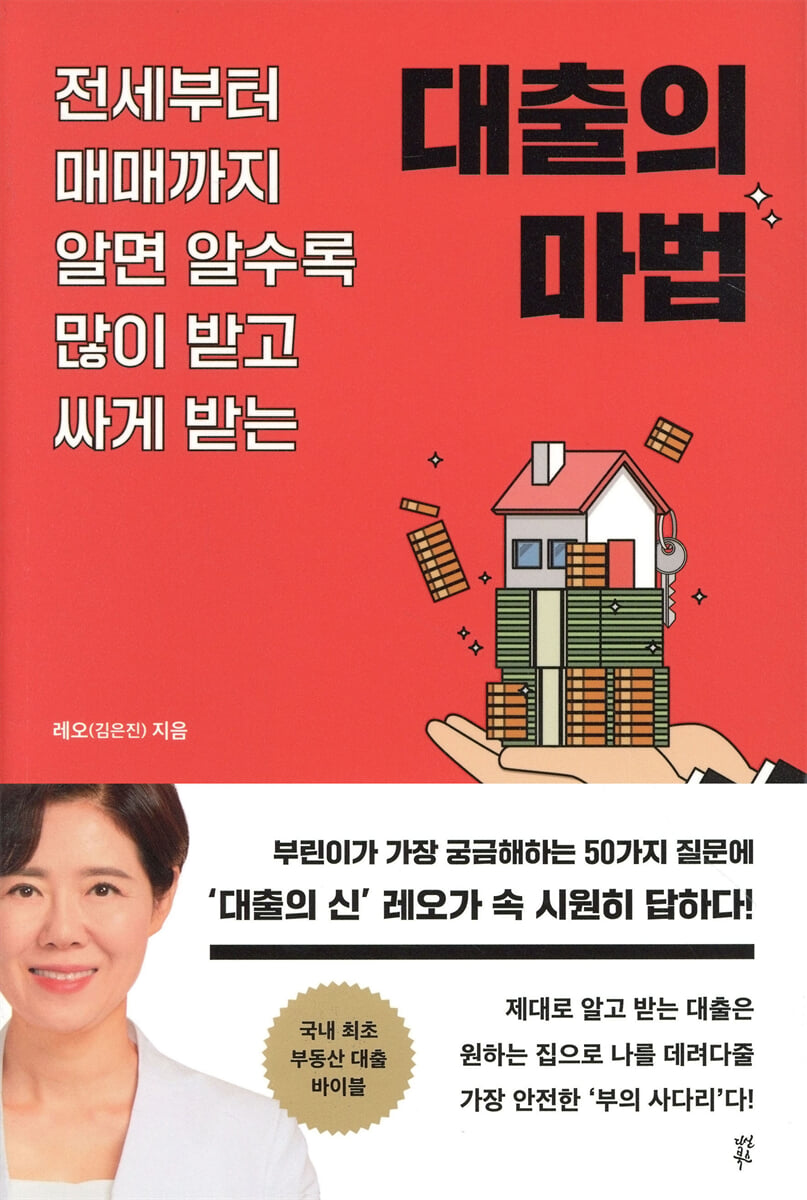
The Magic of Loans
 |
Description
Book Introduction
A loan that you receive with proper knowledge
Take me to the house I want
It is the safest 'ladder of wealth'!
_Leo, the 'God of Loans', reveals his know-how in making money through loans he's researched for 11 years.
Despite numerous regulations, the share of first-time homebuyers exceeded 30% in 2021 for the first time in 10 years.
As "a smart home of my own" emerged as a means of hedging against inflation across generations, many people wondered, "How can I leverage my money to invest in good real estate?" This was when real estate influencers first approached loan experts to offer their insights on lending.
The author of this book, Leo, is the 'God of Loans' who clearly explained the loan knowledge that was difficult to understand because no one had explained it properly, and has provided a refreshing solution to the worries of countless borrowers.
“Even I, who is now called the ‘God of Loans,’ have painful memories of losing 30,000 pyeong of my parents’ land to a loan scam when I was a child.
Everyone told me not to even look at real estate and loans.
But I definitely wanted to reclaim the land my family had lost and the hopes we had dreamed of there.
“I’ll never be in debt again!” That’s why I started studying loans.”
This was precisely why the author decided to write his first book, 11 years after working as the 'No. 1 Real Estate Loan Instructor in Korea.'
I wanted to be a compass that would show real estate beginners the right path when they are about to make the biggest decision of their lives, so that they would not suffer the same bitter losses and wounds as I did.
So, this book contains all 50 pieces of real estate loan common sense that real estate beginners want to know and absolutely must know.
This is not a book to be read once and put away, but rather, it is packed with all of the author's real estate loan knowledge and know-how so that you can take it out and read it whenever you need, from renting to buying.
This book contains tips for saving your money in this era of high interest rates and seizing opportunities to grow your wealth amidst waning lending regulations.
Take me to the house I want
It is the safest 'ladder of wealth'!
_Leo, the 'God of Loans', reveals his know-how in making money through loans he's researched for 11 years.
Despite numerous regulations, the share of first-time homebuyers exceeded 30% in 2021 for the first time in 10 years.
As "a smart home of my own" emerged as a means of hedging against inflation across generations, many people wondered, "How can I leverage my money to invest in good real estate?" This was when real estate influencers first approached loan experts to offer their insights on lending.
The author of this book, Leo, is the 'God of Loans' who clearly explained the loan knowledge that was difficult to understand because no one had explained it properly, and has provided a refreshing solution to the worries of countless borrowers.
“Even I, who is now called the ‘God of Loans,’ have painful memories of losing 30,000 pyeong of my parents’ land to a loan scam when I was a child.
Everyone told me not to even look at real estate and loans.
But I definitely wanted to reclaim the land my family had lost and the hopes we had dreamed of there.
“I’ll never be in debt again!” That’s why I started studying loans.”
This was precisely why the author decided to write his first book, 11 years after working as the 'No. 1 Real Estate Loan Instructor in Korea.'
I wanted to be a compass that would show real estate beginners the right path when they are about to make the biggest decision of their lives, so that they would not suffer the same bitter losses and wounds as I did.
So, this book contains all 50 pieces of real estate loan common sense that real estate beginners want to know and absolutely must know.
This is not a book to be read once and put away, but rather, it is packed with all of the author's real estate loan knowledge and know-how so that you can take it out and read it whenever you need, from renting to buying.
This book contains tips for saving your money in this era of high interest rates and seizing opportunities to grow your wealth amidst waning lending regulations.
- You can preview some of the book's contents.
Preview
index
Recommendation│The wealthy capitalize on the opportunity of leverage, no matter the circumstances! _Kim Hak-ryeol
Prologue│Why Should You Study Loans Now?
Part 1
[Basic] Complex loans become easy and simple!
Chapter 1: 6 Most Frequently Asked Questions by Borrowers Afraid of Borrowing
Question 01_ Isn't it bad to have more debt?
Question 02_ Isn't it a waste of money to pay interest?
Question 03_ If I borrow that much money, when will I be able to pay it back?
Question 04_ My main bank will take care of it for me, but do I really need to study it?
Question 05_ When should I look into loans?
Question 06_ Can complex loans be easily understood?
#LEO'S TIP Is there a bank that is advantageous when purchasing a first floor unit?!
#LEO'S TIP Bank vs.
Non-face-to-face vs.
Loan counselor
Chapter 2: 6 Basics on Loans That New Members Most Want to Know
Question 07_ What percentage of the deposit can I receive as a rental loan?
Question 08_ How much more advantageous are the jeonse loans for young people working at small and medium-sized enterprises (SMEs) and newlyweds?
Question 09_ Does the Korea Housing Finance Corporation (HF) jeonse loan not require the landlord's consent?
Question 10_ Is it possible to apply for the Housing & Urban Guarantee Corporation (HUG)’s secure jeonse loan without income?
Question 11_ Is it possible to get a rental loan from Seoul Guarantee (SGI) even if the rental price is high?
Question 12_ Are there any special circumstances in which I cannot receive a mortgage loan?
Question 13_ Why is credit score important in a mortgage loan?
Question 14_ What is a mortgage, and how do I find a safe rental property?
Question 15_ How do I sign up for a deposit return guarantee insurance?
Question 16_ Can a single-home owner get a jeonse loan? Or can they get a jeonse loan and then buy a house?
Plus Check! Housing Ladder Support System
Question 17_ What documents are required to receive a mortgage loan?
#Leo's Tip: Basics on Jeonse Loans That Landlords Must Know
Part 2
[Practice] All kinds of loan concerns are solved with ease!
Chapter 3: 7 Essential Mortgage Loan Terms Every Homebuyer Should Know
Question 18_ Why is KB market price important when determining the loan limit?
Question 19_ What is LTV, and why are speculative overheated areas and regulated areas distinguished?
Plus Check! MI Loan
Question 20_ What is DSR and how does it affect my loan limit?
Plus Check! DTI
Question 21: What are interest rates, and why do they vary from bank to bank?
Question 22_ Which is more advantageous, fixed interest rate or variable interest rate?
Question 23_ What are the differences between equal principal, equal principal and interest, and lump sum on maturity?
Plus Check! Increasing Repayment Method
Question 24_ What is the difference between the first and second financial sectors?
Plus Check! How Card Loans Affect Your Credit Score
#Leo's TIP: The Secret to a Reduced Loan Limit! Air Defense
Chapter 4: The 5 Best Mortgage Loans Most Loved by First-Time Homebuyers
Question 25_ Is the Stepping Stone Loan the lowest interest rate?
Question 26_ Doesn't the deposit theory apply to DSR?
Plus Check! Combined Loan and Bank Mortgage Loan
Question 27_ Can I receive preferential LTV for a loan for ordinary people with actual demand?
Question 28_ Can I get a loan with an LTV of up to 80% for a first-time homebuyer?
Question 29_ Are qualified loans long-term, fixed-rate?
Plus Check! Where are the speculative areas?
Part 3
[Advanced] A smart lending strategy determines the size of your wealth!
Chapter 5: 10 Loan Strategies for Highest Limits and Lowest Interest Rates
Question 30_ Can I get a credit loan and a home mortgage loan at the same time?
Question 31_ Should I postpone borrowing until interest rates fall?
Plus Check! Peace of Mind Conversion Loan
Plus Check! Interest Rate Reduction Request System
Question 32_ Is it better to repay the loan early when I have money?
Question 33_ Can housewives, the unemployed, and freelancers also get a mortgage loan?
Plus Check! How to Maximize Your Reported Income
Question 34_ Are children who are not separated from their parents at a disadvantage when it comes to mortgage loans?
Question 35_ If my spouse owns only one house before marriage, can I get a mortgage loan for my new home?
Question 36_ Can I get a mortgage loan when purchasing a house with a jeonse deposit?
Question 37_ Are there any loan common sense tips that those who have won a subscription should keep in mind?
Question 38_ What documents are required to receive a home mortgage loan?
Question 39_ Is there a website where I can see the changed loan policies at a glance?
#LEO'S TIP A complete summary of the 'contracts' that plague car owners!
Chapter 6: The Leverage Techniques That Will Make You Rich Faster for Homeowners
Question 40_ Can I use the Living Stability Fund Loan when I need emergency funds?
Plus Check! Emergency Livelihood Mortgage Loan
Question 41_ Are lease eviction loans useful when evicting tenants?
Plus Check! Early Repayment Fee for Leasehold Mortgage Loans
Question 42_ Can I change my home while maintaining the low interest rate on my existing loan?
Question 43_ What is the difference between loans for those without a home, those with one home, and those with multiple homes?
Question 44_ Is there a way to take advantage of the temporary 1st generation 2nd home?
Question 45_ Are there any things I should be careful about when switching to an auction?
#Leo's Tip: Finally, D-Day! Single-Homeowners' Switching Loan Schedule
Plus Check! Interim Loan for General Sales Contracts
Plus Check! Things to Check When Drafting a Sales Contract
Chapter 7: 5 Non-Residential Loan Strategies That Monthly Rental Investors Are Most Curious About
Question 46_ Are loan limits different depending on whether the name is an individual, self-employed person, or corporate business?
Plus Check! Priority Payment for Small Commercial Tenants
Plus Check! How to Become a Sole Proprietor or Corporation
Question 47_ Is the appraised value important when investing in commercial buildings or small buildings?
Plus Check! Commercial and Residential Loan Limits
Question 48_ Is there a strategy for officetel loans?
Question 49_ How can I get a loan from the Knowledge Industry Center?
Question 50_ What documents are required to obtain a land loan?
#LEO'S TIP I want to know about celebrities' corporate investments!
#Leo's Tip: Auction Balance Loan for Income-Generating Real Estate
#Leo's Tip: A checklist of things to remember after taking out a loan, from renting to buying.
Prologue│Why Should You Study Loans Now?
Part 1
[Basic] Complex loans become easy and simple!
Chapter 1: 6 Most Frequently Asked Questions by Borrowers Afraid of Borrowing
Question 01_ Isn't it bad to have more debt?
Question 02_ Isn't it a waste of money to pay interest?
Question 03_ If I borrow that much money, when will I be able to pay it back?
Question 04_ My main bank will take care of it for me, but do I really need to study it?
Question 05_ When should I look into loans?
Question 06_ Can complex loans be easily understood?
#LEO'S TIP Is there a bank that is advantageous when purchasing a first floor unit?!
#LEO'S TIP Bank vs.
Non-face-to-face vs.
Loan counselor
Chapter 2: 6 Basics on Loans That New Members Most Want to Know
Question 07_ What percentage of the deposit can I receive as a rental loan?
Question 08_ How much more advantageous are the jeonse loans for young people working at small and medium-sized enterprises (SMEs) and newlyweds?
Question 09_ Does the Korea Housing Finance Corporation (HF) jeonse loan not require the landlord's consent?
Question 10_ Is it possible to apply for the Housing & Urban Guarantee Corporation (HUG)’s secure jeonse loan without income?
Question 11_ Is it possible to get a rental loan from Seoul Guarantee (SGI) even if the rental price is high?
Question 12_ Are there any special circumstances in which I cannot receive a mortgage loan?
Question 13_ Why is credit score important in a mortgage loan?
Question 14_ What is a mortgage, and how do I find a safe rental property?
Question 15_ How do I sign up for a deposit return guarantee insurance?
Question 16_ Can a single-home owner get a jeonse loan? Or can they get a jeonse loan and then buy a house?
Plus Check! Housing Ladder Support System
Question 17_ What documents are required to receive a mortgage loan?
#Leo's Tip: Basics on Jeonse Loans That Landlords Must Know
Part 2
[Practice] All kinds of loan concerns are solved with ease!
Chapter 3: 7 Essential Mortgage Loan Terms Every Homebuyer Should Know
Question 18_ Why is KB market price important when determining the loan limit?
Question 19_ What is LTV, and why are speculative overheated areas and regulated areas distinguished?
Plus Check! MI Loan
Question 20_ What is DSR and how does it affect my loan limit?
Plus Check! DTI
Question 21: What are interest rates, and why do they vary from bank to bank?
Question 22_ Which is more advantageous, fixed interest rate or variable interest rate?
Question 23_ What are the differences between equal principal, equal principal and interest, and lump sum on maturity?
Plus Check! Increasing Repayment Method
Question 24_ What is the difference between the first and second financial sectors?
Plus Check! How Card Loans Affect Your Credit Score
#Leo's TIP: The Secret to a Reduced Loan Limit! Air Defense
Chapter 4: The 5 Best Mortgage Loans Most Loved by First-Time Homebuyers
Question 25_ Is the Stepping Stone Loan the lowest interest rate?
Question 26_ Doesn't the deposit theory apply to DSR?
Plus Check! Combined Loan and Bank Mortgage Loan
Question 27_ Can I receive preferential LTV for a loan for ordinary people with actual demand?
Question 28_ Can I get a loan with an LTV of up to 80% for a first-time homebuyer?
Question 29_ Are qualified loans long-term, fixed-rate?
Plus Check! Where are the speculative areas?
Part 3
[Advanced] A smart lending strategy determines the size of your wealth!
Chapter 5: 10 Loan Strategies for Highest Limits and Lowest Interest Rates
Question 30_ Can I get a credit loan and a home mortgage loan at the same time?
Question 31_ Should I postpone borrowing until interest rates fall?
Plus Check! Peace of Mind Conversion Loan
Plus Check! Interest Rate Reduction Request System
Question 32_ Is it better to repay the loan early when I have money?
Question 33_ Can housewives, the unemployed, and freelancers also get a mortgage loan?
Plus Check! How to Maximize Your Reported Income
Question 34_ Are children who are not separated from their parents at a disadvantage when it comes to mortgage loans?
Question 35_ If my spouse owns only one house before marriage, can I get a mortgage loan for my new home?
Question 36_ Can I get a mortgage loan when purchasing a house with a jeonse deposit?
Question 37_ Are there any loan common sense tips that those who have won a subscription should keep in mind?
Question 38_ What documents are required to receive a home mortgage loan?
Question 39_ Is there a website where I can see the changed loan policies at a glance?
#LEO'S TIP A complete summary of the 'contracts' that plague car owners!
Chapter 6: The Leverage Techniques That Will Make You Rich Faster for Homeowners
Question 40_ Can I use the Living Stability Fund Loan when I need emergency funds?
Plus Check! Emergency Livelihood Mortgage Loan
Question 41_ Are lease eviction loans useful when evicting tenants?
Plus Check! Early Repayment Fee for Leasehold Mortgage Loans
Question 42_ Can I change my home while maintaining the low interest rate on my existing loan?
Question 43_ What is the difference between loans for those without a home, those with one home, and those with multiple homes?
Question 44_ Is there a way to take advantage of the temporary 1st generation 2nd home?
Question 45_ Are there any things I should be careful about when switching to an auction?
#Leo's Tip: Finally, D-Day! Single-Homeowners' Switching Loan Schedule
Plus Check! Interim Loan for General Sales Contracts
Plus Check! Things to Check When Drafting a Sales Contract
Chapter 7: 5 Non-Residential Loan Strategies That Monthly Rental Investors Are Most Curious About
Question 46_ Are loan limits different depending on whether the name is an individual, self-employed person, or corporate business?
Plus Check! Priority Payment for Small Commercial Tenants
Plus Check! How to Become a Sole Proprietor or Corporation
Question 47_ Is the appraised value important when investing in commercial buildings or small buildings?
Plus Check! Commercial and Residential Loan Limits
Question 48_ Is there a strategy for officetel loans?
Question 49_ How can I get a loan from the Knowledge Industry Center?
Question 50_ What documents are required to obtain a land loan?
#LEO'S TIP I want to know about celebrities' corporate investments!
#Leo's Tip: Auction Balance Loan for Income-Generating Real Estate
#Leo's Tip: A checklist of things to remember after taking out a loan, from renting to buying.
Detailed image
.jpg)
Into the book
Many of the wealthy people I've met have used loans as leverage to start businesses and build wealth.
According to the KB Management Research Institute's "2021 Korea Wealth Report," which analyzes the current status and asset management methods of Korea's wealthy, "the more assets a person has, the greater their debt."
By clearly distinguishing between where to spend 'time' and where to spend 'money', I was able to become rich because I pioneered a shortcut to success.
They could save 'time' in raising capital by borrowing as much money as possible from the bank.
In that short period of time, I was able to develop business strategies and increase my assets faster than others.
Of course, they would have had to pay that much interest.
But for them, that money was not a waste of money.
He was willing to pay the 'fee' because he was confident that he could earn more than the interest.
“Why do we save money in banks, while the rich use it?” This book started with this very question.
---From "Prologue: Why Study Loans Now?"
“Never rent!” This is something you’ll hear at least once if you’re interested in real estate.
However, there are people who interpret this saying to mean, 'You should never live in the world.'
It's because I didn't understand the prerequisite that was omitted before.
"Never rent a house, tying up 100% of your cash!" This means investing your precious assets in places where their value will increase, whether it's stocks, real estate, or pension savings funds.
There are too many opportunities to make money in this world to tie up all your precious cash as a deposit.
When you live in a rental house, the only thing that goes up is the 'rental deposit after 2 years'.
Even among the customers I met, there was one who complained, “I went bankrupt because of a good landlord.”
The reason why he is upset with his landlord who has never raised the deposit for 10 years is because he has never felt the need to buy a house in his life, and he says that such a landlord has made him a 'sudden beggar'.
That's why so many financial experts feel sorry for those of you who have buried your cash in a rented house.
---From "Chapter 1, 6 Most Frequently Asked Questions by Borrowers Afraid of Borrowing"
I told you that you should study loans so that you don't leave everything to the bank.
Banks are not consulting institutions.
Additionally, bank employees with a high workload tend to recommend products that are easy to input into the computer and easy to approve.
Of course, there are many bank employees who are eager and sincere in helping customers.
But that doesn't mean they're responsible for your life.
Home loans are so large that they can determine a person's fate.
'How much risk can I take?' Only you can judge that.
'What are the conditions that are advantageous to me?' As expected, only you can clearly understand this.
So, you shouldn't expect 100% perfect advice from banks.
I've seen countless cases where people had to tearfully give up on a loan because the bank didn't tell them a very important disqualifying factor.
Conversely, I've met countless people who had to settle for lower limits because they didn't fully explain their strengths to their bankers.
This is why you need to study loans in such detail.
---Chapter 2, 11 Basics of Loan Basics that New Members of Society Most Want to Know
In August 2021, Nonghyup Bank had already declared a “lending halt.”
Perhaps because there are so many branches all over the country, the total allocated loan amount was used up early.
On the other hand, Shinhan Bank did well in its lending business until the end of the year.
Thanks to good interest rate management, Shinhan Bank was able to manage its total amount while maintaining high interest rates throughout the year.
Likewise, loan interest rates vary greatly depending on the bank's sales strategy.
Additionally, as the year draws to a close, banks that have reached their full potential may be reluctant to offer preferential interest rates.
I have no intention of engaging in lending business any longer and would rather roll over that portion to next year.
So, if you're wondering which bank offers the best interest rate, carefully consider the base rate, premium rate, preferential rate, and loan application period before making your decision.
---From "Chapter 3, 7 Essential Mortgage Loan Terms That Prospective Homebuyers Must Know"
Banker: What will you use the loan for? / Customer: My sister-in-law will use it to buy a house.
Banker: You're buying a house? Our bank can't lend you one.
Customer: Yes? How can I apply for a different purpose? Banker: Since you said you're buying a house, there's nothing I can do.
It was so heartbreaking to hear this conversation.
It's not because I'm thinking, "Why did my sister-in-law reveal the truth about lending me money to buy a house?" but because the obligation to "prohibit additional home purchases" only applies to the borrower who received the loan and the direct descendants of the borrower at the time of receiving the loan.
In other words, there is no problem with buying a house in your sister-in-law's name.
(Of course, in cases like this, you should use the loan certificate well and receive interest properly.)
---From "Chapter 6, The 6 Leverage Techniques That Will Make You Rich Faster for Single Home Owners"
There is a story I want to emphasize through this case.
This means that the successful investment stories of those who have heated up the media are not just stories of celebrities.
As you study lending diligently, you'll discover a variety of ways to utilize leverage.
This way, you can open your eyes to greater investment returns without having to stay in just one home.
A house is merely a means of hedging against inflation, and has limitations as a means of increasing assets.
Although we may have fewer assets to leverage than R actors or D corporations, we can always find ways to increase our returns.
Instead of simply being swayed by news about celebrities' investments, try to understand the hidden meaning behind the news articles, such as how others are investing and how much profit they're making using loans.
Because one day, you too might become a building owner whose property makes headlines.
According to the KB Management Research Institute's "2021 Korea Wealth Report," which analyzes the current status and asset management methods of Korea's wealthy, "the more assets a person has, the greater their debt."
By clearly distinguishing between where to spend 'time' and where to spend 'money', I was able to become rich because I pioneered a shortcut to success.
They could save 'time' in raising capital by borrowing as much money as possible from the bank.
In that short period of time, I was able to develop business strategies and increase my assets faster than others.
Of course, they would have had to pay that much interest.
But for them, that money was not a waste of money.
He was willing to pay the 'fee' because he was confident that he could earn more than the interest.
“Why do we save money in banks, while the rich use it?” This book started with this very question.
---From "Prologue: Why Study Loans Now?"
“Never rent!” This is something you’ll hear at least once if you’re interested in real estate.
However, there are people who interpret this saying to mean, 'You should never live in the world.'
It's because I didn't understand the prerequisite that was omitted before.
"Never rent a house, tying up 100% of your cash!" This means investing your precious assets in places where their value will increase, whether it's stocks, real estate, or pension savings funds.
There are too many opportunities to make money in this world to tie up all your precious cash as a deposit.
When you live in a rental house, the only thing that goes up is the 'rental deposit after 2 years'.
Even among the customers I met, there was one who complained, “I went bankrupt because of a good landlord.”
The reason why he is upset with his landlord who has never raised the deposit for 10 years is because he has never felt the need to buy a house in his life, and he says that such a landlord has made him a 'sudden beggar'.
That's why so many financial experts feel sorry for those of you who have buried your cash in a rented house.
---From "Chapter 1, 6 Most Frequently Asked Questions by Borrowers Afraid of Borrowing"
I told you that you should study loans so that you don't leave everything to the bank.
Banks are not consulting institutions.
Additionally, bank employees with a high workload tend to recommend products that are easy to input into the computer and easy to approve.
Of course, there are many bank employees who are eager and sincere in helping customers.
But that doesn't mean they're responsible for your life.
Home loans are so large that they can determine a person's fate.
'How much risk can I take?' Only you can judge that.
'What are the conditions that are advantageous to me?' As expected, only you can clearly understand this.
So, you shouldn't expect 100% perfect advice from banks.
I've seen countless cases where people had to tearfully give up on a loan because the bank didn't tell them a very important disqualifying factor.
Conversely, I've met countless people who had to settle for lower limits because they didn't fully explain their strengths to their bankers.
This is why you need to study loans in such detail.
---Chapter 2, 11 Basics of Loan Basics that New Members of Society Most Want to Know
In August 2021, Nonghyup Bank had already declared a “lending halt.”
Perhaps because there are so many branches all over the country, the total allocated loan amount was used up early.
On the other hand, Shinhan Bank did well in its lending business until the end of the year.
Thanks to good interest rate management, Shinhan Bank was able to manage its total amount while maintaining high interest rates throughout the year.
Likewise, loan interest rates vary greatly depending on the bank's sales strategy.
Additionally, as the year draws to a close, banks that have reached their full potential may be reluctant to offer preferential interest rates.
I have no intention of engaging in lending business any longer and would rather roll over that portion to next year.
So, if you're wondering which bank offers the best interest rate, carefully consider the base rate, premium rate, preferential rate, and loan application period before making your decision.
---From "Chapter 3, 7 Essential Mortgage Loan Terms That Prospective Homebuyers Must Know"
Banker: What will you use the loan for? / Customer: My sister-in-law will use it to buy a house.
Banker: You're buying a house? Our bank can't lend you one.
Customer: Yes? How can I apply for a different purpose? Banker: Since you said you're buying a house, there's nothing I can do.
It was so heartbreaking to hear this conversation.
It's not because I'm thinking, "Why did my sister-in-law reveal the truth about lending me money to buy a house?" but because the obligation to "prohibit additional home purchases" only applies to the borrower who received the loan and the direct descendants of the borrower at the time of receiving the loan.
In other words, there is no problem with buying a house in your sister-in-law's name.
(Of course, in cases like this, you should use the loan certificate well and receive interest properly.)
---From "Chapter 6, The 6 Leverage Techniques That Will Make You Rich Faster for Single Home Owners"
There is a story I want to emphasize through this case.
This means that the successful investment stories of those who have heated up the media are not just stories of celebrities.
As you study lending diligently, you'll discover a variety of ways to utilize leverage.
This way, you can open your eyes to greater investment returns without having to stay in just one home.
A house is merely a means of hedging against inflation, and has limitations as a means of increasing assets.
Although we may have fewer assets to leverage than R actors or D corporations, we can always find ways to increase our returns.
Instead of simply being swayed by news about celebrities' investments, try to understand the hidden meaning behind the news articles, such as how others are investing and how much profit they're making using loans.
Because one day, you too might become a building owner whose property makes headlines.
---From "Chapter 7, 5 Non-Housing Loan Strategies That Monthly Rental Investors Are Most Curious About"
Publisher's Review
★ Reflecting the latest loan policies for 2022 ★
★ Korea's first real estate loan bible ★
★ The Secret to Maximum LTV and DSR Limits Revealed ★
★ Survival Strategies for High-Interest Loans, Home Mortgage Loans, and Credit Loans ★
★ Timing for profitable loans for those without a home, those with one home, and those with multiple homes ★
Why we
Just save money in the bank
Did the rich use that money?
How the Rich Use Leverage to Confidently Ask for Limits and Interest Rates
“If you meet a wise banker, you can experience the miracle of changing your loan limit from 0 won to 160 million won.
“I know better than anyone that loans can make someone’s life hell, but they can also make someone’s life heaven.”
“My main bank will take care of the loan, so why do I really need to study?” This book directly refutes this question.
Not only can bank employees not take responsibility for our lives, but they also turn away customers who come to them of their own accord, telling them that 'the products of another company (bank)' are better.
Even when shopping for a single piece of clothing, we meticulously shop around and compare prices. Why not do the same when it comes to loans? It's time to reflect on how proactively and aggressively we've been comparing and evaluating banks, which influence loan limits and interest rates.
The author also emphasizes that “financial shopping is especially important when taking out a mortgage loan or your first home loan.”
Depending on the "guarantor" you choose, rather than a bank, a jeonse loan can be secured by anyone, even those without income, for loans exceeding 100 million won. If you utilize this effectively, you can save money on rent that would otherwise be wasted each month and quickly build up a nest egg.
Numerous examples also prove that strategically utilizing the "first-time homebuyer loan," a once-in-a-lifetime opportunity, can shorten the time it takes to become wealthy by 5 to 10 years compared to others.
If you are still afraid and anxious about borrowing money, you should definitely ask yourself, “Why did we only save money in banks while the rich used it?”
This is an era where even 'being good at paying off debt' is a skill.
The author asserts that if you neglect your loan studies because of a vague fear of debt, you will never be able to keep up with the ever-increasing pace of wealth accumulation among the wealthy.
As you read this book, you'll realize that a well-taken loan is a tool that shortens the time it takes to become rich, and that the interest it pays isn't money wasted, but a "fee" you must willingly pay. The moment you realize this, you'll be on the fast track to wealth, where you can achieve great wealth even with a small starting capital.
If you want to change your life
Instead of reading 100 real estate books
Study the loan just once!
_A short, intensive course that explains the core of complex loan policies in an easy-to-understand manner, like a private tutoring session.
“I didn’t know my hidden limits were this many!”
“I saved just 0.1% on interest rates, but I feel a sense of relief every day!”
There are many systems to know, such as LTV and DSR, and because regulations change so frequently, it has been difficult for anyone to write about the topic of "loans," but this book, "The Magic of Loans," is the first to explain the topic so easily.
This book is Korea's first loan bible and the only book that provides unfailing answers to the most perplexing loan questions that real estate beginners are most curious about.
As if reading a novel, the knowledge of loans accumulated as the pages turn smoothly gives even beginners who know nothing about real estate the confidence and courage to confidently seek loan consultations without fear.
Above all, the book's true beauty lies in its generous offering of "the more you know, the more you get, and the cheaper you get." It offers a comprehensive range of practical loan tips, including the 10 essential rules for raising your DSR, tips for minimizing your out-of-pocket expenses when applying for a mortgage loan, a loan for low-income individuals, or a loan for first-time homebuyers, and which banks offer the highest loan limits to first-floor buyers.
The interest rates and limits you can enjoy will be dramatically different, literally like a world-changing change, depending on whether you read this book or not.
The first real estate policy of the Yoon Seok-yeol administration, which took office in 2022, was 'easing loan regulations.'
The opportunity to reconnect the ladder of wealth that was broken due to regulations is approaching.
This book, which says, “Just as there is a shoe that fits Cinderella perfectly, there is a product that is perfect for me even in the complicated and tricky world of loans!”, will become a reliable “wealth running mate” by presenting “how to quickly save seed money with a jeonse loan” to those just starting out in society, “how to buy your first solid home” to those without a home, and “how to wisely switch by temporarily using two homes in one household”, “jeonse leverage investment method”, and “fixed monthly rent investment method” to those with one or multiple homes.
★ Korea's first real estate loan bible ★
★ The Secret to Maximum LTV and DSR Limits Revealed ★
★ Survival Strategies for High-Interest Loans, Home Mortgage Loans, and Credit Loans ★
★ Timing for profitable loans for those without a home, those with one home, and those with multiple homes ★
Why we
Just save money in the bank
Did the rich use that money?
How the Rich Use Leverage to Confidently Ask for Limits and Interest Rates
“If you meet a wise banker, you can experience the miracle of changing your loan limit from 0 won to 160 million won.
“I know better than anyone that loans can make someone’s life hell, but they can also make someone’s life heaven.”
“My main bank will take care of the loan, so why do I really need to study?” This book directly refutes this question.
Not only can bank employees not take responsibility for our lives, but they also turn away customers who come to them of their own accord, telling them that 'the products of another company (bank)' are better.
Even when shopping for a single piece of clothing, we meticulously shop around and compare prices. Why not do the same when it comes to loans? It's time to reflect on how proactively and aggressively we've been comparing and evaluating banks, which influence loan limits and interest rates.
The author also emphasizes that “financial shopping is especially important when taking out a mortgage loan or your first home loan.”
Depending on the "guarantor" you choose, rather than a bank, a jeonse loan can be secured by anyone, even those without income, for loans exceeding 100 million won. If you utilize this effectively, you can save money on rent that would otherwise be wasted each month and quickly build up a nest egg.
Numerous examples also prove that strategically utilizing the "first-time homebuyer loan," a once-in-a-lifetime opportunity, can shorten the time it takes to become wealthy by 5 to 10 years compared to others.
If you are still afraid and anxious about borrowing money, you should definitely ask yourself, “Why did we only save money in banks while the rich used it?”
This is an era where even 'being good at paying off debt' is a skill.
The author asserts that if you neglect your loan studies because of a vague fear of debt, you will never be able to keep up with the ever-increasing pace of wealth accumulation among the wealthy.
As you read this book, you'll realize that a well-taken loan is a tool that shortens the time it takes to become rich, and that the interest it pays isn't money wasted, but a "fee" you must willingly pay. The moment you realize this, you'll be on the fast track to wealth, where you can achieve great wealth even with a small starting capital.
If you want to change your life
Instead of reading 100 real estate books
Study the loan just once!
_A short, intensive course that explains the core of complex loan policies in an easy-to-understand manner, like a private tutoring session.
“I didn’t know my hidden limits were this many!”
“I saved just 0.1% on interest rates, but I feel a sense of relief every day!”
There are many systems to know, such as LTV and DSR, and because regulations change so frequently, it has been difficult for anyone to write about the topic of "loans," but this book, "The Magic of Loans," is the first to explain the topic so easily.
This book is Korea's first loan bible and the only book that provides unfailing answers to the most perplexing loan questions that real estate beginners are most curious about.
As if reading a novel, the knowledge of loans accumulated as the pages turn smoothly gives even beginners who know nothing about real estate the confidence and courage to confidently seek loan consultations without fear.
Above all, the book's true beauty lies in its generous offering of "the more you know, the more you get, and the cheaper you get." It offers a comprehensive range of practical loan tips, including the 10 essential rules for raising your DSR, tips for minimizing your out-of-pocket expenses when applying for a mortgage loan, a loan for low-income individuals, or a loan for first-time homebuyers, and which banks offer the highest loan limits to first-floor buyers.
The interest rates and limits you can enjoy will be dramatically different, literally like a world-changing change, depending on whether you read this book or not.
The first real estate policy of the Yoon Seok-yeol administration, which took office in 2022, was 'easing loan regulations.'
The opportunity to reconnect the ladder of wealth that was broken due to regulations is approaching.
This book, which says, “Just as there is a shoe that fits Cinderella perfectly, there is a product that is perfect for me even in the complicated and tricky world of loans!”, will become a reliable “wealth running mate” by presenting “how to quickly save seed money with a jeonse loan” to those just starting out in society, “how to buy your first solid home” to those without a home, and “how to wisely switch by temporarily using two homes in one household”, “jeonse leverage investment method”, and “fixed monthly rent investment method” to those with one or multiple homes.
GOODS SPECIFICS
- Publication date: August 26, 2022
- Page count, weight, size: 388 pages | 792g | 152*225*24mm
- ISBN13: 9791130692944
- ISBN10: 1130692949
You may also like
카테고리
korean


korean

![ELLE 엘르 스페셜 에디션 A형 : 12월 [2025]](http://librairie.coreenne.fr/cdn/shop/files/b8e27a3de6c9538896439686c6b0e8fb.jpg?v=1766436872&width=3840)


